Sunlines Explained: How Light Shapes Skin Aging


Quick take ✅
Photoaging is a chronic, dose-dependent injury pattern caused primarily by ultraviolet radiation (UVA/UVB), with additional contribution from visible light, pollution, and smoking. Fine wrinkles typically emerge when dermal collagen becomes fragmented and elastin networks lose organization, reducing structural support.
- Clinical goal: reduce ongoing UV injury and support gradual tissue remodeling.
- Best predictor of success: a routine you can follow daily without triggering persistent inflammation.
- Most common mistake: stacking multiple “anti-aging” actives and causing barrier breakdown.
Doctor note: Dr. Zoe Diana Draelos, MD — photoaging is not simply “cosmetic wear.” It reflects structural change in the skin that requires consistent prevention plus measured, long-term correction.
Skin Goal Meter (simple and clear)
Use this as a visual reminder: improvement is usually gradual. In practice, the first meaningful changes are often texture uniformity and less surface roughness, followed later by visible softening of fine lines. Track direction monthly (photos in the same lighting) rather than reacting to daily variability.
Clinical perspective: Dr. Tina Alster, MD — wrinkle reduction typically lags behind collagen repair. If the barrier is stable and UV control is consistent, staying the course is often the correct decision.
Safe principle ✅
Keep the plan predictable: gentle cleanser, moisturizer, daily SPF, and one active at a time. A stable barrier improves tolerance, reduces setbacks, and makes progress measurable.
Biggest risk ⚠️
“Layering” strong products can convert manageable adaptation into chronic irritant dermatitis. Persistent inflammation can worsen redness, increase sensitivity, and make fine lines look more pronounced.
Best strategy 🎯
Build tolerance first, then refine. Use the smallest effective dose, keep friction low, and prioritize adherence. Long-term remodeling is more effective than repeated “reset cycles.”
Practical advice
If irritation rises, simplify immediately: stop other actives, moisturize generously, and reassess technique. In real-world care, the fastest path to improvement is often reducing variables.
Doctor insight: Dr. Cheryl Burgess, MD — most “non-responders” are actually over-treated. The skin cannot remodel efficiently while inflamed.
What photoaging changes (clinically relevant overview)
UV exposure increases oxidative stress and activates matrix metalloproteinases (MMPs), which degrade collagen. Meanwhile, fibroblast activity declines, and newly produced collagen becomes less organized. These shifts contribute to fine lines, enlarged pores, uneven tone, and a rough “crepey” surface.
| Finding | What it often indicates | Practical implication |
|---|---|---|
| Fine superficial wrinkles | Collagen fragmentation and dermal thinning | Remodeling + sun protection needed for durable change |
| Rough texture / dullness | Slower epidermal turnover | Gentle renewal strategies; avoid harsh scrubs |
| Uneven pigmentation | UV-driven melanocyte dysregulation | Strict UV control reduces relapse; treat gradually |
| Visible vessels | Reduced dermal support around vasculature | Barrier protection and gentle routines minimize flares |
Main active therapy (evidence-based skin remodeling)
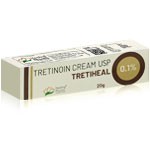
Tretiheal (Tretinoin) topical cream is used for fine wrinkles and photoaging because it supports normalized epidermal differentiation and promotes gradual collagen renewal. The clinical value is not “quick peeling,” but long-term improvement in skin organization, texture, and fine-line visibility.
What patients should expect (realistic timeline)
- Weeks 1–3: dryness, mild redness, or peeling can occur during adaptation.
- Weeks 4–8: texture often becomes smoother; makeup/reflectivity may look improved.
- Months 3–6: fine wrinkles can soften gradually as dermal remodeling progresses.
Outcomes depend on technique, dose, UV control, and whether the skin barrier remains intact.
Doctor note: Dr. Amy Tauber, MD — the most reliable results come from consistent, tolerable use. If inflammation becomes persistent, the plan should be adjusted rather than intensified.
What to do if irritation becomes uncomfortable (practical ladder)
Mild irritation can be compatible with progress, but excessive irritation slows remodeling and increases discontinuation risk. Use stepwise adjustments to restore tolerance while maintaining long-term consistency.
Step 1 ✅
Confirm technique: apply to dry skin, use a thin layer, avoid corners of nose/lips if sensitive. Eliminate scrubs, acids, and fragranced products.
Step 2 ⚠️
Reduce frequency temporarily and emphasize barrier care. Restart slowly once stinging and redness stabilize. A predictable schedule is more valuable than high intensity.
Step 3 🚑
Stop and seek clinical advice if there is swelling, cracking, significant pain, or spreading rash. Do not treat through injury.
Clinical framing
The target is controlled remodeling. If the barrier breaks, you lose time and raise the risk of post-inflammatory pigmentation changes and sensitivity.
Clinician perspective: Dr. Ellen Marmur, MD — tolerability is a clinical endpoint. A plan that patients can finish is often the most effective plan.
Compatibility with cleansing, friction, and “extra actives” (high impact)
Many setbacks are not caused by the active itself, but by friction, over-cleansing, or overlapping products that destabilize the barrier. Photoaged skin can be simultaneously dry and reactive; reducing mechanical and chemical stress improves outcomes.
Friction rule ⚠️
Avoid aggressive towels, facial brushes, or frequent exfoliation. Friction amplifies irritation and prolongs redness.
Barrier rule ✅
Use a simple moisturizer regularly. Barrier support reduces stinging, improves tolerance, and lowers relapse risk.
One-active rule 🎯
Add only one major active at a time. This prevents confusion about what works and what triggers irritation.
Timeline (start, adapt, stabilize)
Photoaging care works best as a staged plan. This reduces early dropout and makes clinical response easier to interpret.
Doctor note: Dr. Tina Alster, MD — meaningful change often becomes clear between months 3 and 6. Consistency and UV control determine the ceiling of improvement.
Special considerations: sensitive skin, pregnancy, and barrier-vulnerable patients
Photoaging treatment should be individualized. Some groups require more conservative pacing due to higher irritation risk, altered healing, or higher risk of pigmentary change after inflammation.
Pregnancy 👶
Anti-aging routines should be clinician-guided. Prioritize SPF, gentle care, and avoid self-directed escalation.
Breastfeeding 🍼
Emphasize transfer prevention and strict hygiene. Choose routines that minimize skin-to-skin transfer risk.
Barrier-vulnerable skin ⚠️
Rosacea/eczema-prone patients often need slower titration, fewer actives, and more barrier support.
Older adults 🧓
Thinner skin and slower recovery may require lower intensity and careful monitoring of irritation.
Doctor note
Dr. Cheryl Burgess, MD — when baseline inflammation is present, stabilize the barrier first. For many patients, that single decision determines whether the plan is sustainable.
Decision tree (symptoms and next action)
Irritation appears
Is there swelling, cracking, or spreading rash?
Yes — stop and seek medical advice
Focus on barrier repair and avoid re-challenging until symptoms fully resolve.
No — simplify, moisturize, reduce frequency
Reassess after 7–14 days; stability is the prerequisite for progress.
Results feel slow
Is daily SPF consistent and UV exposure controlled?
No — correct UV exposure first
Ongoing UV injury can neutralize remodeling gains and worsen pigmentation.
Yes — continue and reassess monthly
Texture changes may appear before fine-line softening becomes obvious.
Doctor note: Dr. Ellen Marmur, MD — many “slow responders” are actually under-protected from UV. Photoprotection is treatment, not an accessory.
Practical use summary
If you are using an active remodeling plan, treat it like a course with clear rules: minimize variables, avoid friction, and prioritize adherence. Improvement is typically additive over months.
- Use Tretiheal (Tretinoin) topical cream at night with conservative technique to reduce irritation.
- Do not add acids, scrubs, or aggressive peels unless the plan is stable and clinician-guided.
- Daily SPF is essential to prevent relapse and protect remodeling progress.
Tretiheal (Tretinoin) topical cream should be approached as structured long-term remodeling: stable barrier + UV control + consistency are what produce clinically meaningful changes.
Drug Description Sources:
U.S. National Library of Medicine, Drugs.com, WebMD, Mayo Clinic, RxList.
Reviewed and Referenced By:
Dr. Zoe Diana Draelos, MD — Board Certified Dermatologist and clinical researcher specializing in photoaging, skin barrier science, and topical retinoid therapy.
Dr. Tina Alster, MD — Dermatologic surgeon and laser specialist with extensive experience in light-induced skin aging and collagen remodeling strategies.
Dr. Cheryl Burgess, MD — Cosmetic dermatologist focused on inflammatory skin responses, pigmentation disorders, and safe long-term anti-aging care.
Dr. Amy Tauber, MD — Board Certified Dermatologist with expertise in acne, photoaging, and retinoid-based skin normalization.
Dr. Ellen Marmur, MD — Dermatologist specializing in skin aging prevention, barrier repair, and evidence-based cosmetic dermatology.
`
(Updated at Jan 5 / 2026)
Tretiheal Tretinoin articles: