Modafinil and Alcohol: Risks, Effects, and What to Know

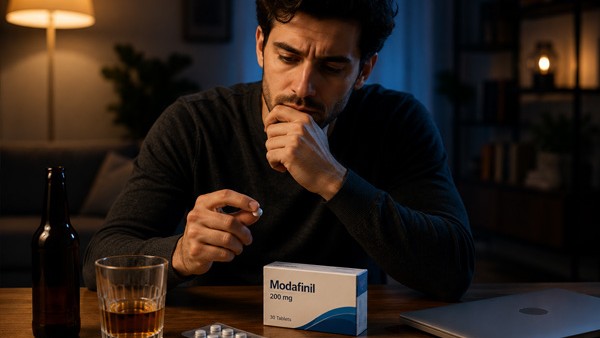
Combining Modalert (modafinil) 200 mg with alcohol is one of the most common questions in modafinil patient forums — and one of the least honestly answered. Most product information sheets simply state "alcohol use has not been clinically studied" and stop there. That carefully worded sentence hides a more useful clinical picture: modafinil masks the sedating effects of alcohol, both drugs share hepatic metabolism pathways, and the combination consistently produces a worse hangover than alcohol alone. None of this is theoretical — it is the well-documented pattern across decades of post-marketing surveillance, even though formal randomised trials of the combination were never run for ethical reasons.
This article walks through why patients combine modafinil with alcohol despite the warnings, the specific risks that "masked intoxication" creates (especially around driving and dose escalation), the metabolic load on the liver when both drugs share clearance pathways, the prolonged hangover effect modafinil's long half-life produces, and the safer combinations that work for patients who want both wakefulness therapy and an active social life. The reference dose throughout is 200 mg modafinil once daily; the alcohol comparisons assume standard drinks (12 oz beer, 5 oz wine, or 1.5 oz spirits).
🍺 Why People Mix Them
The combination scenarios are usually predictable. Shift workers who take modafinil during the working night and want to unwind with a drink before sleep. Long-term modafinil users who have settled into morning dosing and assume the drug is "out of system" by evening cocktails (it isn't — the 12-15 hour half-life means meaningful drug levels are still present at dinner time). Off-label cognitive users who dose during a workday and then attend a social event the same evening. Weekend warriors who dose for productivity on Saturday morning and then drink at a wedding or party that night.
In each case, the underlying assumption is that the modafinil from a morning dose is gone by drinking time. The pharmacokinetics say otherwise. A 200 mg dose taken at 07:00 still leaves roughly 50% of peak concentration circulating at 19:00, and meaningful drug levels persist past midnight. The combination is therefore not "modafinil then alcohol" — it is "modafinil AND alcohol acting on the brain simultaneously."
⚠️ Hidden Risks — Masked Intoxication
The most clinically significant interaction between modafinil and alcohol is not a chemical reaction in the bloodstream — it is a perceptual problem in the brain. Modafinil's wake-promoting effect suppresses the sleepiness, slowed reaction time, and cognitive blunting that normally signal "you are intoxicated." The blood alcohol level rises normally; the felt experience of being drunk lags well behind it.
The practical consequence is dangerous: patients consistently drink more than they would alone because the normal "I've had enough" signal does not arrive. They drive when they should not (legally intoxicated despite feeling sharp). They make decisions they regret because the inhibitory effects of alcohol are still operating, just under a layer of imposed alertness. And when modafinil wears off — typically late evening or overnight — the alcohol load that has been accumulating hits all at once, often producing a much steeper "crash" than the same drinks would have caused alone.
If you have had ANY alcohol while on modafinil, do NOT drive — regardless of how clear-headed you feel. The legal blood alcohol limit (0.08% in most US states, lower in many other countries) is the same whether modafinil is on board or not. Police breathalysers measure BAC, not subjective alertness. A DUI charge while modafinil-masked is the most common preventable harm from this combination.
🫀 Liver Load — The Metabolism Stack
Both modafinil and alcohol are metabolised primarily by the liver, though through partially different enzyme systems. Modafinil clears mainly via CYP3A4 (with smaller contributions from CYP2C19 and amide hydrolysis). Alcohol clears mainly through alcohol dehydrogenase (ADH) and the microsomal ethanol oxidising system (which uses CYP2E1). The two pathways are not directly competing — but the cumulative liver workload of metabolising both drugs simultaneously is real.
| Liver impact | Modafinil alone | Alcohol alone | Combined |
|---|---|---|---|
| Primary metabolism | CYP3A4 hepatic | ADH + CYP2E1 | Both pathways engaged |
| Transient liver enzyme rise | Mild, usually subclinical | Dose-dependent | Additive at moderate doses |
| Risk in fatty liver / hepatitis | Low | Moderate | Higher than either alone |
| Dehydration contribution | Mild | Significant | Strongly additive |
| Acetaldehyde exposure | None | Direct | Prolonged (modafinil delays sleep, which delays alcohol clearance) |
For patients with healthy livers and normal alcohol intake, the metabolic stack is a manageable concern at most. For patients with fatty liver disease, hepatitis B or C, current Hepcvir or Hepcinat therapy, or chronic alcohol use, the combination is genuinely riskier and warrants prescriber discussion. Heavy alcohol use on modafinil days, repeated weekly or daily, is a pattern that can accelerate liver injury over months even when neither drug alone would cause measurable harm.
🌅 Modafinil Hangover Effect
The "modafinil hangover" is one of the most reliably reported effects of the combination — and one of the easiest to explain mechanistically. A normal alcohol hangover develops because acetaldehyde (the toxic intermediate alcohol becomes during liver clearance) accumulates and is then cleared overnight while you sleep. Sleep itself is part of the hangover recovery process. Modafinil prevents this overnight clearance from happening cleanly in two ways: it keeps you awake past the point when alcohol clearance should be completing, and it disrupts the sleep architecture that would normally process residual acetaldehyde.
Patients consistently describe the modafinil hangover as "the worst hangover I've ever had, even from moderate drinking." The intensity-out-of-proportion-to-amount is the giveaway: two drinks on a modafinil day can produce a hangover that feels like a six-drink night when modafinil was not involved. The mechanism is not mysterious — it is the cumulative effect of incomplete sleep, delayed alcohol clearance, and added cardiovascular stress from both drugs working in parallel.
✅ Safer Approaches
For patients who want both modafinil therapy and a normal social drinking life, the safer combinations are about quantity, timing, and patient-side discipline. None of these eliminate risk entirely — but they substantially reduce the most common harm patterns:
1️⃣ Limit alcohol to 1-2 standard drinks on modafinil days. The masking effect of modafinil makes "I'll just have one more" the gateway to genuinely dangerous intoxication. Counting drinks explicitly, rather than relying on felt sobriety, is the single most useful rule.
2️⃣ Never drive after any alcohol on a modafinil day, regardless of subjective alertness. BAC and DUI law operate independently of how clear-headed you feel.
3️⃣ Hydrate aggressively — 250 ml of water for every standard drink, on top of normal daily water intake. Both drugs are mildly dehydrating; the combination worsens it. The next-day headache is usually dehydration as much as it is acetaldehyde.
4️⃣ Do not drink on the same day as a 400 mg modafinil dose if you ever take the higher dose. The cardiovascular load and masking effect are both stronger at 400 mg than 200 mg.
5️⃣ Consider whether you actually need modafinil that day. For shift workers and narcolepsy patients, daily dosing is medical necessity. For off-label cognitive use, skipping the dose on a known social drinking day is an entirely reasonable choice — the drug is forgiving of missed doses and there is no withdrawal.
✨ Bottom Line
Combining Modalert (modafinil) with alcohol is not an absolute contraindication — but it is genuinely riskier than most prescribing information suggests. The dominant practical risk is masked intoxication: modafinil suppresses the felt experience of being drunk while blood alcohol rises normally, leading to drinking more, driving impaired, and discovering the full alcohol load only when modafinil wears off late in the evening. Secondary concerns include cumulative liver load (especially in patients with existing hepatic conditions), prolonged and disproportionately severe hangover effects, and additive cardiovascular acceleration. The safer combination patterns — limit to 1-2 drinks, no driving, aggressive hydration, no 400 mg modafinil days — keep most adults out of trouble. For patients with cardiac, hepatic, or psychiatric concerns, the cleaner answer is to skip alcohol on modafinil days entirely. See also our companion article on Modafinil and Coffee for the parallel discussion of the safer stimulant pairing.
❓ Frequently Asked Questions
Can I drink any alcohol while taking modafinil?
Most healthy adults can tolerate 1-2 standard drinks on a modafinil day without significant harm, provided they do not drive and stay well hydrated. The combination is not an absolute contraindication. The risks rise sharply above 2 drinks because of modafinil's masking effect on intoxication signals, the cumulative liver load, and the disproportionately severe hangover that follows. Patients with cardiac, hepatic, or psychiatric conditions should avoid the combination entirely.
Why do I get such a bad hangover when I drink on modafinil?
Modafinil delays sleep onset, fragments sleep architecture, and prolongs the period during which alcohol-derived acetaldehyde circulates in your system before being cleared. Normal hangover recovery depends substantially on the overnight liver work that happens during proper sleep — when modafinil disrupts that sleep, acetaldehyde clearance is incomplete by morning. The result is a hangover that starts later, lasts longer, and includes brain fog and persistent headache through the next day. The intensity is typically out of proportion to the amount drunk.
How long should I wait between a modafinil dose and drinking alcohol?
Most modafinil users dose at 07:00 and drink at 19:00 or later — and this is generally as safe as the combination gets, because the modafinil curve is past its peak by evening. However, the 12-15 hour half-life means meaningful drug levels are still present at dinner. There is no time interval at which modafinil is completely "out" the same day; choosing not to drink at all is the only fully clean separation. If you do drink, dinner-time alcohol is preferable to late-night alcohol because more of the alcohol clearance happens before modafinil wears off completely.
Is it safer to drink while on armodafinil instead of modafinil?
The masking effect, liver load, and hangover concerns apply essentially identically to Waklert (armodafinil) — the same active R-enantiomer is doing the same things in your body. If anything, armodafinil's longer half-life means more drug is present at evening drinking time than with modafinil. Switching molecules does not solve the combination problem.
Will modafinil help with my alcohol hangover the next morning?
It will mask the tiredness and brain fog while it is active — but it will not accelerate alcohol clearance or speed actual recovery. Taking modafinil the morning after heavy drinking essentially extends the hangover into a second day, because you delay the rest your body needs to complete recovery. The honest fix for a hangover is hydration, food, light activity, and sleep — not stacking another stimulant on top of unresolved acetaldehyde load.
I have a liver condition — should I avoid the combination entirely?
Yes, in most cases. Patients with fatty liver disease, viral hepatitis (including ongoing or recent Hepcinat or Hepcvir therapy), cirrhosis, or any condition affecting hepatic function should not regularly combine modafinil with alcohol. Both drugs require hepatic clearance; combining them stresses an already-compromised system. Discuss with your prescriber and hepatologist if you have any pre-existing liver concern.
📚 References & Further Reading
- FDA prescribing information for modafinil (Provigil) — drug-interaction profile referenced for the safety baseline.
- NIAAA — alcohol metabolism and acetaldehyde clearance mechanisms used as the metabolic baseline.
- EMA assessment report on modafinil — European regulatory framework around alcohol interaction warnings.
- British National Formulary — guidance on hepatic medications and alcohol combinations.
- Modafinil and Coffee: Safety, Effects, and Smart Combining — companion article on the safer stimulant pairing.
- Modalert User Manual: Practical Instructions Beyond Day 1 — long-term prescribing wisdom for established modafinil users.
- Modalert First-Time Guide: Your Safe Day-One Protocol — practical starting guide.
- Modalert 200 mg and Waklert 150 mg — primary product pages.
- RXshop Editorial Team — content reviewed by licensed pharmacist; for adult patient education, not a substitute for individual medical consultation.
Medical Disclaimer: The information in this article is for educational and informational purposes only and is not a substitute for professional medical advice, diagnosis, or treatment. Always seek guidance from a qualified healthcare provider with any questions you may have regarding a medical condition, and before starting, stopping or changing any medication.