Buy Minoxiboon Minoxidil Topical Solution Online for Male Female Pattern Baldness Androgenetic Alopecia Hair Loss

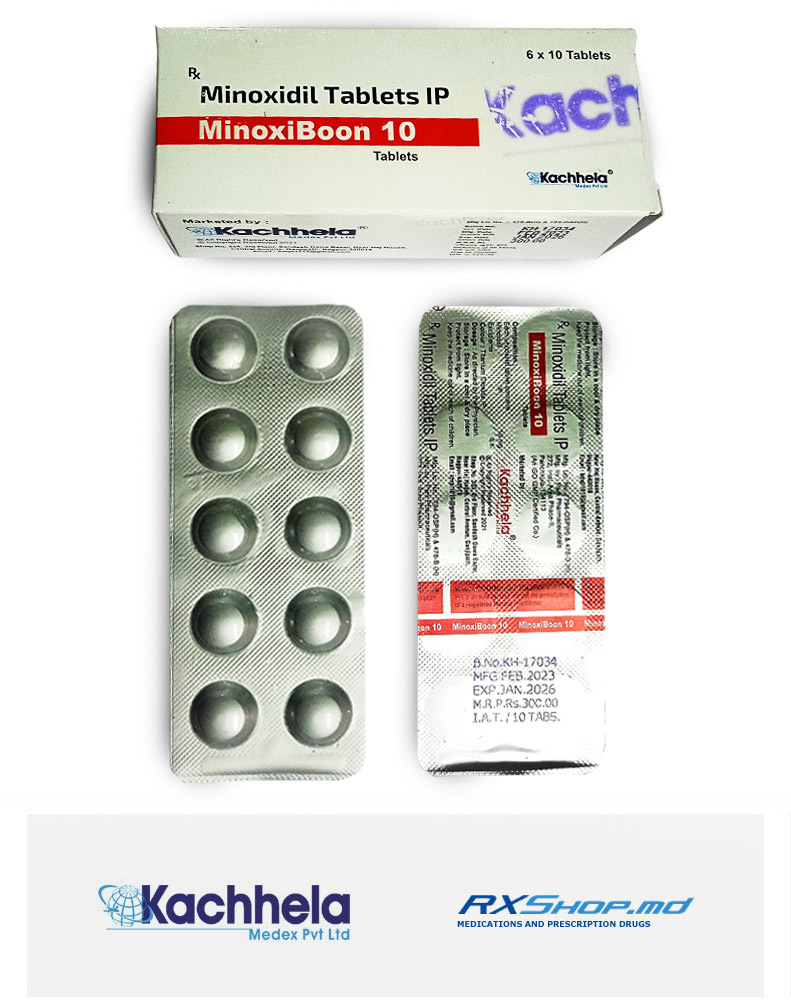
Minoxiboon (Minoxidil 10mg) represents the high-strength oral minoxidil formulation — offering maximum dosing flexibility for both severe resistant hypertension (the original FDA-approved indication) and advanced hair loss treatment protocols. As a powerful ATP-sensitive potassium channel opener and peripheral arterial vasodilator, Minoxiboon provides both systemic blood pressure control and the strongest available oral hair follicle stimulation in a single tablet. The 10 mg oral tablets deliver the original Loniten reference dose, allowing physicians and informed patients to split tablets for personalized dosing from 2.5 mg to 10 mg ranges across diverse clinical scenarios.
Minoxidil works through unique K-ATP channel opening after sulfation to active minoxidil sulfate by hepatic and tissue sulfotransferases. The activated compound opens potassium channels causing powerful arterial smooth muscle relaxation — dramatically reducing peripheral vascular resistance and lowering blood pressure even in patients resistant to multiple other antihypertensives. In hair follicles, the same K-ATP channel activation stimulates dermal papilla cell proliferation, prolongs anagen growth phase, shortens telogen resting phase, and increases scalp blood flow. The result with 10 mg dosing: severe hypertension responds where other drugs fail, hair density increases in 60-80% of treated patients over 6-12 months with hair loss benefits visible at both lower split doses and full 10 mg.
Minoxiboon serves multiple clinical applications. The primary FDA-approved indication is severe symptomatic hypertension not controlled by maximum-dose combinations of other antihypertensives — particularly useful in renovascular hypertension, secondary hypertension, and treatment-resistant cases. For off-label hair loss applications, Minoxiboon 10 mg can be split into quarters (2.5 mg) for standard LDOM hair loss therapy or halves (5 mg) for stronger response cases — providing cost-effective flexible dosing. The medication also treats advanced androgenetic alopecia, severe female pattern hair loss requiring higher doses, resistant chronic telogen effluvium, and serves combination therapy with finasteride in men with rapidly progressing hair loss.
Minoxiboon dosing depends on indication. For hypertension: typically 5-10 mg once daily starting low and titrating up under close BP monitoring. For off-label hair loss: typically 2.5-5 mg daily through tablet splitting. The medication reaches peak blood concentrations within 1 hour with 4-hour blood half-life but extended 12-24 hour pharmacological effect. Blood pressure benefits develop within hours; hair benefits develop over 3-12 months. Generic oral minoxidil provides identical therapeutic outcomes to brand-name Pfizer Loniten formulation at substantially lower cost.
Free prescription
Discrete packaging
Have questions?
Quality Assurance

- Advanced Hair Loss: Severe hair loss benefiting from higher dosing or flexible splitting protocols;
- Androgenetic Alopecia: Hereditary androgen-driven hair loss in both men and women responding to oral minoxidil;
- Pattern Baldness: Male and female pattern baldness following typical anatomical distribution responding to therapy;
- Receding Hairline: Frontal hairline recession responding to systemic vasodilator follicle stimulation;
- Hereditary Hair Loss: Genetic hair loss responding to oral minoxidil regardless of family history strength;
- Age Related Hair Thinning: Hair density decline associated with aging responding to follicle stimulation;
- Thinning Hair: Progressive hair thinning from various causes responding to consistent oral therapy;
- Treatment Resistant Hair Loss: Hair loss not responding to topical or lower-dose oral minoxidil benefiting from higher dosing;
- Flexible Splittable Dosing: 10 mg tablet provides cost-effective access to 2.5/5/7.5/10 mg ranges through splitting;
- Cost Effective LDOM: Single 10 mg tablet split into quarters provides lowest per-dose cost for hair loss therapy;
- Severe Resistant Hypertension: Original FDA indication for severe blood pressure not controlled by other antihypertensives;
- Treatment Resistant Hypertension: Hypertension not responding to maximum doses of multiple combined antihypertensive classes;
- Renovascular Hypertension: Severe hypertension from renal artery disease responding to powerful K-ATP vasodilator;
- Secondary Hypertension: Hypertension from identifiable underlying cause requiring potent vasodilator therapy;
- Combination BP Therapy: Used with diuretic and beta-blocker to manage fluid retention and reflex tachycardia;
- Finasteride Combination Hair Loss: Combined with finasteride at split doses for synergistic male pattern hair loss outcomes;
- Post Transplant Hair Protection: Adjunctive therapy after hair transplant to accelerate graft growth and preserve native hair;
- Oral Vasodilator Therapy: K-ATP channel opener drug class for hair loss and resistant hypertension management;
- K ATP Channel Opener Therapy: Mechanism class targeting potassium channels for vasodilation and follicle stimulation effects.
- Better Hair Density: Hair count per square centimeter increases through anagen phase prolongation and follicle stimulation;
- Less Daily Hair Shedding: Daily hair fall decreases substantially as telogen phase shortens and anagen extends;
- Better Follicle Strength: Dermal papilla cell proliferation improves follicle health and longevity through K-ATP activation;
- Better Scalp Circulation: Arterial vasodilation increases blood flow to scalp delivering nutrients and oxygen to follicles;
- Better Hair Thickness: Hair shaft caliber improves as follicles transition from vellus to terminal hair production;
- Better Resistant Hair Loss Response: Patients not responding to lower doses or topical minoxidil benefit from higher systemic dosing;
- Better Dosing Flexibility: Single tablet splits into quarters or halves allowing personalized 2.5/5/10 mg dosing;
- Better Cost Per Dose: One 10 mg tablet split into 4 daily doses provides lowest cost per LDOM dose;
- Better Both Genders Hair Loss: Effective for both men with androgenetic alopecia and women with FPHL or chronic shedding;
- Better Frontal Hairline: Frontal hairline density improves with systemic delivery reaching all scalp regions;
- Better Crown Density: Vertex hair density improves substantially as crown follicles return to active growth;
- Better Severe Hypertension Control: Resistant hypertension responds where other antihypertensive classes have failed;
- Better BP Reduction Magnitude: Powerful arterial vasodilation produces substantial blood pressure reduction in severe cases;
- Better Finasteride Synergy: Combination with finasteride provides synergistic results targeting different hair loss mechanisms;
- Better Hair Transplant Outcomes: Adjunctive use accelerates graft growth and preserves surrounding native hair density;
- Better Topical Alternative: Patients with topical irritation or non-response benefit from systemic oral approach;
- Better Application Convenience: Single daily tablet eliminates twice-daily topical application and greasy hair texture;
- Once Daily Oral Convenience: Single daily tablet at any consistent time fits any routine without timing restrictions;
- Better Quality of Life: Daily wellbeing improves dramatically as hair loss anxiety resolves and self-confidence returns.
Generic Minoxiboon (Minoxidil 10 mg) Medication guide:
📌 What Minoxiboon Is and How It Grows Hair
The most misleading thing about Minoxiboon is calling it a hair loss drug on purpose. It was built as blood pressure medicine — the hair growth was a side effect so prominent it rewrote the entire product.
Minoxiboon is a generic topical minoxidil solution. Same molecule as Rogaine. Same twice-daily routine. Generic pricing, international supply.
📌 Three things to anchor first:
- 🧬 Vasodilator — opens potassium channels in follicle cells
- 🚫 Not a hormone drug — nothing to do with DHT
- 👩🦰 Works for men and women — the only FDA-approved topical for women
Applied to the scalp, the molecule gets converted by an enzyme called sulfotransferase, opens channels in follicle cells, and tells them to stay in the growth phase longer. Hairs come out thicker. Shrinking follicles get larger. The scalp fills in.
| Property | Minoxiboon |
|---|---|
| Active ingredient | Minoxidil |
| Drug class | Peripheral vasodilator, K-ATP channel opener |
| Strengths | 2% and 5% topical |
| Standard dose | 1 mL twice daily to dry scalp |
| Reference brand | Rogaine, Regaine |
| Hormonal effect | None |
⏰ What the timeline looks like:
- 📉 Weeks 2-8 — early shedding (good sign, follicles activating)
- 🌱 Month 3-4 — first fine new growth visible
- 🌟 Month 12 — peak density achieved
- 🔄 Stopping — gains fade over 3-6 months
⚠️ The commitment: Minoxiboon is maintenance. Hair stays while you use it. Hair fades when you stop. There is no "finish the course and move on."
The reality check: about 60-70% of consistent users see visible density gain at twelve months. Not every scalp responds. The follicles that have been bald longest are least likely to come back.
🧔 Minoxiboon for Male Pattern Baldness Treatment
Male pattern baldness hits half of men by age fifty and up to eighty percent by seventy. The pattern itself is a clue: temples first, crown next, horseshoe fringe at the end.
The driver is a hormone called dihydrotestosterone (DHT) that slowly shrinks genetically susceptible follicles over years. Minoxiboon does not block DHT — it rebuilds the follicle anyway.
🎯 Where Minoxiboon works best:
- 👑 Vertex (crown) — FDA-approved area, strongest response
- 🔄 Mid-scalp thinning — good response, especially with finasteride
- ⚠️ Temporal recession — weakest response, combination therapy needed
- 🚫 Fully bald scalp — no response, follicles already gone
The Olsen 2002 trial settled the strength question: 5% minoxidil produced 45% more hair weight gain than 2% in men over 48 weeks. The vertex responded best. The frontal zone less so.
| Norwood stage | What to expect from Minoxiboon |
|---|---|
| II-III (early) | Excellent response, often enough alone |
| III vertex to IV (moderate) | Pair with finasteride; good density gain |
| V (advanced) | Slows progression, preserves what remains |
| VI-VII (extensive) | Protects donor zone; transplant is primary |
💡 The earlier, the better. Men who start Minoxiboon at Norwood II or III keep more hair at sixty than men who wait until Norwood V. The window to rescue miniaturized follicles narrows every year.
🚫 Where Minoxiboon alone falls short:
- 🎯 Receding temples — needs finasteride added
- 🙈 Rapid loss — needs DHT block to halt the attack
- ⚠️ Advanced balding — too few surviving follicles to rescue
Most men see the clearest result from combination therapy: Minoxiboon regrows what miniaturization already damaged, while finasteride stops the DHT attack that caused it. Together they fix cause and consequence.
👩 Minoxiboon for Female Pattern Hair Loss
Female pattern hair loss (FPHL) looks completely different from the male version. Women rarely get a receding hairline. They get a widening central part and diffuse thinning on top.
Minoxiboon is FDA-approved for women at 2% solution and 5% foam. It is the first-line topical therapy for FPHL worldwide.
👩⚕️ Essential workup before starting:
- 🧪 Ferritin — iron stores, often low in women
- 🥽 TSH and free T4 — thyroid dysfunction mimics FPHL
- ☀️ Vitamin D — deficiency contributes to shedding
- 👸 Testosterone, DHEAS — if PCOS features present
Skipping the workup wastes months on minoxidil when the real issue is iron or thyroid. The two look the same from the outside and respond to entirely different treatment.
| Patient profile | Typical regimen |
|---|---|
| Pre-menopausal early FPHL | 2% twice daily; iron and vitamin D if low |
| PCOS or hyperandrogenic | 5% foam + spironolactone |
| Postmenopausal moderate | 5% foam once or twice daily |
| Advanced midline FPHL | 5% topical + oral low-dose minoxidil |
📏 The scales dermatologists use:
- 🌳 Ludwig I-III — classic midline thinning grades
- 🎄 Olsen Christmas tree — frontal part widening pattern
- 📸 Sinclair 1-5 — photographic reference for tracking
🎯 What women actually see: Not new hair in bald zones. Fuller coverage across the whole top of the scalp. Less visible scalp through the part. More even density. The result is subtle but photographic comparison at six months usually shows clear improvement.
Response in women develops over four to six months, slightly slower than in men. Peak density by twelve months. Stopping reverses the gains over three to six months, same as in men.
For women with hormonal contribution, pairing Minoxiboon with spironolactone (50-200 mg daily) is the female equivalent of the male minoxidil-plus-finasteride combination. Both drugs can run indefinitely alongside each other.
🔵 Minoxiboon in Alopecia Areata Off-Label Uses
Alopecia areata is a completely different disease from pattern hair loss. It is autoimmune — T-cells attack follicles and force them into premature rest. Patches appear within weeks, not years.
Minoxiboon is not first-line here. The autoimmune attack needs to be addressed first. Minoxiboon is adjunct therapy that helps hair recover once the attack settles.
🔵 Clinical forms:
- 🟠 Patchy — discrete round patches, most common
- ⚫ Alopecia totalis — complete scalp hair loss
- 🌐 Universalis — loss of all body hair including brows and lashes
- 🌚 Ophiasis — band along the inferior scalp perimeter
| Severity | Primary treatment | Minoxiboon role |
|---|---|---|
| Limited patches | Intralesional steroids | Adjunct for faster regrowth |
| Extensive patchy | Topical immunotherapy, DPCP | Adjunct across treated zones |
| Totalis / universalis | JAK inhibitors (baricitinib) | Adds to systemic therapy |
💊 Recent breakthrough: Baricitinib gained FDA approval for severe alopecia areata in 2022. Ritlecitinib followed in 2023 for adolescents and adults. These JAK inhibitors have transformed outcomes for severe disease that was previously untreatable.
Minoxiboon added to JAK therapy accelerates cosmetic recovery as the immune suppression lets follicles reactivate. The medication prolongs the growth phase so new hair reaches terminal diameter instead of cycling back out quickly.
👶 Pediatric use: For children with limited patches, 2% solution once or twice daily is often added to intralesional steroids. Facial hypertrichosis from transfer is more common than in adults — strict hand-washing matters even more.
🎯 Realistic expectations for alopecia areata:
- 🔄 Does not stop the autoimmune attack
- 🌱 Supports regrowth once attack is suppressed
- 🎲 Variable response — some see benefit, others see none
- 📈 Alone insufficient for totalis or universalis
🧔 Minoxiboon for Beard and Eyebrow Growth Off-Label
Beard minoxidil is one of the most searched hair cosmetic topics worldwide. Social media drove the demand. Dermatologists now field as many questions about facial minoxidil as scalp use.
The biology is the same as scalp: minoxidil activates existing follicles. If vellus hairs are visible across the beard area, they can thicken. If skin is truly smooth with no follicles, nothing will grow.
🧔 Who responds to beard minoxidil:
- ✅ Patchy beards with visible vellus hairs across the area
- ✅ Genetically sparse growth but with existing follicles
- ✅ Beard alopecia areata recovery (as adjunct)
- ❌ Smooth beardless skin with no vellus hair at all
- ❌ Permanent genetic hairlessness on specific zones
⚠️ Four critical cautions before starting facial use:
🚨 Off-label — no FDA approval, limited published studies
🌡️ Facial skin is more reactive than scalp, irritation more likely
🐾 Spread risk — hair can grow on cheeks, forehead, ears
♻️ Reversible on stopping — same long-term commitment as scalp
📋 Typical protocol:
- 💧 5% solution or foam once or twice daily to beard area
- ⏱️ Four hours minimum before washing off
- 📅 3-6 months for visible result
- 🔁 Stops when application stops within 3-6 months
👁️ Eyebrow use is riskier because solution can run into the eye and the periocular skin is thin. Bimatoprost (the eyelash growth product) has better evidence for eyebrows and is often preferred.
| Scenario | Typical result |
|---|---|
| Patchy beard, vellus hair visible | 📈 Fill-in of thin zones over 9-12 months |
| Fully smooth, no vellus hair | ❌ Little or no response |
| Trans man on testosterone | 🚀 Accelerates growth testosterone has already started |
Realistic framing: Minoxidil cannot create follicles. It activates what is already there. Clients with no follicles to activate need transplantation for cosmetic beard construction, not minoxidil.
🏛️ Minoxiboon Discovery from Antihypertensive to Hair Loss Drug
Minoxidil started as blood pressure medicine. The hair growth was a side effect so prominent it rewrote the entire drug.
Upjohn researchers synthesized the compound in the 1950s. By 1979 it was FDA-approved as Loniten for severe hypertension at 10-40 mg daily. Patients grew hair everywhere.
📅 Key dates in the minoxidil timeline:
- 🧪 1950s — synthesized at Upjohn Company laboratories
- 💊 1979 — FDA approval as Loniten for hypertension
- 🌟 1988 — Rogaine 2% approved for male pattern baldness
- 👩 1991 — Rogaine 2% approved for women
- 💪 1997 — 5% solution approved for men (Olsen trial)
- 🏪 2006 — all strengths move to over-the-counter in US
- 🌫️ 2014 — 5% foam approved for women
- 🚀 2015+ — Sinclair publishes oral low-dose protocol
| Era | Dominant form | Clinical standard |
|---|---|---|
| 1979-1988 | Oral Loniten | Severe hypertension only |
| 1988-1997 | Rogaine 2% prescription | Male AGA, modest response |
| 1997-2014 | 5% solution dominant | OTC adoption, generic era |
| 2015 to today | Topical + oral combination | Sinclair protocol, dual therapy |
💡 How the hair effect was discovered. Patients on oral Loniten for severe hypertension developed hypertrichosis — unwanted body and facial hair. It was common enough that women often stopped the drug. Upjohn asked the obvious question: could the same effect be used on purpose for baldness?
The pivotal trials of the 1980s established the modern approach: a response pattern of early shedding, three-to-four-month regrowth onset, peak at twelve months, reversal on discontinuation. Those numbers remain the benchmark today.
📈 What changed since 1988:
- 💡 Prescription to OTC — access expanded dramatically
- 🌍 Patent expiration — generic brands including Minoxiboon
- 🧬 Mechanism refined — sulfotransferase activation step identified
- 💊 Oral low-dose — Sinclair protocol transformed response rates
The most recent chapter was written by Prof. Rodney Sinclair at the University of Melbourne. His oral low-dose protocol (0.25-5 mg daily) made once-daily tablets an alternative to twice-daily topical and dramatically expanded response in topical non-responders.
🤝 Combining Minoxiboon with Finasteride Standard Approach
The modern standard for male pattern baldness is both drugs together: Minoxiboon on the scalp, finasteride by mouth. Trials consistently show the combination outperforms either alone.
The logic is clean. Finasteride stops the attack (blocks DHT). Minoxiboon rebuilds the follicle (extends growth phase). Different targets, additive effect.
🛡️ Finasteride
Blocks 5-alpha reductase. Lowers scalp DHT by 60-70%. Halts miniaturization. Modest regrowth.
🌱 Minoxiboon
Opens K-ATP channels. Extends anagen. Thickens hair shafts. Active regrowth.
📊 Trial evidence:
- 📑 Khandpur 2002 — combination beat both monotherapies at 12 months
- 📑 Hu 2015 — 94% combination response vs 80% finasteride-only vs 59% minoxidil-only
- 📑 Chen 2020 meta-analysis — combination produced 65% greater density gain
- 📑 Rossi 2016 — 10-year observational data confirmed durability
| Component | Standard dose |
|---|---|
| Finasteride | 1 mg oral once daily, any time of day |
| Minoxiboon | 5% solution or foam, 1 mL twice daily |
| Review | Baseline photos, 3 and 6 months, annually |
📋 What to monitor during combination:
- 📸 Baseline photos — the only objective way to measure change
- 📉 Early shedding at weeks 2-8 (expected, resolves)
- 🟢 First visible benefit at months 3-6
- 🛏️ Finasteride sexual effects — discuss if persistent
- 🏞️ Scalp tolerance — switch to foam if solution irritates
🎯 Starting both together is the current preferred approach for men with moderate loss. Sequential starts (one drug, then adding the other later) delay the full combination benefit by six to twelve months. Simultaneous initiation reaches peak response faster.
👩 For women, the combination is different: Minoxiboon plus spironolactone (50-200 mg daily). Finasteride is off-label and generally avoided in women of childbearing potential because of pregnancy risk. The topical component is identical.
Both components are lifelong. Stopping either loses that component's effect over months. Clients who want to simplify can reduce to once-daily Minoxiboon (keeps most benefit) rather than stopping either drug outright.
🧬 The Minoxidil Mechanism Vasodilation and Follicle Growth
Minoxidil has been FDA-approved for 35+ years. The exact mechanism is still being refined. What is clear: vasodilation is not the main driver, despite being the historical story.
The current picture is multiple complementary actions on the hair follicle, with vasodilation playing a minor role.
🧬 Four pathways activated by minoxidil:
- 🎯 Dermal papilla stimulation — opens K-ATP channels, triggers growth
- 🌱 Growth factor induction — VEGF, HGF, IGF-1 released around follicles
- ⏰ Prolonged anagen — follicles stay in growth phase longer
- 💤 Shortened telogen — resting follicles wake up sooner
🧪 The activation step everyone misses
Topical minoxidil is a pro-drug. It must be converted by scalp sulfotransferase (SULT1A1) into minoxidil sulfate — the actual active molecule. Clients with low scalp sulfotransferase activity respond poorly regardless of how well they apply. This is covered in detail in the dedicated enzyme section.
🔄 What growth factors do inside the follicle:
- 🧫 VEGF — builds perifollicular capillary networks
- 📈 HGF — drives keratinocyte proliferation
- ⚡ IGF-1 — maintains metabolic demands of active anagen
These factors work together to enlarge the follicle and thicken the hair shaft. Over months, previously miniaturized follicles produce visibly longer, darker, thicker hair.
| Myth | Reality |
|---|---|
| Vasodilation drives hair growth | Other vasodilators do not grow hair |
| Minoxidil is directly active on scalp | Requires enzyme conversion to sulfate first |
| Response is purely dose-dependent | Response depends on individual enzyme activity |
💡 Why mechanism matters clinically: The medication acts on the follicle itself, not hormones. That is why it works for women, for men on finasteride, in alopecia areata, and across diverse populations. It is also why fully bald scalp with no follicles cannot respond.
🔄 How Minoxiboon Extends the Anagen Hair Phase
Hair grows in cycles, not continuously. Each follicle switches between growth, transition, and rest phases. Pattern hair loss is really a cycle problem: the growth phase gets shorter with each round.
🔄 What pattern hair loss does to the cycle:
- 📉 Anagen shortens with each successive cycle
- ⏱️ Telogen lengthens — follicles rest longer
- 🌞 Hair gets thinner — less time to grow terminal diameter
- 🚫 Eventually vellus only — invisible fine hair, then nothing
Minoxiboon's main job: extend anagen. Treated follicles stay in growth longer. New hair reaches terminal diameter and length again.
🔄 The paradox of early shedding. Minoxiboon pushes resting follicles into growth sooner than they would have naturally. The old resting hair gets ejected as the new growth hair forms underneath. The shedding looks alarming but is the sign the drug is working.
🎯 The follicle rescue window:
- ✅ Miniaturized but visible — good rescue candidate
- ✅ Vellus hair present — can thicken to terminal
- ❌ No follicle visible for years — cannot be rescued
- ❌ Scarred scalp — follicles destroyed, not dormant
This is why early treatment outperforms late: more surviving follicles are available to reactivate. By the time scalp is truly bald with no vellus hairs, the biologic target is gone.
For women with FPHL, anagen extension works especially well because the condition involves shortened anagen across many follicles simultaneously. Even modest extension per follicle adds up to visible density gain when applied diffusely across the whole top of the scalp.
🧪 Scalp Enzyme Sulfotransferase Activation of Minoxiboon
Topical minoxidil is inactive until an enzyme in the scalp converts it. That enzyme is sulfotransferase (SULT1A1). Low activity = poor response, regardless of how perfectly you apply.
This single step explains why some clients respond dramatically and others see nothing on identical regimens.
🧪 The activation pathway
Pro-drug applied to scalp
Active, opens K-ATP channels
Enzyme: SULT1A1 in outer root sheath. Variability: 10x between individuals.
📉 What reduces scalp sulfotransferase:
- 💊 Chronic aspirin — inhibits SULT1A1 activity
- 🔄 Minoxidil sulfate itself — feedback inhibition over time
- 🧬 Genetic polymorphisms — account for population variation
- 🌡️ Scalp inflammation — alters local enzyme expression
| Sulfotransferase level | Expected response |
|---|---|
| High activity | 🟢 Strong topical response, visible by month 4-6 |
| Average activity | 🟡 Moderate response, visible by month 6-9 |
| Low activity | 🔴 Poor topical response regardless of adherence |
🔄 What to do if you are a topical non-responder. After six months of consistent twice-daily use with no visible benefit, you are likely sulfotransferase-limited. The fix: oral low-dose minoxidil. The liver sulfates oral minoxidil, bypassing the broken scalp step entirely. Many topical non-responders become strong oral responders.
🧪 Can you test for enzyme activity?
- 📋 HairDX minoxidil response test — plucked hair enzyme assay
- 📊 Accuracy at group level — good; individual level — imperfect
- 💰 Not routinely used — cost often exceeds a 4-month empirical trial
The standard clinical approach stays empirical: four to six months of consistent application, then assess. Response patterns speak louder than enzyme assays.
📏 Minoxiboon 2 Percent vs 5 Percent Strength Choice
Minoxiboon comes in two main strengths: 2% and 5%. The difference matters more than the small number suggests. 5% works better. 5% also irritates more.
The Olsen 2002 trial settled the efficacy question: 5% produced 45% more hair weight gain than 2% in men over 48 weeks.
| Factor | 2% | 5% |
|---|---|---|
| FDA approval | Men + women | Men (solution); women (foam) |
| Hair response | Baseline | 45% greater |
| Scalp irritation | 5-10% | 15-25% (solution) |
| Facial hair growth | 3-5% | Up to 15% in women |
| Typical first choice | Women starting; sensitive scalps | Men worldwide |
💧 Why 5% irritates more:
- 🧪 More propylene glycol — needed to dissolve higher drug load
- 💦 More alcohol content — carrier for the solution
- 🌡️ Both are contact irritants — cause most dermatitis
💡 The foam solves the irritation problem. 5% foam contains no propylene glycol. Same efficacy as 5% solution. Better tolerance. Many clients bothered by 5% solution switch to 5% foam and continue twice-daily use without issue.
🛑 Why not go above 5%?
- 🚫 Response curve flattens above 5%
- ⚠️ Side effects scale faster than benefit
- 🧪 Enzyme saturation — sulfotransferase cannot process more
- 💡 Oral low-dose is a better route when 5% is insufficient
👩 For women, the default is 5% foam once daily or 2% solution twice daily. The 5% solution is used off-label when women tolerate it and want maximum response, accepting slightly higher facial hair risk.
🔄 If 5% solution irritates: switch to foam. If foam still irritates: step down to 2%. If 2% still irritates: discuss oral minoxidil. There is almost always a tolerable option.
⏰ Twice Daily Application Timing for Minoxiboon
Standard dose: 1 mL twice daily to dry scalp. Same for everyone regardless of body size or hair loss extent. The drug acts locally — systemic exposure does not scale with weight.
Twice-daily matters because scalp pharmacokinetics support split dosing. One milliliter twice beats two milliliters once.
🕚 Application technique in 7 steps
- Start with dry scalp — wet hair dilutes the dose
- Part the hair to expose scalp skin
- Apply exactly 1 mL — dropper or foam cap measure
- Massage lightly for 20-30 seconds, no aggressive rubbing
- Wash hands immediately with soap
- Wait 4 hours before washing hair
- Wait 2 hours before bedtime for evening dose
🚫 Mistakes that waste the dose:
- 🚿 Applying to wet hair — dilutes the drug
- 🤚 Skipping hand wash — main cause of facial hair spread
- 🛏️ Evening application too close to bed — pillow transfer
- 🌬️ Sweating heavily within hours — washes drug off
- 💦 Washing hair within 4 hours — removes drug before absorption
| Frequency | Relative response |
|---|---|
| Twice daily | 🟢 100% (reference) |
| Once daily | 🟡 60-70% |
| Three times weekly | 🟠 Under 50% |
| Doubling single dose | 🔴 No bonus; absorption saturated |
🎯 The real predictor of response is consistency over months, not perfect technique. Honest once-daily beats aspirational twice-daily that is only followed half the time.
📱 Adherence strategies that actually work:
- 🪥 Pair with teeth brushing — place bottle next to toothbrush
- ⏰ Phone alarms — persistent notifications twice daily
- 🎒 Multiple bottles at home, work, travel bag
- ☁️ Switch to foam if solution takes too long
💧 Solution Foam and Other Minoxiboon Formulations
Minoxidil comes in several delivery systems. The active ingredient is identical. The vehicle determines tolerance, convenience, and cost.
Original. Alcohol + propylene glycol. Standard for women. Lower irritation than 5%.
Standard for men. Highest irritation of standard options. Widely available.
No propylene glycol. Dries fast. Best for sensitive scalps.
Both drugs in one topical. Reduces systemic finasteride.
Retinoid may boost enzyme activity. More irritating.
Sinclair protocol tablet. Bypasses scalp enzyme.
| Factor | Solution | Foam |
|---|---|---|
| Vehicle | Alcohol + propylene glycol | No propylene glycol |
| Drying time | 5-10 minutes | 1-2 minutes |
| Precision | Dropper, targeted | Diffuse coverage |
| Residue | Visible in some hair types | Minimal |
| Cost | Lower | Modestly higher |
🎯 When each formulation makes sense:
- 👨 Men, vertex-only loss — 5% solution, dropper precision
- 👩 Women, diffuse FPHL — 5% foam, broad coverage
- 🌡️ Sensitive scalp — foam always
- 📉 Combined therapy preferred — compounded minoxidil-finasteride
- 🚫 Cannot tolerate any topical — oral low-dose
⚠️ Compounded formulations are not FDA-approved as finished products. Individual ingredients are approved; the specific combination is not. Quality varies by compounding pharmacy. Use reputable, licensed sources.
For most Minoxiboon buyers through international pharmacies, the 5% solution is standard. Request foam if sensitive. Request 2% if even foam irritates. The hair response is similar across formulations at matched concentration.
💊 Oral Low-Dose Minoxidil Sinclair Protocol Overview
The biggest change in hair loss practice over the past decade: oral low-dose minoxidil. Same drug, different route. One tablet daily instead of twice-daily scalp application. Often works where topical fails.
The protocol was developed and popularized by Prof. Rodney Sinclair at the University of Melbourne. The dose range (0.25-5 mg daily) is one-tenth to one-fortieth of what Loniten used for hypertension.
| Population | Starting dose | Target range |
|---|---|---|
| Women pre-menopausal | 0.25-0.5 mg | 0.5-2.5 mg daily |
| Women post-menopausal | 0.5-1 mg | 1-2.5 mg daily |
| Men moderate AGA | 1-2.5 mg | 2.5-5 mg daily |
| Men advanced AGA | 2.5 mg | 5 mg daily |
✅ Advantages over topical:
- 🧪 Bypasses scalp sulfotransferase — works where topical fails
- 📅 Once daily — easier to sustain for years
- 🌍 Treats all follicles — including beard, body hair
- 🚫 No scalp vehicle — eliminates irritation entirely
- 🐾 No pet transfer risk — critical for cat households
⚠️ Trade-offs of the oral route:
🐾 Facial and body hair — majority of women, lower rate in men
💧 Fluid retention — 5-10% at low doses, more at higher
🩸 Blood pressure effect — modest; monitoring required
🏃 Reflex tachycardia — rare at low doses but possible
🎯 Who oral minoxidil is specifically for:
- 🔄 Topical non-responders after 6-month trial
- ❌ Cannot tolerate any topical vehicle
- ⏰ Cannot adhere to twice-daily routine
- 📈 Want maximum response from medical therapy
- 🐈 Cat households where topical risk is unacceptable
👨⚕️ Oral minoxidil is prescription-only in most countries and should be managed by a dermatologist familiar with the Sinclair protocol. Baseline blood pressure, cardiac history, and screening for current antihypertensive medications are standard before starting.
📋 Standard monitoring:
- 🏥 Baseline BP and clinical history
- 📅 4-6 week check after reaching target dose
- 📈 Annual review for ongoing therapy
- 🩺 Reassess if new antihypertensive added
Topical Minoxiboon stays the first-line, OTC-accessible option worldwide. Oral is escalation, not replacement, for clients who need or want more.
⚖️ Minoxiboon vs Finasteride Head-to-Head Clinical Comparison
Minoxiboon vs finasteride is the wrong question for most men. The right question is whether to use both. The two drugs do different things on different pathways and combine without conflict.
| Dimension | Minoxiboon | Finasteride |
|---|---|---|
| Mechanism | K-ATP channel opener | 5-alpha reductase blocker |
| Route | Topical twice daily | Oral once daily |
| Approved for women | Yes | No |
| Primary action | Regrows and thickens | Prevents further loss |
| Visible result | 3-6 months | 6-12 months |
| Side effects | Scalp, facial hair | Sexual, PSA drop |
| Pregnancy risk | Category C (avoid) | Category X (strict avoidance) |
✅ Pick Minoxiboon alone when:
- 📅 Early-stage loss, mostly surviving follicles
- 🚫 Concerned about hormonal side effects
- 👩 Woman with FPHL
- 👶 Adolescent (finasteride not studied)
- ✂️ Post-transplant adjunct
✅ Pick finasteride alone when:
- 📉 Rapid progression, main goal is stopping it
- ⏰ Cannot do twice-daily topical
- 🌡️ Chronic scalp irritation
- 💡 Prefers one tablet over scalp routine
🎯 The clinical consensus: most men with moderate loss benefit most from both drugs together rather than choosing one. Separate pathways, additive effect, same side effect profile as each alone.
👩 For women, the choice is already made: Minoxiboon is first-line. Finasteride is off-label and avoided in women of childbearing potential because of teratogenic risk. The female analog of finasteride is spironolactone.
⏱️ Timing difference matters. Minoxiboon shows benefit faster (3-6 months) because it actively regrows. Finasteride takes longer (6-12 months) because preventing further loss translates slowly into visible density change. Clients looking for rapid cosmetic improvement see change on minoxidil first.
⚖️ Minoxiboon vs Dutasteride for Male Hair Loss
Dutasteride is finasteride's more potent cousin. Blocks both type I and type II 5-alpha reductase. Lowers scalp DHT by over 90% vs 60-70% for finasteride.
Approved for AGA in South Korea; off-label elsewhere. Used mainly when finasteride is not enough or in regions where dutasteride is first-line.
| Factor | Dutasteride | Finasteride |
|---|---|---|
| 5AR blocked | Type I + Type II | Type II only |
| Scalp DHT reduction | Over 90% | 60-70% |
| Half-life | ~5 weeks | ~6 hours |
| Standard dose for AGA | 0.5 mg daily | 1 mg daily |
| Sexual effect rate | Modestly higher | 2-5% |
⚠️ The long half-life changes everything
🕐 Measurable in blood for 4-6 months after last dose
🤒 Side effects reverse slowly — months, not weeks
👶 Fatherhood planning — 6-month washout recommended
🩸 Blood donation — 6-month deferral in most regions
🎯 When to escalate from finasteride to dutasteride:
- 📉 Inadequate response after 12 months of Minoxiboon + finasteride
- 🌍 Regional preference — standard in South Korea, Japan
- 🏆 Maximum response desired — triple combination with Minoxiboon
Minoxiboon pairs with dutasteride the same way it pairs with finasteride: topical regrowth + oral DHT block. Switching between the two antiandrogens does not change the Minoxiboon regimen.
💡 Switching from finasteride to dutasteride? Expect a brief shedding wave during the first 1-2 months as follicles recalibrate to the stronger DHT reduction. The shedding resolves and better response follows.
🛑 Dutasteride is not for everyone:
- 👶 Men planning fatherhood in the near term
- ⚗️ Men concerned about reversibility
- 🩸 Men who had any sexual side effect on finasteride
- 🏥 Blood donors who want to continue regularly
🤝 Combination Minoxiboon Plus Finasteride for Best Results
Combination therapy is the modern standard for male AGA. Trials, guidelines, and real-world practice converge on the same answer: both drugs together outperform either alone, with manageable side effect burden.
🎯 Standard combination protocol
- 💊 Finasteride — 1 mg oral once daily, any time
- 💧 Minoxiboon — 5% solution or foam, 1 mL twice daily
- 📸 Baseline photos — four standardized angles
- 📅 Review — 3, 6, 12 months, then annually
📊 What the trials show:
- 📑 Khandpur 2002 — combination beat both monotherapies at 12 months
- 📑 Hu 2015 — 94% combination vs 80% fin-only vs 59% min-only
- 📑 Chen 2020 meta-analysis — 65% greater density gain combined
- 📑 Rossi 2016 — 10-year observational data confirms durability
| Approach | 12-month response rate |
|---|---|
| Minoxiboon alone | 🟡 59% |
| Finasteride alone | 🟡 80% |
| Combination | 🟢 94% |
🏁 Start both together. Sequential starts delay full combination benefit by 6-12 months. Simultaneous initiation reaches peak response faster. The theoretical downside (harder to attribute response or side effects) matters less than the clinical upside.
📋 What to monitor during combined therapy:
- 📸 Photographic comparison at 3, 6, 12 months
- 📉 Early shedding weeks 2-8 (expected, resolves)
- 🛏️ Finasteride sexual effects — discuss if persistent
- 🏞️ Scalp tolerance — switch to foam if solution irritates
- 🐾 Facial hypertrichosis — adjust Minoxiboon frequency if needed
🔁 Adjustments over the long run:
- 🔄 Reduce to once-daily Minoxiboon if adherence drifts
- ⚗️ Switch to compounded topical finasteride if sexual effects develop
- 💊 Add oral low-dose minoxidil if more response desired
- 🔄 Switch finasteride to dutasteride if 12-month response inadequate
👩 Female combination uses Minoxiboon + spironolactone instead. Topical component is identical. Spironolactone 50-200 mg daily blocks androgen receptors and reduces androgen production, analogous to finasteride in men.
Both drugs run indefinitely. Stopping either loses that component. The decision to combine is a decision for long-term use, not a short-term experiment.
✂️ Minoxiboon Role in Hair Transplant Surgery Support
Modern hair transplantation (FUE or FUT) moves DHT-resistant donor follicles to balding areas. The transplanted hair grows forever. The native hair around it keeps thinning — unless medical therapy stops it.
That is why hair surgeons routinely recommend Minoxiboon alongside surgery, both before and after.
✂️ Minoxiboon through the transplant timeline
- 📅 6-12 months before — start therapy, improve baseline, let surgeon assess true balding
- ⏸️ 1-2 weeks before — pause to minimize scalp vasodilation at harvest
- 🛑 Day of surgery to 2-4 weeks after — held while grafts stabilize
- ▶️ Weeks 4-8 after — resume twice daily to entire scalp
- 🔄 Months 3-12 — supports transplant recovery, protects native hair
- ♾️ Lifelong — prevents the native-hair erosion that would isolate transplanted zones
🎯 What pre-transplant therapy accomplishes:
- 📈 Improves cosmetic baseline — smaller transplant may suffice
- 🔍 Reveals viable follicles — some apparently bald areas regrow
- 🛑 Stops active shedding before surgical plan is finalized
- 💰 Saves donor hair for future sessions if needed
🔄 The 2-4 month awkward phase. Transplanted follicles enter telogen after surgery and shed their initial hair. The scalp can look worse at month 3 than at month 1. Minoxiboon applied through this phase speeds exit from telogen and shortens the thin interval.
🛑 When transplant should wait and Minoxiboon leads:
- 📅 Early Norwood III — medical therapy often enough
- 👑 Diffuse crown thinning — vertex responds well to minoxidil
- 👶 Younger men — evolving loss patterns make transplant plans unreliable
- 👩 Female FPHL — medical therapy almost always first
| Scenario | Primary approach |
|---|---|
| Early loss, surviving follicles | Medical therapy first; transplant later if needed |
| Moderate loss, stable with medical therapy | Continue combination; monitor annually |
| Advanced Norwood V-VII | Transplant primary; Minoxiboon as adjunct |
A surgeon who skips the medical optimization conversation and pushes straight to surgery is often less experienced. Six to twelve months of pre-transplant combination therapy is the standard-of-care starting point for men considering surgical restoration.
⏰ Minoxiboon Response Timeline Three to Six Months
Minoxiboon works on a months-to-years timescale, not days. The response pattern is predictable enough that it serves as the benchmark against which individual results are measured.
Clients who understand the timeline before starting rarely stop prematurely. Clients who do not understand it often stop during the early shedding phase and lose everything they would have gained.
| Time | What happens | What to do |
|---|---|---|
| Weeks 1-2 | Nothing visible; mild dryness possible | 📸 Baseline photos |
| Weeks 2-8 | 📉 Early shedding wave | Keep applying; expected |
| Month 3 | Shedding settles; fine new hairs emerge | 📸 First comparison photos |
| Month 4-6 | 🟢 First visible benefit; density improves | Mid-therapy review |
| Month 6-12 | 🌟 Peak growth phase | Continue; final response at 12 months |
| Month 12-18 | Response plateau | Transition to maintenance mindset |
| Year 2+ | Density stable at new baseline | Annual review; watch for drift |
📸 Baseline photos are not optional
- 💡 Same lighting each time — bright overhead or daylight
- 📐 Four angles — vertex top-down, front, left, right
- ✌️ Same haircut length if possible
- 💧 Dry hair, combed consistently
- 🗓️ Every 2-3 months for the first year
Hair gain is gradual. Nobody can judge their own progress from memory. Photos make the invisible visible.
🎯 At the 12-month mark — the critical decision point:
- 🟢 Clear improvement — continue therapy indefinitely
- 🟡 Modest response — consider adding finasteride/spironolactone
- 🔴 No response — sulfotransferase-limited; try oral low-dose
- 💆♂️ Advanced loss — discuss transplantation
The maintenance phase is often misunderstood. Year 2 and year 10 should look similar — the medication holds density, not increases it indefinitely. If density is declining during maintenance, usual culprits are adherence drift or progression that needs combination escalation.
🩹 Common Side Effects of Minoxiboon Topical Therapy
Topical Minoxiboon has an excellent long-term safety profile. 35+ years of use. Millions of users. Most side effects are local, benign, and solvable without stopping the drug.
Serious systemic effects are rare at scalp doses because absorption through intact skin is limited.
🩹 Side effects by frequency
- Scalp dryness, flaking, itching
- Early shedding at weeks 2-8
- Mild hair texture change
- Contact dermatitis from PG
- Facial hypertrichosis
- Subtle hair color changes
- Severe contact dermatitis
- Significant facial hair
- Scalp burning or stinging
- Lightheadedness, dizziness
- Ankle swelling
- Rapid heartbeat
- Chest discomfort
🔄 Early shedding is the single most common cause of premature discontinuation. The mechanism: Minoxiboon pushes resting follicles into growth, ejecting old club hairs as new anagen hairs form underneath. It is the sign the drug is working.
🚨 Stop and seek medical review if:
- 🩸 Lightheadedness on standing or chest discomfort
- 🏃 Rapid heartbeat lasting hours
- 🦶 Ankle swelling persisting over days
- 🤾 Widespread rash extending beyond scalp
- 😮 Face or lip swelling, difficulty breathing
- 🌡️ Severe scalp reaction with oozing or blistering
👩 Women on 5% have higher facial hypertrichosis rates than men — up to 15% vs 3-5%. The 5% foam reduces this somewhat. Reducing frequency to once daily or switching to 2% is standard if cosmetically unacceptable.
👴 Elderly clients with thinner scalp skin have higher dermatitis rates. Starting with 2% or foam is reasonable.
👶 Pediatric use is off-label; always start at 2% with pediatric dermatology supervision. Facial transfer is a bigger issue in children.
🐈 Cat households require strict precautions — minoxidil is highly toxic to cats. The dedicated pet safety section covers this in detail.
🔥 Scalp Irritation and Contact Dermatitis from Minoxiboon
Scalp irritation is the top reason users quit Minoxiboon. In nearly every case the irritation is from the vehicle, not the drug. Fix the vehicle, keep the drug.
The culprit is usually propylene glycol in the solution formulation. The 5% solution has more of it than 2%. Foam has none.
| Severity | Signs | Action |
|---|---|---|
| Mild | Dryness, flaking, mild itch | Often settles in weeks; watch |
| Moderate | Persistent redness, scaling, intense itch | Switch formulation or step down |
| Severe | Rash, oozing, swelling beyond scalp | Stop; dermatologist review |
🔧 The irritation ladder (try in order)
- ☁️ Switch to foam — no propylene glycol, same efficacy
- 🔄 Reduce to once daily — less total vehicle load
- 📉 Step down to 2% — less drug and less vehicle
- 💊 Add short-course topical steroid — 7-14 days to quiet dermatitis
- 🧪 Treat underlying scalp condition — seborrheic, psoriasis, eczema
- 📋 Patch testing — distinguish PG allergy from true minoxidil allergy
- 💊 Oral low-dose minoxidil — bypasses the vehicle entirely
🤔 Hidden causes often mistaken for drug intolerance:
- 🌳 Seborrheic dermatitis — coexists with AGA in many men
- 🍆 Scalp psoriasis — worsens with alcohol vehicles
- 🚬 Chemical hair treatments — relaxers, perms disrupt barrier
- 🌫️ Climate change — winter dryness amplifies vehicle issues
🧪 True minoxidil allergy is rare but exists. Patch testing by a dermatologist distinguishes propylene glycol allergy (fix with foam) from true minoxidil allergy (requires discontinuation of all topical minoxidil formulations).
🎯 Technique tweaks that reduce exposure without stopping:
- 🎲 Rotate application zones — vertex AM, mid-scalp PM
- 🧽 Blot excess — cotton pad after 30 seconds
- 🏞️ Apply to parts instead of drenching entire top
Most clients bothered by 5% solution are perfectly fine on 5% foam. Switch, continue, keep the hair gains. True non-tolerance of any topical formulation is uncommon and the oral route is the clinical answer when it occurs.
🐾 Unwanted Facial Hair Growth from Topical Minoxiboon
Unwanted facial hair is one of the most common cosmetic side effects of minoxidil. Fine new hairs appear on temples, upper lip, cheeks. In most cases it is a transfer problem, not a drug problem.
| Route | Topical rate | Oral rate |
|---|---|---|
| Men on 5% | 3-5% | Lower (welcomed as beard) |
| Women on 5% | Up to 15% | Majority at some degree |
| Women on 2% | 3-5% | n/a |
🔄 Four ways the hair spreads:
- 🤚 Hand transfer — main cause; residue on fingers reaches face through normal touching
- 🛏️ Pillow transfer — evening dose rubs on face during sleep
- 🌬️ Sweat runoff — exercise washes drug down forehead and temples
- 💧 Systemic absorption — small amount reaches follicles anywhere
🛡️ Six changes that prevent most transfer:
- 🧼 Wash hands with soap immediately after every application
- ⏰ 4 hours minimum before washing hair
- 🛏️ 2 hours minimum before bedtime for evening dose
- 🛌 Dedicated pillowcase, changed twice weekly
- 🏃 Avoid heavy exercise within 4 hours of application
- 🏞️ Apply to scalp, not hair strands that dangle on face
🎯 When facial hair develops despite good technique:
- 🔄 Reduce to once daily — keeps 60-70% of hair benefit
- 📉 Switch 5% to 2% — less total dose
- ☁️ Switch solution to foam — stays better localized
- 💊 Switch to oral low-dose — titrate for minimum effective dose
💆♀️ Cosmetic hair removal is compatible with continued Minoxiboon:
- 🪒 Shaving — simple, frequent
- 🧶 Waxing or threading — longer-lasting
- 🚫 Laser hair removal — durable for long-term users
- ⚡ Electrolysis — permanent, slow for larger areas
♾️ It is reversible. Facial hair that developed during Minoxiboon use fades back to baseline within 6-12 months of stopping as activated follicles return to invisible vellus hair. Not permanent.
Men often find modest beard increases acceptable or welcomed. Pre-menopausal women are the group most bothered by this side effect. Clear discussion before starting prevents surprises.
📉 Minoxiboon Early Shedding Phase Reassurance
Most new Minoxiboon users shed more hair during weeks 2-8 than before starting. It is the main reason people quit prematurely. The shedding is actually the sign the drug is working.
Mechanism: Minoxiboon pushes resting follicles into growth sooner than they would naturally. The old resting hair gets ejected as the new growth hair forms underneath.
🔄 The shedding paradox explained:
- 💤 Follicles in telogen = resting with old club hair in place
- ⚡ Minoxiboon activates = pushes into anagen
- 🌟 New hair forms underneath
- 🚪 Old hair ejected = visible shedding
- 🟢 Two to three months later = new terminal hair visible
⏱️ The typical shedding pattern:
- 📅 Weeks 2-4 — shedding begins
- 📈 Weeks 4-6 — peak shedding intensity
- 📉 Weeks 8-12 — shedding resolves spontaneously
- 🟢 Months 3-4 — new growth replaces shed hairs
| Pattern | Interpretation |
|---|---|
| Mild shedding, 2-3 weeks | 🟢 Normal; good responder likely |
| Dramatic shedding, 6-8 weeks | 🟢 Normal; often strong responder |
| No shedding at all | 🟢 Normal; follicles already in anagen |
| Shedding beyond 3-4 months | 🟡 Investigate; other cause possible |
🛑 Stopping during the shedding does NOT stop the shedding
Follicles that have committed to the telogen-to-anagen transition will complete their shedding whether you continue or quit. Stopping means losing the regrowth that would have followed. The worst outcome is shedding plus no replacement growth.
🎯 How to get through the shedding phase:
- 📸 Take photos — objective reality beats subjective impression
- 🤔 Count hairs — often the shedding feels worse than it looks
- 📅 Mark the calendar — resolves by weeks 8-12 for most
- 🤝 Tell someone who knows about Minoxiboon — reassurance matters
🔄 Shedding can also happen with:
- 🔔 Restarting after a break — same reactivation effect
- 📈 Switching 2% to 5% — stronger activation
- ➕ Adding finasteride or dutasteride — different drug, same cycle effect
In all cases the biology is the same: follicle activation produces temporary shedding that resolves within 8-12 weeks, followed by regrowth 2-3 months later.
🍷 Alcohol and Minoxiboon Scalp Application Considerations
Two separate alcohol questions. Vehicle alcohol in the solution affects scalp tolerance. Alcoholic beverages interact only minimally with topical use.
🧪 Vehicle alcohol (in solution)
- Solvent that keeps drug dissolved
- Promotes scalp penetration
- Can dry and irritate scalp
- Foam has reduced content
🍷 Alcoholic beverages
- No topical minoxidil interaction
- Normal moderate drinking fine
- Heavy drinking affects hair generally
- Matters more with oral minoxidil
🎯 Topical use + beverages: Social drinking at normal rates is fine. Systemic absorption from scalp is too low to interact with ethanol metabolism, blood pressure, or anything else.
💊 Oral low-dose minoxidil + beverages: Different story. Both alcohol and oral minoxidil can lower blood pressure through separate mechanisms.
⚠️ Be more careful with alcohol if on oral minoxidil AND:
- 🩸 Taking multiple blood pressure medications
- 🤿 Baseline low blood pressure
- 👴 Older age (baroreceptor sensitivity drops)
- 😵 Prone to orthostatic lightheadedness
| Scenario | Alcohol caution level |
|---|---|
| Topical Minoxiboon only, otherwise healthy | 🟢 No specific concern |
| Topical only, heavy drinker | 🟡 General health concern, not drug interaction |
| Oral low-dose, moderate drinker | 🟡 Monitor; usually fine |
| Oral low-dose + multiple antihypertensives | 🔴 Discuss with prescriber |
🧴 Alcohol-containing hair products:
- 💨 Styling sprays — apply at least 30 min after Minoxiboon
- 🧴 Hair tonics — may add to scalp drying
- 🧴 Dry shampoos — usually fine with timing gap
🧴 Mouthwash has zero interaction. Oral hygiene routines continue unchanged.
🎯 Simple summary: topical use is unaffected by normal drinking. Oral use needs more care, especially combined with other blood pressure medications. Scalp irritation from vehicle alcohol is solvable by switching to foam.
🔗 Minoxiboon Drug Interactions and Combined Therapy Review
Topical Minoxiboon has minimal clinically significant interactions. The drug acts locally, systemic absorption is limited, and 35+ years of use have not revealed major interaction concerns at scalp doses.
Oral low-dose minoxidil has a different profile because systemic exposure is greater — mainly interacts with other blood-pressure-active medications.
🔗 Interactions organized by category
- Finasteride, dutasteride
- Spironolactone (women)
- Ketoconazole shampoo
- PRP injections
- LLLT laser devices
- Topical steroids (opposite times)
- Topical retinoids
- Salicylic acid shampoo
- Alcohol-based styling
- ACE inhibitors, ARBs
- Beta-blockers
- Calcium channel blockers
- Diuretics
- Chronic aspirin (reduces response)
- Other irritants on broken skin
- Hair dyes within hours
- Chemical relaxers
- Perm solutions
🚫 Common non-interactions — proceed normally:
- 💊 Statins, metformin, SSRIs, PPIs, antihistamines
- 💊 Insulin and other diabetes medications
- 💊 Controlled hypertension on single agent
- 💊 Vitamins, supplements, biotin, iron, vitamin D
- 💊 Normal pain relievers (occasional ibuprofen, paracetamol)
| Procedure or situation | What to do with Minoxiboon |
|---|---|
| Hair transplant | Pause 1-2 weeks before, resume 2-4 weeks after |
| Scalp biopsy, Mohs surgery | Pause 1 week before, resume after healing |
| General anesthesia (unrelated) | No special pause needed for topical |
| Dental procedures | No interaction, continue normally |
| Blood donation | Topical usually OK; check local service rules |
💊 Chronic aspirin and minoxidil response. Daily low-dose aspirin can inhibit scalp sulfotransferase and reduce topical response. Clients taking aspirin for cardiovascular protection should not stop it for hair reasons — cardiovascular benefit outweighs the uncertain hair effect.
🎯 Practical approach: disclose Minoxiboon on your medication list. Expect no specific interaction warnings for most prescriptions. For oral low-dose minoxidil the disclosure matters more because blood pressure interactions are possible.
🐈 Pet Safety from Minoxiboon in the Household
Minoxidil is extremely toxic to cats. Documented fatal poisonings exist in veterinary literature from very small exposures. Dogs are at risk but less sensitive. This is one of the most under-discussed safety issues with topical hair loss therapy.
Cats lack the glucuronidation enzymes needed to detoxify minoxidil. A single lick of residue from a treated scalp, contaminated pillow, or spilled solution can cause acute heart failure, pulmonary edema, and death within hours.
🚨 CRITICAL cat safety protocol
- 🔐 Store in closed cabinet — never on open bathroom counter
- 🧼 Clean spills immediately with disposable paper towels, sealed trash
- 🚪 Keep cats out of application room for 4 hours after
- 🙈 No cats near your head — no sleeping on pillow, no face licking
- 🛏️ Dedicated pillowcase, kept away from cat sleeping areas
- 🧼 Wash hands thoroughly after every application
- ☎️ Emergency vet contact accessible if exposure suspected
| Cat exposure signs | Severity |
|---|---|
| Rapid breathing, drooling, vomiting | 🟡 Early — vet immediately |
| Lethargy, weakness, difficult breathing | 🟠 Progressive — urgent care |
| Collapse, pulmonary edema, arrhythmia | 🔴 Severe — often fatal |
🐕 Dog safety is less critical but still real. Dogs can metabolize some minoxidil but large exposures still cause vomiting, diarrhea, lethargy, rapid heart rate. Same precautions scaled down.
🏥 If any cat exposure suspected: contact emergency veterinary care immediately. Minoxidil toxicity in cats can progress to death within hours. Time matters. There is no specific antidote — only supportive care, and faster intervention improves survival.
🔄 The real alternative for cat households: oral low-dose minoxidil.
- 🚫 No scalp residue — eliminates environmental contamination
- 🚫 No pillow transfer — cats cannot access the drug
- 🚫 No spill risk — tablet instead of liquid
- 👨⚕️ Specialist supervision — prescription required
🎯 Decision framework for cat owners:
- 🐈 One cat, strict routines possible — topical with careful protocol OK
- 🐱🏍️ Multiple cats, high roaming behavior — consider switching to oral
- 😬 Previous close call with contamination — switch to oral
- 🤔 Hard to maintain compartmentalization — switch to oral
Discuss with both a dermatologist (hair side) and a veterinarian (pet side) before starting. Most veterinarians are now aware of the specific toxicity risk. Many prefer owners switch to oral or avoid topical entirely in cat households.
🩸 Blood Pressure Changes from Topical and Oral Minoxidil
Minoxidil was originally a potent antihypertensive. The blood pressure effect persists in principle whenever significant systemic exposure occurs. For topical scalp doses on intact skin, that exposure is minimal.
For oral low-dose use, the effect is real but modest and manageable with standard monitoring.
| Route and dose | BP effect | Monitoring |
|---|---|---|
| Topical 2-5% intact scalp | 🟢 Minimal | None routine |
| Topical on broken skin | 🟡 Potentially significant | Avoid; wait for healing |
| Oral 0.25-1 mg daily | 🟢 Small | Baseline + 4-6 week check |
| Oral 2.5-5 mg daily | 🟡 Modest, symptomatic in minority | Baseline + 4-6 week + annual |
| Oral 10-40 mg (Loniten) | 🔴 Profound | Intensive with beta-blocker |
🩸 Standard monitoring for oral low-dose:
- 📋 Baseline BP — both arms, note heart rate
- 📅 4-6 weeks after target dose — confirm tolerance
- 🗓️ Annual review during continued therapy
- 🔄 Reassess whenever new BP medication added
🚨 Seek urgent evaluation if:
- 🩺 Chest discomfort during therapy
- 🏃 Resting heart rate consistently over 100 bpm
- 😵 Severe lightheadedness or syncope on standing
- 🦵 Rapid ankle swelling or several kg weight gain over days
- 💓 New palpitations or rhythm irregularities
🏃 Reflex tachycardia is prominent at antihypertensive doses, minimal at hair loss doses. Sustained resting heart rate over 90-95 bpm warrants review but rarely requires beta-blocker addition at low doses.
🤿 Orthostatic hypotension is the most common BP-related symptom:
- 🤔 Appears in first days to weeks on oral
- 🔄 Improves as cardiovascular system adapts
- 🛌 Managed by slower postural changes, hydration
- 📉 Rarely requires dose reduction
🏥 Pre-existing cardiovascular disease deserves cardiology consultation before starting oral minoxidil. Heart failure, significant arrhythmias, severe uncontrolled hypertension, pericardial disease, coronary artery disease — all warrant specialist input first. For many of these clients, topical remains the safer choice.
💧 Pericardial effusion was documented at antihypertensive doses. At hair-loss doses it is rare but reported. Unexplained shortness of breath or chest pressure during oral therapy warrants echocardiographic review.
For practical summary: no routine BP monitoring for topical use. Baseline and periodic monitoring for oral. Cardiology coordination for anyone with established cardiovascular disease.
🕚 What to Do When Minoxiboon Application Is Missed
Occasional missed doses are common and usually not clinically significant. The follicle responds to cumulative exposure over months, not single applications. Repeated or extended gaps do erode response over time.
| Missed pattern | What to do | Impact |
|---|---|---|
| Within 4-6 hours | Apply when remembered | 🟢 None |
| Close to next dose | Skip, continue schedule | 🟢 None |
| Several over a week | Resume twice daily | 🟢 Minimal |
| Full week off | Resume; possible small shed | 🟡 Transient |
| 2-4 weeks off | Resume; shedding wave likely | 🟡 Noticeable |
| 1-3 months off | Resume; partial regression | 🟠 Significant transient |
| 6+ months off | Essentially restarting | 🔴 Full response cycle again |
🛑 Do not double the single dose to compensate for a missed one. Scalp absorption is saturable — the second milliliter in one session mostly goes to waste.
✈️ Travel considerations:
- 🧳 Pack supply plus several extra days as buffer
- 🛄 Carry-on only — avoid temperature extremes in cargo hold
- 📏 Container size — comply with 100 mL airport rules
- 🌍 Time zone drift — minor cadence shifts are fine
📉 The real problem is adherence drift, not missed single doses. Clients often start twice daily, slip to once daily by month 6, then to 4-5 times weekly by month 12. Each reduction cuts response proportionally.
| Actual frequency | % of twice-daily response |
|---|---|
| Twice daily | 🟢 100% |
| Once daily | 🟡 60-70% |
| 3-4 times weekly | 🟠 Under 50% |
🎯 Honest once-daily beats aspirational twice-daily
If twice daily is not sustainable, settle on reliable once daily rather than pretending to twice. Discuss adherence honestly with the dermatologist. The regimen you actually follow matters more than the regimen on paper.
🔄 Adherence rescue options:
- ☁️ Foam formulation — faster to apply
- 🪥 Pair with teeth brushing — use existing routine
- ⏰ Phone alarms — twice daily reminders
- 💊 Switch to oral low-dose — one tablet replaces topical
The medication only works while applied. Daily contributions aggregate into the final outcome over years. Sustainable consistency beats perfect compliance that fades.
👶 Pediatric Minoxiboon Use for Alopecia Areata
Topical minoxidil is not FDA-approved for anyone under 18 for pattern hair loss. Pattern loss is uncommon in children. But pediatric dermatologists do prescribe it off-label for selected conditions where follicle activation helps.
👶 Pediatric indications where Minoxiboon has a role:
- 🔵 Patchy alopecia areata — most common pediatric use; adjunct to intralesional steroids
- 🍃 Loose anagen hair syndrome — rare condition; extends anagen phase
- 💇♂️ Chemotherapy recovery — accelerates regrowth after cancer treatment
- 👨🧒 Adolescent-onset AGA — rare; dermatology oversight required
- 🫥 Trichotillomania regrowth — supportive after behavioral intervention
| Pediatric scenario | Typical regimen |
|---|---|
| Limited alopecia areata patches | 2% once daily on patches + intralesional steroid every 4-6 weeks |
| Extensive patchy AA | 2% twice daily to scalp + topical immunotherapy |
| Chemo recovery | 2% twice daily starting weeks after chemo ends |
⚠️ Pediatric-specific safety concerns:
- 👶 Accidental ingestion risk — children lick fingers; store secured
- 🐾 Facial hair more visible — children have less baseline body hair
- 🤚 Higher transfer rate — children touch faces more
- ⚖️ Greater systemic absorption relative to body size
- 🛏️ Sibling transfer — shared pillows, towels, hats
🧑⚕️ Pediatric adaptations to standard regimen:
- 📉 2% not 5% — lower absorption relative to body size
- 🕚 Once daily usually — twice daily hard to supervise
- 📍 Limit to specific patches — not diffuse scalp
- 👨👩👦 Parent applies — not the child alone
👨⚕️ Specialist supervision is non-negotiable. Pediatric Minoxiboon should be initiated and monitored by a pediatric dermatologist or an adult dermatologist with specific hair disorder experience in children.
🔄 For pediatric alopecia areata specifically, remission is common whether treated or not. Attribution of regrowth to minoxidil is difficult. The medication supports recovery through the active phase and is tapered as remission is confirmed.
🧑🧒 Transition to adult care for adolescents on long-term therapy involves handing off the complete pediatric history to the adult dermatologist and reassessing whether the original indication still applies in adulthood.
🌱 Pregnancy and Breastfeeding Topical Minoxiboon Safety
Minoxidil carries FDA pregnancy Category C. Animal studies showed adverse fetal effects at high doses. Human data is limited. Standard practice: pause topical Minoxiboon during pregnancy and breastfeeding.
The caution is milder than for finasteride (Category X, strict avoidance) but the default remains discontinuation during the reproductive window.
| Timeline | Recommendation |
|---|---|
| Planning pregnancy | Stop before conception; washout is quick |
| Pregnancy weeks 1-12 | Stop immediately; inform obstetrician |
| Pregnancy weeks 13-40 | Do not use topical or oral |
| Postpartum | Address telogen effluvium; iron, thyroid first |
| Breastfeeding | Avoid routinely; discuss individual case |
| After breastfeeding | Restart with fresh baseline-and-response cycle |
🛑 Finasteride and dutasteride in pregnancy
- ❌ Category X — strict avoidance by pregnant women
- ❌ Do not handle broken or crushed tablets — skin absorption
- ⚠️ Male fetus risk — genital development interference
- 🛏️ Male partner continuing finasteride is generally safe (semen transfer below threshold)
👶 Postpartum telogen effluvium is a separate condition from pattern hair loss and often mistaken for FPHL:
- 📈 Mechanism — pregnancy prolonged anagen; postpartum synchronized telogen
- ⏱️ Peaks at 2-4 months postpartum
- 🔄 Resolves spontaneously by 6-12 months
- 🚫 Does not require Minoxiboon for resolution
💡 Accidentally pregnant on topical Minoxiboon? Stop immediately. Inform your obstetrician. Available case series have not identified specific birth defects from inadvertent topical exposure. The pregnancy will be monitored routinely without specific additional surveillance related to the exposure.
💇♀️ Postpartum workup worth doing before medications:
- 🧪 Ferritin — iron deficiency common after delivery
- 🥽 TSH, free T4 — postpartum thyroiditis affects 5-10%
- ☀️ Vitamin D — often depleted during pregnancy
- 🍃 Nutritional status — protein, zinc
💊 Oral low-dose minoxidil has stricter pregnancy caution because systemic exposure is greater. Stop before planned conception. Avoid entirely during pregnancy and breastfeeding. Effective contraception during therapy if of childbearing potential.
Resuming Minoxiboon after breastfeeding is routine — same initial response pattern as new users, with early shedding at weeks 2-8 and visible benefit at months 3-6.
🕰️ Elderly Clients Using Minoxiboon for Hair Preservation
Minoxiboon works at any adult age. No specific age-related contraindication. A 70-year-old woman with postmenopausal FPHL benefits from the same mechanism as a 30-year-old man with early AGA — just with modest adaptations for the realities of later life.
Expectations shift. Follicles miniaturized for decades are less likely to recover than those recently affected.
🕰️ Adaptations for elderly users
- 📈 Realistic expectations — stabilization and modest improvement, not dramatic regrowth
- 💇 Thinner scalp skin — start with 2% or 5% foam, not 5% solution
- 🤚 Hand dexterity — foam or spray easier than dropper
- 💊 Polypharmacy — topical safe; oral needs BP coordination
- 🧠 Memory — pair with teeth brushing routine
- 👓 Vision — foam easier to apply without precision
👩 Elderly women with FPHL often respond well. Even modest density gains are cosmetically visible against the thinner baseline. The medication is well-tolerated at older ages with standard precautions.
| Elderly scenario | Typical approach |
|---|---|
| Woman with postmenopausal FPHL | 5% foam once or twice daily; consider spironolactone |
| Man on long-term combination therapy | Continue indefinitely; annual review |
| Older man starting fresh | Modest expectations; consider PSA implications of finasteride |
| Cognitive impairment | Caregiver application; simplified regimen |
🧔 PSA screening and finasteride in older men
- 📉 Finasteride cuts PSA by about 50%
- 📐 Urologists double the measured PSA to compare with age-matched ranges
- 📋 Communicate finasteride use to the lab and screening physician
- 🔄 Minoxiboon alone has no PSA effect — cleaner for men prioritizing prostate screening
💊 Oral low-dose minoxidil in elderly warrants more careful cardiovascular assessment. Many older clients take multiple BP medications; adding oral minoxidil can produce more orthostatic effect than expected. Cardiology input is reasonable before starting.
👨🏫 Caregiver considerations apply when clients cannot apply reliably:
- 👶 Caregiver training on technique, hand washing, transfer prevention
- 🕚 Simplified schedule — once daily often sufficient
- 🔄 Discontinuation may be appropriate if cognitive status limits consistent use
- 🥰 Family involvement in long-term decisions
🏥 End-of-life care — Minoxiboon is routinely among the first prescriptions discontinued during transition to palliative focus. Long time horizons of hair outcomes do not align with palliative priorities. No special tapering needed.
🔄 Minoxiboon Discontinuation and Loss of Gained Hair
The most important long-term point: stopping Minoxiboon reverses the hair gains. Hair stays while you use it. Hair fades when you stop. There is no finishing-the-course.
This is different from hair transplantation, where transplanted follicles grow forever regardless of medical therapy.
| Time after stopping | What you see |
|---|---|
| Weeks 1-4 | 🟢 No visible change; last anagen hairs still growing |
| Weeks 4-12 | 🟡 Follicles return to shorter cycles; new hair thinner |
| Months 3-6 | 🟠 Shedding of maintained hairs; density clearly declines |
| Months 6-12 | 🔴 Returns to the trajectory you would have been on |
| Beyond 12 months | 🔴 Underlying progression resumes from new baseline |
🔄 Tapering does not prevent the loss. Reducing from twice daily to once daily to every-other-day before stopping slows the transition slightly but does not change the end result. The follicles return to their natural trajectory either way.
🎯 Legitimate reasons clients stop:
- 💰 Cost — monthly expense accumulates over years
- 🤕 Side effects that formulation changes did not solve
- 🤰 Pregnancy or planned conception
- 🏥 Surgical planning — usually temporary
- 😮💨 Loss of motivation or priority shift
- 🛑 Decided it was not worthwhile — valid conclusion
🔄 Restarting after a break:
- ▶️ No medical risk to restart at any time
- 📉 Early shedding wave at weeks 2-8 again
- 🟢 First visible regrowth at months 3-4
- 🌟 Full response develops over 6-12 months
- 📈 Usually similar to original response, not always identical
🎯 How to frame Minoxiboon mentally
Not a cure. Not a course. A cosmetic maintenance medication.
Comparable to:
- 🏃 Exercise — benefit lasts while you do it
- 🧴 Sun protection — prevents damage while applied
- 🧴 Moisturizer — works until you stop
- 🧘 Fitness routine — sustained practice sustains the result
None of these produce permanent one-time effects. The practice sustains the result.
The indefinite commitment is a feature of the biology, not a limitation of the specific drug. Pattern hair loss progresses genetically regardless of treatment. A permanent intervention would need to change genetics — which no current medical science can do.
Clients who understand this upfront make better long-term decisions. The informed start produces better satisfaction than imagining the medication as a time-limited course.
🚫 Who Should Not Use Minoxiboon Contraindications List
Topical Minoxiboon has very few absolute contraindications. That is why it is OTC in many countries. Most adults with pattern hair loss can start without specific medical clearance.
But certain scenarios warrant complete avoidance or specialist evaluation first. Knowing them helps match the medication to the right clinical situation.
🚫 Contraindications by category
- Known minoxidil allergy
- Active scalp infection
- Severe uncontrolled CV disease (oral)
- Pregnancy (relative)
- Age under 18
- Breastfeeding
- Active dermatitis / psoriasis
- Scarring alopecia
- Alopecia totalis / universalis
- Cat households
- Multiple BP medications
- Low baseline BP
- History of severe allergies
- Controlled hypertension
- Diabetes, thyroid disease
- Antidepressants, statins, PPIs
- Moderate alcohol
🚫 Conditions where Minoxiboon is NOT the right choice:
- 🔵 Alopecia totalis / universalis — needs JAK inhibitors or systemic therapy
- 🛡️ Scarring alopecias — LPP, FFA, DLE need anti-inflammatory treatment
- 🤞 Traction alopecia — remove the mechanical cause
- 🧠 Trichotillomania — behavioral intervention first
- 🔄 Telogen effluvium with trigger — address iron, thyroid, stress
- 💇♂️ Active chemotherapy — wait until treatment ends
- 🥗 Major nutritional deficiency — correct the deficiency first
| Red flag feature | Likely alternative diagnosis |
|---|---|
| ⚡ Sudden onset over weeks | Telogen effluvium or alopecia areata |
| 🔵 Patchy round areas | Alopecia areata |
| 🔥 Itching, pain, burning | Scarring alopecia or infection |
| ✨ Shiny smooth bald patches | Scarring alopecia |
| 🧑 Eyebrow loss, body hair loss | Hypothyroidism or hypopituitarism |
🧑⚕️ When to see a dermatologist before starting:
- 💓 Heart failure, significant arrhythmias, severe hypertension
- 🤰 Woman planning or in early pregnancy
- 🔄 Rapid onset of loss
- 🛡️ Scarring hair loss patterns
- 🧪 Active scalp disease (seborrheic, psoriasis, eczema)
🎯 For the vast majority of adults with uncomplicated pattern hair loss and intact scalp skin, Minoxiboon is safe, effective, well-studied first-line therapy. 35+ years of use back it up. Careful selection and realistic expectations distinguish satisfied users from disappointed ones.
📚 This guide reflects evidence through 2026. Dermatologic practice continues to evolve, particularly in:
- 💊 Oral low-dose protocols — still being refined
- ⚗️ Compounded combinations — new formulations tested
- 🔬 Newer agents in development pipeline
- 🧬 Sulfotransferase bypass strategies in research
🗓️ Long-term users benefit from annual dermatologist review to confirm the regimen remains appropriate and incorporate any clinically relevant advances as they appear in evidence-based practice.
The decision to use Minoxiboon is a personal cosmetic decision made with clinical input. The medication delivers meaningful density gains for most consistent users, maintains the result over decades of continued use, and protects the client's hair against the natural progression of pattern loss. The costs are the daily routine, manageable side effect profile, long-term expense, and understanding that stopping loses the gains. Informed starts produce the best long-term outcomes.
Minoxiboon — Frequently Asked Questions
-
What is Minoxidil (Minoxiboon)?
Minoxidil, branded as Minoxiboon, is a topical medication used to treat hair loss and promote hair regrowth, particularly in cases of androgenetic alopecia. -
How does Minoxidil (Minoxiboon) work?
It works by widening blood vessels in the scalp, which improves blood flow to hair follicles, stimulating growth and slowing hair loss. -
Who can use Minoxidil (Minoxiboon)?
It's suitable for adults experiencing gradual hair thinning or balding patterns, mainly used by both men and women with androgenetic alopecia. -
How is Minoxidil (Minoxiboon) applied?
Apply directly to the scalp as directed, typically twice a day, morning and night, to the affected areas. -
When can I expect to see results from Minoxidil (Minoxiboon)?
It may take at least 4 to 6 months of consistent use to see noticeable hair regrowth. -
What strength of Minoxidil (Minoxiboon) should I use?
Minoxidil comes in two strengths, 2% and 5%. Your choice depends on the severity of your hair loss and your response to the medication. -
Can women use Minoxidil (Minoxiboon)?
Yes, women can use Minoxidil, but it's recommended to start with the 2% solution due to potential side effects.
See all Minoxiboon questions (21)
📚 Drug Description Sources:
The information in this Minoxiboon guide is compiled from authoritative pharmaceutical, dermatologic, and hair research sources covering topical minoxidil therapy since Upjohn (now Pfizer) obtained the first FDA approval for male pattern hair loss in 1988 and for women in 1991, the vasodilator mechanism and sulfotransferase activation pathway, generic minoxidil formulations, oral low-dose minoxidil for hair loss (Sinclair protocol), and the clinical placement of minoxidil in combined medical and surgical hair restoration.
🏛️ Regulatory and Government Agencies
- FDA Approved Labeling - Rogaine Topical Solution 2 and 5 Percent - the original Upjohn/Pfizer prescribing information covering male and female indications
- FDA OTC Monograph Minoxidil - over-the-counter status rules for topical minoxidil 2% and 5% formulations
- CDSCO India Minoxiboon Product Information - Central Drugs Standard Control Organisation listing for Minoxiboon generic topical minoxidil
- EMA Topical Minoxidil Scientific Reference - European Medicines Agency monograph documents
- MHRA UK Minoxidil Guidance - UK regulatory position on topical and oral minoxidil
📚 Professional Societies and Clinical Guidelines
- AAD Androgenetic Alopecia Guidelines - American Academy of Dermatology first-line topical minoxidil recommendations
- British Association of Dermatologists Hair Loss Guidelines - UK clinical placement of minoxidil
- European Dermatology Forum Hair Loss Guidelines - EU multinational recommendations
- ISHRS Hair Restoration Guidelines - International Society of Hair Restoration Surgery practice standards
- North American Hair Research Society Position Statements - clinical recommendations on topical and oral minoxidil
🔬 Landmark Clinical Research
- Olsen et al. Topical Minoxidil Pivotal Trials JAAD; established efficacy of 2% and 5% formulations for male and female pattern hair loss
- Sinclair et al. Oral Low-Dose Minoxidil Studies - established Sinclair protocol for oral minoxidil in hair loss
- Headington - Hair Cycle Research underlying minoxidil pharmacology
- Buhl et al. Minoxidil Sulfation Research - identified sulfotransferase activation as critical for response
- Combination Finasteride plus Minoxidil Trials - established synergistic effect
📖 Medical References and Textbooks
- Bolognia Dermatology - androgenetic alopecia chapter covering minoxidil, finasteride, and combination therapy
- Unger Hair Transplantation - standard surgical reference including minoxidil adjunct therapy
- Goodman and Gilman - Pharmacological Basis of Therapeutics - vasodilator and ATP-sensitive potassium channel chapter
- Fitzpatrick Dermatology in General Medicine - hair disorders chapter
- UpToDate - Minoxidil clinical use - continuously updated reference
Note: This information is educational and does not replace consultation with qualified dermatologic providers. Minoxiboon is a generic topical minoxidil formulation for international markets; clinical use follows the same evidence-based guidelines as original brand Rogaine. Topical minoxidil has an established safety profile; pregnancy caution applies but is less restrictive than finasteride; oral minoxidil requires specialist supervision and blood pressure monitoring.
🩺 Medical Expert Review:
Content based on the published research and clinical practice of hair restoration and dermatology authorities with particular expertise in minoxidil clinical use, androgenetic alopecia management, hair cycle biology, combined medical therapy, and the clinical placement of topical and oral minoxidil across international practice.
Prof. Rodney D. Sinclair, MD, FACD
Professor of Dermatology, University of Melbourne; Director Sinclair Dermatology research clinic — Melbourne, Victoria, Australia
Prof. Sinclair is the pioneer of the oral low-dose minoxidil protocol for hair loss, which has transformed international hair loss practice over the past decade. He has published extensively on alternative dosing regimens, long-term outcomes with minoxidil and finasteride, and the Sinclair scale for female pattern hair loss. His research shapes dermatologic practice globally and is especially influential for minoxidil clinical use.
Prof. Lidia Rudnicka, MD, PhD
Professor and Chair of Dermatology, Medical University of Warsaw; past President European Hair Research Society — Warsaw, Poland
Prof. Rudnicka is a globally recognized authority on trichoscopy, hair loss diagnosis, and medical therapy for alopecia. Her research spans androgenetic alopecia, alopecia areata, scarring alopecias, and comparative efficacy of topical and oral minoxidil. She has served as President of the European Hair Research Society and contributes to international consensus guidelines.
Prof. Natasha A. Mesinkovska, MD, PhD
Associate Professor of Dermatology, UC Irvine School of Medicine; Chief Scientific Officer National Alopecia Areata Foundation — Irvine, California
Prof. Mesinkovska leads translational research on alopecia areata, cicatricial alopecias, and minoxidil clinical outcomes. As Chief Scientific Officer of NAAF, she contributes to patient advocacy and clinical research direction. Her published research on topical and oral minoxidil regimens informs US and international dermatologic practice.
Prof. Brittany G. Craiglow, MD
Associate Professor Adjunct of Dermatology, Yale School of Medicine; private practice specializing in hair loss — New Haven, Connecticut
Prof. Craiglow is a Yale dermatologist specializing in pediatric and adult alopecia and combination hair loss therapy. Her research covers alopecia areata (including JAK inhibitor pivotal trials), androgenetic alopecia, and the appropriate use of topical and oral minoxidil in both age groups. Her clinical practice provides reference care for complex hair loss cases.
Prof. Daniel Asz-Sigall, MD
Professor of Dermatology, National Autonomous University of Mexico (UNAM); Director Hair and Nail Clinic — Mexico City, Mexico
Prof. Asz-Sigall is a Latin American authority on hair disorders and minoxidil clinical research. His published work covers androgenetic alopecia across diverse populations, combination therapy outcomes, and regional considerations in hair loss management. He has co-authored multiple Latin American and international hair loss guidelines.
Disclosure: Expert names and credentials are cited for educational reference. This content is not endorsed by the named experts. Content prepared by the RXshop editorial team based on published literature, FDA and EMA regulatory documents, and dermatology guidelines current at the time of writing.
More Hair Care Medications