Narcolepsy: How It Is Actually Diagnosed, Why Cataplexy Is Rarely a Collapse and What Treats Each Symptom

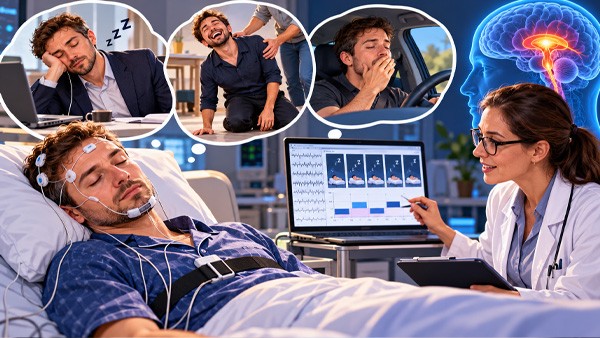

Narcolepsy is not a disorder of sleeping too much. It is a failure of the switch that holds wakefulness and sleep apart, so fragments of sleep intrude into the day and fragments of wakefulness break up the night. The person sleeps a normal number of hours and is still pulled under at two in the afternoon.
The single most important number in the subject is not a dose. It is the diagnostic delay, which commonly runs to eight to fifteen years between the first symptoms and the diagnosis. Those years are usually spent being told to go to bed earlier, and they are preventable by knowing what to ask for.
🧬 Two types, one missing signal
Narcolepsy type 1 is caused by loss of the neurons producing orexin, also called hypocretin — a small population in the hypothalamus whose job is to stabilise wakefulness. Lose them and the wake state becomes fragile. It is an autoimmune process in most cases, and it is this type that involves cataplexy.
Narcolepsy type 2 has the same daytime sleepiness and the same REM intrusions, without cataplexy and with normal orexin levels. It is less well understood and treated similarly for the sleepiness.
Onset peaks in adolescence and the early twenties, with a second smaller peak around the late thirties. It is lifelong, and it is manageable.
⚡ The five symptoms, and what they actually look like
| Symptom | In real life |
|---|---|
| Excessive daytime sleepiness | Irresistible rather than merely tired. Breaks through in quiet, warm, monotonous situations — reading, meetings, lectures, passenger seats. Present in everyone with the condition |
| Sleep attacks and microsleeps | Seconds of lost awareness, often noticed only by the consequence — a missed sentence, a line read three times, arriving somewhere with no memory of part of the journey |
| Cataplexy (type 1) | Usually partial, not a collapse. See below — this is the most misdescribed symptom in the condition |
| Sleep paralysis | Awake, aware, unable to move or speak for seconds to a couple of minutes, on falling asleep or waking. Frightening and harmless |
| Hallucinations at sleep transitions | Vivid, often threatening images or sounds as sleep begins or ends — a figure in the room, a voice. Frequently mistaken for psychosis, which it is not |
| Fragmented night sleep | The paradox: the person who cannot stay awake by day cannot stay asleep by night. Repeated awakenings, vivid dreams, non-restorative sleep |
😮 Cataplexy: what it really is
💡 The textbook picture — a person collapsing at a joke — is the rare version. Most cataplexy is partial and brief:
🔹 The jaw drops or the face sags for a second or two
🔹 The head nods forward
🔹 Knees buckle without falling, or the grip loosens and something is dropped
🔹 Speech becomes slurred mid-sentence
🔹 An odd facial twitching or grimace, particularly in children
Two features identify it and distinguish it from everything else. The trigger is positive emotion — laughter, being told a joke, delight, surprise — far more than fear or stress. And consciousness is completely preserved throughout. The person hears everything, remembers everything, and is simply unable to hold the muscle tone.
That second point is what separates it from fainting, from a seizure and from a cardiac event, all of which involve some loss of awareness. If there is loss of consciousness, it is not cataplexy, and it needs investigating as something else.
🧪 How it is actually diagnosed, with the numbers
The pathway is specific, and the preparation for it matters as much as the test.
- 📓 Two weeks of sleep diary and actigraphy first. This proves you have been getting adequate sleep, because chronic sleep deprivation produces the same test result as narcolepsy
- 🛏️ Overnight polysomnography, which rules out sleep apnea and other causes and must show at least six hours of sleep for the next day to count
- 📊 Multiple sleep latency test the following day — five nap opportunities at two-hourly intervals. The criteria are a mean sleep latency of 8 minutes or less, together with two or more sleep-onset REM periods. A REM period occurring early on the overnight study can count as one of the two
- 🧫 Orexin in cerebrospinal fluid — a level of 110 pg/mL or below is diagnostic of type 1. This is the test to ask about when the sleep study is equivocal, or when antidepressants cannot be stopped
- 🧬 HLA-DQB1*06:02 — present in almost everyone with type 1, and also in a fifth of the general population. So a negative result argues against type 1 and a positive one proves nothing
⚠️ The single most common reason narcolepsy is missed on testing. Antidepressants — SSRIs, SNRIs, tricyclics — suppress REM sleep, which is exactly what the test is looking for. Taken up to the day of the test they produce a false negative.
They have to be stopped about two weeks beforehand, and longer for fluoxetine, which lingers for weeks. This needs organising with the prescribing doctor, not improvised — and if the antidepressant is also controlling cataplexy, stopping it carries its own risk, which is the next warning on this page.
If you were tested while on an antidepressant and told the result was normal, that result does not mean much.
🔍 What else produces the same picture
These are far commoner than narcolepsy and are the reason the testing sequence exists.
- 😴 Insufficient sleep. The commonest cause of severe daytime sleepiness by an enormous margin. Six hours a night produces this in anyone
- 🫁 Obstructive sleep apnea — snoring, breathing pauses, waking unrefreshed, night-time urination. Covered in our guide to obstructive sleep apnea. It can also coexist with narcolepsy, which complicates both
- 🕒 Shift work or a delayed body clock — see our guide to shift work sleep disorder
- 🧠 Depression, where the complaint is usually fatigue and loss of interest rather than falling asleep mid-sentence
- 💊 Sedating medication — antihistamines, opioids, antipsychotics, some blood pressure drugs
- 🧪 Thyroid disease, anaemia, low B12 or vitamin D
- 🦵 Idiopathic hypersomnia — long unrefreshing sleep with severe difficulty waking and no REM intrusions. A different condition with overlapping treatment
📋 The non-drug part, which is not optional
Medication raises the floor; structure determines whether the day works.
- 💤 Scheduled naps are a treatment, not a weakness. Two or three naps of 15 to 20 minutes at planned times — before the usual crash window rather than after it — measurably reduce sleep attacks. Short, because longer naps produce grogginess and disturb the night
- ⏰ A fixed wake time every day, weekends included
- 🍽️ A light lunch. A heavy midday meal makes the early-afternoon trough considerably worse
- ☀️ Daylight and a short walk at the low points
- ☕ Caffeine as a supplement, not a substitute, and not within six hours of bed
- 🍷 Alcohol fragments the night further in a condition where the night is already fragmented
- 🏫 Formal accommodations at school or work — permission to nap, exams in the morning, scheduled breaks, avoiding safety-critical tasks in the trough. Narcolepsy is a recognised disability in most jurisdictions and asking for adjustments is not a favour
💊 Which drug treats which symptom
This is where the article you probably read stopped, and it is the part that determines whether treatment works — because sleepiness and cataplexy are treated by different drugs.
| Drug | Dose | Treats |
|---|---|---|
| Modalert (Modafinil) | 200 mg once daily in the morning; up to 400 mg, commonly split as 200 mg on waking and 200 mg at midday | Sleepiness. First-line, and does little for cataplexy |
| Waklert (Armodafinil) | 150 to 250 mg once daily in the morning | Sleepiness. Longer acting than modafinil |
| Sodium oxybate | Taken at night in two doses — at bedtime and again two and a half to four hours later. Titrated from 4.5 g to 6 to 9 g per night | All three at once — sleepiness, cataplexy and fragmented night sleep. The most effective drug in narcolepsy, and the most demanding to take |
| Pitolisant | Titrated to 4.5 to 35.6 mg once daily in the morning | Sleepiness and cataplexy. Not a controlled substance, which matters for some people |
| Solriamfetol | 75 to 150 mg once daily on waking | Sleepiness. Raises blood pressure, so needs monitoring |
|
Antidepressants venlafaxine, clomipramine, fluoxetine |
Lower doses than for depression | Cataplexy, sleep paralysis and hallucinations — by suppressing REM. Off-label and widely used. Little effect on sleepiness |
|
Stimulants methylphenidate, amphetamines |
Specialist prescribing | Sleepiness, where the above are insufficient. Controlled substances not supplied here |
So a typical plan is often two drugs: a wake-promoting agent for the day and something REM-suppressing for the cataplexy — or sodium oxybate, which covers both. The range stocked here is in the anti-narcoleptic category, and the comparison between the two main options is in our guide to armodafinil versus modafinil.
⛔ Never stop a cataplexy medication abruptly. Where an antidepressant is suppressing cataplexy, sudden withdrawal can cause status cataplecticus — repeated, prolonged cataplexy lasting hours, sometimes with near-continuous collapse. It is a medical emergency and it is almost always caused by running out of tablets, a prescription lapsing, or stopping deliberately before a sleep test without a plan.
If testing requires the antidepressant to be stopped, that is arranged with the sleep specialist, with the risk discussed and covered.
⚠️ What to know before taking modafinil
- 🔴 Rash. Rare but serious skin and multi-organ hypersensitivity reactions occur. Any rash in the first weeks means stopping and seeking assessment the same day
- 💊 Contraception. It induces liver enzymes and reduces the effectiveness of hormonal contraception — pill, patch, ring and implant — during treatment and for about a month after stopping. Narcolepsy typically begins in adolescence or the early twenties, so this applies to a large share of patients and is routinely not mentioned. An additional or alternative method is needed
- 🧠 Psychiatric effects — anxiety, agitation and insomnia commonly; uncommonly mania or psychosis. Report mood changes
- 🩸 Blood pressure and heart rate can rise, and it is avoided after a recent heart attack or with unstable angina
- 📋 It is a controlled substance in many countries, and it interacts with several medicines
- 🕕 Not in the afternoon or evening, since it will prevent the night sleep that is already fragile
🚗 Driving and safety
This is the part that determines independence, and the framing matters: being diagnosed is not what costs people their licence — being untreated and sleepy is.
- ⚖️ Most countries require narcolepsy to be declared to the licensing authority, and most permit driving once symptoms are controlled on treatment. The rules are national and change, so your own authority is the only reliable source — check rather than assume, and rather than concealing it, which invalidates insurance
- 💤 A planned 15 to 20 minute nap immediately before driving, with caffeine taken just before it
- 🛑 Treat drowsiness as a stop signal, not a challenge. Window open, loud music and chewing gum do not work and are what people do instead of stopping
- 🛣️ Break long journeys every hour or two, and avoid monotonous motorway routes at your low points where possible
- 🏭 At work, safety-critical tasks are scheduled into the best alertness window, and heights, machinery and lone working are discussed honestly
- 👥 Tell someone you trust what your warning signs are and what cataplexy looks like in you, so it is not mistaken for a faint or a seizure by people around you
🧒 Narcolepsy in children and teenagers
Onset peaks in adolescence, and in children it rarely presents as a complaint of sleepiness.
- 🏫 Falling academic performance, inattention and being labelled lazy or unmotivated
- 😠 Irritability, mood swings and behavioural problems, which frequently get the psychiatric label first
- 😴 Return of daytime napping in a child who had grown out of it — a genuinely useful clue
- 😮 Cataplexy that looks odd rather than dramatic — a slack open mouth, tongue protrusion, head drooping, unsteady walking, sometimes near-continuous facial movements early in the illness. It is easily read as clumsiness or attention-seeking
- ⚖️ Rapid weight gain, and occasionally early puberty, both associated with type 1
Early diagnosis matters more here than almost anywhere, because the years lost are the years of schooling.
🧩 What travels with it
- ⚖️ Weight gain and obesity, particularly in type 1 and particularly around onset
- 🧠 Depression and anxiety, which are common and treatable, and which the antidepressants used for cataplexy may partly address
- 🛏️ REM sleep behaviour disorder — acting out dreams, which can injure a bed partner
- 🦵 Periodic limb movements and restless legs, adding to the fragmented nights
- 🫁 Obstructive sleep apnea, made more likely by the weight gain, and worth testing for when treatment stops working
📞 When to seek help
Urgently:
- Repeated or prolonged cataplexy, especially after stopping or running out of an antidepressant — possible status cataplecticus
- Any rash in the first weeks of modafinil or armodafinil
- Collapse with loss of consciousness — that is not cataplexy and needs cardiac and neurological assessment
- A road or workplace near-miss — stop driving and get the treatment reviewed
Promptly:
- Months of irresistible daytime sleepiness despite adequate sleep — ask for a sleep medicine referral by name
- Emotion-triggered weakness, sleep paralysis or hallucinations at sleep transitions — describe these explicitly, since they are what shortens the diagnostic journey
- Having been tested while taking an antidepressant —> ask whether the result is reliable and about measuring orexin instead
- A child or teenager with falling grades, new irritability and returning daytime naps
- Snoring, breathing pauses or weight gain on established treatment — ask about sleep apnea
- Low mood, which is common and under-treated here
- On hormonal contraception and starting modafinil — additional cover is needed
- Treatment that has stopped working — before the dose goes up, the night sleep and a coexisting sleep disorder get checked
❓ Frequently asked questions
How is narcolepsy diagnosed?
Two weeks of sleep tracking, an overnight sleep study showing at least six hours of sleep, then a multiple sleep latency test the next day. The criteria are a mean sleep latency of 8 minutes or less plus two or more sleep-onset REM periods.
Why must I stop antidepressants before a sleep test?
Because they suppress REM sleep, which is exactly what the test measures, so taking them produces a false negative. They are stopped about two weeks beforehand, longer for fluoxetine, and always with the prescriber involved.
What does cataplexy actually look like?
Usually partial and brief — a dropping jaw, a nodding head, buckling knees, slurred speech — triggered by laughter or other positive emotion, with consciousness completely preserved. Full collapse is the rare version.
How do I know it is cataplexy and not fainting?
Consciousness. In cataplexy you remain fully aware and remember everything. Fainting, seizures and cardiac events all involve some loss of awareness, and if consciousness was lost it needs investigating as something else.
Is there a blood or fluid test for narcolepsy?
Orexin measured in cerebrospinal fluid at 110 pg/mL or below is diagnostic of type 1, and is the test to ask about when the sleep study is equivocal or antidepressants cannot be stopped. HLA typing is only useful as a negative.
What is the modafinil dose for narcolepsy?
200 mg once daily in the morning, increasing to 400 mg if needed, commonly split as 200 mg on waking and 200 mg at midday. Not taken in the afternoon or evening, since it will disturb an already fragile night.
Does modafinil treat cataplexy?
Barely. Sleepiness and cataplexy need different drugs, which is why plans often involve two: a wake-promoting agent by day and a REM-suppressing one for cataplexy, or sodium oxybate, which covers both plus the broken nights.
What happens if I run out of my cataplexy medication?
Abrupt withdrawal can cause status cataplecticus — repeated prolonged cataplexy lasting hours. It is a medical emergency and almost always follows a lapsed prescription. Keep a buffer supply and never stop deliberately without a plan.
Do scheduled naps really help?
Yes, and they are a treatment rather than a concession. Two or three naps of 15 to 20 minutes at planned times, before the usual crash rather than after it, measurably reduce sleep attacks. Longer naps cause grogginess and disturb the night.
Can I drive with narcolepsy?
In most countries yes, once symptoms are controlled on treatment, and most require the diagnosis to be declared. Being diagnosed is not what costs people their licence; being untreated and sleepy is. Check your own licensing authority.
📑 Sources and editorial
- International Classification of Sleep Disorders criteria for narcolepsy type 1 and type 2, including multiple sleep latency test thresholds and cerebrospinal fluid hypocretin cut-offs
- American Academy of Sleep Medicine practice guidelines on the treatment of central disorders of hypersomnolence
- Guidance on multiple sleep latency test methodology, including prior actigraphy, minimum overnight sleep duration and withdrawal of REM-suppressing medication
- Research on hypocretin-orexin neuron loss in narcolepsy type 1 and its autoimmune basis
- Studies of diagnostic delay in narcolepsy and of the clinical features that shorten it
- Clinical descriptions of partial cataplexy, emotional triggers, preserved consciousness, and cataplectic facies in children
- Case reports and reviews of status cataplecticus following abrupt withdrawal of REM-suppressing medication
- Prescribing information for modafinil and armodafinil, including dosing, serious dermatological and hypersensitivity reactions, psychiatric and cardiovascular precautions and the hormonal contraception interaction
- Trial evidence for sodium oxybate, pitolisant and solriamfetol across sleepiness, cataplexy and disrupted nocturnal sleep
- Evidence on scheduled napping and behavioural management, and guidance on driving and occupational safety in narcolepsy
- Reviews of comorbidity in narcolepsy, including obesity, precocious puberty, depression, REM sleep behaviour disorder and obstructive sleep apnea
- Related reading: obstructive sleep apnea, shift work sleep disorder, armodafinil versus modafinil
- Related products: Modalert (Modafinil), Waklert (Armodafinil), anti-narcoleptic category
- RXshop Editorial Team — reviewed by James Carter, MD — Neurologist & Sleep Medicine Specialist
Medical Disclaimer: The information in this article is for educational and informational purposes only and is not a substitute for professional medical advice, diagnosis, or treatment. Always seek guidance from a qualified healthcare provider with any questions you may have regarding a medical condition, and before starting, stopping or changing any medication.