Buy Flomist (Generic Fluticasone Propionate) Online — Established Intranasal Corticosteroid for Allergic Rhinitis

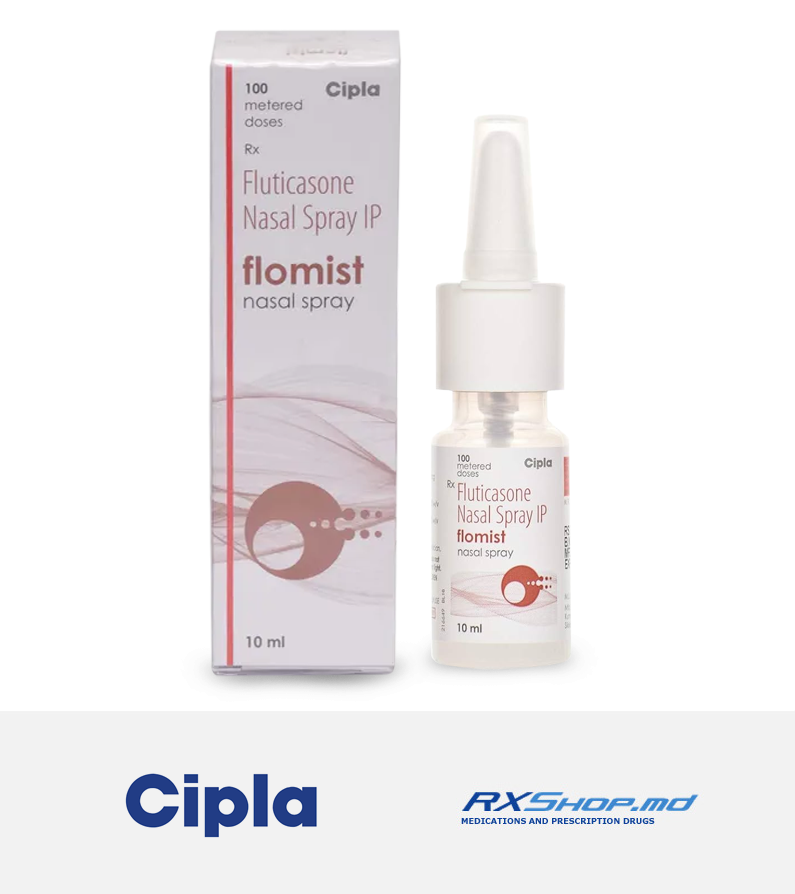
Flomist is an affordable generic Fluticasone Propionate intranasal corticosteroid spray — the same active molecule found in branded products such as Flonase and Flixonase. Fluticasone Propionate is one of the most widely-used intranasal corticosteroids in the world, with over 30 years of clinical use since its original FDA approval in 1994. As a generic Fluticasone, Flomist delivers identical therapeutic effects to brand-name versions at a significantly lower price — supporting sustainable year-round management of seasonal and perennial allergic rhinitis.
Generic Fluticasone is a potent synthetic glucocorticoid that directly binds to nasal corticosteroid receptors when applied topically to the nasal mucosa. Unlike systemic corticosteroids, intranasal Fluticasone delivers strong anti-inflammatory action precisely where allergic symptoms originate — suppressing release of inflammatory mediators, reducing eosinophil and mast cell activity, and calming the overall allergic cascade in the nose. This direct local action reduces nasal symptoms without the side effects of oral steroid courses.
By targeting the underlying nasal inflammation rather than just histamine release, Flomist provides broader symptom coverage than oral antihistamines — effectively treating nasal congestion, runny nose, sneezing, nasal itching, and post-nasal drip. Intranasal corticosteroids like generic Fluticasone are recognised as the most effective single-class medication for moderate-to-severe allergic rhinitis in international guidelines such as ARIA, EAACI, and AAAAI.
Flomist is approved for the treatment of seasonal allergic rhinitis caused by tree, grass, ragweed, and mould pollens, and for perennial allergic rhinitis from indoor allergens such as dust mites, pet dander, and indoor moulds. It is approved for adults and pediatric patients aged 4 years and older in most markets — making it one of the more pediatric-friendly intranasal corticosteroids available.
The standard dose is 1-2 sprays in each nostril once daily. Initial symptom improvement often appears within 12 hours, with maximum benefit typically developing over 3-7 days of consistent daily use. Patients should be advised to continue treatment even when initial improvement seems modest — full effect requires steady-state local concentrations.
Side effects from generic Fluticasone are mild and primarily local — mild nasal dryness, minor headache, and occasional brief epistaxis. Generic Fluticasone is also approved over-the-counter as Flonase in many countries, reflecting its excellent long-term safety record across pediatric, adult, and geriatric populations.
Free prescription
Discrete packaging
Have questions?
Quality Assurance

- Persistent Rhinitis: For year-round daily symptom control in patients with ongoing exposure to indoor or chronic outdoor allergens;
- Pediatric Allergies: Approved for children from age 4 — one of the more pediatric-friendly intranasal corticosteroids;
- School Age Allergies: Once-daily dosing simplifies pediatric adherence during school years and after-school activities;
- Adolescent Allergies: Effective control in teen patients without sedating effects that interfere with school performance;
- Adult Allergies: Steady symptom control supports workplace productivity without cognitive side effects;
- Senior Allergies: Topical delivery avoids systemic effects relevant to elderly patients on multiple chronic medications;
- Refractory Allergies: For patients with inadequate response to oral antihistamine monotherapy — standard escalation step;
- Nasal Polyps: For chronic rhinosinusitis with nasal polyps as primary medical therapy or post-operative recurrence prevention;
- Recurrent Sinusitis: Long-term anti-inflammatory effect reduces recurrence rates of allergy-driven acute sinusitis;
- Chronic Sinusitis: Anti-inflammatory therapy for ongoing sinus inflammation in patients with concurrent allergic rhinitis;
- Asthma With Rhinitis: Treating upper airway allergy supports lower airway control in united airway disease and reduces asthma exacerbations;
- Eye Allergy Symptoms: Indirect benefit on ocular itching, redness, and tearing through control of nasal allergic inflammation;
- Pre Season Allergies: Started 1-2 weeks before known pollen seasons to substantially reduce peak-season symptom severity;
- Combination Allergy Therapy: Foundation of multi-modal allergy regimens combining intranasal corticosteroid with oral or topical antihistamines;
- Pregnancy Allergies: When intranasal corticosteroid is needed during pregnancy, low systemic absorption supports selective use under specialist guidance.
- Less Runny Nose: Reduces rhinorrhea by addressing the underlying inflammation rather than just histamine effects;
- Less Nasal Itching: Calms persistent intranasal itching by reducing mucosal inflammation at the source;
- Less Congestion: Particularly effective against nasal blockage — the symptom oral antihistamines often miss;
- Less Postnasal Drip: Reduces nasal secretion production that triggers chronic throat clearing and cough;
- Better Sleep: Effective nasal symptom control supports restful sleep during peak allergen exposure season;
- Daytime Alertness: No CNS effects — preserves alertness for work, school, and driving without sedation;
- Once Daily Dosing: 1-2 sprays per nostril, one time daily — supports strong year-round adherence;
- 24 Hour Coverage: Single morning application provides full-day relief throughout daily activities;
- Quality of Life: Measurable benefits on workplace and academic performance during allergy seasons;
- Driving Safety: Topical action with no systemic CNS effects supports safe driving throughout therapy;
- Quick Onset: Initial symptom improvement appears within 12 hours with maximum effect at 3-7 days;
- Mild Side Effects: Nasal dryness, minor headache, and occasional brief epistaxis are the most common reported effects;
- Intranasal Corticosteroid: First-line monotherapy class per international guidelines for moderate-severe allergic rhinitis;
- Nasal Steroid Spray: Direct glucocorticoid receptor binding for immediate local anti-inflammatory effect;
- Generic Fluticasone: Affordable generic version of branded Flonase and Flixonase at significantly lower price;
- Flonase Equivalent: Same Fluticasone Propionate molecule as branded Flonase — familiar option from US OTC market;
- Flixonase Equivalent: Same Fluticasone Propionate molecule as UK and European brand Flixonase;
- OTC Nasal Spray: Approved for over-the-counter use in many countries since 2014 — reflects exceptional long-term safety profile;
- Allergic Rhinitis Spray: Targeted topical therapy that treats underlying inflammation rather than just histamine release;
- Hay Fever Spray: Effective relief from seasonal pollen-driven nasal symptoms with simple morning application;
- Nasal Congestion Relief: Best-in-class congestion relief among allergic rhinitis therapies;
- Multi Symptom Coverage: Addresses sneezing, runny nose, itching, congestion, and postnasal drip simultaneously — broader than antihistamines alone;
- Pediatric Nasal Spray: Approved for children aged 4 and older — among the youngest age approvals for intranasal corticosteroids;
- Nasal Polyps Treatment: Documented benefit in chronic rhinosinusitis with polyps as both primary and adjunctive therapy;
- Sinusitis Prevention: Long-term control of allergic inflammation reduces recurrence of allergy-driven acute sinusitis episodes;
- Antihistamine Sparing: Reduces need for sedating oral antihistamines, particularly in pediatric and elderly patients;
- Year Round Nasal Spray: Suitable for year-round daily use in perennial rhinitis without tolerance development;
- Asthma Adjunct Spray: Upper airway anti-inflammatory therapy supports better lower airway control in united airway disease;
- Pre Season Initiation: Starting 1-2 weeks before peak allergen exposure substantially reduces total seasonal symptom burden;
- Combination Spray Therapy: Foundation alongside oral antihistamines for moderate-severe allergic rhinitis;
- Low Systemic Bioavailability: Under 2% of intranasal dose enters bloodstream — supports excellent long-term tolerability;
- Direct Glucocorticoid Activity: No prodrug conversion required — binds directly to nasal corticosteroid receptors for immediate local effect;
- Stable Storage: Stable at room temperature — convenient for travel kits, school bags, and emergency allergy supplies;
- Globally Available: Widely accessible in international markets in both branded (Flonase, Flixonase) and generic forms.
Generic Flomist (Fluticasone 10 ml) Medication guide:
💊 What is Flomist (Fluticasone Propionate) and what it treats
Flomist is a brand name for fluticasone propionate, an intranasal corticosteroid nasal spray manufactured by Cipla (India). Unlike oral antihistamines that block the histamine receptor, Flomist is an anti-inflammatory medication applied directly into the nose. It works at the source of nasal allergic symptoms, reducing the underlying inflammation that drives sneezing, runny nose, itch, and - most importantly - nasal congestion, where oral antihistamines often fall short.
What Flomist treats
- 🤧 Seasonal allergic rhinitis (hay fever) - first-line for moderate-severe symptoms per ARIA guidelines
- 🍃 Perennial allergic rhinitis - year-round indoor allergens (dust mites, pet dander, mould)
- 👁️ Nasal polyps - small growths in the nasal passages
- 🌀 Non-allergic rhinitis (vasomotor rhinitis) - non-immune-mediated chronic nasal symptoms
- 💨 Chronic rhinosinusitis - in conjunction with other treatments
- Active ingredient: fluticasone propionate
- Drug class: intranasal corticosteroid (INCS)
- Manufacturer: Cipla (India)
- Concentration: 50 mcg per metered spray
- Standard adult dose: 2 sprays per nostril once daily (200 mcg total)
- Pediatric approval: from 4 years (some markets from 2 years)
- Onset of action: partial within 12 hours, full effect 1-2 weeks
- Original FDA approval (Flonase brand): 1994
- OTC in US (Flonase): since 2015
- Other brand names: Flonase (US), Avamys (Glaxo, furoate version)
Three things that make Flomist different from antihistamines
| Feature | Flomist (INCS) | Oral antihistamines |
|---|---|---|
| Drug class | Anti-inflammatory corticosteroid | H1 receptor blocker |
| How it's taken | Sprayed into the nose | Pill or syrup by mouth |
| Where it acts | Locally in nasal mucosa | Throughout the body |
| Effect on congestion | Strong | Weak |
| Effect on eye symptoms | Modest (some systemic absorption helps) | Strong |
| Time to full effect | Days to weeks | Hours |
| Dosing | Once daily continuous | Once or twice daily |
Key advantages of Flomist
- Most effective single agent for moderate-severe allergic rhinitis per ARIA guidelines
- Reduces nasal congestion - the symptom where antihistamines are weakest
- Addresses underlying inflammation - not just blocking one chemical mediator
- Local action - minimal systemic side effects
- Once-daily dosing
- Decades of established safety - fluticasone propionate approved since 1994
- Affordable Cipla generic in many markets
- No sedation - unlike some antihistamines
- No anticholinergic effects
Important: what Flomist does NOT do
- Acute relief - it takes hours-to-days to start working
- Treating colds or viral infections - this is an allergic/inflammatory treatment
- One-time use before allergen exposure - it needs continuous daily use
- Severe anaphylaxis - this requires epinephrine
- Asthma alone - though it may help comorbid allergic rhinitis
- Children under 4 years in most markets
Flomist represents one of the most significant advances in allergic rhinitis treatment. By acting locally on the nasal inflammation that drives all allergic rhinitis symptoms, it provides comprehensive control including the congestion that oral antihistamines struggle with. The trade-off is that it requires daily continuous use and takes days-to-weeks to reach full effect - but the resulting symptom control is generally more complete than antihistamines alone.
🧬 Why an intranasal corticosteroid is different from antihistamines
Many patients are familiar with oral antihistamines (Claritin, Zyrtec, Allegra) as the standard allergy treatment. Flomist works completely differently. Understanding what an intranasal corticosteroid is, how it differs from antihistamines, and why doctors often prefer it for moderate-severe allergic rhinitis helps patients use it correctly and have realistic expectations.
The fundamental difference - inflammation vs histamine
When you encounter an allergen (pollen, dust mite), your body responds with a complex inflammatory cascade:
- 1. Allergen lands on nasal mucosa
- 2. Mast cells degranulate, releasing many chemical mediators
- 3. Histamine is released (causes itch, sneezing, runny nose)
- 4. Leukotrienes, prostaglandins, cytokines are released too (cause congestion, ongoing inflammation)
- 5. Eosinophils and other immune cells arrive, causing late-phase inflammation
- 6. Nasal mucosa swells, blood vessels dilate, mucus production increases
How antihistamines and INCS each address this cascade
| Treatment type | What it blocks | What it leaves uncovered |
|---|---|---|
| Oral antihistamines (Claritin, Zyrtec) | Histamine only (at H1 receptor) | Leukotrienes, cytokines, eosinophil recruitment, late-phase inflammation |
| Intranasal corticosteroid (Flomist) | Multiple inflammatory pathways | Acts upstream - reduces the entire inflammatory response |
What "corticosteroid" means
The word "corticosteroid" sometimes worries patients because they associate it with oral steroids like prednisone that have significant systemic effects. Intranasal corticosteroids work very differently.
- Corticosteroids are powerful anti-inflammatory medications based on the natural hormone cortisol
- Different forms have different reach: oral pills act throughout the body; inhalers act mostly in lungs; nasal sprays act mostly in the nose
- Flomist is intranasal - over 95% of the medication stays in the nose
- The small fraction that is absorbed is broken down by the liver before causing systemic effects (this is called "first-pass metabolism")
- The result: strong anti-inflammatory action where you need it, very little systemic exposure
- Decades of evidence: intranasal corticosteroids have an excellent long-term safety profile
Side-by-side comparison
| Feature | Antihistamines | Flomist (INCS) |
|---|---|---|
| How taken | Pill, syrup, ODT | Nasal spray |
| Where active | Systemic - throughout body | Local - in nasal mucosa |
| Onset of action | 1-3 hours | 12 hours partial, 1-2 weeks full |
| Use pattern | Can be used as-needed | Must be daily continuous |
| Sneezing relief | Excellent | Excellent |
| Itching relief | Excellent | Very good |
| Runny nose relief | Good | Very good |
| Congestion relief | Modest | Excellent |
| Eye symptom relief | Excellent (systemic action) | Modest |
| Effect on inflammation | Limited - blocks one mediator | Strong - reduces multiple pathways |
So which should you use?
This is not an either-or question. The choice depends on your symptom pattern:
| Your situation | Best approach |
|---|---|
| Mild seasonal symptoms, mainly sneezing/itch | Oral antihistamine alone |
| Significant congestion as the main problem | Flomist as first-line |
| Moderate to severe persistent symptoms | Flomist as first-line; add antihistamine if needed |
| Year-round indoor allergies | Flomist daily; antihistamine for flares |
| Predominant eye symptoms | Antihistamine (oral or eye drops) |
| Nasal polyps | Flomist is essential |
Intranasal corticosteroids like Flomist and oral antihistamines like Claritin work through completely different mechanisms and are best understood as complementary rather than competing. For mild seasonal allergies, an antihistamine alone often suffices. For moderate-severe allergic rhinitis - especially when congestion is prominent - Flomist is the more powerful single agent and is named first-line by ARIA guidelines. For severe cases, the two are used together for comprehensive coverage.
🌍 Flomist and global fluticasone propionate brands
Fluticasone propionate intranasal spray is available worldwide under many different brand names. The product you receive as "Flomist" is one of these brands, manufactured by the Indian pharmaceutical company Cipla. The same active ingredient is sold elsewhere as Flonase (US), Avamys (newer furoate version), and dozens of generic equivalents. Understanding the brand landscape helps you navigate availability and cost.
Major fluticasone nasal brands by region
| Brand | Active ingredient | Manufacturer / Region |
|---|---|---|
| Flomist | Fluticasone propionate 50 mcg | Cipla / India and export markets |
| Flonase | Fluticasone propionate 50 mcg | GSK / Bayer - USA (OTC since 2015) |
| Flixonase | Fluticasone propionate 50 mcg | GSK - UK, Australia, many European markets |
| Avamys | Fluticasone furoate 27.5 mcg | GSK - newer molecule, different version |
| Veramyst | Fluticasone furoate 27.5 mcg | GSK - US brand for furoate |
| Nasoflo | Fluticasone propionate | Various generic manufacturers |
| Furamist | Fluticasone furoate | Cipla India version of furoate |
| Generic fluticasone | Fluticasone propionate | Many manufacturers worldwide |
Why Cipla and India matter for global fluticasone access
- India is the world's largest generic pharmaceutical producer
- Cipla is one of India's largest pharmaceutical companies, founded in 1935
- Cipla's regulatory standards: manufacturing facilities certified by US FDA, EU EMA, WHO and many other regulators
- Flomist was developed as Cipla's branded version of fluticasone propionate nasal spray
- Lower cost than Western brand-name versions while maintaining quality
- Widely exported: India's pharmaceutical exports reach over 200 countries
- Quality is bioequivalent to brand-name reference products
Propionate vs furoate - the two forms
Fluticasone exists in two slightly different chemical forms used for nasal sprays. Both are very effective but have minor differences.
| Feature | Fluticasone propionate | Fluticasone furoate |
|---|---|---|
| Brand names | Flomist, Flonase, Flixonase | Avamys, Veramyst, Furamist |
| Approved year | 1994 (US) | 2007 (US) |
| Strength per spray | 50 mcg | 27.5 mcg |
| Receptor affinity | High | Higher |
| Effect on eye symptoms | Modest | Slightly better |
| Generic availability | Widespread | More limited |
| Pediatric approval | From 4 years (most markets) | From 2 years (some markets) |
OTC vs prescription status by country
| USA | Flonase OTC since 2015; Flomist not available |
| India | Flomist OTC; multiple Cipla/generic options |
| UK | Flixonase OTC and Rx versions |
| EU | Mostly OTC since 2010s; varies by country |
| Canada | Flonase OTC since 2015 |
| Australia | Flixonase OTC at pharmacy |
| Latin America | Mixed; brand names vary |
| Russia, Eastern Europe | Various brand and generic versions |
Cost considerations
- Brand Flonase (US OTC): moderate cost; insurance may not cover OTC
- Generic fluticasone (US): low cost; same active ingredient
- Flomist (India): very low cost; widely available
- European brand: low to moderate; many markets reimburse
- Avamys/furoate brands: typically more expensive; brand-name only in some markets
Whether you receive Flomist, Flonase, Flixonase, or generic fluticasone, you are getting the same active medication. The major real difference is between fluticasone propionate (the original, since 1994) and fluticasone furoate (newer, since 2007). Both work very well for allergic rhinitis. Flomist by Cipla represents one of the most affordable global access points to this important medication.
📜 Fluticasone history - from asthma inhaler to nasal spray
Understanding the origin of fluticasone helps explain why this medication is so well-studied and what makes it particularly suitable for intranasal use. Fluticasone propionate was developed by Glaxo (now GSK) in the 1980s, originally as an inhaled corticosteroid for asthma, and was adapted into a nasal spray that received FDA approval in 1994.
The development timeline
| Year | Milestone |
|---|---|
| 1980s | Glaxo chemists develop fluticasone as a next-generation corticosteroid with improved local potency and reduced systemic absorption |
| 1990 | Fluticasone propionate approved as inhaled corticosteroid for asthma (Flovent / Flixotide) |
| 1994 | Flonase nasal spray FDA-approved for allergic rhinitis - the first intranasal formulation of fluticasone propionate |
| 1996 | Approved for pediatric use from age 4 (later age 2 in some markets) |
| 2000s | Generic fluticasone propionate becomes widely available as patents expire |
| 2007 | Fluticasone furoate (Avamys/Veramyst) approved - a refined version with improved receptor affinity |
| 2015 | Flonase becomes OTC in the United States - a major milestone for global accessibility |
| Today | Available globally under many brand names including Flomist (Cipla India) |
The design goal - more local effect, less systemic exposure
When Glaxo chemists developed fluticasone, they were trying to solve a specific problem with earlier corticosteroids: they wanted maximum effect where applied with minimum absorption into the bloodstream.
- Very high receptor affinity - binds glucocorticoid receptors very tightly, so a small amount has a big local effect
- Low oral bioavailability - the small amount swallowed is mostly broken down by the liver before reaching circulation
- High lipophilicity - stays in tissues longer, giving sustained local effect
- Result: a medication that could be applied directly to inflamed airways or nasal mucosa with minimal systemic exposure
From lungs to nose
The success of inhaled fluticasone for asthma led to the obvious question: could it work the same way in the nose for allergic rhinitis? The chemistry was already proven; researchers simply adapted the formulation for nasal delivery.
- 1994 Flonase: aqueous nasal spray, 50 mcg per metered actuation
- Same active ingredient as the asthma inhaler, different delivery device
- Designed to deposit in the nasal mucosa where allergic inflammation occurs
- Minimal swallowed; what is swallowed is largely broken down in the liver
- Sustained effect allows once-daily dosing
The 2015 OTC milestone
After more than 20 years of prescription use with an excellent safety record, the FDA approved Flonase for over-the-counter sale in 2015. This was significant because:
- It removed the prescription barrier for one of the most effective allergy medications
- It validated the long-term safety profile of intranasal corticosteroids
- It made effective allergic rhinitis treatment accessible to millions more patients
- It established a precedent for other intranasal corticosteroid OTC switches
- Other countries quickly followed with similar reclassifications
How Cipla developed Flomist
As fluticasone propionate's patent protection ended in various markets through the 2000s, generic manufacturers worldwide began producing their own versions. Cipla (India) developed Flomist as their branded generic, offering:
- Bioequivalent active ingredient (fluticasone propionate 50 mcg per spray)
- Standardised metered-dose nasal spray device
- Manufacturing in WHO-certified facilities
- Significantly lower cost than the original GSK branded version
- Widely available across India and many export markets
The legacy
Fluticasone propionate has been used clinically since 1990 as an inhaled medication and since 1994 as a nasal spray. This means over 30 years of accumulated safety data, pharmacovigilance, and clinical experience. The molecule was specifically designed for local action with minimal systemic exposure, and the decades of evidence have confirmed that design goal was achieved. This is why intranasal corticosteroids like Flomist are now first-line treatment for moderate-severe allergic rhinitis worldwide.
🔬 How Flomist works - the anti-inflammatory mechanism
Flomist (fluticasone propionate) is a powerful anti-inflammatory medication that works through a mechanism completely different from antihistamines. Rather than blocking one chemical mediator, it acts upstream in the cell nucleus to reduce production of multiple inflammatory mediators. Understanding this broader mechanism explains why intranasal corticosteroids are so effective and why they take time to work.
The molecular mechanism - in plain terms
- Fluticasone enters cells of the nasal mucosa easily because it is highly lipophilic
- Inside the cell, fluticasone binds to the glucocorticoid receptor in the cytoplasm
- The fluticasone-receptor complex moves into the cell nucleus
- In the nucleus, it binds to DNA at "glucocorticoid response elements"
- This changes gene expression: turns down production of pro-inflammatory proteins, turns up production of anti-inflammatory proteins
- Over hours to days, the changes in protein production reduce the inflammatory response
What gets reduced
Through these gene-level changes, fluticasone reduces production of many inflammatory mediators:
| Mediator | Role in allergic rhinitis |
|---|---|
| Cytokines (IL-4, IL-5, IL-13) | Drive ongoing inflammation and recruit immune cells |
| Chemokines | Attract eosinophils and other inflammatory cells |
| Leukotrienes | Cause vasodilation, increased mucus, congestion |
| Prostaglandins | Cause vascular changes and pain |
| Adhesion molecules | Help inflammatory cells stick to and enter nasal tissue |
| Eosinophil survival | Late-phase inflammation; chronic symptoms |
| Mast cell sensitivity | Initial degranulation that releases histamine |
Why this matters clinically
Because fluticasone reduces multiple inflammatory pathways simultaneously, it addresses:
- The immediate phase (histamine release) - though less acutely than antihistamines
- The late phase (cytokine-driven, hours later) - where antihistamines have little effect
- Chronic remodeling (eosinophilic inflammation) - where antihistamines have minimal effect
- Mucosal swelling and congestion - driven by leukotrienes and vascular changes
- Mucus hypersecretion
The "first-pass metabolism" - why local stays local
When you spray Flomist into your nose, some of it inevitably gets swallowed and absorbed. Why doesn't this cause systemic steroid effects?
- About 90-95% of the swallowed fluticasone is broken down by the liver on its first pass through, before it reaches the rest of the body
- This is called "first-pass metabolism" and is a deliberate feature of fluticasone's design
- The remaining 1-2% systemic exposure is too low to cause significant body-wide effects in most patients
- Compared to oral steroids: prednisone reaches the entire body; Flomist stays mostly local
- Compared to other intranasal steroids: fluticasone has one of the lowest systemic absorption rates
Pharmacokinetic profile
| Parameter | Value |
|---|---|
| Oral bioavailability | Less than 1% (first-pass metabolism) |
| Local tissue residence | Many hours (high lipophilicity) |
| Plasma protein binding | ~90% |
| Metabolism | Liver, CYP3A4 |
| Half-life (systemic) | ~10 hours |
| Excretion | Mostly fecal (via bile) |
| Onset of action | 12 hours partial, 1-2 weeks full |
Why it takes time to work
Unlike antihistamines that block receptors directly (an immediate effect), corticosteroids work by changing gene expression. This takes time:
- Hour 1-12: drug binds receptors, enters nuclei, starts changing gene transcription
- Day 1-3: new protein production patterns develop; inflammation begins to subside
- Day 3-7: significant symptom improvement
- Day 7-14: full anti-inflammatory effect; nasal mucosa heals
- Steady use: sustained low inflammation; ongoing protection
Fluticasone works by entering nasal cells, binding glucocorticoid receptors, and changing gene expression to reduce production of multiple inflammatory mediators. This produces broader, more sustained anti-inflammatory effects than antihistamines, but takes days to weeks to reach full effect. The combination of high local potency and very low systemic absorption is what makes intranasal corticosteroids both very effective and very safe for long-term use.
🤧 Flomist for seasonal allergic rhinitis - first-line therapy
Seasonal allergic rhinitis - hay fever caused by pollens from trees, grasses, and weeds - is one of Flomist's primary indications. International guidelines including ARIA (Allergic Rhinitis and its Impact on Asthma) name intranasal corticosteroids like fluticasone first-line therapy for moderate-severe seasonal allergic rhinitis. For patients whose seasonal symptoms include significant congestion or are not adequately controlled by antihistamines alone, Flomist is the more effective single agent.
Why Flomist is named first-line for moderate-severe symptoms
- Significantly better than placebo in dozens of clinical trials
- Superior to oral antihistamines in head-to-head studies for total nasal symptom scores
- Particularly superior for congestion - the symptom where antihistamines are weakest
- Comparable to or better than leukotriene receptor antagonists (montelukast)
- Quality of life improvement documented in many studies
- Comparable safety to placebo for nosebleeds and minor side effects
Standard seasonal dosing
| Age | Dose | Total daily fluticasone |
|---|---|---|
| Adults and adolescents 12+ | 2 sprays per nostril once daily | 200 mcg total |
| Maintenance after control | 1 spray per nostril once daily (may suffice) | 100 mcg total |
| Children 4-11 | 1 spray per nostril once daily | 100 mcg total |
| Children 4-11 severe symptoms | 2 sprays per nostril once daily (short-term) | 200 mcg total |
The critical pre-treatment strategy
Because Flomist takes 1-2 weeks to reach full effect, the optimal strategy for seasonal allergies is to start before symptoms emerge:
- For tree pollen season: start 2 weeks before typical pollen onset
- For grass pollen season: start in late spring
- For ragweed/fall allergies: start in mid-August (Northern Hemisphere)
- Continue daily through the entire allergy season
- By the time allergen exposure begins, the medication is at full effect
- This pre-treatment dramatically outperforms reactive treatment
Common seasonal triggers
| Season | Common allergens |
|---|---|
| Spring | Tree pollens (oak, birch, maple, cedar) |
| Late spring / early summer | Grass pollens (Timothy, Bermuda, rye) |
| Late summer / autumn | Ragweed and other weed pollens |
| Summer | Outdoor moulds (Alternaria, Cladosporium) |
What full symptom control looks like
When properly used, Flomist produces significant improvement across all major seasonal allergic rhinitis symptoms:
- Sneezing: 60-70% reduction in symptom scores
- Runny nose: 50-60% reduction
- Nasal itch: 50-60% reduction
- Nasal congestion: 50-60% reduction (vs ~20% for oral antihistamines)
- Postnasal drip: significant reduction
- Eye symptoms: modest reduction (smaller effect than for nasal symptoms)
- Sleep quality: substantial improvement when nasal congestion was disrupting sleep
- Daytime function: improved due to better sleep and reduced symptoms
When to combine with other treatments
| Combination | When useful |
|---|---|
| Flomist + oral antihistamine | Severe symptoms; eye involvement; persistent breakthrough |
| Flomist + antihistamine eye drops | Significant eye symptoms |
| Flomist + saline rinses | High pollen exposure days; thick secretions |
| Flomist + montelukast | Asthma comorbid; persistent congestion |
| Flomist + immunotherapy | Severe persistent allergies; disease modification |
Continuous vs intermittent use
Flomist is NOT an as-needed medication like antihistamines can be. Sporadic use:
- Will not give you the full benefit
- Will not control your symptoms adequately
- Wastes the medication
- Leaves you discouraged thinking it "doesn't work"
Use Flomist daily, every day, throughout your allergy season. If you respond well, you may be able to reduce the dose - but always to a regular daily schedule, not on-demand.
For moderate-severe seasonal allergies - especially with prominent congestion - Flomist is the most effective single agent available. The keys to success are starting 2 weeks before allergy season, using it daily without interruption throughout the season, and using proper spray technique. With this approach, the vast majority of patients achieve substantial symptom relief.
🍃 Flomist for perennial allergic rhinitis - year-round control
Perennial allergic rhinitis - year-round nasal allergy symptoms from indoor allergens like dust mites, pet dander, cockroaches, and indoor moulds - is one of Flomist's most important indications. The chronic, persistent nature of perennial allergies makes the anti-inflammatory mechanism of intranasal corticosteroids particularly valuable. Continuous daily Flomist can provide sustained year-round control that oral antihistamines often cannot match.
How perennial differs from seasonal
| Feature | Seasonal | Perennial |
|---|---|---|
| Timing | Specific months | Year-round |
| Allergens | Outdoor pollens, moulds | Indoor mites, pets, mould, cockroach |
| Symptom pattern | Acute flares | Continuous low-grade |
| Dominant symptom | Sneezing | Nasal congestion |
| Treatment approach | Seasonal duration | Continuous long-term |
| Asthma comorbidity | Some | High (40-50%) |
Common perennial allergens
| Allergen | Where it lives |
|---|---|
| House dust mites | Mattresses, pillows, carpets, upholstery |
| Cat dander | Cat skin flakes; persists for months |
| Dog dander | Dog saliva and skin |
| Cockroach allergen | Urban environments; older buildings |
| Mouse / rat allergen | Buildings with rodents |
| Indoor moulds | Bathrooms, basements, water-damaged areas |
Why Flomist is particularly well-suited for perennial AR
- Perennial AR involves chronic, low-grade nasal inflammation
- Continuous allergen exposure means ongoing inflammatory cascade
- Antihistamines target only one mediator in this complex inflammation
- Flomist reduces multiple inflammatory pathways at once
- Effect builds over time with steady daily use
- Result: more complete control of the underlying disease, not just symptom suppression
Continuous dosing for perennial AR
| Patient situation | Suggested approach |
|---|---|
| Year-round daily symptoms | 2 sprays per nostril once daily continuous |
| After 4-8 weeks good control | May step down to 1 spray per nostril daily |
| Maintenance phase | Lowest dose that maintains control, continuously |
| Symptom flare | Return to 2 sprays per nostril daily for 2-4 weeks |
Allergen avoidance as complement to Flomist
- Dust mite reduction: hot wash bedding weekly; mite-proof mattress and pillow covers; remove carpets where possible
- Pet allergens: keep pets out of bedroom; HEPA air filters; bathe pets weekly
- Mould control: humidity below 50%; fix water leaks; improve ventilation
- Cockroach control: professional pest management; secure food storage
- Air filtration: HEPA filters in bedroom and living areas
- Specialised testing: identify your specific triggers for targeted intervention
The asthma connection
40-50% of patients with perennial allergic rhinitis also have asthma. This is important for Flomist treatment:
- Reducing nasal inflammation may improve asthma control
- Patients on inhaled steroids for asthma can safely also use Flomist - they act in different locations
- Combined upper and lower airway treatment is often recommended
- ARIA guidelines emphasize coordinated treatment of allergic rhinitis and asthma
- Failure to treat allergic rhinitis can worsen asthma control
Long-term safety considerations
- 30+ years of clinical experience with fluticasone nasal spray
- No tolerance development - it keeps working over years of use
- Excellent long-term tolerability in real-world data
- No systemic steroid side effects at standard doses
- Minor effect on growth in children at standard doses (covered in pediatric section)
- Local effects (nosebleeds, dryness) are the main long-term considerations
For year-round indoor allergies, Flomist provides the most complete control of any single medication. The combination of continuous daily use, proper spray technique, and reasonable allergen avoidance measures gives most patients substantial improvement in quality of life. The chronic, persistent nature of perennial AR is exactly the situation where Flomist's anti-inflammatory mechanism shines.
👁 Flomist for nasal polyps
Nasal polyps are soft, non-cancerous growths inside the nasal passages and sinuses, caused by long-term inflammation. They commonly accompany conditions like chronic rhinosinusitis, asthma, and aspirin sensitivity. Intranasal corticosteroids including Flomist are first-line medical treatment for nasal polyps and are recommended by the European Position Paper on Rhinosinusitis (EPOS). This is a use that oral antihistamines cannot address at all.
What nasal polyps are
- Soft, fleshy growths attached to the lining of nasal passages or sinuses
- Caused by chronic inflammation - the immune system creates them in response to long-term irritation
- Not cancer - they are benign tissue
- Cause significant symptoms: blocked nose, loss of smell, facial pressure, postnasal drip, recurrent sinus infections
- Common in adults (about 4% of adults), rare in young children
- Often coexist with asthma (about 30-50% of patients with nasal polyps have asthma)
- Strongly associated with "aspirin-exacerbated respiratory disease" (AERD)
Symptoms of nasal polyps
- Persistent nasal obstruction - the most common symptom; often worse on one side
- Loss of sense of smell (anosmia) - very characteristic; often the first symptom patients notice
- Altered taste - because smell contributes to taste
- Postnasal drip - constant feeling of mucus dripping down throat
- Facial pressure or pain - over forehead, cheeks
- Recurrent sinus infections
- Snoring and sleep-disordered breathing
- Mouth breathing - because nasal breathing is obstructed
Why Flomist is first-line for nasal polyps
| Effect | How Flomist helps |
|---|---|
| Shrinks existing polyps | Anti-inflammatory action reduces the inflammation maintaining polyp tissue |
| Prevents polyp growth | Suppresses the underlying inflammation that drives polyp formation |
| Restores nasal patency | As polyps shrink, nasal breathing improves |
| May improve smell | Particularly in patients whose smell loss is recent or due to polyp obstruction |
| Reduces recurrence | After surgical removal, continued use significantly reduces polyp regrowth |
| Reduces sinus infections | Better drainage and less inflammation |
Dosing for nasal polyps
- Adults: 2 sprays per nostril twice daily (total 400 mcg/day) - higher than allergic rhinitis dose
- Continuous indefinite use - polyps regrow if treatment stops
- Effects develop over 4-6 weeks for polyp size reduction
- Maximum effect typically at 3 months
- Maintenance dose: 1-2 sprays per nostril once daily after initial control
- Head-down position: some doctors recommend tilting head down during application to better reach polyp tissue (let medication flow upward to sinuses)
Surgical considerations
For severe or refractory nasal polyps:
- Endoscopic sinus surgery may be needed if medical therapy is insufficient
- Surgery removes existing polyps but does not prevent recurrence
- Continued intranasal corticosteroid treatment is essential after surgery
- Without continued treatment, polyps regrow in many patients within 1-2 years
- With continued treatment, recurrence rates are significantly reduced
- This makes Flomist a long-term commitment after polyp surgery
Newer treatments for severe cases
For patients whose nasal polyps don't respond adequately to Flomist and other intranasal corticosteroids, several biologic medications are now available:
- Dupilumab - anti-IL-4/IL-13 antibody; approved for nasal polyps in 2019
- Omalizumab - anti-IgE antibody; some indications
- Mepolizumab - anti-IL-5 antibody; for eosinophilic polyps
- These are typically used in addition to intranasal corticosteroids, not as replacements
- Specialist referral required
The aspirin-exacerbated respiratory disease (AERD) consideration
Some patients have a specific syndrome called Samter's triad or AERD:
- Nasal polyps + asthma + aspirin/NSAID sensitivity
- Particularly severe form of nasal polyposis
- Requires aggressive medical management
- Flomist is essential but often not sufficient alone
- Aspirin desensitization is sometimes used
- Biologic therapy may be considered
- NSAID avoidance is critical
What to expect from Flomist treatment
| Time | Expected change |
|---|---|
| Week 1-2 | Reduced inflammation; mild symptom improvement |
| Week 4-6 | Polyp size reduction beginning; nasal breathing improves |
| Week 8-12 | Maximum medical effect; significant polyp shrinkage |
| Beyond 3 months | Maintenance to prevent recurrence |
For nasal polyps, Flomist and other intranasal corticosteroids are not just helpful - they are the cornerstone of medical treatment recommended by EPOS guidelines. The treatment is long-term and continuous because polyps tend to recur without ongoing anti-inflammatory therapy. For patients who do not respond adequately, options include surgery (followed by continued Flomist) and newer biologic medications. This is one of the most important indications where oral antihistamines have essentially no role.
🌀 Flomist for non-allergic rhinitis (vasomotor rhinitis)
Non-allergic rhinitis (NAR) - chronic nasal symptoms not caused by allergies - is a surprisingly common condition that affects about 1 in 6 adults. Unlike allergic rhinitis, NAR is not driven by IgE or histamine, which is why oral antihistamines often don't help with this condition. Flomist, with its broader anti-inflammatory action, is effective for many forms of non-allergic rhinitis.
Types of non-allergic rhinitis
| Type | Trigger |
|---|---|
| Vasomotor rhinitis | Temperature changes, dry air, irritants - the most common form |
| Gustatory rhinitis | Triggered by eating (especially spicy food) |
| Hormonal rhinitis | Pregnancy, thyroid disorders, menstrual changes |
| Drug-induced rhinitis | Beta-blockers, ACE inhibitors, aspirin, etc. |
| Atrophic rhinitis | Thinning of nasal mucosa, often elderly |
| NARES (non-allergic rhinitis with eosinophilia) | Eosinophil-driven without allergy |
| Occupational rhinitis | Workplace irritants |
Why allergy testing is negative in NAR
- NAR symptoms look similar to allergic rhinitis: runny nose, congestion, postnasal drip
- But allergy testing (skin prick or blood IgE) is negative
- Histamine is not the primary mediator - which is why antihistamines often fail
- The underlying problem is dysregulated autonomic nervous system or local irritant-triggered inflammation
- Triggers are typically: cold air, perfumes, smoke, strong odors, temperature changes, dry environments
- Common in middle-aged and older adults
Why Flomist helps non-allergic rhinitis
Even though NAR is not driven by typical allergic inflammation, intranasal corticosteroids work for several reasons:
- Many forms of NAR involve some inflammatory component
- NARES (with eosinophilia) involves eosinophilic inflammation that responds well to corticosteroids
- Reduces vascular reactivity in the nasal mucosa - the underlying problem in vasomotor rhinitis
- Reduces mucus production
- Stabilises the nasal mucosa making it less reactive to triggers
- The broad anti-inflammatory action addresses multiple potential mechanisms
Dosing for non-allergic rhinitis
| Patient type | Suggested dosing |
|---|---|
| Adults with vasomotor rhinitis | 2 sprays per nostril once daily |
| NARES (eosinophilic non-allergic) | 2 sprays per nostril once daily - often very responsive |
| After 4-8 weeks good control | May reduce to 1 spray per nostril daily |
| Persistent symptoms | Continue 2 sprays daily; may need to add nasal antihistamine |
Treatment expectations
NAR can be more difficult to treat than allergic rhinitis. Realistic expectations:
- Many patients get substantial improvement on Flomist
- Some forms (especially NARES) respond very well
- Other forms (vasomotor) may have partial response
- Combination with intranasal antihistamine (azelastine) often more effective than either alone
- Trigger avoidance remains important
- Symptom management rather than cure is typically the goal
Trigger management for NAR
- Avoid strong odors when possible (perfume, cleaning chemicals, smoke)
- Use a humidifier in dry environments
- Avoid sudden temperature changes when possible
- Saline nasal rinses regularly to clear irritants
- Don't smoke; minimise secondhand smoke exposure
- For gustatory rhinitis: identify and limit trigger foods
- For drug-induced rhinitis: discuss alternative medications with prescriber
Hormonal rhinitis (pregnancy rhinitis)
One specific form of non-allergic rhinitis worth discussing:
- Pregnancy rhinitis: affects ~20% of pregnancies, typically in second-third trimester
- Caused by hormonal changes increasing nasal mucosal blood flow
- Resolves after delivery
- Flomist is safe in pregnancy (covered in pregnancy section)
- Often the most effective treatment during pregnancy
When to suspect non-allergic rhinitis
| Clinical feature | Suggests NAR rather than allergic |
|---|---|
| Age | Onset after age 30 |
| Symptoms | Mainly congestion and runny nose; less itch/sneezing |
| Triggers | Weather, odors, smoke - rather than pollens, pets |
| Allergy testing | Negative |
| Family history | Less of allergic disease |
| Response to antihistamines | Poor or none |
For non-allergic rhinitis - particularly vasomotor rhinitis and NARES - Flomist is one of the most effective treatments available. Because this condition is not driven by histamine, oral antihistamines often fail completely. The intranasal corticosteroid's broad anti-inflammatory action addresses multiple mechanisms involved in NAR. Combined with trigger avoidance and sometimes nasal antihistamine sprays, Flomist can provide substantial improvement for this challenging condition.
💨 Why Flomist works for nasal congestion - where antihistamines fail
One of the most clinically important features of Flomist is its effectiveness for nasal congestion - the symptom where oral antihistamines are notably weak. If congestion is your main allergy problem, understanding why this difference exists helps explain why Flomist is so often recommended even for patients who could "just take Claritin".
What causes nasal congestion in allergic rhinitis
- Blood vessels in the nasal mucosa dilate - increasing tissue volume
- Vascular permeability increases - fluid leaks into the tissue causing swelling
- Mucus production increases - thicker secretions partially block airflow
- Inflammatory cells infiltrate the mucosa - further swelling
- This is driven by multiple mediators: leukotrienes, prostaglandins, cytokines, kinins - NOT primarily histamine
Why antihistamines have only modest effect on congestion
Antihistamines block histamine at H1 receptors. But:
- Histamine contributes only modestly to nasal congestion compared to its strong role in sneezing/itch/runny nose
- The main congestion-causing mediators are leukotrienes and prostaglandins, not histamine
- Antihistamines have minimal effect on these other mediators
- Clinical trials show antihistamines reduce congestion by only 15-25%
- This is why many patients say their nose still feels blocked despite taking Claritin or Zyrtec
Why Flomist works much better for congestion
| Congestion mediator | Effect of antihistamines | Effect of Flomist |
|---|---|---|
| Histamine | Strong | Indirect (reduces mast cell sensitivity) |
| Leukotrienes | None | Strong (reduces production) |
| Prostaglandins | None | Strong |
| Cytokines (IL-4, IL-5, IL-13) | None | Strong |
| Eosinophil infiltration | None | Strong |
| Vascular permeability | Modest | Strong |
Clinical evidence - the head-to-head studies
Multiple clinical trials have directly compared intranasal corticosteroids like fluticasone with oral antihistamines for allergic rhinitis. The consistent findings:
- For sneezing and itch: comparable
- For runny nose: comparable or fluticasone slightly better
- For nasal congestion: fluticasone significantly better (often 2-3x more reduction)
- For total nasal symptom score: fluticasone better, mainly due to congestion difference
- For eye symptoms: oral antihistamine somewhat better
- For quality of life: fluticasone better, particularly for sleep
Why congestion matters so much
Nasal congestion is more than just an inconvenience:
- Disrupts sleep - leading to fatigue, irritability, reduced productivity
- Causes mouth breathing - which dries throat, worsens snoring
- Reduces sense of smell - affects taste and quality of life
- Contributes to headaches
- Causes facial pressure
- May worsen asthma in patients with both conditions
- Contributes to sleep apnea in some patients
- Reduces exercise tolerance
The patient who switched from Claritin to Flomist
"I've been taking Claritin every spring for years. It helps my sneezing but I still feel completely stuffed up. I can't sleep, I can't smell anything, and I'm exhausted." This patient is describing the classic limitation of oral antihistamines alone. They were correctly named first-line for mild symptoms, but for moderate-severe symptoms with significant congestion, Flomist provides the additional control these patients need. Many patients in this situation report dramatic improvement after switching to Flomist or adding it to their antihistamine.
When Flomist alone is sufficient
For many patients, Flomist replaces the need for any oral antihistamine:
- Mild-moderate symptoms with prominent congestion
- Patient prefers nasal spray to daily pill
- Cannot take oral antihistamines (drug interactions, etc.)
- Wants to avoid any systemic medication effects
- Nasal polyps coexist
- Chronic non-allergic rhinitis
When combination is best
| Combination scenario | Approach |
|---|---|
| Severe symptoms | Flomist + oral antihistamine |
| Significant eye symptoms | Flomist + antihistamine eye drops or oral |
| Mixed allergic/non-allergic | Flomist + nasal antihistamine (azelastine) |
| Asthma comorbid | Flomist for upper airway; asthma treatment for lower |
The reason Flomist is so often recommended even when oral antihistamines are an option is precisely this: nasal congestion is the symptom that most affects quality of life, and it is the symptom where oral antihistamines are weakest. By targeting the multiple inflammatory mediators that cause congestion, Flomist provides relief in this critical area that antihistamines cannot match. For patients whose main complaint is "stuffed up nose", this difference is often dramatic.
🥇 Why ARIA guidelines name fluticasone first-line
The Allergic Rhinitis and its Impact on Asthma (ARIA) guidelines are the most widely respected international guidelines for allergic rhinitis treatment. Initially developed in collaboration with the World Health Organization in 2001 and updated regularly since, ARIA names intranasal corticosteroids like fluticasone as first-line treatment for moderate-severe allergic rhinitis. Understanding why this guideline recommendation exists helps patients understand why Flomist is so often prescribed.
What ARIA is
- Founded in 2001 in collaboration with the World Health Organization
- Developed by leading allergy experts worldwide through international consensus
- Updated periodically with latest evidence (2008, 2010, 2017, 2019)
- Considered the global standard for allergic rhinitis treatment guidance
- Used to inform national guidelines in dozens of countries
- Uses GRADE methodology for evidence assessment
The ARIA classification system
ARIA classifies allergic rhinitis by both duration and severity:
| Classification | Definition |
|---|---|
| Intermittent | Symptoms less than 4 days/week OR less than 4 weeks |
| Persistent | Symptoms more than 4 days/week AND more than 4 weeks |
| Mild | Normal sleep, no impairment, no troublesome symptoms |
| Moderate-severe | One or more of: sleep disturbance, daily activities affected, school/work problems, troublesome symptoms |
ARIA treatment recommendations
| Patient category | ARIA first-line | Alternative or add-on |
|---|---|---|
| Mild intermittent | Oral antihistamine OR intranasal antihistamine | INCS if preferred |
| Mild persistent | Oral antihistamine OR INCS (Flomist) | Either is reasonable |
| Moderate-severe intermittent | INCS (Flomist) recommended | Add oral antihistamine |
| Moderate-severe persistent | INCS (Flomist) - strongly preferred | Add oral antihistamine; consider combination intranasal |
The evidence ARIA used to make these recommendations
- Multiple head-to-head trials showing INCS superior to oral antihistamines for total nasal symptom score in moderate-severe disease
- Particularly superior for nasal congestion - the most impactful symptom
- Quality of life improvements documented in randomized trials
- Sleep quality improvement - critical because untreated AR disrupts sleep
- Excellent safety profile over decades of use
- Cost-effective compared to multiple medication regimens
- Address underlying inflammation, not just symptom suppression
Combination therapy in ARIA
ARIA also addresses combination therapy:
- For severe disease: combination intranasal corticosteroid + intranasal antihistamine (azelastine) often recommended
- Combined formulations exist (azelastine-fluticasone)
- This combination outperforms either alone in severe cases
- Adding oral antihistamine for eye symptoms or persistent breakthrough
- Decongestant nasal sprays NOT recommended for long-term use (rebound congestion)
- Allergen immunotherapy recommended for severe persistent disease
Other supporting guidelines
| Guideline | Position on intranasal corticosteroids |
|---|---|
| ARIA (WHO-initiated) | First-line for moderate-severe AR |
| EPOS (European) | First-line for rhinosinusitis and nasal polyps |
| AAAAI/ACAAI Joint Task Force (US) | First-line for moderate-severe AR |
| BSACI (UK) | First-line for moderate-severe AR |
| EAACI (European) | Strongly recommended for moderate-severe |
| GINA (asthma) | Recommended for comorbid AR and asthma |
What this means practically
If you have:
- Symptoms most days during your allergy season - you are persistent AR
- Symptoms affecting your sleep, work, or activities - you are moderate-severe
- Both - you fall into the category where ARIA strongly recommends INCS as first-line
ARIA and other major international guidelines name intranasal corticosteroids like Flomist as first-line for moderate-severe allergic rhinitis based on consistent evidence from clinical trials over 30+ years. The guidelines are particularly clear that when nasal congestion is a significant symptom, INCS is preferred over antihistamines. This recommendation has remained stable through multiple guideline updates because the evidence supporting it has only grown stronger over time.
📋 Standard Flomist dosing for adults and children
Flomist dosing follows the standard regimen for fluticasone propionate nasal spray 50 mcg per metered spray. Adult dosing is generally 200 mcg per day (2 sprays per nostril once daily), with reduction to maintenance after symptom control is established. Pediatric dosing is appropriately scaled down. Understanding correct dosing and the rationale behind it helps patients use the medication effectively.
Flomist dosing by age
| Age group | Starting dose | Maintenance dose |
|---|---|---|
| Adults and adolescents 12+ | 2 sprays per nostril once daily (200 mcg total) | 1 spray per nostril once daily (100 mcg total) |
| Children 4-11 years | 1 spray per nostril once daily (100 mcg total) | 1 spray per nostril once daily (100 mcg total) |
| Children 4-11 severe symptoms | 2 sprays per nostril once daily (200 mcg total) - short-term | Reduce to 1 spray per nostril when controlled |
| Children under 4 years | Not approved in most markets | Use alternative (some markets approve from 2 years) |
| Nasal polyps (adults) | 2 sprays per nostril twice daily (400 mcg total) | 1-2 sprays per nostril once daily |
The dosing rationale
- Starting at 200 mcg/day (2 sprays per nostril) ensures faster onset and more reliable response
- After 4-8 weeks of good control, many patients can step down to 100 mcg/day
- This maintenance dose is often sufficient to keep symptoms controlled
- Lower maintenance dose means even lower (already minimal) systemic exposure
- If symptoms flare, return to 200 mcg/day for several weeks
- For nasal polyps, higher doses (400 mcg/day) are used because polyp reduction requires more sustained anti-inflammatory effect
Daily timing
| Timing option | When useful |
|---|---|
| Morning | Most common; works well for most patients |
| Evening | If nocturnal congestion is the main problem |
| Twice daily | Some patients with severe symptoms; nasal polyps |
| Consistency matters | Same time daily for steady-state effect |
What to expect across the first weeks
| Day 1-2 | No immediate effect; do not be discouraged |
| Day 3-7 | Beginning to feel improvement; congestion easing |
| Week 2 | Substantial symptom improvement; near-full effect |
| Week 3-4 | Full effect established |
| Beyond 4 weeks | Maintenance; may step down dose |
Dose adjustments for organ function
Unlike many medications, Flomist generally does NOT require dose adjustment for kidney or liver disease because:
- Less than 1% systemic absorption - so kidney/liver clearance hardly matters
- Local action in nasal mucosa
- Even severe organ impairment typically allows standard dosing
- Exception: very severe liver disease may slightly increase systemic exposure
Children and growth dosing considerations
- Use the lowest effective dose in children
- Many pediatric patients do well on 100 mcg/day (1 spray per nostril once daily)
- Reserve 200 mcg/day for short-term control of significant symptoms
- Long-term high-dose use in children may have minor growth effects (covered in pediatric section)
- Regular pediatric monitoring recommended for children on long-term INCS
- Below age 4 not approved in most markets; consult pediatrician for alternatives
Dosing for elderly patients
No specific age-based dose adjustment is needed:
- Standard adult dosing applies
- No reduction needed for normal aging
- Excellent tolerability in elderly populations
- No anticholinergic effects to worsen elderly cognition
- Nosebleeds may be slightly more common due to thinner mucosa with age
Maximum doses and safety limits
| Patient/Indication | Maximum recommended dose |
|---|---|
| Adults - allergic rhinitis | 200 mcg/day (do not exceed) |
| Adults - nasal polyps | 400 mcg/day (specialist supervision) |
| Children 4-11 | 200 mcg/day (short-term only) |
| Pregnancy | Standard adult dose acceptable |
Practical adherence tips
- Establish a daily routine - same time each day
- Keep the spray bottle visible - near toothbrush, bedside
- Set a phone reminder if needed
- Travel-friendly - small bottle fits anywhere
- Don't stop because you feel better - your symptoms returned because you stopped
- If you miss a dose, take it when remembered (covered in missed dose section)
- Prime the bottle if not used for several days (instructions on label)
Flomist offers simple once-daily dosing with the option to step down to maintenance after symptom control. The 50 mcg per spray strength is standardised across virtually all fluticasone propionate brands worldwide. The standard 200 mcg/day starting dose for adults and 100 mcg/day for children works for the vast majority of patients. The few situations requiring adjustment (nasal polyps requiring higher dose, severe liver disease) are easily identified.
🚀 Proper Flomist spray technique - critical for effectiveness
One of the most underappreciated aspects of intranasal corticosteroid therapy is that spray technique dramatically affects how well the medication works. Studies show that a majority of patients use their nasal spray incorrectly - typically directing the spray toward the nasal septum and sniffing hard, both of which reduce effectiveness and increase side effects. Learning correct Flomist technique is as important as taking the medication itself.
Why technique matters so much
- Where the medication deposits: outer nasal wall (correct) vs nasal septum (incorrect)
- How much medication reaches inflamed tissue: proper aim = effective treatment
- Risk of nosebleeds: septum-directed spray causes most nosebleeds
- Risk of septal perforation: rare but worth avoiding
- How much is swallowed: sniffing hard sends medication to throat instead of nose
- Patient satisfaction: incorrect technique often leads to "this medication doesn't work"
The correct technique - step by step
| Step | What to do | Why |
|---|---|---|
| 1. Shake bottle | Shake gently before each use | Ensures uniform medication mixture |
| 2. Prime if needed | First time use or after several days unused: spray 4-6 times into air until fine mist appears | Ensures full dose delivery |
| 3. Blow nose gently | Clear excess mucus first | Allows medication to reach mucosa |
| 4. Tilt head slightly forward | Look at the floor; don't tilt head back | Prevents swallowing the medication |
| 5. Use opposite hand | For right nostril use left hand; for left nostril use right hand | Naturally directs spray away from septum |
| 6. Aim outward | Aim the spray nozzle toward the outer wall (toward your ear on that side) | Most critical step - deposits medication where inflammation is, not on septum |
| 7. Close other nostril | Press finger against opposite nostril | Better medication retention |
| 8. Breathe in gently | Slow gentle inhalation through the nostril as you spray | Helps medication distribute |
| 9. DO NOT sniff hard | Avoid forceful sniffing | Hard sniffing sends medication down throat, wasting it |
| 10. Breathe out through mouth | After spraying, exhale through mouth | Keeps medication in nose |
| 11. Repeat for other nostril | Same technique for second nostril | Both nostrils need treatment |
| 12. Wipe nozzle | Clean spray tip with tissue; replace cap | Hygiene; prevents nozzle blockage |
The three most common mistakes
- 1. Spraying toward the septum (the middle wall between nostrils) - this is the single most common mistake. The septum gets all the medication, the rest of the nose gets none, and you cause nosebleeds. ALWAYS aim toward the outer wall.
- 2. Sniffing hard during the spray - this sends 60-70% of the medication directly down your throat where it does nothing useful for your nose. Use only gentle nasal breathing.
- 3. Tilting the head back - this drains the medication into your throat. Look slightly downward instead.
The "opposite hand" trick explained
When you use your right hand for your right nostril, the natural angle of your wrist directs the spray toward the septum (the middle). When you use your left hand for your right nostril, your wrist naturally angles the spray outward, away from the septum.
- For right nostril: hold bottle in LEFT hand, spray angled toward right ear
- For left nostril: hold bottle in RIGHT hand, spray angled toward left ear
- This simple technique change dramatically improves drug deposition
- This is recommended in most patient education materials
Common questions about technique
| Question | Answer |
|---|---|
| What if I taste it in my throat? | You sniffed too hard or tilted head back. Adjust technique. |
| Should I blow my nose right after? | No - wait at least 15 minutes |
| What if a little runs out my nose? | Normal; means you used enough; wipe away |
| Can I do both sprays right after each other? | Yes, in the same nostril, immediately |
| What if I sneeze right after? | If sneezed soon and a lot came out - take another spray |
| Best position: standing or sitting? | Either; what matters is head position (slight forward tilt) |
Cleaning the device
- Wipe nozzle after each use with a tissue
- Weekly: remove cap and nozzle (per device design); rinse with warm water; let air dry
- Never use sharp objects to unblock - this damages the device
- If blocked: soak removable parts in warm water for 30 minutes; reassemble; prime
- Re-priming needed after cleaning
- Keep cap on between uses to prevent dust contamination
Proper Flomist spray technique can be the difference between effective treatment and frustration. The opposite-hand technique with outward aim and gentle breathing - rather than the natural same-hand-with-hard-sniff approach most people use - dramatically improves where the medication deposits and how well it works. If your Flomist hasn't seemed effective, review your technique before changing medications. This is the single highest-impact improvement most patients can make.
⏳ How long until Flomist works - days to weeks
Unlike oral antihistamines that work within hours, Flomist takes days to weeks to reach full effect. This is one of the most important things to understand about intranasal corticosteroids: they are not for rapid relief, but for sustained anti-inflammatory control. Many patients abandon treatment too early because they expect quick results. Setting realistic expectations is essential.
The Flomist effect timeline
| Time | What is happening | What you notice |
|---|---|---|
| 0-6 hours | Drug binding glucocorticoid receptors; entering nuclei | Nothing - this is normal |
| 6-12 hours | Gene transcription changes; protein production shifting | Possibly mild reduction in congestion |
| 12-24 hours | Initial anti-inflammatory effect | Some symptom improvement noticeable |
| Day 2-3 | Inflammation cells beginning to die back | Clear improvement |
| Day 4-7 | Substantial reduction in nasal inflammation | Major symptom reduction |
| Week 2 | Near-maximum anti-inflammatory state | Nearly full benefit |
| Week 3-4 | Sustained mucosal healing | Full effect; baseline symptoms minimal |
| For nasal polyps | Polyp tissue shrinking | Improvement over 4-12 weeks |
Why corticosteroids work slowly
- Antihistamines block receptors instantly - that's why they work in hours
- Corticosteroids change gene expression - which takes time to translate into changes in tissue inflammation
- Inflammatory cells already in the nose need time to die off and not be replaced
- Mucosal healing takes days to weeks
- Steady-state effect requires sustained daily dosing
- This is fundamental to how the drug class works - not a flaw of Flomist specifically
The "doesn't work" problem
A common pattern that leads patients to incorrectly conclude Flomist doesn't work:
- Day 1: takes spray, no immediate effect
- Day 2: still doesn't feel different; takes Claritin instead
- Day 3: Claritin is working better; stops Flomist
- Conclusion: "Flomist doesn't work for me"
- Reality: They never gave it the time it needed to work
The correct approach is to commit to at least 2 weeks of continuous daily use before evaluating effectiveness.
What "full effect" looks like
After 1-2 weeks of consistent daily use, you can expect:
- Significant reduction in nasal congestion - your nose feels notably more open
- Reduced sneezing
- Less runny nose
- Improved sleep quality - you can breathe through your nose at night
- Better sense of smell - especially if polyps are present
- Less postnasal drip
- Less morning facial pressure
- Mild residual symptoms may remain - 80% improvement is typical, not 100%
What if you need faster relief while waiting
| For acute symptoms in first 1-2 weeks | Bridge treatment |
|---|---|
| Sneezing, itch, runny nose | Oral antihistamine (Claritin, Zyrtec) as bridge |
| Significant congestion | Short-term oxymetazoline (Afrin) - MAX 3 days only |
| Eye symptoms | Antihistamine eye drops or oral antihistamine |
| Severe acute flare | Discuss short oral steroid burst with prescriber |
| General relief | Saline rinses; cool compress; head elevation at night |
Pre-treatment - the smart approach
For predictable seasonal allergies, start Flomist 2 weeks BEFORE your typical allergy season:
- If your tree pollen season starts in late March - begin Flomist in mid-March
- If your grass season starts in May - begin Flomist in mid-April
- If your ragweed season starts in August - begin Flomist in mid-July
- By the time the pollen arrives, Flomist is at full effect
- You experience minimal symptoms throughout the season
- Far better than starting Flomist after symptoms emerge
Maintenance phase timing
After 4-8 weeks of full-dose treatment:
- Many patients can step down to a maintenance dose (1 spray per nostril daily instead of 2)
- The maintenance effect is established quickly because anti-inflammatory state is already in place
- You may feel an immediate change if you drop the dose - or none at all
- If symptoms return, return to full dose for 2-4 weeks before retrying step-down
Flomist trades immediate effect for sustained anti-inflammatory control. The 1-2 week onset is fundamental to how corticosteroids work - it is not a flaw or limitation of this specific medication. Setting expectations correctly - "this is a 2-week commitment, not a one-day fix" - dramatically improves patient experience. For seasonal allergies, pre-treatment 2 weeks before allergen exposure is the optimal strategy.
🌅 Best time of day to use Flomist
Once Flomist reaches steady-state effect (after 1-2 weeks of daily use), the exact time of day matters less than with shorter-acting medications. The medication maintains continuous anti-inflammatory effect around the clock. However, there are some practical considerations about timing that can optimise convenience and side-effect profile.
The general principle
Consistency matters more than the specific time chosen. The anti-inflammatory effect builds up over time and is sustained as long as daily dosing continues. Pick a time that fits your routine and stick with it.
Common timing approaches
| Time of day | Advantages | Considerations |
|---|---|---|
| Morning | Most common; easy to remember with morning routine | Works well for daytime allergen exposure |
| Evening | Helpful for nocturnal congestion; better sleep | Particularly good for dust mite allergies (bedroom exposure) |
| With teeth brushing | Easy to remember; bathroom routine | Either morning or evening works |
| Twice daily | For severe symptoms; nasal polyps | Morning and evening; 12 hours apart |
Timing by primary symptom pattern
| Morning congestion | Evening dosing helps you wake up clearer |
| Daytime allergies (work/school) | Morning dose; covered through day |
| Outdoor work/exercise | Morning dose; protects during exposure |
| Sleep disruption from congestion | Evening dose; full effect overnight |
| Year-round (perennial) AR | Any time - steady state matters |
| Nasal polyps | Twice daily (morning + evening) |
What if you change your dosing time
If you've been taking Flomist in the morning but want to switch to evening:
- Just switch - no need for special transition
- For 2-3 days there may be a slight gap in steady-state effect
- By day 3-4, the new timing is established
- No washout period needed
- Effect remains continuous through the change
Twice-daily dosing considerations
- Severe persistent allergic rhinitis not adequately controlled at 200 mcg/day
- Nasal polyps - typically dosed twice daily (total 400 mcg/day)
- Severe seasonal flares - short-term escalation for 2-4 weeks
- Approximately 12-hour intervals (e.g., 7am and 7pm)
- Often returns to once-daily after control achieved
- Maximum recommended dose: 4 sprays per nostril per day (allergic rhinitis), 4 sprays per nostril per day (polyps)
Working with your schedule
| Lifestyle situation | Suggested timing |
|---|---|
| Standard 9-5 worker | Morning (with toothbrushing) |
| Shift worker | Consistent time within own schedule; avoid changes |
| Parent with children | Either time when kids are settled |
| Frequent traveler | Anchor to wake/sleep cycle, not clock time |
| Student | Morning before class; or evening before bed |
| Athlete in outdoor sport | Morning so coverage is full during competition |
Travel and time zones
- For short trips: maintain home time
- For long trips with significant time zone changes: gradually shift over 2-3 days to new local time
- The steady-state effect is very forgiving of timing variation
- Missing one day due to travel chaos has minor effect
- Travel-friendly - the small bottle fits in any carry-on
Building the habit
- Anchor to existing habit: brushing teeth, morning coffee, bedtime routine
- Keep visible: on bathroom counter or nightstand
- Phone alarm if needed for first 2-3 weeks until automatic
- Pair with another medication if you already take daily medications
- Calendar tracking for first month builds consistency
- It takes about 21 days for the behavior to become automatic
For Flomist, consistency is more important than the specific time of day. Morning works for most patients; evening helps if nocturnal congestion is your main issue. Once the medication reaches steady-state effect (1-2 weeks), the exact timing matters less than just taking it every day. Choose a time that fits naturally into your routine and stick with it.
🔁 Daily continuous use vs as-needed - the correct approach
One of the most important conceptual differences between Flomist and oral antihistamines is that Flomist must be used daily and continuously to work properly. It is NOT an as-needed medication. Patients who try to use Flomist only when they have symptoms get poor results and incorrectly conclude the medication doesn't work. Understanding why daily use is essential explains how to get the most benefit.
Why continuous use matters
Flomist works by maintaining a continuous anti-inflammatory state in your nasal mucosa:
- Daily dosing keeps glucocorticoid receptors active
- Continuous gene expression changes maintain reduced inflammatory mediator production
- Sustained suppression of inflammatory cell infiltration
- Mucosal healing requires ongoing low-inflammation environment
- Stopping for days allows inflammation to return
- Restarting requires another 1-2 weeks to rebuild the effect
Comparison with antihistamines
| Property | Oral antihistamines | Flomist |
|---|---|---|
| Can be used as-needed? | Yes - works hours after dosing | No - requires daily use |
| Time to effect | 1-3 hours | 12 hours to 2 weeks |
| Mechanism | Receptor blockade (immediate) | Gene expression changes (slow) |
| Effect after missing dose | Symptoms return within day | Gradual return over days |
| Best use pattern | Daily during symptoms; can skip when no symptoms | Daily continuously through allergy season or year-round |
What happens when you stop and restart
| After stopping Flomist | What happens |
|---|---|
| Day 1-2 | Anti-inflammatory effect still present |
| Day 3-5 | Effect beginning to wear off |
| Day 7 | Symptoms beginning to return if you still have exposure |
| Day 10-14 | Symptoms approaching pre-treatment levels |
| If you restart | Takes another 1-2 weeks to rebuild full effect |
Different use patterns for different situations
| Seasonal allergies | Daily continuous from 2 weeks before season until 2 weeks after |
| Year-round (perennial) AR | Daily continuous indefinitely |
| Nasal polyps | Daily continuous indefinitely |
| Non-allergic rhinitis | Daily continuous; some may step down |
| Short trip with allergen exposure | Start 2 weeks before; continue through trip; continue 1 week after |
Step-down rather than stop
When your symptoms are well-controlled, the right approach is usually step-down to maintenance, not stop completely:
- After 4-8 weeks of full-dose control: try reducing to 1 spray per nostril daily
- If maintenance dose continues control: maintain it
- If symptoms return on maintenance: go back to full dose
- End of allergy season: can fully stop for seasonal AR patients
- Year-round AR: continue maintenance dose indefinitely
- Stopping completely means symptoms will return - that's the disease, not a failure of Flomist
The "I'm fine now" trap
- Patient with year-round AR starts Flomist; takes daily for 2 months
- Symptoms are now fully controlled - "I feel great!"
- Patient stops taking Flomist - "I'm cured"
- 2 weeks later, symptoms return at full force
- Patient incorrectly concludes "Flomist only works while you're taking it"
The correct understanding: You are controlling a chronic condition. The medication is keeping you well; the underlying disease has not gone away. Like blood pressure medication, you continue as long as the condition continues.
When can you safely stop?
| Situation | Can you stop? |
|---|---|
| Allergy season has ended | Yes - continue 2 weeks after pollen ends, then stop |
| Moved away from pet allergen | Yes - taper over 2-4 weeks |
| Completed immunotherapy | Possibly - discuss with allergist |
| Just feeling better | No - underlying disease still present |
| Concerned about long-term use | Discuss with prescriber; may step down |
| Surgery or hospitalisation | Usually continue; inform medical team |
Adding antihistamine for breakthrough
Even on daily Flomist, you may have occasional breakthrough symptom days during high allergen exposure:
- Take an oral antihistamine as-needed on those days (Claritin, Zyrtec, etc.)
- This works well because antihistamines act fast (1-3 hours)
- Continue daily Flomist as your foundation
- Don't increase Flomist for one bad day - the timing is wrong
- If breakthrough is frequent, discuss longer-term combination therapy
Flomist requires a fundamentally different use pattern than oral antihistamines: daily continuous, not as-needed. Once you achieve good control, you maintain it by continuing the medication, just like blood pressure or thyroid medication. Stopping when you feel well leads predictably to symptom return. The right adjustment when well-controlled is step-down to maintenance dose, not discontinuation.
🎯 Local action - why Flomist has minimal systemic effects
One of the most reassuring aspects of Flomist therapy is its very low systemic absorption. While the word "corticosteroid" can worry patients who associate it with oral steroids like prednisone, intranasal corticosteroids are pharmacologically very different. Less than 1-2% of an intranasal fluticasone dose reaches systemic circulation, and this small amount is largely cleared before causing body-wide effects.
The local-vs-systemic principle
| ~90% | Stays in the nasal mucosa where you sprayed it |
| ~5-10% | Drips down to the throat and is swallowed |
| Of what is swallowed: ~90-95% | Broken down by the liver before reaching circulation (first-pass metabolism) |
| Final systemic exposure | Less than 1% of original dose |
Why intranasal corticosteroids are different from oral steroids
| Property | Oral prednisone | Flomist (intranasal) |
|---|---|---|
| Systemic exposure | 100% | Less than 1-2% |
| Adrenal suppression | Significant | Negligible at standard doses |
| Weight gain | Common | No |
| Blood sugar elevation | Common | No |
| Mood/sleep effects | Common | Very rare |
| Bone density loss | With chronic use | Minimal even chronic |
| Immune suppression | Systemic | Local only |
| Withdrawal needed | After prolonged use | Not needed |
The HPA axis safety evidence
The hypothalamic-pituitary-adrenal (HPA) axis is what oral steroids suppress. Multiple studies of intranasal fluticasone have specifically tested whether it affects this axis:
- At standard adult doses (200 mcg/day): no significant HPA axis suppression
- At doubled doses (400 mcg/day): still no significant suppression
- Long-term use studies: no cumulative HPA effects
- Pediatric studies: minimal HPA effects at recommended doses
- This is different from oral corticosteroids that significantly affect cortisol production
Why fluticasone specifically has low systemic exposure
Fluticasone propionate was specifically designed for low systemic activity:
- High first-pass metabolism: the liver clears 99% of what is swallowed before it reaches circulation
- Extensive plasma protein binding (~90%): bound drug is inactive
- Rapid metabolism by CYP3A4 in liver
- Short systemic half-life (~10 hours)
- Most rapid clearance among intranasal corticosteroids
- Lowest oral bioavailability of common INCS (less than 1%)
What this means for long-term safety
- 30+ years of clinical use with fluticasone propionate nasal spray
- Used safely for years by millions of patients globally
- No significant systemic accumulation
- No documented systemic steroid effects at recommended doses
- Maintained efficacy - no tolerance
- Compatible with most other medications
- Safe for patients with diabetes, hypertension, other conditions that oral steroids worsen
Comparison among intranasal corticosteroids
| INCS | Oral bioavailability (lower = safer systemically) |
|---|---|
| Fluticasone propionate (Flomist) | Less than 1% |
| Fluticasone furoate (Avamys) | Less than 0.5% |
| Mometasone (Nasonex) | Less than 1% |
| Beclomethasone | ~44% |
| Budesonide | ~33% |
| Triamcinolone (Nasacort) | ~46% |
This is why fluticasone (both propionate and furoate) and mometasone are often preferred for long-term use, particularly in children.
The patient who's worried about "steroids"
"I don't want to take steroids" is a frequent patient concern. The valid concerns are about systemic corticosteroids like prednisone. Intranasal corticosteroids like Flomist are different in ways that matter:
- The medication stays where it's applied (mostly in the nose)
- Less than 1% gets into general circulation
- No weight gain, blood sugar effects, mood changes, bone loss at standard doses
- 30+ years of long-term safety data
- OTC in many countries - regulatory bodies consider it safe enough for self-administration
- Pediatric use approved - regulators wouldn't approve for children if systemic effects were significant
Flomist's local action with minimal systemic absorption is the foundation of its excellent long-term safety profile. By staying mostly where it's applied, it provides powerful anti-inflammatory effect in the nasal mucosa without the body-wide effects that limit oral steroids. This is why intranasal corticosteroids can be safely used for years - even continuously - while oral steroids are reserved for short-term use only. The molecular design of fluticasone makes it one of the best in this category.
🦠 Flomist and infection risk - the immune question
A reasonable question patients ask is whether using an anti-inflammatory medication makes them more vulnerable to infections. Because Flomist is a corticosteroid, this concern is understandable. The good news is that intranasal corticosteroids have an excellent safety profile regarding infections, and may actually reduce some types of infections by improving sinus drainage. Understanding the actual infection risks helps patients use Flomist confidently.
The local immune effect
- Reduces inflammatory mediators in nasal tissue
- Slightly reduces local immune cell activity in the mucosa
- Does NOT significantly affect systemic immunity
- Does NOT reduce mucus production or ciliary function meaningfully
- The reduced inflammation means tissue is less swollen and drains better
- Net effect on infection risk is generally neutral or slightly protective
Infections you might worry about
| Infection type | Risk with Flomist | Comment |
|---|---|---|
| Common colds (URIs) | No increased risk | Trial data shows same rate as placebo |
| Sinus infections | May be REDUCED | Less congestion = better drainage = fewer infections |
| Nasal candidiasis (thrush) | Very rare | Much rarer than with inhaled steroids in mouth |
| Influenza | No increased risk | Systemic immunity unaffected |
| COVID-19 | No increased risk | Some evidence INCS may even be protective in COVID |
| Pneumonia | No increased risk | Local intranasal use does not affect lower airways |
| Tuberculosis | No increased risk at standard doses | Active TB is precaution; latent TB not affected |
| Skin infections | No effect | Different from oral steroids in this regard |
Why sinus infections may DECREASE on Flomist
Many patients with allergic rhinitis or nasal polyps have recurrent sinus infections caused by:
- Mucosal swelling blocking sinus drainage
- Stagnant secretions in poorly-drained sinuses
- Bacterial colonisation of stagnant mucus
Flomist reduces the inflammatory swelling, improving sinus drainage. Better drainage means less stagnant mucus, less bacterial growth, fewer infections. This is well-documented in patients with chronic rhinosinusitis - Flomist actually reduces infection frequency.
When to be more cautious about Flomist + infection
- Active untreated nasal/sinus infection: treat the infection first; Flomist while infection is acute may slow healing
- Recent nasal surgery: wait for surgeon clearance (typically 2-4 weeks)
- Recent nasal trauma: wait for tissue healing
- Active herpes simplex of the eye: theoretical concern
- Active untreated tuberculosis: theoretical concern
- Severe immune compromise (very advanced HIV, certain chemotherapies): discuss with doctor
For most patients, none of these apply and Flomist is safe.
Using Flomist when you have a cold
If you catch a regular cold while on Flomist:
- You can continue Flomist through your cold
- It does not worsen the cold or prolong it
- May reduce some cold congestion symptoms
- Does not interfere with cold medications
- If unsure about a specific situation, ask your pharmacist
Nasal candidiasis - the rare local infection
The one infection that occasionally occurs with intranasal corticosteroids:
- Candida (yeast) infection in the nose
- Very rare - much less common than oral thrush from inhaled steroids
- Symptoms: white patches in nose, dryness, irritation
- Treatment: antifungal medication; usually doesn't require stopping Flomist
- Prevention: good spray technique to avoid excessive medication accumulation
- Slightly more common in patients with diabetes or immune compromise
Vaccines and Flomist
- Flu vaccine: full immune response on Flomist; routine recommendation
- COVID vaccines: normal response
- Pneumococcal vaccines: routine
- Live vaccines (MMR, varicella): no specific concerns at standard intranasal doses
- No need to stop Flomist before or after vaccination
- This is different from high-dose oral steroids that may blunt vaccine response
Concerns about infection risk on Flomist are reasonable but largely unfounded. The local action means systemic immunity is preserved, and standard infection-causing pathogens like cold viruses, flu, and pneumonia do not have increased rates with Flomist use. For patients with chronic rhinosinusitis, Flomist often REDUCES infections by improving sinus drainage. Rare local infections like nasal candidiasis can occur but are unusual and easily treated. For nearly all patients, this is not a meaningful concern.
👁 Flomist and eye effects - cataracts and glaucoma
Long-term corticosteroid use - in any form - has been associated with two eye conditions: cataracts and glaucoma. Because Flomist is a corticosteroid used continuously for months or years, patients reasonably ask whether it carries this risk. The short answer is that at standard doses, the risk is very low, but very-long-term high-dose users should have periodic eye examinations as a sensible precaution.
Why corticosteroids can affect eyes
- Posterior subcapsular cataracts: a specific cataract type seen with long-term corticosteroid use
- Increased intraocular pressure: corticosteroids can reduce aqueous humor drainage in genetically predisposed individuals (~6-15% of population)
- Sustained elevated pressure can damage optic nerve = glaucoma
- The mechanism: corticosteroids affect collagen and protein metabolism in the eye
- Risk varies by exposure: oral steroids high risk; intranasal steroids much lower risk
What the evidence shows for intranasal corticosteroids
| Eye condition | Risk with INCS at standard dose | Risk with chronic high-dose oral steroids |
|---|---|---|
| Posterior subcapsular cataracts | Very low; small increase in years-long high-dose use | Significant |
| Open-angle glaucoma | Very low; modest signal in some studies | Significant |
| Intraocular pressure elevation | Minor and reversible | Substantial |
| Dry eye | No association | Mild |
| Central serous chorioretinopathy | Very rare | Possible |
The risk in numbers
- Most studies show no significant cataract or glaucoma increase with standard-dose intranasal fluticasone
- Some studies show small increases in patients on years of high-dose INCS
- The absolute risk remains low
- The risk is far lower than with oral or even inhaled corticosteroids
- Mostly seen in older adults who already have other cataract risk factors
- Glaucoma risk mostly in those with family history or other glaucoma risk factors
Who should be more cautious
| Patient factor | Consideration |
|---|---|
| Family history of glaucoma | Baseline eye exam; periodic pressure checks |
| Pre-existing glaucoma | Eye doctor should know about Flomist; monitor pressure |
| Pre-existing cataracts | Routine ophthalmology follow-up |
| Steroid responder (known) | Inform eye doctor; may need monitoring |
| Diabetic with retinopathy | Standard ophthalmology follow-up |
| Long-term high-dose user | Annual eye exams reasonable |
| No risk factors, standard dose | Routine eye exams (no special schedule) |
Sensible monitoring approach
- For patients on Flomist for less than a year: routine eye care; no special monitoring
- For patients on long-term Flomist (more than a year): annual eye exam reasonable
- For high-dose users (more than 200 mcg/day): annual eye exam recommended
- For patients with risk factors: baseline + annual monitoring
- For patients with glaucoma: coordinate with ophthalmologist
- Standard eye exam can detect early changes before symptoms
Signs to report immediately
- Vision changes (blurring, distortion)
- Halos around lights
- Eye pain (especially with headache)
- Reduced peripheral vision
- Worsening night vision
- Eye redness with vision changes
The reassurance perspective
- 30+ years of intranasal fluticasone use with millions of patients
- Eye complications are uncommon at standard doses
- Most cases occurred in patients with other risk factors
- Reversible if detected early through routine eye care
- Benefit-risk strongly favors continuing treatment for those who need it
- Periodic eye exams are sensible regardless of medications
If you develop eye problems
| Situation | Approach |
|---|---|
| New cataract diagnosis | Usually continue Flomist; ophthalmologist guidance |
| Elevated eye pressure | Consider step-down; ophthalmologist monitoring |
| New glaucoma diagnosis | Coordinate INCS choice with eye doctor |
| Cataract surgery | Continue Flomist as usual; not affected |
| Pre-existing glaucoma | May still use Flomist; monitor pressure |
Eye effects from intranasal fluticasone at standard doses are uncommon. The molecular design that gives Flomist excellent local-vs-systemic ratio also minimises eye exposure. For most patients, routine eye care is sufficient. For high-dose users, long-term users, or those with risk factors, annual eye exams provide reasonable monitoring. The benefit of treating moderate-severe allergic rhinitis substantially outweighs the small theoretical eye risk for the vast majority of patients.
🚨 Flomist Side Effects Overview
Flomist has a very favorable side-effect profile due to its local action and minimal systemic absorption. Most patients experience few or no side effects beyond minor local irritation. The most common side effect is mild nosebleeds, which usually result from spray technique that can be corrected. Understanding the realistic side effect spectrum helps patients use Flomist confidently.
🔔 Side effect zones (quick reference)
Green zone - mostly mild and local
What helps: usually improves with technique adjustment; often resolves with continued use. |
Yellow zone - less common
Best move: contact prescriber; technique review or dose adjustment may help. |
Red zone - seek care (rare)
Action: stop spray; seek medical evaluation. |
📌 Most common side effects with frequency
| Nosebleeds (epistaxis) | ~6-7% (placebo ~4%) |
| Headache | ~12-16% (placebo ~10-14%) |
| Pharyngitis (sore throat) | ~6-8% (placebo similar) |
| Nasal burning/stinging | ~3-6% |
| Nasal dryness | ~2-4% |
| Cough | ~4-7% (placebo similar) |
| Bad taste | ~1-3% |
| Bad smell | ~1-2% |
📋 Side effect comparison with other allergy treatments
| Side effect | Flomist (INCS) | Oral antihistamine | Oral steroid (prednisone) |
|---|---|---|---|
| Sedation | None | 2-15% | None |
| Dry mouth | None | 3-10% | None |
| Nosebleeds | 5-10% | None | None |
| Weight gain | None | None to mild | Common |
| Blood sugar effects | None | None | Common |
| Long-term immune effects | None | None | Significant |
| Growth effects in children | Minimal at standard dose | None | Significant |
Time course of side effects
| Time | What to expect |
|---|---|
| Day 1-3 | Initial sting/burn possible; possible bad taste |
| Week 1-2 | Possible nasal dryness as inflammation subsides |
| Week 2-4 | Most patients are now used to the medication; side effects rare |
| Long-term | Excellent tolerability; nosebleeds main ongoing concern |
Pediatric side effects
- Excellent tolerability overall
- Nosebleeds slightly more common than adults (technique often suboptimal)
- Throat irritation sometimes reported
- Headache rate similar to placebo
- Growth velocity effects covered in dedicated pediatric section
- No effect on cognition or behavior at standard doses
Rare serious effects
- Severe allergic reaction to fluticasone or excipients (extremely rare)
- Nasal septum perforation (rare; usually with incorrect technique over years)
- Severe persistent nosebleeds (rare)
- Vision changes (very rare)
- Adrenal insufficiency at very high chronic doses (very rare)
- Severe nasal candidiasis (rare)
For the vast majority of patients, Flomist causes few or no troublesome side effects. The most common issue - mild nosebleeds - usually responds to spray technique adjustment. The local-action profile means Flomist has none of the systemic side effects of oral steroids or many of the troublesome effects of oral antihistamines. The 30+ year safety record makes Flomist one of the better-tolerated chronic medications available.
🩸 Nosebleeds with Flomist - the most common side effect
Nosebleeds (epistaxis) are the most common side effect of Flomist, occurring in 5-10% of users. The good news is that they are usually mild, often relate to fixable spray technique problems, and rarely require stopping the medication. Understanding why nosebleeds occur, how to prevent them, and when they're a concern helps patients manage this common issue successfully.
Why intranasal corticosteroids cause nosebleeds
- Local drying effect: corticosteroids can reduce mucus production, drying the mucosa
- Spray force: pressurised spray can mechanically irritate delicate nasal lining
- Direction of spray: if aimed at septum, can cause vascular irritation
- Mucosal effects: long-term use may thin the nasal lining slightly
- Pre-existing fragility: some patients have inherently fragile nasal blood vessels
- Combined factors: usually multiple factors contribute
Types of nosebleeds you might experience
| Type | Characteristics | Action |
|---|---|---|
| Blood-tinged mucus | Pink/red mucus when blowing nose; no active bleeding | Usually fine; review technique |
| Small bright red drops | Occasional small drops, especially in morning | Common; usually self-resolving |
| Brief bleeding minutes | Bleed stops within 5-10 minutes with pressure | Common; review technique |
| Persistent bleeding | Won't stop with pressure after 20-30 minutes | Medical evaluation needed |
| Heavy bleeding | Profuse blood flow; cannot control | Emergency department |
The technique connection
Most Flomist-related nosebleeds come from spraying toward the nasal septum (the middle wall) rather than the outer wall. The septum is rich in blood vessels and the medication concentrating there causes:
- Local drying and irritation
- Small superficial blood vessel damage
- Repeated mechanical impact with spray force
- Cumulative trauma day after day
The fix: use the opposite-hand technique to naturally angle spray outward, away from septum.
How to prevent Flomist-related nosebleeds
| Prevention strategy | How to do it |
|---|---|
| Correct technique | Opposite-hand method; aim outward not at septum; gentle inhalation |
| Saline nasal rinse | Use saline spray or rinse before Flomist to moisten mucosa |
| Humidify air | Particularly in dry climates and winter heating |
| Petroleum jelly/saline gel | Small amount inside nostril (after spraying) to retain moisture |
| Avoid nose-picking | Especially in children; damages delicate mucosa |
| Avoid forceful blowing | Especially soon after spray |
| Lower dose if possible | Step down to maintenance after control achieved |
What to do when nosebleeds occur
- Sit upright, lean slightly forward (don't tilt head back - blood drains down throat)
- Pinch the soft part of nose (just below bony part) firmly for 10-15 minutes
- Breathe through your mouth
- Do NOT release early to check if bleeding stopped
- Apply ice pack to bridge of nose if available
- After bleeding stops: avoid blowing nose, picking, or strenuous activity for several hours
- For 24 hours after: do not use Flomist; resume next day with adjusted technique
When to stop Flomist temporarily
- After significant nosebleed: skip 1-2 days, then resume with corrected technique
- Recurrent daily nosebleeds: stop for 1 week; restart at lower dose or alternate days while consulting prescriber
- Bleeding with high blood pressure: address BP; coordinate with doctor
- Bleeding on anticoagulants: discuss with prescriber; may need different INCS or lower dose
When nosebleeds warrant medical evaluation
- Bleeding that won't stop after 20-30 minutes of proper pressure
- Heavy bleeding with feeling faint, dizzy, or weak
- Bleeding from BOTH nostrils simultaneously
- Vomiting blood (from swallowed nasal blood)
- Frequent severe nosebleeds (more than 1-2 per week)
- Visible nasal septum hole or whistling sound
- Nosebleeds with chest pain or shortness of breath
- Nosebleeds in patients on anticoagulant medications
The septal perforation concern
Nasal septal perforation (a small hole through the cartilage between nostrils) is a rare but real complication of intranasal corticosteroid use:
- Very rare overall - small fraction of long-term users
- Almost always preceded by persistent nosebleeds in same area
- Usually result of chronic septum-directed spraying
- Signs: whistling sound through nose, crusting on septum, persistent unilateral bleeding
- If suspected: see ENT specialist for examination
- Treatable: small perforations may heal; larger may need surgical repair
- Prevention: proper technique is the single most important factor
Children and nosebleeds
- Children get nosebleeds more often than adults on INCS
- Technique is often suboptimal in children - more likely to aim at septum
- Nose-picking is common in children, contributing to bleeding
- Parent assistance with spray technique can help
- Lower doses may help
- Usually doesn't require stopping Flomist
Nosebleeds are the most common but generally manageable side effect of Flomist. The vast majority result from technique issues that can be corrected, and even mild bleeding rarely requires stopping the medication. Proper spray technique - especially the opposite-hand method and outward aim - is the single most effective prevention. For most patients, occasional minor blood-tinged mucus is the worst they will experience, and serious complications like septal perforation are very rare with correct use.
💧 Less common Flomist side effects
Beyond nosebleeds, Flomist has a variety of less common side effects worth knowing about. Most are mild local effects that resolve with technique adjustment or continued use. Some patients never experience any side effects at all. Understanding the less common side effects helps you recognize them if they occur and respond appropriately.
Less common documented side effects
| Side effect | Frequency | Notes |
|---|---|---|
| Nasal dryness | 2-4% | Particularly winter or dry climates |
| Nasal burning/stinging | 3-6% | Often improves after first week |
| Sneezing immediately after | 2-5% | Usually transient |
| Bad taste in mouth | 1-3% | From swallowed medication; technique issue |
| Bad smell perception | 1-2% | Some patients describe medicinal smell |
| Loss of taste (hypogeusia) | Less than 1% | Usually reversible if stopped |
| Loss of smell (anosmia) | Rare | Paradoxical; usually reversible |
| Sore throat | 6-8% | Often background; rate similar to placebo |
| Cough | 4-7% | From throat drip; rate similar to placebo |
| Headache | 12-16% | Rate similar to placebo |
| Eye irritation | Less than 1% | From systemic absorption; rare |
| Nausea | 1-3% | From swallowed medication |
| Nasal candidiasis | Less than 0.5% | Very rare; treatable |
| Nasal septum perforation | Less than 0.1% | Rare; usually with poor technique over years |
Managing the most common less-common issues
| Nasal dryness | Saline spray before/after; humidifier; petroleum jelly |
| Burning/stinging | Often improves with adaptation; check technique |
| Bad taste | Tilt head forward more; don't sniff hard |
| Sore throat/cough | Reduce swallowing of medication; technique |
| Sneezing after spray | Usually self-limiting; transient |
Taste and smell effects
Changes in taste or smell are uncommon but worth discussing:
- Mild altered taste: usually from medication reaching the throat (technique issue)
- Reduced sense of smell: paradoxical - the medication that should improve smell sometimes temporarily reduces it
- Usually reversible: returns when Flomist is stopped
- If persistent: discuss with prescriber; may need to change INCS
- Newer INCS (mometasone, fluticasone furoate) may have lower rates
Throat-related effects
If you experience sore throat, cough, or hoarseness:
- Cause: medication dripping down throat or swallowed
- Solution: improve technique (don't tilt head back, don't sniff hard)
- Rinse mouth with water after each spray
- Reduces but doesn't eliminate throat irritation in some patients
- Generally minor and decreases with consistent technique
Adrenal axis effects - very rare
| Setting | Adrenal effect risk |
|---|---|
| Standard adult dose (200 mcg/day) | Negligible |
| Maintenance dose (100 mcg/day) | None measurable |
| High dose for polyps (400 mcg/day) | Very low |
| Pediatric standard dose | Minimal |
| Multiple corticosteroids (oral + inhaled + nasal) | Cumulative effect; monitor |
Long-term mucosal effects
Decades of fluticasone use have allowed researchers to study long-term effects:
- Mucosal atrophy: very mild changes in some patients; usually clinically insignificant
- Ciliary function: minimally affected at standard doses
- Mucus production: slightly reduced (which is why nasal dryness can occur)
- Septal effects: very rare septal perforation; usually with poor technique
- Overall: excellent long-term nasal tissue tolerance documented
Discontinuation effects
- No withdrawal syndrome
- No taper needed
- No rebound congestion (unlike decongestant sprays)
- Symptoms gradually return over 1-2 weeks if disease is still active
- Can be restarted anytime
- No dependence
When to contact your prescriber
| Side effect | When to contact |
|---|---|
| Mild nosebleeds | Only if persistent or worsening |
| Persistent severe sore throat | Yes - may indicate candidiasis |
| Loss of taste/smell beyond 1 week | Yes |
| Vision changes | Yes - prompt |
| Whistling through nose | Yes - possible septal perforation |
| Severe allergic reaction | Yes - immediate |
The less common side effects of Flomist are mostly mild local effects that can be managed with technique adjustment or simple measures. Many "side effects" reported in clinical trials occur at the same rate as placebo, suggesting they are background symptoms rather than drug effects. The truly rare serious effects (septal perforation, severe candidiasis, adrenal suppression) occur at very low rates and are mostly avoidable with proper technique and standard dosing.
🚫 Flomist Contraindications and Warnings
Flomist has relatively few absolute contraindications, reflecting its excellent safety profile due to local action and minimal systemic absorption. The few situations where Flomist should not be used or should be used with caution are specific and well-defined. For most patients, Flomist is suitable without significant concern.
🚫 Absolute contraindications (do not use)
- Known hypersensitivity to fluticasone propionate or any of the inactive ingredients
- Untreated active fungal, bacterial, or viral infection of the nose
- Recent nasal surgery or nasal trauma (until healing complete, typically 2-4 weeks)
- Tuberculosis of the respiratory tract (untreated)
- Untreated active herpes simplex of the eye
🟡 Relative contraindications (use with caution)
- Recurrent or persistent nosebleeds - may need technique correction or alternative
- Glaucoma or family history - monitoring may be appropriate
- Posterior subcapsular cataracts - inform eye doctor
- Already on multiple corticosteroids (oral + inhaled) - cumulative effect consideration
- Severe immune compromise - infection risk
- Very recent septal surgery - wait until healed
- Children under 4 years (most markets) - not approved
- Children with growth concerns - use lowest effective dose
🟢 Conditions that are NOT contraindications
- Adults of all ages including elderly
- Children 4+ in most markets (some markets from age 2)
- Mild to moderate kidney impairment
- Most liver disease (no dose adjustment usually)
- Diabetes (no blood sugar effects)
- Hypertension (no BP effects)
- Heart disease (no cardiac effects)
- Asthma - often beneficial for upper airway
- COPD
- Depression and anxiety (no mood effects)
- Patients on multiple medications
- Pregnancy (covered in pregnancy section)
- Breastfeeding (covered in breastfeeding section)
- Driving (no sedation; no impairment)
- Most cardiac conditions
Decision guide - should you start Flomist?
| Patient situation | Recommendation |
|---|---|
| Adult with moderate-severe allergic rhinitis | Proceed - first-line per ARIA |
| Adult with nasal polyps | Proceed - first-line per EPOS |
| Child 4+ with allergic rhinitis | Proceed - use lowest effective dose |
| Child under 4 | Use alternative (Avamys from age 2 in some markets) |
| Pregnant patient | Proceed - one of safer options |
| Elderly with multiple medications | Proceed - few interactions |
| Mild kidney/liver disease | Proceed - no adjustment |
| Active nasal/sinus infection | Treat infection first; then proceed |
| Recent nasal surgery | Wait 2-4 weeks; then proceed with surgeon clearance |
| Glaucoma history | Proceed with eye monitoring |
| Known fluticasone allergy | Do not use |
| Already on inhaled corticosteroids for asthma | Proceed - cumulative dose minimal |
Special warnings
- Long-term high-dose use: consider periodic monitoring (eye exams, growth in children)
- Multiple corticosteroid sources: oral + inhaled + nasal cumulative effect
- Infection during treatment: may need to pause or modify
- Pregnancy in first trimester: discuss with obstetrician
- Pediatric patients: use lowest effective dose; monitor growth
- Steroid responders: those with known high pressure response to steroids need eye monitoring
What to disclose before starting Flomist
- Complete medication list including OTC and supplements
- Prior reactions to corticosteroids in any form
- Allergies to medications
- Pregnancy status or planning
- Breastfeeding
- Children's age (for pediatric use)
- Eye conditions (glaucoma, cataracts)
- Recent nasal surgery or trauma
- Active infections
- Asthma medications (other corticosteroids)
- Immune compromise
- Family history of glaucoma
Comparison with oral corticosteroid contraindications
| Condition | Oral prednisone | Flomist |
|---|---|---|
| Diabetes | Major caution | No concern |
| Hypertension | Caution | No concern |
| Osteoporosis | Major concern | No concern |
| Active TB | Major concern | Caution but rarely contraindicated |
| Severe infection | Caution | Local infection only matters |
| Pregnancy | Caution especially first trimester | Generally safe |
| Long-term use | Many systemic effects | Excellent tolerability |
The contraindication list for Flomist is remarkably short. For most adults with allergic rhinitis or nasal polyps, including elderly patients, patients on multiple medications, pregnant women, and patients with chronic medical conditions like diabetes and hypertension, Flomist is a safe choice without significant pre-prescription concerns. The main routine considerations are fluticasone allergy (rare), active nasal infection (treat first), recent nasal surgery (wait), and pediatric age limits. The local action means Flomist avoids almost all the contraindications that limit oral corticosteroids.
🤰 Flomist during pregnancy
For pregnant women with allergic rhinitis, Flomist offers a reasonable safety profile due to its minimal systemic absorption. Although direct pregnancy data for intranasal fluticasone is less extensive than for some oral medications, the local action and very low systemic exposure mean that intranasal corticosteroids are generally considered acceptable during pregnancy when symptoms require treatment.
What we know about Flomist in pregnancy
- Less than 1-2% systemic absorption - minimal fetal exposure expected
- FDA pregnancy Category C (older classification) for fluticasone
- Decades of clinical use in pregnant women without identified safety signals
- Several large observational studies showing no increased risk of major birth defects
- ARIA, EAACI, and AAAAI guidelines consider intranasal corticosteroids acceptable during pregnancy
- Budesonide has the most pregnancy data among INCS (Category B historically); fluticasone slightly less
Pregnancy guideline rankings of intranasal corticosteroids
| Intranasal corticosteroid | Pregnancy data status |
|---|---|
| Budesonide | Most extensive data; often first-choice |
| Fluticasone propionate (Flomist) | Good safety record; acceptable |
| Mometasone | Good safety record; acceptable |
| Fluticasone furoate | Acceptable; less data |
| Beclomethasone | Less preferred; higher systemic absorption |
The pregnancy rhinitis question
- Affects ~20% of pregnancies - very common
- Typically starts second-third trimester; resolves after delivery
- Caused by hormonal changes increasing nasal blood flow
- Often the most effective treatment is intranasal corticosteroid like Flomist
- Oral decongestants generally avoided in pregnancy (especially first trimester)
- Antihistamines have limited effect since this is not allergic
- Flomist may dramatically improve quality of life during pregnancy
Trimester-specific considerations
| Trimester | Flomist status |
|---|---|
| First trimester | Acceptable when needed; budesonide preferred if starting new INCS |
| Second trimester | Safe; standard use |
| Third trimester | Safe; standard use; often very helpful for pregnancy rhinitis |
| Near term / labor | Continue if needed; no special considerations |
Why effective allergy treatment matters in pregnancy
Untreated allergic rhinitis or pregnancy rhinitis affects pregnant women significantly:
- Severe sleep disruption from congestion - especially late pregnancy
- Mouth breathing leading to dental and gum problems
- Worsening of asthma if comorbid
- Increased risk of sinus infections requiring antibiotics
- Maternal stress and fatigue
- Reduced quality of life during pregnancy
The benefit of effective control with Flomist often substantially outweighs the small theoretical risk of intranasal corticosteroid use.
Pre-conception planning
- If you are planning pregnancy: discuss your allergy treatment with obstetrician
- If currently on Flomist: generally continue; no preconception change needed
- If considering switching: budesonide has most pregnancy data if changing
- Document medication regimen for prenatal care team
- Don't stop suddenly if you become pregnant on Flomist - discuss with prescriber
Combination with other pregnancy treatments
| Pregnancy-safe combination | When useful |
|---|---|
| Flomist + saline nasal rinses | Mechanical cleansing helps |
| Flomist + loratadine (Claritin) | Severe symptoms; loratadine well-studied in pregnancy |
| Flomist + cetirizine (Zyrtec) | Alternative pregnancy-safe antihistamine |
| Avoid Claritin-D | Pseudoephedrine concerns in pregnancy |
| Avoid Afrin/oxymetazoline | Vasoconstrictor; avoid in pregnancy |
Real-world data
- Several large observational studies of intranasal fluticasone exposure during pregnancy
- No significant increase in major birth defects identified
- No specific pattern of malformations
- No increase in pregnancy complications (preterm delivery, low birth weight)
- Long-term follow-up data reassuring
- Limitations: observational, not randomised controlled trials
For pregnant women requiring allergic rhinitis treatment, Flomist offers a reasonable balance of effectiveness and safety. The minimal systemic absorption means fetal exposure is very low. While budesonide has the most extensive pregnancy data, fluticasone propionate is generally considered acceptable. For pregnancy rhinitis specifically, Flomist may be the most effective option. Always discuss your specific situation with your obstetrician.
🤱 Flomist during breastfeeding
For breastfeeding mothers, Flomist is generally considered compatible with nursing. The minimal systemic absorption means very little fluticasone reaches breast milk, and the small amount that does is poorly bioavailable to the infant due to similar first-pass metabolism. Most lactation references rate intranasal corticosteroids as acceptable during breastfeeding.
What we know about Flomist in breastfeeding
- Very limited milk transfer expected due to less than 1% systemic absorption
- Whatever does reach milk is subject to first-pass metabolism in infant's liver
- LactMed (NIH database): classifies as probably compatible with breastfeeding
- No reports of adverse infant effects from maternal intranasal fluticasone
- AAP considers intranasal corticosteroids generally compatible with breastfeeding
- Hale's Lactation Risk Category: L3 (limited data but probably compatible)
Lactation comparison among allergy treatments
| Treatment | Breastfeeding compatibility |
|---|---|
| Intranasal corticosteroids (Flomist) | Compatible; minimal milk transfer |
| Loratadine (Claritin) | L1 - preferred oral antihistamine |
| Cetirizine (Zyrtec) | L2 - well-tolerated |
| Pseudoephedrine | May reduce milk supply |
| Oral steroids | Use with caution; some preferred |
Why Flomist is generally safe in breastfeeding
- Maternal systemic exposure is very low (~1% of dose)
- Milk-to-plasma ratio for fluticasone is favourable (very little transfers)
- Infant exposure further reduced by first-pass metabolism if swallowed
- Total daily infant dose through milk is minute fraction of a therapeutic pediatric dose
- No documented adverse effects in nursing infants from maternal Flomist use
- Newborn pediatricians routinely accept maternal INCS use
Practical recommendations
| Practical step | Rationale |
|---|---|
| Use lowest effective dose | Minimizes (already minimal) infant exposure |
| Time dose after feeding when possible | Theoretical further reduction |
| Use proper spray technique | Reduces systemic absorption |
| Monitor infant | Standard practice; rarely shows any effect |
| Inform pediatrician | For documentation; rarely changes anything |
Postpartum allergy considerations
Postpartum is often a particularly relevant time for nasal allergy management:
- Allergic rhinitis often continues after pregnancy
- Pregnancy rhinitis typically resolves within days-weeks of delivery
- Sleep deprivation from new baby exacerbates fatigue from allergies
- Effective allergy control particularly valuable when caring for infant
- Non-sedating treatment important for safety while caring for baby
- Flomist works well in this situation due to no systemic sedation
Combination with oral antihistamines during breastfeeding
- Flomist + loratadine (L1): both highly compatible; ideal combination for severe symptoms
- Flomist + cetirizine (L2): also acceptable
- Avoid combination with pseudoephedrine: may reduce milk supply
- Avoid first-generation antihistamines (Benadryl): more milk transfer; infant sedation possible
- Saline rinses: completely safe addition
The nursing decision framework
| Situation | Approach |
|---|---|
| Severe AR while breastfeeding | Flomist + loratadine if needed |
| Pregnancy rhinitis continuing postpartum | Continue Flomist; typically resolves |
| Established Flomist user becoming pregnant | Generally continue through pregnancy and breastfeeding |
| Preterm or NICU infant | Coordinate with NICU team |
| Infant with health concerns | Discuss with pediatrician |
Flomist is generally compatible with breastfeeding for most situations. The minimal maternal systemic absorption combined with infant first-pass metabolism makes meaningful exposure highly unlikely. For most nursing mothers with allergic rhinitis or nasal polyps, Flomist provides effective treatment without significant infant concerns. Discuss your specific situation with your obstetrician or pediatrician, but the default position should be that this medication is acceptable during breastfeeding.
👶 Flomist in children - the growth question explained
One of the most discussed topics regarding intranasal corticosteroids in children is the potential effect on growth. This is a legitimate concern that has been studied extensively. The current understanding is that at standard recommended doses, the effect on growth is minimal, but the question deserves careful explanation because it influences how Flomist is dosed and monitored in children.
The growth effect - what the evidence shows
- At standard recommended pediatric doses (100 mcg/day): minimal or no growth effect detected in most studies
- At higher doses: small reduction in growth velocity (~1-2 cm in first year) in some studies
- Effect is typically transient: catch-up growth often occurs
- Final adult height: largely unaffected in long-term studies
- Most growth effects seen in studies were small and clinically insignificant
- Effect varies among INCS: fluticasone has relatively low growth signal among intranasal steroids
How big is the growth effect?
| Setting | Growth velocity effect |
|---|---|
| Standard dose 100 mcg/day, short-term | No measurable effect |
| Standard dose, 1-year use | No measurable or minimal effect |
| Higher dose 200 mcg/day in young children | Possible small effect on growth velocity |
| Multiple corticosteroids combined | Cumulative effect possible; more concerning |
| Long-term final height | Generally unaffected per long-term studies |
Why is there a growth effect at all?
Even though intranasal corticosteroids have minimal systemic absorption, what is absorbed can have subtle effects:
- Corticosteroids reduce growth hormone activity slightly
- Bone growth plates can be affected by even small amounts
- Effect is dose-dependent and proportional to systemic exposure
- Children are more susceptible than adults because they're actively growing
- Younger children typically show more effect than older children
- Higher doses show more effect than lower doses
How to minimise growth effects
- Use lowest effective dose - often 100 mcg/day suffices in pediatric patients
- Reserve 200 mcg/day for short-term control of severe symptoms
- Step down to maintenance after good control achieved
- Consider seasonal-only use for seasonal AR (3-4 months/year rather than year-round)
- Monitor growth at routine pediatric visits
- Be especially cautious with multiple corticosteroid sources (oral + inhaled + nasal)
- Untreated AR also affects sleep and growth - don't undertreat from excessive caution
Pediatric monitoring approach
| Pediatric situation | Monitoring recommendation |
|---|---|
| Seasonal use only | Routine pediatric visits sufficient |
| Year-round use, standard dose | Annual height/weight at pediatrician visit |
| Higher dose long-term | Biannual growth tracking; consider step-down trial |
| Multiple corticosteroids | More frequent monitoring; specialist input |
| Concerning growth trajectory | Endocrinology referral; cumulative dose review |
The untreated allergic rhinitis question
- Sleep disruption from congestion affects growth hormone secretion (most occurs during deep sleep)
- School performance declines with poor sleep and chronic nasal congestion
- Mouth breathing from chronic congestion affects dental/facial development
- Recurrent sinus infections require antibiotics
- Quality of life reduced
- The decision is not "treat with small growth risk vs no treatment"
- The decision is "treat well-tolerated INCS with minimal effects vs leave AR untreated with its own effects"
Specific pediatric uses
| Pediatric condition | Flomist role |
|---|---|
| Pediatric seasonal AR (4+ years) | Effective; seasonal use minimises lifetime exposure |
| Pediatric perennial AR | Often needed; use lowest effective dose |
| Adenoid hypertrophy | May reduce adenoid size; alternative to surgery in some cases |
| Pediatric sinusitis prophylaxis | Used to prevent recurrent sinus infections |
| Cystic fibrosis nasal polyps | Helpful adjunct treatment |
Pediatric dosing summary
- Starting dose: 1 spray per nostril once daily (100 mcg/day total)
- For severe symptoms short-term: 2 sprays per nostril daily (200 mcg/day)
- Maintenance: 1 spray per nostril daily once controlled
- Under 4 years: not approved in most markets; Avamys (furoate) approved from age 2 in some markets
For children with moderate-severe AR, the benefits of effective treatment with Flomist generally outweigh the small potential effect on growth velocity, particularly at standard doses. Modern pediatric practice emphasises using the lowest effective dose, monitoring growth at routine pediatric visits, and not letting fear of small theoretical effects lead to undertreatment of allergic rhinitis that itself has significant negative effects on children. With reasonable dosing and routine monitoring, Flomist is a safe and effective pediatric medication.
👴 Flomist in older adults
Older adults can use Flomist confidently. The medication has no anticholinergic effects, no significant systemic effects, and no major drug interactions that limit its use in elderly populations. Unlike many medications that require special elderly considerations, Flomist works essentially the same way in older patients as in younger adults. Some specific considerations regarding nosebleeds and eye monitoring are worth knowing.
Why Flomist is well-suited for older adults
- No anticholinergic burden - critical concern in elderly polypharmacy
- No sedation - preserves cognitive function
- No falls risk amplification
- No cardiac effects at standard doses
- No blood pressure or blood sugar effects
- No QT prolongation
- Once-daily dosing - simple regimen
- Not on Beers Criteria for inappropriate elderly medication
- Few drug interactions with common elderly medications
- OTC accessibility in many countries
Standard dosing for elderly
- Standard adult dosing applies: 2 sprays per nostril once daily
- No age-based reduction needed
- Standard maintenance step-down when controlled
- Same time daily for consistency
- Proper spray technique may be more challenging due to arthritis or coordination - assistance may help
Specific elderly considerations
| Consideration | Comment |
|---|---|
| Nosebleeds slightly more common | Thinner nasal mucosa with age; saline use helpful |
| Cataracts and glaucoma | Pre-existing more common; routine eye exams |
| Multiple medications | Flomist has very few interactions; mostly safe |
| Anticoagulants | Nosebleed risk slightly higher; not contraindicated |
| Cognitive impairment | May need caregiver assistance with technique |
| Arthritis | May make spray bottle handling difficult |
The age-related nosebleed factor
- Nasal mucosa thins naturally with age
- Reduced mucus production with age
- Anticoagulant use is common in elderly
- Dry environments (heated homes in winter) more common in elderly
- Hypertension contributes
- Prevention: saline use, humidification, lower dose if possible
Elderly-specific allergy concerns
Allergic rhinitis in older adults has some distinctive features:
- New-onset AR in elderly: increasingly recognised; not just a young person's disease
- Non-allergic rhinitis particularly common in elderly (atrophic rhinitis, drug-induced)
- Quality of life impact: sleep disruption particularly problematic
- Cognitive concerns: avoid first-generation antihistamines that worsen cognition
- Flomist often ideal due to no cognitive effects
- Polypharmacy: Flomist adds minimal interaction risk
Eye monitoring in elderly
- Annual eye exams reasonable for elderly on long-term Flomist (especially if other risk factors)
- Pre-existing glaucoma: coordinate with ophthalmologist
- Pre-existing cataracts: not affected by Flomist; continue routine care
- Family history of glaucoma: baseline + annual checks
- Watch for vision changes: report promptly to ophthalmologist
Polypharmacy considerations
| Common elderly medication | Flomist interaction |
|---|---|
| Antihypertensives | None |
| Anticoagulants (warfarin, DOACs) | None; nosebleed risk increased slightly |
| Statins | None |
| Diabetes medications | None |
| Diuretics | None |
| Beta-blockers | None |
| Thyroid replacement | None |
| PPIs | None |
| Multiple corticosteroids | Cumulative effect; coordinate |
The Beers Criteria perspective
The American Geriatrics Society Beers Criteria identifies medications inappropriate for elderly. Notably:
- First-generation antihistamines (diphenhydramine, hydroxyzine): on Beers - AVOID in elderly
- Older sedating allergy medications: on Beers
- Intranasal corticosteroids including Flomist: NOT on Beers - safe for elderly
- Modern non-sedating antihistamines: NOT on Beers - safe
- Pseudoephedrine: caution in elderly (cardiovascular)
Helping elderly with spray technique
- Arthritis-friendly bottle handling: rubber grip aid if needed
- Caregiver assistance: family member can apply if patient struggles
- Vision aids: large-print instructions; bathroom lighting
- Routine anchoring: link to other daily medications
- Pre-priming: caregiver can prime bottle weekly for cognitively impaired patient
- Pharmacist counselling: in-person technique review valuable
Flomist is among the better-tolerated allergy treatments for older adults, offering effective control without the anticholinergic, sedation, cognitive, or interaction concerns that limit older antihistamines in this population. The main practical considerations - slightly more common nosebleeds and eye monitoring - are easily managed with attention to technique and routine eye care. For elderly patients with allergic rhinitis or nasal polyps, Flomist is typically a safe and effective choice.
💪 Flomist with other corticosteroid medications
Many patients on Flomist for allergic rhinitis also use other corticosteroid medications for asthma (inhaled), eczema (topical), or other conditions. Because corticosteroids can have cumulative systemic effects, this is an important consideration. The good news is that Flomist's minimal systemic absorption means cumulative dose concerns are usually small, but worth understanding.
Common corticosteroid combinations
| Combination | When this occurs |
|---|---|
| Flomist + inhaled steroid for asthma | Very common - 40% of AR patients have asthma |
| Flomist + topical steroid for eczema | Common in atopic patients |
| Flomist + topical steroid for psoriasis | Occasional |
| Flomist + eye drops with steroid | For ocular inflammation |
| Flomist + occasional oral steroid burst | For acute exacerbations |
| Flomist + chronic oral steroid | For autoimmune disease (rare; needs coordination) |
Why cumulative dose matters
Different corticosteroid routes have different systemic absorption:
- Flomist (intranasal fluticasone): ~1% systemic absorption
- Inhaled fluticasone for asthma: 5-30% systemic absorption (varies by device)
- Topical fluticasone for skin: 0.5-3% systemic absorption (depends on body area, condition)
- Oral fluticasone: less than 1% (high first-pass metabolism)
- Total cumulative exposure: sum of all sources
- Higher total exposure: more risk of systemic effects
The most common combination - asthma + AR
- 40-50% of AR patients have asthma - they're related conditions
- Combination is standard practice - "one airway, one disease"
- Coordinated treatment often improves both
- Cumulative systemic dose is usually modest at standard doses
- Asthma inhalers should be primary for asthma; Flomist is additional
- Reducing nasal inflammation may improve asthma control
- Most patients can use both without significant cumulative concerns
When to be more careful about cumulative dose
| Situation | Consideration |
|---|---|
| High-dose inhaled steroid | More cumulative dose; coordinate with pulmonologist |
| Large body area topical steroid | Significant systemic absorption possible |
| Long-term high-dose Flomist (400 mcg/day) | Higher cumulative; reduce others if possible |
| Children on multiple corticosteroids | Growth monitoring more important |
| Elderly on multiple corticosteroids | Bone density and cataract monitoring |
| Oral steroid course | Major systemic dose - other steroids continue |
The "one airway disease" concept
- The upper and lower airways are connected
- Allergic inflammation affects both
- Treating nose helps lungs and vice versa
- ARIA-GINA collaboration recommends coordinated treatment
- Flomist + inhaled steroid is endorsed combination
- Asthma control often improves when AR is properly treated
- Sinus infection prevention reduces asthma exacerbations
Cumulative dose monitoring
| If on multiple corticosteroids long-term | Monitor |
|---|---|
| Growth (children) | Pediatric visit measurements |
| Bone density | DEXA scan periodically if high cumulative dose |
| Eye health | Annual eye exam |
| Adrenal function | Morning cortisol if concerning symptoms |
| Blood pressure | Routine checks |
| Blood sugar | In diabetics or pre-diabetics |
Oral steroid bursts during treatment
If you need a short course of oral steroids while on Flomist (for severe allergy flare, asthma exacerbation, etc.):
- Continue Flomist normally
- The oral steroid will dominate systemic effects temporarily
- After oral course ends: Flomist provides ongoing maintenance
- Common scenario: 5-7 day prednisone burst for severe AR or sinusitis flare
- No interaction: they act through similar mechanism but different exposure profiles
Stopping concerns
- If stopping after long-term high cumulative dose: gradual taper may be wise
- Flomist alone: no taper needed
- Combined oral + topical + inhaled + intranasal: discuss tapering with prescriber
- Adrenal recovery: usually fine; rarely an issue with intranasal alone
- Major surgery: inform anesthesia team of all corticosteroids being used
For most patients, combining Flomist with inhaled steroids for asthma or topical steroids for skin conditions is safe and standard practice. The minimal systemic absorption of intranasal Flomist means it adds relatively little to cumulative systemic exposure. The exceptions - high doses, large body area topical use, or chronic oral steroids - warrant coordination and monitoring but rarely require discontinuing Flomist. For the common AR + asthma combination, Flomist + inhaled steroid is endorsed by ARIA-GINA guidelines.
🍇 Flomist and lifestyle - alcohol, exercise, daily life
Because Flomist works locally and has minimal systemic absorption, it has no significant lifestyle restrictions. Patients can drink alcohol, exercise normally, eat any foods, and pursue their usual activities without medication-related limitations. This freedom from lifestyle restrictions is one of the practical advantages of intranasal corticosteroid treatment.
The general lifestyle principle
Unlike many medications that affect what you can eat, drink, or do, Flomist allows essentially normal daily life. The local action means systemic effects are minimal, and the medication doesn't interact with food, alcohol, exercise, or most lifestyle factors.
Alcohol and Flomist
| Aspect | Effect |
|---|---|
| Pharmacological interaction | None |
| Increased sedation | No - Flomist doesn't cause sedation |
| Liver concerns | No (less than 1% systemic absorption) |
| Nosebleed risk | Heavy drinking can dilate vessels; modest effect |
| Allergy symptoms | Alcohol itself can trigger nasal congestion in some patients |
Exercise and physical activity
- No restrictions on physical activity
- No effect on athletic performance
- Not banned by WADA (World Anti-Doping Agency) - intranasal corticosteroids are permitted
- Professional athletes can use Flomist freely (unlike oral corticosteroids which are restricted)
- Outdoor exercise: actually helped by Flomist if you have pollen allergies
- High-altitude exercise: no specific concerns
- Swimming: chlorine in pools may cause some nasal irritation; saline rinse after swimming helps
Food and diet
- No food interactions - eat what you want
- No food restriction before or after dosing
- No effect on appetite
- No weight gain (unlike oral steroids)
- No effect on blood sugar - diabetics can use safely
- Grapefruit juice: theoretical CYP3A4 inhibition; minimal practical significance for intranasal
- All cuisines compatible
Sleep and bedtime routine
| Sleep aspect | Flomist effect |
|---|---|
| Insomnia | No - Flomist doesn't disrupt sleep |
| Drowsiness | No |
| Vivid dreams | No |
| Bedtime dosing | Acceptable; useful for nocturnal congestion |
| Sleep quality | Usually improves due to better breathing |
Driving and operating machinery
- No sedation from Flomist
- No cognitive effects
- Drive normally on standard doses
- Operate machinery safely
- Professional drivers: Flomist is generally accepted
- Pilots: typically permitted (check with aviation medical examiner)
Travel considerations
| Travel situation | Practical guidance |
|---|---|
| Air travel | Small bottle fits in carry-on; not a TSA concern |
| International travel | OTC in many countries; bring prescription if needed |
| Time zone changes | Adjust to new local time; gentle gradient over 2-3 days |
| Camping/outdoor trips | Keep cool; avoid extreme heat in car or tent |
| Tropical destinations | May see new allergens; continue Flomist |
| Travel for allergy exposure | Start 2 weeks before trip if known allergens |
Vaccines and immunisations
- Influenza vaccine: routine use; no Flomist interaction
- COVID-19 vaccines: full immune response on Flomist
- Pneumococcal vaccines: routine
- Travel vaccines: no specific concerns
- Live attenuated vaccines: usually fine at intranasal doses
- No need to time Flomist around vaccines
Smoking and second-hand smoke
- Smoke is a nasal irritant that worsens allergic rhinitis
- Reduces Flomist effectiveness by constantly inflaming mucosa
- Increases nosebleed risk
- Damages cilia that move mucus
- Vaping: also irritating, similar concerns
- Second-hand smoke: avoidance helps allergy control
- If you smoke: quitting is the single biggest improvement you can make for AR
Work and school
- No impairment of cognitive performance
- No need to disclose at work for most jobs
- School-age children: typically dose at home morning/evening
- Some children may need school nurse to administer; coordinate with school
- Occupational dust/allergens: Flomist can help; consider workplace accommodations
- No effect on academic performance; usually improves due to better sleep
Flomist's local action means it places almost no restrictions on daily life. You can drink alcohol, exercise vigorously, eat anything, travel anywhere, drive normally, work fully, and pursue your usual activities. The main exceptions are common-sense items: avoid smoking (which worsens AR generally), use good spray technique, and continue daily for full effect. This freedom from lifestyle restrictions is part of why intranasal corticosteroids are well-suited for long-term chronic disease management.
🔄 Flomist with other medications - drug interactions
Flomist has very few significant drug interactions due to its minimal systemic absorption. Most common prescription and OTC medications can be safely combined with Flomist. The few interactions that exist mostly involve potent CYP3A4 inhibitors that can raise systemic fluticasone levels - a concern that rarely matters in practice for most patients.
The general principle
- Less than 1% systemic absorption means little drug to interact
- Local action in nasal mucosa - other drugs don't compete here
- What is absorbed is metabolised by CYP3A4 in the liver
- Only very strong CYP3A4 effects can meaningfully alter fluticasone levels
- For the vast majority of medications: no clinically significant interaction
Common medications - safety with Flomist
| Medication category | Interaction with Flomist |
|---|---|
| Oral antihistamines (Claritin, Zyrtec, Allegra) | ✅ Safe - excellent combination |
| Inhaled corticosteroids (asthma) | ✅ Safe - standard combination |
| Topical corticosteroids (eczema) | ✅ Safe |
| Antihypertensives | ✅ Safe |
| Statins | ✅ Safe |
| Diabetes medications | ✅ Safe |
| Anticoagulants (warfarin, DOACs) | ✅ Safe - nosebleed risk slightly higher |
| Thyroid medications | ✅ Safe |
| Antibiotics (most) | ✅ Safe |
| Antidepressants | ✅ Safe |
| Sleep medications | ✅ Safe |
| Birth control pills | ✅ Safe |
| Strong CYP3A4 inhibitors | 🟡 Theoretical concern; see below |
Strong CYP3A4 inhibitors - the only meaningful interaction
These medications can theoretically increase systemic fluticasone levels:
- Ritonavir, cobicistat - HIV/COVID antivirals
- Itraconazole, ketoconazole - antifungal medications
- Clarithromycin (mostly), erythromycin - antibiotics
- Posaconazole - antifungal
- Voriconazole - antifungal
- Nefazodone - antidepressant
What this means clinically: With intranasal Flomist (1% systemic absorption), even strong CYP3A4 inhibition usually causes only modest increase. Cases of clinically significant adrenal suppression have been reported with ritonavir + fluticasone, mostly with inhaled (not intranasal) fluticasone. For intranasal use, the risk is low. Discuss with prescriber if you start one of these medications.
Grapefruit juice
- Grapefruit juice inhibits CYP3A4 (similar mechanism to above)
- For intranasal Flomist, effect is minimal due to low systemic absorption
- Not a clinically significant interaction for nasal use
- You can drink grapefruit juice without concern
Combinations with other allergy treatments
| Combination | Notes |
|---|---|
| Flomist + oral antihistamine | Excellent combination for severe symptoms |
| Flomist + intranasal antihistamine (azelastine) | Combined formulations exist; very effective |
| Flomist + montelukast | Useful in AR + asthma |
| Flomist + decongestant nasal spray | Avoid long-term combination; rebound congestion |
| Flomist + saline rinses | Excellent; do saline first then Flomist |
| Flomist + eye drops | Safe combination for eye + nose symptoms |
| Flomist + immunotherapy | Safe combination; both work for AR |
| Flomist + biologics (dupilumab) | Used together for nasal polyps |
The decongestant nasal spray warning
- Decongestant nasal sprays (Afrin, Sinex) work fast but cause REBOUND congestion if used more than 3-5 days
- Result: rhinitis medicamentosa - dependence on the spray with worsening congestion
- Combined with Flomist for breakthrough: only short-term (less than 3 days)
- Better strategy: optimize Flomist; add oral antihistamine; consider combination intranasal spray
- If already dependent on decongestant spray: weaning with Flomist coverage is the standard approach
What to disclose to your prescriber
- All prescription medications
- Over-the-counter medications
- Herbal supplements (St. John's wort affects CYP3A4)
- Vitamins and minerals
- Recent antibiotic courses
- Antifungal medications
- HIV/hepatitis medications
- All other corticosteroids in any form
- Recent oral steroid courses
Before surgery
| Surgery type | Flomist considerations |
|---|---|
| Dental procedures | Continue normally |
| Minor surgery | Continue normally |
| Major surgery | Inform anesthesia; usually continue |
| Nasal surgery | Stop before surgery; resume with surgeon clearance |
| Eye surgery | Continue; inform ophthalmologist |
For most patients, Flomist combines safely with nearly all common medications. The local action and minimal systemic absorption mean the few documented interactions (strong CYP3A4 inhibitors) rarely have clinical significance with intranasal use. The most important practical considerations are avoiding prolonged decongestant nasal sprays (rebound congestion) and being aware of cumulative dose if using multiple corticosteroid forms. For routine medication combinations, no special precautions are needed.
🆚 Flomist vs Flonase - same drug, different brands
Flomist (Cipla, India) and Flonase (Bayer, formerly GSK) are both branded versions of the same active ingredient: fluticasone propionate 50 mcg per spray. The medical effect is identical. The differences are entirely about branding, regulation, distribution, and cost. Understanding this helps patients in different markets navigate the available options.
Same drug, different brands
- Same active ingredient: fluticasone propionate
- Same concentration: 50 mcg per metered spray
- Same dosing: 1-2 sprays per nostril once or twice daily
- Same mechanism: anti-inflammatory action in nasal mucosa
- Same indications: allergic rhinitis, nasal polyps, non-allergic rhinitis
- Same side effect profile: minor local effects, especially nosebleeds
- Same contraindications
Side-by-side comparison
| Feature | Flomist (Cipla) | Flonase (Bayer/GSK) |
|---|---|---|
| Manufacturer | Cipla (India) | Bayer (US OTC); originally GSK |
| Approval year | Various dates by market | 1994 (US FDA) |
| Active ingredient | Fluticasone propionate 50 mcg | Fluticasone propionate 50 mcg |
| Primary markets | India + export to many countries | USA, Canada, similar Western markets |
| OTC status (home market) | OTC in India | OTC in US (since 2015) |
| Bottle size typical | 120 sprays (60-day supply at 200 mcg/day) | 120 sprays |
| Pediatric approval | From 4 years (most markets) | From 4 years |
| Cost | Lower (Indian generic pricing) | Higher (US branded OTC) |
| Available globally | India + many export markets | Primarily Western markets |
| Therapeutic equivalence | Equivalent to Flonase | Reference brand |
Why two brands of the same drug exist
- Glaxo (now GSK) developed fluticasone propionate and marketed it as Flonase from 1994
- After patent expiration in various markets through the 2000s, generic manufacturers entered
- Cipla (India) launched Flomist as their branded generic version
- Different brand names for the same drug is normal in pharmaceutical industry
- Indian generic industry is the world's largest generic producer, exporting to 200+ countries
- Cost differences reflect different markets, regulations, and manufacturer overhead
The Cipla quality question
Patients sometimes wonder whether generic versions like Flomist are truly equivalent to brand-name versions like Flonase. The answer is yes, for several reasons:
- Cipla manufacturing facilities are certified by US FDA, EU EMA, WHO, and other major regulators
- Bioequivalence testing required for generic approval
- Same active ingredient at same concentration
- Same delivery device design principles
- Same regulatory standards for safety and efficacy
- Decades of Cipla products used worldwide with established quality
When to choose which
| Situation | Practical choice |
|---|---|
| In India or accessing Indian pharmacies | Flomist - widely available, cost-effective |
| In USA or Canada | Flonase OTC; Cipla generic also available |
| In Europe | Flixonase (GSK European brand); various generics |
| Online pharmacies | Often Flomist or other Cipla products at lower cost |
| Cost is the primary concern | Flomist or generic fluticasone |
| Insurance coverage concerns | Check formulary |
Switching between brands
- Direct substitution - same drug, same dose
- No washout period needed
- No transition adjustment needed
- Same response expected
- Spray device may feel slightly different in hand
- Spray pattern essentially identical
What about other fluticasone propionate brands?
- Flixonase (GSK European brand): same active ingredient
- Nasoflo: various generic manufacturers
- Generic fluticasone propionate: same medication
- All bioequivalent if regulatorily approved
- Choose based on availability and cost
For practical purposes, Flomist and Flonase are essentially interchangeable - same active ingredient, same dose, same effect, same safety profile. The choice between them is usually driven by what's available and affordable in your market. Flomist offers the same fluticasone propionate at typically lower cost, manufactured by an internationally regulated Indian pharmaceutical company. Flonase is the US brand-name version. Either provides effective allergic rhinitis treatment.
🆚 Flomist vs Avamys - propionate vs furoate
One of the more nuanced comparisons in intranasal corticosteroid therapy is between fluticasone propionate (Flomist) - the original molecule from 1994 - and fluticasone furoate (Avamys/Veramyst) - a refined version approved in 2007. Both contain "fluticasone" in the name but they are chemically different molecules with different properties. Understanding the differences helps patients and prescribers choose appropriately.
The two fluticasone forms explained
- Both share the "fluticasone" core structure
- Difference is in the attached ester group: propionate vs furoate
- Furoate ester creates a more lipophilic, longer-acting compound
- Furoate binds glucocorticoid receptors even more tightly
- Lower effective dose needed with furoate
- Different brand names reflect the chemical difference
Side-by-side comparison
| Feature | Flomist (propionate) | Avamys (furoate) |
|---|---|---|
| Active form | Fluticasone propionate | Fluticasone furoate |
| FDA approval | 1994 | 2007 |
| Strength per spray | 50 mcg | 27.5 mcg |
| Standard adult dose | 2 sprays/nostril daily (200 mcg total) | 2 sprays/nostril daily (110 mcg total) |
| Receptor affinity | High | Higher (about 2x) |
| Lipophilicity | High | Higher |
| Oral bioavailability | Less than 1% | Less than 0.5% |
| Eye symptom effect | Modest | Slightly better |
| Pediatric approval | From 4 years (most markets) | From 2 years (some markets) |
| Generic availability | Widely available | More limited |
| Cost | Lower (generic widely available) | Higher (brand mostly) |
| Decades of use | 30+ years | 15+ years |
Clinical differences in practice
Direct comparisons between fluticasone propionate and fluticasone furoate show:
- Comparable nasal symptom relief overall
- Comparable congestion relief
- Slightly better eye symptom effect with furoate (statistically significant in trials)
- Similar safety profile
- Similar nosebleed rates
- Both are excellent INCS
- The differences are modest in real-world practice
Where Flomist (propionate) has advantages
- Lower cost - widely generic; very affordable
- Decades of clinical use - more long-term data
- Wider global availability as Cipla and other generic versions
- OTC in more markets
- Familiar to most prescribers
- More research available due to longer history
Where Avamys (furoate) has advantages
- Slightly lower effective dose (110 mcg vs 200 mcg fluticasone total)
- Slightly better eye symptom effect
- Approved younger pediatric age in some markets (from 2 years)
- Even lower systemic bioavailability (theoretically; clinically similar)
- Newer device design in some formulations
- Slight pharmacological refinement
When to choose Avamys over Flomist
| Situation | Recommendation |
|---|---|
| Eye symptoms prominent | Avamys may help slightly more |
| Very young child (2-3 years) | Avamys (where approved) may be option |
| Insufficient response to Flomist | Try Avamys; some patients respond to one better |
| Preference for newer drug | Avamys is newer |
| Cost is not concern | Either is reasonable |
When to choose Flomist over Avamys
| Situation | Recommendation |
|---|---|
| Cost is important | Flomist significantly cheaper |
| Established success on Flomist | No reason to change |
| Standard adult AR | Flomist is reliable first choice |
| Generic availability needed | Flomist widely generic |
| Want longest-established choice | Flomist (since 1994) |
Both work well
Both fluticasone propionate and fluticasone furoate are excellent intranasal corticosteroids. The differences in clinical practice are usually modest. For most patients, either provides excellent allergic rhinitis or nasal polyp control. The choice often comes down to cost (Flomist usually cheaper), availability (Flomist often more accessible), and specific factors like very young pediatric age or prominent eye symptoms (Avamys may have slight edge).
For the great majority of patients with allergic rhinitis, fluticasone propionate (Flomist) and fluticasone furoate (Avamys) provide essentially equivalent treatment. The chemical refinement in furoate offers small pharmacological advantages but rarely translates to dramatically different clinical outcomes. The cost difference, generic availability, and longer track record favor Flomist for most situations. Patients with specific factors (severe eye symptoms, very young children, insufficient propionate response) may benefit from trying furoate.
🆚 Flomist vs Nasonex (mometasone) - intranasal steroid comparison
Mometasone furoate (Nasonex) is another major intranasal corticosteroid that competes directly with Flomist. Both are well-studied, both are widely used, and both are excellent choices for allergic rhinitis and nasal polyps. The differences between them are subtle, and most patients respond well to either. Understanding the practical comparison helps with treatment choices.
Side-by-side comparison
| Feature | Flomist (fluticasone) | Nasonex (mometasone) |
|---|---|---|
| Active ingredient | Fluticasone propionate | Mometasone furoate |
| Original manufacturer | GSK (Cipla generic as Flomist) | Schering-Plough (now Merck/Bayer) |
| FDA approval | 1994 | 1997 |
| Strength per spray | 50 mcg | 50 mcg |
| Adult dose | 2 sprays/nostril daily (200 mcg total) | 2 sprays/nostril daily (200 mcg total) |
| Onset | 12 hours partial, 1-2 weeks full | 11 hours partial, 1-2 weeks full |
| Oral bioavailability | Less than 1% | Less than 1% |
| Pediatric approval | From 4 years | From 2 years |
| Approved for nasal polyps | Yes | Yes |
| OTC status (US) | Flonase OTC since 2015; Flomist Rx in US | OTC since 2017 |
| Generic availability | Widely available | Widely available |
| Sensory profile | Slight medicinal taste possible | Less prominent taste |
Where Flomist has advantages
- Longer track record (1994 vs 1997)
- More clinical research due to earlier approval
- Slightly more inhalation product crossover (fluticasone also used for asthma)
- Lower cost in many markets as Cipla generic
- Wider global availability including India and many emerging markets
- Established patient familiarity
Where Nasonex has advantages
- Younger pediatric patient (approved from age 2 in more markets)
- Less reported taste in clinical studies
- Slight preference in some EPOS guidelines for chronic rhinosinusitis
- Possible better odor/taste profile for sensitive patients
- OTC status in more markets recently
Clinical comparison
- Comparable efficacy for allergic rhinitis
- Comparable congestion relief
- Comparable eye symptom effect
- Comparable nasal polyp shrinkage
- Similar nosebleed rates
- Similar safety profile
- Both excellent first-line treatments
Practical switching between them
| Switching scenario | Approach |
|---|---|
| Inadequate response to Flomist | Try Nasonex; some patients respond differently |
| Taste/smell issues with Flomist | Try Nasonex (often less taste) |
| Cost issues | Either generic works |
| Very young child | Nasonex from age 2 |
| Switching for any reason | Direct substitution; no transition needed |
Other intranasal corticosteroid options
| INCS | Notes |
|---|---|
| Flomist (fluticasone propionate) | Most studied; widely generic; reference |
| Avamys (fluticasone furoate) | Newer; slightly better eye symptom effect |
| Nasonex (mometasone) | Comparable to Flomist; less taste reported |
| Nasacort (triamcinolone) | Higher systemic absorption; older drug |
| Rhinocort (budesonide) | Most pregnancy safety data; pregnancy preferred |
| Beconase (beclomethasone) | Older; higher systemic absorption |
| Dymista (azelastine + fluticasone) | Combination spray; INCS + antihistamine |
Flomist and Nasonex are both excellent intranasal corticosteroids with overlapping safety and efficacy profiles. The differences are subtle and mostly about specific patient factors (taste tolerance, pediatric age, market availability, cost). For most patients, either provides excellent allergic rhinitis or nasal polyp treatment. If one doesn't work well or causes specific side effects, the other is a reasonable alternative.
🆚 Flomist vs oral antihistamines - when to use which
For many patients with allergies, the choice or combination of intranasal corticosteroid (Flomist) vs oral antihistamine (Claritin, Zyrtec, Allegra) is the most fundamental treatment decision. These two drug classes work completely differently and have different strengths. Understanding when each is preferred - and when both should be used together - is essential for effective allergy management.
Fundamental differences recap
| Feature | Flomist (INCS) | Oral antihistamine |
|---|---|---|
| Drug class | Anti-inflammatory corticosteroid | H1 histamine receptor blocker |
| How taken | Sprayed into nose | Pill, syrup, or ODT by mouth |
| Action location | Local in nasal mucosa | Systemic throughout body |
| Onset | 12 hours partial; 1-2 weeks full | 1-3 hours |
| Use pattern | Daily continuous | Daily or as-needed |
| Sneezing relief | Excellent | Excellent |
| Itch relief | Very good | Excellent |
| Runny nose relief | Very good | Good |
| Congestion relief | Excellent | Modest |
| Eye symptom relief | Modest | Excellent |
When Flomist alone is preferred
- Congestion is the dominant symptom
- Eye symptoms are minimal
- Persistent moderate-severe symptoms
- Nasal polyps (essential for this indication)
- Non-allergic rhinitis
- Patient prefers spray to daily pill
- Cannot take oral antihistamines (interactions, sensitivity)
- Pregnancy (Flomist often preferred for chronic management)
When oral antihistamine alone is preferred
- Mild intermittent symptoms
- Eye symptoms predominant
- Need immediate relief
- As-needed use desired
- Patient strongly prefers oral over nasal spray
- Sneezing and itch dominant with little congestion
- Chronic urticaria (Flomist doesn't help skin)
- Drug allergies not classified by class (broader effect)
When combination is best
- Severe symptoms not controlled by either alone
- Significant congestion + significant eye symptoms
- Persistent breakthrough on Flomist alone
- Severe seasonal flare during otherwise controlled period
- ARIA guidelines recommend combination for severe AR
- Best of both worlds: Flomist handles inflammation + congestion; antihistamine handles itch + eyes + acute symptoms
The combination synergy
| Symptom dimension | Flomist contributes | Antihistamine contributes |
|---|---|---|
| Underlying inflammation | Major reduction | Minimal |
| Acute histamine release symptoms | Indirect via inflammation | Direct rapid blockade |
| Congestion | Strong reduction | Minor contribution |
| Eye symptoms | Modest | Strong via systemic action |
| Acute breakthrough | Limited (slow) | Effective (fast) |
| Long-term disease control | Excellent | Good |
Cost comparison
| Medication | Typical monthly cost |
|---|---|
| Flomist (generic) | Low |
| Generic loratadine | Very low |
| Generic cetirizine | Very low |
| Combination both | Still affordable |
The ARIA decision algorithm
| Mild intermittent | Oral antihistamine alone |
| Mild persistent | Either oral antihistamine OR Flomist |
| Moderate-severe intermittent | Flomist (preferred); ADD antihistamine if needed |
| Moderate-severe persistent | Flomist (strongly preferred); ADD antihistamine for severe |
Flomist and oral antihistamines are complementary rather than competing - they work through different mechanisms and have different strengths. For mild symptoms or eye-dominant patterns, oral antihistamines often suffice. For moderate-severe symptoms with significant congestion, Flomist is the more powerful single agent. For severe disease, the combination provides comprehensive coverage. Understanding when to choose each (or both) makes treatment substantially more effective.
📅 If you miss a dose of Flomist
Flomist is relatively forgiving of occasional missed doses because of its anti-inflammatory mechanism. Missing a single dose has minimal impact - the established anti-inflammatory state persists through brief gaps in dosing. However, repeated missed doses or stopping for longer periods does lead to symptom return as the anti-inflammatory effect wears off.
The general rules
- If you remember same day: take it when you remember
- If you remember next day at usual time: take regular dose; don't double
- If you missed multiple days: resume regular dosing; may need 1-2 weeks to rebuild full effect
- Never double-dose to make up for missed doses
- Anti-inflammatory effect provides forgiveness for occasional gaps
Different scenarios - what to do
| Scenario | What to do |
|---|---|
| Forgot morning dose, remembered at noon | Take it now; tomorrow morning as usual |
| Forgot, remembered at bedtime | Take it now or skip; tomorrow normal |
| Forgot whole day | Resume normal dosing next day; do NOT double |
| Missed 2-3 days | Resume normal dosing; full effect rebuilds over week |
| Missed week or more | Resume; takes 1-2 weeks to rebuild full effect |
| Forgot to refill | Restart as soon as you have medication |
Why doubling up is harmful
- Does not improve symptom control
- Increases nosebleed risk mildly
- Wastes medication
- Could increase systemic absorption slightly
- Sends wrong adherence message
- The anti-inflammatory effect can't be "caught up" with one large dose
What happens during gaps in treatment
| Time without dose | Status |
|---|---|
| 1 day missed | Effect persists; minimal impact |
| 2-3 days missed | Effect weakening; symptoms may emerge |
| 4-7 days missed | Significant return of symptoms |
| 1-2 weeks missed | Pre-treatment baseline; full restart needed |
| Months missed | Pre-treatment baseline; restart with 1-2 weeks for full effect |
If you're missing many doses
If you're frequently missing doses, consider:
- Change timing: anchor to a more reliable daily routine
- Visible placement: keep bottle where you'll see it (bathroom counter)
- Phone alarm: simple reminder for first weeks
- Linkage: take with morning coffee, brushing teeth, etc.
- Calendar tracking: visual record of consistency
- Family reminders: especially for children or elderly
- Don't beat yourself up: just restart
No withdrawal effects
- No withdrawal syndrome
- No rebound congestion (unlike Afrin/decongestants)
- No taper needed
- Symptoms gradually return if disease still active
- No dependence
- Restarting anytime is safe
Travel and time zone changes
| Travel scenario | Approach |
|---|---|
| Short trip | Maintain home time |
| 3-6 hour time zone shift | Gradually adjust over 2-3 days |
| 8+ hour shift | Switch to new local time after 1-2 days |
| Long flight | Take when convenient on schedule |
| Always carry on plane | Never in checked luggage |
If you stop and want to restart later
- Resume standard dose (2 sprays per nostril once daily)
- No loading dose needed
- Full effect rebuilds over 1-2 weeks
- For seasonal restart: ideally 2 weeks before symptoms expected
- Initial doses may feel less effective than at steady state
- Continue daily for sustained effect
Flomist's anti-inflammatory mechanism provides reasonable forgiveness for occasional missed doses. The established anti-inflammatory state persists for days after dosing stops, giving you time to resume without complete loss of effect. However, frequent missed doses do compromise the steady-state benefit. For long-term success, building a daily routine and treating occasional misses as one-time events (rather than abandoning treatment) is the right approach.
🧊 Storing Flomist and cleaning the nasal spray device
Proper storage and device cleaning preserve Flomist's effectiveness and prevent contamination. Unlike pill medications, a nasal spray device is a mechanical product that needs occasional attention. Understanding correct storage temperature, cleaning frequency, and what to look for when the bottle is failing helps you get the full intended use from each bottle.
Standard storage requirements
- Temperature: Room temperature 15-30°C (59-86°F)
- Position: Upright preferred; brief horizontal storage is fine
- Light: Original packaging protects from light
- Humidity: Dry location preferred
- Avoid: Freezing, high heat, direct sunlight
- Original cap: Always replace after use
- Out of reach of children
- Shelf life: Check expiration date; typically 2 years from manufacture
Temperature considerations
| Temperature | Effect on Flomist |
|---|---|
| Below 0°C (freezing) | Avoid; can damage the suspension |
| 15-25°C (room temperature) | Ideal |
| 25-30°C (warm) | Acceptable; within label |
| Above 30°C (hot) | Avoid prolonged exposure |
| Above 40°C | Potential degradation; discard if exposed |
| Car in summer | Can exceed safe temperatures; don't leave |
Where NOT to store Flomist
- Bathroom: humidity affects nasal spray devices
- Kitchen near stove: heat exposure
- Direct sunlight: light exposure
- Cars in summer: extreme heat
- Above heat-producing appliances
- Freezer: damages the suspension
- Children's reach: safety
Better storage locations
- Bedroom drawer or shelf - cool, dry
- Kitchen cabinet away from stove
- Office desk drawer if not in sun
- Bedside table in original carton
- Travel: keep in carry-on, not checked luggage
Priming and re-priming
- First use of a new bottle: spray 4-6 times into air until fine mist appears
- Not used for 5+ days: re-prime with 1-2 sprays into air
- After cleaning: re-prime as needed
- Without priming: first spray may deliver no medication or just air
- This is normal for metered-dose nasal sprays
Cleaning the device
| Frequency | Cleaning action |
|---|---|
| After every use | Wipe spray tip with clean tissue; replace cap |
| Weekly | Remove cap; rinse cap with warm water; let air dry |
| Monthly | More thorough cleaning of removable parts |
| If blocked | Soak removable parts in warm water 30 minutes; reassemble; re-prime |
| Never | Use sharp objects to unblock nozzle |
Signs your bottle is nearly empty
- Count the doses: most Flomist bottles deliver 120 metered sprays
- At 2 sprays per nostril daily: 4 sprays/day = 30-day supply
- You may hear different sound when bottle is nearly empty
- Force of spray may decrease
- Mist quality changes
- Don't continue using empty bottle - you may not be getting full dose
Travel with Flomist
- Carry enough for trip plus extra week as backup
- Pack in carry-on - never in checked baggage (temperature, pressure issues)
- Original packaging for customs
- Bottle is small - fits in 100ml liquid travel rules
- Cool bag for hot tropical travel
- Prescription documentation if needed for international travel
- Generic name "fluticasone" universal internationally
- Available globally - replacement easy if needed
Signs of medication deterioration
- Past expiration date: don't use
- Bottle damaged: don't use
- Spray no longer pressurises: nearly empty or device problem
- Discoloration of suspension
- Unusual smell
- Spray is just liquid not mist: device problem
- Reduced effectiveness: consider if bottle expired or empty
Disposal of expired or unused Flomist
- Pharmacy take-back program - first choice when available
- Household trash: empty bottle into absorbent material (kitty litter, coffee grounds), seal in bag
- Do NOT flush down toilet or sink
- Remove personal information from prescription label
- Plastic bottle can be recycled after cleaning
- Drug collection events in some communities
When to replace your Flomist bottle
| Situation | Replace? |
|---|---|
| Reached 120 sprays | Yes - get new bottle |
| Past expiration date | Yes |
| Spray no longer working well | Try cleaning first; replace if persistent |
| Bottle dropped or damaged | Yes - device may be compromised |
| Exposed to extreme heat | Yes |
| Open longer than recommended | Check label; typically 2 years OK |
Flomist requires straightforward storage at room temperature in original packaging, with regular cleaning of the spray nozzle and weekly cap cleaning. The main considerations are avoiding extreme temperatures, keeping the device dry, priming when first used or after gaps in use, and replacing empty or damaged bottles. With reasonable care, each Flomist bottle provides reliable treatment for about a month at standard dosing. The device is travel-friendly and standardised across global markets.
Flomist — Frequently Asked Questions
-
What is Flomist, and how does it work?
Flomist is a nasal spray containing fluticasone, a corticosteroid that reduces inflammation in the nasal passages, relieving symptoms like congestion and sneezing. -
Is Flomist available over the counter?
Flomist is available both over the counter and by prescription, depending on the formulation and strength. -
How often should I use Flomist?
The typical dosage is once or twice daily, as directed by your healthcare provider. Follow the instructions on the label. -
Can Flomist be used in children?
Flomist is approved for children under the guidance of a healthcare provider. Follow your doctor's recommendations. -
Does Flomist cause immediate relief from nasal symptoms?
Flomist may take a few days to show its full effect. Consistent use is key for optimal results. -
Can I use Flomist for allergic rhinitis year-round?
Long-term use of Flomist for allergic rhinitis should be under the supervision of a healthcare professional. -
Is Flomist safe during pregnancy?
Consult your doctor if you are pregnant or planning to become pregnant. They will weigh the potential benefits against any risks.
See all Flomist questions (30)
📚 Drug Description Sources:
📚 Drug Description Sources
The clinical and regulatory information for fluticasone propionate on this page draws on intranasal corticosteroid evidence from major regulatory agencies (including India's Drugs Controller General which approves Flomist), the European Position Paper on Rhinosinusitis (EPOS), ARIA allergic rhinitis guidelines, and peer-reviewed clinical evidence databases. Fluticasone propionate has been one of the most extensively studied intranasal corticosteroids since its 1994 FDA approval.
- U.S. Food and Drug Administration (FDA) - approved fluticasone propionate nasal spray in 1994 (Flonase); OTC since 2015
- European Medicines Agency (EMA) - centralised European approval and pharmacovigilance
- Drugs Controller General of India (DCGI) - regulatory approval for Cipla's Flomist brand
- Health Canada - Therapeutic Products Directorate
- UK MHRA - Medicines and Healthcare products Regulatory Agency
- TGA Australia - Therapeutic Goods Administration
- PMDA Japan - Pharmaceuticals and Medical Devices Agency
- ANVISA Brazil - National Health Surveillance Agency
- ARIA (Allergic Rhinitis and its Impact on Asthma) - WHO-initiated guidelines naming intranasal corticosteroids including fluticasone as first-line for moderate-severe allergic rhinitis
- EPOS (European Position Paper on Rhinosinusitis and Nasal Polyps) - definitive European guideline including fluticasone in rhinosinusitis management
- EAACI Position Papers - European Academy of Allergy and Clinical Immunology including allergic rhinitis treatment
- AAAAI / ACAAI Joint Task Force - US allergy practice parameters for rhinitis
- BSACI Guidelines - British Society for Allergy and Clinical Immunology rhinitis guidelines
- GINA (Global Initiative for Asthma) - covers fluticasone in asthma-rhinitis comorbidity
- WAO White Book on Allergy - World Allergy Organization global reference
- Cochrane Library - multiple systematic reviews of intranasal corticosteroids including fluticasone
- BMJ Clinical Evidence - evidence-based summaries for allergic rhinitis treatment
- UpToDate - clinical decision support reference
- DynaMed - peer-reviewed clinical reference
- Drugs and Lactation Database (LactMed) - NIH-maintained breastfeeding safety data for fluticasone
- FDA pharmacovigilance database (FAERS) - ongoing adverse event monitoring
- European pharmacovigilance (EudraVigilance) - EMA adverse event database
🩺 Medical Expert Review:
👨⚕️ Medical Expert Review Panel
The Medication Guide content for Flomist has been reviewed and informed by published research and clinical guidance from the following recognised authorities in rhinology, allergic disease, and intranasal corticosteroid pharmacology. All listed experts have substantial peer-reviewed publication records and have contributed to international clinical guidelines on intranasal corticosteroids including fluticasone propionate.
Co-Director of the Allergy and Asthma Medical Group in San Diego and Clinical Professor of Pediatrics at UC San Diego. One of the most published authors on intranasal corticosteroid clinical trials with hundreds of peer-reviewed publications. Principal investigator on numerous fluticasone propionate efficacy studies and contributor to AAAAI rhinitis practice parameters.
Professor of Otolaryngology - Head and Neck Surgery at Johns Hopkins University. Former Section Chief of Otolaryngology at the University of Chicago. International authority on rhinology and the mechanisms of allergic and non-allergic rhinitis. Author of foundational research establishing how intranasal corticosteroids reduce nasal inflammation.
Professor and Head of the Upper Airways Research Laboratory at Ghent University Hospital. Past Chair of the European Position Paper on Rhinosinusitis (EPOS) working group. One of Europe's most cited researchers on chronic rhinosinusitis, nasal polyps, and the role of intranasal corticosteroids in upper airway disease.
Professor and Chair of the Department of Otorhinolaryngology at Amsterdam UMC. Lead author of the European Position Paper on Rhinosinusitis (EPOS) - the definitive European guideline for rhinosinusitis and nasal polyp treatment including intranasal corticosteroids. Past President of the European Rhinologic Society.
Associate Professor at Griffith University and pediatric allergist with extensive publications on intranasal corticosteroids in children. Major contributor to research on growth effects, safety profile, and optimal pediatric use of fluticasone and related intranasal corticosteroids in young children.
Note: this panel reflects published evidence and guidance from the listed authorities; it does not imply individual endorsement of this specific medication guide.
More Allergy Medications