Positive Hepatitis C Antibody Test: What It Means, the HCV RNA Confirmation, Past or Active Infection and Next Steps


🧪 A letter or a portal message says “hepatitis C antibody: reactive”, and most people read it as a diagnosis. A positive antibody test only proves that the immune system has met the hepatitis C virus at some point; it does not prove the virus is still there. 🔍 Roughly a third of people who catch hepatitis C clear it on their own, a small share of reactive results are false alarms, and the rest have an active infection that today can be cured with a short course of tablets. The test that separates these three groups is the HCV RNA test, also called the viral load. This guide explains how to read each result, what happens between the first blood test and the first tablet, who is offered treatment with sofosbuvir-based regimens, and why the antibody usually stays positive for life even after a cure.
📩 What a reactive antibody result actually tells you
🧫 The standard first test for hepatitis C looks for anti-HCV antibodies, proteins the immune system makes after it meets the virus. Antibodies are a footprint of contact, not a measure of the virus itself. They appear whether the infection was cleared years ago, cured with medicine, or is still active today, and in most people they remain detectable for decades. That is why no doctor starts treatment on an antibody result alone. 📖 If you already know you have active hepatitis C and want to understand the cure itself, read hepatitis C cure with sofosbuvir: the course and the SVR12 test. This article stays with the step before: the meaning of the test results.
📋 Those five situations all print the same word on the report. Only the next test, the HCV RNA, tells them apart, together with your history: past treatment, recent risk, and for a baby, the hepatitis status of the mother.
🧬 Antibody test versus RNA test
🔬 The two tests measure very different things. The antibody test looks at your immune memory; the RNA test looks for the genetic material of the virus in the blood right now. A positive RNA result means the virus is replicating, and a number (international units per millilitre, IU/mL) shows how much of it there is.
🧪 Some laboratories and clinics use an HCV core antigen test instead of RNA. Core antigen is a protein of the virus, so a positive result also means active infection; it is slightly less sensitive at very low viral levels, but it is cheaper and is accepted in many national programmes when RNA testing is hard to reach.
📊 Reading the four result combinations
| 🛡️ Antibody | 🧬 RNA | 📝 Most likely meaning | ➡️ Usual next step |
|---|---|---|---|
| Negative | Not tested | No hepatitis C, unless exposure was in the last few months | Repeat later only if new risk or recent exposure |
| Positive | Detected | Current infection (acute or chronic) | Liver assessment and treatment |
| Positive | Not detected | Cleared or cured past infection, or a false positive antibody | No treatment; repeat RNA if exposure was recent |
| Negative | Detected | Very early infection, or weak immune system (dialysis, advanced HIV, transplant) | Repeat both tests; treat as active infection |
💡 The second line is the one that needs action, and the third line is the one that causes the most needless worry. People with a cleared infection sometimes spend years believing they carry the virus because nobody explained that the RNA was negative.
🔁 Reflex testing: two answers from one blood sample
💉 In the past, a reactive antibody meant a second appointment, a second needle and weeks of waiting, and many people never came back for the RNA test. Guidelines now recommend reflex testing: when the antibody is reactive, the laboratory automatically runs the RNA test on the same sample. If your report shows only the antibody, ask whether an RNA test was done or has been ordered.
🏥 Some clinics go further and use point-of-care RNA machines that give a result within about an hour from a finger prick. Testing and starting treatment on the same day is now common in drug services, prisons and community clinics, because every extra visit loses patients.
⏳ The window period: when tests can miss a new infection
📅 After the virus enters the body, the tests turn positive in a predictable order. RNA becomes detectable first, usually within 1 to 2 weeks, while antibodies take about 8 to 12 weeks and occasionally up to 6 months. A negative antibody test a month after a needlestick injury is therefore not reassuring on its own.
🛡️ Cleared on its own: the people with antibody positive and RNA negative
🧬 In about a quarter to a third of infected adults, the immune system wins and the virus disappears within the first six months. Clearance is more likely in younger people, women, people who had symptoms such as jaundice during the acute phase, and people with certain inherited immune gene patterns. These people keep the antibody, but there is no virus to treat and no ongoing liver damage from hepatitis C.
No current infection, no treatment needed, cannot pass on hepatitis C
You are not immune; a new exposure can cause a new infection
Use RNA, not antibody, if a new risk ever happens
📝 A single negative RNA is usually enough when exposure was long ago. If the last risk was within the past six months, a repeat RNA test is sensible, because the virus level can dip below the detection limit for a while during acute infection before rising again.
❓ False positive antibody results
🔎 Screening tests are built to miss as few infections as possible, and the price of that is some false alarms. False positives are more common where hepatitis C is rare, such as in routine screening of pregnant women or blood donors with no risk history. A weakly reactive result, shown on some reports as a low signal-to-cutoff ratio, is more likely to be false than a strongly reactive one.
🧪 When it matters to know, for example for a pregnancy record or insurance paperwork, the laboratory can repeat the antibody with a different assay. If the second assay is negative, the first result was most likely false. For the health of the person, though, the practical answer is the same: a negative RNA means no active hepatitis C.
🔴 Antibody positive and RNA detected: active infection
🧫 A detectable RNA confirms that the virus is replicating in the liver. If it has been there more than six months, it is called chronic hepatitis C, and it rarely goes away without treatment. Most people feel well, and the infection may have started decades ago. Over 20 to 30 years, a part of them develop liver scarring (fibrosis), and some reach cirrhosis, liver failure or liver cancer. How far that process has gone is the next question to answer.
🔢 Does the viral load number matter?
📈 People are often frightened by a viral load in the millions. In hepatitis C, the amount of virus does not show how damaged the liver is, and it does not predict how fast the disease will progress. A person with a low viral load can have cirrhosis, and a person with a very high one can have a nearly normal liver. The number is used mainly to confirm infection and, in a few older treatment schedules, to choose the length of the course.
🧬 Genotype: still needed or not?
🧫 Hepatitis C has several genotypes, labelled 1 to 6 for the common ones, with subtypes such as 1a and 1b. Before pangenotypic regimens, the genotype decided the whole treatment plan; today, for most people, it does not. Combinations such as sofosbuvir with velpatasvir, or glecaprevir with pibrentasvir, work across all common genotypes, and simplified treatment programmes skip the genotype test for people without cirrhosis and without previous treatment.
🌍 Where only sofosbuvir plus daclatasvir or sofosbuvir plus ledipasvir are available, the genotype matters again, because these pairs are less reliable in some genotypes and may need ribavirin or a longer course.
📏 Measuring liver scarring without a biopsy
🩺 Liver biopsy was once routine before hepatitis C treatment. Today fibrosis is staged with simple blood scores and a painless scan called transient elastography, which measures liver stiffness in kilopascals (kPa). The goal is to find out whether cirrhosis is present, because that changes the treatment length, the choice of drugs and the follow-up after cure.
| 📏 Tool | 🧮 How it works | 📋 How it is read |
|---|---|---|
| FIB-4 | Age, AST, ALT and platelet count in a formula | Under 1.45 suggests little scarring; over 3.25 suggests advanced fibrosis |
| APRI | AST compared with platelets | Above 1 raises suspicion of cirrhosis |
| Elastography (FibroScan) | Ultrasound pulse measures stiffness in kPa | Low values exclude advanced fibrosis; values above about 12.5 kPa suggest cirrhosis |
| Ultrasound | Picture of liver shape, spleen size, tumours | Looks for signs of cirrhosis and for liver cancer |
📖 The stage also shapes the long-term outlook, explained in detail in hepatitis C life expectancy by fibrosis stage. Cutoffs differ slightly between guidelines and devices, so your specialist reads the numbers together with the full picture.
📝 The full checklist before treatment
💊 The medicine list is not a formality. Sofosbuvir interacts dangerously with amiodarone, and strong enzyme inducers such as rifampicin, carbamazepine, phenytoin and St John wort can make the treatment fail. Partner drugs such as velpatasvir and ledipasvir also lose absorption with stomach acid reducers.
🧫 Why the hepatitis B check comes first
⚠️ A small number of people carry both viruses. When hepatitis C is cleared quickly by tablets, a hidden hepatitis B infection can flare up, occasionally severely. For this reason everyone is tested for hepatitis B before starting. People who carry HBsAg usually take hepatitis B treatment alongside, and people with only anti-HBc are watched with liver tests during the course.
Active hepatitis B: usually start or continue hepatitis B treatment
Past hepatitis B: monitor liver tests during treatment
Offer hepatitis B vaccination
📖 How to read the hepatitis B panel line by line, and where older medicines such as Epivir (Lamivudine) still fit, is explained in chronic hepatitis B blood tests explained. Tenofovir or entecavir are the usual first choices for hepatitis B today because resistance to lamivudine develops over time.
🎗️ A positive hepatitis C test and HIV
🧬 Hepatitis C and HIV share routes of spread, so each diagnosis is a reason to test for the other. In people with HIV, hepatitis C tends to scar the liver faster, and in advanced HIV the antibody test can even stay negative, which is why RNA testing is preferred when HIV is poorly controlled. Hepatitis C cure rates with modern tablets are the same with or without HIV, but the regimens must be matched carefully.
💊 Many antiretroviral combinations, such as Viropil (Dolutegravir, Lamivudine, Tenofovir) or regimens built on Xapavir (Dolutegravir), can usually be taken together with sofosbuvir-based treatment, while efavirenz and some boosted protease inhibitors interact with certain partner drugs. Tenofovir levels rise with sofosbuvir plus velpatasvir or ledipasvir, so kidney function is checked. A first-time HIV diagnosis is covered in starting HIV treatment: the first regimen and the first year.
🧭 From the first result to the first tablet
👥 Who is offered treatment
✅ Older guidance reserved hepatitis C drugs for people with advanced scarring because the medicines were scarce and expensive. Current guidelines recommend treatment for almost everyone with detectable RNA, whatever the fibrosis stage, including people who still use drugs and people on opioid substitution. Treating early prevents scarring, removes the risk of passing the virus on, and helps with symptoms many people did not link to the infection, such as fatigue and brain fog.
🕒 Acute infection no longer needs a wait-and-see period in many guidelines: if RNA is detectable, treatment can start straight away, which also stops further spread.
💊 Sofosbuvir-based regimens: where Hepcinat fits
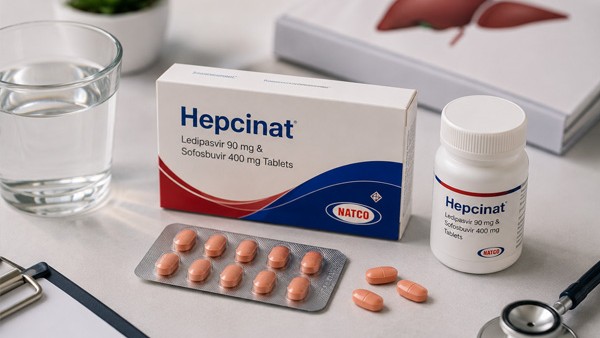
🧪 Sofosbuvir blocks the NS5B polymerase, the enzyme the virus uses to copy itself. It is always given with a second direct-acting antiviral, never alone, usually one 400 mg tablet once a day with or without food for 12 weeks (8 weeks in some groups). Generic versions include Hepcinat (Sofosbuvir) and Hepcvir (Sofosbuvir); the partner drug is prescribed separately or as a combined tablet.
📋 The partner, the length of the course and the need for ribavirin depend on cirrhosis, previous treatment and, in some regimens, the genotype. The choice belongs to the treating doctor, who also checks interactions with every other medicine the patient takes.
🧪 When ribavirin is added
📉 Ribavirin was a backbone of the old interferon era and still has a small role. It is added mainly for decompensated cirrhosis and for some people who have failed earlier treatment, dosed by body weight and taken with food twice daily. Brands include Rebetol (Ribavirin), Copegus (Ribavirin) and Ribasure (Ribavirin).
| ⚠️ Issue | 📝 What to know |
|---|---|
| Anaemia | Ribavirin breaks down red blood cells; haemoglobin is checked often and the dose reduced if it falls |
| Pregnancy | Causes birth defects; women and male partners use reliable contraception during treatment and for 6 months after |
| Kidney disease | Dose adjustment or avoidance |
| Heart disease | Anaemia can strain the heart; used with caution |
| Common effects | Tiredness, cough, rash, itching, insomnia |
🗓️ What the treatment months look like
RNA, fibrosis, hepatitis B, HIV, interactions
One tablet a day; mild headache or tiredness possible
Keep every dose; most feel normal
RNA test: not detected = cured (SVR12)
📱 Practical habits help: a fixed time each day, a phone reminder and a pill box. If a dose is missed, most regimens allow it to be taken later the same day; the exact rule is in the patient leaflet of each product.
🔁 After cure: the antibody stays, the virus is gone
🎉 Cure is defined as RNA not detected 12 weeks after the last tablet, called sustained virological response or SVR12. Relapse after SVR12 is very rare, so it is treated as a cure. The antibody, however, usually stays positive for life. That confuses people when they donate blood, start a new job in health care or see a new doctor, so it helps to keep a copy of the SVR12 result.
📖 Two common liver problems keep going after hepatitis C is gone: fatty liver disease and alcohol-related liver disease. A normal ALT after cure does not prove the liver is healthy if one of them is present.
👶 Babies, pregnancy and the antibody test
🤰 Hepatitis C passes from mother to baby in roughly 5 in 100 births where the mother has active virus, and more often when she also has HIV. Antibodies from the mother cross the placenta and can stay in the baby for up to 18 months, so an antibody test in early infancy says nothing about the baby itself. Exposed babies are checked with an RNA test from about 2 months of age, or with an antibody test after 18 months.
🔍 Who should be tested at least once
📋 Because most infected people have no symptoms, many countries now advise a one-time hepatitis C test for all adults, plus repeated testing for people with ongoing risk. A reactive result in someone with no obvious risk is not unusual, since many infections came from medical procedures or transfusions before routine blood screening.
🏠 Living with a positive result while waiting
🤝 Hepatitis C spreads mainly through blood. It is not passed on by hugging, kissing, sharing cups or cutlery, coughing or sneezing, and household contacts do not need to be tested unless blood has been shared. Sexual spread between long-term heterosexual partners is uncommon, while it is more frequent in men who have sex with men, particularly with HIV.
💉 Vaccination against hepatitis A and B is advised for people with hepatitis C who are not already immune, because a second liver virus on top of the first can cause serious illness. Blood donation is not allowed after a positive antibody in most countries, even after cure.
🗿 Myths about a positive hepatitis C test
💬 Questions to ask at the follow-up visit
- 📌 Was an RNA test or core antigen test done on my sample, and what was the result?
- 📌 If RNA was not detected, do I need a repeat test because of a recent risk?
- 📌 What do my FIB-4 score and elastography reading show about scarring?
- 📌 What are my hepatitis B and HIV results, and do they change the plan?
- 📌 Which regimen and how many weeks? Does any of my current medicine interact with it?
- 📌 When is my SVR12 test, and what follow-up will I need after cure?
🚨 When to see a doctor quickly
⛔ Get medical help soon if you have a positive hepatitis C test and:
🔹 Yellow eyes or skin, dark urine or pale stools.
🔹 A swelling belly, swollen legs, vomiting blood or black stools.
🔹 New confusion, unusual sleepiness or easy bruising and bleeding.
🔹 You are pregnant, or you have HIV or hepatitis B as well.
🔹 You had a needlestick or other blood exposure in the last days: early RNA testing and follow-up are needed.
💡 No warning signs? Still book the follow-up. Chronic hepatitis C is usually silent until the liver is badly scarred, and the earlier it is treated, the simpler the treatment and the follow-up.
❓ Frequently asked questions
Does a positive hepatitis C antibody test mean I have hepatitis C?
Not necessarily. It shows contact with the virus at some time. Only a detected HCV RNA or core antigen confirms a current infection.
What does antibody positive and RNA negative mean?
Usually a past infection that cleared on its own or was cured, and sometimes a false positive antibody. No treatment is needed, but RNA is repeated if exposure was recent.
How long after exposure will a hepatitis C test be positive?
RNA is usually detectable within 1 to 2 weeks. Antibodies appear after about 8 to 12 weeks and sometimes take up to 6 months.
Can a hepatitis C antibody test be a false positive?
Yes, especially in people with no risk history and a weak signal. A negative RNA and a negative second antibody assay support a false result.
Will my antibody test become negative after cure?
Usually not. The antibody stays positive for years or for life. Cure is proven by RNA not detected 12 weeks after the last tablet.
Does a high hepatitis C viral load mean more liver damage?
No. The viral load does not reflect liver damage or speed of progression. Fibrosis is measured with FIB-4, APRI or elastography.
Do I still need a genotype test?
Often not, if a pangenotypic regimen is used and there is no cirrhosis or earlier treatment. It is still useful in cirrhosis, retreatment and with some drug pairs.
Why am I tested for hepatitis B before hepatitis C treatment?
Because a hidden hepatitis B infection can flare when hepatitis C is cleared quickly. People who carry hepatitis B usually take treatment for it alongside.
Can sofosbuvir be taken alone?
No. Sofosbuvir is always combined with a second direct-acting antiviral such as velpatasvir, daclatasvir or ledipasvir, and sometimes with ribavirin.
How is a baby of a mother with hepatitis C tested?
With an HCV RNA test from about 2 months of age, or an antibody test after 18 months, because the antibody of the mother can stay in the baby until then.
📑 Sources and editorial
- 📘 International and national clinical guidelines on testing, management and treatment of hepatitis C
- 🧪 Public health recommendations on hepatitis C screening, reflex RNA testing and interpretation of results
- 📏 Reviews of non-invasive fibrosis assessment: FIB-4, APRI and transient elastography
- 💊 Prescribing information for sofosbuvir, sofosbuvir-based combinations and ribavirin
- 🧫 Guidance on hepatitis B reactivation during direct-acting antiviral therapy and on HIV coinfection
- 👶 Recommendations on testing infants born to mothers with hepatitis C
- 📖 Related reading: hepatitis C cure with sofosbuvir, hepatitis C life expectancy by fibrosis stage, chronic hepatitis B blood tests, starting HIV treatment, fatty liver disease
- 🛒 Related products: Hepcinat (Sofosbuvir), Hepcvir (Sofosbuvir), Ribasure (Ribavirin), Rebetol (Ribavirin), Copegus (Ribavirin), Epivir (Lamivudine), Viropil (Dolutegravir, Lamivudine, Tenofovir), Xapavir (Dolutegravir)
- 🩺 RXshop Editorial Team — reviewed by Emily Chen, MD — Internal medicine
Medical Disclaimer: The information in this article is for educational and informational purposes only and is not a substitute for professional medical advice, diagnosis, or treatment. Always seek guidance from a qualified healthcare provider with any questions you may have regarding a medical condition, and before starting, stopping or changing any medication.