Multiple Chemical Sensitivity: Real Symptoms, a Misunderstood Cause

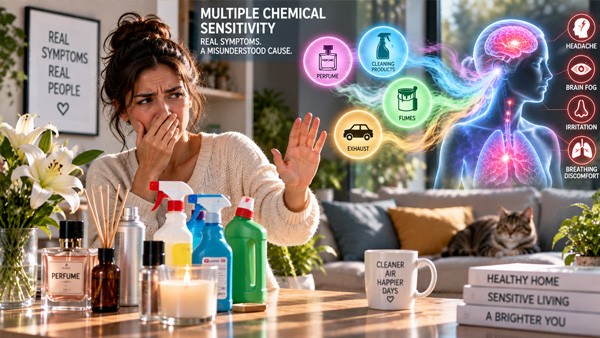

Someone walks past wearing strong perfume, and within minutes you have a pounding headache, a tight chest, nausea and a fog that lasts the rest of the day. The same happens with cleaning sprays, fresh paint, petrol, new carpets, scented candles. Other people in the room notice nothing.
That experience has a name — multiple chemical sensitivity — and it sits at the centre of one of the most polarised arguments in medicine. One side insists it is chemical poisoning at doses the establishment refuses to take seriously. The other side has too often dismissed the people who have it as imagining things.
Both positions are wrong. The symptoms are real, measurable and often disabling. But the research over three decades points consistently away from poisoning and towards something else — a mechanism that is better understood, more treatable, and far less frightening than the idea that ordinary air is toxic.
📋 What people experience
The pattern is recognisable. Symptoms appear on exposure to everyday odours and chemicals at levels well below those that affect most people, involve several body systems at once, and improve when the trigger is removed.
| System | Common symptoms |
|---|---|
| Brain | Headache, difficulty concentrating, memory lapses, dizziness, fatigue |
| Airways | Chest tightness, shortness of breath, cough, burning throat, blocked or running nose |
| Eyes | Burning, watering, stinging |
| Gut | Nausea, abdominal discomfort |
| Body | Muscle aches, tingling, palpitations, flushing |
| Mood | Irritability, anxiety, low mood |
Common triggers include fragrance, cleaning and laundry products, solvents, fresh paint, vehicle exhaust, tobacco smoke, new furniture and carpets, printer ink and pesticides. Over time the list often grows, and new triggers are added that have nothing chemically in common with the original ones.
Mild sensitivity to odours is common — surveys find a substantial minority of adults report some. A smaller group are affected severely enough that work, shopping, travel and friendships become difficult, and a few end up living in near-total isolation.
🚫 What it is not
Two explanations are widely believed and do not hold up well.
It is not an allergy. Allergic reactions involve a specific antibody, produce predictable responses to a specific substance, and show up on allergy testing. People with this condition typically have normal allergy tests, react to chemically unrelated substances, and do not respond to antihistamines. Calling it a chemical allergy leads people towards treatments that do not help.
It is not poisoning at low doses. Toxic effects follow dose: more of the substance produces more harm, and the harm is specific to the chemical. The reactions here happen at concentrations far below known toxic levels, occur with substances that share no mechanism of toxicity, and do not produce the organ damage that poisoning does.
💡 Genuine chemical injury exists. A significant spill, a poorly ventilated workplace using solvents, or a carbon monoxide leak can cause real harm, and occupational exposures deserve proper investigation. The point is not that chemicals are harmless — it is that the pattern described in this article does not behave the way chemical toxicity behaves.
🔬 What the research actually shows
The most informative studies are blinded provocation trials. People with the condition are exposed, in a controlled room, sometimes to their trigger chemical and sometimes to clean air or a neutral substance, without knowing which. The same finding has been repeated many times: symptoms appear when people believe they have been exposed, whether or not the chemical is actually present, and do not reliably appear when they are exposed without knowing.
That finding is often reported as proof the condition is imaginary. It proves nothing of the kind. It shows that the trigger for the reaction is the brain perceiving a threat, and that the body then responds with real physical changes — in breathing, heart rate, muscle tension, gut function and pain processing.
Several mechanisms help explain how that happens:
- 🔔 Conditioning — many cases begin after a genuine unpleasant exposure: a renovation, a chemical incident, a new job with solvents. The brain learns to associate the smell with danger, and afterwards the smell alone triggers the full response, as a single episode of food poisoning can make a food nauseating for years
- 📡 Central sensitisation — the nervous system turns up the volume on incoming signals. The same process is thought to underlie fibromyalgia, irritable bowel syndrome and chronic fatigue, which frequently occur alongside it
- 🌬️ Over-breathing — fear triggers rapid shallow breathing, which alone produces dizziness, tingling, chest tightness, palpitations and brain fog
- 👁️ Attention — once the body is scanned for danger, normal sensations are noticed and interpreted as reactions, which increases fear and the cycle continues
🧠 Real and psychological are not opposites. A panic attack produces genuine chest pain and breathlessness. Stage fright produces genuine nausea. When the brain decides something is dangerous, the body follows with real, measurable effects. Understanding that the alarm system is misfiring does not make the symptoms less real — it makes them treatable, because an alarm that has been trained can be retrained.
🩺 Treatable conditions that can look like this
Before settling on the diagnosis, it is essential to look for conditions in which chemicals and odours do provoke a physical reaction through a known pathway — because these respond well to specific treatment.
| Condition | Clues | Treatment |
|---|---|---|
| Asthma | Wheeze, cough and chest tightness with fumes, smoke, cold air or exercise. Often worse at night | Breathing tests confirm it. Preventer inhalers greatly reduce reactions to irritants |
| Non-allergic rhinitis | Blocked or running nose triggered by perfume, smoke, cleaning products or temperature changes, with negative allergy tests | Steroid and antihistamine nasal sprays |
| Allergic rhinitis | Sneezing, itchy eyes, blocked nose; often seasonal or with dust, pets or mould | Non-sedating antihistamines and steroid nasal sprays |
| Migraine | Strong smells are a well-recognised migraine trigger. Headache with nausea and sensitivity to light | Acute and preventive migraine treatment |
| Contact dermatitis | Rash where a product touches the skin, particularly fragrance and preservatives | Patch testing identifies the substance |
| Panic disorder | Sudden surges of fear with racing heart, breathlessness and dizziness, also in situations without smells | Psychological therapy and medication are highly effective |
| Carbon monoxide | Headache, nausea, dizziness and fatigue at home that improve outside or on holiday. Others in the household or pets affected | An emergency. Leave, ventilate, and have appliances checked |
🔴 Check for carbon monoxide first. Symptoms that appear at home and fade elsewhere, especially in winter or when a boiler, gas fire or stove is running, can be carbon monoxide poisoning — which is invisible, odourless, and kills. Fit a carbon monoxide alarm. If several people or pets in the same home feel unwell together, leave the building and seek help.
If asthma or rhinitis is part of the picture, treating it properly often reduces reactions substantially. Nasal options include Flomist (fluticasone nasal spray) and Astelin (azelastine nasal spray), which has evidence specifically in non-allergic rhinitis triggered by irritants. Non-sedating tablets such as Allegra (fexofenadine) help where there is true allergy. Preventer inhalers are in the asthma category.
🔄 Why avoidance makes it worse
Avoiding triggers feels like the obvious response, and in the short term it works. Over months it usually does the opposite.
Each avoided exposure confirms to the brain that the substance was dangerous. The alarm becomes more sensitive, and the list of triggers extends to new products, new places, and eventually anything that smells. People stop going to shops, then to work, then to see friends whose homes contain the wrong detergent. The world shrinks until a person is confined to one room that feels safe, and the isolation brings depression, financial hardship and loss of identity.
This is the same cycle seen in panic disorder with avoidance and in some chronic pain, and it is the reason the most effective treatments work with the alarm rather than around it. Sudden forced exposure does not help either — it confirms the danger. What works is gradual and controlled.
✅ What actually helps
- A clinician who takes the symptoms seriously. Being dismissed makes people search harder for proof of poisoning and drives them towards expensive and sometimes harmful practitioners
- Proper assessment for asthma, rhinitis, migraine and carbon monoxide, and treatment of whatever is found
- Cognitive behavioural therapy focused on the threat response, with the strongest evidence of any approach
- Graded, planned re-exposure — starting with mild triggers in manageable doses and building up, allowing the alarm to relearn
- Breathing retraining, which directly reduces dizziness, tingling and chest tightness caused by over-breathing
- Treating coexisting anxiety or depression, which are common, understandable, and amplify symptoms. Options are covered in the antidepressants category
- Staying connected with work and people, with reasonable adjustments rather than withdrawal
Reasonable environmental measures — good ventilation, fragrance-free workplaces, avoiding heavy solvent use indoors — are sensible for everyone and are not the same as progressive avoidance.
⚠️ Tests and treatments to avoid
| Offered as | What the evidence says |
|---|---|
| Hair mineral analysis, provoked urine metal tests | Unreliable and produce abnormal-looking results in healthy people. They create false evidence of poisoning |
| Chelation therapy | Designed for genuine heavy metal poisoning. Used without it, it has caused kidney damage and deaths |
| Detox programmes, saunas and supplements | No controlled evidence of benefit, often very expensive |
| Neutralisation drops and provocation-neutralisation testing | Blinded studies show no difference from placebo |
| Moving house repeatedly or building a sealed environment | Extreme avoidance, which predicts worsening rather than recovery |
📈 Outlook
The course varies. Many people with mild or moderate symptoms improve substantially, especially when the condition is recognised early and managed without escalating avoidance. Those who have been severely affected for years improve more slowly but can still regain function. The most consistent predictors of a better outcome are staying active and connected, and a treatment relationship built on taking the symptoms seriously while working with the mechanism rather than against it.
If fibromyalgia or widespread pain is part of the picture, the same principles apply and are set out in the article on fibromyalgia.
🚑 When to seek help
- Several people or pets in the same home unwell together, or symptoms that improve away from home — leave and check for carbon monoxide
- Wheeze or severe breathlessness, particularly with lip or face swelling — emergency
- Symptoms after a significant chemical exposure at work or at home — medical assessment and occupational health
- Nasal, chest or skin symptoms with specific triggers — assessment for asthma, rhinitis or contact dermatitis
- Life shrinking around avoidance — stopping work, shopping or social contact
- Low mood, hopelessness or thoughts of self-harm — promptly, the same day if thoughts are active
❓ Frequently asked questions
Is multiple chemical sensitivity real?
The symptoms are real, measurable and can be disabling. What the research does not support is the idea that they are caused by poisoning at low doses. Blinded studies show reactions follow the perception of exposure rather than the chemical itself, pointing to an over-sensitive threat response in the nervous system, which produces genuine physical effects and can be treated.
Is it an allergy to chemicals?
No. Allergies involve a specific antibody, react to a specific substance and show up on allergy tests. People with this condition usually have normal allergy tests, react to chemically unrelated substances and do not improve with antihistamines. True allergic or irritant rhinitis can coexist, and treating it helps.
What causes it?
The best-supported explanation is a learned threat response. Many cases begin after a genuine unpleasant exposure, after which the smell alone triggers the full reaction. Central sensitisation, over-breathing and heightened attention to body sensations add to it. It often coexists with fibromyalgia, irritable bowel syndrome and chronic fatigue.
Could my symptoms be something else?
Yes, and that should be checked first. Asthma, non-allergic and allergic rhinitis, migraine, contact dermatitis and panic disorder can all be triggered by odours and fumes, and all respond to specific treatment. Symptoms at home that improve elsewhere can be carbon monoxide poisoning, which is an emergency.
Why do I react to more and more things?
Because avoidance teaches the brain that each substance is dangerous, and the alarm becomes more sensitive and generalises to new triggers with nothing chemically in common. This spreading pattern is itself one of the strongest signs that the threat response, rather than chemical toxicity, is driving the reactions.
What treatment works best?
Cognitive behavioural therapy focused on the threat response, combined with gradual planned re-exposure, breathing retraining and treatment of any coexisting asthma, rhinitis, anxiety or depression. Staying active and connected is one of the strongest predictors of improvement.
Do nasal sprays or antihistamines help?
They help where there is rhinitis — a blocked or running nose with irritants or allergens — which is common alongside chemical sensitivity. Azelastine nasal spray has evidence in non-allergic rhinitis triggered by irritants. They do not treat the wider pattern of headache, fatigue and brain fog.
Are detox treatments or chelation worth trying?
No. Hair analysis and provoked urine metal tests produce abnormal-looking results in healthy people. Chelation is meant for genuine heavy metal poisoning and has caused kidney damage and deaths when used without it. Detox programmes, saunas and neutralisation drops have no controlled evidence of benefit.
Should I avoid all fragrances and chemicals?
Sensible measures such as good ventilation and fragrance-free workplaces are reasonable for everyone. Progressive avoidance, where life shrinks around triggers, predicts worsening rather than recovery. Planned, gradual re-exposure with support is more effective than either strict avoidance or sudden forced exposure.
Can people recover?
Yes. Many people with mild or moderate symptoms improve substantially, particularly with early recognition and without escalating avoidance. Those severely affected for years improve more slowly but can still regain function. A treatment relationship that takes the symptoms seriously is one of the most important factors.
📑 Sources and editorial
- Reviews of idiopathic environmental intolerance and multiple chemical sensitivity, including case definitions
- Systematic reviews of double-blind provocation studies
- Research on conditioning, central sensitisation and odour-related threat processing
- Studies of hyperventilation and symptom generation
- Guidance on non-allergic rhinitis, including azelastine and intranasal steroids
- Evidence on cognitive behavioural therapy in functional somatic syndromes
- Safety data on chelation therapy and reviews of unvalidated laboratory tests
- Public health guidance on carbon monoxide poisoning
- Related reading: fibromyalgia
- Related products: allergy category, asthma category
- RXshop Editorial Team — reviewed by Emily Chen, MD, Internal Medicine
Medical Disclaimer: The information in this article is for educational and informational purposes only and is not a substitute for professional medical advice, diagnosis, or treatment. Always seek guidance from a qualified healthcare provider with any questions you may have regarding a medical condition, and before starting, stopping or changing any medication.