Buy Lodonak BP (Naltrexone 8mg + Bupropion 90mg) Online - Modern FDA-Approved Combination Weight Loss Contrave Generic Alternative


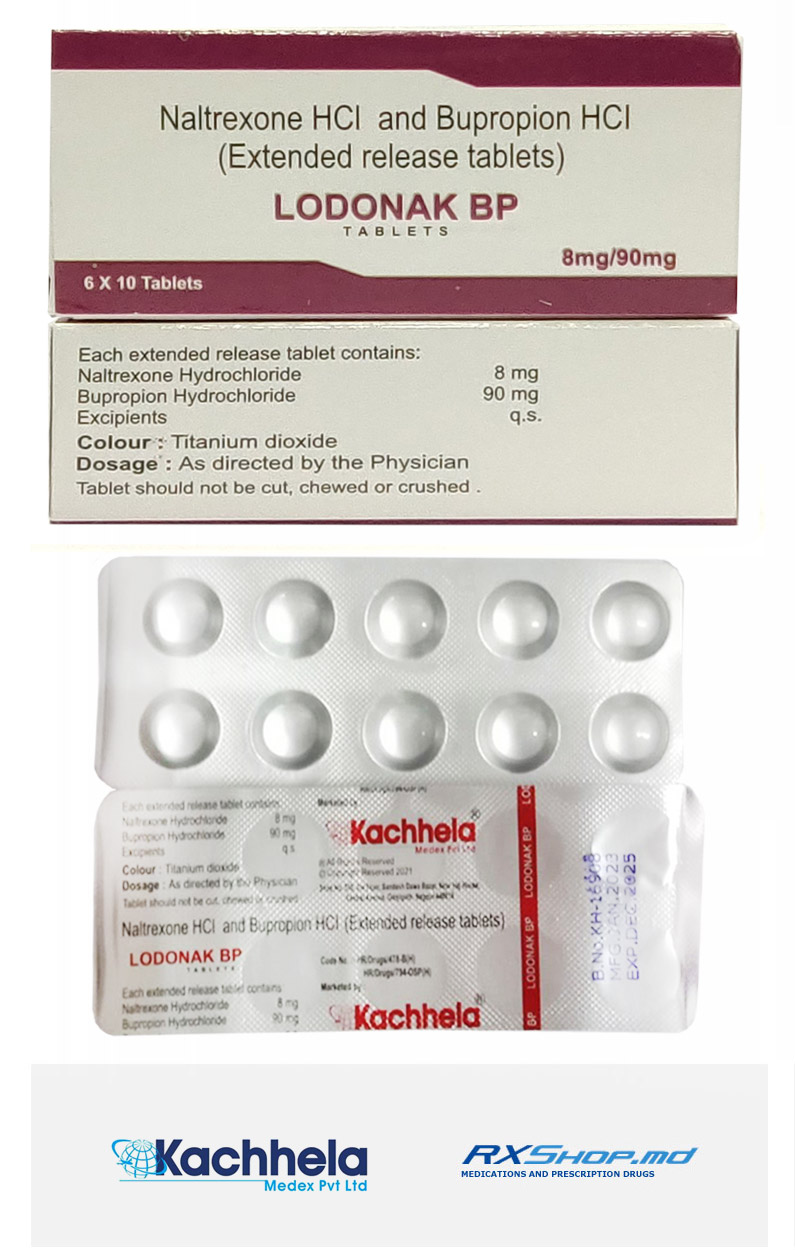
Lodonak BP (Naltrexone 8mg + Bupropion 90mg) represents the modern FDA-approved combination weight loss therapy providing effective obesity management through dual pharmacological targeting of appetite and food reward pathways. Originally developed as Contrave by Nalpropion/Currax Pharmaceuticals and FDA-approved in 2014 (also as Mysimba in Europe 2015), this combination establishes a modern first-line approach to weight loss pharmacotherapy with established safety and efficacy profiles - representing a substantially safer alternative to the withdrawn Acomplia (rimonabant). Manufactured by Kachhela Pharmaceuticals India under WHO-GMP quality standards, Lodonak BP provides bioequivalent generic naltrexone-bupropion combination at accessible cost. Available as sibling weight loss product to Acomplia on rxshop.md, Lodonak BP offers modern regulatory-approved combination therapy as preferred alternative for weight management.
Naltrexone-bupropion combination works through dual mechanism targeting hypothalamic POMC (proopiomelanocortin) neurons. First, bupropion (NDRI) increases norepinephrine and dopamine reuptake inhibition stimulating POMC neurons which normally suppress appetite. Second, naltrexone (mu-opioid antagonist) blocks opioid-mediated auto-inhibitory feedback preventing POMC neurons from being self-suppressed by their own beta-endorphin release. Third, the combination provides synergistic appetite reduction substantially greater than either component alone. Fourth, both components affect the reward pathway reducing food cravings and emotional eating. Fifth, bupropion adds mood support beneficial for weight loss adherence.
Lodonak BP serves adult obesity management (BMI over 30) and overweight (BMI over 27) with cardiovascular risk factors including dyslipidemia hypertension or type 2 diabetes. Adjunct to reduced-calorie diet and increased physical activity. IMPORTANT: Contains same bupropion active ingredient as Zyban — do NOT combine with Zyban, Wellbutrin, or other bupropion products (double-dose seizure risk).
Lodonak BP requires gradual titration over 4 weeks from 1 tablet daily to maintenance 2 tablets BID (32 mg naltrexone + 360 mg bupropion daily). BLACK BOX WARNING for suicidality. Contraindicated with opioids (precipitates withdrawal). Seizure risk. Not for uncontrolled hypertension or eating disorders.


Free prescription
Discrete packaging
Have questions?
Quality Assurance

- Overweight with Comorbid Conditions: BMI over 27 with cardiovascular risk factors including dyslipidemia hypertension type 2 diabetes;
- Weight Management: Long-term comprehensive weight management for obese patients requiring pharmacological support with diet and exercise;
- Craving Control: Effective reduction of food cravings and emotional eating through combined opioid antagonist and NDRI mechanism;
- Type 2 Diabetes with Obesity: Weight reduction in diabetic patients improving glycemic control and cardiovascular risk factors;
- Dyslipidemia with Obesity: Weight loss adjunct in patients with lipid abnormalities providing cardiovascular benefit;
- Metabolic Syndrome: Multiple cardiovascular risk factor improvement through comprehensive weight management approach;
- Failed Lifestyle Intervention Patients: Patients who have exhausted diet and exercise interventions without adequate weight reduction outcomes;
- POMC Neuron Modulation Therapy: Direct hypothalamic modulation of proopiomelanocortin neurons controlling appetite and energy balance;
- Food Reward Pathway Modulation: Dual-mechanism targeting of dopaminergic reward pathway reducing emotional and hedonic eating;
- Dual Mechanism Weight Loss Therapy: Combination approach targeting both hypothalamic appetite center and reward pathway simultaneously;
- Emotional Eating Treatment: Effective for patients whose eating patterns include emotional or reward-driven components;
- Depression Prone Obesity Patients: Bupropion antidepressant component beneficial for obese patients with concurrent low mood or depression risk;
- Sweet Craving Control: Effective reduction of cravings for sweet foods and high-calorie snacks;
- Portion Control Support: Reduced appetite enables easier portion control and adherence to reduced-calorie diet;
- Long Term Weight Maintenance: Sustained therapy supports long-term weight maintenance beyond initial weight loss period;
- Modern FDA Approved Weight Loss Therapy: 2014 FDA-approved combination providing established safety and efficacy versus withdrawn rimonabant alternatives;
- Alternative to Acomplia Withdrawn: Safer modern regulatory-approved alternative to withdrawn rimonabant for weight loss pharmacotherapy;
- Cardiovascular Risk Reduction: Weight loss provides cardiovascular disease morbidity and mortality reduction over subsequent years;
- Generic Contrave Therapy: Bioequivalent Kachhela Pharmaceuticals generic alternative to brand Contrave/Mysimba at accessible cost.
- Effective Weight Loss: Approximately 5-9 percent weight loss over 1 year in clinical trials substantially better than placebo through synergistic combination action;
- Reduces Food Cravings: Effective reduction of food cravings and emotional eating through opioid antagonism and dopamine reward pathway modulation;
- Improves Mood and Motivation: Bupropion antidepressant component provides mood support and motivation beneficial for weight loss adherence and lifestyle changes;
- Better Long Term Weight Management: Sustained therapy supports maintenance of initial weight loss preventing typical weight regain seen with lifestyle intervention alone;
- Helps Manage Comorbid Conditions: Weight loss improves associated conditions including hypertension dyslipidemia diabetes and cardiovascular risk;
- Enhances Overall Wellbeing: Combined effects on weight mood and metabolic parameters dramatically improve quality of life for obese patients;
- Better POMC Neuron Activation: Bupropion stimulates POMC neurons while naltrexone prevents auto-inhibition enabling sustained appetite suppression;
- Better Modern FDA Approved Status: FDA-approved 2014 with established safety and efficacy versus withdrawn Acomplia alternative;
- Better Reward Pathway Effect: Dual targeting of dopaminergic reward pathway reduces emotional eating and food-related pleasure signaling;
- Better Sweet Craving Reduction: Documented substantial reduction in cravings for sweet foods and high-calorie snacks improving dietary compliance;
- Better Portion Control Support: Reduced appetite enables easier portion control and adherence to reduced-calorie diet plans;
- Better Cardiovascular Risk Improvement: Weight loss provides substantial cardiovascular disease risk reduction over subsequent years of maintenance;
- Better for Depression Prone Patients: Bupropion antidepressant properties beneficial for obese patients with concurrent mood disturbances;
- Better Diabetes Weight Loss Component: Weight reduction in diabetic patients improves HbA1c and reduces insulin needs providing dual metabolic benefit;
- Better Metabolic Syndrome Response: Multiple cardiovascular risk factors improve through comprehensive weight management approach;
- Better Gradual Titration Approach: 4-week titration protocol allows body to adjust minimizing side effects during initiation;
- Better Extended Release Formulation: Extended-release tablets provide steady drug levels throughout day for consistent appetite suppression;
- Better Kachhela Manufacturing Quality: WHO-GMP manufacturing standards ensure consistent bioequivalent generic quality for reliable therapeutic outcomes;
- Better Quality of Life: Successful weight loss dramatically improves quality of life through cardiovascular health mood mobility and psychosocial wellbeing.
Generic Lodonak BP (Naltrexone and bupropion 8 mg / 90 mg) Medication guide:
🧭 Meet Lodonak BP - Naltrexone and Bupropion for Weight Loss
👋 Lodonak BP is an extended-release tablet that combines two medicines in one: naltrexone 8 mg and bupropion 90 mg. The same two ingredients, at the same strengths, make up the US brand Contrave (approved by the US Food and Drug Administration in 2014) and the European brand Mysimba. 🧠 Naltrexone blocks opioid receptors, and bupropion is the active ingredient also used in antidepressants and in stop-smoking tablets such as Zyban. Together they act on appetite and on the brain reward circuit that makes food hard to resist.
💡 The medicine is meant for adults with obesity, or overweight plus at least one related condition such as high blood pressure or abnormal blood fats. It is used together with a reduced-calorie diet and more physical activity, never in place of them. In the trials, an average person lost about 2 to 4 percentage points more body weight than on placebo over a year. That is a real but modest gain, and it comes with a long list of rules.
⚠️ Three facts to read before anything else.
🔹 Boxed warning the label carries the strongest FDA warning about suicidal thoughts and behaviour, because bupropion is related to antidepressants.
🔹 Strict exclusions seizure disorder, eating disorders, uncontrolled high blood pressure, regular opioid use and any other bupropion product rule it out.
🔹 Early monitoring blood pressure, pulse and mood need checking from the start, especially in the first three months.
📌 About this tablet and the label this guide follows.
🔹 Reference label the strengths, dose ladder and warnings here come from the US Contrave prescribing information, because Lodonak BP lists the same ingredients and the same 8 mg / 90 mg tablet.
🔹 Your pack governs the leaflet and maker details printed on your own pack decide product specifics. The shop page lists an Indian manufacturer.
🔹 Not a licence the 2014 FDA approval belongs to the Contrave brand, not to every tablet with the same ingredients.
Related reading on the site: weight loss: when strategy meets science and metabolic syndrome and the five numbers that define it.
🔬 How the Two Medicines Work Together on Appetite
🧬 Eating is controlled by two systems that talk to each other. The hypothalamus, a small area at the base of the brain, acts as the appetite centre. The mesolimbic reward circuit decides how pleasant food feels and how strongly you crave it. The two ingredients of Lodonak BP are each aimed at one of these.
| 💊 Ingredient | 🧠 What it is | 🎯 Role in weight control |
|---|---|---|
| Bupropion 90 mg | A dopamine and noradrenaline re-uptake inhibitor, a medicine class that also treats depression | Laboratory studies suggest it acts on both the appetite centre and the reward circuit |
| Naltrexone 8 mg | An opioid receptor blocker, used in higher doses to treat alcohol and opioid dependence | Believed to act on the same two areas; the label says the exact effect is not fully understood |
| The pair | Taken twice a day as an extended-release tablet | In laboratory work the combination increased firing of POMC nerve cells (appetite-regulating cells in the hypothalamus) and cut food intake |
📖 The label is frank that the exact chemistry behind the weight loss is not fully understood. What is documented is the result in people: less hunger, fewer cravings, and a modest drop in weight on top of diet.
✅ What people tend to notice
🍽️ Smaller appetite and fewer snacking urges
🎯 Less food reward from sweet and fatty food
⚡ A little more energy for some, from the stimulant-like bupropion effect
⚠️ What the same chemistry can cause
🤢 Nausea and constipation, the leading complaints
😴 Insomnia, jitteriness, tremor and anxiety
❤️ A small rise in blood pressure and pulse
🎯 Who Lodonak BP Is For and Who It Must Skip
📋 The approved use is narrow: adults with obesity (BMI of 30 or more) or overweight (BMI of 27 or more) plus at least one weight-related condition, together with diet and exercise. BMI, or body mass index, is your weight in kilograms divided by your height in metres squared.
| 📏 Group | 💬 What the label says | 💡 In plain words |
|---|---|---|
| Obesity | BMI of 30 or more | For example 95 kg at 1.78 m |
| Overweight with a condition | BMI of 27 or more plus high blood pressure, abnormal blood fats, type 2 diabetes or similar | Weight alone is not enough |
| Heart outcomes | The effect on heart attacks, strokes and death is not established | It is a weight tool, not a proven heart protector |
| Other products | Not to be combined with other naltrexone or bupropion products | See sections 17 and 18 |
🚦 The next block follows the questions a doctor would ask, in order. Any red box is a stop.
💡 Why the entry bar is high.
🔹 Modest gain the average difference from placebo was a few percent of body weight.
🔹 Real cost about 1 in 4 people on the drug (24 percent) stopped because of side effects, twice the placebo rate (12 percent).
📅 The 4-Week Dose Ladder - Tablet by Tablet
📈 You do not start on the full dose. The label raises the dose one tablet at a time over three weeks, so the body, and especially the seizure threshold and the stomach, can adjust. The full daily dose of 32 mg naltrexone and 360 mg bupropion is reached at the start of week 4.
| ✅ Rule | 📌 What the label says | 💡 Why |
|---|---|---|
| Swallow whole | Do not cut, chew or crush | Breaking the tablet releases bupropion all at once, which raises seizure risk |
| With meals, not fat-heavy ones | Trials gave it with food; a high-fat meal is to be avoided | A fatty meal sharply raises blood levels of both drugs (section 21) |
| Daily ceiling | Not above 32 mg / 360 mg a day | Seizure risk climbs with the bupropion dose |
| Missed dose | Wait for the next scheduled dose | Never double up; see section 31 |
🛑 Do not rush the ladder.
Starting at full dose, or taking extra tablets to feel stronger effects, is exactly how seizures happen. If the stomach upset of a given week is too much, ask the prescriber before moving up; the label does not support jumping steps.
📊 What the Big Trials Showed About Weight Loss
🏁 Four 56-week trials called COR (Contrave Obesity Research) tested the 32 mg / 360 mg dose in 4,536 adults, all with a lifestyle programme. Every number below is the extra effect on top of a placebo tablet.
💬 The difference from placebo was 4.1 points in COR-I, 3.2 with intensive counselling, and 2.0 in type 2 diabetes, where weight loss is harder. In a 100 kg person, 4 points is about 4 kg beyond what diet and placebo gave.
| 🧪 Trial | 👥 Who | 📈 Published |
|---|---|---|
| COR-I | Adults with obesity or overweight and risk factors; diet and activity programme | Greenway, Lancet 2010;376:595-605 |
| COR-II | Similar adults; 56 weeks | Apovian, Obesity 2013;21:935-943 |
| COR-BMOD | Adults in an intensive behaviour programme with 28 group sessions | Wadden, Obesity 2011;19:110-120 |
| COR-Diabetes | Adults with type 2 diabetes not at goal | Hollander, Diabetes Care 2013;36:4022-4029 |
📌 Two honest limits on these numbers.
🔹 Many dropped out 45 percent on placebo and 46 percent on the tablet left before week 56, most within the first 12 weeks.
🔹 Who was studied 83 percent were women, 77 percent white and the average age 46. Only 2 percent of those treated were 65 or older.
🏅 How Many People Lost 5 and 10 Percent of Body Weight
🎯 Averages hide the spread. The label tracks two thresholds: 5 percent of starting weight, the point where blood pressure and blood fats start to improve, and 10 percent, a clearly visible change.
📐 In COR-I that means 25 more people in every 100 reached the 5 percent mark, and 14 more in 100 reached 10 percent, because of the tablet rather than the lifestyle programme alone.
- ✅ The good news: with the best support (the COR-BMOD behaviour programme), 57 percent lost at least 5 percent.
- 📉 The sobering side: in people with type 2 diabetes only 36 percent reached 5 percent, against 18 percent on placebo.
- 🧭 Support matters as much as the tablet: placebo patients in the intensive programme still lost 4.9 percent of their weight.
- ⏳ A first check comes early: the label asks for a weight review after 12 weeks on the full dose (section 7).
⏱️ The 12-Week Rule - Stop If You Have Lost Under 5 Percent
🚦 The label contains a rule that protects you from taking the tablet for nothing: after 12 weeks on the full dose, if you have not lost at least 5 percent of your starting weight, stop it. The reasoning is that such patients are unlikely to reach or keep a meaningful loss.
| ⚖️ Starting weight | 📏 5 percent is | 🎯 Target at week 16 or lower |
|---|---|---|
| 80 kg | 4 kg | 76 kg |
| 100 kg | 5 kg | 95 kg |
| 120 kg | 6 kg | 114 kg |
- ⚖️ Weigh yourself on day 1 on the same scale and at the same time of day.
- 📝 Record weekly in a notebook or app, not daily, to avoid noise.
- 📅 Set the review date for week 16, with the prescriber if there is one.
- 🛑 Stop if under 5 percent, and talk to the prescriber about other options, for example orlistat (Xenical).
💡 If you have lost 5 percent or more, continuing is a decision, not an obligation. The side effect list does not shrink with success, so review the balance again at 6 and 12 months.
🫀 Blood Pressure, Heart Rate and the Heart
💓 Bupropion is a stimulant-like drug, so it can raise blood pressure and resting heart rate. In the trials the rise was small on average, and strongest in the first three months. Weight loss usually pulls blood pressure down later, so the net effect depends on how much you lose.
| 📊 Measure | 🔢 Result on the tablet versus placebo | 💡 Reading |
|---|---|---|
| Systolic pressure (top number) | +1.8 to +2.4 mmHg higher in the first 12 weeks | Small, but statistically clear |
| Diastolic pressure (bottom number) | +1.7 to +2.1 mmHg higher early on | Fades later as weight falls |
| Resting heart rate | +2.1 beats a minute at weeks 4 and 8; +1.7 at week 52 | A few beats faster |
| Blood pressure or pulse side effects | 6.3 percent versus 4.2 percent | Most of it was raised blood pressure (5.9 versus 4.0 percent) |
| Same in diabetes | 12.0 percent versus 6.5 percent had a blood pressure side effect | More likely in people who already have high blood pressure risk |
🚩 Two groups need extra care: people with controlled high blood pressure and people with heart or brain vessel disease. Those with a heart attack or stroke in the past six months, life-threatening rhythm disorders or heart failure were excluded from the trials, so the safety in them is unknown.
📝 Check before and during treatment.
🔹 Before the first tablet measure blood pressure and pulse, and write them down. See DASH diet to control hypertension.
🔹 Often in the first 12 weeks at least every few weeks, then at regular visits.
🔹 Stop and call if readings keep rising, you have chest pain, a pounding heartbeat or a severe headache.
🫀 Robert Hayes, MD, FACC, on this tablet and the heart
Two or three points of blood pressure sound harmless, and for most people they are. What worries me is the unknown. A large outcome trial for this combination ended early in controversy and left the question of heart safety open, and the label itself says the effect on heart attacks and strokes has not been established. In my clinic that means one rule: if your blood pressure is not controlled, this is not the tablet to start, and if it is controlled, I want a reading at every visit for the first three months.
📢 The Boxed Warning - Suicidal Thoughts and Behaviours
⚠️ The first thing printed on the US label is a boxed warning, the strongest kind, and it concerns suicidal thoughts and behaviours. It exists because one ingredient, bupropion, belongs to the antidepressant family, and antidepressants carry this warning for younger people.
| 👥 Age group | 📊 Extra cases of suicidality per 1,000 treated | 💡 Reading |
|---|---|---|
| Under 18 | 14 more than on placebo | Not approved for this age; the warning is strongest here |
| 18 to 24 | 5 more | Young adults need the closest watch |
| 25 to 64 | 1 fewer | No increase seen in adults of this age |
| 65 and older | 6 fewer | Antidepressants lowered the rate in older adults |
📌 These figures come from pooled studies of antidepressants in depression, 295 adult and 24 child trials covering more than 77,000 adults and 4,400 children. They set the class warning. They are not results of the weight trials.
✅ What the weight-loss trials themselves found.
🔹 No suicides or attempts in placebo-controlled obesity studies up to 56 weeks, at bupropion 360 mg a day.
🔹 Suicidal ideation was rare reported by 1 of 3,239 people on the tablet (0.03 percent) and 3 of 1,515 on placebo (0.20 percent).
🔹 Limits people with a history of recent psychiatric hospitalisation or on antidepressants were excluded, so the trials say little about them.
👪 What the label asks of family and prescribers.
🔹 Daily watching families and carers should watch for anxiety, agitation, irritability, unusual behaviour and any suicidal talk, and report it at once.
🔹 Small supplies prescriptions should be for the smallest quantity consistent with good care, to lower overdose risk.
🔹 Stop if it appears discontinue if suicidality or worsening depression emerges.
🧠 Mood, Anxiety and Sleep in the Weight Trials
📈 In the one-year studies, 22.2 percent of people on the tablet reported a psychiatric or sleep problem, against 15.5 percent on placebo. The excess was mostly sleep trouble, with a smaller rise in anxiety and almost none in depression.
💬 Depression rates were nearly identical, which is reassuring for the trial population. But two details deserve attention. Among the 56 people aged 65 or older, psychiatric and sleep events reached 28.6 percent against 6.3 percent on placebo (insomnia 10.7 against 3.1 percent), and the group is too small to draw firm conclusions.
| 🧩 Source | 📋 What was reported | 💡 Reading |
|---|---|---|
| Trials in obesity | Insomnia 9.2 versus 5.9 percent; anxiety 4.2 versus 2.8 percent; irritability 2.6 versus 1.8 percent | Mild, usually in the first weeks |
| Stop-smoking use of bupropion (after launch) | Mood change, psychosis, hallucinations, paranoia, delusions, aggression, hostility, agitation, panic, suicidal thoughts and attempts | Reported in people with and without earlier psychiatric illness |
| Antidepressant class effect | May trigger mania, hypomania or mixed episodes | Screen for bipolar disorder before starting |
🧠 Thomas Walsh, MD, on mood and weight tablets
Before I accept any tablet that touches dopamine and noradrenaline in someone who wants to lose weight, I ask three questions: have you ever had a low period, has anyone in your family had bipolar disorder or a suicide, and have you ever gone days with little sleep and a lot of energy. A yes to any of them does not forbid treatment, but it changes who watches you and how often. And a plain rule for everyone: a new sharp edge in your temper or your thoughts in the first weeks is a signal to call, not a phase to push through.
🚩 Warning Signs to Act On the Same Day
⚡ Early problems on this medicine rarely look like a crisis. They look like a bad week, a short temper or a sleepless night. The three bands below turn those blurry signs into actions.
🛑 Red - stop the tablets and get help the same day
Thoughts of death or self-harm. Feeling hopeless, worthless or a burden. Panic you cannot control. Hearing or seeing things that are not there, or firm beliefs that people mean you harm. A seizure. Unusual high energy, racing thoughts and almost no need for sleep for several days. Contact your local emergency number or a crisis line, and do not stay alone.
🟡 Amber - call the prescriber within a day or two
Low mood or loss of interest lasting more than a few days. New anxiety, agitation, restlessness or irritability. Insomnia that is getting worse. Hostile feelings or impulsive behaviour that is out of character. Blood pressure readings that keep rising. Say it plainly: I started naltrexone and bupropion and something has changed.
🟢 Green - note it and keep watching
Mild nausea or constipation, a dry mouth, a little trouble falling asleep, slight dizziness or a headache in the first weeks. Keep a diary and mention it at the next visit.
🧭 The label specifically lists anxiety, agitation, panic attacks, insomnia, irritability, hostility, aggressiveness, impulsivity, restlessness and unusual changes in behaviour as signs that may come before worse depression or suicidal thoughts. The point is to act on the small signs, not wait for the large one.
| 👥 Who to tell | 💬 What to say |
|---|---|
| One person at home | The tablet name, the date you started, and the red-band signs; ask them to speak up |
| The prescriber or pharmacist | What changed, when it began, and what you have already tried |
| Any new doctor | That you take naltrexone with bupropion: it blocks opioid painkillers and interacts with several medicines |
🆘 If you are thinking about ending your life.
Treat it as an emergency whatever the cause. Stop the tablets, contact local emergency services or a crisis line, and stay with another person. See also major depressive disorder snapshot and generalized anxiety: when the mind never switches off.
📝 A Three-Month Check Routine for Body and Mood
📋 The first three months carry most of the risk for blood pressure changes and the mood and sleep effects. A simple weekly routine makes problems visible in time and gives your prescriber real data.
- 📅 Pick one evening a week and set a phone reminder.
- 🩺 Measure blood pressure and pulse, seated and rested, and write both numbers.
- ⚖️ Weigh yourself and note your waist once a month.
- 😴 Score sleep and mood from 1 to 10 for the week, and note anything out of character.
- 👪 Ask one person at home how you seem, and write down what they say.
| 📒 What to log | ⏰ How often | 🚦 Act when |
|---|---|---|
| Blood pressure and pulse | Weekly for 12 weeks, then at visits | Readings rising on two checks, or a pulse that stays fast |
| Weight and waist | Weekly weight, monthly waist | Under 5 percent loss by week 16: stop (section 7) |
| Sleep hours and mood score | Weekly | A fall of 3 points or more, or any red-band sign |
| Bowel habit and nausea | Daily note in week 1 to 4 | Vomiting or constipation lasting several days |
| Alcohol, caffeine, other medicines | Weekly | Any new medicine; see sections 17 to 20 |
💡 Your prescriber may ask for different intervals, and those override this table. The aim is that nobody is guessing: not you, not your doctor, not your family.
🤢 Nausea, Constipation and Vomiting - the Stomach Effects
📈 The stomach is where most people feel the tablet first. Nausea hit one person in three, constipation one in five and vomiting one in ten. Nausea was also the leading reason for stopping: 6.3 percent left the trials because of it. Dry mouth (8.1 versus 2.3 percent), diarrhoea (7.1 versus 5.2) and upper abdominal pain (3.5 versus 1.3) came next.
- 🍽️ Take the tablets with a meal, but not a high-fat one, which pushes levels up and tends to worsen nausea.
- 💧 Drink water through the day and add fibre gradually for constipation.
- ⏸️ Ask before moving up a step if nausea in one week is still heavy; the label does not set a hold rule, so this is a clinical decision.
- 🚨 Call the same day for repeated vomiting, black or bloody stool, or signs of dehydration.
🤕 Headache, Dizziness, Tremor and Insomnia
🧠 The second group of common effects affects the nervous system. Headache (17.6 versus 10.4 percent), dizziness (9.9 versus 3.4 percent) and insomnia (9.2 versus 5.9 percent) topped the list, along with tremor (4.0 versus 0.7 percent) and ringing in the ears (3.3 versus 0.6 percent).
💡 What is common
🤕 Headache in about 1 in 6
🌀 Dizziness in about 1 in 10, almost all of the dizziness and fainting reports
💤 Insomnia in about 1 in 11
📌 What is less common
👋 Tremor in 4 in 100, often fine and rapid
🔊 Tinnitus (ringing) in 3 in 100
🧩 Attention problems in 2.5 percent against 0.6 percent
📖 Taken together, attention, dizziness and fainting problems occurred in 15.0 percent of people on the tablet and 5.5 percent on placebo. Dizziness was the main reason for stopping in 0.9 percent of people on the drug.
| 🧠 Effect | 💬 In plain words | 📞 When to call |
|---|---|---|
| Dizziness, presyncope (near fainting) | Lightheaded on standing; seeing stars | If you black out, or it comes with chest pain or palpitations |
| Tremor | Shaky hands, worse under stress | If it hampers writing, eating or driving |
| Attention and memory complaints | Hard to concentrate, forgetful | If new, severe or noticed by others |
| Insomnia | Trouble falling or staying asleep | Section 11 amber band if worsening |
🧹 Everyday steps that help.
🔹 Stand up slowly pause for a few seconds on sitting up and again on standing.
🔹 Keep the evening dose earlier ask the prescriber if night-time sleep is poor; taking the second dose with the evening meal rather than late may help.
🔹 Cut caffeine late in the day it stacks with the stimulant-like effect. See trazodone for sleep and what else works for insomnia.
⚡ Seizures - Why the Rule Is Strict
📄 Bupropion can cause seizures, and the risk grows with the dose. In the weight trials the rate was about 0.1 percent on the tablet and 0 on placebo. That sounds tiny, which is why the dose limits and the exclusion list are so firm: they are what keeps it tiny.
| 🛑 Rule | 📋 What the label says | 💡 Why it matters |
|---|---|---|
| Contraindicated | Seizure disorder or past seizure; anorexia nervosa or bulimia; sudden stop of alcohol, benzodiazepines, barbiturates or antiepileptic drugs | These raise seizure risk on their own |
| Use with great care | Head injury, stroke, brain tumour or infection, low blood sugar or sodium, heavy alcohol use, stimulants, diabetes drugs that can cause low sugar | Each lowers the threshold |
| Medicines that add risk | Other bupropion products, antipsychotics, tricyclic antidepressants, theophylline, steroid tablets | Cumulative threshold lowering |
| If a seizure occurs | Stop and do not restart | The label is final on this |
🧠 James Carter, MD, on seizure thresholds
A seizure threshold behaves like a bucket that fills from several taps: sleep loss, alcohol, withdrawal from sedatives, low blood sugar, certain medicines, and the bupropion dose. One tap alone rarely overflows the bucket. People get into trouble when several run together, such as a heavy drinking weekend, a skipped meal, a late night and a missed evening tablet doubled up the next morning. If you have ever had even one unexplained blackout or convulsion, tell the prescriber before the first tablet, not afterwards.
👁️ Eyes, Allergy and Skin Reactions
🩺 Three less common but important areas remain: the eyes, severe allergy and the skin. Each is tied to bupropion and each has a clear action.
| 📍 Area | 📋 What the label says | 📞 What to do |
|---|---|---|
| Eyes | The pupil widening from antidepressants such as bupropion can trigger an angle-closure glaucoma attack in people with anatomically narrow angles | Severe eye pain, a red eye, blurred vision or halos around lights is an emergency |
| Anaphylaxis and angioedema | Itching, hives, swelling and difficulty breathing have been reported with bupropion | Stop, and call emergency services if breathing or swallowing is affected |
| Serious skin reactions | Erythema multiforme, Stevens-Johnson syndrome and anaphylactic shock reported rarely | Stop at the first widespread rash with blisters or mouth sores |
| Delayed hypersensitivity | Joint and muscle pain and fever with rash, resembling serum sickness | Stop and see a doctor within a day |
| Everyday skin effects | Rash 2.4 versus 2.0 percent; sweating 2.6 versus 0.6 percent; hair loss in under 2 percent | Mention at the next visit |
💡 People who have been told they have narrow drainage angles in the eye should mention it before the first dose. An eye specialist can say whether a preventive procedure is needed first.
🛑 Stop and get urgent help for any of these.
🔹 Swelling of the lips, tongue or face or trouble breathing.
🔹 A rapidly spreading rash especially with blisters, peeling skin or sores in the mouth.
🔹 A painful red eye with blurred vision or halos around lights.
🛑 Opioids and Naltrexone - the Strict Rule
🚧 Naltrexone is an opioid blocker. It sits on the same receptors as morphine, codeine, tramadol, methadone and buprenorphine and keeps them from working. That has two consequences that matter in daily life, and both are written into the label as hard rules.
| 💊 Situation | 📌 What the label says | 💡 Why |
|---|---|---|
| Regular opioid use | Contraindicated: chronic opioids, methadone, buprenorphine, or acute opiate withdrawal | The blocker makes opioids ineffective and can trigger severe withdrawal |
| Opioid-free interval before starting | 7 to 10 days after short-acting opioids (including tramadol); up to 2 weeks after buprenorphine or methadone | Avoids sudden withdrawal that can need hospital care |
| Occasional opioids | Stop the tablet for the course and do not raise the opioid dose | You may not get the full effect, and may be more sensitive afterwards |
| Cough, cold and anti-diarrhoea remedies | Opioid-containing ones may not work properly | Read the ingredient list, and ask the pharmacist |
🩺 Planned surgery, dental work and injury all need an opioid plan. Tell every doctor you take naltrexone, and stop the tablets in advance if the surgeon expects strong painkillers. Stopping only wears off over days, so the timing needs agreement with the anaesthetist.
⚠️ Never try to overcome the blockade.
Taking large amounts of opioids to push through the naltrexone block is especially dangerous and can cause fatal overdose, with breathing stopping. After you stop the tablets you may also be more sensitive to opioids than before, even at lower doses. If you have ever used opioids heavily, say so openly: the risk is real and the help is confidential.
💊 MAOIs, Other Bupropion Products and Antidepressants
🔗 Bupropion is the ingredient that makes most of the other medicine rules. It interacts with antidepressants, with other bupropion products and with drugs that raise noradrenaline and dopamine. The table sorts these into never, careful and fine.
⛔ Never together
💊 Another bupropion product: Zyban, Wellbutrin and similar
🧪 MAO inhibitors for depression, plus linezolid and intravenous methylene blue
⚠️ Caution
🧠 SSRIs, tricyclics, antipsychotics (levels rise; seizure risk)
💨 Levodopa and amantadine (restlessness, tremor, unsteadiness)
✅ Not a problem
💉 Atorvastatin, lisinopril, nifedipine, valsartan, glyburide showed no effect in tests
💡 Metformin exposure rose 23 percent, no adjustment needed
| 📌 Combination | 📋 What the label says | 💡 Practical rule |
|---|---|---|
| MAO inhibitor antidepressants | Contraindicated; at least 14 days between stopping an MAOI and starting this tablet, and 14 days after stopping this tablet before an MAOI | Risk of dangerous blood pressure spikes |
| Linezolid, intravenous methylene blue | Starting this tablet in someone already treated with them is contraindicated | Same pressure risk |
| Other naltrexone products | Co-administration not recommended: Nodict, Revia, Lodonak (naltrexone alone) | You would double the opioid blocker |
| Antidepressants of other classes | Bupropion raises levels of SSRIs and tricyclics; lowest dose range advised; consider reducing the original drug | Prescriber decision only |
🚫 Do not stop an antidepressant on your own to make room for a weight tablet. Depression is the more serious problem, and sudden stops cause their own symptoms (see antidepressant side effects and what to expect in the first weeks).
🚨 Lodonak BP Side Effects - the Full List by Frequency
📋 The lists below follow the US label, built from five placebo-controlled trials in 4,754 people (3,239 on the tablet, 1,515 on placebo). Most people were on 32 mg / 360 mg a day. Overall 24 percent of those on the tablet stopped because of an adverse event, against 12 percent on placebo; nausea (6.3 percent), headache (1.7 percent) and vomiting (1.1 percent) led the reasons.
🔴 Most common (5 percent or more)
Nausea 32.5 percent, constipation 19.2, headache 17.6, vomiting 10.7, dizziness 9.9, insomnia 9.2, dry mouth 8.1, diarrhoea 7.1.
🟡 Common (2 to 5 percent)
Anxiety, hot flushes, tiredness, tremor, upper abdominal pain, tinnitus, high blood pressure, sweating, irritability, taste change, rash, palpitations, flu and gastroenteritis, urinary infection, muscle strain.
🔵 Less common (under 2 percent, but at least twice placebo)
Fast heartbeat, vertigo, cholecystitis, raised liver enzymes, dehydration, memory loss, jittery feeling, dissociation (feeling spacey), agitation, mood swings, hair loss, irregular periods, erectile problems.
| 🧩 Body system | 📋 Examples | 🚦 Action |
|---|---|---|
| Stomach and gut | Nausea, constipation, vomiting, diarrhoea, dry mouth, abdominal pain | Section 13 |
| Brain and nerves | Headache, dizziness, tremor, attention problems, insomnia, seizure (about 0.1 percent) | Sections 14 and 15 |
| Mood and mind | Anxiety, irritability, agitation, mood swings, depression, suicidal thoughts (boxed warning) | Sections 9 to 12 |
| Heart and circulation | Higher blood pressure, faster pulse, palpitations, hot flushes | Section 8 |
| Skin and allergy | Rash, sweating, hair loss, hives, angioedema, severe skin reactions | Section 16 |
| Liver and kidney | Raised liver enzymes (naltrexone hepatitis reported), creatinine changes | Section 23 |
📘 How to read the percentages.
🔹 Different from placebo the table of the label lists only effects more common than on placebo.
🔹 Women and white adults dominated 82 percent women, 78 percent white, so rates in men and other groups are less certain.
🔹 Report every new symptom it is how rare effects are found.
🧪 CYP2D6, CYP2B6 and Other Enzyme Interactions
🔬 Bupropion and its breakdown products block an enzyme called CYP2D6, which the liver uses to clear many heart, mood and psychiatric medicines. When it is blocked, those medicines stay longer and hit harder. A second enzyme, CYP2B6, does the opposite job for bupropion itself: medicines that block or boost it change how much bupropion you get.
| 💊 Group | 📝 Examples | 💡 What to do |
|---|---|---|
| Medicines cleared by CYP2D6 | Metoprolol and other beta-blockers (Inderal belongs to this family), SSRIs and tricyclics, haloperidol, risperidone, thioridazine, propafenone, flecainide | Start the other drug at the low end; the doctor may lower the dose |
| Digoxin | Lanoxin | Digoxin levels may fall; monitor |
| CYP2B6 blockers | Ticlopidine, clopidogrel | Bupropion rises; cap at 2 tablets a day |
| CYP2B6 boosters | Ritonavir, lopinavir, efavirenz, carbamazepine, phenobarbital, phenytoin | Bupropion falls and the tablet may fail; avoid combining |
| Urine drug screen | Bupropion can cause a false positive for amphetamines | Tell the lab; a confirmation test sorts it out |
💊 Sarah Mitchell, PharmD, on the quiet interactions
The danger is almost never the combination printed on the box. It is the beta-blocker added by a cardiologist, the antibiotic course at the dentist, the new antidepressant from a second doctor. The metoprolol example is the one I remember: four times the exposure from a blocked enzyme. If a new medicine appears while you hold this tablet, show the list, ask whether the dose should start lower, and expect the doctor to re-check your pulse and blood pressure.
⏳ How Long the Tablets Last and What a Fatty Meal Does
⏱️ Both ingredients work in short windows, but their breakdown products linger. Naltrexone has a half-life of about 5 hours, though its main breakdown product (6-beta-naltrexol) lasts longer and builds up about 3-fold. Bupropion has a half-life of about 21 hours, and its active metabolites take about one week to reach steady levels.
📐 The key timing numbers.
🔹 Peak after a dose naltrexone about 2 hours, bupropion about 3 hours.
🔹 Protein binding naltrexone 21 percent, bupropion 84 percent.
🔹 Route out mainly the kidney (naltrexone 53 to 79 percent of the dose, bupropion 87 percent), so kidney disease raises exposure.
💡 This is why the label says to avoid taking the tablets with a high-fat meal. At steady state the effect is smaller (naltrexone total +70 percent, bupropion +10 percent) but still real, and the label links a fat-heavy meal to a higher seizure risk. A sensible rule: plain, moderate meals with the tablets, and no burger-and-chips dose.
🍽️ The Extended-Release Tablet - Why You Never Crush It
🧱 Each tablet has a three-layer core: two drug layers separated by a faster-dissolving inert layer. That design releases the medicine slowly through the day and keeps peak blood levels low. Break the tablet and the design is gone.
| ❌ Do not | ✅ Do instead | 💡 Reason |
|---|---|---|
| Cut, chew or crush the tablet | Swallow whole with water | Crushing releases bupropion all at once, which can cause seizures |
| Snort, inhale or inject | Oral use only | Seizures and deaths have been reported with bupropion this way |
| Take two tablets at once more than the plan allows | Never more than 2 at one time, 4 in a day | Larger single doses raise seizure risk |
| Take with a high-fat meal | Take with a plain meal | Peak levels rise (section 21) |
- 💧 Swallow with a full glass of water so the tablet moves down without sticking.
- 📦 Keep it in the original pack, with the leaflet, so the maker and batch stay traceable.
- 🛑 A pill that cracks or crumbles in the pack should not be taken; ask the pharmacist.
- 🚨 If a child swallows tablets, call the poison centre at once (the US line in the label is 1-800-222-1222; use your local number).
⚠️ Overdose is not a minor matter.
Cases of up to 30 grams of bupropion are on record, equal to more than 80 times the daily dose. A third had seizures; others had hallucinations, fast or abnormal heart rhythms, fever, coma and breathing failure. Deaths have occurred. There is no antidote, and supportive hospital care is the treatment. This is why labels advise the smallest practical supply.
💛 Liver and Kidney Problems and Lodonak BP
🫀 Both ingredients and their products are cleared by the liver and the kidneys, so organ disease changes the levels in the blood. The label sets ceilings that are lower than the normal four tablets.
💛 Liver
✅ Mild: naltrexone exposure about 2.8 times higher; no dose limit given
⚠️ Moderate: naltrexone 6.1 times and bupropion 2.0 times higher; maximum 2 tablets a day
❌ Severe: naltrexone 34 times and bupropion 3.6 times higher; not recommended
💧 Kidney
✅ Mild: no dose limit; breakdown products rise a little
⚠️ Moderate or severe: breakdown products rise about 1.7 to 2.2 times; maximum 2 tablets a day
❌ End-stage disease: not recommended
| 🧪 Check | 📋 Why it matters |
|---|---|
| Liver blood tests (ALT, AST) | Naltrexone has been linked to hepatitis and liver dysfunction, usually when other liver risks were present (alcohol, hepatitis B or C, other liver-toxic drugs) |
| Kidney function (creatinine, eGFR) | eGFR, the estimated glomerular filtration rate, shows how well your kidneys filter; reduced filtration raises exposure |
| Yellow eyes or skin, dark urine, pale stools, right-sided belly pain | Possible acute hepatitis: stop and see a doctor |
📌 What the trials found.
In the weight trials no one had liver enzymes above three times normal together with raised bilirubin, the pattern that signals serious liver injury. The label still asks you to stop at any sign of acute hepatitis. Older adults more often have reduced kidney function, which adds to the case for a cautious dose.
🍬 Diabetes and Low Blood Sugar While Taking Lodonak BP
🩸 People with type 2 diabetes were studied separately in the COR-Diabetes trial. The tablet lowered blood sugar as weight fell, but the weight result was smaller than in people without diabetes, and some side effects were more common.
| 🧪 Measure (56 weeks) | 💊 Tablet | 📊 Placebo |
|---|---|---|
| Weight | -3.7 percent | -1.7 percent |
| HbA1c (average sugar over three months) | -0.6 points from 8.0 percent | -0.1 points from 8.0 percent |
| Fasting glucose | -11.9 mg/dL | -4.0 mg/dL |
| Waist | -5.0 cm | -2.9 cm |
| Blood-pressure-related side effects | 12.0 percent | 6.5 percent |
| Left the study | 47.8 percent | 41.2 percent |
⚠️ Why low sugar matters here twice.
🔹 Weight loss lowers the dose you need insulin and drugs such as sulfonylureas can cause a low sugar once weight and appetite fall.
🔹 Low sugar lowers the seizure threshold the label lists hypoglycaemia as a risk factor for seizures with bupropion.
🔹 Metformin is fine its exposure rose 23 percent in tests, with no adjustment needed. See Glucophage and type 2 diabetes: when metabolic control starts to collapse.
🍷 Alcohol and Lodonak BP - Minimise or Avoid
🍺 The label tells you to minimise or avoid alcohol during treatment. After launch of bupropion there were rare reports of unusual neuropsychiatric events and of lower alcohol tolerance in people who drank. In plain terms, the same amount of drink may hit harder than before.
| 🍸 Question | 📌 Answer | 💡 Why |
|---|---|---|
| Can I drink normally? | The label says to minimise or avoid | Reduced tolerance and rare neuropsychiatric events were reported |
| What if I drink heavily? | Do not stop suddenly on your own; ask a doctor | Abrupt withdrawal from alcohol is a seizure risk and a contraindication |
| Does alcohol affect mood on the tablet? | Very likely | Alcohol lowers mood and fragments sleep, the same targets the tablet can disturb |
| Does it affect weight loss? | Quietly, yes | Drinks carry calories (about 7 per gram of alcohol) and loosen food control |
- 📉 Keep alcohol low or skip it through the first three months, when the risk of side effects is highest.
- 📝 Log alcohol in your weekly check, so a bad mood is not blamed on the tablet or on the drink without checking.
- 🛑 If you drink to cope with low mood, that is a signal to talk to a doctor, not to adjust either medicine.
- 🧪 Naltrexone alone is also a treatment for alcohol dependence, in much higher doses than in this tablet. See Nodict for that use.
⛔ Sudden alcohol withdrawal is a hard stop.
Anyone who drinks heavily every day and is about to stop suddenly, perhaps to start the diet, is at risk of withdrawal seizures. Combined with bupropion the risk rises. Seek medical advice first. See also what is alcoholic depression and how is it treated.
🌱 Pregnancy, Planning a Baby and Lodonak BP
🤰 The label gives a clear rule: weight loss offers no benefit during pregnancy and may harm the baby, so the tablets should be stopped as soon as pregnancy is recognised. This is a precaution about weight loss itself, because dieting in pregnancy deprives the baby of energy and nutrients.
| 📊 Evidence | 📋 What is known | 💡 Reading |
|---|---|---|
| Women in the weight trials | 21 of 3,024 (0.7 percent) became pregnant: 11 healthy births, 3 elective abortions, 4 spontaneous abortions, 3 outcomes unknown | Too few to settle the question |
| Bupropion in early pregnancy | Registries of 675 and 1,213 first-trimester exposures showed no overall increase in birth defects | Some studies hinted at heart-valve and septal defects; results were inconsistent |
| Naltrexone | Limited case reports show no overall defect increase; animal studies at high doses showed early fetal loss | Data are thin |
| Combination | Never tested in pregnancy animal studies as a pair | Rely on the stop rule |
- 📆 Planning a baby? Talk to your doctor before you conceive and plan to stop the tablets first.
- 🛡️ Use reliable contraception while taking the tablets if pregnancy is possible.
- 🧪 If you find you are pregnant, stop the tablets and tell your doctor. Do not restart.
- 🍽️ Aim for the weight gain recommended for your starting weight, not weight loss.
💡 What helps before conception.
🔹 Gradual change a lower weight before pregnancy, reached by food and movement, is often safer than a drug.
🔹 Folic acid and a check-up standard advice for anyone planning pregnancy; ask your doctor.
🥛 Breastfeeding and Lodonak BP - What the Label Says
🍼 Both ingredients pass into breast milk. In a small study of ten women, the baby would receive about 2 percent of the mother weight-adjusted bupropion dose through milk. After launch, seizures were reported in breastfed babies of mothers taking bupropion, though whether the drug caused them is unclear. No data exist on the effect on milk supply.
| 📋 Point | 💬 What the label says | 🧭 Practical meaning |
|---|---|---|
| Bupropion in milk | Present, with metabolites | The baby is exposed |
| Naltrexone in milk | Present, with its main breakdown product | The baby is exposed |
| Seizures in breastfed babies | Reported after launch; link unclear | A reason for extra caution |
| Weigh the benefit | Breastfeeding benefits against the mother need and possible harm to the baby | A weight tablet is rarely an urgent need |
- 💬 Talk to the baby paediatrician before starting, and tell them if you took the tablets recently.
- 🍽️ Postnatal weight loss is best planned with food, movement and sleep, without a weight medicine.
- 🛑 Watch the baby for unusual jerking, poor feeding or excessive sleepiness, and call at once.
⚠️ The label does not forbid it, but it does not recommend it either.
The decision is individual, and in most cases it is simpler and safer to wait until you stop breastfeeding. This is a different position from rimonabant (Acomplia), where lactation is a contraindication. See Acomplia for that comparison.
🕰️ Adults Over 65 and Lodonak BP
👥 The trials contained very few older adults. Of 3,239 people on the tablet, only 62 (2 percent) were aged 65 or older and none were 75 or older. The label therefore cannot say whether older adults respond differently.
| 🧑 Point | 📊 What the label reports | 💡 What it means |
|---|---|---|
| Brain side effects | Older people may be more sensitive to central nervous system effects | Start low and go slow; expect more dizziness and confusion |
| Psychiatric and sleep events | 28.6 percent versus 6.3 percent on placebo (56 and 32 people) | Very small group, yet the gap is wide |
| Insomnia and depression | Insomnia 10.7 versus 3.1 percent; depression 7.1 versus 3.1 percent | Report new sleep or mood changes early |
| Kidney function | Both drugs leave through the kidney, and kidney function declines with age | A cap of 2 tablets may apply |
🧪 Older adults also take more medicines, which multiplies the interactions in sections 17, 18 and 20. 📉 And weight loss is not always the goal after 65: losing muscle and bone can do more harm than losing fat does good.
⚠️ Where extra caution is sensible.
🔹 Falls dizziness and lower blood pressure on standing raise the risk.
🔹 Several medicines ask a pharmacist to review the whole list before starting.
🔹 Frailty nothing in the label supports use in frail older people.
📚 Teenagers and Lodonak BP - Not Approved Under 18
🧒 The label is blunt: the safety and effectiveness of the tablet in people under 18 have not been established, and use is not recommended. The boxed warning is also strongest here, with 14 extra cases of suicidal thoughts or behaviour per 1,000 young people treated with antidepressants in pooled studies.
📋 What the label says about young people.
🔹 Not approved not recommended below 18 years.
🔹 No evidence no trial data on benefit or safety in teenagers.
🔹 Strongest warning the class warning for suicidal thoughts is greatest in this age group.
🔹 What is advised instead a family-based programme with a paediatric or adolescent specialist.
💡 Weight problems in teenagers are tied to family food, sleep, screen time and mood, and mood is exactly where bupropion is risky. Low mood in teenagers also looks different from adults and often shows as irritability or withdrawal (see childhood depression: symptoms, causes and treatment).
- 👪 Treat the whole household, because a teenager rarely changes alone: shared meals, activity and sleep.
- 🚫 Do not share adult tablets. A parent tablet is never a dose for a child.
- 💬 Watch for restriction or binge eating, and read keys to understanding eating disorders if worried; an eating disorder is also a contraindication.
🚗 Driving, Work, Smoking and Drug Tests on Lodonak BP
🛣️ The label lists dizziness, fainting and attention problems as common (15 percent in total, against 5.5 percent on placebo), plus tremor and insomnia. Each can affect how you drive or work, and any may appear without warning.
| 🏢 Situation | 💡 Point to consider |
|---|---|
| Shift work and night driving | Insomnia is common; a poor night plus a long drive is the risk to avoid |
| Heights, ladders, machinery | Dizziness and tremor are listed effects; avoid risky tasks until you know your reaction |
| Workplace urine drug test | Bupropion can give a false-positive result for amphetamines, even after you stop; tell the examiner and ask for a confirmation test |
| Smoking | Smokers and non-smokers had similar levels, so smoking does not change the dose. Do not add Zyban for quitting: it is also bupropion |
| Caffeine | Adds to jitteriness and poor sleep; cut it after midday |
🚭 Many people who want to lose weight also want to stop smoking, and the same ingredient treats both. The point to keep in mind is that one bupropion product is enough. Adding a second raises seizure risk and is a contraindication. If you wish to quit smoking, tell the prescriber, who can tell you which product fits and with what limits.
⏰ Missed Doses, Stopping and What Happens Afterwards
📅 The label has one rule for a missed dose: wait until the next scheduled dose and take your usual amount. Never take two doses together to catch up, since that is the pattern that raises seizure risk.
| 🚦 Situation | 💡 What to do |
|---|---|
| Missed the morning dose | Skip it; take the evening dose as usual |
| Missed the evening dose | Skip it; take the next morning dose as usual |
| Missed several days | Restarting has no label guidance. The ladder exists for safety, so ask the prescriber whether to start over at 1 tablet |
| Stopping for side effects | Stop and tell the prescriber. Keep mood and blood pressure checks going for several weeks |
| Stopping because 12 weeks brought under 5 percent | Stop, and plan other options |
✅ The label says no withdrawal syndrome was seen.
🔹 No abstinence syndrome after 56 weeks, neither abrupt nor tapered stops caused one.
🔹 No signs of dependence trials of up to 56 weeks found no abuse, diversion or physical dependence.
🔹 Naltrexone does not cause dependence it is a pure blocker with no opioid action.
🚨 After stopping, three cautions remain. First, you may be more sensitive to opioid painkillers than before. Second, an MAO-inhibitor antidepressant must wait at least 14 days after your last tablet. Third, the appetite effect fades as levels fall, and weight can drift back up unless the diet and activity habits remain. The label does not report regain figures, but the logic is the same as for any weight medicine.
- 📈 Weigh weekly after stopping, not daily, and act on a steady rise.
- 💬 Tell any new doctor the date of your last tablet.
- 🍽️ Keep the routine that did the work next to the tablet. See losing weight in obesity safely and effectively and physical activity and obesity.
📦 Packs, Storage and Checking What You Hold
🏷️ The shop lists Lodonak BP as a tablet with naltrexone 8 mg and bupropion 90 mg in packs of 100 and 200. The US reference product, Contrave, is a round, blue, biconvex film-coated tablet marked NB-890, sold in bottles of 120 and stored at 25 degrees C with brief excursions to 15 to 30 degrees C. It contains lactose and cysteine hydrochloride among other ingredients.
| 🔍 Check | ✅ What to look for | 🛑 If it is wrong |
|---|---|---|
| Strength on the pack | 8 mg naltrexone / 90 mg bupropion per tablet, extended release | A different strength or an immediate-release tablet changes the dosing rules |
| Maker, batch and expiry | Printed on both box and blister, readable | Missing or mismatched: stop and ask a pharmacist |
| Leaflet | Complete, in a language you read, with the boxed warning | Without it you cannot check the warnings in this guide |
| Appearance | Intact, uniform tablets; no crumbling | Cracked or chalky tablets should not be taken |
⚠️ A label of origin matters here.
🔹 Brand versus generic the FDA approval of 2014 belongs to Contrave. A tablet from another maker is judged on its own papers, so check the maker and batch details.
🔹 Prescription-only drug in the US and Europe this combination is dispensed on a doctor prescription, after checks of blood pressure, mood and other medicines.
- 🧴 Keep the tablets in the original pack, out of reach of children, at normal room temperature.
- 📆 Record the start date on the box so the 12-week check is not forgotten.
- ♻️ Return unused or expired tablets to a pharmacy collection point rather than binning them loose.
⛔ Lodonak BP Contraindications - When It Must Not Be Taken
🛑 A contraindication is a situation in which a medicine must not be used. The US label lists eight groups, and every one of them rests on a specific danger.
⛔ Absolute contraindications - never take this tablet if:
🔹 You have uncontrolled high blood pressure it can push pressure and pulse higher.
🔹 You have a seizure disorder or a history of seizures bupropion lowers the seizure threshold.
🔹 You use another bupropion product Zyban, Wellbutrin, Aplenzin or any similar tablet.
🔹 You have bulimia or anorexia nervosa both raise the seizure risk.
🔹 You take opioids regularly or are in acute opioid withdrawal including methadone and buprenorphine.
🔹 You are stopping alcohol, benzodiazepines, barbiturates or antiepileptic drugs suddenly withdrawal seizures.
🔹 You take an MAO inhibitor, or did within 14 days including linezolid or intravenous methylene blue.
🔹 You are allergic to bupropion, naltrexone or any ingredient anaphylaxis and Stevens-Johnson syndrome have been reported with bupropion.
📘 Several further situations are not formal contraindications but call for caution or a lower dose. In practice a careful prescriber treats many of them as a stop sign.
| ⚠️ Situation | 📋 What the label says |
|---|---|
| Bipolar disorder or risk factors | Screen first; antidepressants can trigger mania |
| Depression, past suicidal thoughts | Boxed warning applies; close monitoring |
| Narrow-angle glaucoma risk | Pupil widening may trigger an attack |
| Moderate liver or kidney disease | Maximum 2 tablets a day |
| Severe liver disease, end-stage kidney disease | Not recommended |
| Treated diabetes (insulin, sulfonylureas) | Monitor sugar; doses may need cutting |
| Recent heart attack or stroke, serious rhythm problems, heart failure | Excluded from trials; safety unknown |
| Under 18 | Not recommended |
✅ Not contraindications - these do not rule it out.
🔹 Smoking blood levels are similar in smokers and non-smokers.
🔹 Taking metformin, statins, lisinopril or valsartan tests showed no needed dose change.
🔹 Controlled high blood pressure allowed, with regular checks.
🔹 Mild kidney or liver impairment no ceiling in the label for mild kidney disease; mild liver disease raises exposure but has no limit.
Lodonak BP — Frequently Asked Questions
-
What is Lodonak BP (Naltrexone and Bupropion)?
Lodonak BP is a combination medication containing Naltrexone and Bupropion. It is used to aid in weight loss by reducing appetite and controlling cravings. -
How does Lodonak BP work?
Lodonak BP combines two active ingredients: Naltrexone, which helps reduce cravings, and Bupropion, which decreases appetite and enhances mood. -
Who should take Lodonak BP?
Lodonak BP is typically prescribed for adults who are obese (BMI of 30 or greater) or overweight (BMI of 27 or greater) with weight-related conditions such as diabetes or hypertension. -
How should I take Lodonak BP?
Take Lodonak BP as directed by your healthcare provider. Usually, it starts with one tablet daily, gradually increasing to two tablets daily. -
Can I take Lodonak BP with other medications?
Inform your healthcare provider of all medications you are taking, as Lodonak BP can interact with various drugs, including antidepressants and blood pressure medications. -
What are the common side effects of Lodonak BP?
Common side effects include nausea, vomiting, constipation, headache, dizziness, and insomnia. -
How can I manage nausea caused by Lodonak BP?
Taking Lodonak BP with food may help reduce nausea. Eating smaller, more frequent meals can also be beneficial.
See all Lodonak BP questions (32)
📚 Drug Description Sources:
The information in this Lodonak BP (naltrexone 8 mg and bupropion 90 mg extended-release) guide is compiled from authoritative pharmaceutical, medical, and regulatory sources covering the US prescribing information for the reference combination Contrave, the randomised COR trial programme that defined its benefits and risks, and the clinical guidance used to judge weight loss treatment. Because the shop product is made by a different manufacturer, the leaflet inside the pack governs product specific details such as appearance, storage and batch information.
🏛️ Regulatory and government agencies
- US Food and Drug Administration, Contrave (naltrexone hydrochloride and bupropion hydrochloride) extended-release tablets, prescribing information, initial US approval 2014 - the source of the 4-week dose ladder to 32 mg naltrexone and 360 mg bupropion a day, the 12-week rule to stop if less than 5 percent weight is lost, the contraindications (uncontrolled hypertension, seizure disorder, other bupropion products, bulimia or anorexia, chronic opioid use, abrupt withdrawal of alcohol or sedatives, MAO inhibitors, allergy), and the adverse reaction rates
- FDA boxed warning on suicidal thoughts and behaviors - based on pooled analyses of 295 adult antidepressant trials in more than 77,000 patients and 24 paediatric trials in over 4,400 patients, with drug-placebo differences of +14, +5, -1 and -6 cases per 1,000 across the age bands
- European Medicines Agency product information for Mysimba (naltrexone and bupropion prolonged-release tablets) - the European brand of the same 8 mg and 90 mg combination, used as a cross-check on indication and warnings
- FDA MedWatch and national medicines regulator reporting systems - the routes for reporting suspected adverse reactions or a faulty batch
📚 Professional societies and clinical guidelines
- Garvey WT et al. American Association of Clinical Endocrinologists and American College of Endocrinology comprehensive clinical practice guidelines for medical care of patients with obesity. Endocr Pract 2016;22(suppl 3):1-203 - the place of weight-loss medicines as an addition to lifestyle treatment and the choice of drug by comorbidity and safety
- Jensen MD et al. 2013 AHA/ACC/TOS Guideline for the Management of Overweight and Obesity in Adults. Circulation 2014;129(suppl 2):S102-S138 - lifestyle intervention as the foundation of treatment and the setting in which any medicine is judged
- Apovian CM et al. Pharmacological management of obesity: an Endocrine Society clinical practice guideline. J Clin Endocrinol Metab 2015;100:342-362 - selection of weight medicines in relation to coexisting disease and the expectation of at least 5 percent weight loss at three months
🔬 Landmark clinical research
- COR-I: Greenway FL, Fujioka K, Plodkowski RA et al. Lancet 2010;376:595-605 - 1,742 patients randomised to naltrexone SR plus bupropion SR at two doses or placebo with lifestyle counselling; weight change -5.4 versus -1.3 percent for 32 mg and 360 mg versus placebo (all randomised patients in the label)
- COR-II: Apovian CM, Aronne L, Rubino D et al. Obesity 2013;21:935-943 and COR-BMOD: Wadden TA, Foreyt JP, Foster GD et al. Obesity 2011;19:110-120 - the 56-week studies of the combination, the second adding an intensive behaviour programme of 28 group sessions and reaching -8.1 versus -4.9 percent
- COR-Diabetes: Hollander P, Gupta AK, Plodkowski R et al. Diabetes Care 2013;36:4022-4029 - people with type 2 diabetes; weight -3.7 versus -1.7 percent and HbA1c -0.6 versus -0.1
- Nissen SE, Wolski KE, Prcela L et al. Effect of naltrexone-bupropion on major adverse cardiovascular events in overweight and obese patients with cardiovascular risk factors. JAMA 2016;315:990-1004 - a cardiovascular outcomes trial of 8,910 patients that ended early and left the heart safety of the combination uncertain
📖 Medical references and textbooks
- Jameson JL, Fauci AS, Kasper DL, Hauser SL, Longo DL, Loscalzo J, editors. Harrison Principles of Internal Medicine, 21st edition. McGraw-Hill, 2022 - chapters on the evaluation and management of obesity
- Melmed S, Auchus RJ, Goldfine AB, Koenig RJ, Rosen CJ, editors. Williams Textbook of Endocrinology, 14th edition. Elsevier, 2020 - chapters on the pathophysiology and treatment of obesity
Note: This information is educational and does not replace consultation with qualified healthcare providers. Naltrexone with bupropion is a prescription medicine with a boxed warning. The decision to take it, the dose ladder, and the checks of blood pressure, mood and other medicines must be made by a physician who knows your history, your mental health, your other conditions and your test results.
🩺 Medical Expert Review:
Content based on the published research and clinical practice of obesity, behavioural weight management and clinical trial authorities with particular expertise in naltrexone and bupropion combination therapy. The following experts represent authoritative research perspectives on the benefits and risks of this treatment.
Frank L. Greenway, MD
Pennington Biomedical Research Center, Louisiana State University System — Baton Rouge, USA
First author of COR-I (Lancet 2010), the phase 3 trial of 1,742 patients that tested two doses of naltrexone with bupropion against placebo, and a co-author of the COR-Diabetes study. A long-standing researcher on the drug treatment of obesity.
Caroline M. Apovian, MD
Division of Endocrinology, Diabetes and Hypertension, Brigham and Women Hospital, Harvard Medical School — Boston, USA
First author of COR-II (Obesity 2013) and lead author of the Endocrine Society guideline on the pharmacological management of obesity (2015). Her work shapes how weight medicines are chosen for patients with coexisting disease.
Thomas A. Wadden, PhD
Perelman School of Medicine, University of Pennsylvania — Philadelphia, USA
First author of COR-BMOD (Obesity 2011), which combined the tablet with an intensive behaviour programme of 28 group sessions. A leading authority on behavioural treatment of obesity, and on how drug and lifestyle therapy fit together.
Priscilla Hollander, MD, PhD
Baylor University Medical Center — Dallas, USA
First author of COR-Diabetes (Diabetes Care 2013), which tested the combination in adults with type 2 diabetes and measured weight, HbA1c and waist. A clinician-researcher in diabetes and obesity treatment.
Louis J. Aronne, MD
Comprehensive Weight Control Center, Weill Cornell Medicine — New York, USA
Co-author of COR-II and director of the Comprehensive Weight Control Center. Widely cited for work on the medical treatment of obesity and on how appetite medicines are used in practice.
Disclosure: Expert names and credentials are cited for educational reference. This content is not endorsed by named experts. Content prepared by RXshop editorial team based on published literature and regulatory documents.
More Weight Loss Medications


