Buy Tobaren (Tobramycin) Online - Aminoglycoside Antibiotic Eye Drops for Bacterial Eye Infections

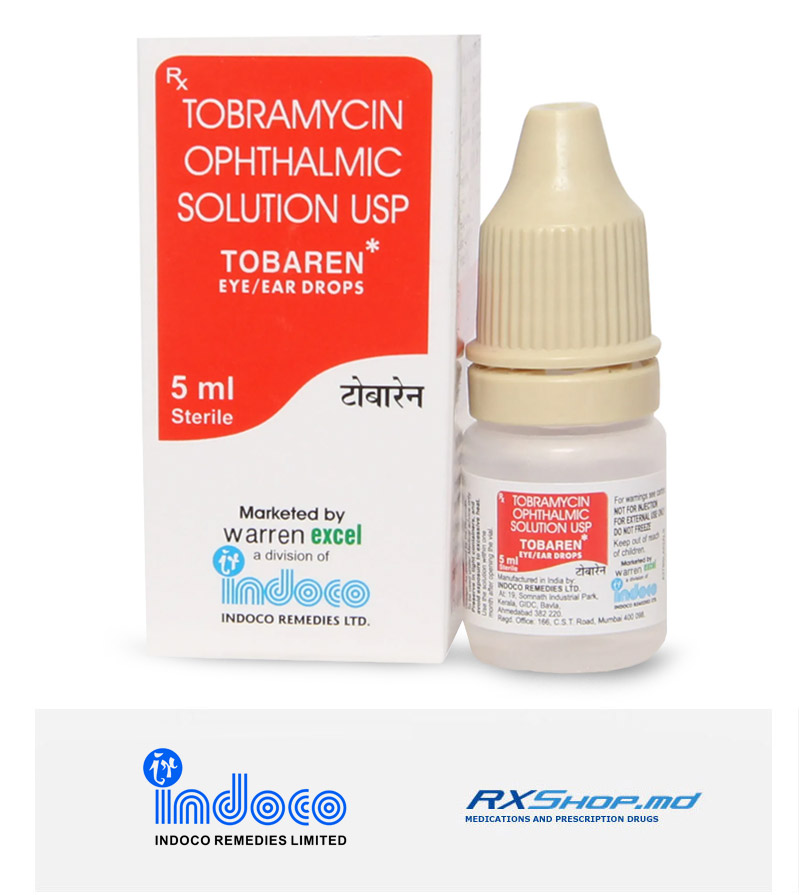
Tobaren (Tobramycin) represents an affordable Indian generic version of brand Tobrex, an established aminoglycoside antibiotic eye drop for treating bacterial eye infections. As a 0.3% ophthalmic solution, Tobaren works locally in the eye to rapidly eliminate susceptible bacteria including challenging Pseudomonas aeruginosa strains that cause serious eye infections. The medication delivers potent bactericidal action with minimal systemic absorption, making it safe for outpatient treatment of bacterial conjunctivitis, blepharitis, and other ocular infections.
Tobramycin works by binding to the 30S ribosomal subunit of bacterial cells, disrupting protein synthesis and causing rapid bacterial cell death. As an aminoglycoside antibiotic, tobramycin demonstrates particularly strong activity against gram-negative organisms including Pseudomonas aeruginosa, E. coli, Klebsiella, Enterobacter, Serratia, and Haemophilus influenzae. The medication also covers many gram-positive bacteria including Staphylococcus aureus and various Streptococcus species commonly found in eye infections. The result: bacterial growth stops within hours of first application, infection symptoms improve dramatically within 24-48 hours, and complete bacterial eradication occurs in 5-7 days of treatment.
Tobaren serves as primary therapy across multiple bacterial eye conditions. For bacterial conjunctivitis (pink eye), the medication rapidly resolves discharge redness and irritation caused by bacterial pathogens. For bacterial blepharitis, Tobaren eliminates infection from eyelid margins. For more serious infections including bacterial keratitis, corneal ulcers, and dacryocystitis, the medication provides potent antibiotic coverage with excellent corneal penetration. Tobaren also serves pre-surgical antibiotic prophylaxis for cataract and refractive surgery patients and post-surgical infection prevention during the critical first weeks of healing.
Tobaren offers convenient dosing from 1-2 drops every 4 hours for mild infections to 1 drop hourly for severe infections during the first 24-48 hours, then tapered as improvement occurs. The medication acts locally with virtually no systemic absorption from eye drops, avoiding the kidney and hearing risks of intravenous tobramycin. Generic tobramycin ophthalmic from quality Indian manufacturers provides identical therapeutic effects to brand Tobrex by Alcon at substantially lower cost across both branded and generic versions of this established aminoglycoside eye drop therapy.
Free prescription
Discrete packaging
Have questions?
Quality Assurance

- Bacterial Eye Infection: Eye infection caused by bacteria requiring antibiotic therapy for complete resolution;
- Conjunctivitis: Inflammation of eye conjunctiva causing redness discharge and irritation commonly known as pink eye;
- Bacterial Conjunctivitis: Pink eye caused by bacterial infection with thick discharge requiring antibiotic eye drops;
- Pink Eye: Common term for conjunctivitis causing eye redness and discharge often contagious in nature;
- Blepharitis: Inflammation of eyelid margins causing redness flaking and crusting requiring antibiotic therapy;
- Bacterial Blepharitis: Eyelid infection from bacteria like Staphylococcus causing chronic eyelid inflammation;
- Keratitis: Inflammation of cornea threatening vision requiring prompt antibiotic treatment to prevent damage;
- Bacterial Keratitis: Severe corneal infection from bacteria requiring intensive antibiotic eye drop therapy;
- Corneal Ulcer: Open sore on corneal surface from bacterial infection requiring potent antibiotic treatment;
- Dacryocystitis: Infection of tear duct system causing swelling and discharge at inner corner of eye;
- Pseudomonas Eye Infection: Serious eye infection from Pseudomonas aeruginosa benefiting from tobramycin coverage;
- Contact Lens Eye Infection: Bacterial infection associated with contact lens use requiring aminoglycoside therapy;
- Pre Eye Surgery Prophylaxis: Antibiotic eye drops before cataract or refractive surgery preventing post-operative infection;
- Post Eye Surgery Prophylaxis: Antibiotic protection during initial healing phase after eye surgery procedures;
- External Stye Treatment: Bacterial infection of eyelid sebaceous gland causing painful red bump responding to antibiotic drops;
- Gram Negative Eye Infection: Eye infections from gram-negative bacteria where tobramycin provides excellent coverage;
- Aminoglycoside Eye Therapy: Aminoglycoside antibiotic drug class for serious bacterial eye infections requiring broad coverage;
- Ophthalmic Antibiotic Therapy: Topical antibiotic eye drop treatment providing local infection control without systemic risks;
- Topical Eye Drops Therapy: Direct eye application providing local concentrated effect with minimal systemic absorption.
- Less Eye Discharge: Thick yellow or green eye discharge from bacterial infection clears within 24-48 hours;
- Less Bacterial Eye Redness: Conjunctival redness from bacterial inflammation fades as infection resolves;
- Less Conjunctivitis Symptoms: Bacterial pink eye symptoms including itching tearing and grittiness resolve quickly;
- Less Pink Eye Symptoms: Pink eye symptoms clear within days of starting antibiotic therapy stopping contagion;
- Faster Infection Resolution: Complete bacterial eradication occurs within 5-7 days of consistent therapy;
- Less Blepharitis Symptoms: Eyelid margin inflammation crusting and flaking improve with topical aminoglycoside use;
- Better Corneal Healing: Bacterial keratitis resolves preserving corneal clarity and preventing vision-threatening scarring;
- Less Corneal Damage: Prompt antibiotic therapy prevents corneal ulceration and permanent visual impairment;
- Better Pseudomonas Coverage: Excellent activity against challenging Pseudomonas aeruginosa eye infections that resist other antibiotics;
- Less Eye Pain: Pain and discomfort from bacterial eye infection resolves as inflammation subsides;
- Less Stye Recurrence: Recurrent bacterial styes decrease through eradication of underlying Staphylococcus colonization;
- Less Post Surgery Eye Infection: Prophylactic use prevents bacterial infection during critical post-surgical healing period;
- Less Eye Surgery Complications: Post-cataract and refractive surgery infection complications decrease with prophylactic use;
- Less Systemic Antibiotic Effects: Topical application avoids systemic side effects including kidney damage from IV aminoglycosides;
- Less Hearing Risk: Topical eye drops avoid the ototoxicity associated with intravenous tobramycin therapy;
- Less Kidney Risk: Topical use avoids the nephrotoxicity associated with systemic aminoglycoside antibiotics;
- Better Outpatient Treatment: Safe outpatient therapy avoids hospital admission for many bacterial eye infections;
- Flexible Dose Frequency: From every 4 hours for mild infections to hourly for severe accommodates infection severity;
- Better Quality of Life: Daily wellbeing improves rapidly as painful uncomfortable eye infection symptoms resolve effectively.
Generic Tobaren (Tobramycin 5 ml 0.3 %) Medication guide:
📖 What Tobaren Is and How Tobramycin Works
Tobaren is tobramycin sulfate 0.3 percent ophthalmic solution, an aminoglycoside antibiotic eye drop. Tobramycin ophthalmic has been in continuous clinical use since 1980. Standard therapy for external bacterial eye infections including bacterial conjunctivitis, blepharitis, and keratitis. Also used for perioperative infection prophylaxis in eye surgery. Broad-spectrum coverage particularly against gram-negative bacteria. Applied topically as eye drops.
Tobaren at a glance
| Active ingredient | Tobramycin sulfate |
| Concentration | 0.3 percent (3 mg/mL) |
| Class | Aminoglycoside antibiotic |
| Route | Topical ophthalmic (eye drops) |
| Standard dose | 1-2 drops 4-6 times daily typical |
| Bottle size | 5 mL typical |
| Preservative | Benzalkonium chloride |
| Original approval | 1980 as Tobrex |
| Manufacturer | Cipla and other generic manufacturers |
How tobramycin works
Blocks bacterial protein synthesis
Tobramycin binds the 30S ribosomal subunit of bacteria. Blocks bacterial protein synthesis. Causes misreading of mRNA and formation of nonfunctional proteins. Bactericidal (kills bacteria) rather than bacteriostatic. Concentration-dependent killing. Broad-spectrum activity particularly against gram-negative bacteria.
Primary indications
Where tobramycin ophthalmic is used
- Bacterial conjunctivitis - most common use; external infection
- Blepharitis - eyelid margin infection
- Bacterial keratitis - corneal infection; often with fortified concentration
- Perioperative prophylaxis - cataract or other eye surgery
- Corneal ulcers (bacterial) - adjunctive
- Dacryocystitis - lacrimal sac infection; adjunctive
Coverage spectrum
Strong gram-negative focus
Tobramycin covers - gram-negative bacteria (Pseudomonas aeruginosa, Escherichia coli, Klebsiella, Proteus, Serratia, Haemophilus, Moraxella), some gram-positive bacteria (Staphylococcus aureus - variable coverage), modest atypical coverage. Not effective against - Streptococci (limited), anaerobes, mycobacteria, fungi, viruses.
Where Tobaren does NOT fit
Not appropriate for
- Viral conjunctivitis - antibiotic ineffective; most conjunctivitis viral
- Allergic conjunctivitis - not infectious
- Fungal keratitis - antibiotic ineffective
- Acanthamoeba keratitis - specific therapy needed
- Aminoglycoside hypersensitivity
- Serious streptococcal infections - inadequate coverage
- Prophylactic use for prevention alone - promotes resistance
Compared to systemic tobramycin
Different indication
Systemic tobramycin (IV/IM) - for serious systemic gram-negative infections; substantial ototoxicity and nephrotoxicity concerns. Ophthalmic tobramycin - minimal systemic absorption; safe for external eye infections. Different concepts entirely.
This guide covers what Tobaren does, its major indications (bacterial conjunctivitis, blepharitis, keratitis, surgery prophylaxis), proper drop instillation, side effects, and modern positioning in ocular anti-infective care.
👁️ Tobaren for Bacterial Conjunctivitis Treatment
Bacterial conjunctivitis treatment is the most common Tobaren indication.
Bacterial conjunctivitis background
Common condition
Bacterial conjunctivitis - infection of the conjunctiva (thin membrane covering white of eye and inside eyelids). Approximately 30 percent of all conjunctivitis cases (viral more common overall). Presents with redness, discharge (typically purulent), and mild discomfort. Usually self-limited but antibiotic drops speed recovery and reduce transmission.
Symptoms and presentation
Typical features
- Red eye - conjunctival hyperemia
- Purulent discharge - yellow or green; morning eyelash crusting
- Mild discomfort - not severe pain
- No substantial vision loss - normal or minimally affected
- Usually unilateral initially; can spread to other eye
- Not itchy (unlike allergic)
- No preauricular lymphadenopathy (typical viral finding)
Common bacterial pathogens
Multiple organisms
Common causes - Staphylococcus aureus, Streptococcus pneumoniae, Haemophilus influenzae, Moraxella catarrhalis. Neisseria gonorrhoeae (hyperacute) - substantial concern; different treatment. Chlamydia - inclusion conjunctivitis; different treatment.
Tobramycin coverage for conjunctivitis
Effective for common pathogens
- Haemophilus influenzae - excellent coverage
- Moraxella catarrhalis - good coverage
- Staphylococcus aureus - variable coverage (resistance increasing)
- Streptococcus pneumoniae - limited coverage
- Pseudomonas aeruginosa - excellent (though rare in conjunctivitis)
- Choice may consider local resistance patterns
Standard treatment protocol
4-6 times daily typical
Standard bacterial conjunctivitis - 1-2 drops of Tobaren every 4 hours (approximately 4-6 times daily) for 5-7 days. Continue at least 48 hours after resolution. Complete prescribed course even if symptoms improve early.
Expected timeline
Recovery expectations
- Day 1-2 - substantial improvement typical
- Day 3-5 - resolution of most symptoms
- Day 5-7 - typically resolved
- No improvement by day 3 - reassess
- Worsening at any point - reassess
Distinguishing from viral conjunctivitis
Important distinction
Viral conjunctivitis - watery discharge, often bilateral, preauricular lymph node, associated URI. Antibiotics ineffective. Bacterial - purulent discharge, no lymph node. Overlap common - some antibiotic use for suspected bacterial. Herpetic (dendritic ulcer) - specific concern, avoid steroids, use antivirals.
Contact lens complications
Substantial concern
Contact lens wearers with conjunctivitis - concern for keratitis. Pseudomonas particularly. Substantially higher risk of vision-threatening infection. Discontinue lens wear immediately. Urgent ophthalmology assessment. Tobramycin particularly valuable given Pseudomonas coverage.
Neonatal considerations
Ophthalmia neonatorum
- Newborn conjunctivitis - substantial concern
- Gonococcal or chlamydial - specific treatment
- Bacterial (other) - antibiotic drops
- Ophthalmology and pediatric evaluation
- Systemic evaluation possible
Highly contagious
Prevention important
Bacterial conjunctivitis contagious - spread through contact. Frequent hand washing. No sharing of towels, pillows, eye makeup. Do not touch other eye. Return to work/school after 24 hours of antibiotic therapy typically acceptable if drainage controlled.
When to seek ophthalmology
Specialist referral for
- Substantial vision loss
- Severe pain
- Photophobia
- Corneal involvement (opacity, ulcer)
- Contact lens wearer
- No improvement 48-72 hours
- Worsening despite treatment
- Hyperacute presentation (suspect gonorrhea)
- Neonatal conjunctivitis
Bacterial conjunctivitis - primary Tobaren indication. Distinguish from viral (much more common). Standard dosing 4-6 times daily for 5-7 days. Contact lens wearers substantial concern. Highly contagious - prevention important. Complete course. Seek ophthalmology for concerning features.
🩹 Tobaren for Blepharitis and Eyelid Infections
Blepharitis and eyelid infections are another Tobaren indication.
Blepharitis background
Common eyelid condition
Blepharitis - inflammation of eyelid margins. Very common condition. Multiple types - anterior (bacterial or seborrheic) or posterior (meibomian gland dysfunction). Chronic condition typically. Can be acute infection or chronic inflammatory. Symptoms - burning, irritation, crusting, foreign body sensation.
Types of blepharitis
Different mechanisms
- Anterior blepharitis - bacterial - Staphylococcus most common; scaling, ulceration possible
- Anterior blepharitis - seborrheic - non-infectious; oily scaling
- Posterior blepharitis (MGD) - meibomian gland dysfunction; usually not bacterial
- Demodex blepharitis - mite-related; specific treatment
- Mixed forms common
Bacterial blepharitis features
Specific signs
Bacterial (staphylococcal) blepharitis - hard scaling on lashes, collarettes around lash bases, marginal ulcers possible, madarosis (lash loss), trichiasis (misdirected lashes), tylosis (lid margin thickening). Chronic recurrent condition typical.
Tobramycin role in blepharitis
Adjunctive therapy
- Standard treatment - lid hygiene first line
- Warm compresses
- Eyelid scrubs
- Tobramycin drops or ointment for active infection
- Tobramycin/dexamethasone (Tobradex) for inflammatory component
- Sometimes systemic tetracyclines (doxycycline) for chronic
- Chronic condition - long-term management
Lid hygiene central
Foundation of therapy
Warm compresses (5-10 minutes twice daily) - softens debris and meibum. Lid scrubs (dilute baby shampoo, commercial preparations, tea tree oil products) - removes scales and bacteria. Foundation of blepharitis management. Chronic maintenance often needed.
Tobramycin dosing for blepharitis
Typical regimen
- Acute exacerbation - 4-6 times daily for 1-2 weeks
- Applied to lid margins as well as into eye
- Ointment sometimes preferred for lid application
- Combined with lid hygiene
- Not for chronic long-term daily use - resistance concern
Ointment vs drops
Different applications
Tobramycin ophthalmic ointment - better contact with eyelid margins. Applied before bed typically. Longer contact time. Drops - easier daytime use. Both effective. Ointment often preferred for blepharitis given lid margin location. Blurs vision briefly - not for daytime driving.
Combined tobramycin/dexamethasone
Tobradex combination
- Combined antibiotic-steroid drop
- Addresses infection and inflammation
- Blepharitis with substantial inflammation
- Short-term use typically
- Steroid concerns - IOP rise, cataract
- Ophthalmology guidance
Chronic blepharitis considerations
Long-term management
Chronic blepharitis - not cured but managed. Lifelong lid hygiene. Intermittent antibiotic for exacerbations. Not continuous long-term antibiotic (resistance). Systemic oral tetracyclines (doxycycline, minocycline) for anti-inflammatory effect in severe cases. Omega-3 supplementation for MGD component.
Hordeolum (stye)
Related condition
Hordeolum (stye) - acute focal infection of eyelid gland. Warm compresses primary. Tobramycin drops or ointment adjunctive. Most resolve without antibiotic. Antibiotic useful for larger lesions or associated cellulitis. Incision and drainage if not resolving.
Chalazion
Not infectious
- Chalazion - blocked meibomian gland; not infected
- Antibiotic drops not typically helpful
- Warm compresses primary
- May resolve spontaneously over weeks
- Steroid injection or incision if persistent
- Distinguish from hordeolum
Preseptal cellulitis
More substantial infection
Preseptal cellulitis - infection of tissues anterior to orbital septum. Substantial swelling and redness of eyelid. Systemic oral antibiotics required (not just topical). Tobramycin drops not adequate. Ophthalmology assessment to distinguish from orbital cellulitis (emergency).
Practical management approach
Multimodal
Blepharitis management - lid hygiene daily throughout, tobramycin for active exacerbations, warm compresses, sometimes oral tetracyclines, sometimes topical steroid-antibiotic combination, addressing associated dry eye. Chronic condition requiring ongoing attention.
Blepharitis - Tobaren useful for bacterial exacerbations, adjunct to lid hygiene. Chronic condition managed with lifelong lid hygiene plus intermittent antibiotic. Tobramycin/dexamethasone combination for inflammatory component. Distinguish from chalazion, hordeolum, preseptal cellulitis. Ointment form useful for lid margin application.
🔬 Tobaren for Bacterial Keratitis Corneal Infections
Bacterial keratitis (corneal infection) is a serious Tobaren indication - vision-threatening condition.
Bacterial keratitis background
Substantial concern
Bacterial keratitis - infection of the cornea. Sight-threatening condition. Substantial cause of corneal blindness globally. Contact lens wear major risk factor. Rapid progression possible - hours to days. Requires urgent aggressive treatment. Ophthalmology emergency.
Risk factors
Substantial risk factors
- Contact lens wear - especially overnight wear, poor hygiene
- Corneal trauma - abrasion, foreign body
- Ocular surface disease - dry eye, blepharitis
- Prior herpetic keratitis
- Prior refractive or corneal surgery
- Diabetes
- Immunocompromised state
- Chronic topical steroid use
Presentation
Emergency features
Bacterial keratitis - severe pain, substantial vision loss, marked redness, photophobia, discharge, visible corneal opacity or infiltrate. Contact lens wearer with these symptoms - immediate emergency care. Hours can matter for outcomes.
Common pathogens
Multiple bacteria
- Pseudomonas aeruginosa - contact lens-associated; substantial concern; rapid progression
- Staphylococcus aureus - common
- Streptococcus pneumoniae
- Serratia marcescens
- Moraxella
- Coagulase-negative staphylococci
- Mixed infections possible
Diagnostic workup
Corneal scraping
For substantial infections - corneal scraping for Gram stain and culture. Guides antibiotic choice. Empiric broad-spectrum coverage initiated immediately without waiting for cultures. Adjusted based on culture results and clinical response.
Empiric treatment
Broad-spectrum coverage
- Fluoroquinolone monotherapy - moxifloxacin, gatifloxacin, besifloxacin; common empiric choice
- Fortified antibiotics - compounded tobramycin plus cefazolin or vancomycin; small severe ulcers
- Standard tobramycin alone - inadequate for substantial keratitis; combination needed
- Modified based on cultures
Fortified tobramycin
Higher concentration
Fortified tobramycin - compounded higher concentration (typically 14 mg/mL, over 4x standard 3 mg/mL). Used for keratitis. Combined with fortified vancomycin or cefazolin for gram-positive coverage. Compounded at hospital pharmacy or specialty pharmacy. Not commercial product.
Dosing intensity for keratitis
Very frequent
- First hour - every 5-15 minutes (loading)
- Then every 30-60 minutes around the clock for 24-48 hours
- Tapering as response occurs
- Substantial commitment - alarm every hour overnight
- Sometimes hospitalization for severe cases
Contact lens keratitis
Substantial concern
Contact lens-associated bacterial keratitis - Pseudomonas particularly. Tobramycin coverage essential. Discontinue lens wear immediately and permanently for that lens/pair. Culture lens and case. Substantial vision loss possible if delayed treatment.
Steroid controversy
Adjunctive after antibiotics
SCUT trial (Steroids for Corneal Ulcers Trial) - steroids after antibiotics for bacterial keratitis. Mixed results overall but potential benefit for specific scenarios. Individual ophthalmology decision. Not for viral or fungal keratitis. Never for Acanthamoeba.
Follow-up in keratitis
Daily initially
Daily follow-up initially - assess response, adjust therapy, culture results review. Photographic documentation. As improvement occurs - taper frequency. Complete resolution over weeks. Scarring may leave residual visual impairment. Corneal transplantation sometimes needed for substantial scarring.
Non-bacterial keratitis differential
Consider alternatives if not responding
- Fungal keratitis - agricultural trauma, immunocompromised; antifungals needed
- Acanthamoeba - contact lens, water exposure; substantial concern; specific therapy
- Herpetic keratitis - antivirals; steroids can worsen
- Marginal keratitis - immunologic; steroids
- Corneal cultures guide differential
Prevention
Contact lens hygiene
- Follow lens care instructions strictly
- No overnight wear unless approved
- Replace lenses on schedule
- Replace case regularly
- No water exposure with lenses
- Wash hands before handling
- Never use tap water for lenses
- Regular eye exams
The urgent care requirement
Emergency care
Bacterial keratitis is ophthalmology emergency. Standard Tobaren dosing (4-6 times daily) inadequate. Urgent aggressive treatment - fortified antibiotics, hourly dosing, corneal cultures. Do not manage as routine conjunctivitis. Immediate ophthalmology referral for suspected keratitis.
Bacterial keratitis - serious sight-threatening Tobaren indication. Requires aggressive therapy - fortified antibiotics, hourly dosing initially. Contact lens wearers substantial risk. Pseudomonas particular concern. Standard drop dosing inadequate for keratitis. Ophthalmology emergency. Complete workup with cultures. Follow-up daily initially.
🏥 Tobaren for Perioperative Surgery Prophylaxis
Perioperative infection prophylaxis for eye surgery is another Tobaren indication.
Endophthalmitis background
Devastating complication
Endophthalmitis - infection inside eye. Rare after cataract surgery (approximately 0.05 percent) but devastating - can cause substantial vision loss or blindness. Prevention through perioperative antibiotic prophylaxis. Bacterial pathogens - Staphylococci, Streptococci, gram-negative organisms.
Prophylaxis approaches
Multiple modalities
- Preoperative povidone-iodine - most established evidence; essential
- Preoperative topical antibiotics - 1-3 days before
- Intracameral antibiotic at surgery - moxifloxacin or cefuroxime
- Postoperative topical antibiotics - 1 week typically
- Sterile technique throughout
Tobramycin role in prophylaxis
Historical use
Tobramycin historically used for perioperative eye surgery prophylaxis - preoperatively and postoperatively. Modern practice increasingly favors fluoroquinolones (moxifloxacin, gatifloxacin) for better spectrum. Tobramycin still option in some settings. Regional practices vary.
Standard cataract surgery prophylaxis
Typical modern protocol
- Preoperative - moxifloxacin or gatifloxacin drops 1-3 days
- Preoperative - povidone-iodine 5-10 percent
- Intraoperative - intracameral moxifloxacin (increasingly common)
- Postoperative - fluoroquinolone drops 1 week
- Sterile technique
Why fluoroquinolones preferred now
Broader spectrum
Fluoroquinolones (moxifloxacin, gatifloxacin, besifloxacin) - broader spectrum than tobramycin. Better gram-positive coverage. Convenient once-daily to 4x dosing. Better tolerance. Modern preferred choice for cataract prophylaxis. Tobramycin remains option but less preferred.
Tobramycin when used for prophylaxis
Specific situations
- Fluoroquinolone allergy
- Fluoroquinolone availability issues
- Cost considerations
- Local practice patterns
- Regional formulary preferences
- Individual surgeon preference
Dosing for prophylaxis
Standard 4 times daily
Tobramycin prophylaxis - 1 drop 4 times daily. Started 1-3 days pre-op. Continued 1 week post-op. Standard cataract prophylaxis timing. Combined with steroid and NSAID drops in postoperative regimen.
Other eye surgery prophylaxis
Various procedures
- Refractive surgery (LASIK, PRK) - antibiotic drops 1 week
- Glaucoma surgery - antibiotic drops
- Corneal transplantation - antibiotic drops
- Retinal surgery - antibiotic drops
- Intravitreal injections - povidone-iodine primary; antibiotic drops sometimes used but efficacy debated
Intravitreal injection consideration
Modern practice
Anti-VEGF injections (for AMD, diabetic retinopathy) - historically used topical antibiotic prophylaxis. Modern evidence suggests povidone-iodine and sterile technique adequate. Routine antibiotic drops for injections may not add benefit - resistance concerns. Many practices no longer routinely use.
Emerging alternatives
Intracameral moxifloxacin
Intracameral moxifloxacin - injected into anterior chamber at end of cataract surgery. Substantially reduces endophthalmitis risk. Increasingly standard. May replace some topical antibiotic use. Combined with reduced topical duration or elimination in some protocols.
Dropless surgery
Simplified regimen
- Combines intracameral antibiotic with intraocular sustained-release steroid
- Reduces or eliminates need for postoperative topical antibiotic drops
- Simplifies regimen substantially
- Good adherence support
- Individual surgeon protocol
Combined tobramycin/dexamethasone
Tobradex/Zylet
Combined antibiotic-steroid drops (Tobradex, Zylet loteprednol variant) - sometimes used postoperatively. Combines antibiotic prophylaxis with anti-inflammatory. Convenient single bottle. Watch for steroid effects (IOP rise).
Resistance considerations
Antibiotic stewardship
Prophylactic antibiotic use can promote resistance. Balance benefits vs risks. Selection based on local resistance patterns. Limited duration. Not for scenarios without evidence of benefit. Antimicrobial stewardship principles apply to ophthalmology.
Regional variation
Practice differences
Perioperative antibiotic practices vary globally. US - fluoroquinolones common with growing intracameral use. Europe - intracameral cefuroxime standard (ESCRS study). India and other regions - varied practices. Cost, availability, formulary preferences influence choice.
The overall context
Historical to current
Tobramycin remains option for perioperative eye surgery prophylaxis though modern practice favors fluoroquinolones or intracameral antibiotics. Regional and individual surgeon variation. Effective when used. Follow specific surgeon protocol.
Perioperative prophylaxis - Tobaren option though modern practice increasingly uses fluoroquinolones or intracameral antibiotics. Standard 4x daily dosing pre-op 1-3 days and post-op 1 week. Combined with povidone-iodine and sterile technique. Cataract surgery main context. Emerging alternatives simplify regimens.
🧬 How Tobramycin Blocks Bacterial Protein Synthesis
Understanding tobramycin mechanism clarifies its activity and appropriate use.
The ribosomal target
30S ribosomal subunit
Tobramycin binds the 30S ribosomal subunit of bacteria. Prevents formation of initiation complex. Causes misreading of mRNA. Results in production of nonfunctional proteins. Bactericidal (kills bacteria) rather than bacteriostatic. All aminoglycosides share this mechanism.
How it enters bacteria
Active transport
- Passes through bacterial outer membrane
- Requires oxygen-dependent transport across inner membrane
- Anaerobes resistant (no oxygen transport)
- Enters cytoplasm
- Binds ribosomes
- Requires bacterial cellular activity for entry
Bactericidal action
Rapid killing
Bactericidal action - actually kills bacteria (as opposed to bacteriostatic that inhibits growth). Concentration-dependent killing - higher concentrations kill more bacteria. Post-antibiotic effect - continued killing even after tobramycin below MIC. Rapid onset when adequate concentration reached.
Spectrum of activity
Coverage overview
- Gram-negative bacteria - excellent coverage (Pseudomonas, E. coli, Klebsiella, Enterobacter, Serratia, Proteus, Haemophilus, Moraxella)
- Staphylococci - variable coverage; resistance increasing
- Streptococci - limited coverage
- Enterococci - poor coverage alone
- Anaerobes - resistant
- Mycobacteria - some activity
- Fungi - no activity
- Viruses - no activity
- Chlamydia - no activity
Resistance mechanisms
How bacteria resist
Bacterial resistance mechanisms - enzymatic modification of tobramycin (most common), altered ribosomal target, reduced permeability, efflux pumps. Cross-resistance among aminoglycosides variable. ARMOR surveillance shows increasing S. aureus resistance to tobramycin.
Step-by-step mechanism
The bactericidal sequence
- Tobramycin drop instilled in eye
- Distributes across tear film
- Contacts bacteria on ocular surface
- Passes through bacterial outer membrane
- Active transport through inner membrane
- Enters cytoplasm
- Binds 30S ribosomal subunit
- Interferes with protein synthesis
- Misreading of mRNA
- Nonfunctional proteins produced
- Bacterial cell death
Corneal penetration
Modest anterior chamber levels
Tobramycin corneal penetration modest - achieves anterior chamber levels for prophylaxis. For deep corneal infection (keratitis) - fortified concentrations often needed. Standard 0.3 percent adequate for surface infections. Higher concentrations for deep tissue involvement.
Pharmacokinetics
| Route | Topical ophthalmic |
| Onset | Within hours |
| Duration | 4-6 hours (dosing 4-6x daily) |
| Systemic absorption | Minimal from topical use |
| Bactericidal | Yes; concentration-dependent |
| Post-antibiotic effect | Yes; continued activity below MIC |
Minimal systemic absorption
Different from systemic
Topical tobramycin minimal systemic absorption. Systemic aminoglycoside effects (ototoxicity, nephrotoxicity) not concern with typical ophthalmic use. Nasolacrimal occlusion further reduces. Different from IV/IM tobramycin where systemic effects substantial concern.
Synergism
Combination effects
- Tobramycin with beta-lactams (penicillins, cephalosporins) - synergistic
- Beta-lactam disrupts cell wall, allows tobramycin entry
- Combined coverage broader
- Fortified tobramycin plus vancomycin/cefazolin for keratitis
- Complementary spectrums
The concentration-dependent killing
Higher = better
Tobramycin killing concentration-dependent. Higher levels kill more bacteria more rapidly. Rationale for fortified concentrations in keratitis. Rationale for high-frequency loading dose in serious infections. Peak concentrations matter more than sustained levels.
Post-antibiotic effect
Continued activity
- Bacterial killing continues after tobramycin levels drop below MIC
- Persistent ribosomal binding
- Allows less frequent dosing than expected from short half-life
- Not relevant for topical (frequent dosing standard)
- More relevant for systemic once-daily aminoglycoside dosing
Mechanism-driven effects
What COX blockade produces
- Bactericidal activity - therapeutic
- Broad gram-negative coverage - therapeutic
- Local ocular irritation possible
- Resistance can develop - concern
- Rare hypersensitivity
- Systemic effects rare from topical
Tobramycin blocks bacterial 30S ribosomal subunit causing misreading of mRNA and nonfunctional proteins. Bactericidal. Concentration-dependent killing. Broad gram-negative coverage. Variable gram-positive. Not effective against anaerobes, fungi, viruses. Minimal systemic absorption from topical use. Synergism with beta-lactams useful in serious infections.
🧪 Tobaren Spectrum Gram-Negative Coverage Focus
Tobramycin has strong gram-negative coverage - key characteristic guiding clinical use.
The gram-negative focus
Class characteristic
Aminoglycosides (including tobramycin) have strong gram-negative coverage as their defining characteristic. Excellent activity against most gram-negative bacteria including Pseudomonas aeruginosa - major cause of contact lens-associated keratitis. This makes tobramycin particularly valuable for external eye infections in contact lens wearers.
Pseudomonas aeruginosa coverage
Critical pathogen
- Pseudomonas major cause of bacterial keratitis
- Particularly contact lens-associated
- Rapid corneal destruction possible
- Tobramycin excellent Pseudomonas activity
- Fortified tobramycin standard for severe Pseudomonas keratitis
- Alternative to fluoroquinolones for resistance
Enterobacteriaceae coverage
Multiple pathogens
Excellent activity against Enterobacteriaceae - E. coli, Klebsiella, Enterobacter, Serratia marcescens, Proteus mirabilis, Citrobacter. Relevant for conjunctivitis and keratitis in various clinical contexts. Occasional endophthalmitis pathogens.
Haemophilus and Moraxella
Conjunctivitis pathogens
- Haemophilus influenzae - common conjunctivitis; excellent tobramycin coverage
- Moraxella catarrhalis - conjunctivitis; good coverage
- Moraxella lacunata - blepharitis; angular conjunctivitis; good coverage
- Neisseria species - variable
Gram-positive coverage limitations
Variable and declining
Tobramycin gram-positive coverage variable. Staphylococcus aureus - resistance rates increasing. ARMOR study data - substantial S. aureus resistance to tobramycin in some regions. Streptococcus coverage limited. Not ideal for suspected gram-positive predominant infections.
Coverage summary table
| Organism | Coverage |
|---|---|
| Pseudomonas aeruginosa | Excellent |
| E. coli, Klebsiella | Excellent |
| Serratia, Proteus | Good |
| Haemophilus influenzae | Excellent |
| Moraxella catarrhalis | Good |
| Staphylococcus aureus | Variable (increasing resistance) |
| Streptococcus pneumoniae | Limited |
| Streptococcus viridans | Limited |
| Enterococcus | Poor alone |
| Anaerobes | Resistant |
| Mycobacteria | Some activity |
| Fungi | No activity |
| Viruses | No activity |
| Chlamydia | No activity |
Clinical implications
When tobramycin appropriate
- Contact lens conjunctivitis - Pseudomonas concern; excellent
- Post-surgical prophylaxis - reasonable coverage
- Gram-negative confirmed infections
- Combined with vancomycin for gram-positive coverage in serious infections
- Alternative when fluoroquinolone allergy
When to choose different antibiotic
Alternative better
Suspected S. aureus - fluoroquinolone or trimethoprim-polymyxin B better. Suspected streptococcal - fluoroquinolone. Broad empiric coverage - fluoroquinolone. Suspected atypical (Chlamydia) - not tobramycin. Fungal - antifungals. Viral - antivirals or supportive. Culture-directed when possible.
The empiric antibiotic choice
Modern preference
- Fluoroquinolones (moxifloxacin, gatifloxacin, besifloxacin) - broader empiric
- Better gram-positive coverage than tobramycin
- Standard empiric for many indications
- Tobramycin specific value when Pseudomonas or gram-negative predominant
- Individual selection based on clinical scenario
ARMOR surveillance
Ongoing resistance monitoring
ARMOR (Antibiotic Resistance Monitoring in Ocular Microorganisms) - annual surveillance of ocular isolates. Tracks resistance patterns. Tobramycin S. aureus resistance approaches 20 percent in some analyses. MRSA universally resistant. Informs antibiotic selection.
Combined coverage strategies
Multiple agents for severe
- Fortified tobramycin + fortified vancomycin - severe keratitis; complete coverage
- Tobramycin + cefazolin - alternative combination
- Not for routine conjunctivitis
- Specialty care for combined therapy
- Compounding pharmacy for fortified preparations
Neisseria consideration
Gonococcal conjunctivitis emergency
Neisseria gonorrhoeae conjunctivitis - hyperacute, sight-threatening. Systemic ceftriaxone required. Topical antibiotic adjunctive. Emergency workup and treatment. Not managed as routine conjunctivitis. STI screening and partner treatment.
Chlamydia inclusion conjunctivitis
Different treatment
Chlamydia inclusion conjunctivitis - trachomatis serotypes. Systemic azithromycin or doxycycline required. Tobramycin ineffective. STI screening and partner treatment. Contact lens wearers - specific concern.
The spectrum considerations
Match to pathogen
Optimal antibiotic choice matches spectrum to suspected pathogens. Tobramycin - gram-negative focus, particularly Pseudomonas. Not first-line for broad empiric coverage in most modern practices. Specific role for gram-negative concerns. Fluoroquinolones offer broader coverage.
Tobramycin gram-negative coverage focus - excellent for Pseudomonas (critical pathogen in contact lens keratitis), Haemophilus (conjunctivitis), Moraxella, Enterobacteriaceae. Variable and declining S. aureus coverage. Limited streptococcal. Not for anaerobes, fungi, viruses, Chlamydia. Fluoroquinolones broader empiric preference. Tobramycin specific value for gram-negative predominant scenarios.
⚖️ Tobramycin vs Fluoroquinolones and Other Antibiotics
Tobramycin compared to other ophthalmic antibiotics - understanding differences guides appropriate choice.
Available ophthalmic antibiotics
Multiple options
Ophthalmic antibiotic classes - aminoglycosides (tobramycin, gentamicin, neomycin), fluoroquinolones (moxifloxacin, gatifloxacin, ciprofloxacin, besifloxacin, ofloxacin, levofloxacin), macrolides (azithromycin, erythromycin), other (polymyxin B combinations, chloramphenicol, bacitracin, sulfacetamide, trimethoprim).
Tobramycin vs gentamicin
Aminoglycoside comparison
- Similar spectrum overall
- Tobramycin better Pseudomonas activity
- Gentamicin better Serratia activity
- Less epithelial toxicity with tobramycin
- Both widely used historically
- Tobramycin more commonly used now
Tobramycin vs fluoroquinolones
Modern comparison
Fluoroquinolones (moxifloxacin, gatifloxacin, besifloxacin, levofloxacin) - broader spectrum than tobramycin. Better gram-positive coverage. Convenient dosing (fewer times daily). Better tissue penetration. Modern first-line for many indications. Tobramycin retains specific value for gram-negative focus.
Fluoroquinolone advantages
Why preferred now
- Broader spectrum
- Better gram-positive coverage (S. aureus, S. pneumoniae)
- Less frequent dosing potential
- Better corneal penetration
- Effective for keratitis monotherapy
- Bactericidal
- Well-tolerated
Fluoroquinolone resistance concerns
Growing concern
Fluoroquinolone resistance increasing globally. MRSA universally resistant. Newer generations (moxifloxacin, gatifloxacin, besifloxacin) better than older (ciprofloxacin) but resistance emerging. Tobramycin sometimes better for resistant S. aureus depending on local patterns. Antibiotic selection increasingly complex.
Comparison table
| Antibiotic | Advantages | Dosing |
|---|---|---|
| Tobramycin | Gram-negative, Pseudomonas | 4-6x daily |
| Moxifloxacin | Broad spectrum, penetration | 3-4x daily |
| Gatifloxacin | Broad spectrum | 2-4x daily |
| Besifloxacin | Broad, gram-positive focus | 3x daily |
| Ciprofloxacin | Established Pseudomonas | 4-6x daily |
| Azithromycin | Convenient once daily, atypical | 1-2x daily |
| Polymyxin/trimethoprim | Broad, gram-negative and positive | 4-6x daily |
| Erythromycin ointment | Blepharitis, gram-positive | 2-4x daily |
Polymyxin B combinations
Popular option
Polymyxin B/trimethoprim (Polytrim) - broad-spectrum combination. Reasonable for empiric conjunctivitis. Less irritating than aminoglycosides for many clients. Polymyxin B/bacitracin ointment - similar concept. Not sting-free but well-tolerated.
Azithromycin
Different mechanism
- Macrolide class - different from tobramycin
- Ophthalmic 1 percent (AzaSite)
- Once-daily then twice-daily convenient dosing
- Some atypical coverage (Chlamydia, Mycoplasma)
- Also used for blepharitis (anti-inflammatory effect)
Erythromycin ointment
Old but useful
Erythromycin ophthalmic ointment - established option. Gram-positive focus. Ointment form good for blepharitis. Neonatal conjunctivitis prophylaxis standard. Well-tolerated. Not sting. Blurs vision briefly.
Neomycin (avoid)
High allergy rate
Neomycin - high rate of allergic reactions (approximately 5-15 percent). Contact dermatitis common. Cross-reactivity with tobramycin possible but less common. Generally avoided in modern ophthalmic practice. When present in combinations (Neosporin, etc.) - watch for hypersensitivity.
Chloramphenicol
Regional variation
- Widely used in UK, Europe, Asia; not commonly in US
- Broad spectrum
- Very rare aplastic anemia concern (theoretical from topical)
- Effective and inexpensive
- Available OTC in some regions
Practical choice considerations
Individual selection
Uncomplicated conjunctivitis - polymyxin/trimethoprim, azithromycin, or fluoroquinolone. Contact lens conjunctivitis - tobramycin or fluoroquinolone (Pseudomonas concern). Blepharitis - erythromycin ointment or bacitracin. Bacterial keratitis - fluoroquinolone empiric, fortified antibiotics for severe. Post-surgical prophylaxis - fluoroquinolone.
Cost considerations
Substantial differences
- Generic tobramycin substantially less expensive than branded fluoroquinolones
- Generic ciprofloxacin, ofloxacin available
- Newer fluoroquinolones (besifloxacin) more expensive
- Erythromycin ointment inexpensive
- Regional and insurance variation
The empiric approach
Broad-spectrum first
For empiric therapy of moderate to severe infections - broad-spectrum fluoroquinolone often first choice. Tobramycin adjunctive or specific gram-negative concerns. Culture-directed for confirmed infections. Local resistance patterns influence choice.
Culture-directed therapy
Adjustment based on results
When cultures obtained (severe infections) - adjust to sensitivity results. Tobramycin appropriate for confirmed sensitive gram-negative infections. Switch to alternative for resistant organisms. Antibiotic stewardship principles.
Ophthalmic antibiotic comparison - fluoroquinolones broader spectrum modern preference. Tobramycin specific value for gram-negative (Pseudomonas) coverage. Polymyxin/trimethoprim reasonable alternative. Azithromycin convenient dosing. Erythromycin ointment for blepharitis. Individual selection based on clinical scenario, resistance patterns, cost. Culture-directed for serious infections.
🤝 Tobaren Combined with Dexamethasone Steroid Drops
Combined tobramycin with dexamethasone (Tobradex) is common formulation - addresses both infection and inflammation.
The combination product
Antibiotic plus steroid
Tobramycin/dexamethasone (Tobradex) - combines tobramycin 0.3 percent with dexamethasone 0.1 percent in single drop. Addresses infection and inflammation simultaneously. Available as suspension drops or ointment. Similar tobramycin/loteprednol (Zylet). Alcon manufacturer.
Common indications
Combined problems
- Blepharoconjunctivitis with inflammation
- Post-cataract surgery - convenient combination
- Marginal keratitis with bacterial component
- Blepharitis - inflammatory flares
- Uveitis with bacterial concern (unusual)
- Ocular surface inflammation plus infection risk
The steroid concerns
Multiple substantial risks
- Increased IOP - steroid response (about 33 percent respond)
- Cataract acceleration with prolonged use
- Delayed wound healing
- Masking of viral infections - dendritic keratitis can worsen
- Fungal infection propagation
- Increased corneal perforation risk in melting conditions
Herpes simplex concern
Critical concern
Never use combination antibiotic-steroid in undiagnosed corneal ulcer. Herpes simplex keratitis worsened by steroids - can lead to substantial vision loss or corneal perforation. Rule out herpes before using combination products. Dendritic epithelial pattern - avoid steroids.
IOP monitoring
Substantial issue
Steroid-induced IOP elevation possible with prolonged Tobradex use. Approximately 1/3 clients are steroid responders. Check IOP if using more than 2 weeks. Baseline glaucoma clients particular attention. Substantial elevation - discontinue or switch to non-steroid antibiotic.
Dosing for Tobradex
4-6 times daily
Tobradex suspension - 1-2 drops every 4-6 hours (4-6 times daily). Shake before use (suspension). Duration typically 1-2 weeks. Not for chronic long-term use. Ointment - twice to four times daily.
Shake requirement
Suspension
Tobradex is suspension (dexamethasone doesn t fully dissolve). Requires shaking before each use to redistribute. Without shaking - inconsistent dosing. Vigorous 5-10 seconds shake before instillation. Standard for all suspension eye drops.
Loteprednol alternative (Zylet)
Lower IOP risk
- Zylet - tobramycin plus loteprednol etabonate
- Loteprednol - lower IOP-raising risk than dexamethasone
- Retro-metabolic design
- Similar efficacy overall
- Alternative for steroid responders
- More expensive than Tobradex
Post-cataract use
Convenient combination
Some surgeons use Tobradex or Zylet post-cataract to combine antibiotic prophylaxis and steroid anti-inflammatory. Convenient single bottle. Modern practice increasingly uses separate agents (fluoroquinolone plus prednisolone plus NSAID) for better spectrum and targeted therapy.
Duration limits
Not prolonged use
Tobradex not for prolonged use - typically 1-2 weeks maximum without ophthalmology monitoring. Steroid risks accumulate with duration. Antibiotic prolonged use promotes resistance. Ophthalmology supervision for extended use.
Blepharitis use
Short-term exacerbations
- Acute blepharitis exacerbation with inflammation
- Short-term Tobradex or Zylet
- Combined with lid hygiene
- 1-2 weeks typical
- Return to non-steroid maintenance
Ointment vs suspension
Different applications
Tobradex ointment - better lid margin contact for blepharitis. Bedtime application. Longer contact time. Tobradex suspension - easier daytime use. Drops instillation. Different preferences depending on scenario.
When to use vs avoid combination
Decision points
- Use combination if - documented bacterial infection with substantial inflammation
- Avoid combination if - simple conjunctivitis (antibiotic alone), viral infection possible, herpetic history, fungal concern, prolonged use planned
- Ophthalmology guidance for complex cases
Modern positioning
Specific indications
Combination antibiotic-steroid drops have specific indications where both components needed. Not first-line for routine conjunctivitis or simple bacterial infections. Substantial concerns limit routine use. Individual assessment.
Tobramycin/dexamethasone (Tobradex) - combines antibiotic and steroid. Specific indications where both needed - blepharoconjunctivitis, post-cataract, marginal keratitis. Substantial concerns - IOP elevation, cataract, herpes worsening. Suspension requires shaking. Duration limits. Loteprednol alternative (Zylet) lower IOP risk. Modern practice increasingly uses separate agents for targeted therapy.
⏰ Tobaren Dose Schedule and Frequency Guidelines
Tobaren dosing depends on indication - different frequencies for different clinical scenarios.
Dosing by indication
| Indication | Dose | Duration |
|---|---|---|
| Uncomplicated bacterial conjunctivitis | 1-2 drops 4-6x daily | 5-7 days |
| Blepharitis (acute) | 1-2 drops 4-6x daily | 1-2 weeks |
| Mild-moderate keratitis | 1-2 drops every 1-4 hours | Individualized |
| Severe keratitis (fortified) | Every 30-60 min around clock | Until improvement, then taper |
| Perioperative prophylaxis | 1 drop 4x daily | 1-3 days pre-op, 1 week post-op |
| Neonatal conjunctivitis (with specialist) | Per specialist protocol | Per specialist protocol |
Available strength
Standard 0.3 percent
Tobaren available as 0.3 percent (3 mg/mL) ophthalmic solution. 5 mL bottle typical. Also ointment form 0.3 percent. Fortified concentrations (typically 14 mg/mL) compounded at hospital or specialty pharmacy for keratitis.
Loading dose approach
First hour intensive
For substantial infections - loading dose approach. First hour: 1 drop every 5-15 minutes. Achieves rapid tissue levels. Then transition to regular scheduled dosing. Not needed for uncomplicated conjunctivitis.
Standard conjunctivitis dosing
Practical schedule
- 1-2 drops 4 times daily typical
- Every 4-6 hours during waking hours
- Example - 8 AM, 12 PM, 4 PM, 8 PM
- 5-7 days duration typical
- Continue at least 48 hours after resolution
- Complete prescribed course
Keratitis intensity
Very frequent
Bacterial keratitis requires intensive dosing - fortified tobramycin every 30-60 minutes around the clock for 24-48 hours, then tapering. Substantial commitment - alarm every hour overnight. Sometimes hospitalization. Not standard concentration adequate alone.
Prophylaxis dosing
Perioperative
- 4 times daily typical
- Started 1-3 days pre-op
- Continued 1 week post-op
- Combined with steroid and NSAID post-op
- Space at least 5 minutes from other drops
Ointment dosing
2-4 times daily
Tobramycin ophthalmic ointment (0.3 percent) - typically 2-4 times daily. Longer contact time than drops. Ribbon of ointment applied inside lower lid. Blurs vision briefly - not for daytime driving. Bedtime application common. Good for blepharitis (lid margin contact).
Missed dose approach
Take when remembered
If dose missed - take as soon as remembered unless close to next dose. Then skip missed dose. Do not double up. Section 23 covers detail. Single missed doses have modest impact.
Both eyes vs one
Individual assessment
- Conjunctivitis often starts unilateral
- Can spread to other eye
- Some protocols treat both eyes even if unilateral
- Others treat affected eye only initially
- Individual ophthalmology decision
- Follow specific instructions
Duration considerations
Not chronic use
Tobaren for acute infections - not chronic long-term daily use. Prolonged use promotes resistance and can affect ocular flora. Standard courses 5-7 days for conjunctivitis, 1-2 weeks for blepharitis exacerbations. Reassessment if longer needed.
Completing the course
Important for outcomes
Complete prescribed course even if symptoms improve early. Stopping too early - incomplete treatment, potential relapse, resistance promotion. Standard antibiotic stewardship principles. Continue at least 48 hours after symptom resolution typically.
Age considerations
Standard across ages
- Same dosing across adult ages
- Older adults - may need instillation assistance
- Pediatric use - specialist ophthalmology
- Neonates - specialist care
- Standard drop instillation technique
Bottle size and refills
Usually one bottle
5 mL bottle contains approximately 100 drops. For 4x daily one eye - approximately 25 days worth. Standard 5-7 day course - one bottle typically sufficient. Longer courses may need second bottle. Refills as needed.
Nasolacrimal occlusion
Improves efficacy
Press inner corner of eye for 1-2 minutes after instillation. Reduces nasolacrimal drainage. Better ocular residence time. Better efficacy. Standard technique for all eye drops.
The consistent schedule
Adherence matters
Consistent dosing throughout prescribed duration important. Missed doses reduce effectiveness. Alarms, written schedule, family reminders support adherence. Complete the full course for optimal outcomes.
Tobaren dosing varies by indication. Conjunctivitis 4-6x daily for 5-7 days. Blepharitis 4-6x daily for 1-2 weeks. Keratitis intensive (every 30-60 min for severe). Prophylaxis 4x daily for 1-3 days pre-op and 1 week post-op. Complete prescribed course. Not for chronic long-term daily use. Nasolacrimal occlusion improves efficacy.
📅 Starting Tobaren - First Days of Therapy
Starting Tobaren typically involves acute infection - understanding first days sets appropriate expectations.
Typical initiation experience
Bacterial conjunctivitis - improvement often within 24-48 hours. Blepharitis exacerbation - gradual improvement over days. Pre-op prophylaxis - no symptomatic effect (prevention only). Post-op - part of comprehensive regimen. Most clients tolerate well.
The acute start
Tobaren for infection - starting during active bacterial illness. Improvement expected soon. Complete course important. Distinguish improvement from resolution - continue drops even after symptoms improve.
Pre-treatment assessment
Baseline evaluation
- Confirmed indication - bacterial infection or appropriate use
- Rule out viral/allergic if conjunctivitis
- Corneal examination if keratitis concern
- Aminoglycoside allergy history
- Contact lens use - discontinue during infection
- Concurrent medications review
- Vision assessment
Setting expectations
Practical points
- Improvement within 24-48 hours typically for conjunctivitis
- Complete 5-7 day course even if better
- Mild stinging on instillation - transient
- Frequent hand washing essential (contagious)
- No contact lens wear during infection
- No eye makeup during infection
- Discard old cosmetics after resolution
- Return if no improvement in 48-72 hours
Home hygiene
Prevent spread
- Frequent hand washing throughout day
- Do not touch eyes with unwashed hands
- Do not touch other eye after touching affected
- Separate towels and pillows
- Wash pillow cases daily
- Do not share eye makeup
- Do not share drops
- Isolate from close contacts if possible
Discharge cleaning
Gentle removal
Purulent discharge and eyelash crusting - gently clean before drop instillation. Warm water on clean cloth. Wipe from inner to outer corner. Fresh cloth for other eye if bilateral. Then instill drops on cleaner surface.
Follow-up schedule
| Timing | Focus |
|---|---|
| 48-72 hours | Response assessment; ophthalmology if no improvement |
| Days 5-7 | Resolution; consider stopping if resolved |
| Any worsening | Immediate reassessment |
| Corneal involvement suspected | Urgent ophthalmology |
| Post-cataract prophylaxis | Standard cataract follow-up |
Warning signs
Contact ophthalmology promptly for
- Substantial pain increase
- Substantial vision loss or decrease
- Substantial worsening despite drops
- Severe photophobia
- Corneal opacity visible
- Substantial swelling extending to face
- Fever
- Rash around eye
Contact lens discontinuation
Important
Discontinue contact lens wear during any eye infection. Substantial risk of keratitis. Discard current lenses and case (may be contaminated). Do not resume lens wear until infection completely resolved and ophthalmologist approves. New lenses and case when restarting.
Makeup considerations
Discard and replace
Discontinue eye makeup during infection. Existing mascara, eyeliner may be contaminated - discard after resolution. New products when starting to use again. Reduces reinfection risk. Applies particularly to mascara.
Work and school
Return considerations
- Bacterial conjunctivitis contagious
- Return after 24 hours of antibiotic drops typically acceptable
- If discharge controlled
- Frequent hand washing at work/school
- Some workplaces (childcare, healthcare) - stricter return criteria
- Individual workplace policies vary
Home drop instillation
Proper technique important
Section 13 covers detailed instillation technique. Wash hands, tilt head back, pull lower lid, instill drop in pocket without touching eye or lashes, close eye, press inner corner for 1-2 minutes. Practice technique.
The typical improvement
Days to resolution
Bacterial conjunctivitis - substantial improvement typically within 24-48 hours. Discharge decreases. Redness improves. Comfort returns. Complete resolution typically 5-7 days. If no improvement 48-72 hours - reassess. Wrong diagnosis (viral, allergic) or wrong antibiotic possible.
Starting Tobaren for conjunctivitis - expect improvement within 24-48 hours. Complete 5-7 day course. Home hygiene critical (contagious). Discontinue contacts and eye makeup. Warning signs prompt ophthalmology contact. Return to work/school after 24 hours antibiotic typically. Proper drop instillation technique. If no improvement 48-72 hours - reassess.
📏 Tobaren Response Assessment and Treatment Duration
Tobaren response assessment focuses on symptom resolution, complete course, and preventing recurrence.
Response parameters
Multiple assessments
Tobaren response assessed through - symptom resolution (discharge, redness, discomfort), discharge changes (purulent to none), vision (any changes), corneal integrity, and duration of response.
Expected recovery timeline
Conjunctivitis typical
- Day 1 - starting therapy
- Day 2 - discharge decreasing
- Day 3 - substantial improvement
- Day 5 - resolution typically
- Day 7 - course complete
- Individual variation
Signs of adequate response
Improvement
Reduced discharge (yellow/green becoming clear or absent). Reduced redness. Reduced discomfort. No new symptoms. Normal vision maintained. Progressive improvement over days. Complete resolution by end of course typical.
Signs of inadequate response
Reassess if
No improvement 48-72 hours. Worsening symptoms. New symptoms (vision loss, severe pain, corneal involvement). Consider alternative diagnosis - viral (common; antibiotic not helpful), allergic, resistant bacteria, corneal complication, herpetic, fungal.
Common adjustments
| Situation | Action |
|---|---|
| Rapid improvement | Complete prescribed course |
| Slow improvement | Continue course; reassess if no better by 72 hours |
| No improvement 48-72 hours | Reassess diagnosis; consider culture, alternative antibiotic |
| Worsening despite therapy | Urgent ophthalmology; reconsider diagnosis |
| New corneal involvement | Urgent ophthalmology; keratitis evaluation |
| Severe irritation from drops | Consider alternative antibiotic |
| Hypersensitivity | Discontinue and switch |
Alternative diagnoses
When to reconsider
- Viral conjunctivitis - watery discharge, lymph node, URI; most common overall
- Allergic - itching predominant, bilateral
- Herpetic - vesicles, dendritic keratitis, prior episodes
- Chlamydia - subacute course, systemic symptoms
- Gonococcal - hyperacute, marked discharge
- Fungal keratitis - agricultural trauma, contact lens
- Acanthamoeba - contact lens with water exposure
Culture-directed therapy
For non-responders
Persistent or worsening conjunctivitis - conjunctival cultures. Guides antibiotic selection. Substantial infections - always culture. Simple conjunctivitis - typically treat empirically. Sensitivity results guide adjustment if needed.
Course completion
Important
- Complete full prescribed course
- Continue at least 48 hours after resolution
- Stopping early promotes resistance and relapse
- Standard antibiotic stewardship
- Discard remaining drops after course
Keratitis response
Slower and specialized
Bacterial keratitis - response over days to weeks. Daily ophthalmology assessment initially. Culture results guide therapy adjustment. Fortified concentrations. Substantial infection. Response monitoring includes photographic documentation. Long course typically.
Prophylaxis assessment
Absence of infection
- Post-op prophylaxis - success measured by absence of endophthalmitis
- Standard cataract follow-up
- Complete 1-week course
- Do not stop early
- Watch for post-op infection signs
Blepharitis chronic management
Long-term perspective
Blepharitis - chronic condition typically. Tobaren for acute exacerbations, not maintenance. After acute course - lid hygiene continues indefinitely. Recurrence common. New antibiotic course for each exacerbation. Consider oral tetracyclines for chronic anti-inflammatory.
Response monitoring intensity
By severity
- Simple conjunctivitis - self-monitoring; ophthalmology if no improvement
- Blepharitis exacerbation - self-monitoring; ophthalmology follow-up
- Keratitis - daily ophthalmology initially; substantial monitoring
- Prophylaxis - post-op ophthalmology schedule
The stewardship perspective
Appropriate use
Appropriate antibiotic use - correct indication, appropriate duration, complete course. Not for viral infections. Not chronic prophylaxis without indication. Not extended without reassessment. Preserves antibiotic effectiveness for future.
Post-infection considerations
After resolution
- Discard remaining drops
- Replace eye makeup
- Discard contaminated contact lenses and case
- Return to normal activities
- Ophthalmology follow-up if any concerns
- Address predisposing factors (dry eye, lid hygiene)
The comprehensive approach
Symptom-based
Response assessment straightforward - improvement or resolution of symptoms indicates success. No improvement 48-72 hours warrants reassessment. Complete prescribed course. Ophthalmology follow-up as indicated by clinical scenario.
Tobaren response - improvement 24-48 hours typical for conjunctivitis. Complete 5-7 day course. Reassess if no improvement 48-72 hours (consider alternative diagnosis, culture). Blepharitis chronic - acute exacerbations treated. Keratitis intensive monitoring. Prophylaxis measured by absence of infection. Antibiotic stewardship principles.
💊 How to Instill Tobaren Eye Drops Properly
Proper Tobaren eye drop instillation technique is essential for effective delivery and infection resolution.
Basic instillation technique
Systematic approach
Proper technique - wash hands, clean discharge if present, tilt head back, pull lower lid down to create pocket, look up, squeeze one drop into pocket without touching eye or lashes, close eye gently, press inner corner for 1-2 minutes.
Step-by-step instructions
Detailed technique
- Wash hands thoroughly with soap and water
- Clean any eyelash crusting or discharge with warm water
- Remove cap; do not touch dropper tip
- Tilt head back and look up
- Pull lower eyelid down with clean finger to create pocket
- Hold bottle over eye pointing down
- Squeeze one drop into pocket without touching eye or lashes
- Close eye gently - do not squeeze tightly
- Press finger on inner corner of eye (nasolacrimal duct) for 1-2 minutes
- Wipe excess with clean tissue
- Replace cap immediately
- Wash hands again after
Contamination prevention
Critical for infection
During active infection - especially important not to contaminate bottle. Do not touch dropper to eye, lashes, or hands. If contaminated - discard bottle to prevent reinfection. Do not share bottles. Do not use expired drops.
Discharge cleaning
Before instillation
Purulent discharge and crusting - gently clean before drop instillation. Warm water on clean cloth or gauze. Wipe from inner to outer corner. Fresh cloth or section for other eye. Clean surface allows better drop contact and absorption.
The nasolacrimal occlusion
Improves efficacy
Press inner corner of eye for 1-2 minutes after instillation. Blocks drainage into nose. Two benefits - less systemic absorption (minimal for tobramycin anyway), drop stays on eye longer (better antibiotic contact). Standard technique.
Common mistakes
Watch for these
- Bottle tip touching eye or lashes (contamination)
- Multiple drops (single adequate)
- Squeezing eye tightly (pumps drop out)
- Not tilting head back enough
- Missing eye entirely
- Not washing hands first
- Sharing bottles
- Using expired bottles
Bottle handling
Best practice
- Never touch dropper tip to anything
- Do not clean tip with tissue
- Replace cap immediately
- Store at room temperature
- One bottle per person
- Discard after course completion
- Do not save for future use
Both eye instillation
Avoid cross-contamination
If treating both eyes - avoid cross-contamination between eyes. Do not touch dropper to one eye then apply to other. Some protocols use separate bottles for each eye during infection. Wash hands between eyes. Attention to prevent spread.
Ointment application
If using ointment
- Wash hands
- Tilt head back
- Pull lower lid down to create pocket
- Apply small ribbon (1/2 cm) inside lower lid
- Do not touch tube tip to eye
- Close eye and roll gently
- Expect brief blurring
- Bedtime application often preferred
Multiple drops spacing
5-minute rule
If also using other eye drops - space at least 5 minutes between different drops. Otherwise second washes out first. Any order acceptable. Consistent daily practice.
Practical adherence tips
Supporting daily habit
- Set alarms for scheduled times
- Pair with meals or routines
- Keep bottle in visible location
- Log doses if helpful
- Family reminders if needed
- Complete full course
Assistance for difficulty
Family or caregiver
Difficulty with self-instillation - family member or caregiver can help. Practice technique. Assistive devices (drop guides) available. Do not skip doses due to difficulty - get help.
Post-instillation
Brief rest
After drop - eye closed for 1-2 minutes with nasolacrimal occlusion. Do not blink excessively or rub eye. Brief blurring possible - resolves quickly. Then normal activities.
Hand hygiene emphasis
Critical
Hand washing before and after drop instillation. Especially important during active infection to prevent spread. Do not touch other eye. Do not touch other body parts. Use tissues to wipe eye and dispose.
The proper technique importance
Effective therapy
Proper drop instillation technique substantially affects therapy effectiveness. Missed eye - no benefit. Contamination - reinfection or worsened infection. Sharing - spreads disease. Learning proper technique supports optimal outcomes.
Proper Tobaren instillation - wash hands, clean discharge, tilt head back, pull lower lid, instill drop in pocket without touching eye, gentle closure, nasolacrimal occlusion 1-2 minutes. Avoid contamination during active infection. Space multiple drops 5 minutes apart. Ointment for lid margin contact. Family help if needed. Complete full course.
🍴 Food Timing and Nutritional Considerations
Food and dietary considerations with Tobaren ophthalmic - minimal because of topical route.
Food timing not relevant
Topical route
Tobaren is topical eye drop - food does not affect it. Can be used with or without meals. No dietary restrictions related to drop use. Different from systemic (oral or IV) tobramycin where food considerations more relevant.
General nutritional support during infection
Immune support
- Balanced diet supports immune function
- Adequate protein for tissue healing
- Adequate hydration
- Vitamins A, C, E, zinc for immune support
- Not specific to Tobaren but overall wellness
Timing suggestions for drops
Practical scheduling
4x daily dosing - associate with meals plus bedtime. Example - breakfast, lunch, dinner, bedtime. Consistent daily times support adherence. Alarms if helpful.
Hydration
General health
- Adequate fluid intake supports overall health
- Supports tear film
- Follows individual medical recommendations
- Not specific to Tobaren
Systemic aminoglycoside consideration
Different concern
If concurrent systemic aminoglycosides (IV tobramycin, gentamicin, amikacin) - substantial concerns for cumulative toxicity. Topical Tobaren adds minimally to this. Notify infectious disease team about any concurrent aminoglycoside use. Very unusual scenario.
Probiotic consideration
Not affected by topical
Topical Tobaren minimal systemic absorption - does not affect gut flora meaningfully. Different from oral antibiotics where probiotic supplementation sometimes considered. Not relevant for eye drops.
Weight management
General health
- Not affected by Tobaren
- General health considerations
- Not part of eye drop management
Diabetes considerations
Continue management
Diabetes clients - continue diabetes management. Elevated glucose affects healing and infection recovery. Optimal glucose control supports better outcomes. Consult diabetes team as usual.
Post-cataract nutrition
Recovery support
- Balanced diet supports healing
- Adequate protein
- Antioxidants (fruits, vegetables)
- Hydration
- Not eye drop-specific
The straightforward nutrition context
Overall wellness
Tobaren as topical antibiotic has minimal nutritional considerations. General healthy diet supports overall health and immune function during infection. Standard dietary approach independent of ophthalmic tobramycin use.
Special populations
Individual considerations
- Elderly - adequate nutrition supports recovery
- Diabetes - continue management
- Immunocompromised - nutrition supports immune function
- Pediatric - normal childhood nutrition
- Pregnancy - standard obstetric guidance
Alcohol consideration
Alcohol consideration - not directly relevant to topical Tobaren. Standard moderate alcohol acceptable. During acute illness - moderation. Section 15 covers detail.
Consistent approach
Not eye drop specific
Dietary approach not affected by Tobaren use. Continue normal healthy diet. Nutrition supports overall health and immune function during infection. Individual medical dietary recommendations continue independent of eye drops.
Food does not affect topical Tobaren - minimal dietary considerations. General healthy diet supports immune function during infection. Continue individual dietary recommendations. Not eye drop-specific. Standard approach independent of ophthalmic tobramycin use.
🍷 Alcohol Rules During Tobaren Therapy
Alcohol rules during Tobaren therapy - minimal considerations because of topical route.
The basic rule
No direct interaction
Alcohol does not directly interact with topical Tobaren. Minimal systemic absorption means minimal alcohol-drug interaction potential. Standard moderate alcohol acceptable during Tobaren use.
Guidelines for moderation
Standard limits
- Men - up to 2 standard drinks daily
- Women - up to 1 standard drink daily
- Standard drink - 12 oz beer, 5 oz wine, 1.5 oz spirits
- Individual assessment - other conditions and medications
Illness considerations
Reduce during acute illness
During active bacterial eye infection - overall illness recovery. Excessive alcohol impairs immune function. Moderation supports recovery. Some clients prefer to abstain during antibiotic course - reasonable but not required for topical use.
Post-surgical considerations
Recovery priority
Post-cataract clients using Tobaren for prophylaxis - recovery period. Moderate alcohol typically acceptable. Some surgeons recommend abstinence for first days. Individual guidance.
Systemic aminoglycoside considerations
Different concern
If concurrent systemic aminoglycosides - alcohol adds to potential nephrotoxicity concerns. Very unusual scenario. Standard topical use - not relevant. Systemic use for other conditions - individual assessment.
Drop adherence during social occasions
Do not skip
- Continue drops on schedule even during social events
- Set alarms if likely to forget
- Alcohol does not exempt from drop regimen
- Complete course
- Consistency matters for outcomes
Ocular effects of alcohol
Not directly related
Alcohol can affect vision temporarily (impaired judgment, dry eye worsening). Not directly related to Tobaren. Individual concern for driving, other activities.
Special situations to minimize alcohol
Consider minimization in
- Substantial systemic illness
- Post-surgical recovery
- Alcohol use disorder
- Pregnancy
- Concurrent medications with alcohol interaction
- Substantial keratitis or serious eye infection
Practical guidance
If drinking
If choosing to drink during Tobaren course - moderate amounts, adequate hydration, do not skip drop doses. Individual assessment based on other conditions and medications.
Contagion consideration
Prevent spread
During bacterial conjunctivitis - prevent spread. Do not share drinks, glasses, or eating utensils. Hand hygiene throughout. Applies regardless of alcohol consumption.
The straightforward context
Minimal consideration
Topical Tobaren has minimal alcohol interaction consideration. Standard moderate alcohol acceptable for most clients. Illness recovery is main concern - not Tobaren specifically. Individual assessment based on other health factors.
Alcohol rules on Tobaren - minimal because of topical route. No direct drug-alcohol interaction. Standard moderate limits acceptable. Illness recovery consideration - moderation supports immune function. Do not skip drops during social occasions. Individual assessment for other conditions.
🚨 Tobaren Side Effects Complete Overview and Warnings
Tobaren side effects are primarily local. Systemic effects rare with topical use.
Common local side effects
Frequent local effects
- Transient stinging or burning on instillation
- Ocular irritation
- Conjunctival hyperemia (redness)
- Eyelid itching
- Eyelid swelling
- Punctate keratopathy (superficial corneal defects)
- Blurred vision temporarily after instillation
- Tearing
- Foreign body sensation
Hypersensitivity reactions
Aminoglycoside class
Aminoglycosides can cause hypersensitivity - approximately 5-10 percent of clients. Contact dermatitis of eyelids. Substantial itching, redness, swelling. Cross-reactivity within aminoglycoside class (tobramycin, gentamicin, neomycin). Discontinue if hypersensitivity develops.
Serious side effects (rare)
Uncommon but substantial
- Severe hypersensitivity reactions
- Superinfection (bacterial or fungal)
- Corneal epithelial defects (prolonged use)
- Bacterial resistance development
- Rare systemic aminoglycoside effects (very unusual from topical)
Managing stinging
Common and manageable
Transient stinging on instillation common. Usually settles within seconds. Improved with proper technique (nasolacrimal occlusion). Refrigeration can reduce sensation. If severe or persistent - consider alternative antibiotic (fluoroquinolones typically less stinging).
Superinfection concern
Overgrowth possible
Prolonged antibiotic use can cause overgrowth of nonsusceptible organisms - fungi (Candida), resistant bacteria. Worsening or new discharge, atypical appearance suggests superinfection. Discontinue Tobaren, obtain cultures, appropriate therapy for new organism.
Corneal effects
Epithelial considerations
- Aminoglycosides can be epithelial toxic with prolonged use
- Punctate keratopathy possible
- Delayed healing possible
- Tobramycin less toxic than gentamicin
- Limit duration to reduce risk
- Preservative (BAK) also contributes
Resistance development
Antibiotic stewardship
Antibiotic use promotes resistance. Prolonged inappropriate use particularly. Complete course but do not use for non-bacterial conditions. Do not use as chronic prophylaxis without indication. Preserve antibiotic effectiveness.
Systemic side effects
Very rare
Topical tobramycin - minimal systemic absorption. Systemic aminoglycoside effects (ototoxicity, nephrotoxicity) rare with typical ophthalmic use. More concern with prolonged use, both eyes treated, pediatric use, or concurrent systemic aminoglycosides. Nasolacrimal occlusion reduces absorption.
Neonatal considerations
Higher systemic exposure
Neonates - smaller body weight means proportionally higher systemic exposure per drop. Systemic aminoglycoside effects theoretical concern. Specialist ophthalmology care. Alternative antibiotics may be preferred for prolonged neonatal use.
When to contact ophthalmology
Contact for
- Substantial worsening pain
- Substantial vision changes
- Substantial redness or swelling
- Substantial itching or rash
- Persistent severe burning
- New symptoms during therapy
- No improvement 48-72 hours
- Corneal appearance changes
Overall tolerability
Well-tolerated typically
Tobaren generally well-tolerated for standard courses. Most side effects mild transient stinging. Serious complications rare. Hypersensitivity possible - identify pre-treatment history. Alternative antibiotics available if not tolerated.
Duration limits
Prevent complications
- Standard conjunctivitis - 5-7 days
- Blepharitis acute - 1-2 weeks
- Not for chronic long-term daily use
- Duration limits reduce corneal complications
- Duration limits reduce resistance
- Duration limits reduce superinfection
Comparison with alternatives
Class safety
Ophthalmic antibiotics similar safety profile overall. Aminoglycosides slightly higher hypersensitivity rate. Fluoroquinolones often better tolerated. Individual assessment for tolerability. Alternative available if issues.
The overall safety perspective
Established safety
Over 40 years of clinical experience with ophthalmic tobramycin. Established safety profile. Well-tolerated for standard courses. Rare serious effects. Substantial ocular surface complications with proper duration limits. Report unusual symptoms to team.
Tobaren side effects primarily local - stinging, irritation, mild redness. Hypersensitivity approximately 5-10 percent. Serious complications rare. Corneal effects with prolonged use. Systemic effects very rare from topical. Resistance and superinfection with prolonged use. Duration limits reduce risks. Alternative antibiotics available if intolerant.
👀 Tobaren Ocular Surface Irritation and Hypersensitivity
Ocular surface irritation and hypersensitivity are important Tobaren considerations.
Transient stinging
Most common effect
Stinging on instillation - most common Tobaren side effect. Usually mild and transient. Settles within seconds. Not usually requiring intervention. Improved with proper technique.
Mechanisms of ocular irritation
Multiple factors
- Tobramycin molecule effects
- BAK preservative
- Formulation pH
- Pre-existing ocular surface disease
- Individual sensitivity
- Concurrent infection may amplify
Aminoglycoside hypersensitivity
Substantial rate
Aminoglycosides have relatively high hypersensitivity rate compared to some antibiotics - approximately 5-10 percent. Contact dermatitis of eyelids common presentation. Substantial itching, redness, swelling. Discontinue if develops. Cross-reactivity within aminoglycoside class.
Cross-reactivity
Within class
- Neomycin sensitivity common (5-15 percent)
- Cross-reactivity with tobramycin and gentamicin possible
- Systemic aminoglycoside allergy - avoid topical
- Prior tobramycin reaction - avoid
- Consider skin patch testing if uncertain
Presentation of hypersensitivity
Warning signs
- Substantial itching (not typical for original infection)
- Substantial redness
- Eyelid swelling
- Rash around eye
- Worsening despite proper therapy
- New symptoms during therapy
Managing hypersensitivity
Discontinue immediately
Suspected hypersensitivity - discontinue Tobaren immediately. Cool compresses for symptom relief. Alternative antibiotic (non-aminoglycoside) - fluoroquinolone typically. Systemic antihistamine if substantial. Ophthalmology assessment. Document in medical record.
Conjunctival hyperemia
Redness
- Baseline redness from infection
- Some redness from drops possible
- Should improve during therapy
- Worsening warrants reassessment
- May indicate hypersensitivity
Blurred vision after instillation
Brief and expected
Immediate blurring after any eye drop - normal. Drop disrupts tear film briefly. Clears within seconds to minutes. Not a side effect but expected physiology. Do not drive immediately after instillation. Wait for vision to clear.
Dry eye consideration
May worsen
Baseline dry eye may worsen with multi-drop regimens (preservative exposure). Preservative-free artificial tears help. Distinguish from Tobaren-specific effect. Consider preservative-free formulations for sensitive clients.
Photophobia
Not typical Tobaren effect
- Photophobia may indicate corneal involvement
- Concerning if new or substantial
- Not typical Tobaren side effect
- Suggests keratitis - ophthalmology assessment
- Sunglasses if bothersome
Distinguishing side effect from infection worsening
Clinical judgment
Hypersensitivity vs worsening infection - both cause increased symptoms. Hypersensitivity typically substantial itching, allergic-appearing swelling. Infection worsening - increased purulent discharge, systemic symptoms. Ophthalmology assessment for uncertain cases.
Refrigeration technique
Comfort measure
Storing Tobaren in refrigerator may reduce sensation of stinging. Cold sensation masks stinging. Bottle stable at refrigerator temperatures. Client preference.
Preservative-free considerations
Options
- Standard Tobaren contains BAK preservative
- Preservative-free tobramycin less commonly available
- Alternative antibiotics available preservative-free
- Preservative-free tears as adjunct helpful
- Individual assessment
Ocular surface disease considerations
Enhanced sensitivity
Clients with baseline dry eye, blepharitis, or other surface disease - more sensitivity to Tobaren. Preservative-free tears adjunct helpful. Consider alternative antibiotics if very sensitive. Individual assessment.
The tolerability perspective
Manageable
Most Tobaren clients tolerate well. Mild transient stinging expected. Hypersensitivity substantial but manageable - identify and switch. Serious ocular surface complications rare. Alternative antibiotics available for those with substantial issues.
Ocular surface effects - stinging most common, usually transient. Hypersensitivity 5-10 percent rate. Contact dermatitis presentation. Cross-reactivity within aminoglycosides. Discontinue and switch if hypersensitivity. Refrigeration reduces stinging. Preservative-free tears adjunct. Alternative antibiotics for those with substantial issues.
🦠 Tobaren Antibiotic Resistance Development Concern
Antibiotic resistance development is important consideration with Tobaren use.
The resistance concern
Growing global issue
Antibiotic resistance growing global concern. Ocular pathogens - resistance patterns evolving. Tobramycin resistance particularly increasing among Staphylococcus aureus. Antibiotic stewardship applies to ophthalmic use.
Resistance mechanisms
How bacteria resist
- Enzymatic modification - most common; aminoglycoside-modifying enzymes
- Altered target - ribosomal modifications
- Reduced permeability - bacterial outer membrane changes
- Efflux pumps - active drug removal from bacteria
- Multiple mechanisms may co-exist
ARMOR surveillance data
Ongoing monitoring
ARMOR (Antibiotic Resistance Monitoring in Ocular Microorganisms) - annual US surveillance. Tobramycin S. aureus resistance approximately 15-20 percent. MRSA universally tobramycin-resistant. Gram-negative resistance lower but growing. Regional variation. Informs antibiotic selection.
Key resistant pathogens
Substantial concerns
- MRSA - methicillin-resistant S. aureus; also tobramycin-resistant typically
- Multi-drug resistant Pseudomonas - emerging concern
- ESBL-producing Enterobacteriaceae - some tobramycin resistance
- Carbapenem-resistant organisms - substantial concern
- Fluoroquinolone-resistant S. pneumoniae - separate class concern
Cross-resistance
Within class
Aminoglycoside cross-resistance variable. Some resistance mechanisms affect all aminoglycosides (broad); others specific (narrow). Tobramycin, gentamicin, amikacin - similar spectrum but sometimes different resistance patterns. Aminoglycoside class resistance different from fluoroquinolone resistance.
Contributors to resistance
What drives resistance
- Antibiotic overuse and misuse
- Inadequate dosing (subinhibitory)
- Incomplete courses
- Use for non-bacterial conditions
- Chronic prolonged use
- Antibiotic use in animal husbandry
- International travel
- Healthcare-associated transmission
Antibiotic stewardship principles
Appropriate use
Correct indication - documented or high-probability bacterial infection. Appropriate spectrum - not broader than needed. Correct dose and duration. Complete course. Not chronic prophylaxis without indication. Culture-directed when appropriate.
Avoiding inappropriate use
Do not use for
- Viral conjunctivitis
- Allergic conjunctivitis
- Dry eye syndrome
- Non-specific eye irritation
- Chronic maintenance without indication
- Prophylaxis without evidence
Empiric vs culture-directed
Balance
- Simple conjunctivitis - empiric treatment
- Serious infections - culture-directed
- Keratitis - culture standard
- Culture results guide adjustment
- Preserve broad-spectrum antibiotics for serious
Resistance-preserving strategies
Practical approaches
Complete prescribed course. Do not save leftover antibiotics for future use. Do not share antibiotics. Follow specific indications. Support local surveillance programs. Individual role in preserving antibiotic effectiveness.
Alternative when resistance suspected
Second-line options
- Fluoroquinolones - broader spectrum
- Vancomycin (fortified) - MRSA coverage
- Cephalosporins (fortified) - gram-positive
- Trimethoprim-polymyxin - broad coverage
- Culture-directed adjustment
- Specialty consultation for resistant infections
MRSA considerations
Substantial concern
MRSA ocular infections increasing. Not covered by tobramycin. Not covered by most fluoroquinolones. Vancomycin (fortified) primary treatment. Trimethoprim also active. Culture confirms diagnosis. Substantial concern in healthcare-associated infections.
Regional variation
Local patterns
Antibiotic resistance patterns vary regionally. Local hospital antibiograms guide empiric choices. Community vs healthcare-associated infections differ. Ophthalmologist awareness of local patterns important.
The long-term perspective
Preserve effectiveness
Antibiotic effectiveness is finite resource. Individual actions collectively affect future antibiotic options. Appropriate use preserves tobramycin and other antibiotics for future patients. Stewardship principles benefit individual clients and society.
Antibiotic resistance is substantial ongoing concern. Tobramycin S. aureus resistance approximately 15-20 percent. MRSA universally resistant. ARMOR ongoing surveillance. Stewardship principles - correct indication, appropriate spectrum, complete course, not chronic without indication. Culture-directed for serious infections. Individual responsibility to preserve antibiotic effectiveness.
👂 Tobaren Systemic Absorption Aminoglycoside Effects
Systemic absorption from Tobaren is minimal, but understanding aminoglycoside class effects provides context.
Minimal systemic absorption
Topical route
Topical ophthalmic tobramycin has minimal systemic absorption. Small amounts reach systemic circulation through nasolacrimal drainage and conjunctival vascular absorption. Systemic levels far below therapeutic doses of IV/IM tobramycin. Systemic effects rare with typical eye drop use.
Systemic aminoglycoside effects
Class concerns
- Ototoxicity - hearing loss and vestibular; substantial concern IV
- Nephrotoxicity - kidney injury; substantial concern IV
- Neuromuscular blockade - rare
- Hypersensitivity reactions
- These effects rare from topical ophthalmic use
Nasolacrimal drainage pathway
Where drops go
- Excess drop drains through nasolacrimal duct
- Reaches nasal cavity
- Swallowed and absorbed
- Enters systemic circulation
- Nasolacrimal occlusion blocks this pathway
- Reduces systemic absorption substantially
Nasolacrimal occlusion importance
Simple safety measure
Pressing inner corner of eye for 1-2 minutes after instillation - reduces systemic absorption. Also improves ocular efficacy. Standard technique. Particularly important for aminoglycosides given class systemic concerns.
Ototoxicity from topical
Very rare
Ototoxicity from topical ophthalmic tobramycin - very rare. Case reports exist particularly with prolonged use, bilateral treatment, or concurrent systemic aminoglycosides. Vast majority of clients have no ototoxicity concern with standard eye drop use. More concern in vulnerable populations.
Nephrotoxicity from topical
Very rare
Nephrotoxicity from topical tobramycin - very rare. Case reports mostly in special circumstances. Standard eye drop use in adults with normal kidney function - not typical concern. Existing renal impairment may increase risk with prolonged use.
Populations at higher risk
Enhanced attention
- Neonates - smaller body weight, developing organs
- Elderly with impaired kidney function
- Concurrent systemic aminoglycosides
- Concurrent nephrotoxic drugs
- Concurrent ototoxic drugs (loop diuretics)
- Pre-existing hearing loss
- Pre-existing renal disease
- Prolonged use over 14 days
Neonatal considerations
Higher exposure
Neonates - smaller body weight means proportionally higher systemic exposure per drop. Developing kidneys and inner ear more vulnerable. Prolonged use particular concern. Specialist ophthalmology and pediatric care. Alternative antibiotics may be preferred.
Systemic aminoglycoside concurrent use
Substantial concern
Concurrent IV/IM tobramycin, gentamicin, or amikacin (for serious infections) plus topical Tobaren - cumulative aminoglycoside exposure. Increased ototoxicity and nephrotoxicity risk. Notify infectious disease team. Consider alternative topical antibiotic if concurrent systemic aminoglycoside.
Loop diuretic consideration
Synergistic ototoxicity
Loop diuretics (furosemide, torsemide, bumetanide) are independently ototoxic. Combined with aminoglycosides - synergistic ototoxicity risk. From systemic use particularly. Topical minimal but consideration for prolonged use. Section 21 covers detail.
Serum levels
Minimal from topical
Topical ophthalmic tobramycin - serum levels far below therapeutic range for IV tobramycin. Not routinely monitored. Systemic monitoring reserved for IV/IM therapy. Different from systemic dosing paradigm entirely.
Neuromuscular blockade
Very rare
- Aminoglycosides can cause neuromuscular blockade
- Very rare from topical use
- More concern with IV rapid infusion
- Myasthenia gravis particular concern
- Ophthalmic use very safe from this perspective
Reducing systemic absorption
Practical measures
- Nasolacrimal occlusion 1-2 minutes after drop
- One drop only per dose
- Close eyes after instillation
- Wipe excess
- Limit duration to necessary
- Not for chronic long-term use
The reassurance context
Generally very safe
Topical ophthalmic tobramycin - very safe from systemic perspective. Minimal absorption. Systemic effects rare. Even in most vulnerable populations with proper duration - typically well-tolerated. Nasolacrimal occlusion further improves safety.
When to discuss with team
Special situations
Discuss with team if - concurrent IV aminoglycosides, prolonged use needed, neonate, pre-existing substantial renal disease, pre-existing hearing loss, concurrent ototoxic medications. Otherwise standard ophthalmic use safe.
Tobaren systemic absorption minimal - primarily through nasolacrimal drainage. Systemic aminoglycoside effects (ototoxicity, nephrotoxicity, neuromuscular blockade) rare from topical use. Higher risk populations - neonates, elderly with CKD, concurrent systemic aminoglycosides, loop diuretic combination. Nasolacrimal occlusion reduces absorption. Standard use very safe.
💉 Tobaren Drug Interactions Complete Overview and Warnings
Tobaren drug interactions are limited given topical route but require awareness.
Interaction categories
Main considerations
Tobaren interactions primarily through - local ocular effects (with other eye drops), additive systemic aminoglycoside effects (with systemic aminoglycosides), ototoxicity synergy (with loop diuretics), and rare direct interactions.
Substantial systemic interactions
Notable interactions
- Systemic aminoglycosides (IV tobramycin, gentamicin, amikacin) - cumulative ototoxicity and nephrotoxicity
- Loop diuretics (furosemide, torsemide) - synergistic ototoxicity
- Vancomycin (systemic) - additive nephrotoxicity concern
- Amphotericin B - additive nephrotoxicity
- Cisplatin - additive ototoxicity/nephrotoxicity
- Neuromuscular blockers - potentiated effect (very rare from topical)
Local eye drop interactions
Spacing important
- Other eye drops - space at least 5 minutes
- Topical corticosteroids - standard combination in some scenarios
- Topical NSAIDs - can combine
- Preservative-free tears - support ocular surface
- Glaucoma drops - continue as prescribed; space
- Ointments - apply after drops
Common concurrent medications
Typically acceptable
Most systemic medications - continue; minimal interaction with topical Tobaren. Antihypertensives - continue. Statins - fine. Diabetes medications - continue. Anticoagulants - no interaction. NSAIDs (oral) - fine.
Systemic aminoglycoside consideration
Substantial concern
Concurrent IV/IM aminoglycosides (uncommon combination - typically for serious infections) - cumulative aminoglycoside exposure. Increased ototoxicity and nephrotoxicity. Consider alternative topical antibiotic if systemic aminoglycoside required. Notify infectious disease team.
Loop diuretic consideration
Ototoxicity concern
Loop diuretics (furosemide, torsemide, bumetanide) - independently ototoxic. Systemic aminoglycoside combination substantial concern. Topical Tobaren minimal absorption but consideration for prolonged use. HF clients on furosemide plus Tobaren - typically fine at standard ophthalmic use.
Vaccine considerations
No interaction
Vaccines do not interact with topical Tobaren. All vaccines acceptable. Continue Tobaren normally around vaccination. Section 27 covers detail.
Other topical antibiotics
Not typical combinations
- Typically not combined with other topical antibiotics for simple infections
- Fortified combinations for severe keratitis
- Different classes may complement
- Ophthalmology guidance for combinations
- Space if used together
Topical steroids
Combination formulations available
Combined tobramycin-dexamethasone (Tobradex) or tobramycin-loteprednol (Zylet) - standard combinations. Address infection and inflammation. Section 9 covers detail. Space 5 minutes if using separate bottles.
Contact lens solutions
No contacts during infection
Contact lens wear discontinued during eye infection. Contact lens solutions not relevant. New lenses and case after infection resolves. Do not use Tobaren with contacts.
Over-the-counter considerations
Awareness
- OTC eye drops - decongestant, artificial tears - space 5 minutes
- OTC oral medications - typically no interaction
- OTC antihistamines - fine
- Preservative-free artificial tears - beneficial adjunct
Herbal supplement considerations
Minimal direct interaction
Herbal supplements - typically no direct interaction with topical Tobaren. Disclose all supplements to team as usual. Standard precautions.
Amphotericin B
Additive nephrotoxicity
Amphotericin B - substantial nephrotoxicity. Combined with systemic aminoglycoside - additive. Topical Tobaren - minimal concern. Very unusual concurrent use scenario. Awareness for hospitalized clients.
Cisplatin consideration
Cancer therapy
Cisplatin (chemotherapy) - ototoxic and nephrotoxic. Aminoglycoside combination substantial. Topical Tobaren generally acceptable. Discuss with oncology if concurrent. Alternative topical antibiotic if concerns.
Neuromuscular blocker interaction
Very rare from topical
Aminoglycosides can potentiate neuromuscular blockers (used in anesthesia, myasthenia gravis). Very rare from topical use. More concern with IV. Typically no adjustment needed for ophthalmic use.
Medication review checklist
Regular review
- All prescription medications
- All OTC medications
- All supplements
- Aminoglycoside allergy history
- Concurrent aminoglycosides
- Loop diuretic use
- Other eye drops
The straightforward interaction profile
Limited concerns
Topical Tobaren has limited drug interaction concerns. Main considerations - spacing other eye drops 5 minutes, awareness of aminoglycoside class interactions (systemic aminoglycosides, loop diuretics). Standard use with most medications acceptable.
Tobaren drug interactions primarily local ocular - space other drops 5 minutes. Systemic aminoglycoside concurrent use - cumulative concern. Loop diuretics - ototoxicity concern minimal from topical. Vaccines fine. Most systemic medications acceptable. Combination formulations with steroids available. Standard cataract surgery care includes multiple concurrent medications.
🛑 Tobaren Systemic Aminoglycosides and Loop Diuretics
Systemic aminoglycosides and loop diuretics represent specific interaction categories with Tobaren.
Systemic aminoglycoside interaction
Cumulative exposure
Concurrent IV/IM aminoglycosides (tobramycin, gentamicin, amikacin, streptomycin) - cumulative aminoglycoside exposure. Increased ototoxicity and nephrotoxicity risks. Uncommon combination - IV aminoglycosides for serious systemic infections typically not concurrent with routine eye drops.
Managing aminoglycoside combination
Approach
- Notify infectious disease team about eye drop use
- Consider alternative topical antibiotic if systemic aminoglycoside
- Standard aminoglycoside monitoring (levels, kidney function)
- Hearing assessment if prolonged
- Nasolacrimal occlusion essential
- Limit ophthalmic tobramycin duration
Alternative topical antibiotics
Non-aminoglycoside options
If concurrent systemic aminoglycoside - consider alternative topical - fluoroquinolone, polymyxin/trimethoprim, azithromycin. Different classes avoid class-cumulative effects. Ophthalmology consultation for appropriate choice.
Loop diuretic interaction
Synergistic ototoxicity
Loop diuretics (furosemide Lasix, torsemide, bumetanide) - independently ototoxic. Aminoglycoside combination - synergistic ototoxicity. Substantial concern with systemic aminoglycoside. Topical Tobaren minimal but consideration for prolonged use or vulnerable populations.
Ototoxicity mechanisms
How hearing damaged
- Aminoglycosides damage cochlear hair cells
- Loop diuretics affect stria vascularis
- Combined - accelerated damage
- Often high-frequency hearing lost first
- Vestibular effects also possible
- Can be permanent
Managing loop diuretic combination
Practical approach
Topical Tobaren with concurrent loop diuretic (very common - HF, CKD clients) - typically no adjustment for standard eye drop course. Nasolacrimal occlusion. Limit duration. Alert for hearing changes (rare). Serious concern only with concurrent IV aminoglycosides or very prolonged topical use.
Vancomycin systemic consideration
Additive nephrotoxicity
Systemic vancomycin (for serious gram-positive infections) - nephrotoxic. Combined with systemic aminoglycoside - additive kidney injury. Topical Tobaren minimal concern. Standard ophthalmic use acceptable.
Amphotericin B consideration
Substantial nephrotoxicity
Amphotericin B - substantial nephrotoxicity, ototoxicity. Combined with systemic aminoglycoside - substantial concern. Topical Tobaren minimal contribution. Very uncommon concurrent scenario. Individual assessment.
Cisplatin consideration
Chemotherapy concern
Cisplatin - substantial ototoxicity, nephrotoxicity. Aminoglycoside combination substantial. Topical Tobaren typically acceptable but discussed with oncology. Baseline hearing assessment. Alternative topical antibiotic may be considered.
Neuromuscular blocker consideration
Very rare from topical
- Aminoglycosides can potentiate neuromuscular blockade
- Systemic use in anesthesia particularly
- Myasthenia gravis - substantial concern
- Topical - very rare
- Around surgery - notify anesthesia team
Myasthenia gravis consideration
Individual assessment
Myasthenia gravis clients - aminoglycosides can worsen muscle weakness (rare with topical). Standard ophthalmic use typically safe. Discuss with neurology if any concerns. Alternative topical antibiotic possible.
Renal disease consideration
Individual assessment
CKD clients - individual assessment. Standard ophthalmic Tobaren use typically acceptable. Concurrent systemic aminoglycoside - substantial concern. Alternative topical antibiotic if concerns. Nephrology input for complex cases.
Pre-existing hearing loss
Enhanced attention
Pre-existing hearing loss - preserve remaining hearing. Standard ophthalmic Tobaren use typically acceptable. Discussion with team if prolonged use planned. Alternative antibiotics if concerns. Baseline audiogram documentation helpful.
Concurrent monitoring
If enhanced risk
- Baseline hearing assessment for high-risk situations
- Baseline kidney function
- Concurrent aminoglycoside serum levels monitoring
- Regular clinical assessment
- Discontinue if concerning changes
Practical clinical scenarios
Common vs unusual
Standard eye drop use in adults on furosemide - typically acceptable. Concurrent systemic aminoglycoside for pneumonia plus eye drops - reconsider topical choice. Individual assessment supports appropriate care.
Communication with team
Comprehensive review
Comprehensive medication review at Tobaren prescription. Aminoglycoside allergy, concurrent systemic aminoglycosides, loop diuretics, nephrotoxic drugs, ototoxic drugs. Individual assessment supports safe therapy. Alternative available if concerns.
Systemic aminoglycosides plus Tobaren - cumulative concern; alternative topical antibiotic if possible. Loop diuretics plus Tobaren - typically acceptable at standard ophthalmic use; concern with concurrent systemic aminoglycosides. Cisplatin, amphotericin B, vancomycin systemic - additive concerns. Individual assessment for high-risk populations.
💊 Tobaren with Other Eye Drops Timing Protocol
Tobaren with other eye drops requires proper spacing and administration.
The 5-minute rule
Fundamental principle
At least 5 minutes between different eye drops. Without spacing, second drop washes out first. Substantial reduction in antibiotic delivery. 5 minutes allows adequate absorption of first drop.
Common combinations
Clinical scenarios
- Tobaren + steroid drops (post-op or inflammation)
- Tobaren + NSAID (post-cataract)
- Tobaren + glaucoma drops (continue as prescribed)
- Tobaren + preservative-free tears (supportive)
- Multiple drops require organized schedule
Typical order
Any order acceptable
Order less important than spacing. Any consistent daily approach acceptable. Sometimes suggested antibiotic first, then anti-inflammatory. Ointments last (drops cannot penetrate through ointment).
Post-cataract regimen
Standard combination
- Antibiotic (Tobaren or fluoroquinolone) - 1 week
- Steroid (prednisolone) - 4-6 weeks with taper
- NSAID (Acular LS, bromfenac, or nepafenac) - 4-6 weeks
- Space each 5 minutes
- Written schedule essential
Glaucoma medication combination
Continue existing
Glaucoma clients continue existing drops during Tobaren treatment. Prostaglandin analogs (once daily bedtime), beta-blockers, alpha-agonists, carbonic anhydrase inhibitors - all continue. Space 5 minutes from Tobaren.
Preservative-free tears
Supportive adjunct
- Support ocular surface during antibiotic therapy
- Dilute preservative exposure
- Multiple times daily as needed
- Space 5 minutes from Tobaren
- Single-use vials preferred
Written schedule
Essential tool
Multi-drop regimens require written schedule. Include each drop name, frequency, duration, order, spacing. Post visibly at home. Family copy. Ophthalmology office typically provides.
Timing example
| Time | Drop |
|---|---|
| 7:00 AM | Tobaren 1 drop |
| 7:05 AM | Steroid drop |
| 7:10 AM | NSAID drop |
| 7:15 AM | Preservative-free tear if needed |
| 11:00 AM | Repeat sequence |
| 3:00 PM | Repeat sequence |
| 8:00 PM | Repeat sequence |
Ointments with drops
Ointment last
If using both drops and ointments - apply drops first (drops cannot penetrate ointment). Apply ointment 10-15 minutes after last drop. Ointment lasts longer overnight. Bedtime application common.
Contact lens rewetting
Not with contacts
No contact lens wear during infection. Rewetting drops not relevant. Discontinue lens wear until infection resolved. New lenses after resolution.
Combining with allergy drops
Different mechanisms
- Uncommon combination (bacterial vs allergic)
- If both needed - space 5 minutes
- Antihistamine drops continue during Tobaren if underlying allergy
Refrigeration coordination
Individual bottles
Some drops benefit from refrigeration for comfort. Others must be room temperature. Read individual labels. Most antibiotic drops stable at both.
Multiple eye considerations
Bilateral treatment
- Both eyes affected - drop in each
- Avoid cross-contamination
- Wash hands between eyes
- Some protocols use separate bottles per eye
- More complex schedule
Adherence support
Multiple strategies
- Written schedule visible
- Set alarms for scheduled times
- Timer for 5-minute intervals
- Log doses if helpful
- Family reminders
- Complete full course
Combination products consideration
Reduces bottles
Combined tobramycin-dexamethasone (Tobradex) - single bottle for two agents. Simpler regimen. Fewer drops to time. Specific indications where both components needed.
The organizational approach
Systematic management
Multi-drop regimens require organized approach. Written schedule, consistent times, proper spacing. Ophthalmology office provides education. Family or caregiver assistance if helpful. Substantial benefit for outcomes with proper adherence.
Tobaren with other eye drops requires 5-minute spacing. Combined post-cataract regimens with steroid and NSAID standard. Glaucoma drops continue. Preservative-free tears supportive. Ointments applied after drops. Written schedule essential. Combination products simplify regimens. Complete full course.
⏱️ What to Do If You Miss Tobaren Dose
Missed doses of Tobaren - handled simply, but adherence important for outcomes.
The basic rule
Take when remembered
If you miss a dose - take it as soon as remembered. If close to next scheduled dose - skip missed dose. Never double up - two drops at once provides no additional benefit and may cause more local irritation.
Time-based decision
Practical timing
- Within 1-2 hours of usual time - take missed dose
- Halfway to next dose - take dose
- Close to next scheduled dose - skip missed
- Never take double
Antibiotic adherence importance
Consistency matters
Antibiotic effectiveness depends on maintaining adequate tissue concentrations. Missed doses reduce this. Subtherapeutic levels promote resistance. Try to maintain consistent schedule. Occasional missed doses acceptable; frequent misses concerning.
Multiple missed doses
Reassess
Multiple missed doses (multiple days) - resume normal schedule. Consider extending duration to compensate. Contact ophthalmology if infection worsens. Address adherence barriers.
If bottle contamination suspected
Safety first
- If bottle tip contaminated - discontinue
- Obtain new bottle
- Resume regular schedule
- Contact ophthalmology if worsening
- Contamination during infection - reinfection risk
If drop misses eye
Try again
If drop misses eye entirely - safe to try again with another drop. Better to get drop in eye than skip dose. If uncertain whether drop got in - single retry acceptable.
If double dose accidentally
Usually inconsequential
- Accidental double dose - typically inconsequential
- Eye holds limited fluid; excess drains
- Slight increase in irritation possible
- Skip next scheduled dose
- Continue normal schedule
Post-op infection monitoring during misses
Watch symptoms
If missed doses post-cataract - watch for infection signs (increased pain, discharge, redness). Endophthalmitis rare but possible. Contact ophthalmologist for concerns.
Strategies to reduce misses
Adherence support
Written schedule visible. Multiple alarms. Pair with routines. Same location daily. Log doses. Family reminders. Set phone reminders for 4x daily.
Vacation or travel
Plan ahead
- Bring bottle in original packaging
- Carry-on luggage
- Adjust for time zones (shift gradually)
- Do not skip due to travel
- Have refills available
Running out of medication
Refill early
Refill before running out. Do not skip doses waiting for refill. Contact pharmacy or ophthalmology if refill delay. Do not stop mid-course due to prescription lapse.
Completing course despite missed doses
Complete duration
Complete full prescribed course despite occasional missed doses. Stopping early promotes resistance and relapse. Standard antibiotic stewardship.
When to seek help
Adherence support
If missing drops regularly - discuss with ophthalmology. Address barriers. Family assistance. Simplified regimen. Not completing course reduces outcomes. Contact team rather than silently discontinuing.
Missed Tobaren doses - take if remembered soon, skip if close to next. Never double. Antibiotic adherence important for effectiveness. Multiple missed doses - resume normal schedule, extend if needed. Contamination - new bottle. Refill early. Complete full course despite occasional misses. Contact team for adherence issues.
🩺 Tobaren Monitoring Vision and Infection Resolution
Tobaren monitoring focuses on vision, infection resolution, and detecting complications.
Self-monitoring central
Home assessment
Home self-monitoring central to routine conjunctivitis. Track symptoms. Report changes. Complete course. Ophthalmology follow-up for concerning findings or serious infections.
Response parameters
What to track
- Discharge amount and character
- Redness level
- Comfort/discomfort
- Vision
- New symptoms
- Both eye involvement
Expected recovery trajectory
Days to resolution
Bacterial conjunctivitis - improvement within 24-48 hours. Discharge decreases. Comfort returns. Redness resolves. Complete resolution typically 5-7 days.
Ophthalmology follow-up schedule
| Scenario | Follow-up |
|---|---|
| Uncomplicated conjunctivitis | Self-monitoring; return if no improvement 48-72 hours |
| Blepharitis exacerbation | Follow-up 1-2 weeks |
| Keratitis | Daily initially; specialist care |
| Post-cataract prophylaxis | Standard cataract schedule (day 1, week 1, month 1) |
| Contact lens complications | Frequent follow-up |
Warning signs to report
Contact ophthalmology for
- Substantial vision loss
- Severe pain
- Photophobia
- Substantial worsening despite drops
- Corneal opacity visible
- Substantial swelling extending to face
- Fever
- Rash around eye (hypersensitivity)
- No improvement 48-72 hours
Vision monitoring
Simple home assessment
- Check each eye separately
- Read text at reading distance
- Distance vision (signs, TV)
- Compare eyes
- Note any changes
Discharge tracking
Objective marker
Discharge amount and character - central conjunctivitis monitoring. Improvement - less discharge, becoming clearer. Persistence or worsening - reassess. Purulent to serous transition typical during recovery.
Endophthalmitis awareness
Post-cataract emergency
Post-cataract - endophthalmitis awareness critical. Severe pain, substantial vision loss, marked redness, discharge, hypopyon. Peak days 3-7. Emergency ophthalmology contact.
Keratitis monitoring
Intensive
Bacterial keratitis - daily ophthalmology assessment initially. Culture results guide therapy. Photographic documentation. Response over days to weeks. Substantial specialist care.
Contact lens complications
Substantial concern
Contact lens wearers - substantial keratitis risk with infection. Immediate discontinuation of lens wear. Ophthalmology assessment. Discard current lenses and case. Do not restart lens wear until cleared by ophthalmologist.
Hypersensitivity monitoring
Watch for
- Substantial itching (not typical for original infection)
- Substantial swelling
- Rash around eye
- Worsening despite treatment
- Discontinue and switch if hypersensitivity develops
Corneal complications monitoring
Rare with duration limits
Corneal complications rare with standard courses. More concern with prolonged use. Ophthalmology follow-up for extended courses. Symptoms - increased pain, blurred vision, photophobia.
Course completion documentation
Complete duration
Complete prescribed course. Continue 48 hours after resolution. Standard course 5-7 days for conjunctivitis. Do not stop early even if symptoms improve.
Post-infection monitoring
After resolution
- Complete course fully
- Discard bottle
- Replace makeup and contact lenses
- Return to normal activities
- Ophthalmology follow-up if any concerns
- Address predisposing factors
Reporting to team
Communication
Report vision changes, hypersensitivity, worsening symptoms, or any concerns to ophthalmology promptly. Do not wait for scheduled follow-up if concerns develop.
The comprehensive approach
Home plus professional
Comprehensive Tobaren monitoring combines self-monitoring at home plus ophthalmology assessment for concerning findings or serious infections. Standard uncomplicated conjunctivitis - largely self-managed. Serious infections - close specialist care.
Tobaren monitoring - home self-monitoring for conjunctivitis; ophthalmology assessment for concerning findings. Track discharge, redness, comfort, vision. Warning signs prompt contact. Endophthalmitis awareness post-cataract. Keratitis intensive specialist care. Contact lens complications substantial concern. Complete course. Post-infection replace makeup and contacts.
👵 Tobaren in Older Adults Common Use Population
Tobaren in older adults - common use population given cataract surgery and eye infection prevalence.
Common in older adults
Multiple scenarios
Older adults commonly use Tobaren for - cataract surgery prophylaxis (very common), age-related blepharitis, bacterial conjunctivitis, and other external eye infections. Well-tolerated for most.
Age-related considerations
Multiple factors
- Dry eye common - baseline reduced tear production
- Blepharitis common - age-related
- Reduced dexterity - drop instillation challenges
- Cognitive considerations
- Polypharmacy
- Reduced kidney function - relevant for prolonged use
- Hearing loss common - baseline consideration
Drop instillation challenges
Common difficulty
Older adults commonly have difficulty with eye drops - tremor, reduced dexterity, arthritis, vision issues. Substantial number of missed drops or improper technique. Family or caregiver assistance often needed. Assistive devices helpful.
Support strategies
Practical measures
- Family or caregiver assistance
- Home health nursing if living alone
- Drop delivery devices
- Written schedule large font
- Alarms and reminders
- Simplified regimen if possible
Dry eye considerations
Common baseline
Age-related dry eye common in older adults. May amplify Tobaren surface effects. Preservative-free tears adjunct helpful. Complete recovery may include ongoing dry eye management.
Blepharitis prevalence
Age-related
- Blepharitis very common in older adults
- Chronic condition management
- Tobaren for acute exacerbations
- Lifelong lid hygiene
- Sometimes oral doxycycline chronic
Cataract surgery context
Common use
Cataract surgery predominantly in older adults. Tobaren for prophylaxis common. Combined with steroid and NSAID postoperative regimen. Complex schedule - support strategies important.
Kidney function considerations
CKD common
- Age-related eGFR decline
- Standard Tobaren ophthalmic use acceptable
- Concurrent systemic aminoglycoside - substantial concern
- Individual assessment for advanced CKD
Hearing considerations
Baseline hearing loss
Older adults commonly have baseline hearing loss. Preserving remaining hearing important. Standard Tobaren ophthalmic use very low ototoxicity risk. More concern with concurrent loop diuretics plus systemic aminoglycosides.
Polypharmacy
Multiple medications
Older adults often on multiple medications. Regular medication review important. Loop diuretics common (HF). Nephrotoxic drugs possible. Concurrent systemic aminoglycosides rare but possible. Assessment supports appropriate care.
Cognitive considerations
Support needed
- Cognitive impairment - complex regimen challenges
- Family or caregiver essential
- Written schedules
- Simplified regimens preferable
- Sometimes nursing home care includes drop administration
Assisted living considerations
Facility administration
Assisted living or nursing home - facility staff can administer drops. Clear written schedule for staff. Communication with ophthalmology. Follow-up transportation arrangements.
Alternative simplified regimens
Modern options
- Once-daily antibiotic alternatives (azithromycin) - simpler than Tobaren 4x daily
- Combination products (Tobradex) - reduces bottle count
- Dropless cataract surgery - intraocular sustained-release
- Individual assessment
Falls prevention
Related concern
Elderly with eye infections - additional fall risk from vision changes. Post-cataract recovery - vision changing. Not Tobaren-specific but general recovery consideration. Extra caution during first weeks post-op.
Contact lens elderly considerations
Less common
Contact lens wear less common in elderly (many have cataract surgery). When present - same infection risks. Substantial concern for keratitis. Immediate lens discontinuation with infection.
The elderly cataract perspective
Life-changing
Cataract surgery for elderly often substantially life-changing. Vision restoration. Postoperative regimen including Tobaren supports optimal outcomes. Age alone not contraindication. Modern techniques safe for very elderly.
Tobaren in older adults - common for cataract prophylaxis, blepharitis exacerbations, conjunctivitis. Age-related considerations - dry eye, blepharitis, drop instillation challenges, polypharmacy. Support strategies - family help, assistive devices, simplified regimens. Facility administration option. Standard use very safe. Substantial concern only with concurrent systemic aminoglycosides.
🤒 Sick Days and Illness During Tobaren Therapy
Sick days and illness during Tobaren therapy - continue drops through most illness.
Standard illness
Continue drops
Standard illness (cold, flu, minor infection) - continue Tobaren drops normally. Systemic illness does not affect topical eye drop schedule. Complete antibiotic course.
When unable to instill drops
Practical difficulties
- Severely fatigued
- Bedbound
- Family or caregiver assistance
- Do not skip more than necessary
- Resume normal schedule when able
Fever considerations
Not eye-related typically
Fever from unrelated illness does not affect eye drop schedule. Continue Tobaren. Concurrent fever and severe eye pain post-cataract - concerning for endophthalmitis emergency.
Vomiting
Different from oral
- Vomiting does not affect eye drops (unlike oral medications)
- Continue drops during nausea/vomiting
- Time drops between episodes if constant
- Family assistance if severely ill
Upper respiratory infections
Common overlap
URIs often cause associated conjunctivitis (viral). Tobaren for bacterial not viral. If treating bacterial component - continue. If drop was empiric for URI eye symptoms - reassess if viral more likely.
COVID-19
Continue drops
- COVID-19 diagnosis does not affect Tobaren
- Continue drops through illness
- Isolate per current guidelines
- Emergency ophthalmology if needed
Post-op infection concerns
Endophthalmitis emergency
Post-cataract endophthalmitis symptoms - severe pain, substantial vision loss, marked redness, purulent discharge, hypopyon. Peak days 3-7 post-op. Fever plus eye symptoms particularly concerning. Immediate ophthalmology emergency contact.
Distinguishing eye infection from cold
Different presentations
- Cold-related eye symptoms - watering, mild redness, bilateral typically
- Bacterial complication - purulent discharge, unilateral often
- Post-cataract complications - severe pain, vision loss
- Substantial symptoms warrant ophthalmology
Follow-up appointment during illness
Communicate
If scheduled follow-up during illness - contact office. Non-urgent visit may be rescheduled if too ill. Urgent post-op assessment - still attend with precautions. Communicate symptoms in advance.
Adherence during illness
Maintain schedule
- Try to maintain drop schedule
- Family assistance if needed
- Occasional missed doses acceptable
- Multiple missed days - inform ophthalmology
- Complete course when recovered
Recovery from illness
Resume normal schedule
When illness resolves - resume normal Tobaren schedule. Missed doses during illness typically manageable. Contact ophthalmology if concerns.
Systemic medication changes
Review interactions
- New oral antibiotics for illness - typically no interaction with Tobaren
- Concurrent systemic aminoglycoside - substantial concern (uncommon)
- NSAIDs for symptoms - no interaction
- Standard medications continue
Contact team when
During illness contact for
- Concerning eye symptoms
- Substantial vision changes
- Severe eye pain
- Fever with eye symptoms
- Multiple missed drop doses
- Post-op complications concerns
The straightforward approach
Continue drops
Standard illness - continue Tobaren drops. Systemic illness does not require drop changes. Distinguish post-op eye complications (endophthalmitis emergency) from general illness. Otherwise normal continuation.
Sick days with Tobaren - continue drops through standard illness. Systemic illness does not affect eye drops. Family assistance if unable to instill. Distinguish post-op eye complications (endophthalmitis emergency) from general illness. Contact team for concerning eye symptoms. Resume normal schedule when recovered.
📅 Vaccinations While Using Tobaren Eye Drops
Vaccinations proceed normally during Tobaren use - no interactions.
Vaccine safety
No interaction
Topical Tobaren does not affect immune response to vaccines. All vaccines can be received on schedule. Continue Tobaren normally around vaccination.
Standard adult vaccinations
Recommended for adults
- Influenza (annual) - all clients
- COVID-19 - per current guidance
- Tdap - every 10 years
- Pneumococcal - age 65+ or high-risk
- Zoster (shingles) - age 50+
- RSV - age 75+ (60+ high-risk)
Cataract clients and vaccination
Elderly importance
Cataract clients predominantly elderly. Vaccination particularly important. Shingles vaccine reduces zoster (which can affect eye - herpes zoster ophthalmicus). All recommended vaccines beneficial.
Timing around cataract surgery
Flexible
- Vaccines can be given before or after cataract surgery
- Ideally not day of surgery
- During Tobaren course - fine
- Post-op recovery period - fine
Post-vaccine symptoms
Common reactions
Post-vaccination fever, aches common. Continue Tobaren drops normally. Acetaminophen or NSAIDs for symptoms. Typically resolves 1-2 days. Contact primary care if concerning.
Travel vaccinations
Standard protocols
- Standard travel vaccines proceed normally
- Yellow fever, typhoid, hepatitis A
- Travel clinic assessment
- Recovery considerations for travel
Live vaccine considerations
All acceptable
Live vaccines (MMR, varicella, zoster live, yellow fever) - all acceptable during topical Tobaren. Not immunosuppressive. Different from oral corticosteroids where live vaccines might be avoided.
Pediatric vaccine considerations
Standard schedule
- Standard childhood vaccine schedule
- No modification for eye drops
- Pediatric ophthalmology guidance
Older adult vaccination
Age-specific
- High-dose influenza vaccine 65+
- Pneumococcal 65+
- Shingles 50+
- RSV 75+
The straightforward context
No vaccine restrictions
Tobaren has no vaccine interactions. All vaccine types acceptable. Continue drops normally. Standard age-appropriate vaccinations recommended.
Vaccinations on Tobaren - no restrictions. All vaccine types acceptable. Continue drops normally. Standard adult schedule per age. Live vaccines acceptable. No timing restrictions around cataract surgery. Post-cataract elderly benefit from comprehensive vaccination.
🤰 Tobaren in Pregnancy Aminoglycoside Considerations
Tobaren in pregnancy - aminoglycoside considerations require assessment.
The pregnancy consideration
Class considerations
Systemic aminoglycosides - fetal ototoxicity concern (irreversible congenital deafness). Streptomycin most concerning historically; other aminoglycosides similar concerns. Topical ophthalmic tobramycin - minimal systemic absorption; theoretical concern lower but exists.
Pregnancy category
FDA category B
Ophthalmic tobramycin historically FDA Pregnancy Category B. Animal studies did not demonstrate fetal harm. Human data limited but reassuring. Considered acceptable for use during pregnancy when benefits outweigh risks.
First and second trimester
Individual assessment
- Minimal systemic absorption from topical
- Short courses generally acceptable
- Discussion with obstetrics
- Alternative approaches considered
- Nasolacrimal occlusion reduces exposure
Third trimester
Individual assessment
Topical ophthalmic tobramycin generally acceptable in third trimester. Different from systemic NSAIDs which have specific late-pregnancy contraindications. Discussion with obstetrics for individual clients.
Emergency situations
If essential in pregnancy
- Bacterial keratitis in pregnancy - vision-threatening
- Multidisciplinary team decision
- Benefits typically outweigh minimal fetal risk
- Standard antibiotic care applies
- Minimize duration
Alternative options during pregnancy
Non-aminoglycoside options
Erythromycin ointment - long-established safety in pregnancy. Polymyxin/trimethoprim - acceptable. Azithromycin - generally acceptable. Individual assessment.
Pre-conception planning
Optimizing before pregnancy
- Complete cataract surgery before planned pregnancy if possible
- Address chronic blepharitis
- Discuss any pregnancy plans with ophthalmologist
If inadvertent use in pregnancy
Reassurance
If Tobaren used before pregnancy known - contact obstetrics. Minimal systemic absorption from topical eye drops - very unlikely to cause fetal harm. Not typically reason for concern with brief early use.
Ocular changes in pregnancy
Normal physiological
- Dry eye may worsen
- Contact lens intolerance possible
- Increased risk of infection possible
- Standard eye care
The obstetric consultation
Multidisciplinary
Any medication decisions in pregnancy - obstetric input important. Individual assessment of benefits and risks. Alternative approaches considered. Documentation of decisions.
Fetal monitoring
Standard care
Standard obstetric fetal monitoring. Ophthalmic tobramycin very unlikely to cause fetal effects. No specific additional monitoring needed for typical use.
Postpartum use
Different consideration
- Postpartum breastfeeding considerations (Section 29)
- Standard adult approach after delivery
- Coordinate with pediatrician if breastfeeding
The comprehensive approach
Individualized decisions
Pregnancy considerations with Tobaren individualized. Generally acceptable for short courses when needed. Alternative approaches available. Multidisciplinary decisions.
Tobaren in pregnancy - generally acceptable for short courses given minimal systemic absorption. Aminoglycoside class concern for fetal ototoxicity mainly from systemic use. Alternatives (erythromycin ointment, polymyxin/trimethoprim) considered. Individual assessment with obstetrics. Emergency situations - benefits typically outweigh minimal fetal risk.
🍼 Breastfeeding While Using Tobaren Ophthalmic Drops
Breastfeeding while using Tobaren - generally acceptable given minimal systemic absorption.
Minimal transfer to milk
Topical route
Topical ophthalmic tobramycin has minimal systemic absorption. Very small amount reaches breast milk. Infant exposure very low. Aminoglycosides poorly absorbed orally by infants - unlikely systemic effect in infant even if transferred.
Systemic aminoglycoside comparison
Different consideration
- Systemic aminoglycosides have some milk transfer
- Infant oral absorption of aminoglycosides poor
- Topical eye drops - substantially less exposure
- Generally acceptable during breastfeeding
LactMed rating
Generally acceptable
LactMed database (US NIH breastfeeding resource) rates ophthalmic tobramycin as acceptable during breastfeeding. Minimal expected infant exposure. No specific breastfeeding-related concerns reported at typical ophthalmic use.
Nasolacrimal occlusion importance
Reduces systemic absorption
- Press inner corner 1-2 minutes after drop
- Reduces nasolacrimal drainage
- Less systemic absorption
- Less transfer to breast milk
- Simple safety measure
Infant monitoring
Watch for unusual signs
Breastfed infant of mother on Tobaren - watch for any unusual signs (feeding difficulties, unusual fussiness, GI symptoms). Very unlikely at topical maternal doses. Report concerns to pediatrician.
Timing considerations
Minimal impact
- No specific need to time drops around feeds
- Very minimal milk transfer
- Continue normal drop schedule
- Continue normal breastfeeding
Duration considerations
Short courses fine
Standard 5-7 day Tobaren course - fine during breastfeeding. Not requiring shortened duration. Complete regimen for optimal outcomes. Longer courses (blepharitis, keratitis) - individual assessment.
Coordinated care
Multiple providers
- Ophthalmologist - infection management
- Obstetrician - postpartum care
- Pediatrician - infant health
- Lactation consultant - breastfeeding support
Milk supply considerations
Not affected
Topical Tobaren does not affect milk supply. Not concern for breastfeeding continuity. Continued breastfeeding supported.
Alternative if concerns
Options
- Erythromycin ointment - long-established breastfeeding safety
- Polymyxin/trimethoprim - acceptable
- Azithromycin - acceptable
- Individual assessment
Discussion with pediatrician
Reassurance available
Discuss with pediatrician if any concerns. Reassurance about minimal infant exposure. Standard infant monitoring. Continued breastfeeding supported.
The overall assessment
Generally safe
Topical Tobaren during breastfeeding - generally acceptable. Minimal systemic absorption means minimal infant exposure. Not typically requiring modification. Standard care fine.
Tobaren acceptable during breastfeeding - minimal systemic absorption. LactMed rates as generally safe. Aminoglycosides poorly absorbed orally by infants. Nasolacrimal occlusion further reduces exposure. No specific timing needed around feeds. Standard course fine. Alternative antibiotics available if concerns.
⚕️ Tobaren Around Eye Procedures and Surgery
Tobaren around other eye procedures and surgery - context-dependent management.
Cataract surgery context
Prophylactic use
Cataract surgery - Tobaren commonly used for perioperative prophylaxis. Pre-op 1-3 days plus post-op 1 week typical. Combined with steroid and NSAID drops post-op.
Ophthalmology procedures
Standard use
- Cataract surgery - prophylaxis
- Refractive surgery (LASIK, PRK) - post-op prophylaxis
- Glaucoma surgery - post-op antibiotic
- Corneal transplantation - post-op antibiotic
- Retinal surgery - post-op antibiotic
- Intravitreal injections - varies by practice
Non-ophthalmology surgery
Continue drops
Other surgery (non-ophthalmology) - continue Tobaren drops through procedure. Minimal impact on surgical bleeding or healing. Notify surgical team about eye drops. Nursing administration during hospitalization if needed.
Pre-operative planning
Standard practice
- Include eye drops in medication list
- Surgeon and anesthesiologist aware
- Continue drops through NPO period
- Bring bottles to hospital
Day of surgery approach
Continue drops
Ophthalmic surgery day - specific drops per protocol (may include Tobaren). Non-ophthalmic surgery - continue Tobaren normally. Facility nursing administers if needed.
YAG capsulotomy
Post-cataract PCO
- YAG laser for posterior capsule opacification
- Sometimes brief antibiotic post-procedure
- Tobaren option
- Individual protocols
Refractive surgery
Post-op antibiotic
LASIK and PRK - post-op antibiotic drops. Tobaren or fluoroquinolone. 4-6 times daily for 1 week. Combined with steroid and lubricants. Prevents post-surgical infection.
Corneal transplantation
Extended prophylaxis
- Corneal transplant substantial infection risk
- Extended antibiotic prophylaxis
- Combined with steroid immunosuppression
- Long-term management
Intravitreal injections
Variable practice
Anti-VEGF injections (AMD, diabetic retinopathy) - historically used topical antibiotic prophylaxis. Modern evidence suggests povidone-iodine adequate. Practices vary. Some still use Tobaren or other antibiotic for a few days after injection.
Dental procedures
Continue drops
Dental procedures - continue Tobaren drops. No interaction with dental care. Notify dental team about eye drops.
Contrast studies
No interaction
CT or MRI with contrast - no interaction with Tobaren. Continue drops.
Emergency surgery
Continue if possible
- Emergency surgery proceeds without Tobaren concerns
- Continue drops if possible during hospitalization
- Nursing administration
Cardiac procedures
Continue drops
Cardiac catheterization, pacemaker, CABG - continue Tobaren. Nursing administers during hospitalization.
Orthopedic surgery
Continue drops
Joint replacement, fracture surgery - continue Tobaren. Nursing administers. Inform team.
The straightforward approach
Minimal impact
Topical Tobaren minimal impact on other surgical procedures. Continue drops typically. Notify all teams about medications. Individual protocol for ophthalmology procedures.
Tobaren around procedures - cataract surgery prophylaxis common use. Other ophthalmology procedures - post-op antibiotic. Non-ophthalmology surgery - continue drops through procedure. Notify all teams. Hospitalization - nursing administration. Emergency surgery proceeds without concerns.
🔄 Switching Tobramycin and Alternative Antibiotic Options
Switching Tobaren - between formulations or to alternative antibiotics.
Between tobramycin formulations
Bioequivalence
Tobramycin ophthalmic formulations (Tobaren brand and other generics) generally bioequivalent. Some clients report differences between brands but rarely clinically meaningful.
Solution vs ointment
Different applications
- Solution drops - easier daytime use
- Ointment - better lid margin contact, longer duration
- Ointment blurs vision briefly
- Combine - drops daytime, ointment bedtime possible
- Blepharitis - ointment often preferred
Switch to fluoroquinolone
Broader coverage
Switch to fluoroquinolone (moxifloxacin, gatifloxacin, besifloxacin, levofloxacin) - broader spectrum. Better gram-positive coverage. Often less stinging on instillation. Convenient dosing. Modern first-line for many indications.
Switch to polymyxin/trimethoprim
Alternative broad coverage
- Polytrim - broad-spectrum combination
- Reasonable conjunctivitis coverage
- Different mechanism from aminoglycoside
- Less irritating for some clients
- Widely available
Switch to azithromycin
Convenient dosing
Azithromycin ophthalmic (AzaSite) - convenient once or twice daily dosing. Different mechanism. Anti-inflammatory effect useful for blepharitis. Reasonable conjunctivitis coverage. More expensive.
Switch to erythromycin ointment
Old but useful
- Long-established ophthalmic antibiotic
- Ointment form
- Better gram-positive coverage
- Well-tolerated
- Neonatal ophthalmia prophylaxis standard
- Inexpensive
Reasons for switch
Common triggers
- Hypersensitivity to tobramycin
- Substantial stinging affecting adherence
- No improvement 48-72 hours (culture-directed adjustment)
- Suspected gram-positive predominant infection
- Resistance patterns unfavorable
- Preference for once-daily dosing
- Cost considerations
- Formulary or insurance preferences
Fortified tobramycin
Higher concentration
For substantial keratitis - switch from standard 0.3 percent to fortified concentration (typically 14 mg/mL). Compounded at hospital or specialty pharmacy. Combined with fortified cefazolin or vancomycin.
Culture-directed switching
Sensitivity-guided
- Culture results guide antibiotic adjustment
- Resistance detected - switch to sensitive antibiotic
- Different organism identified - appropriate coverage
- Modern approach for serious infections
Combined tobramycin-steroid
Add inflammation control
Switch from Tobaren alone to Tobradex (tobramycin-dexamethasone) or Zylet (tobramycin-loteprednol) for combined infection and inflammation control. Specific indications - substantial inflammation with bacterial component.
Practical switching approach
Direct switch
Between ophthalmic antibiotics - direct switch typically. Class effect for most conjunctivitis - similar outcomes. Different dosing schedules per specific formulation. Monitor response.
Discontinuation
Sometimes appropriate
- Hypersensitivity - discontinue and switch
- Corneal complications - discontinue
- Diagnosis reconsidered - viral, allergic (discontinue antibiotic)
- End of prescribed course
Monitoring after switch
Assess response
After switch to different antibiotic - monitor infection response. Ophthalmology follow-up as usual. Adjust further if needed.
Cost considerations
Substantial differences
- Generic tobramycin often least expensive
- Generic fluoroquinolones (ciprofloxacin, ofloxacin) affordable
- Branded fluoroquinolones (moxifloxacin, besifloxacin) more expensive
- Azithromycin more expensive
- Erythromycin ointment inexpensive
The individualization principle
Personalized
Switching decisions individualized based on clinical scenario, sensitivity, tolerability, cost, availability. Ophthalmologist guidance for specific transitions.
Switching Tobaren - to fluoroquinolone for broader coverage, polymyxin/trimethoprim alternative, azithromycin convenient dosing, erythromycin ointment for blepharitis. Fortified for keratitis. Combined with steroid (Tobradex/Zylet) for inflammation. Culture-directed for serious infections. Direct switch typically. Individualized approach.
🛑 Tobaren Contraindications When to Avoid Tobramycin
Tobaren has specific contraindications requiring identification before use.
Absolute contraindications
Do not use Tobaren if
- Hypersensitivity to tobramycin or other aminoglycosides
- Neomycin allergy - substantial cross-reactivity concern
- Prior anaphylaxis to any aminoglycoside
Relative contraindications (use with caution)
Requires careful assessment
- Mild aminoglycoside sensitivity - individual assessment
- Concurrent systemic aminoglycosides - cumulative effect
- Substantial renal impairment - individual assessment
- Pre-existing substantial hearing loss - preserve remaining
- Concurrent loop diuretics plus systemic aminoglycosides
- Myasthenia gravis - very unusual concern from topical
- Neonates - specialist care
- Prolonged use over 14 days - resistance and complication risk
- Contact lens wear - discontinue during use
Aminoglycoside hypersensitivity
Substantial concern
History of aminoglycoside hypersensitivity - absolute contraindication. Includes prior reactions to tobramycin, gentamicin, neomycin, streptomycin, amikacin. Cross-reactivity common within class. Alternative antibiotic classes available (fluoroquinolones, polymyxin/trimethoprim, azithromycin, erythromycin).
Neomycin cross-reactivity
Common allergy
Neomycin sensitivity common (5-15 percent population). Cross-reactivity with tobramycin possible though less common. Prior neomycin reaction - consider alternative. Skin patch testing for uncertain cases.
Concurrent systemic aminoglycoside
Cumulative concern
Concurrent IV aminoglycosides - cumulative aminoglycoside exposure. Increased ototoxicity and nephrotoxicity risk. Consider alternative topical antibiotic when possible. Notify infectious disease team.
Substantial renal impairment
Individual assessment
- Standard ophthalmic use typically acceptable
- Very advanced CKD - individual assessment
- Concurrent nephrotoxic drugs - consideration
- Alternative antibiotics available
Pre-existing hearing loss
Individualized
Pre-existing substantial hearing loss - preserve remaining hearing. Standard ophthalmic Tobaren very low ototoxicity risk. Alternative antibiotics if concerns.
Myasthenia gravis
Very rare topical concern
Aminoglycosides can potentiate neuromuscular blockade. Myasthenia gravis - can worsen muscle weakness. Very rare with topical use. Standard ophthalmic use typically safe. Discuss with neurology if any concerns.
Neonatal considerations
Specialist care
Neonates - smaller body weight, developing organs. Systemic aminoglycoside effects theoretical concern. Specialist ophthalmology and pediatric care. Alternative antibiotics may be preferred for extended use.
Contact lens wear
Discontinue during use
Contact lens wear during Tobaren use - not recommended. BAK preservative absorbs into contact lens material. During eye infection - contacts always discontinued anyway. New lenses after infection resolves.
Prolonged use consideration
Increases risks
Prolonged use over 14 days without ophthalmology monitoring - resistance development, superinfection, corneal complications, systemic absorption concerns increase. Standard courses 5-14 days. Longer needs reassessment.
Viral or allergic conjunctivitis
Wrong indication
Viral conjunctivitis or allergic conjunctivitis - Tobaren ineffective. Do not use. Allergic - antihistamine drops. Viral - supportive care. Distinguishing important. Antibiotic overuse promotes resistance.
Fungal keratitis
Antibiotic ineffective
Fungal keratitis - Tobaren ineffective. Antifungal therapy required. Corneal cultures identify fungi. Substantial concern in agricultural trauma. Do not use antibiotic drops alone for suspected fungal.
Acanthamoeba keratitis
Specific therapy
Acanthamoeba keratitis - Tobaren ineffective. Specific antiacanthamoeba therapy (chlorhexidine, PHMB, hexamidine). Contact lens with water exposure classic risk. Substantial vision-threatening infection. Specialist care.
Herpes simplex keratitis
Antivirals needed
Herpes simplex keratitis - Tobaren ineffective. Antivirals (trifluridine, ganciclovir topical, systemic acyclovir). Dendritic ulcer classic sign. Do not use steroids alone (worsens). Specialist care.
Chlamydia consideration
Different treatment
Chlamydia inclusion conjunctivitis - Tobaren ineffective. Systemic azithromycin or doxycycline required. STI screening and partner treatment.
Pregnancy consideration
Individual assessment
Pregnancy - individual assessment. Generally acceptable for short courses. Alternative antibiotics available. Section 28 covers detail.
The comprehensive contraindication assessment
Individualized
Tobaren contraindications include - aminoglycoside hypersensitivity (absolute), concurrent systemic aminoglycosides (relative), pre-existing hearing loss (relative), substantial renal impairment (relative), myasthenia gravis (relative), inappropriate indications (viral, fungal, allergic). Alternative antibiotics available for various scenarios.
Tobaren absolute contraindications - aminoglycoside hypersensitivity, prior anaphylaxis. Relative contraindications - concurrent systemic aminoglycosides, substantial renal impairment, pre-existing hearing loss, myasthenia gravis, prolonged use. Not for viral, allergic, fungal, Acanthamoeba, or Chlamydia infections. Contact lens discontinuation during use. Alternative antibiotics available.
📦 Storage Bottle Handling and Course Completion
Storage, bottle handling, and course completion complete the practical Tobaren guide.
Standard storage
Room temperature
Store Tobaren at room temperature (68-77 degrees F / 20-25 C). Protect from light. Keep bottle upright. Away from children and pets. Do not freeze. Do not expose to extreme heat.
Refrigeration option
Comfort technique
Some clients refrigerate Tobaren to reduce stinging on instillation. Cold sensation partly masks stinging. Bottle stable at refrigerator temperatures. Client preference.
Storage practical tips
Optimal storage
- Original bottle preferred
- Keep cap on tightly
- Do not touch dropper tip
- Away from direct sunlight
- Do not share bottles
- Discard if contaminated
- Check expiration date
Bottle handling
Contamination prevention
Never touch dropper tip to anything. Especially important during active infection. Contaminated bottle - discard and get new one. Do not share. Do not save for future use.
Post-opening use
Duration guidelines
- Once opened, use within 28-30 days typically
- Check individual product package
- Discard remaining after this period
- Standard 5-7 day course - one bottle sufficient
Travel considerations
Practical planning
Travel with Tobaren - carry-on luggage. Small bottle (5 mL) fits standard travel size guidelines. Original bottle with pharmacy label helps at security. Not exposed to extreme heat or freezing.
Course completion
Complete duration
Complete full prescribed course. Even if symptoms improve early. Stopping too early - incomplete treatment, potential relapse, resistance promotion. Continue at least 48 hours after resolution typically.
Post-course discontinuation
End of therapy
- Complete prescribed course
- Can stop abruptly at end
- Discard remaining bottle
- Do not save leftover antibiotics
- Replace eye makeup and contact lenses
Do not save leftover
Antibiotic stewardship
Do not save leftover antibiotics for future use. New infections require assessment and appropriate antibiotic selection. Old bottles may be contaminated. Not effective for new organisms. Do not share with others. Discard leftover.
Refills and continuity
Refill if needed
Standard 5-7 day course - one bottle sufficient. Longer courses may need refill. Do not skip doses waiting for refill. Contact pharmacy or ophthalmology if refill delay.
Cost considerations
Generally affordable
- Generic tobramycin generally inexpensive
- Insurance typically covers
- Global availability generally good
- Cipla and other generic manufacturers
Signs to escalate
Contact ophthalmology for
- Substantial vision changes
- Severe pain
- Substantial redness or swelling
- Hypersensitivity signs
- No improvement 48-72 hours
- Worsening despite treatment
- Corneal opacity
- Substantial swelling extending to face
Post-infection considerations
After resolution
- Discard remaining bottle
- Replace eye makeup (may be contaminated)
- Discard contaminated contact lenses and case
- Return to normal activities
- Ophthalmology follow-up if concerns
- Address predisposing factors
Family and workplace
Contagion prevention
Bacterial conjunctivitis contagious. Return to work/school after 24 hours antibiotic typically. Frequent hand washing. Do not share items. Family and workplace hygiene.
Recurrence considerations
Address underlying factors
- Recurrent conjunctivitis - assess underlying causes
- Chronic blepharitis needs ongoing management
- Contact lens hygiene review
- Dry eye management
- Immunocompromise assessment
Summary of key points
Tobaren essentials
- Aminoglycoside antibiotic - tobramycin 0.3 percent
- Strong gram-negative coverage - Pseudomonas particularly
- Standard use - bacterial conjunctivitis, blepharitis, keratitis, prophylaxis
- 4-6 times daily for 5-7 days typical
- Proper instillation essential
- Nasolacrimal occlusion improves efficacy
- Minimal systemic absorption
- Hypersensitivity 5-10 percent
- Not for viral, allergic, fungal, Acanthamoeba
- Complete prescribed course
- Contact lens discontinuation during use
Storage at room temperature or refrigerator for comfort. Bottle handling prevents contamination. Complete prescribed course fully - do not stop early even if symptoms improve. Discard bottle after course. Do not save leftover antibiotics. Replace makeup and contacts after resolution. Antibiotic stewardship principles preserve effectiveness for future.
Tobaren — Frequently Asked Questions
-
What is Tobaren (Tobramycin)?
Tobaren (Tobramycin) is an antibiotic used to treat bacterial infections, particularly those affecting the eyes, respiratory tract, and urinary system. It works by inhibiting bacterial protein synthesis, effectively stopping the growth of bacteria. -
How does Tobaren (Tobramycin) work?
Tobaren works by binding to bacterial ribosomes, disrupting protein synthesis. This action prevents bacteria from growing and multiplying, allowing the bodys immune system to eliminate the infection. -
What infections does Tobaren (Tobramycin) treat?
Tobaren is used to treat a variety of bacterial infections, including eye infections like conjunctivitis, respiratory tract infections, and severe urinary tract infections. -
How should I use Tobaren eye drops?
For eye infections, apply the prescribed number of Tobaren eye drops to the affected eye(s) as directed by your healthcare provider. Ensure your hands are clean before applying the drops to avoid contamination. -
Can Tobaren be used for respiratory infections?
Yes, Tobaren can be administered via inhalation for treating respiratory infections, especially in patients with conditions like cystic fibrosis. -
How long does it take for Tobaren to work?
The onset of action for Tobaren is relatively quick. Patients often notice improvement in symptoms within a few days of starting treatment, though the full course should be completed. -
WWhat should I do if I miss a dose of Tobaren?
If you miss a dose, take it as soon as you remember. If it is almost time for your next dose, skip the missed dose and continue with your regular schedule. Do not double up on doses.
See all Tobaren questions (32)
📚 Drug Description Sources:
The information in this Tobaren (tobramycin 0.3 percent ophthalmic solution) guide is drawn from ophthalmology, infectious disease, and clinical pharmacology sources. Content reflects over 40 years of clinical experience with ophthalmic tobramycin since introduction. Tobaren is a generic brand of tobramycin ophthalmic. Tobramycin is an aminoglycoside antibiotic with broad-spectrum gram-negative coverage. Standard therapy for external bacterial eye infections. Also used for perioperative infection prophylaxis in eye surgery.
🏛️ Regulatory and government agencies
- FDA (US Food and Drug Administration) - tobramycin ophthalmic approved 1980 as Tobrex; current DailyMed prescribing information
- EMA (European Medicines Agency) - tobramycin ophthalmic authorised across European Union
- MHRA (UK) - tobramycin ophthalmic summary of product characteristics
- Health Canada - tobramycin ophthalmic product monograph
- CDSCO (India) - Cipla and other manufacturer regulation
- WHO Essential Medicines List - tobramycin included as essential antibiotic
📚 Professional societies and clinical guidelines
- American Academy of Ophthalmology (AAO) Conjunctivitis Preferred Practice Pattern
- AAO Bacterial Keratitis Preferred Practice Pattern
- American Society of Cataract and Refractive Surgery (ASCRS) - endophthalmitis prophylaxis guidelines
- European Society of Cataract and Refractive Surgeons (ESCRS) - endophthalmitis prophylaxis
- Cornea Society - infectious keratitis management
- Infectious Diseases Society of America (IDSA) - antimicrobial stewardship
🔬 Clinical research
- ARMOR Study (Antibiotic Resistance Monitoring in Ocular Microorganisms) - ongoing surveillance of resistance patterns
- Steroids and Antibacterial for Corneal Ulcers Trial (SCUT) - bacterial keratitis management
- Endophthalmitis Vitrectomy Study (EVS) - historical foundational endophthalmitis trial
- Multiple prospective trials - tobramycin efficacy for external ocular infections
- Fortified tobramycin studies - bacterial keratitis treatment
- Perioperative antibiotic prophylaxis studies
📖 Medical references and textbooks
- Yanoff and Duker Ophthalmology - comprehensive ophthalmology reference
- Kanski Clinical Ophthalmology
- Cornea (Krachmer, Mannis, Holland) - specialized cornea reference
- Basic and Clinical Science Course (AAO)
- Goodman and Gilman Pharmacological Basis of Therapeutics
- UpToDate - ophthalmic antibiotic monographs
- American Journal of Ophthalmology, Cornea, Journal of Cataract and Refractive Surgery, Ophthalmology - specialized journals
Note: This information is educational and does not replace consultation with an ophthalmologist. Ophthalmic tobramycin has an established safety and effectiveness profile over 40+ years. Broad-spectrum coverage particularly against gram-negative bacteria. Requires proper drop instillation. Never for oral use. Complete the prescribed course. Always follow the treating team specific instructions.
🩺 Medical Expert Review:
Content based on the published research and clinical practice of authorities in corneal disease, ocular infections, and anterior segment ophthalmology - the disciplines shaping ophthalmic antibiotic use worldwide.
Prof. Elmer Y. Tu, MD
Professor of Clinical Ophthalmology; Director of Cornea and External Diseases; University of Illinois at Chicago — Chicago, Illinois, USA
Prof. Tu is one of the foremost authorities on corneal infections globally. His scholarship on infectious keratitis, Acanthamoeba keratitis, and ocular anti-infective therapy shapes modern corneal infection practice. Multiple key publications on antibiotic resistance patterns and treatment protocols. Recognized authority on contact lens-associated infections.
Prof. Francis S. Mah, MD
Director of Cornea and External Disease; Co-Director of Refractive Surgery; Scripps Clinic — La Jolla, California, USA
Prof. Mah is a leading ocular anti-infective research authority. His scholarship on antibiotic resistance patterns, endophthalmitis prophylaxis, and ocular pharmacology shapes contemporary anti-infective practice. Multiple leadership roles at ASCRS and Cornea Society. Key contributions to ARMOR resistance surveillance studies.
Prof. Bennie H. Jeng, MD
Professor and Chair of Ophthalmology; Scheie Eye Institute; University of Pennsylvania Perelman School of Medicine — Philadelphia, Pennsylvania, USA
Prof. Jeng is a leading corneal infectious disease scholar. His scholarship on bacterial keratitis, ocular surface disease, and corneal transplantation shapes contemporary cornea practice. Multiple key publications on infectious keratitis management. Past leadership roles at Cornea Society.
Prof. Christopher J. Rapuano, MD
Chief of Cornea Service; Wills Eye Hospital; Professor of Ophthalmology; Sidney Kimmel Medical College at Thomas Jefferson University — Philadelphia, Pennsylvania, USA
Prof. Rapuano is a leading cornea clinician-scholar. His scholarship on infectious keratitis, corneal transplantation, and ocular surface disease shapes contemporary cornea practice. Past Chair of AAO Cornea/External Disease Preferred Practice Pattern Panel. Multiple textbook contributions.
Prof. Marjan Farid, MD
Vice-Chair of Ophthalmic Faculty; Director of Cornea, Cataract and Refractive Surgery; Gavin Herbert Eye Institute; University of California Irvine — Irvine, California, USA
Prof. Farid is a leading cornea and ocular surface scholar. Her scholarship on infectious keratitis, ocular surface disease, and anti-infective therapy shapes contemporary cornea practice. Multiple key contributions to ASCRS Cornea Clinical Committee and Cornea Society leadership.
More Eye Care Medications