Nail Fungus: Why Creams Rarely Work, What a Tablet Course Involves, and How Long the Nail Takes to Grow Out

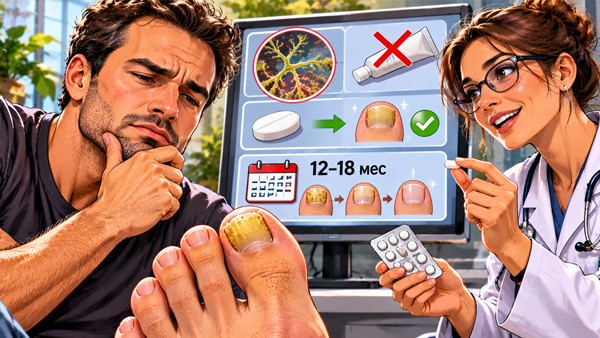

🦶 A big toenail that has gone thick, yellow and crumbly at the edge. Nothing hurts, so it waits. Then a cream gets tried for three months, nothing changes, and the conclusion is that nothing works. Two separate things are going wrong there, and neither is the one people assume.
📌 The last two tiles are the whole reason this treatment gets abandoned. The tablets finish at three months while the nail still looks terrible, because the damaged part has to grow off the end. Nothing can speed that up. Knowing it in advance is most of the battle.
🔎 First: make sure it is actually fungus
🧪 This is the step that gets skipped, and skipping it means months of tablets for nothing. Only about half of thick, discoloured, deformed nails turn out to be fungal when a clipping is tested. The rest are something that looks identical and responds to nothing antifungal.
| 🔎 Clue | 📝 What it points to |
|---|---|
| 🟡 Starts at the outer edge and creeps toward the cuticle | Classic fungus. Yellow-white streaking along one side, the nail lifting away from the bed underneath, crumbly debris when you clip it |
| 🦶 The athlete foot is there too | Scaling between the toes or on the sole almost always accompanies toenail fungus, and treating the nail without the skin guarantees reinfection |
| 🔨 Only one nail, on a toe that takes a beating | Running, football, a toe that catches in the shoe. Trauma thickens and discolours a nail without any infection at all |
| 🪶 Tiny pits in the surface, or orange-brown patches | Nail psoriasis. Often several nails, often with scalp or elbow patches. Antifungals do nothing for it |
| 🟢 Green-black discolouration | Bacterial, not fungal, and treated completely differently |
| 🟤 A single dark streak running the length of the nail | Needs seeing promptly. A brown or black band growing out from the cuticle, especially if it widens or spreads onto the skin, is checked for a melanoma of the nail. Never treat this as fungus |
| 🤚 All twenty nails involved | Unusual for fungus. Points at psoriasis, lichen planus or a generalised skin condition |
| 💥 Painful, red and swollen around the nail | Infection of the nail fold, which is bacterial or yeast and acute. Fungal nail disease is painless until the nail gets thick enough to press |
💡 How to get it confirmed, so the next three months are not wasted.
🔹 Clip generously and include the crumbly material from under the nail, as far back as you can reach — the living fungus is at the advancing edge, not at the tip.
🔹 Stop any antifungal for two weeks first, including creams and lacquers, or the test comes back falsely negative.
🔹 Microscopy is quick; culture takes weeks, because these organisms grow slowly. A negative first result with a convincing nail is often repeated rather than accepted.
🔹 The result also decides the drug, because a yeast or a mould responds differently from the usual dermatophyte, and that changes which tablet is worth taking.
👴 Who gets it, and why it becomes common with age
🎯 Other things that raise the risk substantially: diabetes, poor circulation in the legs, a weakened immune system, repeated nail trauma, communal showers and swimming pools, occlusive footwear worn all day, and a family history — the last of which is genuine and not just shared shoes.
📊 What actually cures it, with the real numbers
📉 These figures are lower than people expect and worth seeing before deciding. Complete cure means the nail looks normal and the laboratory finds nothing — a harder standard than simply killing the fungus, which happens more often.
🤔 So why does a cream do nothing? The nail plate is dense, dead keratin with no blood supply, and the fungus lives underneath it and inside it. A cream sits on top. Tablets reach the nail from the blood supply at the nail root and then get laid down inside the growing nail, which is why they work and why they take so long to show.
💊 The medicines, and which one fits which situation
| 💊 Medicine | 🎯 Its place, and the practical detail |
|---|---|
| Lamisil (Terbinafine) | First choice for nails, and the highest cure rate of anything here. Usually 250 mg daily — six weeks for fingernails, twelve for toenails. Liver tests before starting and sometimes during. Loss or distortion of taste happens in a small number and usually recovers, though it can take weeks. Report a rash, yellow eyes or dark urine |
| Sporanox (Itraconazole) | The alternative, and better than terbinafine against yeasts and some moulds — which is one reason the laboratory result matters. Often given as pulses: a week on, three weeks off, repeated. Interacts with a long list of drugs including statins, some blood thinners and some heart and blood pressure medicines, and is avoided in heart failure. Absorbed properly only with food and normal stomach acid, so antacids and acid-reducing tablets blunt it |
| Diflucan (Fluconazole) and Fluconaz (Fluconazole) | Weekly dosing, used where the first two are unsuitable. Cure rates are lower and courses run longer, but it is well tolerated and the schedule is easy to keep. The mainstay for yeast infections elsewhere — see vaginal candidiasis and the fluconazole question |
| Luliconaz (Luliconazole) | A cream, and the right tool for the skin rather than the nail. Essential alongside nail treatment, because the athlete foot on the sole and between the toes is the reservoir that reinfects the nail. Apply to the whole foot, not just the visible patch, and keep going two weeks after it looks clear |
| Nizoral (Ketoconazole) and Fungicyte (Ketoconazole) | Ketoconazole has a role in skin and scalp fungal disease, and the shampoo form is useful for seborrhoeic scaling and dandruff. Oral ketoconazole is no longer used for nails because of liver risk, when better options exist |
| Fulvicin, Grisactin, Grisovin FP, Griseo (Griseofulvin) | The old standard, now largely superseded for nails — it needs six to twelve months and still cures less often than three months of terbinafine. It keeps a real role in scalp ringworm, especially in children, where it remains a recommended option. Taken with a fatty meal. It weakens hormonal contraception and does not mix with alcohol |
| 🧴 Medicated nail lacquer | Honest assessment: low cure rates, but a reasonable choice where only the outer part of one or two nails is involved, where the nail root is spared, or where tablets are unsafe. Needs daily or weekly application for a year, and filing the surface first |
| ✂️ Thinning or removing the nail | Not a cure on its own, but reducing a grossly thick nail improves comfort and lets everything else work better. Done by a podiatrist, not at home with a craft knife |
🗓️ How long the tablets run, and how long the waiting runs
⏳ And then the part nobody warns about. The nail does not improve during the course. It improves after it, as the treated healthy nail grows out and pushes the damaged nail off the end.
🧦 Stopping it coming back
🔄 Recurrence runs at roughly a fifth to a quarter of people within a few years, and the two reasons are almost always the same: the skin infection on the foot was never treated, or the shoes were never dealt with. Both are fixable and neither needs a prescription.
⚠️ What to expect on the tablets, and what to report
| ✅ Common and manageable | 🚨 Stop and contact a doctor |
|---|---|
| 🤢 Mild stomach upset or nausea, usually easier with food | 🟡 Yellow eyes or skin, dark urine, pale stools, pain under the right ribs — possible liver injury |
| 🤧 Headache in the first week or two | 🤕 A spreading rash, blistering, or sores in the mouth — needs assessing urgently |
| 👄 Taste changes on terbinafine, from a metallic tang to losing taste entirely. Uncommon, usually reversible, and worth reporting rather than enduring silently | 🫁 Breathlessness or swelling ankles on itraconazole — it can worsen heart failure and is avoided in it |
| 💪 Aching muscles or joints | 🧪 Unexplained bruising, bleeding or repeated infections |
| 📈 Mildly raised liver enzymes on a routine check, which is why the baseline test exists | 💊 Starting any new medicine while on itraconazole — check it first, because the interaction list is long |
⚠️ Two safety points worth stating plainly.
🔹 Do not take these in pregnancy or while trying to conceive. Nail fungus is a cosmetic and comfort problem; there is no reason to accept any risk, and the treatment can simply wait. Griseofulvin in particular requires contraception for a period after stopping, and it weakens hormonal contraception while you take it.
🔹 Tell the prescriber everything else you take, including statins, blood thinners, heart and blood pressure tablets, antidepressants, acid-reducing tablets and herbal products. Itraconazole is one of the more interaction-heavy drugs in common use, and this is not a formality.
👩⚕️ When this is not a cosmetic matter
🚨 See someone promptly, do not self-treat
A dark brown or black streak growing out from the cuticle, or pigment spreading onto the surrounding skin · a red, hot, swollen, painful toe · spreading redness up the foot or ankle, with or without fever · an ulcer or break in the skin near the nail in anyone with diabetes
🟡 Get medical advice before starting anything
Diabetes, where the cracked skin of athlete foot is a recognised entry point for serious infection — see why numbness is more dangerous than pain · poor circulation or cold, discoloured feet · a weakened immune system · existing liver disease · several other regular medicines · pregnancy or breastfeeding · a child with an affected nail
🟢 Worth a routine appointment
You want it confirmed before committing to months of tablets · the nail is thick enough to hurt in shoes · a cream or lacquer has been tried for six months with no change at the base · the fungus keeps coming back · several nails are involved · pitting or patches suggest psoriasis rather than fungus
🗿 Five things that waste time and money
| 💭 The belief | ✔️ What is actually the case |
|---|---|
| "A cream will clear it eventually." | A cream cannot cross the nail plate. It is essential for the skin of the foot and close to useless on the nail itself |
| "Tea tree oil, vinegar soaks or bleach will do it." | Same obstacle, plus a real risk of irritating or burning the skin around the nail, which in diabetes is genuinely dangerous |
| "It failed, because the nail still looked bad at the end of the tablets." | It is supposed to look bad then. The treated nail has to grow out, which takes twelve to eighteen months on a toe. Judge it at a year |
| "If a nail looks like that, it is fungus." | Only about half are. Trauma and nail psoriasis look identical and respond to nothing antifungal, which is why a clipping is tested first |
| "It cleared, so it is over." | Around a fifth to a quarter come back within a few years, almost always through untreated foot skin or the same shoes. The prevention steps are the cure that holds |
❓ Frequently asked questions
What is the best treatment for toenail fungus?
Oral terbinafine, usually 250 mg daily for twelve weeks, which gives the highest cure rate of any option. Itraconazole is the main alternative, and is better against yeasts.
Why do creams not work on nail fungus?
The nail plate is dense dead keratin with no blood supply, and the fungus lives under and inside it. A cream sits on top and cannot cross. Tablets reach the nail from the root.
How long before the nail looks normal?
Twelve to eighteen months for a big toenail, because it grows only about a millimetre a month. The tablets finish at three months while the nail still looks abnormal.
How do I know it is actually fungus?
Only a nail clipping sent for microscopy and culture tells you. About half of abnormal nails are not fungal, with trauma and nail psoriasis being the commonest look-alikes.
What are the cure rates really like?
Roughly 38 percent complete cure with terbinafine tablets, around 20 percent with itraconazole, and under 10 percent with medicated lacquers. No option is close to guaranteed.
Does terbinafine affect the liver?
Serious liver injury is rare but recognised, so liver tests are usually done before starting. Report yellow eyes, dark urine or pain under the right ribs straight away.
Why did I lose my sense of taste?
Taste disturbance is an uncommon effect of terbinafine and usually recovers after the course, though it can take weeks. Report it rather than simply putting up with it.
Do I need to treat my feet as well as the nail?
Yes. Athlete foot on the sole and between the toes is the reservoir that reinfects the nail. Treating the nail alone is the commonest reason it returns.
Can nail fungus come back after treatment?
Around a fifth to a quarter of people see it return within a few years, usually through untreated foot skin or the same footwear. Shoe rotation and antifungal powder matter.
Is a dark line in my nail fungus?
Not usually, and it needs checking rather than treating. A brown or black streak growing out from the cuticle, especially if it widens or reaches the skin, is assessed for melanoma.
📑 Sources and editorial
- 📘 Dermatology guidelines on the diagnosis and management of onychomycosis, including the recommendation to confirm the diagnosis mycologically before starting systemic therapy
- 🔎 Studies on the proportion of clinically abnormal nails confirmed as fungal on microscopy and culture, and on the differential diagnosis including trauma, nail psoriasis, lichen planus, bacterial colonisation and nail unit melanoma
- 🧪 Guidance on nail sampling technique, including sampling the proximal advancing edge and subungual debris, and the need to withhold antifungal treatment before sampling
- 📊 Systematic reviews and network analyses of treatment efficacy in onychomycosis, reporting complete cure and mycological cure rates for oral terbinafine, oral itraconazole, oral fluconazole and topical nail preparations
- 📅 Dosing schedules for onychomycosis, including continuous terbinafine for six weeks in fingernail and twelve weeks in toenail disease, pulsed itraconazole regimens, weekly fluconazole, and the extended courses required with griseofulvin
- 📏 Data on nail growth rates for fingernails and toenails, the time to complete nail plate replacement, and the effect of age and peripheral circulation on growth
- 👴 Epidemiological data on the prevalence of onychomycosis by age group and on risk factors including diabetes, peripheral vascular disease, immunosuppression, nail trauma, occlusive footwear and communal bathing
- 🔄 Studies on recurrence and relapse rates after successful treatment of onychomycosis, and on the role of untreated tinea pedis and footwear contamination as sources of reinfection
- 💊 Prescribing information for terbinafine, itraconazole, fluconazole, ketoconazole, griseofulvin and luliconazole, including hepatic monitoring, taste disturbance with terbinafine, the contraindication to itraconazole in ventricular dysfunction, itraconazole absorption requirements and cytochrome P450 interactions, and griseofulvin effects on hormonal contraception
- ⚠️ Guidance on the avoidance of systemic antifungal therapy in pregnancy and on the deferral of treatment for cosmetic nail disease
- 🦶 Guidance on tinea pedis management alongside onychomycosis, including treatment of the whole plantar surface and interdigital spaces and continuation beyond clinical clearance
- 🧪 Clinical guidance on the continuing role of griseofulvin in tinea capitis, particularly in children
- 🚨 Guidance on foot care and infection risk in diabetes, including fissured skin as a portal for cellulitis, and on assessment of longitudinal melanonychia
- 📖 Related reading: vaginal candidiasis and the fluconazole question, why numbness is more dangerous than pain
- 🛒 Related products: Lamisil (Terbinafine), Sporanox (Itraconazole), Diflucan (Fluconazole), Fluconaz (Fluconazole), Luliconaz (Luliconazole), Nizoral (Ketoconazole), Grisovin FP (Griseofulvin), antifungal range
- 👩⚕️ RXshop Editorial Team — reviewed by Sarah Mitchell, PharmD — Clinical Pharmacist
Medical Disclaimer: The information in this article is for educational and informational purposes only and is not a substitute for professional medical advice, diagnosis, or treatment. Always seek guidance from a qualified healthcare provider with any questions you may have regarding a medical condition, and before starting, stopping or changing any medication.