Angina: Types, Symptoms, Treatment and Prevention

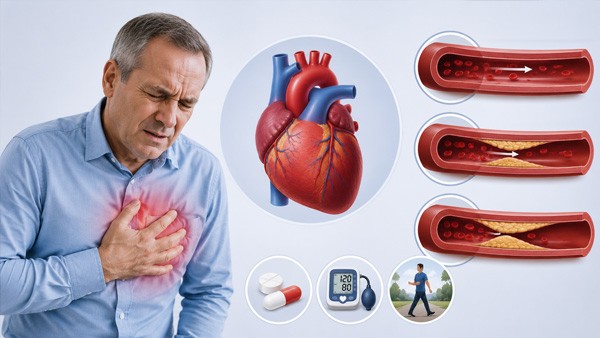

Angina is not a disease. It is a symptom — chest discomfort produced when heart muscle receives less oxygen than it is demanding — and the same sensation can mean anything from a stable condition manageable with tablets for decades to a heart attack in progress. Telling those apart is the single most useful thing a person with chest pain can understand.
This guide covers what angina is, the four distinct types and how they differ, which presentations require an ambulance rather than an appointment, how the diagnosis is made, which drugs relieve symptoms, which drugs actually prolong life, and where stents and surgery genuinely fit.
🚨 Call emergency services now if chest discomfort: lasts more than 15 to 20 minutes at rest, appears for the first time, is more severe or more frequent than the usual pattern, does not settle with rest or the usual nitrate spray, or comes with sweating, breathlessness, nausea, vomiting or collapse. Those describe unstable angina or a heart attack, and the treatment window is measured in minutes.
❤️ What is happening in the heart
The heart muscle receives its blood supply from the coronary arteries. At rest, demand is modest and even a narrowed artery delivers enough. During exertion, cold, emotion or a heavy meal, demand rises — and if a narrowing prevents supply from rising to match it, the muscle becomes ischaemic and produces pain.
That explains the classic pattern of stable angina: predictable discomfort at a reproducible level of effort, relieved within minutes by rest, because stopping the activity restores the balance. The narrowing itself is usually atherosclerotic plaque, built up over years from the same processes driven by cholesterol, blood pressure, smoking and diabetes.
Unstable angina works differently. There, a plaque ruptures and a clot forms on it, abruptly reducing supply regardless of demand — which is why the pain appears at rest and why it belongs to the same family of events as a heart attack rather than to chronic disease.
🗂️ The four types
They are treated differently, and one of them is made worse by a drug used routinely for the others.
| Type | Pattern | Mechanism and treatment note |
|---|---|---|
| Stable angina | Predictable, on exertion, relieved by rest within minutes | Fixed narrowing; managed medically, revascularisation for persistent symptoms |
| Unstable angina | At rest, new, or worsening in frequency and severity | Plaque rupture with clot — an acute coronary syndrome requiring emergency care |
| Vasospastic angina | At rest, often at night or early morning, cyclical | Coronary spasm; calcium channel blockers first-line, beta blockers can worsen it |
| Microvascular angina | Exertional, but coronary arteries look normal on angiography | Small-vessel dysfunction; more common in women, frequently dismissed |
The last two deserve emphasis because both are routinely missed. Vasospastic angina produces pain at rest with normal arteries, and treating it with a beta blocker alone can intensify the spasm. Microvascular angina affects people whose angiogram is reported as clear, who are then told nothing is wrong — despite genuine ischaemia in vessels too small for the catheter to see, and a symptom burden that limits their lives.
📋 What it feels like, including when it does not
The textbook description is a heavy, squeezing or crushing pressure behind the breastbone, sometimes radiating to the jaw, neck, left arm or between the shoulder blades, brought on by effort and eased by rest. Many people describe it as tightness or a band rather than pain, and some deny pain entirely while describing an unmistakable discomfort.
Presentations that do not follow the pattern are common enough to matter.
- Women more often report breathlessness, fatigue, nausea, jaw or back discomfort rather than classic central chest pressure.
- People with diabetes may have reduced pain perception from neuropathy, presenting with breathlessness or unexplained fatigue — silent ischaemia.
- Older adults frequently present with breathlessness, confusion or collapse rather than pain.
- Some describe indigestion, which is why new dyspepsia on exertion in a person with cardiac risk factors deserves an ECG rather than an antacid.
⚠️ The distinguishing question is not what it feels like but what brings it on. Discomfort reproducibly triggered by walking uphill and reliably relieved by standing still is cardiac until proven otherwise, whatever words the person uses to describe it. Pain reproduced by pressing on the chest wall, or sharp pain lasting seconds, or pain lasting all day unchanged, is far less likely to be angina.
🩺 How it is investigated
Assessment begins with an estimate of how likely coronary disease is in this particular person, based on age, sex, symptom character and risk factors. That pre-test probability determines which test is worth doing, because investigating a very low-risk person produces mostly false positives.
A resting ECG is done in everyone, though it is frequently normal in stable angina and its main value is detecting previous infarction or acute changes. Blood tests cover cholesterol, glucose or HbA1c, kidney function, full blood count and thyroid function, since anaemia and thyroid disease both provoke angina. Troponin is measured where an acute coronary syndrome is suspected.
Beyond that, imaging has largely replaced the traditional treadmill test. CT coronary angiography is now first-line in many guidelines for stable chest pain, because it visualises the arteries directly and reliably excludes disease. Functional imaging — stress echocardiography or perfusion scanning — is used where the question is whether a known narrowing is actually causing ischaemia. Invasive angiography is reserved for high-risk findings or where revascularisation is being considered.
💊 Drugs that relieve symptoms
Antianginal treatment works by reducing the heart's oxygen demand or improving supply. Several classes exist, and combining them is normal.
| Class | How it helps | Available here |
|---|---|---|
| Beta blockers | Slow the heart and reduce contractility, lowering oxygen demand | Inderal, Atenheal, Coreg |
| Dihydropyridine calcium blockers | Dilate coronary and peripheral arteries | Plendil, Adalat |
| Rate-limiting calcium blockers | Dilate arteries and slow the heart; useful where beta blockers are unsuitable | Calan, Cardizem |
| Short-acting nitrates | Relieve an attack within minutes; also used before predictable exertion | Prescribed locally — every person with angina should carry one |
| Long-acting nitrates | Prevent attacks; require a nitrate-free interval to avoid tolerance | Prescribed as part of a specialist plan |
| Second-line agents | Ranolazine, ivabradine, nicorandil and others for persistent symptoms | Specialist prescribing |
Guidelines place beta blockers and calcium channel blockers as first-line, either alone or combined, with the choice driven by heart rate, blood pressure and other conditions. A slow resting heart rate favours a dihydropyridine; coexisting asthma argues against beta blockers; vasospastic angina calls for a calcium blocker specifically.
Nitrate tolerance is worth understanding: continuous exposure blunts the effect, so long-acting preparations are dosed to leave a nitrate-free window of roughly eight to twelve hours daily, usually overnight. Taking them around the clock steadily reduces their benefit.
⛔ Nitrates and erectile dysfunction drugs must never be combined. Sildenafil, tadalafil, vardenafil and avanafil taken with any nitrate can cause a catastrophic fall in blood pressure. The interval matters: at least 24 hours after sildenafil or vardenafil, and at least 48 hours after tadalafil, before a nitrate is given. Anyone carrying a nitrate spray must tell their prescriber if they use these medicines, and must tell emergency staff during chest pain.
🛡️ Drugs that change the outcome
The distinction between symptom control and prognosis is the part patients most often miss. Antianginal drugs make life more comfortable. A different set makes it longer.
- Antiplatelet therapy. Low-dose aspirin, or clopidogrel where aspirin is unsuitable, reduces the risk of heart attack in established coronary disease.
- Statins. High-intensity statin therapy reduces cardiovascular events substantially regardless of the starting cholesterol level, and the benefit is among the best documented in medicine.
- ACE inhibitors in those with diabetes, kidney disease, heart failure or hypertension — see our guide on ACE inhibitors and blood pressure.
- Blood pressure and diabetes control, both of which drive the underlying disease process.
- Stopping smoking, which reduces risk faster and more steeply than any drug on this list.
Beta blockers occupy both categories after a heart attack, where they improve survival as well as symptoms. In stable angina without previous infarction, their role is primarily symptomatic.
🔧 Stents and bypass surgery
The intuitive assumption is that a narrowed artery should be opened, and that opening it prevents heart attacks. For stable angina, large randomised evidence has complicated that considerably.
Trials comparing an initial invasive strategy with optimal medical therapy in stable coronary disease found no reduction in death or heart attack from routine revascularisation, though it did produce greater relief of symptoms in those who had significant angina to begin with. The practical conclusion adopted in guidelines is that stents and bypass surgery in stable disease are treatments for symptoms and for specific high-risk anatomy, not a routine preventive measure.
| Situation | Approach |
|---|---|
| Acute coronary syndrome or heart attack | Urgent revascularisation — clearly life-saving |
| Stable angina, symptoms controlled on medication | Continue medical therapy; revascularisation adds little |
| Stable angina, symptoms persisting despite two drug classes | Revascularisation for symptom relief |
| Left main disease, extensive multivessel disease, poor heart function | Revascularisation improves outcome; bypass often preferred |
| Diabetes with multivessel disease | Bypass surgery generally outperforms stenting |
None of this means stents are overused in every case — in acute coronary syndromes they save lives unambiguously. It means the conversation about a stent for stable angina should be about how much the symptoms limit daily life, not about a belief that the procedure prevents a future heart attack.
🏃 What patients can change
The lifestyle component in coronary disease is not an afterthought; several elements produce effects comparable to medication.
Stopping smoking is the single most powerful intervention available, with risk beginning to fall within months. Regular aerobic activity, ideally through a supervised cardiac rehabilitation programme, improves symptoms, exercise capacity and survival — and rehabilitation is consistently under-referred. Dietary pattern matters more than any single food, with Mediterranean-style eating having the strongest trial support. Weight, alcohol moderation and sleep apnoea treatment each contribute.
Practical management of attacks also belongs here: sit or stop at the first symptom, use the nitrate spray as instructed, and if the discomfort persists beyond the agreed interval, treat it as an emergency rather than waiting to see whether a third dose works.
✅ A simple action plan worth writing down: stop what you are doing at the first symptom; take the short-acting nitrate; if not relieved in five minutes, take a second dose; if still present five minutes after that, call emergency services. Carry the spray at all times, check its expiry date, and tell whoever you live with where it is kept.
The full range of cardiovascular medicines is in the blood pressure and heart category.
❓ Frequently asked questions
How do I know whether chest pain is angina or a heart attack?
Stable angina is predictable, brought on by a reproducible level of exertion and relieved within minutes by rest or a nitrate spray. A heart attack or unstable angina produces discomfort at rest, lasting more than 15 to 20 minutes, not relieved by the usual measures, often with sweating, breathlessness or nausea. The second requires emergency services immediately.
Can you have angina with normal coronary arteries?
Yes. Microvascular angina involves dysfunction of vessels too small to appear on angiography, and vasospastic angina involves spasm of arteries that look normal between episodes. Both produce genuine ischaemia and genuine symptoms. Being told the angiogram is clear does not mean nothing is wrong, and these diagnoses are more common in women.
Why can beta blockers make some angina worse?
In vasospastic angina, where the problem is coronary spasm rather than fixed narrowing, beta blockers can intensify the spasm and worsen symptoms. Calcium channel blockers are first-line for that type. This is one of the reasons establishing which type of angina a person has matters before treatment is chosen.
Do stents prevent heart attacks in stable angina?
Large randomised trials found that routine revascularisation in stable coronary disease did not reduce death or heart attack compared with optimal medical therapy, though it did relieve symptoms better in those with significant angina. In acute coronary syndromes the picture is entirely different and revascularisation is life-saving. For stable disease the decision is about symptom relief and specific high-risk anatomy.
Which medicines actually prolong life?
Antiplatelet therapy such as low-dose aspirin, statins, and ACE inhibitors in those with diabetes, kidney disease, heart failure or hypertension. Beta blockers also improve survival after a heart attack. Antianginal drugs including nitrates and calcium channel blockers relieve symptoms without changing prognosis, which is why both groups are usually prescribed together.
Why must nitrates never be combined with erectile dysfunction drugs?
Because both lower blood pressure through the same pathway, and together they can cause a catastrophic and potentially fatal drop. Required intervals are at least 24 hours after sildenafil or vardenafil and at least 48 hours after tadalafil before any nitrate. Anyone using these drugs must tell their prescriber, and must tell emergency staff during chest pain.
Why do long-acting nitrates need a drug-free interval?
Because continuous exposure produces tolerance and the drug progressively stops working. Long-acting preparations are therefore dosed to leave roughly eight to twelve hours daily without nitrate cover, usually overnight. Taking them around the clock feels more thorough but steadily reduces their effect.
What should I do during an attack?
Stop the activity and sit down. Use the short-acting nitrate as prescribed. If the discomfort persists five minutes later, take a second dose. If it is still present five minutes after that, call emergency services rather than waiting. Carry the spray at all times, check its expiry date, and make sure someone at home knows where it is.
Can angina present without chest pain?
Frequently. Women more often report breathlessness, fatigue, nausea or jaw and back discomfort. People with diabetes may have blunted pain perception and present with breathlessness alone. Older adults may show confusion or collapse. New exertional indigestion in someone with cardiac risk factors deserves an ECG rather than an antacid.
Which test is used to diagnose it?
A resting ECG is done in everyone but is often normal in stable angina. CT coronary angiography is now first-line in many guidelines because it visualises the arteries directly and reliably excludes disease. Functional imaging assesses whether a known narrowing causes ischaemia, and invasive angiography is reserved for high-risk findings or when revascularisation is planned.
Is exercise safe with angina?
Not only safe but beneficial once assessed, and supervised cardiac rehabilitation improves symptoms, capacity and survival. It is one of the most under-used treatments in cardiology. The programme is tailored to the individual, teaches recognition of warning symptoms, and is far preferable to either avoiding activity entirely or pushing through pain unsupervised.
What single change helps most?
Stopping smoking. The reduction in cardiovascular risk begins within months and exceeds what any individual medication achieves. After that: taking the statin and antiplatelet consistently, controlling blood pressure and diabetes, completing cardiac rehabilitation, and adopting a Mediterranean-style dietary pattern, which has the strongest trial support of any diet in this setting.
📑 Sources and editorial
- ESC guidelines on chronic coronary syndromes and on acute coronary syndromes
- ACC/AHA guideline on the evaluation and diagnosis of chest pain
- ISCHEMIA and COURAGE trials on invasive versus medical management of stable coronary disease
- FDA prescribing information for nitrates, beta blockers and calcium channel blockers, including the PDE5 inhibitor contraindication
- Related reading on RXshop: ACE inhibitors and blood pressure, What is angina
- RXshop Editorial Team — reviewed by Robert Hayes, MD, FACC, Cardiologist & Cardiovascular Disease Specialist
Medical Disclaimer: The information in this article is for educational and informational purposes only and is not a substitute for professional medical advice, diagnosis, or treatment. Always seek guidance from a qualified healthcare provider with any questions you may have regarding a medical condition, and before starting, stopping or changing any medication.