Vaginal Dryness: Causes and What Actually Helps

Vaginal dryness is common, treatable, and discussed far less than it should be. Surveys consistently find that a large share of women affected by it never raise it with a clinician, and a large share of clinicians never ask — so a problem with straightforward solutions goes untreated for years, quietly reshaping intimacy, comfort and confidence.
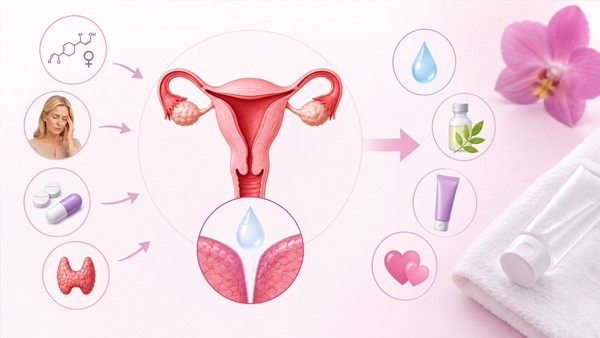
It is a symptom rather than a diagnosis, and the reason it responds so variably to treatment is that two quite different problems produce it. Telling them apart is the whole task, because the answer to one is not the answer to the other.
🧠 The distinction that determines treatment: dryness during arousal in tissue that is otherwise healthy is a different problem from dryness caused by thinned, fragile tissue that lacks oestrogen. The first responds to context, arousal and lubricants. The second responds to restoring the tissue, and lubricant alone treats the surface of it. Many women are given lubricant for a problem that needed oestrogen, use it for years, and conclude nothing helps.
🔬 How lubrication actually works
A widespread assumption is that vaginal lubrication comes from glands. It largely does not. The vagina has no secretory glands along its walls.
What happens during arousal is a vascular event. Blood flow to the pelvis increases, the vaginal walls become engorged, and pressure within those vessels pushes plasma outward through the vaginal lining — a process called transudation. That fluid, together with a small contribution from cervical mucus and from the Bartholin glands near the entrance, is what provides lubrication. It typically appears within ten to thirty seconds of effective arousal.
Three things follow from this, and they explain most cases of dryness.
First, lubrication depends on blood flow, so anything that reduces genital vasocongestion reduces it. Second, it depends on arousal, meaning the physical response, which is not the same thing as desire and does not always accompany it. Third, it depends on the health of the vaginal wall itself, which is maintained by oestrogen. When oestrogen falls, the lining thins, blood supply to it decreases, elasticity is lost and the tissue can no longer produce transudate effectively no matter how aroused the woman is.
⚖️ Two different problems
Separating these is worth doing carefully, because the history usually makes it clear.
| Feature | Arousal-related dryness | Tissue-related dryness |
|---|---|---|
| Timing | Situational; varies with circumstances and partner | Constant, present outside sex entirely |
| Other symptoms | None between episodes | Itching, burning, irritation, discomfort sitting or in clothing |
| Urinary symptoms | Absent | Frequency, urgency, recurrent urinary infections |
| Bleeding | Rare | Light bleeding or spotting after sex is common |
| Context | Stress, tiredness, relationship factors, insufficient time | Menopause, breastfeeding, cancer treatment, ovarian removal |
| Response to lubricant | Usually good | Partial; helps friction but not the underlying fragility |
The tissue-related form has a name that has replaced the older term vaginal atrophy: genitourinary syndrome of menopause. The change of name was deliberate, reflecting that it affects the bladder and urethra as well as the vagina, and that it is progressive rather than something that settles on its own. Unlike hot flashes, which usually fade over time, this does not improve without treatment.
🗂️ What causes it
Low oestrogen is the largest single category, but far from the only one.
| Cause | Notes |
|---|---|
| Menopause, natural or surgical | The commonest cause; surgical removal of the ovaries produces an abrupt and often severe version |
| Breastfeeding and the postpartum period | Oestrogen is suppressed while breastfeeding; usually reversible, and frequently distressing because it is unexpected |
| Breast cancer treatment | Aromatase inhibitors such as letrozole and anastrozole, ovarian suppression and chemotherapy all lower oestrogen sharply; this group often has the most severe symptoms |
| Some hormonal contraception | Low-oestrogen and progestogen-only methods cause dryness in a proportion of users |
| Medications | Antihistamines, some antidepressants, certain blood pressure drugs, and treatments that reduce secretions generally |
| Sjogren syndrome | An autoimmune condition drying eyes, mouth and vagina together; frequently missed for years |
| Pelvic radiotherapy | Damages the tissue directly, sometimes severely |
| Smoking | Reduces blood flow and lowers oestrogen levels |
| Irritants and douching | Perfumed washes, douching, harsh soaps and some wipes strip the natural barrier |
| Psychological and relational factors | Stress, anxiety, depression, fear of pain, relationship difficulty, insufficient arousal time |
| Pain conditions | Vulvodynia, lichen sclerosus and vaginismus cause pain that is often attributed to dryness but needs quite different treatment |
⚠️ A note about breast cancer treatment. Aromatase inhibitors work by suppressing oestrogen throughout the body, and severe vaginal dryness is one of their most consistent effects — severe enough that it contributes to women stopping treatment early, which affects cancer outcomes. This group needs active management rather than being told the symptom is unavoidable. Non-hormonal options come first, and the use of local oestrogen is a decision made jointly with the oncology team rather than ruled out automatically.
🔴 When to be examined rather than self-treating
Most vaginal dryness is straightforward. Some presentations are not, and treating them as dryness delays a diagnosis that matters.
- Bleeding after menopause, whether or not related to sex, requires assessment. It is usually caused by thin tissue, but it must be investigated to exclude endometrial cancer
- Abnormal discharge, odour or itching suggesting infection rather than dryness
- Visible changes — white patches, thickened or fused skin, ulceration or a lump. Lichen sclerosus in particular causes dryness and pain, requires a specific steroid treatment, and carries a small risk of vulval cancer if untreated
- Pain at a specific point or on light touch, which points to vulvodynia rather than dryness
- Pain preventing penetration entirely, which suggests pelvic floor muscle spasm and responds to physiotherapy rather than lubricant
- Dry eyes and dry mouth alongside, which raises the possibility of Sjogren syndrome
💧 Lubricants and moisturisers are not the same thing
These two categories are constantly conflated, including on packaging, and using the wrong one is a frequent reason women conclude that nothing works.
| Lubricant | Vaginal moisturiser | |
|---|---|---|
| Purpose | Reduce friction during sex | Rehydrate the tissue over time |
| When used | At the time | Every two to three days, regardless of sexual activity |
| Duration | Minutes to an hour | Effect builds over weeks |
| Helps daily discomfort | No | Yes |
Someone with tissue-related dryness needs a moisturiser used regularly, and a lubricant additionally for sex. Using only a lubricant addresses the moment and leaves the underlying dryness unchanged.
Choosing a lubricant involves more than preference. Water-based products are the most versatile and condom-safe but dry out and need reapplying. Silicone-based products last much longer and suit water use, but degrade silicone toys. Oil-based products, including coconut oil and petroleum jelly, destroy latex condoms and diaphragms and should not be used with them.
Two technical properties matter more than most people realise. Osmolality describes how concentrated the product is; excessively high osmolality draws water out of the vaginal lining and damages the epithelium, and the World Health Organization has published limits for this reason. pH should approximate the vagina, around 3.8 to 4.5, since alkaline products disturb the normal bacterial balance.
Worth avoiding: high concentrations of glycerin, which may promote thrush in susceptible women; warming, tingling and flavoured products, which frequently irritate already fragile tissue; petroleum jelly, associated with bacterial vaginosis; and anything with fragrance.
💊 Local oestrogen
Where the problem is tissue-related, local oestrogen is the definitive treatment, and it does something no lubricant can: it restores the tissue itself.
Applied directly to the vagina as a tablet, pessary, ring or cream, it thickens the lining, restores elasticity and blood flow, returns the pH to normal, and re-establishes the healthy bacterial population. Improvement usually begins within two to three weeks and continues over several months. It also reduces recurrent urinary tract infections and urinary urgency, which is a substantial benefit in older women that is frequently overlooked.
Vagifem (vaginal estradiol 25 mcg) is one of the commonly used forms, given as a small tablet inserted into the vagina — typically daily for a short initial period, then reduced to twice weekly for maintenance. Treatment is ongoing, because symptoms return within months of stopping.
✅ Local is not the same as systemic. The dose used vaginally is a small fraction of that in systemic hormone therapy, and blood oestrogen levels stay within the postmenopausal range. Consequently the risks associated with systemic hormone therapy — the ones most women have heard about and worry over — do not apply in the same way, and major menopause societies state that low-dose vaginal oestrogen does not require a progestogen for endometrial protection in women with a uterus. Any postmenopausal bleeding still needs investigating.
The situation in women with a history of breast cancer is more nuanced and should be decided with the treating team rather than by a general rule. Non-hormonal measures are tried first. Where they fail and quality of life is significantly affected, local oestrogen is used in some circumstances, with the decision weighted by the type of cancer and the treatment the woman is receiving.
🧬 Other prescription options
Several alternatives exist for women who cannot or prefer not to use local oestrogen.
Vaginal DHEA (prasterone) is a precursor converted locally into small amounts of oestrogen and testosterone within the vaginal cells, improving dryness and pain with sex.
Ospemifene is an oral tablet acting selectively on oestrogen receptors, with a positive effect on vaginal tissue. It suits women who dislike vaginal application, and carries its own considerations including hot flashes.
Systemic hormone therapy — oral or transdermal oestradiol, or conjugated oestrogens — treats vaginal symptoms alongside hot flashes, night sweats and bone loss. It is the right choice when those broader symptoms are present, and an unnecessarily large intervention when dryness is the only complaint. A proportion of women on systemic therapy still need local treatment as well.
Pelvic floor physiotherapy deserves a mention here because it is under-used. Where dryness has led to painful sex, the pelvic floor commonly tightens protectively, and that muscular response then perpetuates the pain after the dryness itself is treated. Physiotherapy addresses it directly.
❤️ The arousal side
Where the tissue is healthy and the dryness is situational, the useful interventions are different, and they are not lesser for being non-pharmacological.
Time matters more than technique. Genital response takes considerably longer for many women than the surrounding culture suggests, and much dryness is simply insufficient arousal before penetration. This is a mechanical fact rather than a failing.
Desire is often responsive rather than spontaneous. A large proportion of women, particularly in longer relationships, do not experience desire before intimacy begins; desire emerges in response to pleasant physical contact. Waiting for spontaneous desire that never arrives, and interpreting its absence as a problem, is a common and unnecessary source of distress.
Context is a physiological variable. Fatigue, stress, resentment, worry about being interrupted and anxiety about pain all suppress the arousal response directly. Fixing the circumstances often achieves what no product will.
Pain creates its own cycle. Once sex has hurt, anticipation of pain reduces arousal, which reduces lubrication, which causes more pain. Breaking that loop usually requires treating the original cause, using generous lubrication, and a period without pressure to proceed to penetration. Psychosexual therapy is genuinely effective here and is not a last resort.
Talking to a partner is difficult and it is also the intervention with the largest effect, because a partner who understands that dryness is physiological rather than a verdict on the relationship responds quite differently.
🔎 What about tablets that increase blood flow
Since the article this replaces mentioned tadalafil, the evidence deserves an accurate summary.
PDE5 inhibitors such as tadalafil and sildenafil increase genital blood flow in women as they do in men. What has not followed reliably is improvement in the experience of arousal, and trials in women with general sexual dysfunction have been largely disappointing. The clearest signal in the evidence is a specific one: some benefit in women whose sexual difficulty was caused by antidepressants of the SSRI class.
They are not a treatment for genitourinary syndrome of menopause, because the problem there is thinned tissue rather than insufficient blood flow, and increasing flow to tissue that cannot produce transudate achieves little. Anyone whose dryness is constant and accompanied by irritation or urinary symptoms is being offered the wrong solution if this is the first suggestion.
🚫 Things that make it worse
Several widely practised habits actively harm the vaginal environment.
Douching removes the protective bacterial population and raises the risk of infection. The vagina is self-cleaning; washing the vulva externally with water or a plain non-fragranced product is all that is required.
Perfumed products — intimate washes, wipes, bath additives, scented sanitary products — are a common cause of irritation that then gets attributed to dryness.
Smoking reduces blood flow and lowers oestrogen, and is associated with earlier menopause.
Avoiding sex entirely because it hurts is understandable and unfortunately counterproductive in tissue-related dryness, where regular gentle activity, with or without a partner, maintains blood flow and elasticity. Treatment first, then gradual return.
🔴 What does not work, despite persistent claims: drinking more water does not increase vaginal lubrication in a woman who is not dehydrated; the fluid comes from blood plasma crossing the vaginal wall, and hydration status is not the limiting factor. Nor do herbal supplements marketed for feminine dryness have credible evidence behind them. Vaginal steaming, jade eggs and similar practices carry real risks of burns and infection with no benefit whatsoever.
📋 A practical order of steps
For most women, working through this sequence resolves the problem.
Start by identifying which type of dryness is present, using the timing and associated symptoms described above. If it is constant and accompanied by irritation or urinary symptoms, the tissue is the problem and a lubricant alone will not be enough.
Remove irritants: stop douching, drop perfumed products, review whether a medication started recently coincided with the onset.
Add a well-chosen vaginal moisturiser used regularly, and a good lubricant for sex, with attention to osmolality, pH and condom compatibility.
Seek a prescription assessment if that is insufficient, particularly after menopause, where local oestrogen is likely to be the answer and improvement should be evident within a few weeks.
Address arousal, context and the relationship in parallel rather than afterwards, since the two sides interact and treating only one frequently leaves the problem half-solved.
And raise it at all. The reluctance to mention this to a clinician is the single largest obstacle to treating a condition that responds well — and it is a routine consultation for anyone working in this field.
Local treatment for menopausal dryness is stocked as Vagifem (vaginal estradiol), with the fuller range in the womens health category.
❓ Frequently asked questions
Where does vaginal lubrication come from?
Not from glands, which is the usual assumption. The vaginal walls have no secretory glands. During arousal, blood flow to the pelvis increases and plasma is pushed outward through the vaginal lining, a process called transudation. Cervical mucus and the Bartholin glands near the entrance contribute a small amount. This is why lubrication depends on blood flow, on arousal, and on the health of the vaginal wall itself.
How do I know whether my dryness is hormonal?
Timing and accompanying symptoms usually make it clear. Hormonal dryness is constant rather than situational, present outside sex entirely, and accompanied by itching, burning, discomfort in clothing, urinary urgency or recurrent urinary infections. Light bleeding after sex is common. Arousal-related dryness varies with circumstances, causes no symptoms between episodes, and responds well to lubricant alone.
What is the difference between a lubricant and a vaginal moisturiser?
A lubricant reduces friction during sex and lasts minutes to an hour. A moisturiser is used every two to three days regardless of sexual activity and rehydrates the tissue over weeks, relieving daily discomfort as well. Someone with tissue-related dryness needs the moisturiser regularly and the lubricant additionally. Using only a lubricant treats the moment and leaves the underlying dryness unchanged, which is why many women conclude nothing helps.
Which lubricants should be avoided?
Oil-based products including coconut oil and petroleum jelly destroy latex condoms and diaphragms. Very high osmolality products draw water out of the vaginal lining and damage it, which is why the World Health Organization publishes limits. Warming, tingling and flavoured products frequently irritate fragile tissue, high glycerin content may promote thrush in susceptible women, and fragrance is best avoided entirely. Aim for a pH around 3.8 to 4.5.
Is vaginal estrogen as risky as hormone replacement therapy?
No. The dose used vaginally is a small fraction of that in systemic hormone therapy, and blood oestrogen levels remain within the postmenopausal range. Major menopause societies state that low-dose vaginal oestrogen does not require a progestogen for endometrial protection in women with a uterus, and the risks associated with systemic therapy do not apply in the same way. Any postmenopausal bleeding still needs investigation.
How long does vaginal estrogen take to work?
Improvement usually begins within two to three weeks and continues over several months as the tissue thickens, elasticity returns and pH normalises. Treatment is typically daily for an initial period then reduced to twice weekly for maintenance. It is ongoing rather than a course, because symptoms return within months of stopping. It also reduces recurrent urinary infections, a benefit often overlooked.
Why is dryness so severe on breast cancer treatment?
Because aromatase inhibitors such as letrozole and anastrozole work by suppressing oestrogen throughout the body, and ovarian suppression and chemotherapy do the same. The resulting dryness is often severe enough to contribute to women stopping treatment early, which affects cancer outcomes. This group needs active management rather than acceptance. Non-hormonal measures come first, and any use of local oestrogen is decided jointly with the oncology team.
Does dryness while breastfeeding go away?
Usually yes. Oestrogen is suppressed during breastfeeding, and levels recover once feeding reduces and periods return. It is worth knowing about in advance because it surprises many women and can be quite pronounced. In the meantime a good lubricant, and a moisturiser if discomfort is present outside sex, manage it well, and local oestrogen can be used where symptoms are severe.
Does drinking more water help?
Not in someone who is not dehydrated. Lubrication comes from blood plasma crossing the vaginal wall, and hydration status is not the limiting factor — oestrogen levels, blood flow and arousal are. General hydration is good for other reasons, but presenting it as a treatment for vaginal dryness sets up an expectation that will not be met and delays effective treatment.
When should I see a doctor rather than treat it myself?
Any bleeding after menopause, whether or not related to sex. Abnormal discharge or odour suggesting infection. Visible changes such as white patches, thickened or fused skin, ulceration or a lump, since lichen sclerosus needs specific treatment. Pain at a single point or on light touch. Pain preventing penetration entirely. And dry eyes and mouth alongside vaginal dryness, which raises the possibility of Sjogren syndrome.
Do tablets like sildenafil or tadalafil help women?
They increase genital blood flow, but improvement in the actual experience of arousal has not followed reliably, and trials in women with general sexual dysfunction have been largely disappointing. The clearest benefit in the evidence is narrow: women whose sexual difficulty was caused by SSRI antidepressants. They are not a treatment for menopausal dryness, where the problem is thinned tissue rather than insufficient blood flow.
Is it normal not to feel desire before sex begins?
Yes, and it is very common. A large proportion of women, particularly in longer relationships, experience responsive rather than spontaneous desire — desire emerges in response to pleasant physical contact rather than preceding it. Waiting for spontaneous desire that does not arrive, and reading its absence as a problem, causes a great deal of unnecessary distress. Allowing more time before penetration addresses much situational dryness on its own.
📑 Sources and editorial
- North American Menopause Society position statement on genitourinary syndrome of menopause
- International Society for the Study of Womens Sexual Health terminology consensus on genitourinary syndrome of menopause
- World Health Organization advisory on personal lubricant osmolality and pH
- NICE guidance on menopause diagnosis and management
- Evidence reviews on vaginal oestrogen use in women with a history of breast cancer
- FDA prescribing information for vaginal estradiol and conjugated oestrogens
- Related products: Vagifem vaginal estradiol, womens health category
- RXshop Editorial Team — reviewed by Anita Sharma, MD, FACOG, Obstetrics and Gynecology
Medical Disclaimer: The information in this article is for educational and informational purposes only and is not a substitute for professional medical advice, diagnosis, or treatment. Always seek guidance from a qualified healthcare provider with any questions you may have regarding a medical condition, and before starting, stopping or changing any medication.