Is Erectile Dysfunction Really Caused by Age


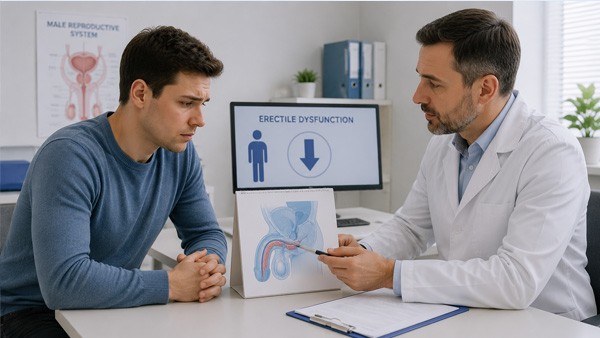
Erectile dysfunction becomes commoner with every decade of life. That is not the same as being caused by age, and the difference is not academic — it decides whether a man is told to accept the situation or investigated for the vascular disease that is usually driving it.
Ageing alone produces a gradual, modest change: erections take longer to develop, need more direct stimulation, and may be slightly less rigid. What it does not produce is the inability to achieve or maintain an erection sufficient for sex. When that occurs, something else is responsible, and identifying it frequently matters for reasons well beyond the bedroom.
🧠 The single most important fact in this article: the arteries supplying the penis are roughly one to two millimetres across, while the coronary arteries supplying the heart are three to four. The same atherosclerotic process narrows both, but it produces symptoms in the smaller vessel first. Erectile dysfunction of vascular origin therefore precedes a cardiac event by an average of three to five years. It is not merely a quality-of-life issue — it is one of the earliest warnings the body gives.
📊 What the numbers show
Large population studies give a consistent picture. Around half of men between forty and seventy report some degree of erectile difficulty, and severity rather than presence is what shifts with age: complete erectile dysfunction affects a small minority in the fourth decade and roughly triples in proportion by the seventh.
Two things are usually missed in these figures. The first is that a substantial proportion of younger men are affected — enough that presentations under forty have become a routine part of urology practice rather than an oddity. The second is that the rise with age tracks the rise in cardiovascular disease, diabetes, obesity and medication use, not age itself. Men who reach seventy in good metabolic health have far less erectile dysfunction than the average figures suggest.
🔬 How an erection works
Understanding the mechanism explains both why so many conditions interfere with it and why the tablets work the way they do.
Sexual stimulation, whether physical or from the brain, causes nerve endings in the penis to release nitric oxide. This triggers production of a messenger molecule called cyclic GMP, which relaxes the smooth muscle in the walls of the arteries and in the spongy erectile tissue. Blood floods in. As the tissue expands it compresses the veins carrying blood away, trapping it inside. Rigidity is maintained by that combination of inflow and restricted outflow.
An enzyme called phosphodiesterase type 5 continuously breaks down cyclic GMP, which is how an erection subsides. PDE5 inhibitors block that enzyme, allowing cyclic GMP to accumulate. This is why they do not cause erections on their own — without stimulation there is no nitric oxide, no cyclic GMP, and nothing for the drug to preserve. That single point accounts for a large share of the men who conclude the medication does not work for them.
The system requires healthy arteries, functioning nerves, adequate testosterone, intact veins and a receptive mental state. Failure at any point produces the same symptom.
🗂️ What actually causes it
| Category | Examples | Notes |
|---|---|---|
| Vascular | Atherosclerosis, high blood pressure, high cholesterol, smoking | The largest category by far; the same disease that causes heart attacks |
| Metabolic | Diabetes, obesity, metabolic syndrome | Diabetes affects both vessels and nerves; onset is often earlier and more severe |
| Neurological | Spinal injury, multiple sclerosis, Parkinson disease, pelvic surgery | Prostate surgery and pelvic radiotherapy are common causes |
| Hormonal | Low testosterone, thyroid disorders, raised prolactin | Less common than assumed, but treatable and worth excluding |
| Medication | Some blood pressure drugs, antidepressants, antipsychotics, hormone therapy for prostate cancer | Frequently overlooked; timing relative to a new prescription is informative |
| Lifestyle | Smoking, excess alcohol, recreational drugs, sedentary living, poor sleep | The most modifiable group, and improvement is genuinely achievable |
| Psychological | Performance anxiety, depression, stress, relationship difficulty | Dominant in younger men; often coexists with physical causes in older men |
| Anatomical | Peyronie disease, previous injury | Curvature and pain point to this |
| Sleep apnoea | Untreated obstructive sleep apnoea | Strongly associated and frequently undiagnosed; treating it often improves erections |
In practice, most men over forty have a mixture. A vascular problem develops gradually, the first failure creates anxiety, anxiety worsens the next attempt, and by the time the man seeks help both elements are present. Treating only one leaves the problem half-addressed.
⚖️ Telling physical from psychological
The history usually distinguishes them, and no test does it better.
| Feature | Suggests physical cause | Suggests psychological cause |
|---|---|---|
| Onset | Gradual over months or years | Sudden, often traceable to an event |
| Morning and night erections | Absent or diminished | Preserved |
| Erections alone | Also affected | Normal |
| Situation | Consistent across all circumstances | Varies by partner, setting or mood |
| Age and health | Older, with vascular risk factors | Younger, otherwise healthy |
| Course | Steadily progressive | Fluctuating, with good periods |
The question about morning erections is the most useful single item in the whole assessment. Their preservation indicates the plumbing works and points toward a psychological or situational cause; their disappearance points to a physical problem requiring investigation.
🧑 When it happens young
Erectile difficulty in men under forty is more frequent than most people assume, and the causes differ in proportion rather than in kind.
Performance anxiety is the dominant factor. A single failure — from alcohol, tiredness or nerves — creates apprehension about the next occasion, and that apprehension activates the sympathetic nervous system, which physiologically opposes erection. The mechanism is straightforward and the cycle is self-sustaining.
Expectation and comparison contribute. Men frequently arrive believing that reliable, immediate, effortless erection in every circumstance is the norm, and measure themselves against that. It is not the norm at any age.
Substances matter more than young men expect: alcohol, cannabis, stimulants, opioids, anabolic steroids — the last suppressing the body own testosterone production, sometimes for a long period after stopping.
Antidepressants, particularly SSRIs, are a frequent and under-discussed cause in this group.
What must not be assumed is that young age excludes a physical cause. Type 1 diabetes, low testosterone, previous injury and early cardiovascular disease all present in this age group, and a young man with erectile dysfunction and absent morning erections deserves the same assessment as anyone else.
🩺 What a proper assessment covers
Because erectile dysfunction is a marker as much as a symptom, the assessment is broader than the complaint.
- History — onset, morning erections, situational variation, relationship context, previous surgery
- Medication review — including anything started around the time symptoms began
- Cardiovascular assessment — blood pressure, cholesterol, smoking, family history, and a formal risk estimate
- Blood glucose or HbA1c, since erectile dysfunction is sometimes the presenting feature of diabetes
- Morning testosterone, measured before eleven in the morning as levels fall through the day; repeated if low
- Examination including the penis for curvature or plaque, the testicles, and the prostate where indicated
🔴 Do not skip the cardiovascular part. A man presenting with erectile dysfunction and no other complaint has a meaningfully raised risk of a cardiac event in the following years. Guidelines in several countries treat the presentation as an indication for cardiovascular risk assessment for exactly this reason. Being handed a prescription without anyone checking blood pressure, glucose and lipids is an incomplete consultation, however satisfying the tablet is.
💊 The tablets and how they differ
PDE5 inhibitors are effective in the large majority of men and are the first-line treatment regardless of age. They differ mainly in timing.
| Drug | Onset | Duration | Notes |
|---|---|---|---|
| Tadalafil | 30 to 60 minutes | Up to 36 hours | Unaffected by food; can be taken daily at low dose for spontaneity; also treats prostate symptoms |
| Sildenafil | 30 to 60 minutes | 4 to 6 hours | Absorption reduced considerably by a heavy or fatty meal |
| Vardenafil | 30 to 60 minutes | 4 to 8 hours | Similar to sildenafil, somewhat less affected by food |
| Avanafil | 15 to 30 minutes | About 6 hours | Fastest onset; more selective, which may mean fewer side effects |
The choice between them is a lifestyle decision more than a medical one. Tadalafil suits men who want a long window and dislike planning; the shorter-acting agents suit men who prefer a defined occasion. Response varies individually, and a man who does poorly on one may do well on another, which is a reason to try a second before concluding tablets do not work.
🚫 The absolute contraindication
PDE5 inhibitors must never be combined with nitrates — glyceryl trinitrate spray or tablets, isosorbide mononitrate or dinitrate, and the recreational drugs known as poppers, which are alkyl nitrites. Both lower blood pressure through overlapping pathways, and together they can cause a catastrophic drop.
This matters in a specific and dangerous scenario: a man who takes a tablet, develops chest pain, and is given a nitrate spray by paramedics who have not been told. Anyone using these drugs must disclose them in any emergency, and the interaction window extends to about twenty-four hours for the short-acting drugs and forty-eight hours for tadalafil.
Caution also applies with alpha-blockers used for prostate symptoms, with certain antifungals and antibiotics that raise drug levels, in significant liver or kidney impairment, and in men with unstable cardiac disease who should not be having sex until stabilised. A rare but serious risk is sudden vision loss from non-arteritic anterior ischaemic optic neuropathy, which requires immediate assessment.
❗ Why they seem not to work
A substantial proportion of men who report failure have not actually had an adequate trial. Studies of men referred as non-responders find that many respond once the following are corrected.
| Problem | Correction |
|---|---|
| Expecting an erection without stimulation | The drug preserves the response; it does not create one. Sexual stimulation is required |
| Giving up after one or two attempts | Guidance suggests at least six to eight attempts at an adequate dose before judging |
| Dose too low | Titration upward is standard practice, not an admission of severity |
| Sildenafil taken after a heavy meal | Take on an empty stomach, or choose tadalafil, which food does not affect |
| Untreated low testosterone | PDE5 inhibitors work poorly when testosterone is genuinely low; correcting it restores response |
| Alcohol | Impairs erection directly and negates the drug |
| Anxiety overriding the effect | Requires addressing alongside, not instead of, the medication |
🧬 When tablets are not enough
Several effective options exist beyond oral treatment, and men are often unaware of them.
Vacuum erection devices draw blood into the penis mechanically and hold it with a constriction ring. They work independently of the vascular system, which makes them useful where drugs fail, and they require some practice.
Intracavernosal injection of alprostadil produces an erection directly and is highly effective even in severe vascular or neurological disease. The prospect deters many men; those who try it are usually less troubled than they expected.
Intraurethral alprostadil, inserted as a small pellet, is less effective than injection but avoids the needle.
Testosterone replacement is appropriate only where levels are genuinely and repeatedly low with corresponding symptoms. It is not a treatment for erectile dysfunction with normal testosterone, and it requires monitoring including prostate assessment.
Penile prosthesis is a surgical implant with high satisfaction rates, reserved for men in whom other treatments have failed. It is definitive and irreversible, since the natural erectile tissue is replaced.
Low-intensity shockwave therapy is widely marketed. The evidence base is developing and shows promise in mild vascular disease, but it remains less established than the treatments above and is frequently sold at prices out of proportion to the evidence. It is reasonable to try after standard options and unreasonable to be offered instead of them.
🏃 What genuinely reverses it
This section deserves emphasis, because lifestyle advice is usually delivered as an obligatory preamble and skipped by everyone involved. In erectile dysfunction the evidence is unusually good.
Weight loss and exercise improve erectile function measurably in trials, with effect sizes comparable to medication in men with obesity or metabolic syndrome. Aerobic exercise improves endothelial function directly, which is the mechanism at issue.
Stopping smoking improves erectile function, and the improvement is greater the younger the man and the sooner he stops.
Treating sleep apnoea frequently improves erections in men who have it, and it is very often undiagnosed. Snoring, witnessed pauses in breathing and daytime sleepiness are worth mentioning at the consultation.
Reducing alcohol, improving sleep and treating depression all contribute, as does reviewing medications with the prescriber — several antihypertensives have alternatives with less sexual effect, and switching is often possible.
Pelvic floor exercises have reasonable evidence, particularly where venous leak contributes, and are entirely without downside.
✅ The reason this is worth taking seriously: everything that improves erectile function through the vascular route also reduces the risk of heart attack and stroke. The motivation to act on cardiovascular risk is often much stronger when the immediate reward is visible, and clinicians who work in this field regularly observe men making changes for this reason that years of general advice never produced.
⚠️ A warning about what is sold online
Erectile dysfunction attracts more fraudulent products than almost any other condition, and two specific dangers recur.
Herbal supplements marketed as natural alternatives are frequently found by regulators to contain undeclared sildenafil or tadalafil, sometimes in unpredictable amounts. A man avoiding prescription medication because of a heart condition or nitrate use may take one of these believing it to be herbal, with exactly the interaction the caution was meant to prevent.
Counterfeit tablets from unregulated sources have been found to contain the wrong dose, no active ingredient, or contaminants. The proper safeguards are a genuine prescription, a known dose and a supplier that can be identified.
The honest position is that erectile dysfunction is highly treatable with medicines that are well studied, that treatment should follow an assessment rather than replace it, and that the assessment is where the cardiovascular risk gets found.
📋 The short answer to the question
Age changes erectile function. It takes longer, needs more direct stimulation, and firmness may be modestly reduced. That is normal and does not prevent a satisfying sex life at any age.
Erectile dysfunction — the persistent inability to achieve or maintain an erection sufficient for sex — is not part of that. It becomes more prevalent with age because the diseases that cause it do, and treating those diseases treats the symptom. A man of seventy in good vascular health, not taking interfering medication, without diabetes or untreated sleep apnoea, generally does not have it.
Which means the answer to whether it is age-related is: correlated with age, caused by disease. And that is the more useful answer, because disease can be treated.
Treatments discussed here are stocked in the mens health category, including Cialis (tadalafil) for men who prefer a long window of effect.
❓ Frequently asked questions
Is erectile dysfunction a normal part of getting older?
No. Ageing produces a gradual change — erections take longer, need more direct stimulation and may be modestly less firm — but not the persistent inability to achieve or maintain one. Prevalence rises with age because the diseases that cause it become commoner, not because of age itself. Men who reach seventy in good vascular and metabolic health have far less erectile dysfunction than population averages suggest.
Why is erectile dysfunction linked to heart disease?
Because the same atherosclerotic process affects both, and the penile arteries are much smaller — roughly one to two millimetres against three to four for the coronary arteries. Narrowing therefore produces symptoms there first. Vascular erectile dysfunction precedes a cardiac event by an average of three to five years, which is why guidelines treat the presentation as an indication for cardiovascular risk assessment rather than simply a prescription.
What do morning erections tell you?
A great deal, and it is the most useful single question in the assessment. If morning and night-time erections are preserved, the vascular and nerve machinery works, which points toward a psychological or situational cause. If they have disappeared or diminished, a physical cause is likely and warrants investigation. Their presence or absence separates the two categories better than any test.
Why did the tablet not work for me?
Usually one of a short list. The drug preserves an erection but does not create one, so sexual stimulation is required. Many men give up after one or two attempts when guidance suggests six to eight at an adequate dose. The dose may be too low. Sildenafil absorbs poorly after a heavy meal. Alcohol negates it. And where testosterone is genuinely low, PDE5 inhibitors work poorly until that is corrected.
What is the difference between tadalafil and sildenafil?
Mainly timing. Tadalafil lasts up to thirty-six hours, is unaffected by food, and can be taken daily at a low dose so that timing becomes irrelevant. Sildenafil lasts four to six hours and absorbs considerably less well after a fatty meal. Neither is inherently stronger. The choice is a lifestyle decision, and a man who responds poorly to one may respond well to the other, which is worth trying before concluding tablets do not work.
Which medicines must never be combined with these tablets?
Nitrates, absolutely — glyceryl trinitrate spray or tablets, isosorbide mononitrate and dinitrate, and the recreational nitrites known as poppers. Together they can cause a catastrophic drop in blood pressure. The interaction window is about twenty-four hours for the short-acting drugs and forty-eight hours for tadalafil, and it must be disclosed in any emergency where chest pain is being treated. Caution also applies with alpha-blockers and certain antifungals and antibiotics.
Can a man in his twenties have erectile dysfunction?
Yes, and it is commoner than assumed. Performance anxiety dominates: one failure creates apprehension, and apprehension physiologically opposes erection. Alcohol, cannabis, stimulants, opioids and anabolic steroids all contribute, as do SSRI antidepressants. Young age does not exclude a physical cause, though — diabetes, low testosterone and early vascular disease all occur, and absent morning erections warrant the same assessment as at any age.
Should I have my testosterone checked?
Yes, as part of a full assessment, measured in the morning before eleven since levels fall through the day, and repeated if low. Genuinely low testosterone is less common than popular discussion suggests, but it is treatable, and PDE5 inhibitors work poorly when it is low. Replacement is appropriate only where levels are repeatedly low with corresponding symptoms — it is not a treatment for erectile dysfunction with normal testosterone.
Can erectile dysfunction be reversed?
Often, yes, particularly where lifestyle and metabolic factors drive it. Weight loss and aerobic exercise improve erectile function measurably in trials, with effects comparable to medication in men with obesity or metabolic syndrome. Stopping smoking helps, treating sleep apnoea frequently helps and is often undiagnosed, and switching a medication that causes it is often possible. Pelvic floor exercises have reasonable evidence and no downside.
Are natural or herbal alternatives safe?
Frequently not. Regulators repeatedly find undeclared sildenafil or tadalafil in products marketed as herbal, sometimes in unpredictable amounts. The specific danger is a man avoiding prescription treatment because of a heart condition or nitrate use, taking one of these believing it to be herbal, and encountering exactly the interaction he was trying to avoid. A known drug at a known dose from an identifiable supplier is the safer position.
Does shockwave therapy work?
The evidence is developing and shows promise in mild vascular erectile dysfunction, but it is considerably less established than tablets, vacuum devices, injections or surgery, and it is frequently sold at prices out of proportion to what is known. It is reasonable to consider after standard treatments have been tried, and unreasonable to be offered in place of them or before a proper assessment.
What if tablets do not help at all?
Several effective options remain. Vacuum erection devices work mechanically and independently of the vascular system. Intracavernosal injection of alprostadil is highly effective even in severe vascular or neurological disease, and men who try it are usually less troubled by it than they expected. Intraurethral alprostadil avoids the needle at some cost in effectiveness. A penile prosthesis has high satisfaction rates where everything else has failed.
📑 Sources and editorial
- European Association of Urology and American Urological Association guidelines on erectile dysfunction
- Massachusetts Male Aging Study — prevalence of erectile dysfunction by age
- Princeton Consensus recommendations on sexual activity and cardiovascular risk
- Evidence reviews on erectile dysfunction as a predictor of cardiovascular events
- Trial evidence on lifestyle intervention and erectile function in metabolic syndrome
- FDA prescribing information for sildenafil, tadalafil, vardenafil and avanafil, including nitrate contraindication
- Related products: Cialis tadalafil, mens health category
- RXshop Editorial Team — reviewed by Michael Reeves, MD, FACS, Urology
Medical Disclaimer: The information in this article is for educational and informational purposes only and is not a substitute for professional medical advice, diagnosis, or treatment. Always seek guidance from a qualified healthcare provider with any questions you may have regarding a medical condition, and before starting, stopping or changing any medication.