Schizophrenia Treatment in Practice: What Works

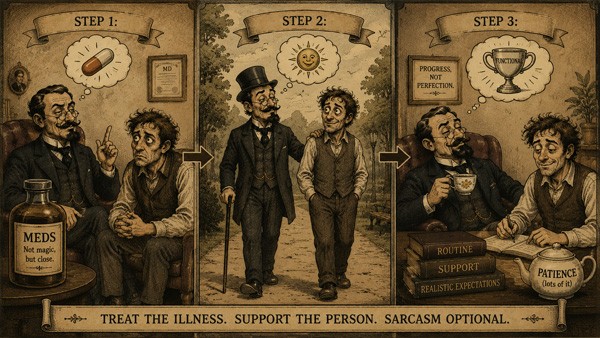
The textbook account of treating schizophrenia is short: antipsychotic medication plus psychosocial support. What that means in practice occupies years and involves a series of decisions the textbook does not describe — which drug, at what dose, for how long, what to do about the side effects, when to change, and what happens when nothing is working.
This guide covers those decisions as they are actually made, including the parts that go wrong most often: the drug that is left too late, the side effect that gets mistaken for the illness, and the physical health problems that shorten lives more than the psychiatric ones do.
🧠 The single most consequential fact in schizophrenia pharmacology: antipsychotics are broadly similar in effectiveness with one exception. Clozapine works in a substantial share of people who have failed everything else, and nothing else does. Guidelines recommend it after two adequate trials of other antipsychotics, and in practice it is typically delayed by years while combinations and dose escalations are tried instead. That delay costs function that does not fully return.
🎯 What treatment is actually aiming at
Schizophrenia produces three quite different groups of symptoms, and medication addresses them very unequally. Understanding that prevents both unrealistic expectations and premature conclusions that treatment has failed.
| Symptom group | What it involves | Response to antipsychotics |
|---|---|---|
| Positive | Hallucinations, delusions, disorganised thinking and speech | Good — this is what antipsychotics treat |
| Negative | Reduced motivation, flattened emotional expression, social withdrawal, poverty of speech | Poor — and these drive most of the long-term disability |
| Cognitive | Difficulty with attention, working memory, planning | Poor, and sometimes worsened by sedating drugs |
The mismatch matters. Families frequently describe a person whose voices have stopped but who still cannot work, study or maintain friendships, and interpret that as the medication failing. It is not failing — it is doing the part it does. Negative and cognitive symptoms need psychosocial approaches, structure, occupation and time, and they are where the real burden of the illness sits.
⏱️ Why early treatment matters
The interval between psychotic symptoms beginning and effective treatment starting is called the duration of untreated psychosis, and it is one of the more consistent predictors of outcome. Longer intervals are associated with poorer symptom response, worse social functioning and higher relapse rates.
This is the reasoning behind early intervention services, which combine medication at low doses with intensive psychosocial support, family work and help with education and employment during the first years. Where they exist, outcomes are better than with standard care, and the effect is large enough that access to such a service is worth asking about specifically.
It also means that reluctance to start treatment, while understandable, carries a cost that accumulates. The common approach of waiting to see whether things settle is reasonable over days and expensive over months.
💊 Choosing an antipsychotic
With the single exception of clozapine, comparative trials show relatively modest differences in effectiveness between antipsychotics. What differs substantially is the side effect profile, and that is what the choice is actually made on.
| Drug | Notable characteristics |
|---|---|
| Risperidone | Widely used first-line; movement side effects at higher doses; raises prolactin markedly |
| Olanzapine | Highly effective; the greatest weight gain and metabolic burden of the commonly used agents |
| Quetiapine | Sedating, which is sometimes useful; fewest movement side effects; metabolic effects moderate |
| Ziprasidone | Metabolically favourable; requires food for absorption; attention to cardiac conduction |
| Aripiprazole | Partial dopamine agonist; metabolically favourable; akathisia is the characteristic problem |
| Blonanserin | Used mainly in Asia; relatively low metabolic burden |
| Clozapine | The most effective drug available; reserved for treatment resistance because of monitoring requirements |
In practice the choice weighs what the person can least afford to experience. Someone whose work depends on alertness avoids the sedating options; someone already overweight or with diabetes in the family avoids olanzapine; someone who has had distressing movement side effects avoids risperidone at higher doses; a young person concerned about sexual side effects avoids the agents that raise prolactin most.
Response takes time. Some improvement often appears within the first week or two, and full assessment of a given drug requires four to six weeks at an adequate dose. Judging failure earlier leads to unnecessary switching and to the accumulation of drugs that follows.
⚠️ The side effects that matter most
Akathisia deserves to be first, because it is the one most often missed and the most dangerous when it is.
It is an intense inner restlessness — an inability to stay still, a compulsion to pace or rock, a feeling of being unable to tolerate being in one's own skin. It is profoundly distressing, it is associated with suicidal thinking, and it is regularly mistaken for agitation caused by the illness itself. When that happens the antipsychotic dose is increased, which makes it worse, which is read as further deterioration.
🔴 New or worsening restlessness after starting or increasing an antipsychotic should be assumed to be akathisia until proven otherwise. The distinguishing feature is that the person can usually describe it as physical restlessness they cannot control rather than as anxiety about something. It is treated by reducing the dose, switching drug, or adding a specific agent — never by increasing the antipsychotic. Anyone who becomes newly and unbearably restless on medication should say so immediately and specifically.
Parkinsonism — stiffness, slowness, tremor, reduced facial expression — is dose-related and reversible, and is frequently mistaken for negative symptoms or depression.
Tardive dyskinesia is involuntary movement, typically of the face, mouth and tongue, developing after prolonged treatment. It may persist after the drug is stopped, which makes early recognition important. Regular examination for it is part of proper monitoring.
Metabolic effects — weight gain, raised glucose, raised lipids — are the most consequential in the long run, and are covered separately below.
Raised prolactin causes sexual dysfunction, breast enlargement and tenderness, milk production, menstrual disruption and, over years, reduced bone density. It is under-asked about because both clinicians and patients avoid the subject, and it is a leading unspoken reason people stop taking medication.
Sedation interferes with work, study and driving, and contributes to the impression of flattened engagement.
Neuroleptic malignant syndrome is rare and an emergency: high fever, severe muscle rigidity, confusion and autonomic instability. It requires immediate hospital assessment.
🫀 The problem nobody treats
People with schizophrenia die on average fifteen to twenty years earlier than the general population. The largest share of that gap is not suicide, though suicide risk is real and elevated. It is cardiovascular disease.
The contributors compound each other: antipsychotics that cause weight gain and impair glucose handling, very high smoking rates, physical inactivity, poor diet, poverty, and a healthcare system that attributes physical symptoms to the psychiatric diagnosis and investigates them less thoroughly.
What proper care involves is unglamorous and specific:
| Monitoring | When |
|---|---|
| Weight and waist circumference | Baseline, then frequently in the first months, then at least annually |
| Blood glucose or HbA1c | Baseline, at three months, then annually |
| Lipid profile | Baseline, at three months, then annually |
| Blood pressure | Baseline and regularly |
| ECG | Baseline for several agents and where cardiac risk exists |
| Prolactin | Where symptoms suggest it is raised |
| Movement examination | Regularly, for parkinsonism and tardive dyskinesia |
| Smoking status and cessation support | Repeatedly — and it works, contrary to assumption |
This monitoring is frequently not done, and it is entirely reasonable for a patient or family member to ask when the last set of bloods was, what the weight trend is, and whether anyone has offered help with smoking.
🔑 Clozapine
Roughly a third of people with schizophrenia do not respond adequately to standard antipsychotics. For that group, clozapine is qualitatively different: it produces meaningful improvement where two or more other drugs have failed, it reduces suicide risk specifically, and no other medication has replicated its effect.
The criterion for using it is failure to respond to two antipsychotics, each given at an adequate dose for an adequate duration. That is the guideline position in essentially every country.
What happens instead is well documented: combinations of two or more antipsychotics, doses pushed above licensed limits, and repeated switching between drugs that are pharmacologically similar. Average delays to clozapine are measured in years, and the longer the delay the poorer the eventual response.
Why it is delayed comes down to the monitoring. Clozapine can cause agranulocytosis — a severe fall in the white cells that fight infection — in a small proportion of people, and this can be fatal if undetected. Mandatory blood monitoring, weekly at first and less frequently thereafter, detects it in time, and the monitoring systems built around this have made the risk manageable.
🔴 Clozapine cannot be taken without blood monitoring. This is not a precaution that can be skipped or arranged informally. Registration with a monitoring service, regular full blood counts on a defined schedule, and a clinician reviewing each result are part of the treatment rather than an administrative add-on. Anyone taking clozapine also needs to know that a sore throat, fever or flu-like illness requires an urgent blood count rather than waiting, and that constipation on clozapine is a serious matter, not a minor one — severe bowel obstruction on this drug has caused deaths and is more common than agranulocytosis.
Two further points that get missed. Smoking dramatically affects clozapine levels — tobacco smoke induces the enzyme that clears it, so someone who stops smoking or is admitted to a smoke-free ward can develop toxic levels within days without any dose change. And myocarditis can occur in the first weeks, presenting with chest pain, breathlessness, fever or a fast heart rate, and requires immediate attention.
Where blood monitoring genuinely cannot be arranged, clozapine is not an option, and that is a real constraint rather than a formality.
💉 Long-acting injections
Most relapses follow discontinuation of medication, and most discontinuation is not a decision but a drift — missed doses, a prescription not collected, a period of feeling well.
Long-acting injectable antipsychotics, given every two to twelve weeks depending on the preparation, remove that failure mode. Relapse and rehospitalisation rates fall substantially in studies comparing them with oral treatment, particularly in real-world rather than trial settings.
They are typically offered late, after several relapses, and often framed as a response to non-adherence, which makes them feel punitive. Offered early and framed as a convenience — not having to think about it daily, no risk of forgetting — they are accepted considerably more readily. Many people who try one prefer it.
⏳ How long to continue
This is the question people most want answered and where the evidence is genuinely uncomfortable.
After a first episode, continuing for at least one to two years after full recovery is standard. Discontinuation before that carries a high relapse rate.
After multiple episodes, treatment is generally continued indefinitely, because each relapse carries risks — to relationships, employment, housing, safety — that are difficult to reverse.
Discontinuation studies consistently find relapse rates several times higher off medication than on it. The claim that a large proportion of patients successfully stop is true only in a specific and narrow sense: a minority, generally those with a single episode, full recovery, good support and no ongoing symptoms, do discontinue and remain well. Presented as a general expectation, it encourages a decision that goes badly for most people who make it.
⚠️ If stopping is being considered, it is a plan rather than a decision. That means discussing it openly rather than doing it silently, reducing gradually over months rather than stopping abruptly, identifying the individual early warning signs of relapse in advance, agreeing with family what they should watch for, and having a clear route back to treatment quickly if needed. Done that way, an attempt to reduce is reasonable for some people. Done by simply stopping, it is the commonest route to a relapse that could have been avoided.
🚫 Polypharmacy and high doses
The critique in the original version of this article was correct and is worth keeping.
Combining two or more antipsychotics has little supporting evidence, adds side effects, complicates monitoring and makes it impossible to know which drug is doing what. It happens because switching properly requires patience during a cross-taper and it feels safer to add than to change.
Doses above licensed maxima likewise have little evidence of additional benefit, since dopamine receptor occupancy plateaus, while side effects continue to rise.
Where standard doses of two different antipsychotics have failed, the answer indicated by guidelines is clozapine, not a third drug added to the first two.
🧬 Pharmacogenetic testing
The original article recommended pharmacogenomic analysis to select the optimal drug and dose, and this deserves an accurate rather than an enthusiastic assessment.
Testing for variants in the enzymes that metabolise drugs — particularly CYP2D6 and CYP2C19 — does give real information about how quickly someone clears certain medications, and can explain unusual sensitivity or apparent non-response. That is a genuine and limited use.
What it does not do is predict which antipsychotic will work for a given person. No variant currently identifies who will respond to which drug, and major guidelines do not recommend routine pharmacogenomic testing to guide antipsychotic selection. Commercial panels marketed as personalising psychiatric treatment considerably overstate what the evidence supports.
🗣️ The treatments that are not medication
These are consistently under-provided, and one of them has the strongest relapse-reduction evidence of anything in this article.
Family intervention — structured work with the family on communication, understanding the illness and managing stress — reduces relapse and rehospitalisation substantially. The effect size rivals medication for relapse prevention, and it is available to a small fraction of families who would benefit.
Cognitive behavioural therapy for psychosis helps with distress caused by persisting symptoms, particularly voices, and with the beliefs built around them. It does not remove the symptoms and it changes their impact.
Supported employment using the place-and-train model gets substantially more people into real jobs than traditional pre-vocational training. Work matters here beyond income, because structure, purpose and social contact address exactly the negative-symptom domain medication does not.
Early intervention services, where available, combine these during the period when outcomes are most modifiable.
Smoking cessation deserves specific mention because of the assumption that people with schizophrenia cannot or should not stop. Both are wrong: cessation treatment works in this population, does not worsen psychiatric symptoms, and addresses the largest single contributor to the mortality gap. It also changes clozapine levels, which must be planned for.
🚩 Recognising relapse early
Relapse rarely arrives without warning. Most people have a characteristic pattern of early changes appearing days to weeks before symptoms return, and identifying that pattern in advance allows intervention while it is still easy.
Common early signs include disturbed sleep, withdrawal from contact, increased tension or irritability, difficulty concentrating, heightened suspiciousness, and changes in appetite or routine. They are individual, which is why writing down what happened before previous episodes is more useful than a general list.
An agreed plan — what the signs are, who to contact, how quickly, and what will be done — converts a crisis into an appointment. Family members are usually better at noticing these changes than the person themselves, which is a reason to involve them explicitly rather than a reflection on insight.
📋 What good treatment looks like
Assembling the above into a checklist a patient or family can use:
- One antipsychotic, at a dose within licensed limits, given a fair trial of four to six weeks
- Side effects asked about specifically, including restlessness, sexual effects and movements, rather than waiting for them to be volunteered
- Physical health monitored — weight, glucose, lipids, blood pressure — on a schedule, with smoking cessation offered
- Clozapine considered after two adequate trials have failed, rather than a third drug added
- A long-acting injection offered as an option, not as a consequence
- Family intervention and psychological therapy offered, not just medication
- A written relapse plan with individual early warning signs
- Employment or education support where wanted
- Honest discussion about duration, including any wish to reduce or stop
Antipsychotic medication is stocked in the antipsychotics category, including Risperdal (risperidone). These are treatments requiring diagnosis, dose titration and ongoing monitoring by a psychiatrist, and clozapine in particular cannot be taken without the mandatory blood monitoring described above.
❓ Frequently asked questions
Are some antipsychotics more effective than others?
With one exception, differences in effectiveness are modest and the choice is made mainly on side effect profile. The exception is clozapine, which produces meaningful improvement in a substantial share of people who have failed two or more other antipsychotics, and which nothing else replicates. Response to any of them takes four to six weeks at an adequate dose before it can be judged.
The voices stopped but nothing else improved. Is the medication working?
Yes, and it is doing what it does. Antipsychotics treat positive symptoms — hallucinations, delusions, disorganised thinking — well, and negative and cognitive symptoms poorly. Reduced motivation, social withdrawal, flattened expression and concentration difficulties drive most of the long-term disability and need psychosocial approaches, structure and occupation rather than more medication.
What is akathisia and why does it matter so much?
An intense inner restlessness, an inability to stay still, a feeling of being unable to tolerate being in your own skin. It is profoundly distressing and associated with suicidal thinking, and it is regularly mistaken for agitation caused by the illness — at which point the dose is increased and it worsens. New restlessness after starting or increasing an antipsychotic should be assumed to be akathisia and reported immediately.
Why is clozapine used so late?
Because of the monitoring it requires, and because adding another drug feels easier than switching. Guidelines recommend it after two adequate trials have failed, and in practice delays of years are common while combinations and higher doses are tried. The longer the delay the poorer the eventual response, which makes it one of the more consequential deviations from guidance in psychiatry.
What monitoring does clozapine need?
Regular full blood counts on a defined schedule — weekly at first, less frequently later — with a clinician reviewing each result, because it can cause a severe fall in infection-fighting white cells. This is part of the treatment rather than an administrative formality, and where monitoring cannot be arranged the drug is not an option. Fever or sore throat requires an urgent blood count rather than waiting.
Why does smoking affect clozapine?
Tobacco smoke induces the liver enzyme that clears clozapine, so smokers need higher doses to achieve the same blood level. Someone who stops smoking, or is admitted to a smoke-free ward, can develop toxic levels within days without any change in dose. Any change in smoking status needs to be reported so the dose can be adjusted and levels checked.
Why do people with schizophrenia die younger?
Mainly from cardiovascular disease rather than suicide, though suicide risk is real. Antipsychotics causing weight gain and impaired glucose handling, very high smoking rates, inactivity, poverty and a healthcare system that attributes physical symptoms to the psychiatric diagnosis all compound. Regular monitoring of weight, glucose, lipids and blood pressure, with smoking cessation offered, addresses most of it and is frequently not done.
Can medication ever be stopped?
For a minority, generally those with a single episode, full recovery, good support and no ongoing symptoms. Discontinuation studies consistently find relapse rates several times higher off medication than on it, and after multiple episodes treatment is usually continued indefinitely because each relapse costs relationships, employment and housing. Stopping should be a plan — gradual, discussed, with agreed warning signs and a route back — rather than a silent decision.
Why would an injection be better than tablets?
Because most relapses follow discontinuation, and most discontinuation is drift rather than decision — missed doses, a prescription not collected, a period of feeling well. Long-acting injections given every two to twelve weeks remove that failure mode, and relapse and rehospitalisation rates fall substantially. They are usually offered late and framed as a response to non-adherence, which makes them feel punitive rather than practical.
Is taking two antipsychotics together better?
Rarely. Combining them has little supporting evidence, adds side effects, complicates monitoring and makes it impossible to know which drug is doing what. It happens because switching properly requires a patient cross-taper and adding feels safer than changing. Where two different antipsychotics at standard doses have failed, guidelines indicate clozapine rather than a third drug on top.
Does genetic testing show which drug will work?
No. Testing for metabolising enzymes such as CYP2D6 and CYP2C19 gives real information about how quickly someone clears certain drugs and can explain unusual sensitivity or apparent non-response. It does not predict which antipsychotic will be effective, no variant currently does, and major guidelines do not recommend routine testing to guide selection. Commercial panels marketed as personalising psychiatric treatment overstate the evidence.
What helps besides medication?
Family intervention has relapse-reduction evidence rivalling medication and reaches a small fraction of families who would benefit. Cognitive behavioural therapy for psychosis reduces distress from persisting symptoms. Supported employment using a place-and-train approach gets substantially more people into real work, which addresses the negative-symptom domain medication does not. Early intervention services combine these during the years when outcomes are most modifiable.
📑 Sources and editorial
- NICE guideline on psychosis and schizophrenia in adults, and the Scottish and international equivalents
- Leucht S et al. — network meta-analyses comparing antipsychotic efficacy and tolerability
- Evidence on clozapine in treatment-resistant schizophrenia and on delays to its initiation
- Research on duration of untreated psychosis and early intervention service outcomes
- Studies of long-acting injectable antipsychotics and relapse prevention
- Literature on premature mortality and cardiovascular risk in severe mental illness
- Cochrane reviews of family intervention and cognitive behavioural therapy for psychosis
- FDA prescribing information for risperidone, olanzapine, quetiapine and clozapine
- Related products: antipsychotics category
- RXshop Editorial Team — reviewed by Thomas Walsh, MD, Psychiatry
Medical Disclaimer: The information in this article is for educational and informational purposes only and is not a substitute for professional medical advice, diagnosis, or treatment. Always seek guidance from a qualified healthcare provider with any questions you may have regarding a medical condition, and before starting, stopping or changing any medication.