Pulmonary Arterial Hypertension: Diagnosis and Treatment Explained

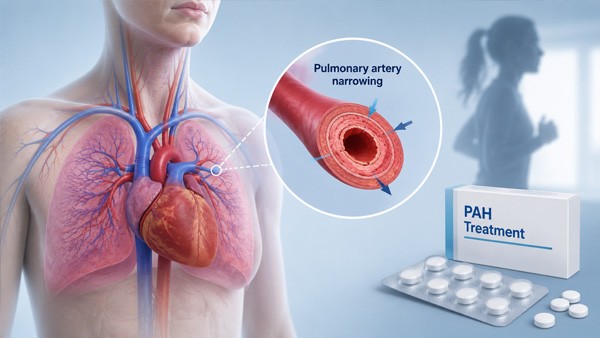

Pulmonary arterial hypertension is not high blood pressure in the usual sense. It is a disease of the small arteries inside the lungs, which thicken, narrow and eventually obliterate, forcing the right side of the heart to pump against steadily rising resistance until it fails. The blood pressure measured on the arm can be entirely normal throughout.
It is rare, affecting a small number of people per million, and it is diagnosed late with depressing regularity — typically more than two years after the first symptom, because breathlessness on exertion in a middle-aged adult gets attributed to asthma, weight, deconditioning or anxiety. This guide covers what the disease is, why the classification matters more here than in almost any other condition, how it is diagnosed properly, and what current treatment achieves.
🫁 The distinction that governs everything below: pulmonary hypertension is a haemodynamic finding with many causes, and only one group of causes responds to the specialised drugs described here. Giving those drugs to the wrong group is not merely useless — it can be harmful. That is why classification precedes treatment in every guideline.
🫀 What is happening in the lungs
The pulmonary circulation is normally a low-pressure system. Blood leaves the right ventricle, passes through the lungs to collect oxygen, and returns to the left side of the heart, all at pressures a fraction of those in the systemic circulation. The right ventricle is built accordingly — a thin-walled chamber designed for volume rather than pressure.
In pulmonary arterial hypertension the small pulmonary arteries undergo progressive remodelling: the inner lining proliferates, the muscular layer thickens, the vessels constrict, and in advanced disease characteristic plexiform lesions obliterate them entirely. Resistance rises, and the right ventricle must generate steadily higher pressure to push blood through. For a time it compensates by thickening. Eventually it dilates and fails, and right heart failure is what most patients ultimately die from.
Current definitions set the threshold at a mean pulmonary artery pressure above 20 mmHg at rest with raised pulmonary vascular resistance and a normal wedge pressure — the last criterion establishing that the problem lies in the pulmonary arteries themselves rather than upstream in the left side of the heart.
🗂️ The five groups, and why they matter
Pulmonary hypertension is divided into five clinical groups by cause. This is not academic taxonomy: the treatments described later in this article apply to group 1 only.
| Group | Cause | Treatment implication |
|---|---|---|
| Group 1 — pulmonary arterial hypertension | Idiopathic, heritable, drug-induced, or associated with connective tissue disease, HIV, portal hypertension, congenital heart disease | The specific therapies below apply here |
| Group 2 — left heart disease | Heart failure, valve disease — pressure backs up from the left side | Treat the heart condition; PAH drugs can cause harm |
| Group 3 — lung disease and hypoxia | COPD, interstitial lung disease, sleep apnoea, high altitude | Treat the lung disease and hypoxia; PAH drugs worsen oxygenation |
| Group 4 — chronic thromboembolic | Organised clot obstructing pulmonary arteries after embolism | Potentially curable by surgery — must not be missed |
| Group 5 — multifactorial | Sarcoidosis, haematological and metabolic disorders, others | Managed case by case |
🔴 Two errors in this table cause real harm. Using pulmonary vasodilators in group 2 can precipitate pulmonary oedema, because dilating the pulmonary arteries pushes more blood into a left ventricle that cannot handle it. Using them in group 3 can worsen oxygenation by increasing blood flow to poorly ventilated parts of the lung. Neither group benefits, and both can deteriorate.
Group 4 deserves separate emphasis for the opposite reason. Chronic thromboembolic pulmonary hypertension results from organised clot that never resolved after a pulmonary embolism, and in suitable patients surgical removal of that material can cure the disease. Missing it means condemning someone to lifelong medical therapy for a condition that surgery could have resolved — which is why one specific test is mandatory in the workup.
📋 Symptoms and why diagnosis takes years
The early symptoms are entirely non-specific, and that is the whole problem.
- Breathlessness on exertion, progressing gradually — the earliest and most universal symptom.
- Fatigue out of proportion to activity.
- Light-headedness or fainting on exertion, which is an ominous sign indicating the right ventricle cannot increase output.
- Chest pain resembling angina, from right ventricular strain.
- Ankle swelling and abdominal distension as right heart failure develops.
- Palpitations and, later, a bluish tinge to lips and fingers.
Each of those has a dozen commoner explanations, and the physical examination is normal early in the disease. The result is a median delay of over two years from first symptom to diagnosis, by which time most patients present in advanced functional classes. Certain groups warrant a lower threshold for suspicion: people with systemic sclerosis, in whom screening is recommended; those with HIV, portal hypertension or congenital heart disease; anyone with a family history of the condition; and survivors of pulmonary embolism with persistent breathlessness.
🩺 How it is diagnosed properly
The pathway has a fixed logic, and the last step is non-negotiable.
Echocardiography is the screening test. It estimates pulmonary pressures indirectly and shows right ventricular size and function. It raises or lowers suspicion; it does not make the diagnosis, and it can be wrong in both directions.
Ventilation-perfusion scanning is performed in every patient with unexplained pulmonary hypertension, specifically to look for chronic thromboembolic disease. This matters because a V/Q scan is more sensitive than CT angiography for the chronic organised clot of group 4 — a normal CT does not exclude it. Missing this step is the commonest way a potentially curable patient is placed on lifelong medication instead.
Right heart catheterisation is required to confirm the diagnosis. A catheter is passed to the pulmonary artery to measure pressures directly, including the wedge pressure that separates pulmonary arterial hypertension from disease of the left heart. No diagnosis of PAH should be made without it, and treatment should not begin on echocardiography alone.
Alongside these come lung function tests, high-resolution CT of the chest, autoimmune serology, HIV testing, liver imaging, blood tests including natriuretic peptides, and a six-minute walk test to establish functional baseline. During catheterisation, a vasoreactivity test is performed in idiopathic and heritable cases, because a small minority respond dramatically to calcium channel blockers — and only those with a positive test should receive them.
⚠️ Why referral to a specialist centre matters here more than in most conditions: the diagnosis requires invasive testing, the classification determines whether treatment helps or harms, the drugs are expensive and hazardous, and outcomes are measurably better in centres that manage significant numbers of these patients. This is not a condition to manage locally with a trial of tablets.
💊 The three treatment pathways
Modern therapy for group 1 disease targets three biological pathways, each with its own drug classes. Understanding the framework explains why combination therapy became standard.
| Pathway | Drug classes | Examples |
|---|---|---|
| Nitric oxide | Phosphodiesterase-5 inhibitors; soluble guanylate cyclase stimulators | Sildenafil, tadalafil; riociguat |
| Endothelin | Endothelin receptor antagonists | Bosentan, ambrisentan, macitentan |
| Prostacyclin | Prostacyclin analogues; prostacyclin receptor agonists | Epoprostenol, treprostinil, iloprost; selexipag |
| Activin signalling | Newer class targeting vascular remodelling directly | Sotatercept |
The phosphodiesterase-5 inhibitors will be familiar under other names: sildenafil and tadalafil are the same molecules used for erectile dysfunction, at different doses and under different brand names for this indication. The men's health category stocks those molecules for their urological indication; pulmonary hypertension dosing, monitoring and formulation are entirely separate matters handled by a specialist centre.
⛔ Self-treating pulmonary hypertension with erectile dysfunction tablets is dangerous and should not be attempted. The doses differ, the drug must be matched to the classification group, combining a PDE5 inhibitor with riociguat is absolutely contraindicated because of severe hypotension, and treatment requires monitoring that does not exist outside specialist care. A person with suspected PAH needs catheterisation, not a prescription bought online.
🎯 How treatment is actually selected
Contemporary practice starts by stratifying risk — low, intermediate or high — using functional class, six-minute walk distance, natriuretic peptide levels and haemodynamic measurements. That assessment determines the starting regimen and is repeated at each review.
- Low or intermediate risk: initial combination therapy, typically an endothelin receptor antagonist plus a PDE5 inhibitor, started together rather than sequentially. This approach outperformed starting one drug and adding another later.
- High risk: triple therapy including a parenteral prostacyclin, delivered by continuous infusion through a pump. Demanding, but it changed survival in severe disease more than any other intervention.
- Positive vasoreactivity test — a small minority of idiopathic cases: high-dose calcium channel blockers, with close follow-up, since some lose the response over time.
- Inadequate response at review: escalation by adding the third pathway rather than substituting within a pathway.
Treatment goals are defined explicitly: reaching and maintaining low-risk status, which correlates with survival. Reviews occur every three to six months with repeated walk tests, biomarkers and echocardiography.
⚠️ Safety, monitoring and the hard rules
These drugs carry substantial requirements, and several restrictions are absolute.
| Issue | What it involves |
|---|---|
| Pregnancy | Contraindicated — maternal mortality is high. Effective contraception is mandatory, and several of these drugs are teratogenic |
| Contraception interaction | Bosentan reduces the effectiveness of hormonal contraception; two methods or a non-hormonal method are required |
| Liver monitoring | Bosentan requires monthly liver function testing |
| Riociguat with PDE5 inhibitors | Absolutely contraindicated — severe hypotension |
| Nitrates with PDE5 inhibitors | Absolutely contraindicated for the same reason |
| Anaemia and fluid retention | Endothelin antagonists cause both; monitored routinely |
| Infusion line care | Parenteral prostacyclins carry infection and interruption risks; abrupt cessation can be fatal |
The pregnancy point deserves emphasis rather than a table row. Pregnancy in pulmonary arterial hypertension carries a high risk of maternal death, and women of childbearing age need that discussed explicitly at diagnosis, with reliable contraception arranged. Anyone who becomes pregnant requires immediate specialist involvement.
🏥 Supportive care and surgery
Beyond the targeted drugs, several measures form part of standard management. Diuretics control right heart failure and fluid overload. Supplemental oxygen is used where oxygen saturation is persistently low. Anticoagulation is applied selectively rather than universally, having fallen out of routine use in most forms. Vaccination against influenza, pneumococcus and COVID-19 is recommended, since respiratory infection is poorly tolerated. Iron deficiency is common and worth correcting.
Supervised exercise rehabilitation deserves specific mention, because it was long avoided out of caution and has since been shown to improve capacity and quality of life when delivered in a specialist programme with stable patients on optimised therapy. Unsupervised heavy exertion remains inadvisable.
Surgical options exist at both ends. For group 4 disease, pulmonary endarterectomy can be curative, and balloon pulmonary angioplasty offers an option for those unsuitable for surgery. For advanced group 1 disease failing maximal therapy, lung transplantation remains the final option, and timely referral matters because waiting-list mortality is significant.
📈 What the outlook is now
Prognosis has improved substantially. Before targeted therapy existed, median survival after diagnosis of idiopathic PAH was measured in a few years. Contemporary cohorts on modern combination treatment do considerably better, though the condition remains serious and is not curable outside the thromboembolic group.
What predicts outcome is broadly what treatment targets: functional class, exercise capacity, natriuretic peptide levels and right ventricular function. Reaching low-risk status and staying there is associated with markedly better survival, which is why the risk-stratification framework governs practice rather than sitting in a guideline appendix.
✅ The three things that most change an individual outcome: being diagnosed earlier rather than after years of attributed breathlessness; being classified correctly, so that treatment matches the actual disease; and being managed by a specialist centre with sufficient volume. None of those is about a specific drug, and all of them are decided before the first prescription is written.
For related cardiovascular topics see our guides on blood pressure and ACE inhibitors and the blood pressure medication range.
❓ Frequently asked questions
Is pulmonary hypertension the same as high blood pressure?
No. It refers to raised pressure in the arteries of the lungs, not in the systemic circulation measured at the arm, and the two are separate conditions with different causes and treatments. A person with pulmonary arterial hypertension can have completely normal blood pressure on a standard cuff reading, which is one reason the diagnosis is missed.
Why does diagnosis take so long?
Because the early symptoms are breathlessness on exertion and fatigue, which have many commoner explanations, and the physical examination is normal early on. The median delay from first symptom to diagnosis exceeds two years. Certain groups warrant earlier suspicion: people with systemic sclerosis, HIV, portal hypertension, congenital heart disease, a family history, or persistent breathlessness after pulmonary embolism.
Can echocardiography make the diagnosis?
No. Echocardiography is the screening test: it estimates pressures indirectly and assesses right ventricular function, but it can be misleading in both directions. Diagnosis requires right heart catheterisation, which measures pressures directly and includes the wedge pressure that distinguishes pulmonary arterial hypertension from disease of the left side of the heart.
Why is a lung scan needed if a CT was normal?
Because ventilation-perfusion scanning is more sensitive than CT angiography for the organised chronic clot of group 4 disease, and a normal CT does not exclude it. This matters enormously: chronic thromboembolic pulmonary hypertension can be cured surgically in suitable patients, so missing it means lifelong medication for a condition that an operation could have resolved.
Can I take sildenafil for pulmonary hypertension myself?
No. Although the molecule is the same as that used for erectile dysfunction, the dose, indication and monitoring differ entirely, and the drug helps only one of the five classification groups — in groups 2 and 3 it can cause harm. Combining it with riociguat or with nitrates is absolutely contraindicated. This treatment requires catheterisation, correct classification and specialist supervision.
What does combination therapy mean here?
Starting two drugs from different biological pathways at the same time rather than adding a second later. For patients at low or intermediate risk this usually means an endothelin receptor antagonist with a PDE5 inhibitor, and it produces better outcomes than sequential treatment. High-risk patients receive triple therapy including a parenteral prostacyclin delivered by continuous infusion.
Are calcium channel blockers used?
Only in the small minority of idiopathic or heritable cases with a positive vasoreactivity test performed during right heart catheterisation. Those patients can respond dramatically to high doses. Giving calcium channel blockers to patients without a demonstrated positive response is ineffective and potentially dangerous, which is why the test is part of the diagnostic catheterisation.
Is pregnancy possible with this condition?
Pregnancy is contraindicated because maternal mortality is high, and several of the treatments are teratogenic. Effective contraception is mandatory for women of childbearing age, and there is an added complication: bosentan reduces the effectiveness of hormonal contraception, so two methods or a non-hormonal method are required. Anyone who becomes pregnant needs immediate specialist involvement.
Can exercise be harmful?
Unsupervised heavy exertion is inadvisable, particularly anything causing dizziness or chest pain. Supervised exercise rehabilitation in a specialist programme, for stable patients on optimised therapy, has been shown to improve exercise capacity and quality of life. The distinction is between structured, monitored activity and pushing to exhaustion alone.
Is it ever curable?
Group 4 disease — chronic thromboembolic pulmonary hypertension — can be cured by surgical removal of the organised clot in suitable patients, which is why identifying it is so important. Group 1 pulmonary arterial hypertension is not curable with current medication, though modern combination therapy controls it substantially. Lung transplantation remains the final option for advanced disease failing maximal treatment.
What is the outlook today?
Considerably better than before targeted therapy existed, when median survival after diagnosis of idiopathic disease was a few years. Contemporary outcomes on combination treatment are substantially improved, though the condition remains serious. Prognosis tracks functional class, exercise capacity, natriuretic peptides and right ventricular function — reaching and maintaining low-risk status is associated with markedly better survival.
Why must treatment happen in a specialist centre?
Because diagnosis requires invasive testing, classification determines whether treatment helps or harms, the drugs carry serious interactions and monitoring requirements, and outcomes are measurably better in centres managing sufficient numbers of these patients. Parenteral prostacyclin therapy in particular requires infrastructure and training that general practice cannot provide.
📑 Sources and editorial
- ESC and ERS guidelines for the diagnosis and treatment of pulmonary hypertension, including current haemodynamic definitions and risk stratification
- World Symposium on Pulmonary Hypertension clinical classification of the five groups
- FDA prescribing information for sildenafil, tadalafil, bosentan, ambrisentan, macitentan, riociguat and prostacyclin analogues
- Published trial evidence on initial combination therapy and on exercise rehabilitation in pulmonary arterial hypertension
- Related reading on RXshop: Blood pressure and ACE inhibitors
- RXshop Editorial Team — reviewed by Robert Hayes, MD, FACC, Cardiologist & Cardiovascular Disease Specialist
Medical Disclaimer: The information in this article is for educational and informational purposes only and is not a substitute for professional medical advice, diagnosis, or treatment. Always seek guidance from a qualified healthcare provider with any questions you may have regarding a medical condition, and before starting, stopping or changing any medication.