Pomegranate: Which Claims Survive the Evidence


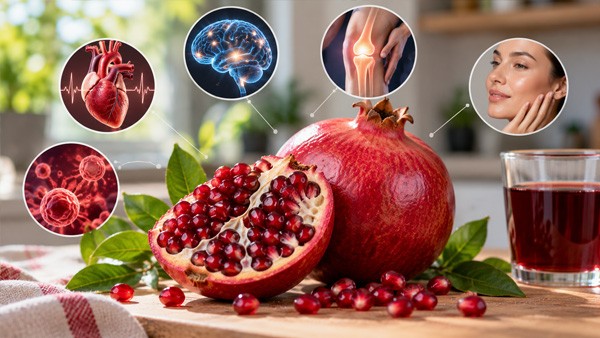
Pomegranate is credited with a long list of benefits, and the list is unusual in one respect: a couple of the entries are genuinely supported by controlled trials, while most rest on laboratory work, small studies or straightforward assumption.
Sorting them is worth doing, partly because the supported claim is useful, and partly because pomegranate is one of the few foods with a real reason to check what medicines you take before adding it to your day.
💡 Two things distinguish this article from the usual list. First, one claim — blood pressure — holds up across randomised trials, with an effect size that is small but genuinely worth having. Second, pomegranate juice affects the liver enzymes that process a number of medicines, and adds to the effect of blood pressure drugs. That combination means it is one of the few fruits where the sensible advice depends on what else you are taking.
📊 The ten claims, ranked by evidence
| Claim | What the evidence actually shows |
|---|---|
| Lowers blood pressure | Supported. Randomised trials and pooled analyses show a consistent modest reduction |
| Improves blood vessel function | Reasonably supported. Measurable improvement in several trials |
| Reduces muscle soreness after exercise | Modest support from small trials |
| Anti-inflammatory | Small changes in some blood markers; unclear whether that matters clinically |
| Improves cholesterol | Inconsistent. Some trials show an effect, others none |
| Helps memory | Preliminary. A few small studies, nothing settled |
| Slows prostate cancer | Not supported. Early promising results were not confirmed when tested properly — see below |
| Raises testosterone or improves erections | Very weak. One small trial did not reach significance on its main measure |
| Antimicrobial | In a laboratory dish only, which is true of most plant extracts and means little |
| Diuretic and aids weight loss | No meaningful evidence |
❤️ The one that holds up
Blood pressure is the claim with real trial evidence behind it, and it has been examined repeatedly.
Pooled analyses of randomised controlled trials find pomegranate juice produces a modest reduction in systolic blood pressure, in the region of a few millimetres of mercury, with a smaller effect on the lower figure. The effect appears across studies rather than in isolated ones, which is what separates it from most food claims.
A few points on how to read that.
The size is small. A reduction of four or five points is not a substitute for medication in anyone who needs it. Across a population, though, a shift of that size is associated with meaningfully fewer strokes and cardiac events, which is why it is taken seriously despite being modest for any individual.
It requires a real quantity. The trials generally used around 240 millilitres of juice daily — a decent glass, every day, not occasionally.
It is one of several small levers. Reducing salt, losing excess weight, regular activity, moderating alcohol and better sleep each do at least as much, and stack.
The related finding on blood vessel function points the same direction. The lining of the arteries appears to work somewhat better after regular intake, which is plausibly the mechanism behind the blood pressure effect rather than a separate benefit.
🧬 Why it works for some people and not others
This is the most interesting thing about pomegranate and it explains a great deal of the inconsistency in the research.
The compounds pomegranate is famous for — the large polyphenols called ellagitannins — are barely absorbed in their original form. They pass into the large intestine, where gut bacteria convert them into a smaller compound that the body can actually absorb and use.
That compound is where most of the biological activity appears to sit. And here is the part that matters: not everyone has the gut bacteria to make it. Estimates suggest only around four people in ten convert efficiently, with the rest producing little or none.
The implications are real. Two people can drink identical amounts and end up with quite different levels of the active compound in their blood. Trials that do not account for this mix responders and non-responders together, which dilutes any true effect and helps explain why results vary so much between studies.
It also means there is no way to know in advance which group you are in, short of specialised testing that is not routinely available. Practically, that is an argument for trying it for a month or two and judging by your own blood pressure readings rather than by what a study average says.
🔬 About antioxidants
Pomegranate is regularly described as extraordinarily high in antioxidants, and that is true as a measurement. The inference usually drawn from it is not.
The reasoning goes: free radicals damage cells, antioxidants neutralise free radicals, therefore more antioxidants means less damage and better health. Each step sounds right and the chain does not hold in practice.
Large trials of antioxidant supplements have been consistently disappointing and occasionally worse than that — beta-carotene supplementation increased lung cancer in smokers rather than reducing it. High-dose vitamin E and vitamin C trials have largely failed to show the expected benefits.
Several explanations have been proposed. Free radicals also serve useful signalling functions that indiscriminate suppression interferes with. The antioxidant capacity measured in a test tube does not predict what happens in a body. And whole foods deliver hundreds of compounds in combination, which is not the same as a concentrated dose of one.
So antioxidant content is a reason to expect a food to be worth eating, not evidence that it does anything specific. Where pomegranate has demonstrated an effect, it has done so in trials measuring outcomes, and those are the ones worth quoting.
🎗️ The prostate claim, corrected
This deserves its own section because it is the most widely repeated pomegranate claim and it did not survive proper testing.
Early studies in men with rising PSA after prostate cancer treatment reported that the rate of rise slowed considerably during pomegranate juice consumption. The results were striking and were widely reported.
Those studies had no comparison group. Every participant received pomegranate, and their rate of PSA rise was compared with their own earlier rate — a design that cannot separate a real effect from the natural variability of the measure or from everything else changing at once.
When the question was tested properly, with participants randomly assigned to pomegranate extract or to placebo, the difference between the groups was not statistically significant.
This is a textbook illustration of why the study design matters more than the result. Anyone with prostate cancer should treat pomegranate as a pleasant fruit rather than as part of their treatment, and should be particularly cautious of supplements marketed on the strength of the earlier findings. The article on hormonal therapy for prostate cancer covers what does work.
💊 The section other articles leave out
Pomegranate juice interacts with medicines, and this is where an article on a pharmacy site should earn its place.
🔴 Check before adding daily pomegranate juice if you take any of the following.
Warfarin. There are case reports of raised clotting measurements after starting pomegranate juice, and laboratory work suggests it affects the enzyme that clears warfarin. Anyone on warfarin should either avoid it or keep intake consistent and mention it before the next check, rather than starting and stopping unpredictably.
Blood pressure medication. The effect adds to the drug’s. That is usually welcome and it can occasionally produce dizziness or light-headedness, particularly on standing, and particularly when starting.
ACE inhibitors, angiotensin receptor blockers and potassium-sparing diuretics. Pomegranate is high in potassium, and these drugs raise potassium too. In anyone with reduced kidney function that combination is worth being aware of.
Statins and other drugs processed by the same liver enzyme. Pomegranate inhibits it, less strongly and less consistently than grapefruit does, and there is at least one report of serious muscle injury in someone combining a statin with pomegranate juice. The interaction is not as well established as the grapefruit one and it is not dismissible either.
The general principle applies here as with any food that turns out to be pharmacologically active: tell prescribers and pharmacists what you consume regularly, not only what you have been prescribed. A daily glass of juice is a daily dose of something.
🥤 Juice, fruit or capsule
The form changes what you are getting.
| Form | Consider |
|---|---|
| Whole fruit | Fibre included, sugar released more slowly, more filling, and the seeds themselves are eaten. The best default |
| Juice | What the trials used, so the evidence applies to it most directly. Also concentrated sugar with no fibre — a glass carries roughly the sugar of a soft drink |
| Extract or capsule | Content varies enormously between products and frequently does not match the label. Doses used in research are not standardised across brands |
| Juice drinks and blends | Often mostly apple or grape juice with a small proportion of pomegranate. Check the percentage on the label |
For anyone with diabetes or watching weight, the sugar content of the juice is the relevant consideration and the whole fruit is the better route. For anyone specifically pursuing the blood pressure effect, the juice is what was studied.
🎯 Who should be careful
- Anyone taking warfarin — discuss before starting, and keep intake consistent if you do
- Anyone on blood pressure medication — the effects add, which is usually good and occasionally too much
- Anyone with reduced kidney function, because of the potassium
- Anyone with diabetes — whole fruit rather than juice
- Anyone taking a statin or another medicine processed by the same enzyme — worth a check
- Anyone with prostate cancer — enjoy it as a fruit, do not treat it as treatment
📋 The honest summary
Pomegranate is a good fruit. It is high in fibre, contains useful vitamins and minerals, and is worth eating.
One specific claim is well supported — a modest reduction in blood pressure with a daily glass of juice, alongside a related improvement in blood vessel function.
Several claims are preliminary, and preliminary means they might turn out to be true rather than that they are.
One prominent claim did not survive testing, and continues to be repeated.
It genuinely interacts with medicines, which almost no article about it mentions.
It is not a substitute for treatment. Anyone with raised blood pressure should have it managed properly, since a few points from juice does not address a reading that needs treating.
Blood pressure treatment is stocked in the blood pressure category, and related options in the cardiovascular and cholesterol categories. What is appropriate depends on the readings, the overall cardiovascular risk and what else is present, which is a matter for a prescriber rather than a fruit.
❓ Frequently asked questions
Does pomegranate really lower blood pressure?
Yes, modestly, and this is the one claim with real trial evidence behind it. Pooled analyses of randomised controlled trials find a reduction in systolic pressure of a few millimetres of mercury, appearing consistently across studies rather than in isolated ones. The trials generally used around 240 millilitres of juice daily — a decent glass every day, not occasionally.
Is a few points of blood pressure worth bothering with?
For any individual it is small and not a substitute for medication where medication is needed. Across a population, a shift of that size is associated with meaningfully fewer strokes and cardiac events, which is why it is taken seriously. It is best thought of as one of several small levers alongside salt reduction, weight, activity, alcohol and sleep, all of which stack.
Medical Disclaimer: The information in this article is for educational and informational purposes only and is not a substitute for professional medical advice, diagnosis, or treatment. Always seek guidance from a qualified healthcare provider with any questions you may have regarding a medical condition, and before starting, stopping or changing any medication.