Folic Acid Before Pregnancy: Why Day 28 Matters

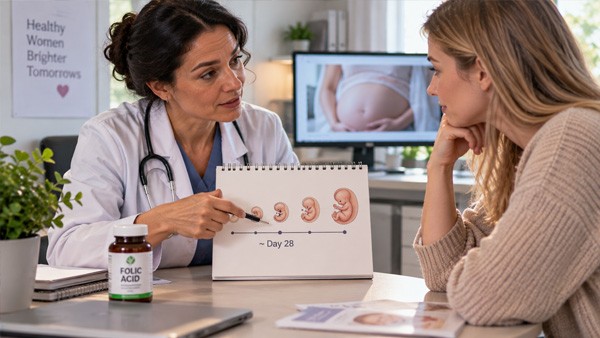

There is a piece of information about pregnancy that arrives too late for most people who need it, and the reason is a matter of days.
The structure that becomes the brain and spinal cord forms and seals itself very early — earlier than almost anyone assumes. By the time a pregnancy test turns positive, that process is finishing or already finished. Everything that can be done to protect it had to be done beforehand.
This article is about that window, what closes it, and who needs more protection than the standard advice provides.
🗓️ The timeline, which is the entire point. The neural tube — the folded sheet of tissue that becomes the brain and spinal cord — forms and closes during roughly the third and fourth weeks after conception. It is complete by about day twenty-eight.
Day twenty-eight after conception is around the time of the first missed period. So a woman taking a test on the day her period does not arrive is looking at a positive result on or after the day the window shut. Starting folic acid at that moment is not late by a little. It is late entirely, for this particular purpose.
That single fact explains why every guideline says before conception rather than during pregnancy, and why the advice is aimed at women who might become pregnant rather than only those who already are.
📅 Why the standard advice misses most people
The usual instruction is to start folic acid when planning a pregnancy. That works well for planned pregnancies and does nothing at all for the rest — and roughly half of all pregnancies are unplanned, including a great many that are welcome.
A woman who was not planning to conceive has no reason to take a supplement, discovers the pregnancy at five or six weeks, and starts folic acid then. Everything about her behaviour was reasonable. The timing simply cannot work.
This is why the recommendation in most countries is broader than it first appears: anyone who could become pregnant, and is not using reliable contraception, benefits from taking folic acid routinely — not as preparation for a specific plan, but as ordinary background cover for a possibility.
It is inexpensive, it is safe, there is no accumulation problem, and it is one of very few interventions in medicine where a small daily action prevents a catastrophic outcome outright.
💊 The dose, and who needs a bigger one
For most people the standard dose is 400 micrograms daily, started at least a month before conception where possible and continued through the first twelve weeks of pregnancy. Taken that way it reduces the risk of these defects by roughly two thirds to three quarters.
But there is a second dose, more than ten times higher, prescribed for specific groups — and this is the part that is widely unknown, including by some of the people who need it.
⚠️ A higher dose — typically 5 milligrams daily, on prescription — is recommended where risk is increased. That includes:
- A previous pregnancy affected by a neural tube defect
- A neural tube defect in either parent, or a close family history
- Diabetes, whether type 1 or type 2
- Taking antiepileptic medication
- Significantly raised body weight
- Coeliac disease or another condition affecting absorption, and after certain weight-loss surgery
- Sickle cell disease and some other blood disorders
- Taking certain medicines that interfere with folate, including some used for malaria, some antibiotics, and methotrexate
Several of these are common. Someone with type 2 diabetes or a raised body weight who buys a standard supplement in good faith is taking a twelfth of what is recommended for her, and nothing on the packet tells her so. If any of the above applies, this needs a conversation with a doctor rather than a purchase decision.
🚨 The medication that matters most
Among the risk factors above, one deserves separating out, because it is the largest modifiable one and because it is frequently described inaccurately.
🔴 Valproate carries by far the highest risk of the antiepileptic medicines. It raises the chance of a neural tube defect several times over, and it carries a separate and substantial risk of developmental and learning problems in children exposed during pregnancy. For these reasons it is restricted across much of the world for women and girls able to become pregnant, and must not be used in that group unless nothing else works and strict pregnancy prevention is in place.
Carbamazepine also raises the risk, though less. Lamotrigine and levetiracetam are among the safer options — a point worth stating clearly, because valproate and lamotrigine are sometimes confused, and the difference between them here is enormous.
Nobody should stop an antiepileptic medicine on their own. Uncontrolled seizures are dangerous in pregnancy for both mother and baby, and abrupt withdrawal can cause them. This is a planned change made with a specialist, ideally months before conception, alongside the higher folic acid dose.
Valproate is stocked here as Depakote and the same warning applies to it whatever the reason for taking it. The article on valproate covers this in detail.
🩹 Two things that can be changed beforehand
Beyond supplementation, two common conditions raise the risk and both respond to action taken before conception rather than after.
Diabetes. Poorly controlled blood sugar in the first weeks substantially increases the risk of neural tube defects and several other malformations — and again, those first weeks are before most women know. Bringing glucose control to target before conceiving reduces that risk considerably, which is why preconception planning is standard advice in diabetes and why it is worth acting on rather than filing away. Some diabetes medicines also need reviewing before pregnancy.
Body weight. Higher body weight is associated with increased risk, and the mechanism is not fully explained by folate levels alone, which is part of why the higher supplement dose is advised rather than simply relying on the standard one.
A third exposure is worth knowing because it is avoidable and rarely mentioned: a high body temperature in the earliest weeks — from a significant fever, or from prolonged use of very hot baths or saunas — is associated with increased risk. Fever in early pregnancy is worth treating rather than sitting out.
💊 Medicines to settle before conceiving
Several treatments require planning rather than a last-minute decision, and the common thread is that the harm occurs early.
Isotretinoin, used for severe acne, is among the most powerful known causes of birth defects. Pregnancy must be avoided during treatment and for a period afterwards, and the prevention programmes attached to it exist for exactly this reason. It is stocked as Accutane and related products, and the requirement is absolute rather than cautious.
Methotrexate interferes directly with folate and must be stopped well before conception, with specialist guidance on timing.
Some medicines for blood pressure, mood and infection also need review. The correct approach is never to stop something abruptly, but to raise the subject early — ideally at the point of considering a pregnancy rather than after a positive test.
🧬 What does not cause this
This section matters as much as the rest, and it is usually missing.
The great majority of neural tube defects occur in pregnancies with no identifiable risk factor at all, in women who took folic acid exactly as advised, ate well, avoided everything they were told to avoid, and did nothing wrong. Folic acid reduces the risk substantially. It does not eliminate it, and no supplement does.
These defects are not caused by stress, by an argument, by lifting something heavy, by a glass of wine before the pregnancy was known, by exercise, by sexual activity, or by anything a parent thought or felt. They are not inherited in a simple way, and having one affected pregnancy does not mean a future one will be affected — the risk rises, but the great majority of subsequent pregnancies are unaffected, particularly with the higher supplement dose.
Parents in this situation search for what they did. They usually find something to blame themselves for, because anyone looking hard enough will. It is worth saying plainly that in the overwhelming majority of cases there is nothing there to find.
🔍 What screening shows
Anencephaly is one of the conditions ultrasound identifies most reliably, and it can usually be seen from around the eleven to fourteen week scan, sometimes earlier. Spina bifida is generally identified at the detailed scan around eighteen to twenty weeks, and certain features visible earlier can raise suspicion.
The two conditions have very different outlooks, and conflating them causes unnecessary fear. Anencephaly is not survivable — the brain and skull have not formed sufficiently, and babies who reach birth live a very short time. Spina bifida is survivable, and outcomes vary enormously depending on the site and severity, with many people living full lives with varying degrees of physical disability. Surgery is performed after birth and, in selected cases, during pregnancy.
Families receiving either diagnosis are facing decisions that no article can help with, and they should have access to specialist counselling, genetic advice and support organisations rather than information alone. Those services exist and are worth asking for explicitly.
📋 The practical version
- If pregnancy is possible, take 400 micrograms of folic acid daily, whether or not you are trying
- If actively trying, start at least a month before, and continue to twelve weeks
- If any higher-risk factor applies, ask about the 5 milligram dose rather than assuming the standard one is enough
- If you take medication for epilepsy, raise pregnancy plans early and never stop treatment yourself
- If you have diabetes, get control to target before conceiving rather than after
- If you take isotretinoin or methotrexate, treat pregnancy prevention as absolute and plan the timing with a doctor
- Treat significant fever in early pregnancy rather than waiting it out
- Do not rely on fortified food alone, which raises intake but is not designed to reach the protective level on its own
- Do not double up on multivitamins to increase folic acid — some contain vitamin A in forms that are harmful in pregnancy
🩺 When to seek help
- Before stopping any epilepsy medication — always, and well in advance
- On discovering a pregnancy while taking valproate, isotretinoin or methotrexate — urgent, and not a reason to stop anything without advice
- Diabetes and considering pregnancy — preconception review, ideally months ahead
- A previous pregnancy affected by a neural tube defect — ask about the higher dose and about genetic counselling before conceiving again
- Coeliac disease, malabsorption or previous weight-loss surgery — standard supplementation may not be adequate
- Fever above 38 degrees in early pregnancy — seek advice rather than waiting
- Any regular medication and a possible pregnancy — a pharmacist can check it quickly
- After a diagnosis at any scan — ask specifically for specialist counselling and support services, not only medical information
Fertility treatment is stocked in the womens health category, including Clomid (clomiphene) and Duphaston (dydrogesterone). Anyone starting treatment to conceive should already be taking folic acid at that point — the supplement needs to be established before conception occurs, not begun once a pregnancy is confirmed.
❓ Frequently asked questions
When exactly does the neural tube close?
During roughly the third and fourth weeks after conception, complete by about day twenty-eight. That is around the time of the first missed period, so a positive test on the day a period fails to arrive comes on or after the day the window shut. This is why every guideline says before conception rather than during pregnancy.
I only started folic acid when I found out. Is it too late?
For this particular purpose the main window has passed, and that is worth knowing rather than worrying about — it is not something you could have controlled without knowing you were pregnant. Continue taking it, because folate matters for other aspects of development and for you. And be reassured that the overwhelming majority of pregnancies in exactly this situation are entirely unaffected.
Should I take it if I am not trying to conceive?
If pregnancy is possible and you are not using reliable contraception, yes. Around half of pregnancies are unplanned, and by the time an unplanned one is discovered the window has closed. The recommendation is deliberately broad for that reason. It is inexpensive, safe, does not accumulate, and covers a possibility rather than a plan.
How much should I take?
400 micrograms daily for most people, started at least a month before conception and continued to twelve weeks. But a much higher prescription dose, usually 5 milligrams, is recommended for a long list of situations including diabetes, raised body weight, epilepsy medication, coeliac disease, a previous affected pregnancy and a family history. Several of those are common, and nothing on a standard packet flags them.
Which epilepsy medicine is the risky one?
Valproate, by a wide margin. It raises the risk of neural tube defects several times over and separately carries a substantial risk of developmental and learning problems, which is why it is restricted for women and girls able to become pregnant across much of the world. Carbamazepine raises risk less. Lamotrigine and levetiracetam are among the safer options — a distinction worth being clear about, since valproate and lamotrigine are sometimes confused.
Should I stop my epilepsy medication if I want to conceive?
Never on your own. Uncontrolled seizures are dangerous in pregnancy for both mother and baby, and stopping abruptly can cause them. Any change is planned with a specialist, ideally months before conception, and usually involves switching rather than stopping, alongside the higher folic acid dose. Raise it early rather than at the point of a positive test.
Is fortified food enough on its own?
It helps and it is not designed to be sufficient alone. Fortification raises intake across a population and reduces defect rates measurably, but it does not reliably deliver the protective amount to an individual. Take the supplement as well. And do not try to increase folic acid by doubling a multivitamin, since some contain vitamin A in forms that are harmful in pregnancy.
Did something I did cause this?
Almost certainly not. The great majority of these defects occur with no identifiable risk factor, in women who took folic acid as advised and did nothing wrong. They are not caused by stress, an argument, lifting something, a drink before the pregnancy was known, exercise or anything a parent thought or felt. Anyone searching hard enough will find something to blame themselves for, and in the overwhelming majority of cases there is nothing there.
If one pregnancy was affected, will the next one be?
The risk is higher than average, and the great majority of subsequent pregnancies are still unaffected — particularly with the higher folic acid dose, which is specifically recommended in this situation and which substantially reduces recurrence. Genetic counselling before conceiving again is worth asking for, both for accurate figures and for planning.
Are anencephaly and spina bifida the same thing?
They are both neural tube defects with the same prevention, and their outlooks are entirely different. Anencephaly is not survivable, since the brain and skull have not formed sufficiently. Spina bifida is survivable, with outcomes varying widely by site and severity, and many people live full lives with varying degrees of physical disability. Conflating the two causes a great deal of unnecessary fear.
📑 Sources and editorial
- Embryological literature on neural tube formation and closure timing
- Trial and cohort evidence on periconceptional folic acid supplementation and neural tube defect reduction
- Guideline recommendations on standard and high-dose folic acid, including qualifying risk factors
- Population data on the proportion of unplanned pregnancies and implications for preconception advice
- Regulatory restrictions and risk data on valproate in pregnancy, including neurodevelopmental outcomes
- Comparative teratogenicity data across antiepileptic drugs
- Evidence on periconceptional glycaemic control and congenital malformation risk in diabetes
- Literature on maternal body weight, hyperthermia and neural tube defect risk
- Pregnancy prevention programme requirements for isotretinoin, and folate antagonism by methotrexate
- Guidance on prenatal ultrasound detection of anencephaly and spina bifida, and on recurrence risk
- Related reading: valproate, cycle disorders and conception, contraception
- Related products: womens health category
- RXshop Editorial Team — reviewed by Anita Sharma, MD, Obstetrics and Gynaecology
Medical Disclaimer: The information in this article is for educational and informational purposes only and is not a substitute for professional medical advice, diagnosis, or treatment. Always seek guidance from a qualified healthcare provider with any questions you may have regarding a medical condition, and before starting, stopping or changing any medication.