Gut Bacteria: What Antibiotics Do and What Follows

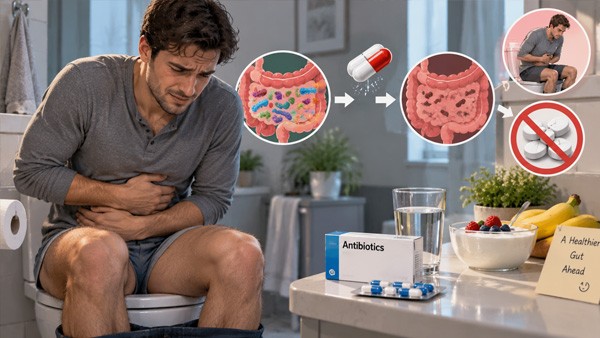

The large intestine holds a bacterial population comparable in number to all the cells of the body it lives in. It ferments what you cannot digest, produces vitamins, occupies the space that harmful organisms would otherwise take, and trains the immune system throughout childhood.
It is also the reason a course of antibiotics for a chest infection can cause a problem in the bowel weeks later, and that connection is the most practically useful thing on this page.
🚫 The single most important thing here, stated before anything else. Diarrhoea after antibiotics is common and usually harmless. Occasionally it is an infection called Clostridioides difficile, which is dangerous — and the instinctive response, an anti-diarrhoeal tablet, makes that infection considerably worse. Slowing the bowel keeps the toxin in contact with the lining and can lead to the colon distending catastrophically. Watery diarrhoea several times a day after a course of antibiotics, particularly with fever or abdominal pain, means being assessed rather than reaching for a remedy.
🧬 What they actually do
Several functions are firmly established, as distinct from the much longer list of things the microbiome is claimed to influence.
They ferment fibre. Human digestion cannot break down most plant fibre. Bacteria in the colon can, and the short-chain fatty acids they produce are the main fuel source for the cells lining the bowel itself. The colon is largely fed by its own bacteria rather than by the bloodstream.
They produce vitamins, including vitamin K and several B vitamins.
They occupy the space. A dense established population leaves little room and few nutrients for an incoming organism to establish itself. This is called colonisation resistance and it is the mechanism that matters most in what follows.
They train the immune system, particularly in early childhood, when exposure shapes how the immune system later distinguishes threat from harmless.
They process medicines. Some drugs are activated, inactivated or recycled by gut bacteria, which is one route by which antibiotics alter the effect of other treatments.
💊 What a course of antibiotics does
An antibiotic taken for an infection anywhere in the body reaches the intestine and kills a large proportion of what lives there, indiscriminately.
Diversity falls within days. Recovery begins after the course ends and takes weeks to months for most of the population, and some species do not return for a year or more, or at all. Broader-spectrum drugs and longer courses cause more disruption.
Most of the time nothing is noticed beyond a few loose days. The consequence that matters is the temporary loss of colonisation resistance — for a period after the course, the gut is unusually open to an organism that would ordinarily find no space.
🚨 When the diarrhoea is an infection
Loose stools during or shortly after antibiotics affect a substantial minority of people and are usually mild, self-limiting and of no consequence.
A small proportion is something else. Clostridioides difficile is present harmlessly in some people and normally kept in check by everything else. Remove the competition and it can multiply and release toxins that inflame the lining of the colon.
| Ordinary antibiotic-associated diarrhoea | Infection needing treatment | |
|---|---|---|
| Stool | Loose, a few times a day | Watery, frequent, sometimes with mucus or blood |
| Fever | No | Often |
| Abdominal pain | Mild cramping at most | Significant, with tenderness |
| Feeling unwell | No | Yes |
| Timing | During the course, settling after | During, or up to two or three months afterwards |
| Course | Improves within days | Persists or worsens |
The timing row catches people out repeatedly. The infection can appear weeks after the antibiotic was finished and forgotten, so the connection is not made and the diarrhoea is treated as a stomach bug.
Risk is higher after certain antibiotics in particular, with increasing age, after a hospital stay, and in people taking acid-reducing medicines — stomach acid is itself a barrier, and suppressing it removes one line of defence. That last point is worth knowing for anyone on a long-term acid-reducing tablet who has never been asked whether they still need it.
🛑 The tablet that makes it worse
🔴 Anti-diarrhoeal medicines slow the bowel, and in this infection that is exactly wrong. The diarrhoea is expelling the toxin. Slowing transit retains it against the inflamed lining, and in severe cases the colon distends enormously and can perforate — a life-threatening complication.
The same applies to a flare of inflammatory bowel disease and to some other bowel infections. Anti-diarrhoeal tablets are for ordinary gastroenteritis and travellers diarrhoea in someone who is otherwise well. They are not for diarrhoea with fever, with blood, with severe abdominal pain, or following a course of antibiotics.
Where any of those apply, the correct action is assessment and a stool test rather than symptomatic treatment.
🔬 How it is treated
Three elements, and the first is often the most effective.
Stop the antibiotic that caused it where the original infection allows, since continuing it maintains the conditions the organism needs.
Treat with a specific antibiotic — and the choice has changed over the past decade. Oral vancomycin and fidaxomicin are now preferred, with metronidazole reserved for milder situations or where those are unavailable. It is one of the few situations where an antibiotic is the treatment for a problem caused by antibiotics.
Support — fluids and electrolytes, and careful attention to hand hygiene, since the spores survive alcohol gel and require soap and water.
Recurrence is common, affecting roughly one in four or five, because the treatment itself further disturbs the population it is trying to restore.
🧪 Faecal transplant, where it genuinely works
For recurrent infection, the most effective treatment is not a drug.
Transferring processed stool from a screened healthy donor into the affected person’s bowel restores the missing population directly, and the cure rate in recurrent cases is around eighty-five to ninety percent — considerably better than repeated antibiotics. It is now in guidelines and is a routine specialist procedure in many centres.
It also illustrates the limits. This spectacular result is confined to one indication. Faecal transplant has been trialled in inflammatory bowel disease, irritable bowel syndrome, obesity, autism and several other conditions, and results have been inconsistent to disappointing. It is not an established treatment for anything else, despite being marketed as one, and unregulated attempts carry real risk of transmitting infection.
💊 Probiotics, honestly
The evidence is more modest and more specific than the marketing.
Where there is reasonable support: reducing antibiotic-associated diarrhoea, with a modest effect that is strain-specific rather than a property of probiotics in general. Certain strains for acute infectious diarrhoea in children, again modestly.
Where it is weak or mixed: irritable bowel syndrome, where trials disagree and any effect is small. Prevention of the infection described above, where results have been inconsistent and expert bodies have not endorsed routine use.
Where there is essentially none: the broad claims about immunity, mood, weight and general wellbeing.
Two practical points. Probiotics are sold as supplements rather than medicines in most countries, so the strains and quantities are not verified, and analyses regularly find products that do not match their labels. And they are not risk-free for everyone — in people who are severely immunocompromised or critically ill there are reports of the organisms themselves causing bloodstream infection.
The reasonable position: a specific strain during and after a course of antibiotics is low-risk and may modestly help; a permanent daily supplement in a healthy person is largely spending money on hope.
🔭 Where the science actually stands
The gut microbiome is a genuinely important area of research and the popular version runs far ahead of what is established.
Associations have been found between the composition of gut bacteria and obesity, depression, autoimmune disease, autism and a long list of other conditions. Associations are real findings and they do not establish direction. Illness changes what you eat, how you move, how you sleep and what medicines you take — all of which change gut bacteria. Whether the bacteria contributed to the illness or the illness reshaped the bacteria is frequently unresolved.
Much of the striking work is in mice, and mice raised entirely germ-free are a long way from a human being.
None of this means the field is unimportant — it means the confident claims currently sold to consumers are ahead of the evidence by a wide margin.
💡 On the tests sold directly to the public. Services offering to analyse your gut bacteria and recommend foods or supplements based on the result have no validated clinical use. There is no agreed definition of a healthy microbiome to measure against, results vary substantially between samples from the same person and between laboratories, and the dietary advice generated is not derived from evidence linking that profile to that outcome. Money spent on one of these would do more for your gut spent on vegetables.
🌾 What genuinely supports it
The measures with the best support are unglamorous and none of them is sold in a capsule.
Fibre, and variety of fibre. Different bacteria ferment different plant fibres, so range matters as much as quantity. The popular target of around thirty different plant foods across a week — counting vegetables, fruit, grains, nuts, seeds, herbs and pulses — is a rough heuristic with reasonable support behind the principle. Most people eat considerably less fibre than recommended.
Fermented foods. Yoghurt with live cultures, kefir, sauerkraut, kimchi. A controlled trial found that increasing them raised bacterial diversity and lowered inflammatory markers, more consistently than increasing fibre alone did.
Not taking antibiotics that cannot work. The commonest avoidable disruption is a course prescribed for a viral illness, where there is no possible benefit and the full cost is paid.
Physical activity, which is independently associated with greater diversity.
Reviewing long-term acid-reducing medicines. Many people continue them for years without anyone asking whether they are still needed, and they alter the gut environment while raising infection risk.
🤔 A word on overdiagnosis
Small intestinal bacterial overgrowth is a real condition in which bacteria colonise the small intestine, which normally holds few. It occurs where the anatomy or the movement of the bowel is abnormal — after certain surgery, in some connective tissue diseases, in diabetes affecting the nerves.
It has also become a fashionable explanation for ordinary bloating. The breath tests used to diagnose it perform poorly, false positives are frequent, and a positive result is regularly used to justify repeated long antibiotic courses in someone whose symptoms are those of irritable bowel syndrome.
Bloating is common and usually not this. Repeated antibiotic courses on the strength of an unreliable test do exactly what the rest of this article describes.
🩺 When to seek help
- Watery diarrhoea several times a day after antibiotics — particularly with fever or abdominal pain, and up to two or three months afterwards
- Blood in the stool
- Severe abdominal pain with distension, or a swollen tender abdomen — urgent
- Unable to keep fluids down, or signs of dehydration
- Diarrhoea lasting more than a week
- Weight loss, night sweats or persistent change in bowel habit
- Recurrent episodes after apparently successful treatment
- Anyone immunocompromised, with any of the above, sooner rather than later
- Before taking an anti-diarrhoeal tablet if there is fever, blood or recent antibiotics
Treatment for gut infections is stocked in the gastrointestinal category, including Flagyl (metronidazole), alongside Imodium (loperamide) — which is appropriate for ordinary gastroenteritis in someone otherwise well and not for diarrhoea with fever, blood or a recent course of antibiotics. The article on how antibiotics work covers why they disturb the gut in the first place.
❓ Frequently asked questions
I have diarrhoea after antibiotics. Should I take something for it?
Not before establishing what it is. Loose stools after antibiotics are common and usually harmless, but a small proportion is an infection where anti-diarrhoeal tablets make things considerably worse — slowing the bowel retains the toxin against the inflamed lining and can lead to the colon distending dangerously. Watery diarrhoea several times a day, with fever or abdominal pain, needs assessment instead.
How long after antibiotics can this happen?
Up to two or three months afterwards, which is what catches people out. By then the course is finished and forgotten, so the diarrhoea gets treated as an unrelated stomach bug. Anyone with significant diarrhoea who has had antibiotics within the preceding few months should mention it, even if the connection seems unlikely.
How long does the gut take to recover from antibiotics?
Diversity falls within days and most of the population returns over weeks to months, while some species do not come back for a year or more, or at all. Broader-spectrum drugs and longer courses cause more disruption. The consequence that matters is a temporary loss of resistance to colonisation — for a period afterwards, the gut is unusually open to organisms that would normally find no space.
Do probiotics actually work?
Modestly and specifically. There is reasonable support for reducing antibiotic-associated diarrhoea, with an effect that depends on the particular strain rather than being a property of probiotics generally. Evidence is mixed for irritable bowel syndrome and essentially absent for the broad claims about immunity, mood and wellbeing. They are also sold as supplements, so contents frequently do not match labels.
Is a faecal transplant a real treatment?
For one indication, yes and spectacularly so. In recurrent infection following antibiotics, transferring stool from a screened donor cures around eighty-five to ninety percent, better than repeated antibiotics, and it is in guidelines. For everything else — inflammatory bowel disease, irritable bowel, obesity and the rest — results have been inconsistent to disappointing, and unregulated attempts risk transmitting infection.
Are microbiome tests worth buying?
No. There is no agreed definition of a healthy microbiome to measure against, results vary substantially between samples from the same person and between laboratories, and the dietary advice generated is not derived from evidence linking that profile to that outcome. The money would do more for your gut spent on vegetables.
Do gut bacteria really affect mood and weight?
Associations exist and direction is largely unresolved. Illness changes what you eat, how you move, how you sleep and what you take, all of which change gut bacteria — so whether the bacteria contributed or the illness reshaped them is frequently unknown. Much of the striking work is in mice raised entirely germ-free, which are a long way from a person. The field is important; the confident consumer claims run ahead of it.
What actually improves it?
Fibre and variety of fibre, since different bacteria ferment different plant fibres — the popular target of around thirty different plant foods across a week is a rough but reasonable heuristic. Fermented foods, where a controlled trial found increased diversity and lower inflammatory markers. Physical activity. And not taking antibiotics that cannot work, which is the commonest avoidable disruption there is.
Does my acid tablet affect this?
Stomach acid is itself a barrier against organisms swallowed, and suppressing it removes one line of defence — long-term acid-reducing medicines are associated with a higher risk of the infection described here. That is not a reason to stop one that is needed, and it is a reason to check whether it still is, since many people continue them for years without anyone reviewing the need.
I was told I have bacterial overgrowth. Is that real?
The condition is real, occurring where the anatomy or movement of the bowel is abnormal. It has also become a fashionable explanation for ordinary bloating. The breath tests used perform poorly with frequent false positives, and a positive result is regularly used to justify repeated long antibiotic courses in someone whose symptoms are those of irritable bowel syndrome — which does exactly the damage described above.
📑 Sources and editorial
- Revised estimates of bacterial to human cell ratios in the body
- Research on short-chain fatty acid production and colonocyte metabolism
- Studies of gut microbiota recovery following antibiotic courses
- Guidance on the diagnosis and management of Clostridioides difficile infection
- Evidence on proton pump inhibitor use and infection risk
- Trials of faecal microbiota transplantation in recurrent infection and in other indications
- Cochrane and other systematic reviews of probiotics for antibiotic-associated diarrhoea
- Reports of probiotic-associated bloodstream infection in immunocompromised patients
- Controlled trial of fermented food and high-fibre diets on microbiota diversity and inflammatory markers
- Critical appraisals of direct-to-consumer microbiome testing and of breath testing for bacterial overgrowth
- Related reading: how antibiotics work, abdominal pain
- Related products: gastrointestinal category
- RXshop Editorial Team — reviewed by Emily Chen, MD, MPH, Internal Medicine
Medical Disclaimer: The information in this article is for educational and informational purposes only and is not a substitute for professional medical advice, diagnosis, or treatment. Always seek guidance from a qualified healthcare provider with any questions you may have regarding a medical condition, and before starting, stopping or changing any medication.