Hemolytic Uremic Syndrome: When Diarrhoea Turns Into Kidney Failure

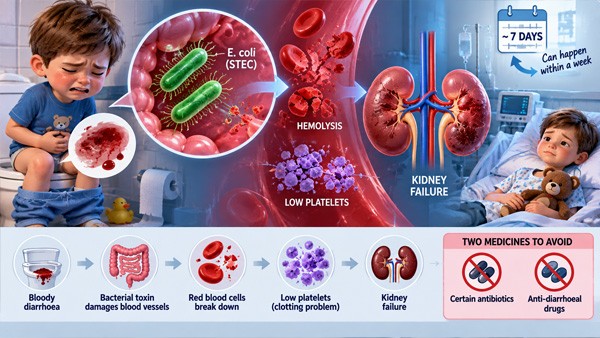

Hemolytic uremic syndrome usually begins as an ordinary stomach bug. A child has cramps and diarrhoea for a few days, the diarrhoea becomes bloody, and then — often just as it starts to settle — the child becomes pale, tired and stops passing much urine. By then the kidneys are failing.
It is the most common cause of sudden kidney failure in young children. Most recover, many need dialysis on the way, and a substantial minority carry some kidney damage for life. The outcome depends heavily on things that happen in the first days of the diarrhoea, before anyone has thought of the diagnosis.
This article explains what the syndrome is, how it develops, which warning signs matter, the two common medicines that can make it more likely, and what follow-up is needed afterwards.

🩸 Three problems at once
The name describes the three things that happen together:
- 🔴 Hemolytic anaemia — red blood cells are torn apart as they pass through damaged small vessels, so the blood count falls and the person becomes pale and exhausted
- 🟣 Low platelets — platelets are consumed forming tiny clots inside those vessels, which causes bruising and pinpoint spots on the skin
- 🟤 Acute kidney injury — the kidney filters are packed with the smallest vessels in the body, so they take the worst of the damage and urine output falls
The root of all three is injury to the inner lining of small blood vessels. Once the lining is damaged, clots form on it, and blood cells passing through are shredded. Under a microscope, the fragments of broken red cells are one of the key diagnostic clues.
🧬 The different types
| Type | What drives it | Who it affects |
|---|---|---|
| Shiga toxin HUS | A toxin produced by certain strains of E. coli, most often O157, and occasionally by Shigella | Around nine in ten cases in children, mostly under five. Also older adults |
| Pneumococcal HUS | Severe pneumococcal infection, usually pneumonia with fluid around the lung, or meningitis | Young children; less common and often more severe |
| Atypical HUS | Uncontrolled activation of part of the immune system called complement, often due to a genetic variant, triggered by infection, pregnancy or other stress | Any age; tends to relapse and has a much worse outlook without specific treatment |
| Secondary HUS | Certain medicines, some cancers and their treatment, transplantation, severe high blood pressure, autoimmune disease | Mainly adults |
A closely related condition, thrombotic thrombocytopenic purpura, produces a very similar picture in adults but is caused by a missing enzyme, affects the brain more than the kidneys, and needs urgent plasma exchange. Telling the two apart is one of the first things a hospital team does, because the treatments differ.
⏱️ The timeline, and why it catches families out
The typical sequence in Shiga toxin HUS is predictable, and knowing it is the best protection a parent has.
| When | What happens |
|---|---|
| Day 0 | Swallowing the bacteria — from food, water, animals or another person |
| Days 1 to 3 after | Watery diarrhoea and cramping abdominal pain, often severe. Fever is usually low or absent |
| Days 2 to 4 of diarrhoea | Diarrhoea becomes bloody in most cases. This is the point to seek assessment and a stool test |
| Days 5 to 10 of illness | In roughly one in seven children with E. coli O157, HUS develops. Often as the diarrhoea is improving |
| The following one to three weeks | Kidney function is at its worst and then, in most, gradually recovers |
💡 The trap is the improvement. Families understandably relax when the diarrhoea eases, and that is exactly when HUS appears. A child who has had bloody diarrhoea and then becomes pale, unusually tired, puffy or passes little urine in the following week needs to be seen the same day — even if the tummy problem seems to be over.
🚨 Warning signs
🔴 Seek urgent medical care for:
- Blood in diarrhoea, especially in a young child or an older adult
- Passing little or no urine, or a dry nappy for many hours
- Pallor — pale skin, pale inside the lower eyelids and on the lips
- Unusual tiredness, drowsiness or irritability
- Bruising or tiny red or purple spots on the skin that do not fade when pressed
- Swelling of the face, around the eyes, legs or feet
- Shortness of breath
- Confusion, a seizure, weakness or a severe headache — emergency services
💊 Two medicines to avoid in bloody diarrhoea
This is the section that most often changes outcomes, because both of these medicines are commonly reached for at home.
| Medicine | Why it is a problem |
|---|---|
| Antibiotics, taken before the cause is known | In E. coli O157 infection, several antibiotics appear to increase the release of Shiga toxin from dying bacteria, and studies in children have linked them to a higher risk of HUS. They also do not shorten this illness. Some other causes of bloody diarrhoea, such as certain Shigella and Campylobacter infections, do benefit from antibiotics — which is exactly why the stool test must come first |
| Anti-diarrhoeal medicines such as loperamide | Slowing the gut keeps the toxin in contact with the bowel for longer and is associated with worse outcomes, including more neurological complications. They are not for use in any diarrhoea with blood or fever, and not in young children at all |
| Anti-inflammatory painkillers | Ibuprofen and similar medicines reduce blood flow to the kidneys and are best avoided while kidney function may be threatened. Paracetamol is the safer choice for pain or fever |
Imodium (loperamide) is a useful medicine for ordinary watery diarrhoea in adults, and we stock it for that purpose. It should not be used when there is blood in the stool, a high fever, or in children — in those situations the diarrhoea is part of the body clearing an infection that needs identifying rather than stopping.
💧 What helps early
The most important protective step during the diarrhoea phase is keeping the child well hydrated. Studies have found that children who received more fluid — including intravenous fluid in hospital — in the days before HUS developed were less likely to need dialysis. Dehydration reduces blood flow through the kidneys at exactly the time they are most vulnerable.
At home, that means oral rehydration solution in small, frequent sips, continuing breast or formula feeds, and seeking help early if the child cannot keep fluids down. The practical detail on rehydration is covered in the article on norovirus and stomach bugs. Where E. coli O157 is confirmed or strongly suspected, hospitals often admit children for intravenous fluids and daily blood tests even before any sign of HUS.
🔬 How it is diagnosed
| Test | What it shows |
|---|---|
| Stool test | Identifies E. coli O157 or detects the Shiga toxin genes directly. Should be sent in any bloody diarrhoea |
| Full blood count | Falling haemoglobin and platelets |
| Blood film | Fragmented red cells under the microscope |
| Kidney function | Rising creatinine and urea, and changes in potassium and sodium |
| Markers of red cell breakdown | Raised LDH, low haptoglobin |
| Urine | Blood and protein |
| Further tests where atypical HUS or TTP is possible | Complement levels and genetics, and the enzyme activity that distinguishes TTP |
🏥 Treatment
For Shiga toxin HUS there is no medicine that switches the process off. Treatment is supportive — carrying the child through until the vessels heal — and it is very effective when done well.
- Careful fluid balance — enough to protect the kidneys, not so much that fluid builds up once urine output falls
- Dialysis — needed by roughly half of children with HUS, usually temporarily, for days to a few weeks
- Red cell transfusion for severe anaemia
- Platelet transfusion generally avoided unless there is bleeding or a procedure is needed, as it can worsen clotting in the small vessels
- Blood pressure control, which often rises as the kidneys fail
- Nutrition, sometimes by tube, because appetite is poor and the illness is long
- Close watch for complications in the brain, bowel, pancreas and heart
🧬 Atypical HUS is treated differently. Because it is driven by the complement system, it responds to complement-blocking antibody treatment, given by infusion. This has transformed the outlook, which was previously poor, with frequent progression to permanent kidney failure. Anyone receiving it needs meningococcal vaccination, since complement is part of the defence against that infection. Severe Shiga toxin HUS with brain involvement is sometimes treated this way too, though the evidence there is less clear.
⚠️ Complications beyond the kidneys
The same small-vessel damage can occur anywhere. The brain is the most important: irritability, drowsiness, seizures and stroke occur in a minority of children and account for most deaths. The bowel can become severely inflamed and occasionally perforate. The pancreas can be affected, sometimes causing diabetes that may be temporary or permanent. The heart muscle is occasionally involved.
Overall, a small percentage of children with Shiga toxin HUS die in the acute phase. The risk is higher in the very young, in older adults, and where the brain is involved.
📈 After recovery: why follow-up lasts years
Most children leave hospital with kidney function that looks normal or near normal. That is not the end of the story. Around a quarter to a third show some long-term effect when followed up over years:
- Protein in the urine, which is an early sign of kidney strain
- High blood pressure
- Reduced kidney function, occasionally progressing to chronic kidney disease many years later
The practical consequence is simple: annual checks of blood pressure and urine for at least five years, and longer if anything abnormal is found. Anyone who had HUS as a child should mention it to their doctor as an adult, and especially before or during pregnancy, when kidney strain may reappear.
🥩 Where the infection comes from
E. coli O157 lives harmlessly in the gut of cattle and some other animals. People become infected when a tiny amount of contaminated material is swallowed — very few bacteria are needed.
| Source | Prevention |
|---|---|
| Undercooked minced beef | Cook burgers and mince until no pink remains and juices run clear — an internal temperature of at least 70°C (160°F). Surface bacteria are spread through the meat by mincing, unlike a whole steak |
| Unpasteurised milk, cheese and juice | Avoid for young children, pregnant women and older adults |
| Raw sprouts and leafy vegetables | Wash thoroughly; raw sprouts are a recognised risk for vulnerable groups. A large outbreak in Europe in 2011, caused by contaminated sprouts, mainly affected adults |
| Farm and petting-zoo animals | Wash hands with soap and water afterwards — gels are not enough. No eating or dummies in animal areas |
| Contaminated water | Private wells, lakes and poorly maintained paddling pools |
| Other people | Spread easily in nurseries and households. Careful hand-washing after nappy changes and toilet use; children with confirmed infection are usually kept away from nursery until stool tests are clear |
🚑 When to seek help
- Any bloody diarrhoea in a child or older adult — same day, with a stool sample
- Reduced urine or dry nappies after a diarrhoeal illness — same day
- Pallor, unusual tiredness, bruising or spots on the skin within two weeks of diarrhoea — same day
- Swelling of the face or legs — same day
- Seizure, confusion or severe drowsiness — emergency services
- Vomiting that prevents keeping fluids down in a child with diarrhoea
- A history of HUS — annual blood pressure and urine checks for years, and mention it before pregnancy
Our gastrointestinal category covers medicines for acid, nausea and ordinary diarrhoea. None of them is a treatment for HUS, and anti-diarrhoeals should not be used at all where there is blood in the stool.
❓ Frequently asked questions
What is hemolytic uremic syndrome?
A condition in which damage to the lining of small blood vessels causes three problems together: red blood cells are destroyed, platelets are used up, and the kidneys fail. In children it almost always follows a gut infection with a toxin-producing strain of E. coli, most often O157. It is the leading cause of sudden kidney failure in young children.
When does HUS appear after diarrhoea?
Usually five to ten days after the illness began, and often as the diarrhoea is improving. That timing catches families out. A child who had bloody diarrhoea and then becomes pale, tired, puffy or passes little urine in the following week needs to be seen the same day.
Should antibiotics be given for bloody diarrhoea?
Not before the cause is known. In E. coli O157 infection several antibiotics appear to increase toxin release and have been linked to a higher risk of HUS in children, without shortening the illness. Some other causes of bloody diarrhoea do benefit from antibiotics, which is why a stool test comes first and the decision is made on the result.
Can I use loperamide for bloody diarrhoea?
No. Slowing the gut keeps the toxin in contact with the bowel longer and is associated with worse outcomes. Anti-diarrhoeal medicines are for ordinary watery diarrhoea in adults, not for diarrhoea with blood or high fever, and not for young children at all.
What can parents do to lower the risk?
Keep the child well hydrated with oral rehydration solution in small, frequent sips, continue feeds, seek assessment for any blood in the stool, and avoid antibiotics, anti-diarrhoeals and ibuprofen unless a doctor advises them. Children who receive more fluid before HUS develops appear less likely to need dialysis.
Will my child need dialysis?
Roughly half of children with HUS need dialysis for a period, usually days to a few weeks, while the kidneys recover. For most it is temporary. Needing dialysis does not mean the kidneys will not recover, though longer periods are linked to a higher chance of long-term effects.
What is atypical HUS?
A form not caused by E. coli, driven instead by uncontrolled activation of part of the immune system called complement, often because of a genetic variant. It can occur at any age, tends to relapse, and used to lead frequently to permanent kidney failure. Complement-blocking antibody treatment has transformed the outlook. Anyone receiving it needs meningococcal vaccination.
How is HUS different from TTP?
Both involve destroyed red cells, low platelets and small clots. TTP is caused by a missing enzyme, mainly affects adults, involves the brain more than the kidneys, and needs urgent plasma exchange. HUS mainly affects the kidneys. Measuring the enzyme activity is how the two are distinguished.
Can there be kidney problems years later?
Yes. Around a quarter to a third of children show some long-term effect, such as protein in the urine, high blood pressure or reduced kidney function. That is why annual blood pressure and urine checks are recommended for at least five years, and why a past history of HUS should be mentioned before pregnancy.
How do children catch E. coli O157?
From undercooked minced beef, unpasteurised milk or juice, raw sprouts and unwashed vegetables, contact with farm animals, contaminated water, and from other infected people, particularly in nurseries. Very few bacteria are needed. Cooking mince until no pink remains and washing hands with soap after animal contact are the most effective precautions.
📑 Sources and editorial
- Reviews of Shiga toxin-producing E. coli infection and progression to hemolytic uremic syndrome
- Cohort studies of antibiotic and antimotility agent use and HUS risk in children
- Studies of early intravenous volume expansion and dialysis requirement
- Clinical guidance on supportive management, transfusion thresholds and dialysis in HUS
- Consensus guidance on diagnosis and complement-inhibitor treatment of atypical HUS
- Long-term follow-up studies of renal outcomes after childhood HUS
- Public health guidance on prevention of E. coli O157 infection and exclusion from childcare
- Related reading: norovirus and stomach bugs
- Related products: gastrointestinal category
- RXshop Editorial Team — reviewed by Emily Chen, MD, Internal Medicine
Medical Disclaimer: The information in this article is for educational and informational purposes only and is not a substitute for professional medical advice, diagnosis, or treatment. Always seek guidance from a qualified healthcare provider with any questions you may have regarding a medical condition, and before starting, stopping or changing any medication.