Chlordiazepoxide (Librium): What It Treats and What It Costs You

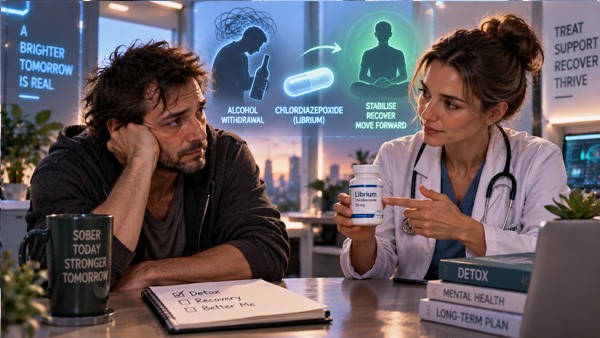

Chlordiazepoxide was the first benzodiazepine ever made. It arrived at the end of the 1950s, was sold as Librium, and became one of the most widely prescribed medicines of the twentieth century. The class it founded went on to replace barbiturates, then spent two decades being prescribed for anything that resembled worry.
Most of that has been unwound. Today chlordiazepoxide has essentially one job it does better than almost anything else, and a long list of jobs it should no longer be doing at all. The one job is getting a physically dependent drinker safely through alcohol withdrawal, where the alternative can be fatal.
This article covers how the drug works, what it is genuinely useful for, the side effects and dependence risk, the detox timeline it is built around, and the part that determines whether any of it was worthwhile — what happens after the detox is over.

🧪 How it works, and why the slow onset matters
The brain runs on a balance between signals that excite nerve cells and signals that quieten them. The main quietening signal is a chemical called GABA. Benzodiazepines do not create that signal — they make the brain more responsive to the GABA it already produces, so the same natural braking effect is amplified.
That is why the effects are predictable across the class: reduced anxiety, sedation, muscle relaxation, and suppression of seizures. It is also why these drugs are so dangerous combined with anything else that sedates.
⏳ Chlordiazepoxide is deliberately slow and long. It is absorbed gradually, so it does not produce the sharp rush that makes shorter-acting benzodiazepines attractive to misuse. It is then broken down into several active substances that themselves last a long time, so levels fall gently over days rather than hours.
In detox that is an advantage: the drug partly tapers itself and smooths out the peaks and troughs. In an elderly person or someone with liver disease it is the opposite — those long-lasting breakdown products accumulate, and sedation builds up over days.
⚖️ What it is actually used for now
| Use | Standing today |
|---|---|
| Alcohol withdrawal | First-line, and the main reason the drug is still manufactured. Prevents withdrawal seizures and delirium, usually over five to seven days |
| Severe short-term anxiety | Occasionally, for days rather than weeks, in a crisis. Not a treatment for an anxiety disorder |
| Before a procedure | Sometimes used for its calming effect, though shorter-acting alternatives are usually preferred |
| Muscle spasm | Historic use, largely superseded |
| Insomnia | Not appropriate. The long duration leaves people impaired the next day |
| Ongoing anxiety or stress | Not appropriate. Tolerance develops within weeks and the underlying problem is untreated |
The shift is not fashion. Benzodiazepines still work perfectly well for anxiety — that is the problem. They work immediately and convincingly, which makes them very easy to keep taking, and the effect fades while the dependence does not. Treatments that take four to six weeks to help are harder to start and far better to be on a year later.
🍷 Alcohol withdrawal: why a drug is needed at all
Sustained heavy drinking suppresses the brain excitatory system, and the brain compensates by turning that system up. Remove the alcohol suddenly and the compensation is left running unopposed. The result is not discomfort — it is a brain in a state of over-excitation, and in its severe form it kills people.
| Time after the last drink | What typically happens |
|---|---|
| 6 to 12 hours | Tremor, sweating, anxiety, nausea, racing heart, difficulty sleeping |
| 12 to 24 hours | Hallucinations may appear — usually visual, with the person aware they are not real |
| 24 to 48 hours | Peak risk of withdrawal seizures |
| 48 to 72 hours and beyond | Delirium tremens: confusion, disorientation, severe agitation, fever, dangerous swings in heart rate and blood pressure. A medical emergency |
| Weeks to months | Sleep disturbance, low mood and anxiety often persist well after the physical withdrawal has ended |
Delirium tremens carries a real death rate even when treated, and a far higher one when it is not. It is also more likely in people who have withdrawn repeatedly before — each unmanaged withdrawal appears to make the next one worse.
🔴 Do not stop heavy daily drinking abruptly on your own if any of these apply:
- A previous withdrawal seizure or episode of delirium tremens
- Drinking heavily every day, particularly with morning drinking to stop shaking
- Shaking, sweating or vomiting when a few hours pass without a drink
- Any significant medical illness, infection, injury or liver disease
- Older age, or use of other sedatives or opioids
- Confusion, unsteadiness or double vision — emergency, see the thiamine section below
Stopping is the right goal. Stopping unsupervised, in these circumstances, is the dangerous part — and a supervised detox is a short, scheduled, ordinary medical procedure.
🧠 The vitamin that has to come first
Heavy drinking depletes thiamine, also called vitamin B1, through poor diet, poor absorption and increased loss. The brain needs it continuously, and reserves last only a matter of weeks.
When thiamine runs low, the result is Wernickes encephalopathy: confusion, unsteadiness on the feet, and abnormal eye movements or double vision. Fewer than one in five people show all three together, which is exactly why it is missed. Untreated, it either kills or leaves permanent memory damage in which recent events simply fail to record.
⚠️ Giving carbohydrate to a thiamine-depleted person can trigger it. Sugar consumes the remaining thiamine to be metabolised. This is why hospitals give thiamine before or alongside any glucose or substantial meal in a person who has been drinking heavily — and why a sweet drink offered with good intentions can do harm. Where risk is significant, thiamine is given by injection, because absorption from the gut in this state is unreliable.
The same principle applies in severe malnutrition of any cause, described in the article on alcohol and nerve damage.
📋 How a detox regimen is actually run
Chlordiazepoxide substitutes for alcohol at the same receptors, then is withdrawn in a controlled way over several days. Two approaches are used.
- 📉 Fixed reducing schedule — a set dose several times a day, stepped down each day, typically over five to seven days. Predictable, and the standard where monitoring is limited
- 📊 Symptom-triggered dosing — withdrawal severity is scored regularly and medication given only when the score crosses a threshold. Uses less total drug and shortens treatment, but requires trained staff doing the scoring
Several points about the regimen matter more than the numbers:
Doses used in detox look alarming compared with anxiety doses, and that is expected — a person in withdrawal is far less sensitive to the drug than a person who is not. Those same doses given to someone who is not withdrawing would be heavily sedating.
The course ends. Detox medication is finished within about a week. Continuing a benzodiazepine after detox trades an alcohol dependence for a benzodiazepine dependence, and the second is harder to get out of than the first.
Chlordiazepoxide is not always the right choice. In significant liver disease the long-acting breakdown products build up and cause deep sedation and confusion; shorter-acting alternatives that bypass that pathway are used instead. The same caution applies in older people.
⚠️ Side effects worth knowing before the first dose
| Effect | Detail |
|---|---|
| Drowsiness and slowed thinking | The most common effect, and it persists into the following day because of the long duration |
| Unsteadiness and falls | The main serious risk in older people. Hip fractures following benzodiazepine sedation are a well-documented harm |
| Memory gaps | Difficulty forming new memories while the drug is active. Events during that period may simply be absent afterwards |
| Paradoxical agitation | Restlessness, irritability or aggression instead of calm. More common in older people and children, and a reason to stop |
| Slowed breathing | The mechanism behind most benzodiazepine deaths, and it almost always involves a second sedating substance |
| Blurred vision, dry mouth, nausea | Common and generally mild |
| Reduced sex drive | Reported with longer use |
| Emotional blunting | With continued use, a flattening of feeling rather than relief of anxiety |
🚗 Driving. Impairment lasts well beyond the point at which a person feels normal, and the next-day effect is real. Driving or operating machinery during a detox, or in the days after it, is not safe, and in many countries it is also an offence regardless of whether the medicine was prescribed.
🚫 Who should not take it, and interactions
| Situation | Why it matters |
|---|---|
| Opioids of any kind | The most dangerous combination. Both suppress breathing, and together the risk of fatal respiratory depression multiplies. This includes prescribed painkillers and substitution treatment |
| Alcohol | Additive sedation and breathing suppression. Drinking during a detox defeats the purpose and is hazardous |
| Other sedatives | Sleeping tablets, sedating antihistamines, some antipsychotics and muscle relaxants all add to the effect |
| Severe breathing problems | Sleep apnoea and advanced lung disease increase the risk of dangerous under-breathing |
| Severe liver disease | Accumulation and deep sedation; can precipitate confusion. A different benzodiazepine is chosen |
| Myasthenia gravis | Muscle relaxant effect worsens the underlying weakness |
| Pregnancy and breastfeeding | Crosses the placenta and enters breast milk; use near delivery can leave a newborn sedated and floppy. Alcohol withdrawal in pregnancy still needs treating, but it is a specialist decision |
| Older age | Lower doses, shorter duration, and a far higher priority on fall risk |
🔗 Dependence, and getting off it
Physical dependence on a benzodiazepine can develop within two to four weeks of regular use, at ordinary prescribed doses, in someone with no history of any addiction. That is not misuse — it is how the drug works.
Stopping abruptly after sustained use produces a withdrawal that mirrors alcohol withdrawal, for the same reason: rebound anxiety, insomnia, tremor, sweating, hypersensitivity to light and sound, and, in serious cases, seizures.
✅ How a taper is done properly: slowly, in small steps, with the timetable set by how the person is coping rather than by the calendar. Reductions of a small percentage of the current dose at a time, held until symptoms settle before the next step, are far more successful than a fixed fast schedule. There is no prize for finishing early, and a taper that takes months is a success, not a failure. Long-acting chlordiazepoxide is sometimes used as the substitute drug during a taper from a shorter-acting benzodiazepine, precisely because it falls away gently.
Some people experience a prolonged period of low-grade anxiety, poor sleep and unease after the taper finishes. It fades, but it can take months, and knowing it is expected removes much of its power to frighten.
🎯 Detox is not treatment
This is the single most important paragraph on the page. A detox removes the physical dependence and does almost nothing about the drinking. Relapse rates after detox alone are very high, and repeated detoxes carry their own escalating risk. What changes outcomes is what is put in place in the weeks that follow.
| Medicine | What it does |
|---|---|
| Naltrexone | Blocks part of the reward response to alcohol, reducing craving and the amount drunk if a lapse occurs. Started after detox. Must not be combined with opioid painkillers. Liver function is checked |
| Acamprosate | Helps stabilise the over-excited brain chemistry left behind after stopping, supporting continued abstinence. Taken three times daily. Not currently in our catalogue |
| Disulfiram | Causes an intensely unpleasant reaction if alcohol is drunk — flushing, pounding heart, vomiting. Works through deterrence, not craving, and depends on supervision. Must never be started while alcohol is still in the body |
| Psychological and social support | The component with the strongest evidence of all, and the one most often skipped |
Relapse-prevention options are in the treatment for alcohol problems category, including Nodict (naltrexone 50mg) and Revia (naltrexone 50mg), with Carnotol (disulfiram 250mg) and Antabuse (disulfiram) as the deterrent approach. None of these is a detox medicine and none should be started during withdrawal.
💊 If the reason was anxiety, not alcohol
People arrive at this drug from two directions, and the second group is looking for something to take the edge off permanent anxiety. For that, a benzodiazepine is the wrong tool, and the reason is worth stating plainly: it works today and costs you next year.
The options that hold up over time are buspirone, which is not sedating and does not cause dependence but takes two to four weeks to build an effect, and the antidepressants category, where several medicines are first-line treatments for anxiety disorders rather than antidepressants used off-label. Psychological therapy outperforms both over the long run and is the only one whose benefit continues after treatment stops.
Anxiety in older people is a particular trap for sedatives, and is covered separately in the article on anxiety in later life.
📝 A note on availability. We do not stock chlordiazepoxide or any other benzodiazepine. These are controlled medicines that require supervision, dose adjustment and a defined end point, and alcohol detox in particular needs monitoring that no pharmacy can provide. What we do stock are the medicines used after detox, where the long-term outcome is actually decided.
🚑 When to seek help
- Confusion, unsteadiness or double vision in a heavy drinker — emergency, possible thiamine deficiency
- A seizure during withdrawal — emergency
- Agitation with fever, sweating and disorientation two to three days after the last drink — emergency, possible delirium tremens
- Very slow or shallow breathing, or a person who cannot be roused — emergency, particularly if opioids are involved
- Shaking, sweating or vomiting in the morning until a drink is taken — arrange a supervised detox rather than stopping alone
- Wanting to come off a benzodiazepine — ask for a planned taper; do not stop abruptly
- Increasing the dose to get the same effect — tolerance, and a signal to review the treatment rather than raise it
- Yellowing of the skin or eyes, dark urine, or severe abdominal pain — urgent liver assessment
❓ Frequently asked questions
What is chlordiazepoxide mainly used for today?
Alcohol withdrawal, where it is first-line and typically given as a reducing course over five to seven days. It is occasionally used for severe short-term anxiety lasting days rather than weeks. It is no longer considered appropriate for ongoing anxiety or for insomnia, because tolerance develops and the long duration leaves people impaired the next day.
Why is stopping alcohol suddenly dangerous?
Heavy drinking suppresses the brain excitatory system, and the brain compensates by turning it up. Removing alcohol leaves that compensation running unopposed. Seizures peak at twenty-four to forty-eight hours, and delirium tremens, which can be fatal, usually appears after forty-eight to seventy-two hours. Risk is highest in daily heavy drinkers and in anyone who has withdrawn badly before.
Why is thiamine given before food or glucose?
Because metabolising sugar consumes thiamine, and in a depleted person that can trigger Wernickes encephalopathy — confusion, unsteadiness and abnormal eye movements, which can cause permanent memory damage. Heavy drinking depletes thiamine within weeks. Where risk is significant it is given by injection, since absorption from the gut is unreliable in this state.
How long does a detox course last?
Usually five to seven days, either as a fixed reducing schedule or with doses given according to regularly scored withdrawal severity. The course is designed to end. Continuing a benzodiazepine afterwards simply exchanges one dependence for another that is harder to escape.
Why are detox doses so much higher than anxiety doses?
Because a person in withdrawal is far less sensitive to the drug. The same doses given to someone who is not withdrawing would be heavily sedating. This is one reason detox needs supervision: the dose has to match the state of the person, and that state changes daily.
What is the most dangerous interaction?
Opioids. Both suppress breathing, and the combined risk of fatal respiratory depression is far greater than either alone. This includes prescribed painkillers and opioid substitution treatment. Alcohol and other sedatives, including sedating antihistamines and sleeping tablets, add to the same effect.
How quickly can dependence develop?
Within two to four weeks of regular use, at ordinary prescribed doses, in someone with no history of addiction. That is how the drug works rather than a sign of misuse. Stopping abruptly after sustained use can cause rebound anxiety, insomnia, tremor and, in serious cases, seizures.
How should a benzodiazepine be tapered?
Slowly, in small steps, with the pace set by how the person is coping rather than by a fixed calendar. Small percentage reductions held until symptoms settle work far better than a rapid schedule. A taper lasting months is a success. Some people have a prolonged period of anxiety and poor sleep afterwards, which fades.
What should happen after detox?
Detox removes physical dependence and does very little about drinking, so relapse rates after detox alone are high. Naltrexone reduces craving and the amount drunk after a lapse. Acamprosate supports abstinence by stabilising brain chemistry. Disulfiram works by deterrence and needs supervision. Psychological and social support has the strongest evidence of all.
What can be used for anxiety instead?
Buspirone is not sedating and does not cause dependence, though it takes two to four weeks to work. Several antidepressants are first-line treatments for anxiety disorders in their own right. Psychological therapy outperforms medication over the long term and is the only option whose benefit continues after treatment ends.
📑 Sources and editorial
- Pharmacology of chlordiazepoxide: absorption, active metabolites and duration of action
- Clinical guidance on management of alcohol withdrawal, including fixed-dose and symptom-triggered regimens
- Evidence on benzodiazepines for prevention of withdrawal seizures and delirium tremens
- Guidance on thiamine administration and prevention of Wernicke encephalopathy
- Reviews of benzodiazepine dependence, tolerance and tapering strategies
- Safety communications on combined benzodiazepine and opioid use
- Trial evidence for naltrexone, acamprosate and disulfiram in relapse prevention
- Data on falls and fracture risk with benzodiazepines in older adults
- Related reading: alcohol and nerve damage, anxiety in later life
- Related products: treatment for alcohol problems, Buspar (buspirone)
- RXshop Editorial Team — reviewed by Thomas Walsh, MD, Psychiatry
Medical Disclaimer: The information in this article is for educational and informational purposes only and is not a substitute for professional medical advice, diagnosis, or treatment. Always seek guidance from a qualified healthcare provider with any questions you may have regarding a medical condition, and before starting, stopping or changing any medication.