Premature Ejaculation: Causes and Treatment

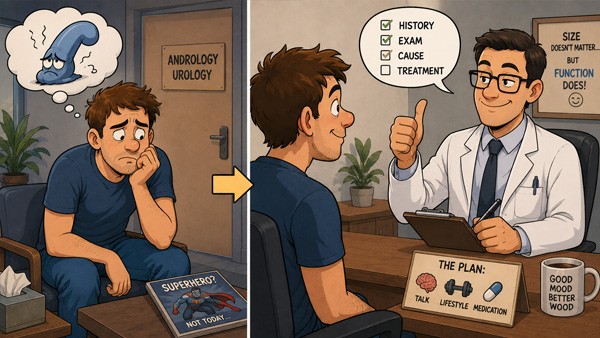
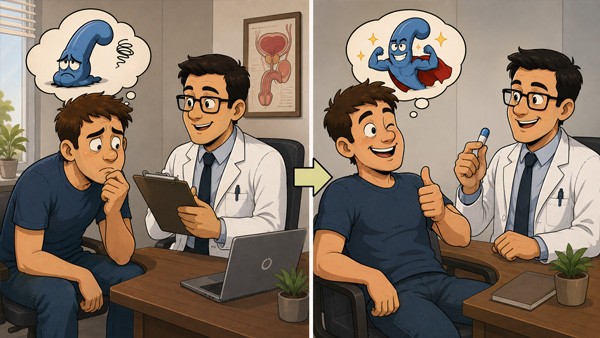
Premature ejaculation is the commonest male sexual difficulty, more prevalent than erectile dysfunction across every age group, and it is discussed far less. It is also, unusually, a condition where a substantial share of men seeking treatment turn out to have entirely normal function and unrealistic expectations — and where another substantial share have a different problem driving it.
Sorting those groups apart is most of the clinical work, and the second one contains the single most useful insight in this subject.
🧠 The connection almost nobody makes: erectile difficulty causes premature ejaculation. A man who is unsure his erection will hold rushes, consciously or otherwise, to finish before it fails. Anxiety compounds it. Treating the erectile problem first frequently resolves the ejaculation problem entirely, without any drug aimed at ejaculation at all. Anyone with both should have the erection question addressed first rather than being given something for the timing.
⏱️ What actually counts
Three things must be present together, and the last two matter as much as the first.
| Criterion | Detail |
|---|---|
| Short time to ejaculation | Around a minute or less from penetration in lifelong cases; a clinically significant reduction, commonly to around three minutes or less, in acquired cases |
| Inability to delay | On all or nearly all occasions |
| Distress or avoidance | Negative personal consequences — frustration, distress, or avoiding sexual intimacy because of it |
The distress criterion is not a formality. A couple entirely content with their sex life does not have a disorder regardless of the stopwatch, and treating the number rather than the problem is a recognised way of creating a difficulty where none existed.
⚠️ A calibration worth having: studies measuring time to ejaculation in the general population find a median in the region of five to six minutes, with wide variation and a substantial proportion of ordinary couples well below that. A great many men who seek treatment are within normal limits and are comparing themselves against durations from pornography, which are edited and frequently pharmacologically assisted. Being told the actual figures resolves the problem for a meaningful share of them.
⚖️ Lifelong or acquired
This distinction determines whether there is a cause to find.
Lifelong means it has been present since the first sexual experiences. It appears to involve constitutional differences in the reflex controlling ejaculation, with serotonin signalling implicated — which is why drugs acting on serotonin work. There is usually nothing else to find, and treatment is symptomatic.
Acquired means a clear change from previous normal function. This is the group where investigation pays off, because there is frequently something identifiable and treatable underneath.
| Cause of acquired premature ejaculation | Note |
|---|---|
| Erectile difficulty | The commonest and most important. Rushing to finish before the erection fails. Treating the erection resolves it |
| Overactive thyroid | A recognised and readily treatable cause; worth checking, particularly with palpitations, weight loss, tremor or heat intolerance |
| Prostatitis or chronic pelvic pain | Inflammation of the prostate is associated with acquired cases |
| Anxiety, particularly performance anxiety | Both cause and consequence, forming a cycle |
| Relationship difficulty | Frequently the context rather than a coincidence |
| Withdrawal from opioids or other substances | Ejaculation frequently accelerates on stopping |
| Long intervals between sexual activity | A physiological rather than pathological effect |
Assessment is largely a conversation. Onset, whether it happens in every situation including masturbation, the state of erections, the relationship context, medication and substance use, and whether there are thyroid symptoms. Examination and blood tests are directed by what that conversation suggests rather than done routinely.
👋 The behavioural techniques
These have modest evidence on their own and work considerably better combined with medication than either alone. They also produce durable change in a way medication does not, since the learning persists.
Stop-start. Stimulation continues until the point just before ejaculation feels inevitable, then stops entirely until the sensation subsides, then resumes. Repeated several times before allowing ejaculation. Practised alone first, then with a partner. The purpose is learning to recognise the point of no return, which many men with this difficulty genuinely cannot identify.
The squeeze technique. A variation in which firm pressure is applied to the head of the penis at that point, which reduces the urge. Older, somewhat less used now, and equivalent in effect.
Pelvic floor exercises. This is the technique with the best recent evidence and the one least known. Training the muscles involved in ejaculatory control produces measurable improvement in trials, and it takes weeks rather than a single session. Identifying the correct muscles matters — they are the ones used to stop urine flow midstream, and a physiotherapist specialising in pelvic health can confirm the technique.
Reducing performance pressure. Removing intercourse from the agenda for a period, in the same way it is used for erectile anxiety, breaks the cycle where anticipating the problem accelerates it.
🔴 The one thing not to do is distract yourself. The traditional advice to think about something else during sex is counterproductive. Attention moved away from sensation becomes attention spent monitoring and evaluating — the same self-observation that drives performance anxiety — and it interferes with recognising the point of no return, which is exactly the skill the techniques above are teaching. Paying closer attention to sensation, not less, is what allows control.
💊 Dapoxetine
Dapoxetine is the only drug developed and licensed specifically for this condition, and it differs from other serotonergic drugs in a way that defines how it is used.
Other SSRIs delay ejaculation as a side effect, and because they take weeks to build up and remain in the body for days, they are taken daily and continuously. Dapoxetine is absorbed rapidly and cleared rapidly, which allows it to be taken on demand, one to three hours before sexual activity, without accumulating.
That difference is the entire point of it: a man who has sex twice a week does not need continuous serotonergic medication with the mood, sleep and sexual side effects that accompany it.
Practical points that determine whether it works and whether it is tolerated:
- Take it one to three hours beforehand, with a full glass of water
- Not more than once in twenty-four hours
- Do not combine it with alcohol. This matters more than the usual advice about alcohol, for the reason below
- Be well hydrated before taking it
- The first dose is the one to be careful with, and it is sensible to take it somewhere you can sit or lie down
🔴 The specific risk with dapoxetine is fainting. It can cause a drop in blood pressure on standing, and syncope — sometimes with no warning symptoms first — has occurred, particularly with the first dose, with alcohol, with dehydration, and on standing up quickly. Anyone who feels lightheaded, dizzy or unwell should lie down immediately with the legs raised and stay down until it passes fully. It must not be used by anyone with significant heart disease, heart failure, conduction abnormalities or a history of fainting, and it must never be combined with monoamine oxidase inhibitors, thioridazine, or within the specified interval of stopping them.
Common side effects are nausea, dizziness, headache and diarrhoea, and they are dose-related. Nausea in particular is the commonest reason it gets abandoned and frequently settles with continued use or a lower dose.
It should not be combined with other serotonergic drugs, including other SSRIs, SNRIs, tramadol, triptans, lithium and St John wort, because of the risk of serotonin syndrome.
🧪 The other options
| Treatment | How it is used | Notes |
|---|---|---|
| Dapoxetine | On demand, one to three hours before | The only agent licensed for this indication; no accumulation |
| Daily SSRIs — paroxetine, sertraline, fluoxetine | Continuously, off-label | Paroxetine is the most effective of them and also the hardest to stop; all carry the usual antidepressant side effects and take weeks to work |
| Topical anaesthetic cream or spray | Applied to the glans shortly before, then removed or covered | Effective and cheap; see the caution below |
| Tramadol | On demand, off-label | Delays ejaculation but carries dependence potential and serotonin interactions; not a first choice |
| PDE5 inhibitors | Where erectile difficulty coexists | Treating the erection resolves the ejaculation problem in a substantial share of men with both |
| Combination tablets | Where both conditions are genuinely present | Convenient where both are established; not a reason to take a PDE5 inhibitor if erections are normal |
On topical anaesthetics: lidocaine and prilocaine preparations reduce sensitivity and are genuinely effective. Two practical points determine whether they are usable. They must be given time to work — typically ten to twenty minutes — and then wiped off or covered with a condom, because transferring the anaesthetic to a partner causes numbness and loss of sensation for them. Excessive application can also reduce sensation to the point of causing erectile difficulty, which is a self-defeating outcome.
🔗 Where both problems coexist
This deserves its own section because it is common and because getting the order wrong wastes time.
When a man has both erectile difficulty and rapid ejaculation, the sequence matters. The erection is treated first. If the ejaculation problem was driven by rushing to finish before the erection failed — which is the usual pattern — it resolves once the erection is reliable, with no further treatment needed.
Where the ejaculation problem persists after the erection is dealt with, then it is treated in its own right, and a combination product becomes a reasonable convenience rather than a first assumption.
Taking a combination tablet from the outset in someone whose erections are actually normal means taking a PDE5 inhibitor unnecessarily, with its side effects and its absolute contraindication with nitrates, for no benefit.
The erectile side is covered in the guides to types of erectile dysfunction and, where anxiety is central, performance anxiety.
🗣️ The partner side
Studies of couples affected by this consistently find something men do not expect: partners are typically considerably less concerned about duration than the man is, and considerably more concerned about the avoidance, the anxiety and the withdrawal that follow.
What partners report as the actual problem is the man becoming tense before sex, avoiding intimacy to avoid the possibility, or ending contact abruptly afterwards out of embarrassment. Those are the things worth addressing, and several of them are more readily fixed than the timing.
Practically, treatment works better when the partner is involved rather than when the man attempts to solve it privately — the behavioural techniques require cooperation, and the pressure that drives the problem reduces considerably once it is spoken about.
📋 A sensible order
First, establish whether there is a problem. Compare against the actual distribution rather than against pornography, and consider whether there is genuine distress or only a number someone has decided is unacceptable.
Second, check whether erections are reliable. If not, treat that first, and reassess afterwards.
Third, in acquired cases, look for a cause. Thyroid function, prostatic symptoms, substance use and relationship context.
Fourth, start the behavioural work. Pelvic floor training has the best evidence and takes weeks, so beginning it early is sensible even where medication is also used.
Fifth, consider medication. Dapoxetine on demand where sex is intermittent; a daily SSRI where it is frequent and continuous treatment is acceptable; a topical anaesthetic where a drug-free option is preferred.
Sixth, involve the partner rather than solving it alone.
✅ The outlook is good and the main obstacle is silence. This is treatable, it is the commonest male sexual difficulty rather than a rarity, and combining a behavioural approach with medication produces better and more durable results than either alone. The men who do worst are those who never mention it, avoid relationships because of it, and assume nothing can be done — which was true decades ago and has not been for some time.
🚨 When to see someone
- A clear change from previous normal function, which warrants looking for a cause
- Erectile difficulty alongside it, which should be assessed first
- Palpitations, weight loss, tremor or heat intolerance, suggesting thyroid overactivity
- Pain on ejaculation, or pelvic or perineal pain
- Blood in the semen
- Avoidance of relationships or intimacy because of it
- Low mood or anxiety developing around it
- Any fainting or near-fainting after taking dapoxetine
Treatment is stocked in the mens health category, including Priligy (dapoxetine), the only medication developed and licensed specifically for this condition and designed to be taken on demand rather than continuously. Combination products with a PDE5 inhibitor are appropriate where erectile difficulty is genuinely present as well, and unnecessary where it is not.
❓ Frequently asked questions
How long is normal?
Studies measuring time to ejaculation in the general population find a median around five to six minutes, with wide variation and a substantial proportion of ordinary couples well below that. A great many men seeking treatment are within normal limits and are comparing themselves against durations from pornography, which are edited and frequently pharmacologically assisted. The distress criterion matters as much as the number.
Could my erection problem be causing this?
Very likely, and it is the connection most often missed. A man unsure whether his erection will hold rushes, consciously or otherwise, to finish before it fails, and anxiety compounds it. Treating the erectile problem first frequently resolves the ejaculation problem entirely with no drug aimed at ejaculation at all. Anyone with both should have the erection addressed first.
What is the difference between lifelong and acquired?
Lifelong means present since the first sexual experiences, appears to involve constitutional differences in the ejaculatory reflex with serotonin signalling implicated, and usually has nothing else to find. Acquired means a clear change from previous normal function, and that is the group where investigation pays off — erectile difficulty, thyroid overactivity, prostatitis, anxiety, relationship context and substance withdrawal all cause it.
Should I check my thyroid?
It is worth checking in acquired cases, particularly alongside palpitations, weight loss, tremor or heat intolerance. An overactive thyroid is a recognised cause of accelerated ejaculation and is readily treatable, at which point the sexual symptom resolves. It is a simple blood test and it is one of the few genuinely reversible causes.
How is dapoxetine different from other SSRIs?
It is absorbed and cleared rapidly, so it can be taken on demand one to three hours before sex without accumulating. Other SSRIs delay ejaculation as a side effect, take weeks to build up and remain in the body for days, so they must be taken continuously. That difference is the point: someone having sex twice a week does not need continuous serotonergic medication with its mood, sleep and sexual effects.
Why must I not drink alcohol with dapoxetine?
Because the specific risk with this drug is fainting. It can cause a drop in blood pressure on standing, and syncope has occurred sometimes without warning symptoms, particularly with the first dose, with alcohol, with dehydration and on standing quickly. Take it with a full glass of water, be well hydrated, and treat the first dose with particular care. Anyone feeling lightheaded should lie down with legs raised until it passes fully.
Who should not take dapoxetine?
Anyone with significant heart disease, heart failure, conduction abnormalities or a history of fainting. It must never be combined with monoamine oxidase inhibitors or thioridazine, or taken within the specified interval of stopping them. It should also not be combined with other serotonergic drugs including other SSRIs, SNRIs, tramadol, triptans, lithium or St John wort, because of serotonin syndrome risk.
Do the techniques actually work?
They have modest evidence alone and work considerably better combined with medication, and unlike medication the learning persists. Stop-start and the squeeze technique teach recognition of the point of no return, which many men with this difficulty genuinely cannot identify. Pelvic floor training has the best recent evidence and is the least known — it takes weeks and produces measurable improvement in trials.
Should I try to distract myself during sex?
No — this traditional advice is counterproductive. Attention moved away from sensation becomes attention spent monitoring and evaluating, which is the same self-observation that drives performance anxiety, and it interferes with recognising the point of no return. That recognition is precisely the skill the behavioural techniques teach. Paying closer attention to sensation, not less, is what allows control.
How do I use a numbing cream properly?
Apply it to the head of the penis, allow ten to twenty minutes for it to work, then wipe it off or cover with a condom — otherwise it transfers to a partner and causes numbness and loss of sensation for them. Excessive application can reduce sensation enough to cause erectile difficulty, which defeats the purpose. Used correctly it is effective, cheap and free of systemic side effects.
Should I take a combination tablet?
Only where erectile difficulty is genuinely present as well. Combining a PDE5 inhibitor with dapoxetine is a convenience for men with both established conditions. Taking one when erections are actually normal means taking a PDE5 inhibitor unnecessarily, with its side effects and its absolute contraindication with nitrates, for no benefit. Where both are present, treat the erection first and reassess.
What does my partner actually think about it?
Studies of affected couples consistently find partners considerably less concerned about duration than the man is, and considerably more concerned about the avoidance, tension and withdrawal that follow — becoming tense beforehand, avoiding intimacy to avoid the possibility, or ending contact abruptly out of embarrassment. Those are the things worth addressing, and treatment works better when the partner is involved rather than when it is tackled privately.
📑 Sources and editorial
- International Society for Sexual Medicine definition of premature ejaculation
- European Association of Urology guidelines on male sexual dysfunction
- Waldinger MD and colleagues — population studies of intravaginal ejaculatory latency time
- Trial evidence for dapoxetine in premature ejaculation, including syncope and orthostatic effects
- Evidence reviews of pelvic floor muscle training for premature ejaculation
- Literature on the association between erectile dysfunction and acquired premature ejaculation
- Studies of partner perspectives and the burden of premature ejaculation on couples
- FDA and EMA prescribing information for dapoxetine and topical anaesthetic preparations
- Related reading: types of erectile dysfunction, performance anxiety
- Related products: mens health category
- RXshop Editorial Team — reviewed by Michael Reeves, MD, FACS, Urology
Medical Disclaimer: The information in this article is for educational and informational purposes only and is not a substitute for professional medical advice, diagnosis, or treatment. Always seek guidance from a qualified healthcare provider with any questions you may have regarding a medical condition, and before starting, stopping or changing any medication.