Types of Erectile Dysfunction and What Treats Each

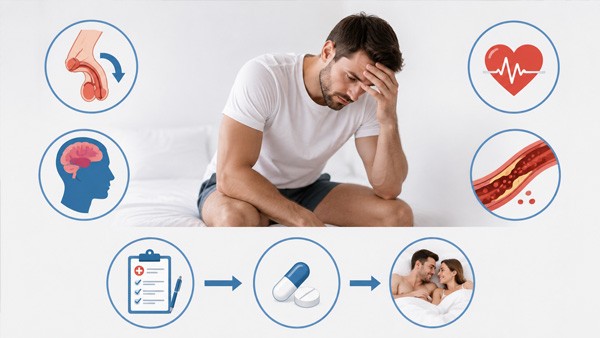

Erectile dysfunction is treated as though it were a single condition with a single treatment, and it is neither. Several quite different mechanisms produce the same symptom, and the mechanism determines whether the usual tablets will work, work partially, or not work at all.
That distinction explains something that frustrates a great many men: two people with apparently identical complaints can have entirely different responses to the same prescription. It is not that one tried harder. It is that they had different conditions.
🧠 The practical value of classifying properly: PDE5 inhibitors work by amplifying a signal that relaxes arteries and traps blood. That requires arteries capable of dilating, nerves capable of sending the signal, and veins capable of holding the blood in. Where one of those three is the problem, the tablet may be the wrong instrument entirely — and identifying which one it is takes a history and an examination rather than a further prescription.
🗂️ The main types
| Type | Mechanism | Response to tablets |
|---|---|---|
| Vasculogenic — arterial | Narrowed arteries cannot deliver enough blood | Usually good, less so as disease advances |
| Vasculogenic — venous leak | Blood enters but does not stay trapped | Frequently poor |
| Neurogenic | The signal to relax the arteries does not arrive | Variable; depends on how much nerve function remains |
| Hormonal | Low testosterone, thyroid disorder, raised prolactin | Poor until the hormone problem is corrected |
| Drug-induced | Medication interferes directly | Improves when the drug is changed |
| Structural | Peyronie disease, previous injury | Tablets do not address the mechanical problem |
| Psychogenic | Anxiety physically opposes erection | Often good, and useful for breaking the cycle |
| Mixed | More than one of the above | The commonest situation over forty |
Mixed presentations dominate in practice. A vascular problem develops gradually, the first failure creates anxiety, anxiety worsens subsequent attempts, and by the time a man seeks help both are operating. Treating one and ignoring the other is why results disappoint.
🩸 Vascular problems, in two forms
This is the largest category and it divides into two mechanisms that behave quite differently.
Arterial insufficiency means the arteries supplying the penis are narrowed by the same atherosclerotic process that affects the heart and legs. Because those arteries are only one to two millimetres across against three to four for the coronary arteries, they produce symptoms earlier — which is why erectile dysfunction of vascular origin typically precedes a cardiac event by several years. It develops gradually, worsens over time, and is associated with diabetes, smoking, high blood pressure and raised cholesterol.
Venous leak, properly called veno-occlusive dysfunction, is a different problem with the same appearance. Blood enters normally, but the mechanism that compresses the outflow veins fails, so it drains away as fast as it arrives. The characteristic history is an erection that develops adequately and then collapses within a short time, frequently on changing position or during penetration.
⚠️ Venous leak explains a large share of tablet failures. PDE5 inhibitors increase inflow; they do nothing about outflow. A man whose erection arrives and then disappears within a minute or two, reliably and in every situation, may be given progressively higher doses of a drug addressing the wrong half of the problem. That pattern is worth describing precisely to a clinician, because it points to a specific diagnosis with specific management — constriction rings, vacuum devices, injection therapy or surgery, rather than another prescription.
🧠 Neurogenic causes
An erection begins with a nerve signal releasing nitric oxide. Where the nerves are damaged, the signal never arrives, and the vascular machinery downstream sits unused however healthy it is.
| Cause | Notes |
|---|---|
| Diabetes | Damages nerves and vessels together; onset earlier and progression faster than in non-diabetics |
| Pelvic surgery | Prostate, bladder and rectal surgery can injure the nerves running alongside the prostate |
| Spinal cord injury | Effect depends on the level and completeness of injury; reflex erections may be preserved |
| Multiple sclerosis | Common, and frequently one of the earlier symptoms |
| Parkinson disease | Both the disease and some treatments contribute |
| Pelvic radiotherapy | Damages nerves and vessels progressively over months to years |
| Cycling | Prolonged pressure on the perineum from an unsuitable saddle; usually reversible |
Diabetes deserves particular mention because it is the commonest cause of erectile dysfunction in younger men and because it produces a combined vascular and neurological picture, which is why response to tablets is less reliable than in men with vascular disease alone. It is also why glycaemic control matters here as much as anywhere.
🔬 Hormonal causes
Hormonal causes are less common than popular discussion suggests, and they are worth excluding because they are treatable and because leaving them uncorrected makes everything else work poorly.
Low testosterone reduces desire more than it reduces erection, and the pattern of reduced libido alongside erectile difficulty is what suggests it. It must be measured in the morning before eleven, since levels fall through the day, and confirmed on a repeat sample before treatment. PDE5 inhibitors respond poorly when testosterone is genuinely low, and correcting it restores that response.
Thyroid disorders in either direction affect sexual function and are easily checked.
Raised prolactin, often from a benign pituitary tumour or from certain antipsychotic medication, suppresses testosterone and causes reduced desire. It is uncommon and specifically worth looking for where libido has fallen markedly.
💊 Medication as the cause
This category is worth checking early because it is common, frequently unrecognised, and often entirely reversible.
| Drug group | Notes |
|---|---|
| SSRI antidepressants | Very common; alternatives with lower rates exist |
| Thiazide diuretics and older beta blockers | Long-recognised; newer blood pressure options affect function less |
| Antipsychotics | Often via raised prolactin |
| Finasteride and dutasteride | Used for hair loss and prostate enlargement; effects reported by a minority |
| Hormone therapy for prostate cancer | An expected effect of removing testosterone |
| Opioids | Suppress testosterone with long-term use |
| Anabolic steroids | Suppress the body own production, sometimes long after stopping |
| Excess alcohol, cannabis, stimulants | Direct effects on arousal and vascular function |
The useful clue is timing. A problem that began within weeks of starting a new medication is worth attributing to it until proven otherwise. Nothing should be stopped independently — particularly antidepressants and blood pressure treatment — but raising it with the prescriber frequently produces a switch that resolves the problem entirely.
🎭 Psychogenic causes
Anxiety physically opposes erection, because arousal requires the parasympathetic nervous system while anxiety activates the sympathetic one. The result is a self-sustaining cycle in which the fear of failure produces the failure.
The distinguishing features are sudden onset traceable to a specific occasion, variation between partners and settings, preserved morning erections, and normal erections alone. It dominates in younger men and coexists with physical causes in older ones.
This mechanism, the techniques that address it and the partner dimension are covered in detail in the guide to performance anxiety and erectile problems.
🩺 After prostate surgery
This deserves its own section because it affects a large number of men, follows a particular timeline, and is managed in a way that is not obvious.
The nerves controlling erection run in bundles immediately alongside the prostate. Even where surgery spares them, they are stretched and bruised, and they recover slowly — over a period measured in many months to a couple of years. Erectile function immediately after surgery is therefore usually absent, and that is not the final outcome.
Penile rehabilitation is the approach used during that recovery window. The rationale is that erectile tissue deprived of regular oxygenated blood flow undergoes structural change, with fibrosis and loss of elasticity, which can make the eventual return of nerve function less useful. Regular induced erections — through a daily or frequent PDE5 inhibitor, a vacuum device, or injections — maintain the tissue while the nerves recover.
The evidence for rehabilitation is genuinely mixed rather than settled, and protocols vary between centres. What is consistent is that outcomes depend heavily on age, function before surgery, and whether the nerves were spared, and that recovery is slow enough that judging the result at three months is premature.
Where nerve function does not return sufficiently, injection therapy and penile prosthesis both work well in this group, and satisfaction with prosthesis surgery after prostatectomy is high.
➰ Peyronie disease
A structural cause that is frequently missed and that tablets do not address.
Fibrous plaque forms in the tissue of the penis, producing curvature, indentation or shortening, often with pain in the early stage. It can make intercourse difficult or impossible independently of erectile quality, and it also causes erectile dysfunction in its own right where the plaque interferes with blood trapping.
It runs in two phases. The active phase, over roughly six to eighteen months, involves pain and changing deformity, and surgery is avoided during it because the shape is still evolving. The stable phase follows, with the deformity fixed and pain usually gone, and it is then that definitive treatment is considered.
Treatment options include injectable collagenase, traction therapy, and surgery to straighten or reconstruct. Oral medication has limited evidence. The important point for anyone noticing a new bend or lump is that this is a recognised condition with specific management, not something to be embarrassed about or to work around silently.
🧪 Working out which type it is
Most of the answer comes from the history, and a few targeted tests settle the rest.
| Assessment | What it shows |
|---|---|
| Onset and pattern | Sudden and situational suggests psychogenic; gradual and constant suggests organic |
| Morning and night erections | Preserved indicates intact vascular and nerve function |
| Erection that arrives then collapses quickly | Suggests venous leak |
| Libido | Reduced desire alongside points toward hormonal causes or depression |
| Medication timeline | Onset soon after a new prescription points to drug cause |
| Examination | Curvature or plaque, testicular size, secondary sexual characteristics |
| Blood tests | Glucose or HbA1c, lipids, morning testosterone, thyroid function, prolactin where indicated |
| Cardiovascular assessment | Blood pressure and formal risk estimate — not optional in vascular presentations |
| Penile duplex ultrasound | Measures arterial inflow and detects venous leak directly; used in selected cases |
| Nocturnal tumescence testing | Records erections during sleep; separates organic from psychogenic where the history is unclear |
The last two are specialist investigations rather than routine ones, used when the answer changes management — typically before surgery, in younger men with severe dysfunction, or after trauma.
🎯 Matching treatment to type
| Type | First approach | If that is insufficient |
|---|---|---|
| Arterial | PDE5 inhibitor plus aggressive cardiovascular risk management | Injection therapy, vacuum device |
| Venous leak | Constriction ring, vacuum device with ring | Injection therapy, prosthesis |
| Neurogenic | PDE5 inhibitor, often at higher dose | Injection therapy, prosthesis |
| Hormonal | Correct the hormone abnormality first | Add a PDE5 inhibitor once corrected |
| Drug-induced | Review and switch the medication | PDE5 inhibitor if switching is not possible |
| Structural | Specific treatment for the deformity | Surgery, with prosthesis where both problems coexist |
| Psychogenic | Reduce pressure, address anxiety, involve the partner | PDE5 inhibitor as temporary support alongside therapy |
| Post-prostatectomy | Penile rehabilitation during nerve recovery | Injections, prosthesis if function does not return |
💊 Choosing among the tablets
All four PDE5 inhibitors work by the same mechanism and differ mainly in timing. Where they diverge more meaningfully is in how they suit particular situations.
Vardenafil is somewhat more potent per milligram than sildenafil and has been studied specifically in men who are difficult to treat, including those with diabetes and following prostate surgery. Its onset is comparable and food affects it less than sildenafil.
Tadalafil lasts up to thirty-six hours, is unaffected by food, can be taken as a low daily dose, and also treats prostate symptoms — useful where both coexist.
Sildenafil is the most established and least expensive, at the cost of poorer absorption after a heavy meal.
Avanafil acts fastest, within fifteen to thirty minutes, and is the most selective, which may mean fewer side effects.
✅ Before concluding tablets do not work: confirm the dose was adequate rather than the starting one, that at least six to eight attempts were made, that sexual stimulation was present since the drug preserves a response rather than creating one, that sildenafil was not taken after a heavy meal, that alcohol was not involved, and that testosterone is not low. A meaningful proportion of men referred as non-responders respond once these are corrected. Trying a second drug in the class before giving up is also worthwhile, since individual response varies.
🔧 When tablets are not the answer
Several effective options exist, and men are frequently unaware of them because the conversation stops after the prescription.
Vacuum erection devices draw blood in mechanically and retain it with a constriction ring. Because they bypass the vascular system entirely, they work where arteries and nerves do not, and they are particularly suited to venous leak, where the ring addresses the actual problem.
Intracavernosal injection of alprostadil produces an erection directly and is effective even in severe vascular and neurological disease, including after prostate surgery. The prospect deters most men who then find it far less troubling than expected.
Intraurethral alprostadil avoids the needle at some cost in effectiveness.
Penile prosthesis is a surgical implant with high satisfaction rates, appropriate where other treatments have failed. It is definitive and irreversible, since it replaces the natural erectile tissue.
Low-intensity shockwave therapy shows promise in mild vascular disease, but its evidence base remains less established than the options above and it is frequently sold at prices out of proportion to what is known. Reasonable to consider after standard treatments; unreasonable to be offered instead of them.
🚨 The point that outlives the sexual complaint
Whatever the type, one implication carries beyond the bedroom.
Vascular erectile dysfunction is an early manifestation of arterial disease, and it appears in the small penile arteries several years before it appears in the larger coronary arteries. Guidelines in multiple countries therefore treat the presentation as an indication for cardiovascular risk assessment.
A man given a prescription without anyone measuring his blood pressure, checking his glucose and lipids or asking about smoking has had an incomplete consultation, however satisfactory the tablet turns out to be. The full argument for that is set out in the guide to erectile dysfunction and age.
Treatments discussed here are stocked in the mens health category, including Levitra (vardenafil). Which agent suits depends on the type of dysfunction, other conditions and other medication, so treatment should follow assessment rather than replace it.
❓ Frequently asked questions
Why does the type of erectile dysfunction matter?
Because it predicts what will work. PDE5 inhibitors amplify a signal that dilates arteries and traps blood, which requires arteries able to dilate, nerves able to send the signal, and veins able to hold blood in. Where one of those three is the problem, the tablet addresses the wrong part of the mechanism. Two men with identical complaints can respond completely differently because they have different conditions.
What is venous leak?
A failure of the mechanism that compresses the outflow veins during an erection, so blood drains away as fast as it arrives. The typical history is an erection that develops adequately and then collapses within a short time, often on changing position or during penetration. It responds poorly to tablets, which increase inflow and do nothing about outflow, and it is better addressed with a constriction ring, vacuum device, injections or surgery.
Why is erectile dysfunction worse in diabetes?
Because diabetes damages nerves and blood vessels together, producing a combined neurogenic and vascular picture rather than one or the other. Onset tends to be earlier and progression faster than in men without diabetes, and response to tablets is less reliable than in vascular disease alone. Glycaemic control matters here as much as it does for any other diabetic complication.
Could my medication be causing this?
Quite possibly, and it is frequently unrecognised and often reversible. SSRIs, thiazide diuretics, older beta blockers, antipsychotics, finasteride, opioids and anabolic steroids all contribute. The useful clue is timing: a problem beginning within weeks of a new prescription is worth attributing to it until proven otherwise. Do not stop anything independently, but raise it with the prescriber, since a switch often resolves it entirely.
What happens to erections after prostate surgery?
The nerves controlling erection run immediately alongside the prostate, and even where surgery spares them they are stretched and bruised and recover slowly, over many months to a couple of years. Function is usually absent immediately afterwards, and that is not the final outcome. Penile rehabilitation maintains the tissue during recovery, and where function does not return, injections and prosthesis both work well in this group.
What is penile rehabilitation?
Deliberately inducing regular erections during the period after prostate surgery while nerves recover — using a daily or frequent PDE5 inhibitor, a vacuum device or injections. The rationale is that erectile tissue deprived of regular oxygenated blood flow becomes fibrotic and loses elasticity, which would make returning nerve function less useful. The evidence is genuinely mixed and protocols vary between centres, but the reasoning is sound and it is widely practised.
I have noticed a bend in my penis. What is that?
Possibly Peyronie disease, in which fibrous plaque forms in the tissue producing curvature, indentation or shortening, often with pain early on. It runs through an active phase of six to eighteen months while the shape changes, then a stable phase when definitive treatment is considered. Options include injectable collagenase, traction and surgery. It is a recognised condition with specific management, not something to work around silently.
Which tablet should I try?
All four work by the same mechanism and differ mainly in timing. Vardenafil is somewhat more potent per milligram than sildenafil and has been studied specifically in harder-to-treat groups including diabetes and after prostate surgery. Tadalafil lasts up to thirty-six hours and can be taken daily. Sildenafil is the most established and cheapest. Avanafil acts fastest. Individual response varies, so a second drug is worth trying before giving up.
What tests identify the type?
Most of the answer comes from the history — onset, pattern, morning erections, whether the erection collapses quickly, libido, and medication timeline. Blood tests cover glucose, lipids, morning testosterone, thyroid function and sometimes prolactin. Penile duplex ultrasound measures arterial inflow and detects venous leak directly, and nocturnal tumescence testing separates organic from psychogenic; both are specialist tests used when the result changes management.
The tablets did not work. What now?
First check the trial was adequate: proper dose rather than the starting one, at least six to eight attempts, sexual stimulation present, no heavy meal before sildenafil, no significant alcohol, and testosterone not low. A meaningful proportion of men referred as non-responders respond once those are corrected. If genuinely ineffective, vacuum devices, intracavernosal injections, intraurethral alprostadil and penile prosthesis all remain, and all work well in the right situation.
Can low testosterone be the whole problem?
It is less common than popular discussion suggests, but it is worth excluding because it is treatable and because PDE5 inhibitors work poorly while it remains uncorrected. Low testosterone reduces desire more than it reduces erection, so reduced libido alongside erectile difficulty is what suggests it. Measurement must be in the morning before eleven and confirmed on a repeat sample before any treatment is started.
Why does this matter for my heart?
Because vascular erectile dysfunction is an early manifestation of arterial disease, appearing in the small penile arteries several years before symptoms reach the larger coronary arteries. Guidelines in several countries treat the presentation as an indication for cardiovascular risk assessment. A prescription issued without anyone checking blood pressure, glucose, lipids and smoking history is an incomplete consultation.
📑 Sources and editorial
- European Association of Urology and American Urological Association guidelines on erectile dysfunction
- Princeton Consensus recommendations on sexual activity and cardiovascular risk
- Evidence reviews on penile rehabilitation after radical prostatectomy
- AUA guideline on the management of Peyronie disease
- Comparative studies of PDE5 inhibitors in diabetes and after prostatectomy
- Literature on penile duplex ultrasonography and veno-occlusive dysfunction
- FDA prescribing information for vardenafil, tadalafil, sildenafil and avanafil
- Related reading: erectile dysfunction and age, performance anxiety
- Related products: mens health category
- RXshop Editorial Team — reviewed by Michael Reeves, MD, FACS, Urology
Medical Disclaimer: The information in this article is for educational and informational purposes only and is not a substitute for professional medical advice, diagnosis, or treatment. Always seek guidance from a qualified healthcare provider with any questions you may have regarding a medical condition, and before starting, stopping or changing any medication.