Panic Attacks: Why They Feel Like Dying

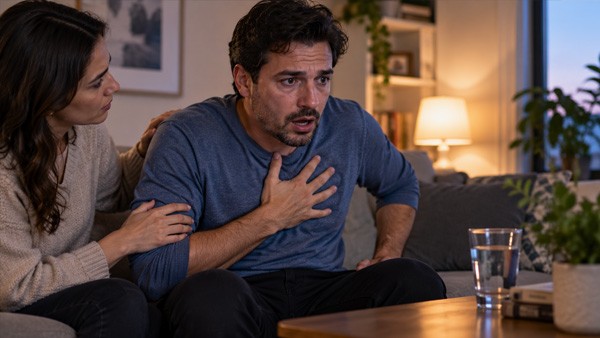
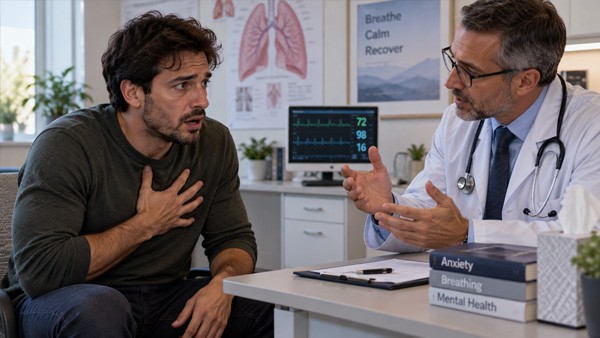
A panic attack is one of the most frightening experiences a healthy person can have. The heart hammers, the chest tightens, breathing feels impossible, the hands go numb, the world takes on an unreal quality, and the overwhelming conviction is that something catastrophic is happening right now.
Nothing catastrophic is happening. Understanding precisely what is happening turns out to be a substantial part of the treatment, which is unusual in medicine and worth taking seriously.
⚡ Every symptom on that list is one thing: an adrenaline surge, arriving without a threat. The response exists to prepare you to fight or run — heart faster to deliver blood, breathing faster for oxygen, blood diverted from hands and gut to the large muscles, muscles tensed, senses sharpened. It is a functioning system, deployed at entirely the wrong moment. The sensations are not evidence of damage. They are evidence of preparation. Nobody has ever been harmed by the surge itself, and the body is doing exactly what it was built to do.
🔄 The loop that sustains it
An adrenaline surge alone would be unpleasant and brief. What turns it into a panic attack is what happens next.
A sensation appears — the heart skips, the chest tightens, the head swims. It is interpreted as dangerous: this is a heart attack, I am suffocating, I am losing my mind. That interpretation is itself a threat signal, so the brain releases more adrenaline. Which intensifies the sensation. Which confirms the interpretation.
The loop closes within seconds and accelerates. What makes it so convincing is that each step genuinely follows from the last — the person is not imagining the symptoms and is not being irrational. They are reasoning correctly from a false premise.
This matters practically, because it identifies where the loop can be broken. Not at the sensation, which cannot be stopped by will. At the interpretation. Someone who knows what a racing heart during panic means does not add the second surge, and the attack collapses far faster.
💨 The part nobody explains
Half of what makes a panic attack terrifying comes from breathing, and the mechanism is counterintuitive enough that explaining it often produces visible relief.
During panic, breathing becomes fast and deep. That is the fight-or-flight response supplying oxygen for exertion that never happens. The oxygen is not used, so blood oxygen stays normal or rises slightly.
What falls is carbon dioxide, which is blown off faster than the body produces it. And carbon dioxide is not merely waste — it regulates the acidity of the blood, and through that a great deal else.
When it drops:
- Blood vessels to the brain narrow, producing light-headedness, blurred vision, and the sense that the world is not quite real
- Nerves become excitable, producing tingling and numbness in the hands, feet and around the mouth, and sometimes cramping of the fingers
- The chest wall tightens, producing chest discomfort
- The sense of not getting enough air intensifies — which is the cruellest part, because it drives more over-breathing
💡 You are not short of oxygen. You have too little carbon dioxide. The feeling of suffocation during a panic attack is produced by over-breathing rather than under-breathing, which is why gasping for more air makes it worse and why breathing slowly makes it better. Slow breathing is not working because it is relaxing — it is working because it allows carbon dioxide to return to normal. That is also why the old advice to breathe into a paper bag has been abandoned: it does restore carbon dioxide, and it is dangerous if the cause turns out to be asthma or a genuine cardiac event. Slowing the breath achieves the same thing without that risk.
⏱️ Why it ends
A panic attack peaks within about ten minutes and typically settles within twenty to thirty. This is not encouragement; it is physiology.
The surge depends on adrenaline, and the body has a finite quantity available for immediate release. It cannot be sustained. There is also a counter-system that switches on automatically once the surge has run, actively bringing things back down.
So the attack is self-limiting by design. It cannot continue indefinitely, whatever you do or fail to do.
That fact does real work. A great deal of the fear during an attack is fear that it will escalate without limit — that the heart will keep accelerating, that breathing will stop. Knowing there is a ceiling, and that the descent begins on its own, removes a substantial part of what was fuelling the loop.
🫀 The question everyone asks
Almost everyone having a first panic attack believes they are having a heart attack, and going to be assessed is the correct response. This section is about the pattern afterwards, not about self-diagnosis.
| More typical of panic | More typical of a cardiac cause | |
|---|---|---|
| Onset | Sudden, often at rest or in a specific situation | Frequently during or after exertion |
| Character | Sharp or stabbing, in one spot | Pressure, heaviness or squeezing, central |
| Spread | Stays where it is | To the arm, jaw, neck or back |
| Pressing on it | Often reproduces the pain | Does not change it |
| Breathing in | Often makes it worse | Usually no effect |
| Company it keeps | Tingling hands, unreality, fear of dying | Sweating, nausea, breathlessness, sense of doom |
| Duration | Peaks in minutes, settles within half an hour | Persists |
| Exertion | Often improves it | Reliably worsens it |
🔴 That table describes tendencies, not a test you can apply to yourself. Cardiac events present atypically often, particularly in women, in people with diabetes and in older adults, and a panic attack and a heart attack can occur in the same person. A first episode of chest pain always needs assessing. So does any episode that differs from your usual pattern, or that comes with exertion, or that persists beyond half an hour. Being assessed and told it was panic is a good outcome, not a wasted trip.
🏥 The cycle that follows
What frequently happens next is its own problem.
The person is assessed, the tests are normal, they are told it was anxiety and sent home. The reassurance lasts a few days. Then another attack occurs, and the reassurance evaporates — because nobody explained the mechanism, only the absence of disease.
Some people go through this five or six times. Each normal result is reassuring for less time than the one before, and each visit reinforces the sense that something is being missed.
The way out is not another test. It is an explanation of what the symptoms are and why they occur, which is what converts a normal result from a puzzle into an answer.
🚪 How the world shrinks
Panic disorder rarely stays confined to the attacks. What disables people is what grows around them.
An attack occurs somewhere — a supermarket, a train, a motorway. The place becomes associated with it. That place is then avoided. The avoidance brings relief, which reinforces it. Then similar places are avoided.
Over months the accessible world contracts: no public transport, no crowds, no driving alone, eventually not leaving the house without a companion. That is agoraphobia, and it is not fear of open spaces — it is fear of being somewhere escape would be difficult or help unavailable if an attack began.
Alongside avoidance come safety behaviours: sitting near exits, carrying water, only going out accompanied, keeping a tablet in a pocket.
These feel protective and they are the mechanism by which the disorder persists. Every time an attack is survived while performing them, the person concludes the behaviour saved them — and never learns that the attack would have ended anyway. The safety behaviour prevents the discovery that would end the problem.
🔍 What should be excluded
Panic disorder is a positive diagnosis, and a small number of conditions produce identical episodes and should be considered once.
A fast heart rhythm disturbance is the most important. Certain arrhythmias start and stop abruptly, produce a racing heart, breathlessness, chest discomfort and terror, and are frequently diagnosed as panic for years. The clue is that the racing heart comes first and the fear follows, rather than the other way round, and that the rate is very fast and regular. An ambulatory heart monitor settles it.
An overactive thyroid produces anxiety, palpitations, tremor, heat intolerance and weight loss. One blood test.
Low blood sugar, particularly in anyone treated for diabetes.
Asthma, where breathlessness leads and anxiety follows.
Substances. Caffeine is a genuine and potent trigger, and people prone to panic are measurably more sensitive to it. Also stimulants, cannabis, decongestants, asthma inhalers, thyroid medication, steroids — and alcohol withdrawal, including the morning after heavy drinking.
Cutting caffeine deserves particular emphasis because it is free, it is frequently ignored, and in some people it substantially reduces attack frequency on its own.
🧠 The treatment that works best
Cognitive behavioural therapy for panic disorder has among the strongest evidence in psychiatry, and its distinctive component is one most people have never heard of.
Understanding the mechanism comes first — adrenaline, the loop, carbon dioxide, the self-limiting nature of the attack. For some people this alone reduces frequency considerably.
Then the interpretations are examined. Not by being told the fear is irrational, but by testing it: what actually happens, what has happened every previous time, what the evidence supports.
Then, distinctively, the sensations are deliberately produced. Spinning in a chair to create dizziness. Breathing quickly for a minute to create the tingling and unreality. Breathing through a narrow straw to create the sense of restricted air. Running on the spot to raise the heart rate.
This sounds unkind and it is the most effective element. The disorder is sustained by a learned association between a bodily sensation and catastrophe. Producing the sensation repeatedly, deliberately, and having nothing catastrophic follow, breaks the association at the level where it lives — which explanation alone cannot reach.
Then avoidance is reversed, gradually and by agreement, until the world reopens.
Most people improve substantially, many stop having attacks altogether, and the benefit persists after treatment ends, which is not true of medication.
💊 Medication
Medication is effective, particularly where attacks are frequent or avoidance is entrenched, and it works best alongside the above rather than instead of it.
SSRI antidepressants are first-line. They reduce both the frequency of attacks and the anticipatory dread between them.
⚠️ One prescribing detail decides whether it works, and it is regularly missed. SSRIs commonly cause a transient increase in anxiety and jitteriness in the first one to two weeks, and people with panic disorder are especially sensitive to it. Started at a normal dose, the first days can feel like the illness getting dramatically worse — and the person stops, concluding the drug caused it. The answer is to start at roughly half the usual dose and increase slowly. The early worsening then largely disappears. Anyone starting one for panic should be told to expect this, that it settles, and that it is not a sign the treatment is wrong.
Benefit takes four to six weeks, as with any SSRI, and treatment is usually continued for six to twelve months after response before considering reduction.
🚫 The tablet that undermines recovery
Benzodiazepines stop a panic attack within twenty minutes. Given that, prescribing one to carry seems obviously humane, and it works against the person in two specific ways.
It becomes a safety behaviour. The tablet is taken, the attack ends, and the person concludes the tablet ended it — when the attack was going to end anyway. That conclusion is never disproved while the tablet is available, so the central lesson of recovery is never learned. Merely carrying one has the same effect, which is why people describe not needing to take it as long as they have it.
It blocks the therapy from working. The whole mechanism of exposure treatment is experiencing the sensations without escape and discovering that nothing follows. A drug that removes the sensations removes the learning, and outcomes are measurably worse when the two are combined.
Added to that are tolerance, dependence within weeks, and withdrawal that produces anxiety indistinguishable from the original problem.
There is a narrow legitimate role — covering the first weeks while an SSRI takes effect, in someone severely disabled — and it is a short bridge rather than a long-term arrangement. The article on lorazepam covers that class in detail.
🛠️ During an attack
Name it. This is a panic attack. It has happened before. It will peak and pass.
Slow the breathing out. Not deep breaths — slow ones, with the out-breath longer than the in. Four counts in, six or more out. This restores carbon dioxide, which is what most of the frightening symptoms come from.
Do not fight it. Trying to stop it is another threat signal and adds adrenaline. Letting it run is genuinely faster.
Stay where you are if you safely can. Leaving ends the attack and teaches that leaving was necessary, which makes the next one likelier. This is the single most valuable thing to do and the hardest.
Put attention outside your body. Name what you can see, hear and touch. Monitoring your own heart rate feeds the loop directly.
Wait. Ten minutes to the peak. It is going to end.
🌙 Attacks that wake you
Some people wake abruptly from sleep in full panic. It is genuinely frightening because there is no trigger, no thought that started it, and no warning.
These are not nightmares — there is no dream. They occur in the transition between sleep stages and are a recognised feature of panic disorder rather than a separate problem.
They frequently lead to a fear of going to sleep, which produces sleep deprivation, which increases attacks. Breaking that requires treating the panic rather than the sleep, though the sleep problem needs saying out loud since it is rarely volunteered.
🩺 When to seek help
- A first episode of chest pain — always assessed, whatever you suspect
- Any episode different from your usual pattern, or brought on by exertion, or lasting beyond half an hour
- A racing heart that starts before the fear, very fast and regular — needs a heart rhythm monitor
- Recurrent attacks, or persistent dread of the next one
- Avoiding places or situations you previously managed
- Attacks waking you from sleep
- Drinking or using anything to manage it
- Low mood alongside, which is common and treatable
- Weight loss, tremor and heat intolerance with the attacks — check the thyroid
- Thoughts of self-harm — immediately
Treatment is stocked in the antidepressant category, including Lexaheal (escitalopram) and Sertafine (sertraline), both first-line for panic disorder and both started at a lower dose than for depression. Buspirone, in the anti-anxiety category, is effective for generalised anxiety and not for panic disorder, which is a distinction worth knowing before ordering.
❓ Frequently asked questions
Can a panic attack actually harm me?
No. Every symptom is an adrenaline surge arriving without a threat — the heart faster to deliver blood, breathing faster for oxygen, blood diverted from the hands to the large muscles, muscles tensed. It is a functioning system deployed at the wrong moment. The sensations are evidence of preparation rather than damage, and nobody has been harmed by the surge itself.
Why do my hands tingle and the world feel unreal?
Over-breathing. Fast deep breathing blows off carbon dioxide faster than the body makes it, and the drop narrows the blood vessels to the brain — producing light-headedness and unreality — while making nerves excitable, producing tingling in the hands, feet and around the mouth. Your oxygen is normal or high. It is the carbon dioxide that has fallen.
Why does slow breathing help?
Not because it is relaxing — because it lets carbon dioxide return to normal, and most of the frightening symptoms come from its loss. Slow rather than deep, with the out-breath longer than the in: four counts in, six or more out. Gasping for more air makes it worse, since the problem is over-breathing rather than a shortage of oxygen.
How long can an attack last?
It peaks within about ten minutes and usually settles within twenty to thirty. That is physiology rather than encouragement: the surge depends on adrenaline, the body has a finite amount for immediate release, and a counter-system switches on automatically once it has run. It cannot escalate indefinitely, whatever you do, and knowing there is a ceiling removes much of the fear driving it.
How do I know it is not my heart?
You do not, and a first episode of chest pain should always be assessed. Afterwards, some features are more typical of panic — sharp pain in one spot, reproduced by pressing, worse breathing in, with tingling hands and unreality, peaking in minutes. Cardiac pain is more often pressure, central, spreading to arm or jaw, brought on by exertion. Both patterns overlap, particularly in women and older adults.
My tests keep coming back normal. What now?
Not another test. Reassurance from a normal result lasts a few days and evaporates at the next attack, because absence of disease is not an explanation. What converts it from a puzzle into an answer is understanding the mechanism — the adrenaline surge, the interpretation loop, the carbon dioxide. Some people go through five or six normal workups before anyone explains it.
Should I carry a tablet just in case?
It works against you. The attack ends, you conclude the tablet ended it, and the fact that it would have ended anyway is never discovered. Simply carrying one has the same effect, which is why people say they do not need to take it as long as they have it. It also blocks exposure therapy from working, since the whole mechanism is experiencing the sensations and finding nothing follows.
The antidepressant made me worse at first. Why?
SSRIs commonly cause a transient increase in anxiety and jitteriness in the first one to two weeks, and people with panic disorder are especially sensitive. Started at a normal dose it can feel like the illness worsening dramatically, and stopping at that point is common. The answer is starting at roughly half the usual dose and increasing slowly, which largely removes it. It settles, and it is not a sign the treatment is wrong.
Why is deliberately causing the symptoms part of treatment?
Because the disorder is sustained by a learned association between a bodily sensation and catastrophe, and explanation alone does not reach where that association lives. Spinning to create dizziness, breathing fast to create tingling, breathing through a straw to create restricted air — repeatedly, deliberately, with nothing catastrophic following — breaks the link directly. It is the most effective element of the therapy.
Could it be something other than panic?
Worth excluding once. A fast heart rhythm disturbance is the important one — it starts and stops abruptly and is diagnosed as panic for years; the clue is the racing heart coming first and the fear following, at a very fast regular rate, and a wearable monitor settles it. Also an overactive thyroid, low blood sugar, asthma, and substances including caffeine, stimulants, decongestants and alcohol withdrawal.
📑 Sources and editorial
- DSM-5 criteria for panic attack, panic disorder and agoraphobia
- NICE guideline on panic disorder in adults
- Cognitive models of panic and the catastrophic misinterpretation of bodily sensations
- Research on hyperventilation, hypocapnia and the physiological basis of panic symptoms
- Trials of cognitive behavioural therapy with interoceptive exposure in panic disorder
- Evidence on combining benzodiazepines with exposure therapy and its effect on outcomes
- Guidance on SSRI initiation dosing in panic disorder and early activation symptoms
- Literature on supraventricular tachycardia misdiagnosed as panic disorder
- Studies of caffeine sensitivity and panic induction
- Related reading: generalised anxiety disorder, lorazepam and benzodiazepines
- Related products: antidepressant category
- RXshop Editorial Team — reviewed by Thomas Walsh, MD, Psychiatrist and Mental Health Specialist
Medical Disclaimer: The information in this article is for educational and informational purposes only and is not a substitute for professional medical advice, diagnosis, or treatment. Always seek guidance from a qualified healthcare provider with any questions you may have regarding a medical condition, and before starting, stopping or changing any medication.