Supporting Someone With Bipolar Disorder

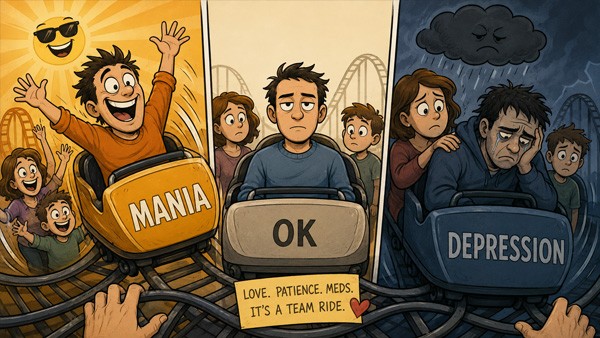

Living alongside someone with bipolar disorder involves a particular kind of difficulty: the person you are trying to help may, during an episode, be certain that nothing is wrong and that your concern is the problem. Meanwhile you are expected to know the difference between a good mood and the start of an episode, and to somehow act on that without controlling an adult who has not asked for your supervision.
There are ways through this that work considerably better than instinct, and most of them involve decisions made while the person is well rather than reactions during a crisis.
🧠 The most valuable thing a family can do, and almost nobody is told about it: make a written plan together during a period of stability. It records the individual early warning signs, who should be contacted and how quickly, what the person wants done if they lose insight, what treatment they do and do not want, and practical safeguards such as limiting access to money during a manic episode. Agreed in advance by the person themselves, it turns an argument during an episode into following a plan they wrote.
🔬 What the condition actually involves
Bipolar disorder is a condition of mood regulation in which episodes of elevated mood alternate with episodes of depression, separated by periods of stability that can last months or years.
Two forms are distinguished, and the difference matters more than it appears.
| Bipolar I | Bipolar II | |
|---|---|---|
| Elevated phase | Mania — severe, often requiring hospital, may involve psychosis | Hypomania — milder, no psychosis, functioning may improve |
| Depression | Present in most | Present, usually longer and more frequent than the elevated phases |
| Typical presentation | Recognised during a manic episode | Presents as depression; hypomania never mentioned |
| Diagnostic delay | Shorter | Frequently many years |
The average interval between symptoms starting and a correct diagnosis is commonly reported as six to ten years, and the reason is nearly always the same. People seek help when depressed, not when hypomanic, because hypomania feels good — more energy, more confidence, more productivity, less need for sleep. Nobody books an appointment about that. So the depression is treated as unipolar, and the diagnosis is missed.
This is where family members have information nobody else has. A partner or parent has seen the elevated periods from the outside. Mentioning them to the treating clinician, with permission, frequently changes the diagnosis.
🚩 Recognising the early signs
Episodes rarely arrive without warning. Most people have an individual and fairly consistent pattern of changes appearing days to weeks beforehand, and identifying that pattern is what makes early intervention possible.
| Early signs of an elevated episode | Early signs of a depressive episode |
|---|---|
| Reduced need for sleep — sleeping less and not feeling tired | Sleeping more, or waking early and unable to return to sleep |
| Talking faster or more than usual | Withdrawing from contact, taking longer to reply |
| New projects, plans and ideas in quick succession | Losing interest in things previously enjoyed |
| Increased spending or financial optimism | Neglecting routine tasks and self-care |
| More sociable, more confident, more irritable when interrupted | Slowed movement and speech |
| Increased alcohol, drug use or sexual activity | Expressions of guilt, worthlessness or hopelessness |
| Being convinced of unusual abilities or importance | Difficulty concentrating or making decisions |
⚠️ Reduced need for sleep is the single most reliable early sign of an elevated episode, and it is different from insomnia. Someone with insomnia wants to sleep and cannot, and feels exhausted the next day. Someone entering a manic or hypomanic episode sleeps four hours and wakes energised, and does not experience it as a problem. If a family member notices this pattern for several nights running, it is worth acting on. Sleep loss also drives episodes forward, so the sign and the accelerant are the same thing.
💊 What treatment consists of
The foundation is a mood stabiliser, taken continuously between episodes as well as during them. The purpose is preventing the next episode rather than treating the current one, which is why it continues when the person feels entirely well — a point that causes a great deal of misunderstanding.
| Treatment | Role |
|---|---|
| Lithium | The longest-established mood stabiliser; the only one with consistent evidence of reducing suicide risk; effective against both poles, and particularly against mania |
| Valproate | Effective in mania; must not be used in women who could become pregnant because of serious risks to the fetus |
| Lamotrigine | Best evidence against the depressive pole; must be increased very slowly because of a rare serious rash |
| Quetiapine | Effective in mania and one of the few options with good evidence in bipolar depression |
| Olanzapine, risperidone, ziprasidone, aripiprazole | Antipsychotics used in mania and, for some, in maintenance |
🔴 Antidepressants in bipolar disorder require care and should never be given alone. In someone with bipolar disorder, an antidepressant without a mood stabiliser can precipitate a switch into mania or produce rapid cycling — episodes coming more frequently and becoming harder to treat. This is one of the main reasons the diagnosis matters: a person with unrecognised bipolar disorder presenting with depression may be given exactly the treatment most likely to destabilise them. If a family member is on an antidepressant alone and starts becoming unusually energetic, sleeping less and talking faster, that needs reporting urgently rather than being welcomed as recovery.
Psychological treatment alongside medication improves outcomes. Psychoeducation about the condition, cognitive behavioural therapy, and specifically family-focused therapy all reduce relapse rates. Interpersonal and social rhythm therapy works on stabilising daily routines, particularly sleep, which is unusually important in this condition.
🧪 If lithium is the treatment
Lithium has been in use for decades and remains the reference standard, but it requires more active management than most medications, and families are often the people who notice when something is wrong.
Blood levels are checked regularly, because the difference between an effective level and a toxic one is narrow. Alongside this, kidney function, thyroid function and calcium are monitored, since long-term use affects all three.
Toxicity is a medical emergency and its early signs are easy to dismiss: coarse tremor, vomiting, diarrhoea, unsteadiness, slurred speech, drowsiness and confusion. A fine tremor of the hands is a common ordinary side effect; a coarse shaking tremor is not.
Several everyday things raise lithium levels and cause toxicity in someone whose dose has not changed:
- Dehydration — vomiting, diarrhoea, fever, hot weather, heavy exercise
- Anti-inflammatory painkillers such as ibuprofen, which are widely bought without advice
- Some blood pressure medications, particularly ACE inhibitors and diuretics
- Major changes in salt intake, in either direction
Anyone taking lithium should carry that information, mention it whenever any medication is prescribed or bought, and increase fluid intake during illness or hot weather rather than waiting to feel unwell.
Stopping lithium abruptly carries a particular risk of rebound mania and should never be done without a planned reduction.
📝 The advance plan
This is the intervention with the best return on effort and it is largely unknown outside specialist services.
Written while the person is well, with their full involvement, it typically records:
Individual early warning signs — not a general list but what specifically happened before previous episodes. Reviewing past episodes together often reveals a consistent sequence.
Who does what. Who the person wants contacted, how quickly, and by whom. Whether they want their family member to phone the clinical team directly.
Treatment preferences. Which medications have helped, which have not, which side effects were intolerable, and what they want to happen if they become unwell enough to refuse treatment.
Practical safeguards. Arrangements for money agreed in advance — a second signature, a limited-access account, cards held by someone else during an episode. Financial damage during mania is among the most lasting consequences and among the most preventable.
Responsibilities. Who looks after children, pets, work notification and household matters if hospital admission is needed.
What helps and what does not. In the person own words — how they want to be spoken to during an episode, what makes things worse, what they found helpful last time.
The value of this is that it converts the hardest conversation into a document the person authored themselves. Saying you agreed we would do this is a completely different exchange from saying I think you are unwell.
💬 What to say and what not to
Families consistently report that the wording matters enormously during episodes.
| Less helpful | More helpful |
|---|---|
| You are getting manic again | I have noticed you have not been sleeping much this week |
| You need to take your medication | How are you finding the medication at the moment |
| Snap out of it | I am not expecting anything from you today |
| You were fine last month | What would be useful right now |
| Calm down | Shall we go somewhere quieter |
| Everyone gets sad sometimes | This looks harder than usual and I am here |
The general principle is describing observations rather than delivering diagnoses. What someone can dispute is the label; what they cannot dispute is that they have slept four hours a night for a week.
During depression, the useful stance is presence without demands. Practical help — a meal, a lift to an appointment, taking something off their list — is worth more than encouragement. Avoid framing recovery as a matter of effort, since that is precisely the capacity the illness removes.
During elevated episodes, arguing rarely works and confrontation escalates. Reducing stimulation, avoiding debate about whether they are unwell, and focusing on immediate safety and on delaying irreversible decisions is more productive than trying to convince.
🛏️ Routine, and why sleep matters so much
Circadian disruption is not merely a symptom in bipolar disorder; it precipitates episodes. This makes sleep and routine part of the treatment rather than general wellbeing advice.
Practical implications worth knowing:
- Consistent sleep and wake times matter more here than in almost any other condition
- Night shifts and rotating shift work are genuinely destabilising and worth factoring into career decisions
- Long-haul travel, particularly eastward, is a recognised trigger and warrants planning — adjusting gradually beforehand, protecting sleep, and having a plan if symptoms appear
- Regular meal times and activity reinforce the same rhythm
- Alcohol and stimulants disrupt sleep and destabilise mood, and alcohol is a frequent form of self-treatment during depression
- A period of unavoidable sleep loss — a newborn, an exam period, a crisis — is a time for heightened vigilance rather than a reason for alarm
🔴 Suicide risk
This has to be addressed directly. Bipolar disorder carries one of the highest suicide risks of any psychiatric condition, and the periods of greatest risk are not always the obvious ones.
Highest risk periods include severe depressive episodes, mixed states where depressed mood coexists with agitation and energy, the early phase of recovery from depression when energy returns before mood improves, after discharge from hospital, and following a significant loss or humiliation.
Mixed states deserve particular attention because they are dangerous in a way that is easy to misread. Someone with depressed mood but agitated energy has both the intent and the capacity to act, whereas profound depression frequently removes the capacity. A depressed person who becomes restless and driven is not necessarily improving.
Asking directly does not plant the idea. This is one of the more robust findings in the field and it contradicts a widespread fear. Asking clearly — whether they have thought about ending their life — is more likely to open a conversation than to create a risk.
Act on it. Where there is expressed intent, a plan, access to means, or a sudden unexplained calm after a period of distress, contact the clinical team or emergency services. Removing access to means — medication stockpiles, firearms, car keys during a crisis — reduces risk measurably.
👤 Looking after yourself
The literature on caring for someone with bipolar disorder describes consistently high levels of strain, and family members frequently deprioritise their own health for years.
Several things help and are worth treating as necessary rather than indulgent.
Learn about the condition properly. Family psychoeducation reduces relapse rates for the person who is unwell and reduces distress for the family. It is among the better-evidenced interventions in this whole area and is under-provided everywhere.
Have your own support. Carer groups, whether in person or online, provide something clinicians cannot — recognition from people in the same position.
Keep your own life. Work, friendships and interests are protective, and abandoning them tends to increase resentment on both sides rather than helping.
Accept the limits of your role. You cannot make an adult take medication, cannot prevent every episode, and are not responsible for outcomes you do not control. Episodes happening despite good support are not evidence of failure.
Watch your own mental health. Depression and anxiety are common in carers and are treatable, and being unwell yourself reduces what you can offer.
Ask what is expected of you. The role is easier when it is defined. Some people want a family member involved in appointments and informed by the clinical team; others want independence. Agreeing this explicitly, in advance, avoids a great deal of conflict.
✅ Worth holding on to: bipolar disorder is treatable, and with effective treatment most people work, maintain relationships and live full lives. Episodes become less frequent with good maintenance treatment, and the periods between them are periods of ordinary life rather than of waiting. The picture people carry from crisis moments is not representative of the condition as a whole.
🚨 When to seek help urgently
- Any expression of intent to end life, or a plan, or access to means
- Psychotic symptoms — beliefs or perceptions clearly detached from reality
- Behaviour placing the person or others at risk — dangerous driving, aggression, exposure to harm
- Not eating or drinking, or physical deterioration
- Signs of lithium toxicity — coarse tremor, vomiting, unsteadiness, slurred speech, confusion
- Rapidly escalating mania with no sleep for several nights
- A depressed person becoming suddenly agitated and energised
- Abrupt stopping of medication, particularly lithium
Medication used in bipolar disorder is stocked in the psychiatric medication categories, including Lithobid (lithium) and the antipsychotics used in mania and maintenance. Lithium in particular requires regular blood level and organ function monitoring arranged with a clinician, and it must never be stopped abruptly.
❓ Frequently asked questions
What is the earliest sign of an episode starting?
Reduced need for sleep is the most reliable early sign of an elevated episode, and it differs from insomnia. Someone with insomnia wants to sleep, cannot, and is exhausted next day. Someone entering mania or hypomania sleeps four hours, wakes energised and does not see it as a problem. Several nights of that pattern is worth acting on, and sleep loss also drives the episode forward, so the sign and the accelerant are the same.
Why does the diagnosis take so long?
Because people seek help when depressed, not when hypomanic. Hypomania feels good — more energy, confidence and productivity, less need for sleep — and nobody books an appointment about it. The depression is then treated as ordinary depression. Average delays of six to ten years are commonly reported. Family members have information nobody else has, having seen the elevated periods from outside, and mentioning them frequently changes the diagnosis.
Why can antidepressants be a problem in bipolar disorder?
Given without a mood stabiliser they can precipitate a switch into mania, or produce rapid cycling where episodes become more frequent and harder to treat. This is one of the main reasons the diagnosis matters: someone with unrecognised bipolar disorder presenting with depression may receive exactly the treatment most likely to destabilise them. Unusual energy, reduced sleep and faster speech after starting one needs reporting urgently rather than welcoming as recovery.
What is an advance plan and how do we make one?
A document written together during a stable period, recording individual early warning signs, who to contact and how fast, treatment preferences including what the person wants if they lose insight, practical safeguards such as limiting access to money during mania, and who covers responsibilities if hospital is needed. Its value is that it converts the hardest conversation into following a plan the person wrote themselves.
How do I raise it without starting an argument?
Describe observations rather than delivering diagnoses. What someone can dispute is the label; what they cannot dispute is that they have slept four hours a night for a week. So not you are getting manic, but I have noticed you have not been sleeping much. Where an advance plan exists, referring to it — we agreed we would do this — is a completely different exchange from asserting they are unwell.
What should I know about lithium?
It requires regular blood level checks because the gap between effective and toxic is narrow, plus monitoring of kidney and thyroid function and calcium. Toxicity signs are coarse tremor, vomiting, diarrhoea, unsteadiness, slurred speech and confusion, and it is an emergency. Dehydration, ibuprofen and similar painkillers, some blood pressure medicines and major changes in salt intake all raise levels without any dose change.
Why continue medication when they are completely well?
Because the purpose of a mood stabiliser is preventing the next episode rather than treating the current one, so it continues between episodes as well as during them. Feeling well is the treatment working, not evidence it is unnecessary. Stopping is the commonest route to relapse, and stopping lithium abruptly carries a specific risk of rebound mania, so any reduction needs planning rather than simply ceasing.
How do we protect against financial damage during mania?
By arranging it in advance, while the person is well and can agree to it. Options include a second signature on significant transactions, a limited-access account for daily spending, cards held by someone else during an episode, and notifying a bank of the arrangement. Financial damage during mania is among the most lasting consequences and among the most preventable, and agreements made beforehand are far easier than intervening during an episode.
Is it safe to ask about suicidal thoughts?
Yes, and asking does not plant the idea — this is one of the more robust findings in the field and it contradicts a widespread fear. Asking clearly is more likely to open a conversation than to create a risk. Where there is expressed intent, a plan, access to means, or a sudden unexplained calm after distress, contact the clinical team or emergency services and reduce access to means.
Why is a mixed state particularly dangerous?
Because depressed mood combined with agitation and energy gives both the intent and the capacity to act, whereas profound depression frequently removes the capacity. A depressed person who becomes restless and driven is not necessarily improving. The same applies to the early phase of recovery from depression, when energy returns before mood does, which is a recognised period of raised risk.
Does shift work or travel really matter?
Considerably. Circadian disruption does not merely accompany bipolar disorder, it precipitates episodes, which makes sleep and routine part of the treatment rather than general advice. Night and rotating shift work are genuinely destabilising and worth factoring into career decisions. Long-haul travel, particularly eastward, is a recognised trigger and warrants adjusting gradually beforehand and having a plan if symptoms appear.
How do I cope with the strain on myself?
Treat it as necessary rather than indulgent. Family psychoeducation reduces relapse for the person unwell and distress for the family, and is under-provided everywhere. Carer groups offer recognition clinicians cannot. Keeping your own work, friendships and interests is protective, and abandoning them increases resentment on both sides. And accept the limits: episodes happening despite good support are not evidence of failure.
📑 Sources and editorial
- NICE guideline on bipolar disorder assessment and management in adults, children and young people
- Miklowitz DJ and colleagues — family-focused therapy for bipolar disorder and its effect on relapse
- Evidence on lithium and reduction of suicide risk in mood disorders
- Literature on antidepressant-associated mood switching and rapid cycling in bipolar disorder
- Research on prodromal symptoms and early warning sign monitoring in bipolar disorder
- Studies of social rhythm disruption as a precipitant of affective episodes
- Guidance on advance statements and crisis planning in mental health care
- FDA prescribing information for lithium, quetiapine, olanzapine and ziprasidone
- Related products: antipsychotics category
- RXshop Editorial Team — reviewed by Thomas Walsh, MD, Psychiatry
Medical Disclaimer: The information in this article is for educational and informational purposes only and is not a substitute for professional medical advice, diagnosis, or treatment. Always seek guidance from a qualified healthcare provider with any questions you may have regarding a medical condition, and before starting, stopping or changing any medication.