Electroconvulsive Therapy: What the Risks Really Are


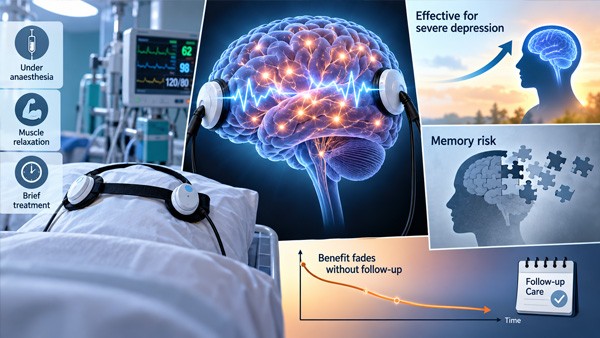
Most people picture this treatment from films: a conscious person strapped down, convulsing violently, in a dim institutional room. That image was accurate for a period decades ago. It has almost nothing to do with how the treatment is given now, and the gap between the two is the main reason people refuse something that could help them.
This article answers the question in the title honestly, which means taking the fear seriously where it is justified — memory — and setting it aside where it is not. It also covers the part almost nobody is told: what has to happen after the course ends for the improvement to last.
🏥 What actually happens in a session. The person is given a short general anaesthetic and a muscle relaxant, so they are asleep and the body barely moves — often the only visible sign is a slight movement of a hand or foot. A brief electrical stimulus produces a seizure in the brain lasting well under a minute. The person wakes a few minutes later, usually with some confusion and a headache, and is typically back on the ward within the hour.
A course is usually two or three sessions a week for several weeks, commonly six to twelve in total. Consent is required, and it can be withdrawn at any point, including partway through a course.
📊 Why it is still used
It remains in use for one reason: for severe depression, it works better and faster than any other available treatment. A large majority of people with severe depression respond, including many who have not improved on several medicines, and the improvement often begins within the first two weeks rather than the six to eight that medication usually takes.
That speed is why it is used in particular situations where waiting is itself dangerous.
| Situation | Why it is considered |
|---|---|
| Severe depression with psychotic symptoms | Responds particularly well, and often poorly to medication alone |
| Not eating or drinking | A physical emergency where weeks of waiting for medication are not available |
| Severe and persistent suicidal risk | Speed of response matters |
| Catatonia | A state of marked immobility or unresponsiveness, where it is often the most effective option |
| Depression that has not responded to several medicines | Response rates remain high even here |
| Severe mania | Where medication has not controlled it |
| Pregnancy with severe illness | Sometimes preferred to high-dose medication |
🛡️ How physically dangerous is it
The physical risk is low, and the figures are worth stating because the fear is usually far out of proportion to them. The risk of death is comparable to that of a general anaesthetic for minor surgery — a few per hundred thousand treatments — and most of that risk comes from the anaesthetic and from the heart, rather than from the treatment itself.
Imaging studies have not shown structural brain damage. The common effects after a session are temporary: headache, aching muscles and jaw, nausea, and a period of confusion that usually clears within an hour or so.
Certain conditions need careful assessment beforehand, because the treatment briefly raises heart rate, blood pressure and pressure inside the skull: a recent heart attack or stroke, raised pressure inside the skull, and an unstable aneurysm. None of these is an absolute bar in every case, but each changes the risk calculation, which is why a full medical assessment comes before a course.
🧠 Memory, which is the real concern
⚠️ This is the legitimate part of the fear, and it deserves a straight answer rather than reassurance.
During a course and for a few weeks after, forming new memories is often harder — conversations, appointments and visitors can be forgotten. This improves over the weeks after treatment ends.
Memories from the period around the course — the weeks and sometimes months before and during treatment — can be patchy, and for some people a part of that gap does not return. Personal memories, such as events and occasions, are more affected than general knowledge and skills. Long-established memories from years earlier are usually unaffected.
How much memory is affected depends partly on how the treatment is given. Placing the electrodes on one side of the head, and using very brief pulses of current, both reduce memory effects considerably compared with older methods, at a modest cost in speed of response. These are reasonable things to ask about before starting.
It is also worth separating what the treatment does from what the illness did. Severe depression itself impairs memory and concentration, often markedly, and much of that improves as the depression lifts.
🔄 The part almost nobody is told
A course of treatment is highly effective at lifting severe depression. It is much less effective at keeping it lifted on its own.
Without continuing treatment afterwards, around half of people relapse within six months, and a large proportion of those relapses happen in the first few weeks. That figure is the most important number on this page, and it is frequently not discussed until relapse has already happened.
The answer is continuation treatment, started as the course ends rather than after symptoms return. The combination with the strongest trial evidence is nortriptyline with lithium: in a landmark trial it substantially reduced relapse compared with no medication, and it performed better than nortriptyline alone. For some people, continuation or maintenance sessions at lengthening intervals are used instead, or alongside.
Both medicines need proper management. Nortriptyline is covered in the article on tricyclic antidepressants, including why it is kept securely at home. Lithium needs more explanation, because it is the one where careful management matters most.
💊 Lithium, and why it needs care
Lithium has an unusual place in psychiatry. It reduces relapse in severe mood disorders, and it is the medicine with the most consistent evidence of reducing suicide. It also has a narrow margin between an effective level and a toxic one, so it is managed by blood tests rather than by dose alone.
| What to know | Detail |
|---|---|
| Blood levels | Measured regularly, more often at the start, with the sample taken about twelve hours after the last dose |
| Kidneys and thyroid | Checked before starting and periodically, since long-term use can affect both |
| Dehydration | Raises the level quickly. Vomiting, diarrhoea, heavy sweating or not drinking can push it into the toxic range within days |
| Other medicines | Anti-inflammatory painkillers, some blood pressure medicines ending in pril or sartan, and water tablets all raise lithium levels |
| Salt intake | A sudden reduction in salt raises the level, so large dietary changes should be discussed first |
🔴 Signs of a lithium level that is too high: worsening tremor, unsteadiness, slurred speech, confusion, vomiting and diarrhoea, and muscle twitching. Because the early signs resemble a stomach upset, the danger is attributing them to illness while the level keeps rising. Stop the dose and seek urgent assessment with a blood test. The same applies to anyone on lithium who develops vomiting or diarrhoea from any cause — the article on stomach infections lists lithium among the medicines needing attention during such an illness.
🧪 Medicines around the course itself
Several medicines affect the treatment and are reviewed beforehand. Benzodiazepines and anticonvulsants make a seizure harder to produce and may be reduced. Lithium can increase confusion after sessions, so its timing around treatment days is sometimes adjusted by the team — which is separate from its role as continuation treatment once the course ends. None of these should be changed independently; the treating team plans it.
⚖️ The alternatives, briefly
Other options exist for severe or resistant depression, and it is reasonable to ask about them. Magnetic stimulation applied over the scalp while awake has fewer memory effects and is generally less effective in the most severe illness. Ketamine-based treatments can act quickly, with their own considerations around monitoring and misuse. Medication strategies — switching, combining, or adding lithium or an antipsychotic — remain the usual steps before this treatment is considered.
What distinguishes this treatment is not that it is the only choice. It is that in the most severe situations — psychosis, not eating, catatonia, high immediate risk — it is often the one most likely to work, and to work in time.
🩺 When to seek help
- Thoughts of suicide — same day, and emergency services if there is immediate risk
- Not eating or drinking in someone with severe depression — urgent
- Return of low mood, poor sleep or withdrawal in the weeks after a course — early contact, since relapse is most common early
- Memory problems that are not improving several weeks after a course ends — worth assessment
- Tremor, unsteadiness, confusion, vomiting or diarrhoea on lithium — urgent blood test
- Any illness causing dehydration while on lithium
- Before starting any new medicine alongside lithium, including painkillers bought over the counter
Continuation treatment after a course is stocked as Lithobid (lithium) and the nortriptyline products Pamelor and Primox. Lithium requires regular blood level monitoring and kidney and thyroid checks, and both medicines are started and adjusted by the treating team — ideally as the course of treatment ends, not after symptoms return.
❓ Frequently asked questions
Is ECT still done the way it is shown in films?
No. It is given under a short general anaesthetic with a muscle relaxant, so the person is asleep and the body barely moves — often only a slight movement of a hand or foot. The seizure happens in the brain and lasts well under a minute. The person wakes within minutes, usually with some confusion and a headache, and is typically back on the ward within the hour.
How dangerous is it physically?
The risk of death is comparable to a general anaesthetic for minor surgery, a few per hundred thousand treatments, and mostly comes from the anaesthetic and the heart. Imaging has not shown structural brain damage. Common after-effects are temporary: headache, muscle and jaw aches, nausea, and confusion that usually clears within an hour. A recent heart attack, stroke or raised pressure inside the skull need careful assessment first.
Will I lose my memory?
Some memory effects are common and are the legitimate concern. Forming new memories is often harder during the course and for a few weeks after, then improves. Memories from around the period of treatment can be patchy, and some of that gap may not return. Long-established memories are usually unaffected. Electrodes on one side of the head and very brief pulses reduce these effects considerably and are worth asking about.
How well does it work?
For severe depression it works better and faster than any other available treatment. A large majority respond, including many who have not improved on several medicines, and improvement often begins within two weeks rather than the six to eight that medication usually takes. That speed is why it is used where waiting is dangerous — psychosis, not eating, catatonia or high immediate risk.
Why do people relapse after a course?
Because the course lifts depression effectively but does not keep it lifted on its own. Without continuing treatment, around half of people relapse within six months, many in the first weeks. The answer is continuation treatment started as the course ends, not after symptoms return — either medication or maintenance sessions at lengthening intervals.
What medication is used afterwards?
The combination with the strongest trial evidence is nortriptyline with lithium, which substantially reduced relapse compared with no medication and performed better than nortriptyline alone. Other antidepressant strategies and maintenance sessions are also used. The choice depends on previous responses, other health conditions and tolerability, and is made by the treating team.
Why does lithium need blood tests?
Because the margin between an effective level and a toxic one is narrow, so it is managed by measuring the level rather than by dose alone. Samples are taken about twelve hours after the last dose, more often at the start. Kidney and thyroid function are also checked periodically, since long-term use can affect both.
What are the signs of lithium toxicity?
Worsening tremor, unsteadiness, slurred speech, confusion, vomiting, diarrhoea and muscle twitching. The early signs look like a stomach upset, which is the danger. Stop the dose and get urgent assessment with a blood test. Dehydration from any cause, anti-inflammatory painkillers, and some blood pressure medicines and water tablets all push the level up.
Can I refuse or stop partway through?
Yes. Consent is required, and it can be withdrawn at any point including partway through a course. It is reasonable to ask how the treatment will be given, what the memory effects are likely to be for you, what the alternatives are, and what the plan is for after the course ends before agreeing.
Are there alternatives?
Yes. Magnetic stimulation over the scalp while awake has fewer memory effects and is generally less effective in the most severe illness. Ketamine-based treatments act quickly, with their own monitoring considerations. Medication strategies — switching, combining, or adding lithium or an antipsychotic — are usually tried first. In the most severe situations this treatment is often the one most likely to work in time.
📑 Sources and editorial
- Clinical guidance on indications, procedure and consent for electroconvulsive therapy
- Meta-analytic evidence on response and remission rates in severe and treatment-resistant depression
- Data on mortality rates per treatment and on the contribution of anaesthetic and cardiac risk
- Neuroimaging studies examining structural brain changes after treatment
- Literature on anterograde and retrograde memory effects, and on the influence of electrode placement and pulse width
- Evidence on relapse rates following an acute course without continuation treatment
- Randomised trial evidence comparing continuation nortriptyline with lithium, nortriptyline alone and placebo
- Guidance on lithium monitoring, toxicity recognition and interacting medicines
- Evidence on lithium and suicide reduction in mood disorders
- Comparative evidence for transcranial magnetic stimulation and ketamine-based treatments
- Related reading: tricyclic antidepressants, bipolar disorder, depression and memory
- Related products: antidepressants category
- RXshop Editorial Team — reviewed by Thomas Walsh, MD, Psychiatry
Medical Disclaimer: The information in this article is for educational and informational purposes only and is not a substitute for professional medical advice, diagnosis, or treatment. Always seek guidance from a qualified healthcare provider with any questions you may have regarding a medical condition, and before starting, stopping or changing any medication.