The Health Halo: Why Looking Natural Is Not Being Safe

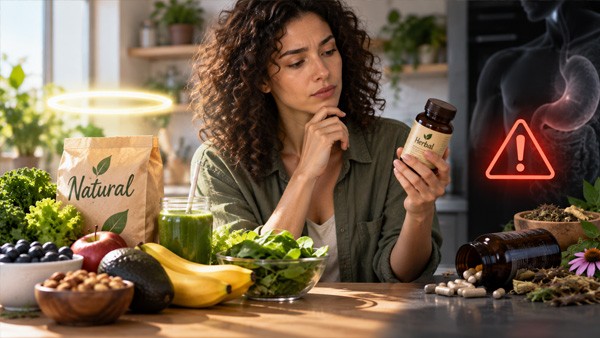
Show people two portions of identical food, one arranged carefully and one thrown onto the plate, and something odd happens. They do not simply prefer the attractive one. They rate it as healthier, more natural, and less processed, and they will pay substantially more for it — even though the two portions are the same food with the same nutritional content.
This has been studied properly, and the finding holds up. Appearance changes what people believe about the contents of a plate, and the belief is formed before any thought about nutrition takes place.
That is a mildly amusing fact about restaurants. It becomes something else entirely when the same mental shortcut is applied to a bottle of capsules.
🧠 The shortcut runs in a chain, and each link seems reasonable on its own. Attractive suggests undamaged. Undamaged suggests fresh. Fresh suggests natural. And natural, in the modern mind, suggests healthy and safe.
Every step is a plausible inference and the conclusion is unreliable, because the chain works just as smoothly when it is being deliberately constructed. Food photography exists to trigger it. So does packaging that uses green, leaves, handwriting fonts and the word natural on products where none of those correspond to anything measurable.
🏷️ The same effect, printed on a label
Appearance is only one trigger. Words do the same job, often more efficiently, and the research on labelling has produced a consistent and slightly deflating picture.
A claim on the front of a package changes how people estimate what is inside it, and the change goes well beyond what the claim actually says. A product labelled organic is judged lower in calories than the identical product without the label. A product labelled low fat is judged suitable in larger portions. And — this is the part that matters — people then eat more of it, often enough to erase the difference the claim described in the first place.
| The claim | What it actually means | What people hear |
|---|---|---|
| Organic | A statement about farming method | Lower in calories, better for you |
| Low fat | Less fat, frequently more sugar to compensate | You can have more of this |
| Gluten free | Essential for coeliac disease, nutritionally irrelevant for everyone else | A healthier version |
| Natural | In most jurisdictions, almost nothing. It is largely unregulated | Safe, gentle, no side effects |
| Plant based | A statement about ingredients, not about processing or nutrition | Light, healthy, unprocessed |
| No added sugar | None added. Says nothing about sugar already present | Low in sugar |
The pattern behind all six rows is the same: a narrow, technically accurate statement gets read as a broad verdict on the whole product. Nobody is being lied to. The inference is simply doing more work than the claim can support, and the packaging is designed knowing that it will.
🍴 Why this quietly defeats weight loss
The halo does specific damage to anyone trying to lose weight, and it does it through a mechanism that feels like good behaviour rather than a mistake.
Choosing the option that seems healthy produces a sense of having earned something. That sense then licenses an addition — a side, a drink, a dessert — and the addition is usually larger than the saving. The person has made a genuinely virtuous choice and finished the meal with more energy than if they had chosen the obviously indulgent option and stopped there.
Portion size compounds it. Food believed to be healthy is served in larger quantities, eaten faster, and less carefully registered, because the internal accounting has already filed it as safe. This is why a salad assembled with dressing, cheese, croutons and nuts can outweigh what it was chosen instead of, while feeling like the disciplined option throughout.
None of this is a failure of willpower. It is a filing error, and the correction is unglamorous: judge food by what is in it rather than by what it signals, and be most suspicious of the options that feel most virtuous.
🌿 Where the illusion stops being harmless
Everything so far costs a few hundred calories. The same shortcut applied to what people swallow deliberately costs considerably more.
Natural is not a safety category. Some of the most toxic substances known are entirely natural, a great many effective drugs were derived from plants precisely because plants are chemically active, and a substance strong enough to have an effect is strong enough to have an unwanted one. The word describes an origin, not a risk profile.
There is also a regulatory point that most people have never been told. In most countries, herbal products and supplements are regulated as foods rather than as medicines. That means no requirement to prove they work, no requirement to prove they are safe before sale, and no routine verification that the contents match the label. A prescription medicine carries a leaflet listing every documented interaction. A supplement carries marketing copy.
🔴 The interactions are real, they are documented, and some of them are severe.
St John of Jerusalem wort is the most important single example. It accelerates the liver enzymes that clear many drugs, which means it can reduce the effectiveness of oral contraceptives to the point of unintended pregnancy, of transplant anti-rejection drugs to the point of organ rejection, and of antiretroviral and several cancer treatments. Combined with an antidepressant it can also cause serotonin syndrome.
Grapefruit does the opposite, blocking those enzymes so that drug levels rise. With certain statins and blood pressure medicines this produces muscle damage or an excessive drop in pressure.
Ginkgo, high-dose fish oil, garlic and ginger add to the effect of blood thinners and raise bleeding risk. Licorice raises blood pressure and lowers potassium. Kava and high-dose green tea extract have both caused serious liver injury.
Tell every prescriber and pharmacist what you take, including anything herbal. Most people do not, because they do not classify a supplement as a medicine — which is the halo doing its work at the exact moment it causes the most harm.
💉 What has been found inside the bottles
There is a second problem, and it is less about pharmacology than about honesty.
Because these products are not verified before sale, regulators find out what is in them only by testing samples afterwards — and what has repeatedly turned up is undeclared prescription medication. Herbal slimming products have been found to contain withdrawn appetite suppressants and powerful laxatives. Products marketed for male sexual performance have been found to contain the same drug family sold on prescription for erectile dysfunction, at unpredictable doses. Adrenal and energy supplements have been found to contain steroid and thyroid hormone.
Consider what that means for the buyer. Someone taking a nitrate for heart disease avoids erectile dysfunction medication because the combination can be fatal — and then takes a herbal alternative believing it contains no drug at all. Someone whose blood pressure medication is being managed carefully takes a slimming product containing an agent that was removed from world markets for causing cardiovascular events. Neither knows, and neither can be warned, because the ingredient is not on the label.
The rule that follows is simple and worth stating plainly: a herbal product that produces a strong, fast effect is a reason for suspicion rather than confidence. Genuine botanical preparations are generally mild. A dramatic result usually means something pharmaceutical is present.
⚖️ Honest expectations about weight-loss medication
Since this article is about inflated expectations, it would be poor form to leave one standing.
Orlistat is the most widely available option and it works by a mechanism with no mystery to it: it blocks an enzyme in the gut so that a proportion of the fat eaten passes through unabsorbed. It does not suppress appetite, alter metabolism or act on the brain.
| Question | Honest answer |
|---|---|
| How much does it add? | A modest amount beyond what diet and activity achieve alone — measured in a few kilograms over a year, not a transformation |
| Does it work without dietary change? | No. It amplifies a change rather than replacing one |
| What are the side effects? | Gastrointestinal, and directly proportional to how much fat is eaten. A high-fat meal produces urgent, oily and sometimes uncontrolled bowel movements |
| Is that a design flaw? | Arguably it is the point. The side effects punish the meals the treatment is meant to discourage, which is a form of feedback no supplement provides |
| Anything to watch? | It reduces absorption of fat-soluble vitamins, so a multivitamin taken at a different time of day is usually advised |
That is an unexciting profile, and it is a real one, which distinguishes it from anything promising effortless results. The article on how body fat actually works covers why the location of fat matters more than the number on the scale, which is the other correction worth making here.
🔎 How to switch the shortcut off
The effect cannot be reasoned away, because it operates before reasoning starts. What can be done is to build in a few checks that do not depend on intuition.
- Read the back, not the front. The front is marketing; the ingredient list and nutrition panel are the product
- Treat a health claim as a reason to check rather than as a reason to relax
- Watch for the licence effect — the addition that follows a virtuous choice is usually where the meal is decided
- Count the whole dish, including dressing, oil, cheese and nuts, which frequently outweigh the base
- Treat every supplement as a drug, and list it at every appointment
- Be more suspicious of strong effects, not less, when a product is sold as natural
- Buy anything with a pharmacological effect as a labelled medicine, where the dose is known and the interactions are documented
- Distrust before and after photographs entirely, since lighting, posture and timing account for most of the difference in almost all of them
🩺 When to seek help
- Yellowing of the skin or eyes, dark urine, or pain under the right ribs after starting any supplement — urgent, this can be liver injury
- Unusual bruising or bleeding while taking a blood thinner alongside any herbal product
- Breakthrough bleeding on the contraceptive pill while taking a herbal remedy — contraception may have failed
- Palpitations, chest pain or a sharp rise in blood pressure after starting a slimming or energy product — stop and seek help
- Agitation, sweating, tremor and confusion on an antidepressant plus a herbal product — urgent
- Muscle pain and weakness on a statin — mention grapefruit and any supplements
- Any transplant, cancer or HIV treatment — take nothing herbal without asking first, as the consequences are measured in treatment failure
- Before starting any supplement while on prescribed medication — a pharmacist can check interactions in a couple of minutes
Weight management options are stocked in the weight loss category, including Xenical, Slimtop, Orligal and Orlijohn — all of which contain the same active ingredient at the same strength, so the choice between them is a matter of price and pack size rather than effect.
❓ Frequently asked questions
Why does attractive food seem healthier?
Because the brain runs a chain of plausible inferences very quickly: attractive suggests undamaged, undamaged suggests fresh, fresh suggests natural, and natural suggests healthy. Each step is reasonable and the conclusion is unreliable. Research has shown people rate identical food as more nutritious and are willing to pay considerably more for it when it is arranged attractively. Food photography exists precisely to trigger that chain.
Does an organic label mean fewer calories?
No. Organic is a statement about farming method and says nothing about calories, sugar or fat. But labelling research consistently finds that people estimate the identical product as lower in calories when it carries the label, and then eat more of it. The claim is narrow and accurate; the inference drawn from it is broad and wrong.
How does this sabotage a diet?
Through the licence effect. Choosing something that seems healthy creates a sense of having earned an addition — a side, a drink, a dessert — and the addition usually exceeds the saving. Food believed to be healthy is also served in larger portions and eaten less attentively. A salad with dressing, cheese, croutons and nuts can easily outweigh what it was chosen instead of.
Is natural the same as safe?
No. The word describes where something came from, not how risky it is. Several of the most toxic substances known are natural, and many effective drugs were derived from plants precisely because plants are chemically active. Anything powerful enough to have an effect is powerful enough to have an unwanted one. In most countries the word is also barely regulated on packaging.
Which herbal product interacts with the most medicines?
St John of Jerusalem wort, by a clear margin. It accelerates the liver enzymes that clear many drugs, reducing the effectiveness of oral contraceptives to the point of unintended pregnancy, of transplant anti-rejection medication to the point of organ rejection, and of antiretroviral and several cancer treatments. Taken with an antidepressant it can also cause serotonin syndrome.
Why does grapefruit matter with medication?
It blocks the same liver enzymes that St John of Jerusalem wort accelerates, so drug levels rise rather than fall. With certain statins that can cause muscle damage, and with some blood pressure medicines an excessive drop in pressure. It is worth checking against your specific medication rather than assuming, since it affects some drugs in a class and not others.
Are supplements checked before they are sold?
In most countries they are regulated as foods rather than medicines, which means no requirement to prove they work, no requirement to prove safety before sale, and no routine verification that contents match the label. Regulators typically discover problems by testing samples after the fact. That is a very different standard from the one a prescription medicine has to meet.
Have herbal products really been found to contain drugs?
Repeatedly. Herbal slimming products have been found to contain withdrawn appetite suppressants and powerful laxatives, products for male sexual performance have contained the same drug family sold on prescription for erectile dysfunction at unpredictable doses, and energy supplements have contained steroid and thyroid hormone. The danger is that the buyer cannot avoid an interaction with an ingredient that is not on the label.
How much weight does orlistat actually cause you to lose?
A modest amount beyond what diet and activity achieve on their own — a few kilograms over a year rather than a transformation. It blocks an enzyme so that some dietary fat passes through unabsorbed, and it does not suppress appetite or alter metabolism. It amplifies a dietary change rather than replacing one, and its side effects are directly proportional to how much fat is eaten.
Should I tell my doctor about supplements?
Yes, every one of them, at every appointment, and tell the pharmacist too. Most people do not, because they do not classify a supplement as a medicine — which is exactly the halo effect operating at the moment it causes the most harm. A pharmacist can check interactions in a couple of minutes, and that check is worth having before starting anything rather than after a problem appears.
📑 Sources and editorial
- Research on food aesthetics, perceived naturalness and healthiness, and willingness to pay
- Labelling research on the health halo effect and calorie underestimation
- Literature on compensatory consumption following perceived virtuous choices
- Regulatory frameworks classifying herbal products and supplements as foods rather than medicines
- Pharmacological literature on hypericum-mediated enzyme induction and clinical consequences
- Documentation of grapefruit-mediated enzyme inhibition and affected drug classes
- Case literature on herb-anticoagulant bleeding interactions
- Reports of hepatotoxicity associated with kava and concentrated green tea extract
- Regulatory findings of undeclared pharmaceutical ingredients in slimming, sexual performance and energy supplements
- Trial evidence on orlistat efficacy, adverse effect profile and fat-soluble vitamin absorption
- Related reading: how body fat actually works, cortisol and adrenal supplements, understanding eating disorders
- Related products: weight loss category
- RXshop Editorial Team — reviewed by Sarah Mitchell, PharmD, Clinical Pharmacist and Chief Editorial
Medical Disclaimer: The information in this article is for educational and informational purposes only and is not a substitute for professional medical advice, diagnosis, or treatment. Always seek guidance from a qualified healthcare provider with any questions you may have regarding a medical condition, and before starting, stopping or changing any medication.