PCOS: A Metabolic Condition With a Misleading Name

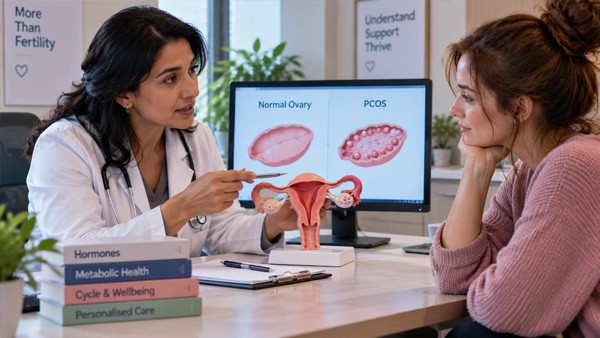

The name is wrong in two separate ways, and the confusion it causes is not trivial — it sends women for scans they do not need, and it convinces others that they cannot have the condition because a scan came back clear.
The cysts are not cysts. What shows on an ultrasound is a larger than usual number of small immature follicles, each of which is a normal structure that has stalled partway through development. They are not growths, they do not need removing, and they are not dangerous in themselves.
And it is not really an ovary condition. The ovaries are where the effect is most visible, but the process driving it is metabolic and involves the whole body. That distinction determines the entire approach to treatment.
🔎 You do not need an ultrasound to be diagnosed, and in younger women you should not have one for this purpose. Diagnosis requires two of three features: irregular or absent ovulation, evidence of excess male-type hormones either on examination or in blood, and the appearance on ultrasound. Two of three — so the scan is optional if the other two are present.
In anyone within about eight years of their first period, the ovary appearance is explicitly not used, because at that age the same picture is common in girls with nothing wrong at all. Diagnosing a teenager on the basis of a scan is a recognised error, and it results in a lifelong label applied to normal development.
Other conditions producing the same picture — thyroid disease, raised prolactin, and certain adrenal conditions — have to be excluded first, which is why the blood tests are not optional even when the diagnosis seems obvious.
⚙️ The engine underneath
Most of what happens in this condition follows from one process, and understanding it makes the rest coherent rather than a list of unrelated complaints.
The body becomes less responsive to insulin, so the pancreas produces more of it to achieve the same effect. That high circulating insulin does two things at once. It drives the ovaries to produce more male-type hormones. And it lowers the protein that normally binds those hormones in the blood, so a greater proportion of what is produced is biologically active.
The result is a rise in effective androgen exposure from both directions simultaneously, which disrupts the monthly maturing of a single follicle. Follicles start and stall, no egg is released, the cycle does not complete, and the characteristic ultrasound appearance forms as a consequence.
This happens in slim women too. The assumption that this is a condition of body weight is one of the reasons lean women wait years for a diagnosis while being told their symptoms are unrelated. Excess weight worsens insulin resistance considerably, but it does not create the condition and its absence does not exclude it.
| What is experienced | Where it comes from |
|---|---|
| Irregular or absent periods | Follicles stall, so ovulation does not occur and the cycle does not complete |
| Unwanted hair on face and body | Higher effective androgen levels acting on hair follicles |
| Acne, often along the jaw | Androgen stimulation of oil glands |
| Thinning hair at the crown | The same hormones, opposite effect on scalp follicles |
| Difficulty conceiving | No egg released means nothing to fertilise. Usually the most treatable part |
| Weight gain, particularly around the middle | Insulin resistance, which also makes losing it harder |
| Dark velvety patches at neck or armpits | A visible sign of high insulin, and a useful clue |
| Fatigue and low mood | Multiple contributors, and more common in this group than is acknowledged |
🚨 The risk nobody mentions
🔴 Periods matter for reasons that have nothing to do with wanting a baby, and this is the single most under-communicated thing about PCOS.
The lining of the womb thickens under the influence of oestrogen and is shed when a period occurs. Where ovulation does not happen, oestrogen continues to act on the lining without the counterbalancing hormone that follows ovulation, and nothing sheds it. Over years, that unopposed stimulation causes the lining to overgrow, and overgrowth carries a raised risk of endometrial cancer.
Fewer than about four periods a year is the threshold at which this needs addressing, whether or not pregnancy is wanted and whether or not the absence of periods feels convenient.
It is straightforward to prevent. Options include the combined pill, a course of progestogen tablets taken cyclically to bring on a bleed every few months, or a hormonal coil, which thins the lining directly and is often the easiest long-term solution. Any of them removes the risk.
Report any bleeding that is unusually heavy, prolonged, or occurring between episodes, and particularly any bleeding after a long gap. That needs assessment rather than being filed as another irregular cycle.
👶 If you want to conceive
This is the part of the condition with the best outlook, which is worth saying early because the diagnosis is frequently delivered as though infertility were a foregone conclusion. It is not. Most women with PCOS who want a child have one.
The problem is usually a single, addressable one: no egg is being released. Treatment aims at restarting that.
| Approach | Where it stands |
|---|---|
| Letrozole | Now first choice for inducing ovulation in PCOS. Trial evidence shows higher live birth rates than the older alternative, with a lower chance of twins |
| Clomiphene | The long-established option and still widely used. Effective, and superseded by the above as first line |
| Metformin | Improves cycle regularity and the metabolic picture, and less effective than letrozole for achieving pregnancy. Often used alongside rather than instead |
| Weight reduction | A loss of around five to ten per cent restores ovulation in a substantial number of women, without any medication |
| Specialist options | Injected hormones, ovarian surgery and assisted conception where the above do not work |
Two practical points that matter more than they appear to.
Start folic acid before you start treatment, not after a positive test. The structure that becomes the brain and spinal cord closes about four weeks after conception, which is roughly when a test first turns positive. The article on that window explains why, and note that a higher prescription dose is recommended for several groups including those with raised body weight and diabetes — both common here.
Get blood sugar checked before conceiving. Women with PCOS have a higher rate of diabetes in pregnancy, and knowing beforehand changes how the pregnancy is managed from the start.
🪒 Hair, skin and the patience they require
Treatment for unwanted hair works, and it works slowly, and being told the timeline in advance prevents most of the disappointment.
Nothing can be judged before six months. Hair grows in cycles, and a treatment only affects follicles as they enter a new cycle, so hairs already growing continue regardless. Abandoning something at three months means abandoning it before it could have shown anything.
The combined pill helps both hair and acne by raising the binding protein and lowering free androgen levels. Spironolactone blocks androgen action directly and is effective for hirsutism, with an important condition attached: it can affect the development of a male fetus, so reliable contraception is required throughout treatment. It is also potassium-sparing, which means potassium-based salt substitutes and potassium supplements should be avoided alongside it.
Mechanical hair removal — laser and electrolysis — works well alongside medication and addresses hair that is already established, which the tablets do not. Persistent acne unresponsive to the usual treatments may need dermatological options.
Rapid onset of these features, or a deepening voice or increasing muscle bulk, is a different situation and needs prompt assessment rather than routine treatment, since it points to something other than PCOS.
⚖️ About weight, honestly
Two things are true simultaneously and both deserve saying.
Modest weight loss produces disproportionate benefit here. Five to ten per cent frequently restores ovulation, improves insulin sensitivity, and reduces androgen symptoms — a considerably better return than the same loss produces in most conditions.
And weight loss is genuinely harder with this condition, because insulin resistance works against it. Being told to lose weight without acknowledgement of that is one of the more demoralising experiences women with PCOS report, and it is a common reason for disengaging from care entirely.
What follows practically: aim at the metabolic problem rather than the scale. Resistance training and regular activity improve insulin sensitivity measurably even when weight does not change — covered in the article on what exercise actually does. Reducing refined carbohydrate has a specific rationale here rather than being generic advice.
One caution. Rates of disordered eating are higher in this group, driven partly by years of weight-focused advice. Where food has become a source of distress rather than a lever, that needs addressing first — the article on eating disorders covers what that looks like.
🩺 What to ask for over the years
PCOS is a long-term metabolic condition and deserves the same periodic monitoring as any other, which it frequently does not get once fertility is no longer the issue.
- Blood sugar testing every one to three years, and before any planned pregnancy
- Blood pressure and cholesterol periodically
- Endometrial protection reviewed if you have fewer than about four periods a year
- Screening for sleep apnoea if there is snoring or unrefreshing sleep, which is commoner in this group
- Liver assessment where indicated, since fatty liver is more frequent
- Mood asked about directly, since depression and anxiety are more common and rarely raised unprompted
Symptoms also change over time. Cycles often become more regular approaching the forties, and the metabolic aspects generally require attention for longer than the reproductive ones — which is the opposite of how the condition is usually followed up.
🚑 When to seek help
- Fewer than four periods a year — needs endometrial protection regardless of pregnancy plans
- Bleeding after a long gap, unusually heavy bleeding, or bleeding between episodes — needs assessment
- Rapidly increasing hair growth, deepening voice or increasing muscle bulk — prompt assessment, this is not routine PCOS
- Trying to conceive for a year, or six months if over thirty-five
- Before conceiving — folic acid started in advance and blood sugar checked
- On spironolactone without reliable contraception
- Excessive thirst, frequent urination or unexplained weight loss — possible diabetes
- Snoring with daytime exhaustion — possible sleep apnoea
- Low mood, anxiety, or distress around food and body — treatable, and worth raising
- Diagnosed as a teenager on a scan alone — worth having the diagnosis reviewed
Ovulation induction is stocked as Femara (letrozole) and Clomid (clomiphene), and insulin resistance is treated with Glucophage (metformin). For androgen symptoms, Aldactone (spironolactone) is used alongside reliable contraception. Where periods are absent, endometrial protection can be provided by cyclical progestogen such as Provera or Duphaston, or by combined hormonal options in the birth control category. All of these require a confirmed diagnosis and medical supervision.
❓ Frequently asked questions
Are the cysts actually cysts?
No. What appears on the scan is a larger than usual number of small immature follicles — normal structures that have stalled partway through development. They are not growths, they are not dangerous, and they do not need removing. The name has caused a great deal of unnecessary alarm and a fair number of unnecessary investigations.
My scan was normal. Can I still have PCOS?
Yes. Diagnosis requires two of three features — irregular or absent ovulation, evidence of excess male-type hormones, and the ovary appearance — so the scan is optional when the other two are present. In anyone within about eight years of their first period the scan is explicitly not used, because the same appearance is common in girls with nothing wrong.
Can I have it if I am slim?
Yes, and this causes long delays in diagnosis. Insulin resistance occurs in lean women too. Excess weight worsens the condition considerably but does not create it, and its absence does not exclude it. Being told your symptoms cannot be PCOS because of your weight is a reason to ask for the actual tests rather than to accept the conclusion.
Why does missing periods matter if I do not want children?
Because the womb lining thickens under oestrogen and is shed when a period occurs. Without ovulation, that stimulation continues unopposed and nothing sheds the lining, and over years the overgrowth carries a raised risk of endometrial cancer. Fewer than about four periods a year is the threshold needing action — through the combined pill, cyclical progestogen tablets, or a hormonal coil.
Will I be able to have children?
Most likely. The diagnosis is often delivered as though infertility were certain, and it is not — most women with PCOS who want a child have one. The problem is usually a single addressable one: no egg is being released. Treatment aims at restarting ovulation, and several options work, starting with weight reduction of five to ten per cent and tablets to induce ovulation.
Which fertility tablet is better?
Letrozole is now first choice for inducing ovulation in PCOS. Trial evidence shows higher live birth rates than the older alternative, clomiphene, along with a lower chance of twins. Clomiphene remains effective and widely used. Metformin improves cycle regularity and the metabolic picture but is less effective for achieving pregnancy, and is often used alongside rather than instead.
What does metformin actually do here?
It addresses the insulin resistance underlying the condition, which improves cycle regularity, lowers androgen levels somewhat, and helps the metabolic picture including long-term diabetes risk. What it does less well is achieve pregnancy compared with letrozole. It is a useful long-term treatment for the condition rather than a fertility drug.
How long before hair treatment shows anything?
Six months at minimum. Hair grows in cycles and treatment only affects follicles entering a new cycle, so hairs already growing continue regardless of what you take. Stopping at three months means stopping before anything could have shown. Medication also does not remove hair already established, which is why laser or electrolysis works well alongside it rather than instead.
Why is losing weight so hard with this?
Because insulin resistance works against it, so the same effort produces less result than it would otherwise. Both things are true at once: modest loss of five to ten per cent produces disproportionate benefit here, and achieving it is genuinely harder. Aiming at insulin sensitivity rather than the scale is more productive — resistance training and regular activity improve it measurably even when weight does not move.
What should I be monitored for long term?
Blood sugar every one to three years and before any planned pregnancy, blood pressure and cholesterol periodically, endometrial protection reviewed if you have fewer than four periods a year, sleep apnoea if there is snoring or unrefreshing sleep, and mood asked about directly. The metabolic aspects need attention for longer than the reproductive ones, which is the opposite of how follow-up usually works.
📑 Sources and editorial
- International evidence-based guideline for the assessment and management of polycystic ovary syndrome
- Diagnostic criteria requiring two of three features, and restrictions on ultrasound use within eight years of menarche
- Literature on insulin resistance, sex hormone binding globulin suppression and ovarian androgen production
- Evidence on lean phenotype and insulin resistance independent of body weight
- Trial evidence comparing letrozole with clomiphene for ovulation induction and live birth rate
- Evidence on metformin effects on ovulation, metabolic parameters and pregnancy outcomes
- Literature on unopposed oestrogen, endometrial hyperplasia and endometrial cancer risk in anovulation
- Guidance on endometrial protection strategies and bleeding frequency thresholds
- Evidence on antiandrogen therapy for hirsutism, treatment latency and contraception requirements
- Data on weight reduction thresholds for restoring ovulation, and on prevalence of disordered eating in this population
- Screening recommendations for type 2 diabetes, obstructive sleep apnoea, hepatic steatosis and mood disorder
- Related reading: irregular cycles, folic acid before conception, exercise and insulin sensitivity
- Related products: womens health category, diabetes category
- RXshop Editorial Team — reviewed by Daniel Kim, MD, Endocrinology
Medical Disclaimer: The information in this article is for educational and informational purposes only and is not a substitute for professional medical advice, diagnosis, or treatment. Always seek guidance from a qualified healthcare provider with any questions you may have regarding a medical condition, and before starting, stopping or changing any medication.