Pain After Stroke That Painkillers Do Not Touch

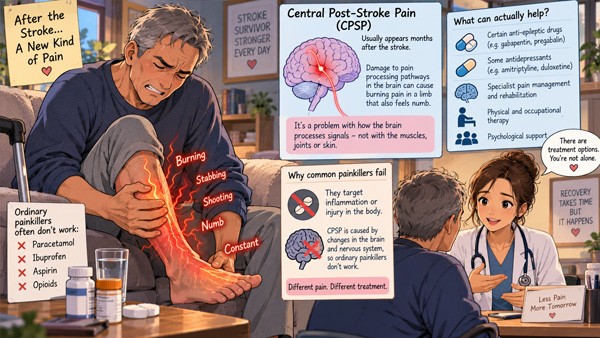

Some people develop pain after a stroke that behaves unlike any pain they have had before. It burns constantly. Light touch is unbearable. A cool draught is agony. And ordinary painkillers do nothing at all, however many are taken.
This is central post-stroke pain, and it affects a meaningful minority of stroke survivors. It is poorly recognised, frequently dismissed, and treatable — with drugs that are not painkillers in the usual sense.
🧠 The reason nothing ordinary works. Normal pain is a signal: tissue is damaged, nerves report it, the brain receives the message. Painkillers work at the tissue or the nerve ending, reducing the signal at its source. Here there is no damaged tissue and no signal to reduce. The stroke has damaged the pathway that carries and interprets pain, and the damaged pathway generates pain on its own — a fire alarm that has been broken by the fire and now sounds continuously in an empty building. Turning down the smoke does nothing, because there is no smoke.
⏱️ Why nobody connects it to the stroke
The timing is the main reason this goes unrecognised for so long.
The pain frequently begins weeks or months after the stroke rather than immediately, and occasionally after a year or more. By then the stroke has receded into history, rehabilitation is under way or finished, and a new symptom is assumed to be something new.
People are investigated for arthritis, for circulation problems, for a trapped nerve. They are prescribed anti-inflammatories that do nothing. They are sometimes told the pain cannot be real, since the affected area is also numb — which sounds like a contradiction and is in fact the diagnostic clue.
🔍 What it feels like
The description is distinctive enough that recognising it is usually straightforward once it is known.
- Burning, above all
- The commonest description by a wide margin. Also aching, freezing, tearing, or electric shocks running through the area.
- Constant, with surges
- A background that does not stop, punctuated by sudden intensifications lasting seconds to minutes.
- Pain from things that should not hurt
- The most characteristic feature. Bedsheets, clothing, a light touch, someone brushing past. This is called allodynia and it is why people stop being touched by the people they love.
- Cold is particularly unbearable
- A cool room, a draught, cold water. Cold sensitivity is especially typical of this condition.
- In an area that is also numb
- Reduced or altered sensation in the same region as the pain. This apparent contradiction is required for the diagnosis rather than arguing against it.
- Following the stroke territory
- One side of the body, or an arm and the same side of the face, or a single limb — matching what the stroke affected.
It worsens with stress, fatigue, movement and changes in temperature, and it disturbs sleep, which worsens the pain in turn.
📊 Three different kinds of pain
| Ordinary pain | Nerve pain from the limb | Central pain | |
|---|---|---|---|
| Where the problem is | Damaged tissue | Damaged nerve in the body | Damaged pathway in the brain |
| Feels like | Aching, throbbing, sharp | Burning, shooting, tingling | Burning, freezing, electric |
| Light touch | Normal | Sometimes painful | Frequently unbearable |
| Sensation in the area | Normal | Often reduced | Always altered |
| Ordinary painkillers | Work | Work poorly | Do not work |
| What does work | Analgesics | Nerve-acting drugs | Nerve-acting drugs |
❌ Why the usual drugs fail
Worth stating explicitly, because people conclude they are not being taken seriously when the tablets do nothing.
Paracetamol and anti-inflammatories reduce pain signals arising from tissue. There is no such signal here, so they have nothing to act on.
Opioids work poorly in central pain, considerably less well than in ordinary pain, and bring dependence, constipation, falls and cognitive effects — all particularly unwelcome after a stroke. They are not the answer to a failed course of anti-inflammatories.
What does work is a group of drugs developed for other purposes entirely — some for epilepsy, some for depression — which act on the excitability of the nerve pathways themselves. That is why someone with pain is offered an epilepsy tablet or an antidepressant, and why the explanation for that matters: it is not a comment on the pain being imagined, and the doses used for pain are frequently quite different from those used for the original indication.
💊 The treatments that help
None of these works for everyone, meaningful improvement is more realistic than abolition, and several are usually tried before the right one is found.
| Option | Notes |
|---|---|
| Amitriptyline | Long-established for nerve pain at doses far below those used for depression, taken at night. Also helps sleep. Limited in older people by dry mouth, constipation, confusion and falls |
| Gabapentin | Widely used, taken three times daily, requires slow building up. Dose reduced where kidney function is impaired |
| Pregabalin | Similar, twice daily, reaches an effective dose faster |
| Lamotrigine | Has specific evidence in central post-stroke pain. Must be increased very slowly because of the rash risk |
| Duloxetine | An antidepressant with established use in nerve pain |
| Brain stimulation techniques | Non-invasive magnetic stimulation has evidence in resistant cases; implanted stimulation exists for a small minority |
⚠️ Most treatment failures are not failures of the drug. Two mistakes account for the majority. Too fast — escalating quickly causes drowsiness, dizziness and unsteadiness, the person feels worse and stops, concluding it does not suit them. Too little for too short — stopping at a starting dose after two weeks, when these drugs need building gradually over weeks and then holding at an adequate dose to judge fairly.
The correct approach is slow increases with time to adjust at each step, and a proper trial at a proper dose before concluding anything. Someone who has tried gabapentin at a low dose for a fortnight has not tried gabapentin.
🎯 Setting the expectation
Honesty here prevents a great deal of demoralisation.
The realistic goal is reduction, not abolition. A halving of pain is considered a good result in nerve pain of any kind, and it is genuinely life-changing when it arrives — sleep returns, being touched becomes possible again, and the pain stops occupying every waking thought.
Several drugs may need trying, and failure of one predicts very little about another, since they act by different mechanisms. Combinations are frequently used where single agents are insufficient.
And the pain frequently improves over years, though slowly.
🧊 What helps alongside
Keeping warm. Since cold provokes the pain so reliably, an unglamorous but effective measure: a warm room, layers, gloves, avoiding draughts, and heating the room before getting up.
Protecting the sensitive area. Soft seamless fabrics, loose clothing, sometimes a light dressing over the area so that contact is predictable rather than sudden.
Graded desensitisation, guided by a therapist — brief deliberate contact with progressively less tolerable textures, which over weeks reduces the reaction. It is counterintuitive and it works for some people.
Treating the sleep. Pain wrecks sleep and poor sleep amplifies pain, and breaking that loop at either end helps both.
Treating depression. Common after stroke, common with chronic pain, and each makes the other worse. It is not a substitute for pain treatment and it changes how much the pain can be tolerated.
Pacing activity, since overdoing it on a good day reliably produces a worse one.
🦾 Not all pain after a stroke is this
Important, because the commonest causes of pain after stroke are mechanical and have entirely different treatments.
Shoulder pain on the weak side is far more frequent than central pain. A paralysed arm hangs on a shoulder joint that depends on muscle to hold it together, and the joint partially separates under its own weight. Add rotator cuff strain and a stiffening capsule, and the result is severe pain with a specific cause. It responds to positioning, support, physiotherapy and sometimes injection — not to nerve-pain drugs.
Spasticity produces aching from muscles held permanently contracted, and cramping spasms. Treated with stretching, positioning, muscle relaxants and targeted injections.
Contractures, where a joint has shortened and become fixed, hurt on any attempt to move.
A swollen, discoloured, exquisitely painful hand with skin and nail changes suggests a different pain condition again, which has its own treatment and responds better when caught early.
These frequently coexist with central pain, and someone can have two or three at once. Which is why a description of exactly where, what character, and what provokes it is worth more than any scan.
📋 What to bring to an appointment
Where exactly, marked on a body outline if possible.
What it feels like, in your own words — burning, freezing, electric, aching.
What makes it worse — particularly whether light touch and cold provoke it, which points strongly toward central pain.
Whether sensation in that area is altered — numb, tingling, or feeling different from the other side.
When it started in relation to the stroke.
What has been tried, at what dose and for how long — this is the detail that determines whether something was genuinely tried or merely started.
How it affects sleep, mood and daily life.
🩺 When to seek help
- Any new weakness, speech difficulty or facial droop — emergency, since a further stroke is possible
- Burning or electric pain in an area affected by a previous stroke, particularly if light touch hurts
- Pain that ordinary painkillers do not touch at all
- A shoulder that is painful on the weak side — treatable and different
- A swollen, discoloured, very painful hand — assess early
- Pain preventing sleep over more than a few nights
- Low mood, or thoughts of not wanting to go on — common, treatable, and urgent
- Side effects on a nerve-pain drug — usually a reason to adjust the schedule rather than abandon it
- No improvement after an adequate dose for an adequate time — a reason to try a different agent
Treatment is stocked in the anticonvulsant category, including Gabatop (gabapentin), Neurontin (gabapentin) and Lamictal (lamotrigine), and in the antidepressant category, including Elavil (amitriptyline) and Cymbalta (duloxetine). All require building up gradually from a low starting dose, so the higher strengths are for maintenance rather than for starting.
❓ Frequently asked questions
Why do painkillers do nothing for this pain?
Because there is nothing for them to act on. Ordinary pain is a signal from damaged tissue, and painkillers reduce that signal at its source. Here the tissue is fine — the stroke damaged the pathway that carries and interprets pain, and the damaged pathway generates the pain itself. It is a fire alarm broken by the fire, sounding in an empty building.
How can an area be numb and painful at the same time?
That combination is not a contradiction — it is required for the diagnosis. The stroke damaged the sensory pathway, so normal sensation is reduced, and the same damaged pathway generates pain signals of its own. Being told the pain cannot be real because the area is numb is a misunderstanding of the mechanism, and it is a common experience for people with this condition.
Why did it start months after the stroke?
That timing is typical, and it is the main reason the connection is missed. The pain often begins weeks to months afterwards, occasionally after a year or more, by which point the stroke feels like history and a new symptom seems unrelated. People are investigated for arthritis or circulation problems and given anti-inflammatories that do nothing.
Why does light touch hurt so much?
It is called allodynia, and it is the most characteristic feature. The damaged pathway misinterprets ordinary touch signals as pain, so bedsheets, clothing, a draught or someone brushing past become unbearable. Cold is particularly provoking. It is also one of the most isolating aspects, because it makes ordinary physical contact impossible.
Why was I given an epilepsy tablet for pain?
Because the drugs that work here act on the excitability of nerve pathways rather than on tissue damage, and several of them were developed for epilepsy or depression. It is not a comment on the pain being imagined or on your mental state, and the doses used for pain are frequently quite different from those used for the original condition.
The tablet did not help. Should I stop?
Check first whether it was genuinely tried. Most apparent failures are one of two things: escalating too quickly, so drowsiness and unsteadiness appear and the person stops, or staying at a starting dose for a fortnight and concluding it does not work. These drugs need building gradually over weeks and then holding at an adequate dose before anything can be judged.
Will the pain go away completely?
Reduction is the realistic goal rather than abolition. A halving of pain is considered a good result in nerve pain of any kind, and it is genuinely life-changing when it happens — sleep returns, contact becomes bearable, and the pain stops occupying every waking thought. Several drugs may need trying, since failure of one predicts little about another, and the pain often eases slowly over years.
Are opioids an option?
They work poorly in central pain, considerably less well than in ordinary pain, and they bring dependence, constipation, falls and cognitive effects — all particularly unwelcome after a stroke. They are not the logical next step after anti-inflammatories have failed, and escalating along that route usually adds harm without adding relief.
Is all pain after a stroke this condition?
No, and the mechanical causes are commoner. Shoulder pain on the weak side is the most frequent — a paralysed arm partially separates the joint under its own weight, and it responds to positioning, support and physiotherapy rather than nerve-pain drugs. Spasticity, fixed joints and a separate pain condition affecting the hand all occur too, and several can be present at once.
What helps besides medication?
Keeping warm, since cold provokes it so reliably — a warm room, layers, heating the room before getting up. Soft seamless fabrics and loose clothing, sometimes a light dressing so contact is predictable rather than sudden. Graded desensitisation with a therapist helps some people. And treating sleep and mood, since pain, poor sleep and low mood amplify one another in every direction.
📑 Sources and editorial
- Diagnostic criteria for central neuropathic pain and central post-stroke pain
- Epidemiological studies of pain prevalence and onset timing after stroke
- Literature on allodynia and cold hypersensitivity in central pain
- Randomised trials of amitriptyline, gabapentinoids and lamotrigine in central post-stroke pain
- Evidence on opioid efficacy in central versus nociceptive pain
- Guidance on titration schedules and adequate trial duration for neuropathic pain agents
- Evidence for repetitive transcranial magnetic stimulation in refractory central pain
- Literature on hemiplegic shoulder pain, glenohumeral subluxation and spasticity-related pain
- Related reading: nerve pain after shingles, why an antidepressant is used for pain
- Related products: anticonvulsant category
- RXshop Editorial Team — reviewed by James Carter, MD, Neurologist
Medical Disclaimer: The information in this article is for educational and informational purposes only and is not a substitute for professional medical advice, diagnosis, or treatment. Always seek guidance from a qualified healthcare provider with any questions you may have regarding a medical condition, and before starting, stopping or changing any medication.