Erectile Dysfunction in Young Men: Causes and Treatment

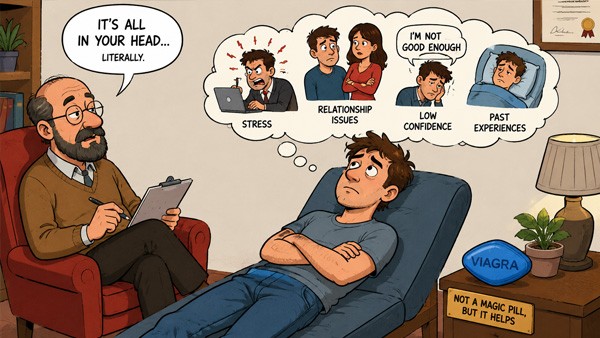
Erectile difficulty in men under forty is considerably commoner than most people assume, and it is surrounded by a silence that makes it worse. Older men have a socially available explanation for it; younger men mostly conclude that something is wrong with them specifically, and they wait years before mentioning it to anyone.
Psychological factors do dominate in this age group. They are not the only thing going on, and the causes specific to young men — several of them entirely reversible — are routinely missed because the whole thing gets attributed to nerves.
🧠 The single question that sorts most of this out: are morning and night-time erections still happening normally? If they are, the vascular and nerve machinery works, and the problem is psychological, situational or drug-related. If they have diminished or disappeared, something physical is involved and it needs investigating — being young does not exclude that, and in some respects makes it more significant.
🔄 The cycle
The mechanism behind most psychogenic erectile difficulty is straightforward and worth understanding, because understanding it is a substantial part of the treatment.
An erection requires the parasympathetic nervous system — the branch that operates when a person feels safe and unhurried. Anxiety activates the sympathetic branch instead, which constricts blood vessels and directly opposes erection. Worrying about whether it will happen is therefore not merely unhelpful; it is physiologically the thing preventing it.
From there the sequence is predictable. Something ordinary causes a first failure — alcohol, exhaustion, an unfamiliar partner, being rushed, a heavy meal. It is interpreted not as a circumstance but as information about the man himself. At the next opportunity that interpretation is present in the room, attention shifts from the encounter to monitoring what is happening physically, anxiety rises, and it fails again — this time for a genuine physiological reason. Each repetition strengthens the expectation, and the expectation produces the outcome.
The self-monitoring itself has a name in sex therapy: spectatoring. Arousal requires attention to be in the body, and checking whether you are aroused moves it into the head. The mechanism and the techniques that address it are covered in the guide to performance anxiety and erectile problems.
👤 What is different about young men
Several contributors are far more relevant under forty than over it, and they are the ones most often overlooked.
| Factor | Note |
|---|---|
| Anabolic steroids | Suppress the body own testosterone production, sometimes for many months after stopping. A major and under-discussed cause in this age group |
| SSRI antidepressants | Very common cause of reduced desire and erectile difficulty; frequently not connected to the medication by the person taking it |
| Finasteride | Taken by young men for hair loss; sexual side effects are recognised in the prescribing information |
| Cannabis | Regular use is associated with erectile difficulty; the association strengthens with frequency |
| Alcohol | The commonest single cause of the first failure that starts the cycle |
| Stimulants and other recreational drugs | Cocaine, amphetamines and opioids all interfere |
| Chronic sleep deprivation | Lowers testosterone and impairs arousal; consistently underestimated |
| Expectation and comparison | Discussed below |
Two of these deserve expansion.
Anabolic steroids shut down the body own production of testosterone through negative feedback, and the system does not always restart promptly when the drugs stop. Recovery can take many months, and in some men it is incomplete. Erectile difficulty and loss of libido after a cycle is a recognised presentation, it responds poorly to the usual tablets while testosterone remains suppressed, and it needs assessment with hormone testing rather than being treated as anxiety. This is worth raising honestly with a clinician even though it is uncomfortable, because the management is different.
Finasteride, taken by many young men for hair loss, lists sexual side effects in its prescribing information. Whether symptoms persist in some men after stopping remains genuinely contested and is the subject of ongoing regulatory and research attention. What is reasonable to say is that anyone developing erectile difficulty or reduced libido after starting it should raise it rather than assuming a coincidence, and that the decision to continue is theirs to make with full information.
🖥️ Expectation, comparison and pornography
This subject attracts strong claims in both directions and deserves an accurate rather than a confident answer.
What is reasonably established: a great many young men hold expectations about sexual performance derived from material that is produced, edited and frequently pharmacologically assisted, and measuring oneself against it produces anxiety. The belief that reliable, immediate, effortless erection in every circumstance is the normal baseline is widespread and simply untrue, at any age.
What is not established: that pornography use causes erectile dysfunction through a physiological mechanism. The research consists largely of observational studies and self-report, findings are inconsistent, and where associations appear they cannot separate cause from effect — men with sexual difficulties may use more pornography rather than the reverse.
What is worth doing regardless: if someone finds they respond readily alone and not with a partner, that is a genuine and specific pattern worth examining, whatever the underlying explanation. Adjusting expectations, reducing conditioned patterns of arousal, and shifting attention toward the actual encounter rather than toward evaluating it are useful whether or not any causal claim holds up.
Framing it as an addiction with a physiological withdrawal is going beyond the evidence. Framing it as a source of unrealistic expectation and of arousal patterns that do not transfer well to partnered sex is fair, and it is actionable.
⚖️ Telling psychological from physical
| Feature | Points to psychological | Points to physical |
|---|---|---|
| Morning and night erections | Preserved and normal | Reduced or absent |
| Alone versus with a partner | Normal alone, difficult with a partner | Difficult in both |
| Onset | Sudden, traceable to a specific occasion | Gradual over months |
| Consistency | Varies by partner, setting, mood | The same in all circumstances |
| Course | Fluctuating, with good periods | Steadily progressive |
| Desire | Preserved | Frequently reduced, particularly with hormonal causes |
The morning erection question does most of the work, and it is the one to answer honestly rather than approximately. Their preservation is genuinely reassuring; their disappearance is genuinely informative.
🩺 When it is physical in a young man
Being under forty does not exclude an organic cause, and several present in exactly this age group.
- Type 1 diabetes, which affects nerves and vessels and can produce erectile difficulty relatively early
- Low testosterone from primary testicular failure, from pituitary causes, from genetic conditions such as Klinefelter syndrome, or from prior anabolic steroid use
- Raised prolactin, usually from a benign pituitary tumour, presenting with reduced libido and sometimes headache or visual field changes
- Thyroid disorders in either direction
- Venous leak — blood entering the penis normally but not being retained, producing an erection that arrives and collapses quickly. It can occur congenitally in young men and responds poorly to tablets
- Peyronie disease or previous injury, producing curvature or plaque
- Multiple sclerosis and spinal cord problems, in which erectile difficulty is sometimes an early feature
- Early cardiovascular disease, particularly with smoking, a strong family history or an inherited lipid disorder
🔴 Erectile dysfunction in a young man carries a stronger cardiovascular signal than the same symptom at seventy, not a weaker one. The penile arteries are one to two millimetres across against three to four for the coronary arteries, so atherosclerosis produces symptoms there first. In an older man that finding sits among many other risk factors; in a man in his thirties it is a genuinely unusual event that warrants taking seriously. Blood pressure, glucose, lipids and smoking history should be checked, and a young man handed a prescription with none of that done has had an incomplete consultation.
🧪 What assessment should cover
- History — onset, morning erections, alone versus partnered, situational variation, relationship context, and an honest account of substances including steroids
- Medication review, particularly antidepressants and finasteride
- Morning testosterone, measured before eleven since levels fall through the day, and repeated if low
- Prolactin where libido is markedly reduced
- Glucose or HbA1c, lipids, blood pressure
- Thyroid function
- Examination including the penis for curvature or plaque and the testicles for size and consistency
Specialist tests such as penile duplex ultrasound, which measures arterial inflow and detects venous leak directly, are reserved for cases where the answer would change management — a young man with severe unexplained dysfunction, or after trauma.
💊 Where medication fits
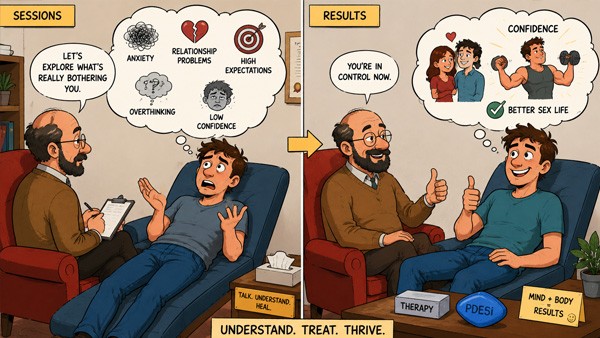
Using a PDE5 inhibitor for anxiety-driven difficulty is not avoiding the real issue. Used deliberately it is one of the more effective ways of breaking the cycle: the pattern is sustained by the expectation of failure, and several reliably successful occasions replace that expectation with a different one. Once confidence returns, many men need it less or stop entirely. Combined medication and psychological work consistently outperforms either alone.
| Drug | Onset | Duration | Suits |
|---|---|---|---|
| Avanafil | 15 to 30 minutes | About 6 hours | Spontaneity with minimal planning; the most selective of the class, which may mean fewer side effects |
| Tadalafil | 30 to 60 minutes | Up to 36 hours | Removing the timing pressure entirely, which is itself an anxiety trigger |
| Sildenafil | 30 to 60 minutes | 4 to 6 hours | The most established and least expensive; absorption reduced by a heavy meal |
| Vardenafil | 30 to 60 minutes | 4 to 8 hours | Studied in harder-to-treat groups including diabetes |
Avanafil suits this situation particularly well for two reasons. Its rapid onset means less waiting, and the waiting period — taking a tablet and then watching the clock — is itself an anxiety trigger for exactly this group. And it is the most selective agent in the class, which translates to a somewhat lower rate of the flushing, headache and nasal congestion that make a young man self-conscious about having taken something.
⚠️ Nitrates and PDE5 inhibitors must never be combined, and the version relevant to this age group is poppers — alkyl nitrites, used recreationally. Together with any of these tablets they can cause a catastrophic drop in blood pressure. The interaction window is roughly twenty-four hours for the shorter-acting drugs and forty-eight for tadalafil. This is not a theoretical concern and it needs stating plainly.
Also worth knowing: these drugs preserve an erection rather than creating one, so sexual stimulation is required; guidance suggests six to eight attempts at an adequate dose before judging; alcohol negates them; and they work poorly where testosterone is genuinely low, which is why the hormone question comes first in this age group.
🗣️ Talking about it
Two conversations matter and both get avoided.
With a partner. Partners very commonly conclude that the man is no longer attracted to them, which produces hurt, withdrawal or pressure — all of which raise the anxiety. Explaining that anxiety physically opposes erection changes their response more than almost anything else. Do it outside the bedroom, in an ordinary conversation, and make clear early that it is not about attraction.
With a clinician. The average delay before young men seek help for this runs to years, and the reasons are predictable: embarrassment, an assumption that they are the only one, and a fear of being dismissed. It is a routine consultation for anyone working in this area, it is common in this age group, and delaying it means both a longer entrenched cycle and a missed opportunity to find the reversible causes listed above.
🏃 The things that reliably help
Reduce alcohol. It is the commonest cause of the first failure and it negates the medication if one is being used.
Sleep properly. Chronic sleep restriction lowers testosterone measurably and impairs arousal, and it is consistently underestimated in this age group.
Exercise. Aerobic exercise improves endothelial function, which is the mechanism at issue, and the effect is real rather than general wellness advice.
Stop smoking. The benefit is greatest the younger the man and the sooner he stops.
Review the medication. Where an SSRI is responsible, alternatives with lower rates of sexual side effects exist, dose adjustment sometimes helps, and it is a recognised reason for switching. Do not stop an antidepressant independently — raise it.
Reconsider anabolic steroids. The endocrine consequences persist well beyond the last dose, and continuing while trying to treat the symptom is working against yourself.
Take the pressure off deliberately. Agreeing with a partner to remove intercourse from the agenda for a period is the intervention that costs nothing and does the most.
✅ The outlook here is genuinely good, and worth stating because it is not what people in the middle of it believe. Anxiety-driven erectile difficulty in a young man has one of the best prognoses in this whole field. Most of it resolves once the cycle is broken, and the men who do worst are the ones who never mention it to anyone and spend years avoiding situations rather than the ones whose problem was more severe.
🚨 When to see someone rather than wait
- Morning erections have diminished or stopped
- It happens in every situation including alone
- Onset was gradual over months rather than traceable to an occasion
- Desire has fallen markedly alongside it
- You have used anabolic steroids, currently or previously
- It began after starting a medication
- There is curvature, pain or a lump in the penis
- You have diabetes, high blood pressure, raised cholesterol or a strong family history of early heart disease
- It has persisted for months and is affecting mood or the relationship
Treatment is stocked in the mens health category, including Avana (avanafil), whose rapid onset removes the waiting period that itself triggers anxiety. It requires a prescription, and in this age group it works best alongside addressing the reversible causes above rather than instead of finding them.
❓ Frequently asked questions
Is it normal to have this problem in my twenties?
Commoner than most people assume, and presentations under forty are a routine part of urology practice rather than an oddity. Psychological factors dominate in this age group, but they are not the only thing going on, and several causes specific to young men — anabolic steroids, antidepressants, finasteride, cannabis, chronic sleep restriction — are reversible and routinely missed when everything gets attributed to nerves.
How do I know whether it is psychological?
Morning and night-time erections answer most of it. If they are preserved and normal, the vascular and nerve machinery works and the cause is psychological, situational or drug-related. Responding normally alone but not with a partner points the same way, as does sudden onset traceable to a specific occasion and variation between partners or settings. Diminished or absent morning erections point to something physical.
Why does worrying about it cause it?
Because an erection requires the parasympathetic nervous system, which operates when a person feels safe, while anxiety activates the sympathetic branch, which constricts blood vessels and directly opposes erection. The worry is therefore not merely unhelpful — it is physiologically the thing preventing what is being worried about. That is why trying harder always makes it worse and why every effective approach reduces pressure rather than increasing effort.
Can anabolic steroids cause this?
Yes, and it is a major under-discussed cause in this age group. They suppress the body own testosterone production through negative feedback, and the system does not always restart promptly — recovery can take many months and is sometimes incomplete. Erectile difficulty and lost libido after a cycle responds poorly to the usual tablets while testosterone remains suppressed. It needs hormone testing rather than being treated as anxiety.
Could my antidepressant be responsible?
Very possibly. SSRIs are a common cause of reduced desire and erectile difficulty and are frequently not connected to the medication by the person taking it. The timing relative to starting is usually informative. Do not stop an antidepressant independently, but raise it — alternatives with lower rates of sexual side effects exist, dose adjustment sometimes helps, and it is a recognised reason for switching.
What about finasteride for hair loss?
Sexual side effects are listed in its prescribing information. Whether symptoms persist in some men after stopping remains genuinely contested and is the subject of ongoing research and regulatory attention. What is reasonable to say is that anyone who develops erectile difficulty or reduced libido after starting it should raise it rather than assume coincidence, and that continuing is a decision to make with full information.
Does pornography cause erectile dysfunction?
That it causes it through a physiological mechanism is not established — the research is largely observational and self-reported, findings are inconsistent, and associations cannot separate cause from effect. What is reasonable is that it sets expectations derived from material that is produced, edited and often pharmacologically assisted. If someone responds readily alone but not with a partner, that specific pattern is worth examining whatever the explanation.
Should a young man worry about his heart?
More rather than less. The penile arteries are one to two millimetres across against three to four for the coronary arteries, so atherosclerosis produces symptoms there first. In an older man that finding sits among many risk factors; in a man in his thirties it is genuinely unusual and warrants attention. Blood pressure, glucose, lipids and smoking history should all be checked rather than a prescription simply being issued.
Is taking a tablet just avoiding the real problem?
Not when used deliberately. The cycle is sustained by the expectation of failure, and several reliably successful occasions replace that expectation with a different one, after which many men need the medication less or stop entirely. Combined medication and psychological work consistently outperforms either alone. What tablets cannot do is repair a relationship, treat depression or correct suppressed testosterone.
Which tablet suits a younger man best?
Avanafil often fits this situation well: it acts within fifteen to thirty minutes, so there is less waiting, and that waiting period is itself an anxiety trigger for this group. It is also the most selective agent in the class, which means somewhat less flushing, headache and nasal congestion. Tadalafil suits those who want the timing question removed entirely, with a window of up to thirty-six hours.
What must never be combined with these tablets?
Nitrates, and the version most relevant to this age group is poppers — alkyl nitrites used recreationally. Together with any PDE5 inhibitor they can cause a catastrophic drop in blood pressure. The interaction window is roughly twenty-four hours for the shorter-acting drugs and forty-eight hours for tadalafil. It also needs disclosing in any emergency where chest pain is being treated.
How do I tell a partner?
Outside the bedroom, in an ordinary conversation rather than a crisis one, and make clear early that it is not about attraction — because that is what will otherwise be assumed. Partners commonly conclude they are being rejected, which produces hurt, withdrawal or pressure and raises the anxiety further. Explaining that anxiety physically opposes erection changes their response more than almost anything else.
📑 Sources and editorial
- European Association of Urology and American Urological Association guidelines on erectile dysfunction
- Masters WH and Johnson VE — original description of spectatoring
- Princeton Consensus recommendations on erectile dysfunction as a cardiovascular risk marker
- Literature on hypothalamic-pituitary-gonadal suppression and recovery following anabolic androgenic steroid use
- Prescribing information and regulatory reviews of finasteride sexual adverse effects
- Systematic reviews of pornography use and sexual function, including their methodological limitations
- Evidence on antidepressant-associated sexual dysfunction and management options
- FDA prescribing information for avanafil, tadalafil, sildenafil and vardenafil
- Related reading: performance anxiety, erectile dysfunction and age
- Related products: mens health category
- RXshop Editorial Team — reviewed by Michael Reeves, MD, FACS, Urology
Medical Disclaimer: The information in this article is for educational and informational purposes only and is not a substitute for professional medical advice, diagnosis, or treatment. Always seek guidance from a qualified healthcare provider with any questions you may have regarding a medical condition, and before starting, stopping or changing any medication.