Head and Neck Cancer: Signs, Causes and Treatment

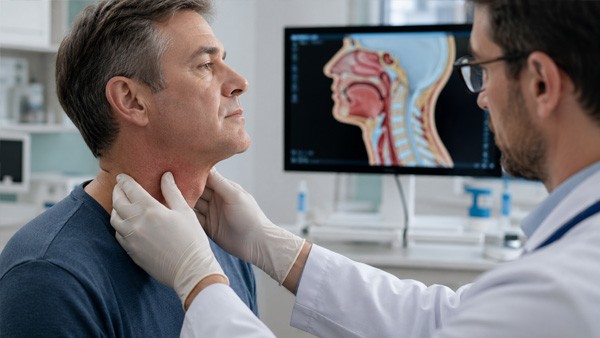
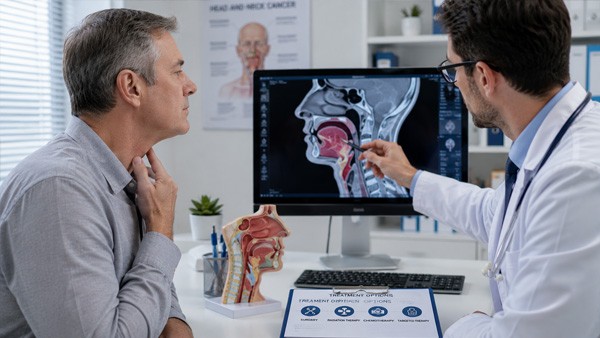
Head and neck cancer covers tumours of the mouth, throat, voice box, nose, sinuses and salivary glands. It has changed more in the past twenty years than almost any other cancer, and not because of a new treatment — because a substantial share of it is now caused by a virus rather than by tobacco, affects a different group of people, and behaves considerably better.
This guide covers the symptoms that warrant checking rather than waiting, what has changed and why it matters, how treatment is decided, and what living through it and afterwards actually involves.
🧠 The single most useful rule: hoarseness, a mouth ulcer, difficulty swallowing, a lump in the neck or one-sided ear pain that has lasted three weeks or more should be examined, particularly in anyone who smokes or drinks. Most such symptoms turn out to be benign. The ones that are not are far more treatable when caught early, and the single biggest determinant of outcome in this disease is how long it took before somebody looked.
🗂️ What it covers
| Site | Typical presentation |
|---|---|
| Oral cavity — tongue, floor of mouth, gums, cheek lining | A non-healing ulcer, a white or red patch, a lump, loose teeth, poorly fitting dentures |
| Oropharynx — tonsil, base of tongue, soft palate | Frequently a painless neck lump as the first sign; sore throat, difficulty swallowing, one-sided ear pain |
| Larynx — voice box | Persistent hoarseness, which is why voice change is taken seriously |
| Hypopharynx | Difficulty swallowing, referred ear pain, neck lump; frequently found late |
| Nasopharynx | Blocked nose on one side, nosebleeds, hearing loss or fluid in one ear, neck lump |
| Nose and sinuses | One-sided blockage, bleeding, facial swelling or numbness |
| Salivary glands | A painless lump; facial weakness is a concerning feature |
These cancers account for something in the region of four to five per cent of cancers worldwide, with considerable geographical variation — rates are far higher where tobacco chewing and betel quid use are common.
🚩 The symptoms that matter
Almost all of these are far more often caused by something harmless. The point is not alarm but timing: three weeks is the threshold at which a benign explanation stops being safe to assume.
- Hoarseness lasting more than three weeks, particularly in a smoker
- A mouth ulcer that has not healed in three weeks
- A lump in the neck that persists, particularly if painless and firm
- Difficulty or pain on swallowing that persists or is worsening
- Persistent one-sided ear pain with a normal-looking ear — referred pain from the throat, and a classic overlooked sign
- A white or red patch in the mouth that does not resolve
- One-sided nasal blockage or repeated nosebleeds
- Unexplained loose teeth or dentures that have stopped fitting
- Numbness of the lip, tongue or face
- Coughing up blood, or blood in saliva
- Unexplained weight loss alongside any of the above
🔴 The pattern that is missed most often is a painless neck lump in a healthy adult. Because it does not hurt and the person feels well, it gets watched. In HPV-related throat cancer the primary tumour can be small and symptomless while the first sign is a swollen lymph node, and it is frequently treated as an infection with successive courses of antibiotics for months. A neck lump persisting beyond three weeks in an adult, particularly over forty, needs examination rather than another antibiotic.
🧬 What has changed: the HPV story
This is the most important development in the field and it is absent from most older material on the subject.
Historically these cancers were overwhelmingly caused by tobacco and alcohol, which act together — someone who both smokes and drinks heavily has a risk considerably greater than the sum of the two exposures separately.
Over the past two decades a second disease has emerged within the same category: cancer of the oropharynx caused by human papillomavirus, the same family of viruses that causes cervical cancer. It is now the commonest cause of oropharyngeal cancer in several countries, and incidence has risen sharply while tobacco-related cases have fallen.
| Tobacco and alcohol related | HPV related | |
|---|---|---|
| Typical patient | Older, with a history of smoking and drinking | Younger, frequently a non-smoker |
| Site | Anywhere in the head and neck | Tonsil and base of tongue |
| First sign | Local symptoms — ulcer, hoarseness, pain | Frequently a painless neck lump with a small hidden primary |
| Response to treatment | Less favourable | Substantially better |
| Prognosis | Poorer | Considerably better, stage for stage |
| Staging | Conventional | A separate staging system, because outcomes differ so much |
| Prevention | Not smoking, moderate alcohol | HPV vaccination |
The prognostic difference is large enough that these are now staged separately — the same anatomical extent carries a different stage number depending on HPV status, because grouping them together would have made the numbers meaningless for both.
HPV vaccination prevents these cancers. Programmes originally introduced to prevent cervical cancer are now given to boys as well as girls in many countries precisely because of head and neck cancer, and early data on falling infection rates in vaccinated populations is encouraging.
One point worth stating plainly for anyone recently diagnosed: HPV is extremely common, most people acquire it at some point, the vast majority clear it without ever knowing, and infection may have occurred decades before the cancer appeared. It is not a reflection on anyone behaviour, and it is not something that can be traced to a particular person or moment.
🚬 Other risk factors
- Tobacco in all forms — cigarettes, cigars, pipes, and chewed or smokeless tobacco, which carries particularly high oral cancer risk
- Betel quid and areca nut, major causes in South and South-East Asia
- Alcohol, with risk rising with quantity and multiplying with tobacco
- Epstein-Barr virus, specifically associated with nasopharyngeal cancer
- Sun exposure, for cancers of the lip
- Occupational exposures — wood dust, leather dust, nickel, formaldehyde, associated with nasal and sinus cancers
- Previous radiotherapy to the head and neck
- Immune suppression, including after transplantation
- Poor oral health, which is associated though the relationship is complex
- Genetic conditions such as Fanconi anaemia, which carry markedly increased risk
🧪 How it is diagnosed
Assessment begins with examination, including nasendoscopy — a thin flexible camera passed through the nose to view the throat and voice box, done in clinic under local anaesthetic and considerably more tolerable than it sounds.
Biopsy confirms the diagnosis. Where a neck lump is the presenting feature, a needle sample from the lump is taken rather than cutting it out, since removing a malignant node surgically before staging complicates later treatment.
Imaging — CT, MRI and often PET-CT — determines the extent and looks for spread. HPV testing of the tumour is now routine in oropharyngeal cancer because it changes staging and prognosis, and increasingly influences treatment discussions.
An examination under anaesthetic allows thorough inspection and biopsy of areas difficult to reach awake, and looks for a hidden primary tumour where a neck node has appeared without an obvious source.
All of this is reviewed by a multidisciplinary team — surgeons, oncologists, radiologists, pathologists, specialist nurses, speech and language therapists and dietitians — before a plan is agreed. That structure exists because the decisions involve genuine trade-offs between cure and function that no single specialty can weigh alone.
🏥 How it is treated
Treatment depends on the site, the stage, HPV status and the person overall health, and the aim is to cure while preserving the ability to speak, swallow and breathe.
| Approach | Role |
|---|---|
| Surgery | Often first choice for oral cavity cancers and for salivary gland tumours; increasingly performed through the mouth using robotic or laser techniques for selected throat cancers |
| Radiotherapy | Curative on its own in early laryngeal cancer, preserving the voice; also given after surgery where features suggest higher risk |
| Chemoradiation | Radiotherapy with chemotherapy, usually cisplatin, for locally advanced disease; more effective than radiotherapy alone and more toxic |
| Neck dissection | Removal of lymph nodes, either because they are involved or because the risk of hidden involvement is high |
| Immunotherapy | Checkpoint inhibitors have substantially changed outcomes in recurrent and metastatic disease |
| Targeted therapy | Cetuximab in specific situations, including where cisplatin is unsuitable |
| Reconstruction | Tissue transferred from elsewhere in the body to restore form and function after major surgery |
Modern radiotherapy techniques shape the dose around the tumour and spare surrounding structures, particularly the salivary glands, which has reduced the permanent dry mouth that was previously almost universal.
⚠️ Dental assessment before radiotherapy is not a formality and should not be skipped. Irradiated jaw bone heals poorly, and an extraction performed after treatment can lead to osteoradionecrosis — bone that dies and will not heal, a difficult and sometimes disabling complication. Teeth requiring removal are dealt with before radiotherapy begins, with time allowed for healing, and lifelong meticulous dental care with fluoride follows. Anyone starting head and neck radiotherapy should have seen a dentist first.
😕 What treatment is like
Being honest about this helps people prepare rather than being ambushed by it.
Mucositis — inflammation and ulceration of the mouth and throat lining — is the dominant problem during radiotherapy, building over the weeks and peaking near the end and shortly after. It is painful enough to require strong analgesia and to make eating difficult.
Swallowing becomes difficult, and many people need a feeding tube for a period. Planning this in advance is better than reacting to weight loss, and swallowing exercises taught before and during treatment reduce long-term problems considerably.
Dry mouth results from salivary gland damage. Modern techniques reduce it, and it may be partially permanent, affecting taste, speech, comfort and dental health.
Taste changes are near universal during treatment and usually recover substantially over months.
Skin reaction over the treated area behaves like sunburn and settles afterwards.
Fatigue accumulates through treatment and takes months to resolve fully.
Later effects include trismus — restricted mouth opening from fibrosis, reduced by jaw exercises started early — lymphoedema of the face and neck, hypothyroidism in a substantial proportion after neck radiotherapy, which is easily treated once tested for, and voice and speech changes.
Speech and language therapists and dietitians are not optional extras here. They are central members of the team, and their involvement before, during and after treatment substantially affects how well someone eats and speaks afterwards.
🚭 The thing that changes outcomes most
Continuing to smoke during and after treatment measurably worsens results — poorer response to radiotherapy, more complications, higher recurrence, and a substantially raised risk of a second, entirely new cancer in the same region.
That last point is worth understanding. The whole lining of the upper airway has been exposed to the same carcinogens, so a second primary cancer can arise elsewhere in it years later. Stopping smoking reduces that risk, and it does so at any point — including after a diagnosis, when people frequently assume it is too late to matter.
Reducing alcohol has the same logic, and both are supported by services that exist precisely for this.
📈 Outlook
Outcomes vary enormously by site, stage and HPV status, which is why single survival figures are unhelpful.
What holds generally: early-stage disease has a good outlook, with high cure rates for small tumours of the larynx and oral cavity; HPV-positive oropharyngeal cancer does substantially better than the tobacco-related equivalent at the same stage; and advanced disease, particularly with extensive nodal involvement, is considerably harder, though immunotherapy has improved what was previously a bleak picture in recurrent and metastatic disease.
Follow-up is intensive, most often for five years, because recurrence is commonest early and because second primary cancers arise later. Thyroid function is checked after neck radiotherapy, and dental review continues indefinitely.
🔴 This is not a cancer that can be treated with medication obtained online. Treatment requires surgery, radiotherapy delivered by specialist equipment, chemotherapy given under supervision and immunotherapy administered in hospital, planned by a multidisciplinary team. Anything offered as a treatment for head and neck cancer outside that framework is not treatment. What can genuinely be done from outside the hospital is different and still substantial: presenting early, stopping smoking, keeping alcohol low, maintaining dental health, and taking HPV vaccination where it is offered.
🛡️ Prevention
An unusually large share of this disease is preventable.
Not smoking, in any form, is the single largest factor. Smokeless and chewed tobacco carry particularly high oral cancer risk and are frequently assumed to be safer.
Limiting alcohol, especially alongside tobacco, where the two multiply rather than add.
HPV vaccination, given to boys as well as girls in a growing number of countries specifically because of these cancers.
Avoiding betel quid and areca nut.
Sun protection for the lips, including lip balm with sun protection for anyone working outdoors.
Regular dental checks, since dentists examine the whole mouth and detect early lesions that patients have not noticed — a genuinely underrated route to early diagnosis.
Occupational protection where wood dust, leather dust or nickel exposure occurs.
✅ If one thing is worth remembering: the three-week rule. Hoarseness, a mouth ulcer, a neck lump, swallowing difficulty or one-sided ear pain lasting three weeks warrants examination. The overwhelming majority prove harmless, and the small number that do not are far more curable at that point than three months later. The commonest reason for late diagnosis is not that people ignore symptoms — it is that they and sometimes their clinicians assume a benign cause for too long.
Oncology medications, where a specialist has prescribed them as part of a treatment plan, are stocked in the cancer medications category. Specific treatment for head and neck cancer is planned and delivered by a hospital multidisciplinary team, and nothing available without that framework substitutes for it.
❓ Frequently asked questions
Which symptoms should I get checked?
Anything lasting three weeks or more: hoarseness, a mouth ulcer that has not healed, a persistent neck lump, difficulty or pain swallowing, one-sided ear pain with a normal-looking ear, a white or red patch in the mouth, one-sided nasal blockage, unexplained loose teeth, or numbness of the lip or tongue. The overwhelming majority prove harmless. Three weeks is where assuming a benign cause stops being safe.
Why does a painless neck lump matter so much?
Because it is the pattern most often missed. In HPV-related throat cancer the primary tumour can be small and symptomless while the first sign is a swollen lymph node, and because it does not hurt and the person feels well it gets watched, or treated as an infection with successive antibiotic courses for months. A neck lump persisting beyond three weeks in an adult, particularly over forty, needs examination.
Why is HPV relevant to throat cancer?
It is now the commonest cause of oropharyngeal cancer in several countries, and incidence has risen sharply while tobacco-related cases have fallen. HPV-related disease affects younger, often non-smoking people, typically starts in the tonsil or base of tongue, and responds substantially better to treatment — enough that it is staged separately, because grouping it with tobacco-related cancer would make the numbers meaningless for both.
Does the HPV vaccine prevent these cancers?
It prevents infection with the virus types that cause them, and programmes originally introduced for cervical cancer are now given to boys as well as girls in many countries specifically because of head and neck cancer. Early data on falling infection rates in vaccinated populations is encouraging. It is a prevention measure rather than a treatment for existing disease.
I have been diagnosed with HPV-related cancer. What does that say about me?
Nothing. HPV is extremely common, most people acquire it at some point, the vast majority clear it without ever knowing, and infection may have occurred decades before any cancer appeared. It cannot be traced to a particular person or moment, and it is not a reflection on anyone behaviour. What it does mean, practically, is a substantially better outlook than the tobacco-related form.
Why do I need to see a dentist before radiotherapy?
Because irradiated jaw bone heals poorly, and an extraction after treatment can cause osteoradionecrosis — bone that dies and will not heal, a difficult and sometimes disabling complication. Teeth needing removal are dealt with before radiotherapy starts, with time allowed for healing, followed by lifelong meticulous dental care with fluoride. This is not a formality and should not be skipped.
What is treatment actually like?
Mucositis — painful ulceration of the mouth and throat lining — dominates during radiotherapy, building over weeks and peaking near the end. Swallowing becomes difficult and many people need a feeding tube for a period. Dry mouth, taste changes, skin reaction over the treated area and accumulating fatigue are expected. Most improve over months, though dry mouth may be partly permanent.
Does stopping smoking still help after diagnosis?
Considerably, and people frequently assume it is too late to matter. Continuing to smoke during and after treatment worsens response to radiotherapy, increases complications, raises recurrence and substantially increases the risk of a second entirely new cancer in the same region — because the whole lining of the upper airway has had the same exposure. Stopping reduces that risk at any point.
Will I lose my voice?
Not necessarily, and preserving voice and swallowing is a central aim of treatment planning. Early laryngeal cancer is frequently cured by radiotherapy alone with the voice preserved. Where more extensive surgery is needed, reconstruction and speech rehabilitation follow, and speech and language therapists are involved from the start rather than afterwards. Voice changes of some degree are common even where the voice box is preserved.
Why is a multidisciplinary team involved?
Because the decisions involve genuine trade-offs between cure and function that no single specialty can weigh alone — whether surgery or radiotherapy offers the better balance for a particular tumour, what speaking and swallowing will be like afterwards, what nutrition will require. Surgeons, oncologists, radiologists, pathologists, specialist nurses, speech therapists and dietitians all contribute before a plan is agreed.
Should my thyroid be checked afterwards?
Yes. A substantial proportion of people develop an underactive thyroid after radiotherapy to the neck, sometimes years later, and it is easily missed because the symptoms — fatigue, weight gain, low mood, feeling cold — get attributed to recovery from cancer treatment. It is straightforward to test for and straightforward to treat, and thyroid function should be part of long-term follow-up.
Can this be treated with medication bought online?
No. Treatment requires surgery, radiotherapy delivered by specialist equipment, chemotherapy given under supervision and immunotherapy administered in hospital, planned by a multidisciplinary team. Anything offered as a treatment for head and neck cancer outside that framework is not treatment. What can be done independently is different and still substantial: presenting early, stopping smoking, limiting alcohol, dental health and HPV vaccination.
📑 Sources and editorial
- NCCN and ESMO clinical practice guidelines for head and neck cancers
- AJCC staging system revisions introducing separate staging for HPV-associated oropharyngeal cancer
- Chaturvedi AK and colleagues — changing incidence of HPV-related oropharyngeal cancer
- WHO and IARC data on tobacco, alcohol and betel quid as causes of head and neck cancer
- Evidence on HPV vaccination and prevention of oropharyngeal infection
- Guidance on dental assessment before radiotherapy and prevention of osteoradionecrosis
- Trial evidence for checkpoint inhibitor immunotherapy in recurrent and metastatic disease
- Literature on smoking cessation during cancer treatment and outcomes
- Related products: cancer medications category
- RXshop Editorial Team — reviewed by Emily Chen, MD, MPH, Internal Medicine
Medical Disclaimer: The information in this article is for educational and informational purposes only and is not a substitute for professional medical advice, diagnosis, or treatment. Always seek guidance from a qualified healthcare provider with any questions you may have regarding a medical condition, and before starting, stopping or changing any medication.