Asthma Inhalers: Why the Blue One Does Not Treat Asthma, and the Technique That Doubles the Dose

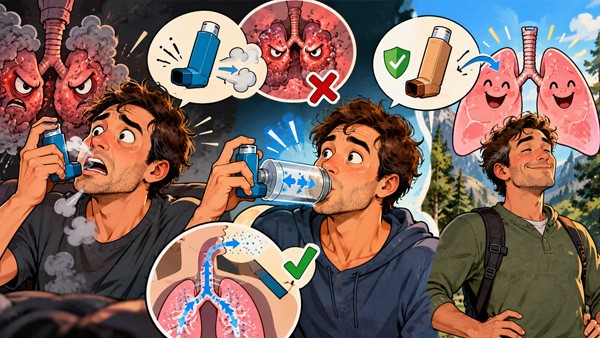

Two inhalers, and almost everybody prefers the wrong one.
The reliever works in minutes. You can feel it. The chest opens, the wheeze eases, and the relief is unmistakable. So it lives in the pocket and gets used whenever breathing gets tight.
The preventer does nothing you can feel. Take it and nothing happens. It sits in a drawer and gets forgotten within a fortnight.
⚠️ And the one you cannot feel is the one that keeps you out of hospital.
The reliever opens a narrowed airway for four to six hours and does nothing whatsoever to the inflammation underneath. The preventer treats that inflammation, which is the disease, and it is the drug that reduces attacks and reduces deaths.
Reviews of asthma deaths find the same pattern again and again: heavy reliever use, and the preventer not being taken. Feeling fine on the blue inhaler is not control; it is the symptom being masked while the disease continues.
🔵 The two jobs
| Reliever | Preventer | |
|---|---|---|
| What it is | Short-acting beta agonist — albuterol, also called salbutamol | Inhaled corticosteroid — fluticasone, budesonide, ciclesonide |
| What it does | Relaxes the airway muscle. Treats the symptom | Reduces the inflammation in the airway lining. Treats the disease |
| How fast | Minutes | Days to weeks for the full effect |
| How long | 4 to 6 hours | Continuous, while taken daily |
| When to use it | As needed, and before exercise if that triggers you | Every day, whether or not you feel well. Including through good spells |
| What you notice | Immediate relief | Nothing — which is why it gets abandoned |
| Effect on attacks | Treats one in progress | Prevents them |
The practical consequence is counter-intuitive: if you are using the reliever often, the answer is more preventer, not more reliever. Reaching for the blue inhaler more frequently treats the same symptom repeatedly while the cause goes untouched.
📊 How often is too often
There is a number for this, and it is lower than most people assume.
📌 Needing the reliever more than two or three times a week means the asthma is not controlled. Not that you need a stronger reliever — that the preventive treatment is insufficient and should be reviewed.
And one clear warning sign: getting through more than one reliever canister a month marks someone at genuinely raised risk of a severe attack. If that describes you, it is worth an appointment this week rather than another canister.
Four questions settle whether asthma is controlled, and they are the ones a clinician asks. In the past month, have you:
- ☀️ Had daytime symptoms more than twice a week
- 🌙 Been woken at night by asthma, even once
- 💨 Needed the reliever more than twice a week
- 🏃 Had to limit any activity because of breathing
No to all four is controlled asthma. One or two yeses means partly controlled. Three or four means uncontrolled, and the plan needs changing rather than enduring.
💨 The technique, which decides whether any of it works
This section matters more than drug choice, because an inhaler used badly delivers most of the dose to the back of the throat and almost none to the lungs. Studies consistently find the majority of patients make at least one significant error, and nobody checks.
For a standard pressurised inhaler — the pocket puffer:
- 🌀 Shake it for five seconds
- 💨 Breathe all the way out, away from the inhaler. This is the most commonly skipped step and one of the most important — you cannot draw the dose in on a full chest
- 👄 Seal your lips around the mouthpiece
- 🟦 Press once and breathe in slowly and deeply over four to five seconds — slow, like sipping through a straw, not a sharp sniff
- ⏱️ Hold your breath for ten seconds, or as long as is comfortable
- 🔄 Wait thirty seconds before the second puff, and shake again
The five errors that waste the dose: not breathing out first; breathing in too fast; firing two puffs in one breath; not holding the breath afterwards; and pressing before the breath has started or after it has finished.
✅ The single biggest improvement available, and it costs almost nothing: use a spacer.
A spacer is a plastic chamber between the inhaler and your mouth. It roughly doubles the amount of drug reaching the lungs, removes the need to coordinate pressing and breathing, and cuts the amount deposited in the throat.
It is essential in young children and it is substantially better in adults too, particularly for the steroid inhaler. One puff into the spacer, then breathe in and out through it four or five times, then repeat for the next puff. Never fire several puffs into it at once.
Wash it in warm soapy water monthly and let it air dry without wiping — wiping creates static that holds the drug to the walls.
And the trap that catches people who switch devices: dry powder inhalers — the disc and twist types — need the opposite technique. With those you breathe in fast and hard, not slow and deep. Someone trained on a puffer who is handed a powder device and keeps inhaling gently gets very little of it. Always ask to be shown the technique for the specific device you have been given.
One more step that is almost always omitted: rinse your mouth and spit after every steroid inhaler dose. It prevents oral thrush and hoarseness, which are the two complaints that make people stop taking the preventer.
📈 The ladder, and the one rule that must not be broken
Treatment steps up and down according to control.
| Step | What it looks like |
|---|---|
| Starting point | A low-dose inhaled steroid daily, plus a reliever as needed |
| If not controlled | Check technique and adherence first — these explain most apparent treatment failure. Then increase the steroid dose, or add a long-acting bronchodilator |
| Next | A combination inhaler containing both a steroid and a long-acting bronchodilator in one device |
| Add-on | Montelukast, a tablet rather than an inhaler, useful particularly where allergy or exercise is a strong trigger |
| Older option | Theophylline, still used, with a narrow margin between effective and toxic and more interactions than the inhalers |
🚨 A long-acting bronchodilator must never be used on its own in asthma.
Salmeterol and formoterol last twelve hours and feel like a better reliever — which is exactly the danger. Used without an inhaled steroid they have been associated with an increased risk of severe attacks and asthma deaths, because the symptoms are suppressed while the inflammation worsens unopposed.
They are safe and useful alongside a steroid, which is why combination inhalers containing both in one device exist. If you have been given a long-acting bronchodilator alone, query it.
Stepping down matters too. Once control has been stable for around three months, the dose can often be reduced — but it is reduced deliberately with review, not by quietly stopping, which is how people end up back at the beginning.
💨 An attack: what to do, in order
Everyone with asthma should have this written down, and most do not.
- Sit upright. Do not lie down
- Take the reliever: one puff at a time, through a spacer if you have one, up to ten puffs, with about thirty to sixty seconds between each
- Wait ten minutes. If breathing is easing, continue to monitor and arrange to be seen
- If there is no improvement after ten puffs, or you are getting worse at any point — call emergency services
- While waiting, keep taking the reliever, one puff a minute, up to ten more puffs
🚨 Signs of a severe attack — call emergency services:
🔹 Cannot complete a sentence in one breath, or cannot speak
🔹 Too breathless to eat, drink or sleep
🔹 Blue or grey lips or fingertips
🔹 Exhaustion, agitation, drowsiness or confusion
🔹 Peak flow below half your best
🔹 A silent chest. This one is counter-intuitive and life-saving to know: a chest that has stopped wheezing in a severe attack is more serious, not less — it means too little air is moving to make a sound
Two practical notes. Never withhold the reliever during an attack for fear of overusing it — the limits above exist for routine use, not emergencies. And an attack that needed emergency treatment or oral steroids is a reason for the preventive plan to be reviewed within a few days, not just for the episode to be survived.
🌳 Triggers, and the ones worth acting on
Avoiding every trigger is not achievable. A few are worth real effort because the return is large.
- 🚬 Smoking, and smoke in the house. Beyond the direct irritation, smoking substantially reduces how well inhaled steroids work — so it undermines the treatment as well as worsening the disease. The highest-value change available, and the methods are in our guide to smoking cessation
- 🤧 Hay fever and a blocked nose. Treating the nose measurably improves the chest, and this connection is routinely missed — the airway is continuous
- 💤 House dust mite, where testing shows it matters: mattress and pillow covers, hot washing, reduced soft furnishings in the bedroom
- 🐾 Pets, where relevant — at least keeping them out of the bedroom
- 🌡️ Cold air and exercise — use the reliever ten to fifteen minutes beforehand and warm up gradually. Exercise is good for asthma and should not be avoided
- 🤒 Colds and flu, the commonest trigger of all. Annual influenza vaccination is worth having
Three things that worsen asthma and are rarely connected to it:
- 💊 Aspirin and anti-inflammatories in a minority of people with asthma, sometimes severely. If one has ever made your breathing worse, avoid the whole class and say so
- 🩸 Beta blockers, including eye drops for glaucoma, which can provoke bronchospasm
- 🔥 Acid reflux, which can drive a persistent cough and worsen control
Weight matters too — excess weight worsens asthma control and reduces response to treatment.
📏 Peak flow, used properly
A peak flow meter measures how fast you can blow out, and its value lies in comparison rather than in the absolute number.
Establish your personal best over two weeks of good control, then use that as the reference. Readings are taken standing, before the reliever, morning and evening.
- 🟩 Above 80 percent of your best — good control
- 🟧 50 to 80 percent — worsening. Follow your action plan and seek advice
- 🟥 Below 50 percent — severe. Emergency treatment
One pattern worth knowing: a large gap between the morning and evening reading, or readings that dip sharply before dawn, indicates poorly controlled asthma even when the daytime number looks acceptable.
💊 Side effects, and the ones that are avoidable
The steroid inhaler. At the doses used in asthma it acts locally in the airway with limited systemic absorption, which is the whole point of inhaling it rather than swallowing it. The two common complaints are oral thrush and hoarseness, and both are largely prevented by the two measures above — a spacer and rinsing the mouth afterwards. At higher doses and over years, bone density and other systemic effects become a consideration, which is why the dose is stepped down when control allows.
The reliever. Tremor, palpitations and a jittery feeling are dose-related and harmless, though unpleasant. Heavy use can lower potassium.
Montelukast. Generally well tolerated, with one caution worth stating because it is not widely known: it carries a warning about neuropsychiatric effects — sleep disturbance, vivid dreams, agitation, low mood and behavioural change, particularly in children. These are reversible on stopping and should be reported rather than attributed to something else.
Theophylline. A narrow therapeutic range, so blood level monitoring is used, and a long list of interactions — including with several antibiotics and with stopping smoking, which raises its level. It belongs under supervision rather than as a self-managed addition.
🔎 When it is not asthma
Breathlessness and cough have several other explanations, and two are commonly confused with it.
- 🫁 COPD — in a smoker or ex-smoker over 40, with breathlessness that is steadily progressive rather than variable, and less response to a reliever. Asthma varies from day to day; COPD does not vary much. Chronic productive cough is covered in our guide to chronic bronchitis
- 🦠 A chest infection — fever, feeling systemically ill, one-sided chest pain. See our guide to pneumonia and when hospital is needed
- 🗣️ Upper airway causes — noisy breathing on the in-breath, throat tightness, a sensation at the voice box rather than in the chest, and a reliever that does nothing
- ❤️ Heart failure — breathlessness lying flat, waking at night, ankle swelling
- 😰 Breathing pattern disorder — frequently alongside genuine asthma rather than instead of it, and it responds to breathing retraining rather than to more medication
Where the diagnosis is uncertain, spirometry with reversibility testing is the standard, and a normal result when you are well does not exclude asthma because it varies by definition.
📞 When to seek help
🚨 Emergency: cannot complete a sentence; too breathless to eat, drink or sleep; blue or grey lips; exhaustion, agitation or drowsiness; peak flow below half your best; a silent chest; or no improvement after ten puffs of the reliever.
This week:
- Using the reliever more than two or three times a week
- More than one reliever canister a month
- Waking at night with asthma, even occasionally
- Any attack that needed emergency treatment or oral steroids — the plan needs reviewing, not just the episode surviving
- Peak flow consistently between 50 and 80 percent of your best
- Given a long-acting bronchodilator without a steroid — query it
Worth an appointment:
- Never having had your inhaler technique checked — ask to demonstrate it and be corrected. This is the highest-value ten minutes available
- No spacer, particularly if you use a steroid inhaler
- No written action plan
- Thrush or hoarseness on the preventer — fixable with a spacer and rinsing, rather than a reason to stop
- Hay fever or a persistently blocked nose alongside asthma
- Breathing worse after aspirin or an anti-inflammatory
- Taking a beta blocker, including eye drops
- Sleep disturbance, vivid dreams or mood change on montelukast, especially in a child
- Stopping smoking while on theophylline, which raises its level
- Pregnancy — asthma treatment is continued in pregnancy, and uncontrolled asthma is the greater risk
❓ Frequently asked questions
What is the difference between a preventer and a reliever inhaler?
The reliever relaxes the airway muscle within minutes and treats the symptom for four to six hours. The preventer is an inhaled steroid that reduces the underlying inflammation over days to weeks and is the one that prevents attacks.
How often is too often to use a reliever?
More than two or three times a week means the asthma is not controlled, and the answer is more preventive treatment rather than more reliever. Using more than one canister a month marks genuinely raised risk.
How do I use a puffer inhaler correctly?
Shake it, breathe all the way out, seal your lips, press once and breathe in slowly and deeply over four to five seconds, then hold for ten seconds. Wait thirty seconds before the next puff.
Do I really need a spacer?
It roughly doubles the amount of drug reaching the lungs and removes the need to coordinate pressing and breathing. Essential in children and substantially better in adults, particularly for the steroid inhaler.
Why do dry powder inhalers need a different technique?
Because they need a fast, hard breath in to lift the powder, the opposite of the slow deep breath a puffer needs. Someone trained on a puffer who inhales gently through a powder device gets very little of the dose.
Why rinse my mouth after a steroid inhaler?
Rinsing and spitting prevents oral thrush and hoarseness, which are the two complaints that most often make people stop taking the preventer. A spacer reduces them further.
Can I use a long-acting inhaler on its own?
No. Used without an inhaled steroid, long-acting bronchodilators have been associated with increased risk of severe attacks and asthma deaths, because symptoms are suppressed while inflammation worsens unopposed.
Why is a silent chest serious?
Because wheezing requires air movement. A chest that has stopped wheezing during a severe attack means too little air is moving to make a sound, which is more dangerous rather than reassuring.
How many puffs can I take during an attack?
Sit upright and take up to ten puffs, one at a time through a spacer, thirty to sixty seconds apart. No improvement after ten, or worsening at any point, means calling emergency services while continuing the reliever.
Does smoking affect how well inhalers work?
Yes, substantially. Smoking reduces how well inhaled steroids work, so it undermines the treatment as well as worsening the disease. It is the highest-value change available in asthma.
📑 Sources and editorial
- Global and national asthma management guidelines, including the role of inhaled corticosteroids as controller therapy, assessment of control, and the stepwise approach to treatment
- National asthma death review findings on reliever over-reliance and under-use of preventive inhaled corticosteroid therapy
- Guidance on reliever use frequency and canister consumption as markers of poor control and of risk of severe exacerbation
- Studies of inhaler technique error rates in patients and of the effect of technique on lung drug delivery
- Evidence on valved holding chambers and spacers, including the effect on pulmonary deposition and on oropharyngeal deposition, and guidance on cleaning and static
- Comparative guidance on inhalation manoeuvre for pressurised metered-dose inhalers versus dry powder inhalers
- Regulatory and trial evidence on long-acting beta agonist monotherapy in asthma and associated risk of severe exacerbation and death, and on fixed-dose combination inhalers
- Prescribing information for inhaled fluticasone, budesonide and ciclesonide, including local adverse effects and measures to reduce them
- Prescribing information for albuterol, including dose-related tremor, palpitations and effects on potassium
- Regulatory warnings on montelukast and neuropsychiatric adverse events
- Prescribing information and monitoring guidance for theophylline, including therapeutic range and interactions, and the effect of smoking cessation on serum levels
- Guidance on recognition and emergency management of acute asthma, including the silent chest, peak flow thresholds and reliever dosing during an attack
- Evidence on the effect of cigarette smoking on inhaled corticosteroid responsiveness in asthma
- Literature on aspirin-exacerbated respiratory disease, beta blocker use in asthma, gastro-oesophageal reflux, allergic rhinitis and obesity as modifiers of asthma control
- Guidance on peak expiratory flow monitoring, personal best values and diurnal variation
- Related reading: chronic bronchitis, pneumonia and when hospital is needed, respiratory tract infections, smoking cessation aids
- Related products: Flovent (Fluticasone), Proventil (Albuterol), Singulair (Montelukast), Theo-24 (Theophylline), asthma category
- RXshop Editorial Team — reviewed by Emily Chen, MD, MPH — Internal Medicine Specialist
Medical Disclaimer: The information in this article is for educational and informational purposes only and is not a substitute for professional medical advice, diagnosis, or treatment. Always seek guidance from a qualified healthcare provider with any questions you may have regarding a medical condition, and before starting, stopping or changing any medication.