IBS With Diarrhea: What Actually Helps, What Does Nothing, and the Diagnosis That Gets Missed

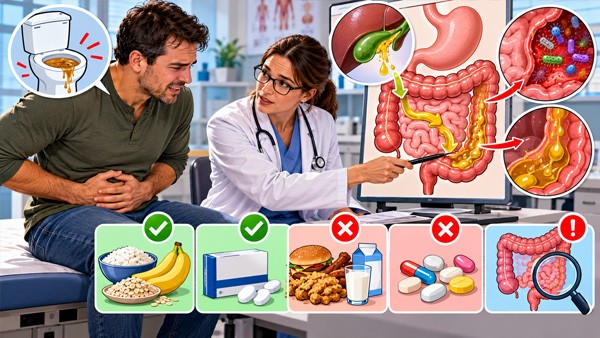

🚪 Urgency that plans your day around toilets, loose stools within minutes of eating, cramping that eases after going, and a normal colonoscopy. That combination gets labelled irritable bowel syndrome with diarrhea, and for most people the label is right. For a sizeable minority it is wrong in a specific and treatable way, and that is where this page starts.
📌 Those last two numbers explain most of the confusion around this condition. One means a treatable diagnosis is being missed on a large scale. The other means almost any remedy will produce enthusiastic testimonials, which is why the internet is full of cures.
📐 What the diagnosis actually requires
🔎 IBS is a positive diagnosis made on a pattern, not a label applied when tests come back clear. The current criteria are narrower than the ones used a decade ago, which is why prevalence figures online disagree so wildly.
| ✅ What must be present | 📝 The detail that matters |
|---|---|
| 🕰️ Recurrent abdominal pain | At least one day a week over the last three months. Pain is required — diarrhea alone is not IBS |
| 🚽 Linked to defecation | The pain relates to opening the bowels, improves after, or both |
| 🔄 A change in stool frequency | More often than your own normal |
| 💧 A change in stool form | Looser than your own normal. Two of the three features above are needed |
| ⏳ Six months of symptoms | Onset within the last few weeks is a different problem and is investigated differently |
| 🚫 No red flags | Weight loss, bleeding, anemia, nocturnal symptoms, fever or a family history of bowel cancer all take the case out of this category |
📋 Subtype is then decided by what the stools look like on the days they are abnormal, using the Bristol scale. This is more than a formality: the subtype decides the treatment entirely, and treating the wrong subtype is a common reason nothing works.
| 📊 Type | 🖊️ What it looks like | 🎯 Meaning |
|---|---|---|
| 1 | Separate hard lumps | 🔴 Constipated end |
| 2 | Sausage-shaped but lumpy | |
| 3 | Sausage-shaped with cracks | 🟢 Normal range |
| 4 | Smooth and soft, like a sausage | |
| 5 | Soft blobs with clear edges | 🟡 Tending loose |
| 6 | Mushy with ragged edges | 🔵 IBS-D sits here |
| 7 | Entirely liquid, no solid pieces |
📒 Worth being honest about why this matters practically. People describe themselves as having diarrhea when they mean going three times a morning with type 4 stools, and as being constipated when they mean once every two days without difficulty. Neither is what the words mean clinically, and both send treatment in the wrong direction.
🟡 The diagnosis behind up to a third of IBS-D labels
⚡ This is the most useful thing on the page. Bile acid diarrhea is common, it is testable, and it responds to a specific treatment that has nothing to do with IBS medicines. It is also missed constantly, because its symptoms are identical to IBS-D.
🧫 The mechanism is simple. The liver makes bile acids, the small intestine reabsorbs most of them at its far end, and the rest go on to the colon. If too many reach the colon, they pull in water and stimulate movement. The result is urgent watery diarrhea, often first thing in the morning and after meals.
🔵 Points toward true IBS-D
🕰️ Pain is a prominent part of the picture, easing after opening the bowels
🎈 Bloating and distension that build through the day
🔄 Alternating with normal or firmer days
🌙 Nothing wakes you at night
📅 Years of the same pattern, often starting in the twenties or thirties
🟡 Points toward bile acid diarrhea
🚰 Watery and urgent rather than painful — the volume is the problem
🌅 Worst in the morning and shortly after eating
🧈 Much worse after fatty meals
🔪 Follows gallbladder removal, bowel surgery, Crohn disease of the ileum or radiotherapy
🌙 Can wake you at night, which true IBS rarely does
💛 Sometimes pale, greasy, hard-to-flush stools
🧪 Two ways it is confirmed, and one way it is treated.
🔹 A SeHCAT scan or a blood test measuring bile acid turnover settles it where available.
🔹 Where neither is available, a trial of a bile acid binder is used as the test. If a binder transforms the symptoms within a week, that is the answer.
🔹 The treatment is a bile acid sequestrant — colestyramine, colesevelam or colestipol — which binds the bile acids in the gut so they stop irritating the colon. It works within days when the diagnosis is right.
🔹 These are not IBS drugs and they are not interchangeable with them. That is exactly why this diagnosis is worth chasing before accepting years of antispasmodics that do little.
⚠️ They also bind other medicines, so everything else is taken at least an hour before or four hours after.
🧬 The other things to exclude first
Before settling on IBS, a small set of tests covers almost everything that imitates it. None of them is elaborate, and the whole panel is usually done at once.
| 🎭 Mistaken for IBS-D | 🔍 What gives it away |
|---|---|
| 🌾 Coeliac disease | Three to four times more common in people with IBS symptoms than in everyone else. Can present purely as diarrhea and bloating, with no weight loss at all |
| 🥛 Lactose intolerance | Symptoms within hours of dairy specifically, and gone when dairy is removed. Very common, and easy to test by trial |
| 🦠 Microscopic colitis | Watery diarrhea with no pain, often in women over 50, sometimes nocturnal. Invisible at colonoscopy — found only on biopsy. Can be triggered by common medicines |
| 🔥 Inflammatory bowel disease | Blood, weight loss, night symptoms, raised calprotectin. See Crohn disease, how it behaves and intestinal inflammation |
| 💊 Medicines | Metformin, magnesium, proton pump inhibitors, antibiotics, sertraline, non-steroidal anti-inflammatories, sugar-free sweeteners. Always worth reviewing the list before diagnosing anything |
| 🦠 Post-infectious change | It began with a definite bout of food poisoning or travel illness and never fully settled. This is a recognised and real route into IBS |
| 🧪 Overactive thyroid | Weight loss despite appetite, tremor, palpitations, heat intolerance alongside loose stools |
| 🍭 Sweeteners and sugar alcohols | Sorbitol, mannitol, xylitol in gum, mints and diet drinks. Enough chewing gum alone can do this |
📊 What actually works, ranked by evidence
📉 The honest way to compare treatments is the number of people who need to take something for one extra person to benefit, beyond what placebo achieves. Lower is better. Here is where the common options sit.
🧐 Two things jump out of that chart. Peppermint oil performs better than most prescription options, which surprises people and is genuinely supported. And rifaximin sits at the bottom, which matters because it is the most heavily marketed of the group.
💡 Why the placebo number is the most useful fact about IBS.
🔹 Thirty to forty percent of people improve on a dummy tablet in IBS trials, which is among the highest placebo responses in medicine.
🔹 That is not imaginary improvement. Symptoms genuinely ease, because attention, expectation and routine all act on a gut-brain system that is sensitive to exactly those things.
🔹 It does mean every supplement, tea, detox and elimination plan will have glowing reviews, regardless of whether it does anything specific.
🔹 So the test of a treatment is not whether someone online improved on it. It is whether it beat placebo in a trial, which is what the chart above shows.
💊 The medicines, and what each one is for
| 💊 Medicine | 🎯 What it is for, and the practical detail |
|---|---|
| Colospa (Mebeverine) | Cramping and spasm. A smooth muscle relaxant whose main licensed use is IBS. Taken 20 minutes before meals rather than when the pain arrives, which is the part people get wrong. Does not cause the dry mouth and blurred vision of the older antispasmodics |
| Cyclopam (Dicyclomine and Paracetamol) | Acute cramping episodes. Stronger and faster, with the trade-off of dry mouth and drowsiness. Suited to a bad day rather than daily use |
| Imodium (Loperamide) | Urgency and stool frequency. Underused properly: taken before a commute, a meeting or a meal out rather than after the event. Start at a low dose and titrate — the commonest complaint is swinging into constipation, which means the dose was too high, not that the drug failed |
| Elavil (Amitriptyline) | Pain and urgency together, at 10 to 25 mg at night — a fraction of the antidepressant dose. It is prescribed here for gut nerve signalling, not for mood, and that explanation matters because people refuse it otherwise. Takes four to six weeks. Its constipating effect is a bonus in IBS-D |
| Rexigut and Rixmin (Rifaximin) | A 14-day course, second or third line, acting only inside the gut. Two honest caveats: the benefit over placebo is nine percentage points, and the studied regimen is 550 mg three times daily, which neither the 200 mg nor the 400 mg tablet delivers conveniently. Worth discussing with a clinician rather than self-starting |
| 🟡 Bile acid binders | The treatment for the diagnosis above, and not stocked here. If the morning-urgency pattern fits, this is the conversation to have with your doctor |
| 🌿 Peppermint oil | Enteric-coated capsules, the best-performing option on the chart. Can worsen reflux, so the coating is what makes it tolerable |
| ❌ Proton pump inhibitors | Not an IBS treatment, and long-term use is itself a recognised cause of loose stools. Prilosec and the rest belong to reflux, not to this |
| ❌ Antibiotics generally | Ordinary systemic antibiotics make IBS worse rather than better. Rifaximin is a special case precisely because it stays in the gut |
⏳ How long to give each thing before calling it a failure
🚩 Abandoning a treatment at day four is the single commonest reason people conclude that nothing helps. Each option has its own honest waiting time, and they differ by a factor of twenty.
🟡 Note where the binder sits. If bile acid diarrhea is the real diagnosis, a week settles it — which is a short experiment compared with six weeks on a tricyclic that was never going to address the cause.
🥗 The diet question, done properly
📉 Diet is the most effective single intervention in IBS and the most badly implemented. Roughly half to three quarters of people get meaningful relief from a low-FODMAP approach, and it is designed as a three-phase process, not a permanent way of eating. Stopping after phase one is the usual mistake, and it leaves people on a needlessly narrow diet for years.
| 🚫 Common high-FODMAP item | ✅ What to swap it for |
|---|---|
| 🧄 Onion and garlic — in almost every sauce, stock cube and ready meal, and the biggest hidden source of all | Garlic-infused oil, the green tops of spring onions, chives, asafoetida |
| 🍞 Wheat bread and pasta in large portions | Sourdough spelt, oats, rice, quinoa, or simply smaller portions |
| 🥛 Milk, soft cheese, ice cream | Lactose-free milk, hard cheeses, which are naturally low in lactose |
| 🍎 Apple, pear, mango, watermelon, dried fruit | Berries, citrus, kiwi, banana, grapes, pineapple |
| 🫘 Beans, lentils, chickpeas | Small portions of canned and well-rinsed lentils, firm tofu |
| 🍬 Sorbitol, mannitol, xylitol in gum, mints and diet drinks | Plain water, and read the label on anything sugar-free |
⚠️ Three cautions about doing this alone.
🔹 Test for coeliac disease before cutting wheat. Removing gluten first makes the test unreliable, and people end up on a lifelong restriction without ever knowing whether they had a diagnosable disease.
🔹 Phase one is restrictive enough to affect nutrition and the gut bacteria if it runs for months. Six weeks is the limit; a dietitian makes the whole thing considerably easier and shorter.
🔹 Not everyone needs it. Simpler measures — regular meals, less caffeine and alcohol, less fat per meal, fewer sweeteners, soluble rather than insoluble fibre — resolve a good number of cases on their own.
🌾 Fibre: the detail that reverses the advice
🤔 Being told to eat more fibre and getting worse is a familiar experience with IBS, and it happens because the advice omits which kind.
- ✅ Soluble fibre helps. Ispaghula and psyllium form a gel that firms loose stools and eases passage. It is one of the few things that works in both IBS-D and IBS-C, which sounds contradictory until you picture the gel
- ❌ Insoluble fibre usually makes IBS worse. Wheat bran is the classic offender, and it is exactly what generic bowel advice recommends
- 🐌 Start low and build slowly. A full dose from day one causes bloating and gets abandoned in a week
- 💧 Take it with plenty of water. A gel-forming fibre without fluid is a worse problem than no fibre
- ⏳ Give it three to four weeks. The first week often feels like a step backwards
🧠 Why the gut-brain part is not a dismissal
😢 Being told that IBS involves the nervous system lands as being told it is imaginary, so it is worth stating what is actually meant. The gut has its own dense network of nerves, and in IBS that network reports normal events as painful. Ordinary gas distension that most people never notice registers as cramping. The signal is real; the calibration is off.
🔗 That is also why stress worsens symptoms without being the cause, and why treatments that act on nerve signalling — the low-dose tricyclic, gut-directed hypnotherapy, cognitive behavioural therapy adapted for IBS — produce some of the best numbers in the whole field. Gut-directed hypnotherapy in particular has results comparable with the low-FODMAP diet, which few people expect of it.
💡 What helps day to day, for reasons that are mostly mechanical.
🕛 Regular meals, never skipped. A long gap then a large meal provokes the strongest response.
☕ Less caffeine. It stimulates the colon directly, and coffee on an empty stomach is the commonest trigger of the morning rush.
🍺 Less alcohol, particularly beer and wine, which carry their own fermentable load.
🚶 Daily walking. Modest, boring, and consistently shown to reduce symptom severity.
😴 Sleep. A bad night reliably means a worse gut day, and the link runs in that direction.
🚬 Stopping smoking, which speeds gut transit as long as it continues.
📒 The two-week diary that does more than another tablet
Before changing treatment again, two weeks of structured recording usually identifies something nobody had spotted. It needs to be specific enough to be useful.
🔎 What this reliably catches: a 6 a.m. coffee driving the morning rush, a magnesium supplement nobody counted as a drug, sugar-free gum through the working day, and a clear link to the week before a period. All four are fixable without a prescription.
🧫 Probiotics, and what can honestly be said
🛑 This deserves a straight answer rather than either enthusiasm or dismissal. Some strains help some people, the evidence is inconsistent across products, and the strain matters more than the brand. Three practical rules follow from that.
- 🧪 Try one product at a time for four weeks, not three at once, or you learn nothing
- 🚫 Stop if nothing changes. Taking a probiotic indefinitely because it might be working is how people end up spending years on it
- 🎈 If bloating gets worse, stop sooner. In some people a probiotic adds to the fermentable load rather than reducing it
🚫 What is not supported, despite being sold hard: colon cleanses, detox regimens, routine stool microbiome panels sold direct to consumers, and IgG food-sensitivity blood tests. The last of those produces a long list of foods to avoid that has no relationship to symptoms, and it is a common route into an unnecessarily restricted diet.
👩⚕️ When the pattern changes, start again
🚩 A long-standing IBS diagnosis is not permanent protection. The thing to watch for is a change in your own pattern, because that is what distinguishes a flare from something new.
🚨 Tier 1 — see a doctor promptly, do not wait for a flare to pass
Blood in the stool or black stools · unintended weight loss · diarrhea that wakes you at night · a new lump in the abdomen · fever with the symptoms · vomiting that will not stop · symptoms starting for the first time after 50
🟡 Tier 2 — book a review within a week or two
A clear change in your usual pattern · symptoms that stopped responding to what used to work · diarrhea after a course of antibiotics · new symptoms after starting any medicine · progressive tiredness, which may mean anemia
🟢 Tier 3 — worth raising at the next appointment
Never had coeliac testing · never had bile acid diarrhea considered, especially with morning urgency or after gallbladder surgery · stuck on phase one of a FODMAP diet for months · want to try a low-dose tricyclic or hypnotherapy · a family history of bowel cancer or inflammatory bowel disease
📌 And the point that deserves repeating, because it is the one most likely to change an outcome: if the diarrhea is watery, urgent, worst in the morning, worse after fatty food and it followed gallbladder removal, ask about bile acid diarrhea by name. A one-week trial of a binder either transforms things or rules it out.
❓ Frequently asked questions
Is my IBS with diarrhea actually something else?
Possibly. Around a quarter to a third of people labelled IBS-D have bile acid diarrhea, which responds to a binder within a week. Coeliac disease and microscopic colitis also imitate it.
What is the best medicine for IBS with diarrhea?
There is no single best one. Mebeverine for cramping, loperamide for urgency, a low-dose tricyclic for pain and urgency together. The subtype and the dominant symptom decide it.
Should I take loperamide every day?
Regular low-dose use is reasonable under guidance, and taking it before a commute or a meal out works better than afterwards. Swinging into constipation means the dose is too high.
Why was I given an antidepressant for IBS?
At 10 to 25 mg it is treating gut nerve signalling, not mood, and that is a fraction of the antidepressant dose. It is among the most effective options and takes four to six weeks.
Does the low FODMAP diet work?
Half to three quarters of people get real relief. It has three phases and the restriction phase is meant to last six weeks at most, then foods are reintroduced one group at a time.
Should I stop eating gluten?
Get tested for coeliac disease first, while still eating gluten, or the test is unreliable. Coeliac disease is three to four times more common in people with IBS symptoms.
Why does more fibre make me worse?
Because the kind matters. Soluble fibre such as ispaghula helps, while insoluble fibre like wheat bran usually worsens IBS, and generic bowel advice recommends exactly the wrong one.
Does rifaximin cure IBS?
No. In the trials 41 percent responded against 32 percent on placebo, a real but modest nine-point gain, and the studied dose was 550 mg three times daily for 14 days.
Do probiotics help IBS?
Some strains help some people and the evidence varies by product. Try one for four weeks, stop if nothing changes, and stop sooner if bloating gets worse.
Does IBS turn into cancer or bowel disease?
No. IBS does not damage the bowel and does not become cancer or inflammatory bowel disease. What matters is reporting a change in your own pattern rather than assuming it is a flare.
📑 Sources and editorial
- 📘 Rome IV diagnostic criteria for irritable bowel syndrome, including the pain frequency requirement, the association with defecation, subtyping by predominant stool form and the positive-diagnosis approach
- 📊 Systematic reviews and meta-analyses of global irritable bowel syndrome prevalence, including the difference in pooled prevalence between Rome III and Rome IV criteria and the female predominance
- 🖊️ The Bristol stool form scale and its use in subtype classification
- 🟡 Literature on bile acid diarrhea, including the proportion of patients meeting criteria for diarrhea-predominant irritable bowel syndrome found to have bile acid malabsorption, diagnosis by SeHCAT retention or serum markers, the use of a therapeutic trial where testing is unavailable, and treatment with bile acid sequestrants
- 🌾 Evidence on the increased prevalence of coeliac disease among patients presenting with irritable bowel syndrome symptoms, and on the requirement for gluten intake at the time of serological testing
- 🦠 Guidance on the use of faecal calprotectin to distinguish functional bowel disorder from inflammatory bowel disease, and its role in avoiding colonoscopy in younger patients without alarm features
- 🔎 Guidance on microscopic colitis, including the typical presentation of painless watery diarrhea in older women, normal endoscopic appearance, the requirement for biopsy and recognised drug associations
- 💊 Systematic reviews reporting numbers needed to treat in irritable bowel syndrome for antispasmodics, soluble fibre, peppermint oil, tricyclic antidepressants and rifaximin
- 📉 Meta-analyses of placebo response rates in irritable bowel syndrome clinical trials
- 🧪 The pivotal randomised trials of rifaximin in diarrhea-predominant irritable bowel syndrome, including the 550 mg three times daily regimen for 14 days and the responder rates against placebo
- 🥗 Trial evidence and clinical guidance on the low-FODMAP diet, including reported response rates, the three-phase structure of restriction, reintroduction and personalisation, the time limits on the restriction phase and concerns about nutritional adequacy and microbiota with prolonged restriction
- 🌿 Evidence on soluble versus insoluble fibre in irritable bowel syndrome, including the benefit of ispaghula and the worsening associated with wheat bran
- 💊 Prescribing information for mebeverine, dicyclomine, loperamide, amitriptyline and rifaximin, including dosing, timing relative to meals and adverse effects
- 🧠 Evidence on gut-brain interaction in irritable bowel syndrome, including visceral hypersensitivity, and trial evidence for gut-directed hypnotherapy and cognitive behavioural therapy adapted for the condition
- 🧫 Reviews of probiotics in irritable bowel syndrome, including strain-specific effects and the inconsistency of evidence across preparations
- 🚫 Position statements on the absence of validated utility for IgG food-sensitivity testing, direct-to-consumer microbiome panels and colon cleansing
- 🦠 Literature on post-infectious irritable bowel syndrome following acute gastroenteritis
- 🚩 Guidance on alarm features requiring investigation rather than a functional diagnosis, and on the absence of progression from irritable bowel syndrome to inflammatory bowel disease or malignancy
- 📖 Related reading: acute diarrhea, rehydration and when loperamide helps, Crohn disease and what controls it, intestinal inflammation and recovery, pain on the left side, sorting urgent from ordinary, which painkiller to take
- 🛒 Related products: Colospa (Mebeverine), Imodium (Loperamide), Elavil (Amitriptyline), Cyclopam (Dicyclomine and Paracetamol), Rexigut (Rifaximin), gastrointestinal range
- 👩⚕️ RXshop Editorial Team — reviewed by Emily Chen, MD, MPH — Internal Medicine Specialist
Medical Disclaimer: The information in this article is for educational and informational purposes only and is not a substitute for professional medical advice, diagnosis, or treatment. Always seek guidance from a qualified healthcare provider with any questions you may have regarding a medical condition, and before starting, stopping or changing any medication.