Acute Diarrhea: Rehydration, When Loperamide Helps and When It Is Dangerous

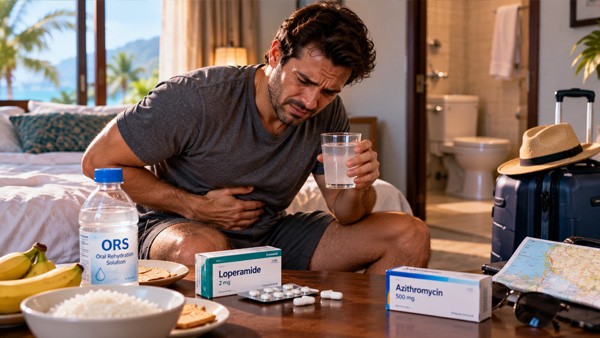

Acute diarrhea means three or more loose or watery stools a day, lasting under fourteen days. In adults it is usually viral, usually over within three days, and usually needs nothing beyond fluid. The reason it still kills people worldwide is not the infection. It is the water and salt lost while the infection runs its course.
That makes rehydration the treatment and everything else an adjunct. It also means the two decisions worth getting right are how to replace fluid properly, and whether this is one of the situations where slowing the bowel is the wrong move.
💧 Why sugar and salt together, and not just water
An inflamed gut loses the ability to absorb sodium on its own. But it keeps one transporter working: a protein that carries a sodium ion and a glucose molecule across the intestinal wall together. Neither passes efficiently without the other, and water follows the sodium.
That is the whole principle behind oral rehydration solution, and it is why plain water rehydrates poorly while a correctly balanced sugar-salt mixture rehydrates well. It is one of the most consequential findings in modern medicine, and it fits on one line.
🧂 The home recipe, when a sachet is not available. In one litre of clean water, dissolve six level teaspoons of sugar and half a level teaspoon of salt. Sip continuously rather than drinking large amounts at once, which provokes vomiting. Adults need roughly 200 to 400 mL after each loose stool. Getting the proportions right matters: too much sugar draws water into the bowel and makes diarrhea worse.
What not to rehydrate with: fruit juice and regular soft drinks, which have far too much sugar and too little sodium and reliably worsen the diarrhea; sports drinks, which are formulated for sweat loss, not stool loss; alcohol and strong coffee. Plain water alongside salty broth and crackers is a reasonable improvisation for a mild case in an adult.
🔍 Reading the dehydration
| Degree | Signs | What to do |
|---|---|---|
| Mild | Thirst, slightly dark urine, normal energy | Oral fluids at home |
| Moderate | Dry mouth, passing little urine, dizzy on standing, sunken eyes, tired | Structured oral rehydration; seek advice if not improving in a few hours |
| Severe | No urine for 8 hours or more, confusion or drowsiness, cold mottled skin, racing pulse, fainting | Emergency care; intravenous fluid |
In young children the signs differ and move faster: no tears when crying, a sunken soft spot on the head, a dry nappy for six hours, unusual sleepiness or floppiness. Infants can become dangerously dehydrated within hours rather than days.
💊 Loperamide: dose, and the situations where it must not be used
Imodium (Loperamide 2 mg) acts on opioid receptors in the gut wall, slowing intestinal muscle contractions so that contents spend longer in the bowel and more water is reabsorbed. It does not reach the brain in normal doses and does not treat the cause.
- 💊 4 mg to start, then 2 mg after each loose stool
- 📏 Maximum 16 mg in 24 hours under medical supervision, and 8 mg for self-treatment
- ⏱️ It works within an hour. If two days of correct dosing change nothing, stop and get assessed
- 🚽 Stop as soon as stools firm up. Continuing causes constipation and cramping
⛔ Do not take loperamide if any of these apply.
- Blood or mucus in the stool, or a fever above 38.5 ℃. This pattern suggests an invasive infection, and slowing the bowel keeps bacteria and toxin in contact with the wall for longer
- Suspected Shiga toxin producing E. coli, the cause of the O157 outbreaks. Antimotility drugs raise the risk of haemolytic uraemic syndrome, which damages the kidneys
- Diarrhea starting during or after a course of antibiotics, which may be Clostridioides difficile. Slowing the bowel can precipitate toxic megacolon
- A flare of ulcerative colitis, for the same reason
- Children under two years, where deaths have been reported. It is used with great caution up to twelve
💓 Loperamide is not harmless above the maximum dose. At doses far above those labelled, it reaches the heart and causes QT prolongation and dangerous rhythms, and deaths have occurred among people taking very large quantities for an opioid effect. The 16 mg ceiling is a real limit, not a cautious suggestion.
🚨 When diarrhea is not a self-limiting problem
Get medical assessment for any of these:
- Blood in the stool, or black tarry stools
- Fever above 38.5 ℃
- Severe abdominal pain, particularly if localised
- Signs of moderate to severe dehydration, or inability to keep fluids down
- Lasting more than 6 to 7 days, or recurring in cycles
- Recent antibiotics, recent hospital stay, or a nursing home resident
- Recent travel to a region with poor sanitation
- Weakened immunity, from chemotherapy, HIV or immunosuppressive treatment
- Age over 70 or under 2, where reserves are smaller
- Weight loss, night sweats or symptoms waking you from sleep
🌍 Travelers diarrhea: which drug where
Most cases are mild and settle with fluid and loperamide. Where treatment is needed, the choice now depends on destination, because resistance patterns differ.
| Medicine | Regimen | Best for |
|---|---|---|
| Rifagut (Rifaximin 200 mg) or Rixmin (Rifaximin) | 200 mg three times daily for 3 days | Watery diarrhea without fever or blood. Stays in the gut, so almost no systemic side effects. Does not work for invasive infection |
| Zithromax (Azithromycin) | 1 g single dose, or 500 mg daily for 3 days | South and Southeast Asia, and any case with fever or blood. Preferred where Campylobacter resistance to fluoroquinolones is high |
| Cipro (Ciprofloxacin) | 500 mg twice daily for 3 days | Latin America and Africa. Avoided in Asia because of resistance, and carries tendon and nerve warnings |
✈️ Antibiotics are not taken preventively for ordinary travel. They breed resistance, they carry their own risk of causing diarrhea, and most episodes resolve without them. A single standby course carried in the bag, with clear instructions on when to start it, is the sensible approach. Do not use rifaximin where there is fever or blood in the stool: it does not reach beyond the gut wall.
🍳 What to eat, and the advice that is out of date
The old instruction to rest the bowel and eat only rice, bananas, applesauce and toast has been dropped. That diet is too low in protein and energy, and prolonged fasting slows the repair of the intestinal lining.
- Start eating as soon as you can keep food down
- Small frequent portions of whatever is tolerated. Salty foods are useful because they replace sodium.
- Reasonable choices
- Rice, pasta, potato, bread, lean meat, eggs, soup, crackers, bananas and cooked vegetables.
- Pause dairy for a few days
- Gut infections temporarily strip the enzyme that digests lactose, so milk worsens symptoms for a week or two. Yoghurt is usually tolerated.
- Avoid sugar alcohols
- Sorbitol, mannitol and xylitol in sugar-free gum and sweets draw water into the bowel.
- Avoid large amounts of fat, caffeine and alcohol
- All increase bowel activity while the gut is irritable.
Two additions worth knowing: zinc supplementation for 10 to 14 days shortens diarrhea and reduces recurrence in young children, and is a standard recommendation in countries where it is common. Probiotics have modest evidence for shortening episodes by around a day, with results depending heavily on the specific strain.
🔬 When it does not stop
Diarrhea lasting beyond two weeks is no longer acute and needs a different line of investigation.
- 🦠 Giardia — greasy floating stools, bloating, belching and weight loss after travel or camping. Treated with Flagyl (Metronidazole)
- 🐛 Intestinal parasites — Albenza (Albendazole) where worms are identified
- 🍞 Lactose intolerance that persisted after the infection cleared
- 🧬 Coeliac disease, inflammatory bowel disease or microscopic colitis
- 🌀 Post-infectious irritable bowel syndrome, which develops in roughly one in ten people after an episode of infectious gastroenteritis and can persist for months
🧼 Prevention that actually reduces risk
- 🧼 Soap and water beats hand sanitiser for norovirus, which alcohol gels do not reliably kill
- 🍴 Boil it, cook it, peel it or forget it while travelling, and that includes ice
- 🥗 Avoid raw salads and unpeeled fruit where water quality is uncertain
- 🏠 A household case is contagious. Norovirus spreads easily; separate towels and thorough surface cleaning matter, and the affected person should not prepare food for 48 hours after symptoms stop
- 👶 Rotavirus vaccination has substantially reduced severe infant diarrhea where it is used
❓ Frequently asked questions
How much Imodium can I take?
Four milligrams to start, then 2 mg after each loose stool, up to 8 mg a day for self-treatment or 16 mg under medical supervision. The ceiling is a real limit: far above it, loperamide reaches the heart and can cause dangerous rhythm disturbances.
When should I not take loperamide?
With blood or mucus in the stool, a fever above 38.5 degrees, diarrhea that began during or after antibiotics, a flare of ulcerative colitis, or in a child under two. In those situations slowing the bowel keeps bacteria and toxin in contact with the wall for longer.
How do I make oral rehydration solution at home?
Dissolve six level teaspoons of sugar and half a level teaspoon of salt in one litre of clean water, and sip it continuously. Adults need roughly 200 to 400 mL after each loose stool. Too much sugar draws water into the bowel and makes things worse.
Why not just drink water?
Because an inflamed gut cannot absorb sodium alone. It keeps working one transporter that carries sodium and glucose together, and water follows the sodium. That is why a balanced sugar and salt mixture rehydrates far better than plain water.
Can I drink fruit juice or a sports drink?
Better not. Juice and soft drinks contain far too much sugar and too little sodium and reliably worsen diarrhea. Sports drinks are formulated for sweat loss, not stool loss, and have the wrong balance.
Which antibiotic is used for travelers diarrhea?
Rifaximin 200 mg three times daily for three days for watery diarrhea without fever or blood; azithromycin 1 g as a single dose in South and Southeast Asia or where there is fever or blood; ciprofloxacin in Latin America and Africa. Most cases need no antibiotic.
Should I stop eating until it passes?
No. Prolonged fasting slows repair of the intestinal lining. Eat small frequent portions of whatever is tolerated as soon as you can keep food down, and pause dairy for a week or two because gut infections temporarily remove the enzyme that digests lactose.
How long should acute diarrhea last?
Most viral cases settle within one to three days and almost all within a week. Beyond six or seven days it needs assessment, and beyond two weeks it is no longer acute and requires investigation for causes such as giardia, lactose intolerance or inflammatory bowel disease.
How do I know if dehydration is serious?
Passing no urine for eight hours or more, confusion or drowsiness, cold mottled skin, a racing pulse or fainting need emergency care. In young children look for no tears when crying, a sunken soft spot, a dry nappy for six hours or unusual floppiness.
Why do my symptoms continue after the infection cleared?
Roughly one person in ten develops post-infectious irritable bowel syndrome after infectious gastroenteritis, with loose stools and cramping lasting months. Temporary lactose intolerance is the other common explanation and resolves in a few weeks.
📑 Sources and editorial
- Gastroenterology guidelines on the management of acute diarrheal infection in adults
- World Health Organization guidance on oral rehydration solution composition and zinc supplementation
- Prescribing information for loperamide, including the paediatric restriction and cardiac warnings at high dose
- Travel medicine guidance on antibiotic choice by destination and rifaximin limitations in invasive disease
- Research on antimotility agents and haemolytic uraemic syndrome in Shiga toxin producing E. coli
- Studies of post-infectious irritable bowel syndrome incidence
- Related products: Imodium (Loperamide), Rifagut (Rifaximin), Zithromax (Azithromycin), Flagyl (Metronidazole), gastrointestinal category
- RXshop Editorial Team — reviewed by Emily Chen, MD, MPH — Internal Medicine Specialist
Medical Disclaimer: The information in this article is for educational and informational purposes only and is not a substitute for professional medical advice, diagnosis, or treatment. Always seek guidance from a qualified healthcare provider with any questions you may have regarding a medical condition, and before starting, stopping or changing any medication.