Graves Disease: The Carbimazole Rule About Sore Throats, and Why It Takes Six Weeks to Feel Better

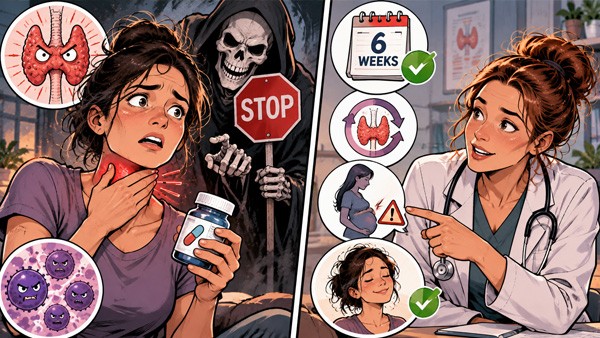

Losing weight while eating more. Hot when everyone else is comfortable. Heart racing at rest. Hands trembling. Awake at three in the morning with a mind that will not stop.
Most people with this are told they have anxiety, and for a while the description fits. What separates it is that the body is running fast as well as the mind — the pulse, the weight, the heat and the bowels all change together, and no amount of relaxation touches any of it.
🚨 Before anything else, the one instruction that matters most if you are taking carbimazole.
A sore throat, a mouth ulcer, a fever or suddenly feeling unwell means stopping the tablet and getting a blood count the same day. Not tomorrow, not after the weekend.
Carbimazole can rarely cause a sudden collapse in white cell count, which leaves the body unable to fight infection. It is uncommon, it is usually in the first three months, and it is dangerous specifically because the first sign looks exactly like an ordinary cold.
Anyone handed this drug without being told that sentence has been short-changed on the single most important part of the prescription.
🔥 What is actually happening
Graves disease is not a gland wearing out or working too hard by choice. It is an autoimmune condition: the immune system produces antibodies that lock onto the thyroid receptor and switch the gland on permanently, as if the pituitary were shouting at it continuously.
Which has two useful consequences. The gland itself is healthy — it is being wrongly instructed, which is why blocking the overproduction can be enough. And because it is an immune process, it can go into remission on its own, which is the basis for giving tablets for a year or so and then stopping to see.
It is also why it travels with other autoimmune conditions — type 1 diabetes, vitiligo, coeliac disease, pernicious anaemia — and why family history is often present.
🚩 The symptoms, and the ones that are actually specific
| Common, and shared with anxiety | More specific to an overactive thyroid |
|---|---|
| Palpitations, fast pulse | Weight loss while eating more |
| Anxiety, irritability, restlessness | Heat intolerance and sweating when others are comfortable |
| Insomnia | A fine tremor of the outstretched hands |
| Tiredness | Frequent loose stools without infection |
| Poor concentration | Weakness in the large muscles — difficulty rising from a chair or climbing stairs |
| Hair thinning | A swelling in the neck, sometimes with a soft rushing sound through it |
| Lighter or absent periods, and reduced fertility | |
| Eye changes — see below. Almost unique to Graves |
In older people the picture can be stripped back to almost nothing but an irregular heartbeat, weight loss and apathy, with none of the agitation. That version gets missed for a long time, and atrial fibrillation is frequently the first thing noticed.
👁️ The eyes, and the one thing that changes them
Eye involvement happens in a substantial minority and it is the feature that makes Graves recognisable: gritty, watering, reddened eyes, a staring appearance from lid retraction, bulging, puffiness around the lids, and in more severe cases double vision or pain on moving the eyes.
It runs on its own timetable, and it does not necessarily improve when the thyroid blood tests normalise.
🚭 Smoking is by a wide margin the most important modifiable factor in Graves eye disease. Smokers develop it more often, more severely, and respond less well to treatment for it.
Stopping smoking is the single most effective thing available for the eyes — more than any eye treatment. If you have Graves disease and you smoke, this is the conversation that matters most, and the methods that work are in our guide to smoking cessation.
Two related points: radioiodine treatment can worsen active eye disease, which influences the choice of treatment, and selenium supplementation has modest evidence in mild cases.
Urgent eye symptoms: sudden loss or dimming of vision, loss of colour vision, severe pain, or an eye that cannot close. Those need same-day assessment, because pressure on the optic nerve is sight-threatening.
🧪 How it is confirmed
- 📉 TSH suppressed, often to undetectable, with free T4 and often T3 raised. That combination makes the diagnosis of overactivity
- 🧬 TSH receptor antibodies — present in Graves disease, and this is the test that distinguishes it from the other causes of an overactive thyroid
- 🔎 An uptake scan or ultrasound where the antibodies are negative or the picture is unclear, to separate Graves from a toxic nodule or from thyroiditis
- 🩸 Full blood count and liver function before starting treatment, as the baseline against which later results are judged
The distinction matters because not every overactive thyroid is Graves disease. A single overactive nodule does not remit and is usually treated definitively. Thyroiditis — often after a viral illness or after pregnancy — is temporary, settles on its own, and does not respond to carbimazole at all, because the gland is leaking stored hormone rather than making too much.
💊 Carbimazole: the schedule and the wait
Carbirose (Carbimazole) blocks the enzyme the thyroid uses to build hormone. It is converted in the body to the active form, methimazole.
| How it is used | |
|---|---|
| Starting dose | 15 to 40 mg daily, depending on severity — commonly 20 to 40 mg in moderate or marked overactivity |
| Time to work | Four to eight weeks for blood tests to normalise. Not days |
| Monitoring | Thyroid function every four to six weeks at first, then less often once stable |
| Then either | Titration — reduce to a maintenance dose, usually 5 to 15 mg daily |
| Or | Block and replace — keep the full blocking dose and add levothyroxine to supply what the gland can no longer make. Fewer blood tests, more tablets |
| Course length | 12 to 18 months, then stop and see whether remission has occurred |
That second row explains the commonest frustration with this treatment. Carbimazole stops new hormone being made; it does nothing to the hormone already stored in the gland and already circulating. So the first two or three weeks can feel like nothing is happening, which is expected rather than a sign the dose is wrong.
💡 Which is why a beta blocker is usually added at the start. Propranolol, typically 10 to 40 mg three times daily, does not treat the thyroid at all — it blunts the effects of the excess hormone on the body.
It settles the palpitations, tremor, sweating and much of the anxiety within hours, which makes the four to eight week wait tolerable, and it is then withdrawn as the carbimazole takes hold. If you are starting carbimazole and feel dreadful, this is the thing to ask about.
⚠️ Carbimazole safety in full
Returning to the opening point, with the rest of the picture.
The white cell problem. Carbimazole can suppress the production of neutrophils, the cells that fight bacterial infection. It is uncommon, most often occurs in the first three months, and can happen at any point.
- 🚨 Stop the drug and get a full blood count the same day for: sore throat, mouth or throat ulcers, fever, chills, or suddenly feeling generally unwell
- 📄 Carry a note saying you take carbimazole, so that any doctor seeing you with a fever knows to check the count before anything else
- ❌ Do not assume it is a cold. The whole risk lies in that assumption
The liver. Rare but real. Stop and seek advice for yellowing of the eyes or skin, dark urine, pale stools, persistent itching, nausea with right upper abdominal pain, or unusual fatigue.
The common and minor. A rash and itching affect a reasonable number of people in the first weeks and are usually mild and manageable. Joint aches, mild nausea and a change in taste also occur. None of these is the emergency above, and a widespread or blistering rash still needs reporting.
And the opposite problem, which is easy to miss: overtreatment. Too much carbimazole makes the thyroid underactive, which feels like tiredness, weight gain, cold intolerance and low mood arriving a couple of months into treatment. It is corrected by reducing the dose, and it is found by the blood tests rather than by waiting to feel better.
🔄 The relapse figure, and the three roads
The honest number that shapes the whole decision: after a 12 to 18 month course of antithyroid tablets, roughly half of people relapse, most within the first year or two after stopping.
Relapse is more likely with a large goitre, very high hormone levels at diagnosis, high antibody levels, young age at onset, and continued smoking.
| Option | What it involves | The trade-off |
|---|---|---|
| Antithyroid tablets | 12 to 18 months, then stop and see | No permanent damage to the gland, chance of lasting remission — and around a 50 percent relapse rate, plus the blood count rule above |
| Radioiodine | A single drink or capsule; the thyroid absorbs it and is gradually destroyed over weeks to months | Definitive and simple. But it usually produces permanent underactivity needing levothyroxine for life, it can worsen active eye disease, and it comes with contact precautions and a period in which pregnancy must be avoided |
| Surgery | Removal of the thyroid | Immediate and definitive, and preferred with a very large goitre, suspicious nodules or severe eye disease. Requires levothyroxine for life, and carries small risks to the voice and to calcium control |
Worth noting what the second and third rows have in common: the definitive cures convert an overactive thyroid into an underactive one. That is not a failure — an underactive thyroid on a stable daily tablet is far easier to live with than Graves disease. But it does mean committing to a lifelong daily medicine, and that belongs in the decision.
🤰 Pregnancy, which has to be planned
⚠️ The switch that is easy to miss and matters enormously.
Carbimazole taken in the first trimester is associated with birth defects. So the usual approach is to use propylthiouracil instead through the first trimester, then often switch back afterwards, because propylthiouracil carries its own small risk of serious liver injury with longer use.
Which means this is a planned change, made before conception or at the first positive test — not something to discover at a twelve week scan.
And the other half of the picture: untreated overactivity in pregnancy is itself dangerous, raising the risk of miscarriage, pre-eclampsia, preterm birth and poor fetal growth. The answer is never to stop treatment on discovering a pregnancy, but to get the regimen changed urgently.
Radioiodine is absolutely contraindicated in pregnancy and breastfeeding, and pregnancy must be avoided for a period after it — typically six months, and this is confirmed with the treating team.
Reliable contraception while the thyroid is being brought under control is sensible for a further reason: fertility often returns as levels normalise, and periods that had stopped come back.
🚨 Thyroid storm
Rare, and the reason the condition is not left untreated.
Thyroid storm is severe, decompensated overactivity: high fever, a very fast or irregular heart, agitation or confusion, vomiting and diarrhoea, and collapse. It is most often triggered by an infection, surgery, trauma, childbirth, an iodine load from a contrast scan, or abruptly stopping antithyroid medication.
It is a medical emergency with a significant mortality, and it is treated in hospital. The practical implications for anyone with Graves disease are simple: do not stop your tablets abruptly, tell any surgeon or anaesthetist about the diagnosis in advance, and treat a fever in the context of untreated overactivity seriously.
🧂 What makes it worse
- 🚭 Smoking — worse eye disease, worse treatment response, higher relapse
- 🧪 Iodine loads. This catches people out: contrast dye for CT scans, kelp and seaweed supplements, iodine-containing tonics, and the heart drug amiodarone can all worsen or trigger overactivity. Mention the diagnosis before any scan with contrast
- ☕ Caffeine, which adds to the palpitations and tremor without causing the disease
- 📉 Missed doses, and abrupt stopping most of all
- 😰 Major physical stress — infection, surgery, childbirth — which is when storm risk rises
And what untreated overactivity does over time, which is the argument for persisting: atrial fibrillation and its stroke risk, bone loss and fracture, heart failure in the vulnerable, and progressive weight and muscle loss.
📊 What recovery looks like
- 🔹 Days — tremor, palpitations and sweating settle, if a beta blocker has been added
- 🔹 Four to eight weeks — blood tests normalise on carbimazole
- 🔹 Two to three months —> energy, sleep and mood improve, and weight begins to return, which some people find unwelcome and which is the body repairing
- 🔹 Three to six months — muscle strength recovers
- 🔹 Independently of all of the above — the eyes, which follow their own course
Two expectations worth setting. The weight comes back, and people who enjoyed losing it find this difficult; it is not a treatment side effect to be corrected. And feeling well is not a reason to stop — the course runs 12 to 18 months precisely because stopping early guarantees relapse.
📞 When to seek help
🚨 Same day, stop the carbimazole first: sore throat, mouth ulcers, fever, chills or suddenly feeling unwell. Also same day: yellowing of the eyes or skin, dark urine or persistent itching.
🚨 Emergency: high fever with a racing or irregular heart, agitation or confusion, vomiting and collapse — possible thyroid storm. And for the eyes: sudden loss or dimming of vision, loss of colour vision, severe eye pain, or an eye that cannot close.
Promptly:
- Weight loss while eating normally or more, with heat intolerance, tremor or palpitations
- Being treated for anxiety with no improvement — ask for thyroid function to be checked
- A new irregular heartbeat, particularly over 60
- A swelling in the neck, or new eye symptoms
- Pregnancy, or planning one, on carbimazole — this needs the drug changed, urgently and deliberately
- Before any scan with contrast dye, or before surgery
- Tiredness, weight gain and feeling cold a couple of months into treatment — likely overtreatment, corrected by reducing the dose
- Symptoms returning after finishing a course — relapse is common and is managed, not a failure
- Smoking with Graves disease, especially with any eye involvement
❓ Frequently asked questions
Why does a sore throat matter on carbimazole?
Because carbimazole can rarely cause a sudden collapse in white cell count, and the first sign looks like an ordinary cold. A sore throat, mouth ulcer, fever or feeling unwell means stopping the tablet and getting a blood count the same day.
How long does carbimazole take to work?
Four to eight weeks for blood tests to normalise. It stops new hormone being made but does nothing to hormone already stored and circulating, which is why the first weeks can feel like nothing is happening.
What is the carbimazole dose?
Usually 15 to 40 mg daily to start, commonly 20 to 40 mg in moderate or marked overactivity, then reduced to a maintenance dose of 5 to 15 mg, or kept high with levothyroxine added. The course runs 12 to 18 months.
Why was I given a beta blocker as well?
Propranolol does not treat the thyroid but blunts the effects of the excess hormone, settling palpitations, tremor and sweating within hours. It makes the four to eight week wait for carbimazole tolerable.
How often does Graves disease come back?
Roughly half of people relapse after a 12 to 18 month course of tablets, most within a year or two. Relapse is more likely with a large goitre, very high levels at diagnosis, high antibodies, young onset and continued smoking.
Can I take carbimazole in pregnancy?
Not in the first trimester, where it is associated with birth defects. Propylthiouracil is used instead through that period and often switched back afterwards. This is planned in advance, and treatment is never simply stopped.
Why does smoking matter so much in Graves disease?
Smokers develop Graves eye disease more often and more severely, respond less well to treatment for it, and relapse more. Stopping smoking is the most effective single measure available for the eyes.
Will radioiodine mean tablets for life?
Usually yes. It is definitive and simple but normally produces permanent underactivity needing levothyroxine for life, and it can worsen active eye disease, which influences the choice.
I feel tired and I am gaining weight two months in. What happened?
Most likely overtreatment, with the thyroid now underactive. It is found on blood tests and corrected by reducing the dose. Some weight return is also the normal recovery from an overactive period.
Should I avoid anything with iodine?
Large iodine loads can worsen overactivity — contrast dye for CT scans, kelp and seaweed supplements, iodine tonics and the heart drug amiodarone. Mention the diagnosis before any scan with contrast.
📑 Sources and editorial
- Thyroid association and endocrine society guidelines on the diagnosis and management of hyperthyroidism and Graves disease, including choice between antithyroid drugs, radioiodine and surgery
- Guidance on antithyroid drug regimens, including titration and block-and-replace approaches, starting and maintenance dose ranges, duration of therapy and monitoring intervals
- Literature on antithyroid drug-induced agranulocytosis, including incidence, timing, presenting features and the requirement for immediate drug cessation and urgent full blood count
- Data on hepatotoxicity associated with carbimazole and methimazole, and the distinct hepatic risk profile of propylthiouracil
- Guidance on antithyroid drug use in pregnancy, including the association of carbimazole and methimazole with congenital malformations in the first trimester and the use of propylthiouracil in that period
- Evidence on maternal and fetal outcomes in untreated hyperthyroidism in pregnancy, and on contraindications to radioiodine in pregnancy and breastfeeding
- Studies of relapse rates following antithyroid drug withdrawal and of predictors of relapse including goitre size, antibody titre, age and smoking
- Guidance on Graves orbitopathy, including the effect of smoking on incidence, severity and treatment response, the effect of radioiodine on active eye disease, selenium supplementation in mild disease, and features of sight-threatening orbitopathy
- Diagnostic guidance on TSH receptor antibody testing and on differentiating Graves disease from toxic nodular disease and from thyroiditis
- Guidance on recognition and management of thyroid storm, including precipitating factors
- Evidence on beta blockade for symptomatic control during the latency period of antithyroid drug therapy
- Literature on iodine-induced thyrotoxicosis, including iodinated contrast media, amiodarone and iodine-containing supplements
- Data on atrial fibrillation, bone loss and cardiovascular outcomes in untreated thyrotoxicosis
- Related reading: hypothyroidism, smoking cessation aids, anxiety and the worry loop, adrenal gland disorders
- Related products: Carbirose (Carbimazole), Synthroid (Levothyroxine), Eltroxin (Levothyroxine), thyroid category
- RXshop Editorial Team — reviewed by Daniel Kim, MD — Endocrinologist & Diabetes Specialist
Medical Disclaimer: The information in this article is for educational and informational purposes only and is not a substitute for professional medical advice, diagnosis, or treatment. Always seek guidance from a qualified healthcare provider with any questions you may have regarding a medical condition, and before starting, stopping or changing any medication.