Adrenal Cortex Disorders: Addison Disease, Cushing Syndrome, Conn Syndrome and the Sick Day Rules

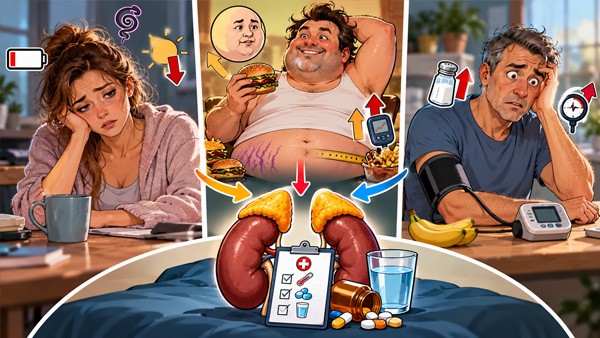

Two small glands sitting on top of the kidneys make three groups of hormones, and the body cannot survive without one of them.
Which means adrenal disease comes in two directions — too little and too much — and the conditions on each side look nothing like each other. One kills by collapse within hours. The other does its damage slowly over years and is most often caused by a prescription.
🚨 The emergency to know before anything else.
Adrenal crisis — severe weakness, vomiting, abdominal pain, confusion, fever, collapse, very low blood pressure — is a medical emergency in anyone known or suspected to have adrenal insufficiency, or anyone who has recently stopped long-term steroids.
Treatment is an immediate injection of hydrocortisone plus intravenous fluids, given before any test result. People die from this when treatment is delayed while confirmation is awaited.
If this applies to you, the words to say are: I have adrenal insufficiency and I need hydrocortisone now. Carry a steroid emergency card so someone else can say it for you.
🧬 Three layers, three hormone groups
The outer shell of the gland — the cortex — is arranged in three layers, and each makes something different. Naming them matters, because the symptoms follow directly from which hormone is affected.
| Layer | Hormone | What it does | Controlled by |
|---|---|---|---|
| Outer | Aldosterone | Holds sodium, excretes potassium, maintains blood pressure and fluid volume | The kidney renin system — not the pituitary |
| Middle | Cortisol | Maintains blood glucose, drives the stress response, regulates immunity, blood pressure and mood | ACTH from the pituitary |
| Inner | DHEA and androgens | Contribute to libido and body hair, and are the main androgen source in women | ACTH from the pituitary |
The inner core of the gland — the medulla — is separate and makes adrenaline. A rare tumour there, phaeochromocytoma, produces episodic headache, sweating, palpitations and spiking blood pressure in attacks, and is found by measuring metanephrines. Worth knowing it exists, because it is a different disease from everything else on this page.
One structural fact explains much of what follows. Cortisol runs on an ACTH loop and aldosterone does not. So a pituitary problem removes cortisol and leaves aldosterone intact, while a problem in the gland itself removes both. That single difference separates the two forms of insufficiency and determines whether fludrocortisone is needed.
📉 Too little cortisol: the two kinds
Both produce the same core symptoms — fatigue that rest does not fix, weakness, poor appetite, nausea, weight loss, dizziness on standing, low mood. What separates them is everything else.
| Primary (Addison disease) | Secondary | |
|---|---|---|
| Where the fault is | The adrenal gland itself | The pituitary, or suppression by steroid treatment |
| Commonest cause | Autoimmune destruction in most of the developed world; tuberculosis elsewhere | Stopping long-term steroids too quickly — by far the commonest cause of adrenal insufficiency overall |
| Aldosterone | Also lost | Preserved |
| Potassium | High | Normal |
| Sodium | Low | Low or normal |
| Salt craving | Characteristic | Absent |
| Skin | Darkening, because ACTH is high | Pale, because ACTH is low |
| Fludrocortisone needed | Yes | No |
📌 The sign that makes the diagnosis, and it is visible. In Addison disease, ACTH rises as the gland fails, and ACTH stimulates pigment cells. The result is tanning in places the sun does not reach:
🔹 Palm creases and knuckles
🔹 Inside the mouth — gums, inner cheeks, tongue edges
🔹 Old scars, which darken
🔹 Pressure areas — elbows, knees, belt line, bra straps
Someone looking suntanned in winter, with dark gums and dark palm creases, and feeling exhausted with a low blood pressure, has a diagnosis written on them. It is missed because the pigmentation develops slowly and gets attributed to sun or to being naturally dark-skinned.
Addison disease rarely travels alone. It belongs to a cluster of autoimmune conditions, so it is worth checking for — and worth mentioning if you already have — autoimmune thyroid disease, type 1 diabetes, pernicious anaemia, coeliac disease and vitiligo. The presence of one raises the chance of another.
⚠️ The steroid-withdrawal problem, which affects far more people than Addison disease ever will.
Taking steroid tablets for more than about three weeks switches off the body own cortisol production. The glands shrink. Stop abruptly and there is nothing to take over — which produces secondary adrenal insufficiency and can produce a crisis.
Anyone on prednisolone for more than three weeks, on repeated courses, or on high-dose inhaled or injected steroid, must come off it by a taper rather than stopping. Recovery of the axis can take months, and sick day cover is needed throughout that period. This is a very common and entirely avoidable harm.
🧪 How insufficiency is actually diagnosed
Short list, and worth knowing because the first test is a single blood sample taken at a particular time.
- 🌅 Morning cortisol, taken between 8 and 9 am. Cortisol peaks on waking, so a sample taken in the afternoon is uninterpretable. A clearly low morning value strongly suggests the diagnosis; a clearly high one excludes it
- 💉 ACTH stimulation test — synthetic ACTH is injected and cortisol measured before and after. This is the confirmatory test
- 📊 ACTH level — high means primary, low or normal means secondary. One number separates the two
- 🩸 Sodium, potassium, renin and aldosterone
- 🧬 21-hydroxylase antibodies, positive in autoimmune Addison disease
- 🔎 Imaging of the adrenals or pituitary where the cause is not autoimmune
Important practical point: if a crisis is suspected, treatment comes first. Blood can be drawn before the injection, but nobody should wait for a result.
💊 Replacement: two hormones, two jobs
Treatment replaces what the gland no longer makes, and in primary insufficiency that means both hormone groups.
The glucocorticoid replaces cortisol. Hydrocortisone, 15 to 25 mg daily in two or three divided doses, with the largest dose on waking to imitate the natural rhythm, is the standard. Prednisolone at 3 to 5 mg once daily is used as an alternative where a single daily dose suits better. Too little leaves fatigue and crisis risk; too much produces the Cushing features described below, so the dose is set to the lowest that maintains wellbeing.
The mineralocorticoid replaces aldosterone, and is needed in primary insufficiency only. Florinef (Fludrocortisone) is given as 50 to 200 micrograms once daily — one or two of the 100 microgram tablets, or a half.
- 📈 How the dose is judged: blood pressure lying and standing, the drop between them, sodium, potassium, and sometimes renin. Not by symptoms alone
- 🧂 Salt is not restricted — in primary insufficiency salt craving is physiological and salt intake is usually liberal
- ⚠️ Too much causes ankle swelling, raised blood pressure, headache and low potassium. Too little leaves dizziness on standing, salt craving and fatigue
- 🔄 Fludrocortisone stays unchanged during illness — it is the glucocorticoid that gets doubled, not this one
- 💊 Interactions: diuretics, liquorice in quantity, and anything affecting potassium
DHEA replacement is sometimes added, mainly in women with persistent low energy and libido on otherwise adequate treatment. It is a secondary consideration, not part of the core.
🛡️ The sick day rules
This is the part that keeps people out of hospital, and it is simple enough to memorise.
A healthy adrenal gland produces several times its usual cortisol during illness, injury or surgery. A replaced gland cannot, so the extra has to be taken deliberately.
| Situation | What to do |
|---|---|
| Fever, or an infection needing treatment | Double the glucocorticoid dose until recovered, usually two to three days. Fludrocortisone unchanged |
| Vomiting or diarrhoea | Tablets are not being absorbed. Use the emergency injection and seek medical help. Do not keep swallowing doses and hoping |
| Minor procedure or dental work | Extra dose beforehand, arranged in advance |
| Surgery, or bowel preparation for a colonoscopy | Intravenous cover, planned ahead. Tell the anaesthetist well before the day |
| Serious injury or accident | Emergency injection, then emergency care |
| Very strenuous exercise, extreme heat, long-haul travel | An additional dose may be advised; agree a plan in advance |
| Pregnancy | Doses change, particularly in the third trimester. Managed by a specialist |
Three things everyone on replacement should have, and many do not:
- 💉 An emergency injection kit — hydrocortisone for intramuscular use, with you and a family member trained to give it. Check the expiry date
- 💳 A steroid emergency card, plus a bracelet or necklace. In a collapse you will not be able to explain
- 💊 Spare tablets everywhere — bag, car, work, suitcase. Never in checked luggage
And never stop replacement because you feel well. This is not a treatment that gets finished.
📈 Too much cortisol: Cushing syndrome
The first thing to say is the thing least often said: by a wide margin the commonest cause of Cushing syndrome is prescribed steroid medication, not a tumour. Tablets, high-dose inhalers, injections into joints and potent skin creams can all do it.
Where it is not caused by medication, the usual sources are a small pituitary tumour producing excess ACTH, an adrenal tumour producing cortisol directly, or more rarely a tumour elsewhere making ACTH.
The features overlap heavily with ordinary weight gain, which is why the diagnosis is delayed. These are the ones that discriminate:
- 💪 Weakness in the large muscles — difficulty standing from a chair without pushing up with the arms, or climbing stairs. This is the most useful single sign
- 🟣 Wide purple stretch marks, over a centimetre across, on the abdomen, thighs, upper arms or breasts. Ordinary stretch marks are narrow and pale
- 🩸 Easy bruising with no remembered injury, and skin that tears and heals badly
- 🦴 A fracture from minor force, or osteoporosis found at an unexpectedly young age
- 📍 Fat redistributing centrally — abdomen, face, upper back and above the collarbones — while arms and legs get thinner
Alongside those: new or rapidly worsening high blood pressure, new diabetes, mood change or frank psychiatric symptoms, and in women facial hair and periods stopping. Central weight gain with high blood pressure alone is far more likely to be ordinary metabolic disease — it is the muscle weakness, the purple striae, the bruising and the fragility that point here.
Screening uses an overnight dexamethasone suppression test, a late-night salivary cortisol, or a 24-hour urine collection, and two abnormal results are normally required before proceeding. Only then is the source located and treated, which usually means surgery, with medical treatment used as a bridge.
🩸 Too much aldosterone, and why it is worth screening for
This section is here because it is the most under-diagnosed treatable cause of high blood pressure, and the numbers are larger than almost anyone expects.
Primary hyperaldosteronism — Conn syndrome — accounts for something in the region of 5 to 10 percent of all hypertension, and a considerably higher share of hypertension that resists treatment. It is frequently curable.
💡 Why it gets missed: everyone was taught that it causes high blood pressure with low potassium — but potassium is normal in more than half of cases. So a normal potassium is used to rule it out, and the diagnosis never happens.
Worth asking for an aldosterone-to-renin ratio if: blood pressure needs three or more drugs; blood pressure with low potassium, including potassium that falls on a diuretic; hypertension diagnosed under 40; an adrenal lump found incidentally on a scan; or a family history of stroke at a young age.
It matters beyond the numbers: excess aldosterone damages the heart, kidneys and vessels more than the same blood pressure from ordinary causes, so finding it changes the outlook rather than just the tablet.
A single adenoma can be removed, which often cures the hypertension outright. Where both glands are overactive, the treatment is an aldosterone blocker — spironolactone being the usual choice. General management of blood pressure is covered in our guide to arterial hypertension.
🧬 Congenital adrenal hyperplasia, including the adult form
An inherited enzyme deficiency — most often 21-hydroxylase — which blocks cortisol production and diverts the pathway into androgens.
The severe form presents in the first weeks of life with vomiting, dehydration, salt loss and collapse, and with ambiguous genitalia in affected girls. Newborn screening exists for this reason, and lifelong replacement with both hormone groups follows.
The mild late-onset form matters more to adult readers, because it is routinely misdiagnosed. It appears in adolescence or adulthood as excess facial and body hair, acne, irregular or absent periods, and difficulty conceiving — which is the picture of polycystic ovary syndrome, and gets labelled as such. The distinguishing test is 17-hydroxyprogesterone, measured in the early morning in the first half of the cycle. It is worth asking for where the hirsutism is marked, started early, or runs in the family, because the treatment differs.
❌ Adrenal fatigue is not a diagnosis
This needs saying clearly, because a large industry depends on it not being said.
There is no recognised condition called adrenal fatigue. The proposition — that ordinary stress gradually wears the adrenal glands into partial failure — has been examined and the evidence does not support it. Endocrine societies do not recognise it. The salivary cortisol panels sold to diagnose it are not validated for that purpose, and the results fluctuate normally through the day and with sleep, shift work, illness and alcohol.
The reason to care is not terminology. It is that the label causes three specific harms:
- 🔍 Real adrenal disease gets missed. Addison disease and Cushing syndrome both present with fatigue, and both are found with the tests listed above rather than with a cortisol curve
- 🩸 Treatable causes of fatigue go unchecked — underactive thyroid, iron deficiency, B12 deficiency, coeliac disease, sleep apnea, diabetes, depression, and medication effects. Every one of those is found with an ordinary blood test or a straightforward assessment
- 💊 Some supplements sold for it have caused harm, including products containing actual glucocorticoid or animal adrenal extract, which suppress the axis and create the very insufficiency they claim to treat
If the complaint is persistent exhaustion, the productive route is the standard list of blood tests and a proper look at sleep and mood — set out in our guide to low drive and fatigue. If there is genuine suspicion of adrenal disease, a morning cortisol settles it.
🔎 An adrenal lump found by accident
Adrenal nodules turn up on scans done for other reasons, and they are common — more so with age. Most are benign and produce no hormone, and the assessment is short:
- 📏 Size and appearance on imaging
- 🧪 Is it producing anything — cortisol, aldosterone, and metanephrines for the medulla
- 🩸 Blood pressure and potassium
A non-functioning, small, benign-looking nodule needs no treatment. One that is producing a hormone, or is large or has worrying features, needs specialist assessment. The point of mentioning it is that the hormone tests are the part most often skipped, and they are the part that finds curable hypertension.
📞 When to seek help
🚨 Emergency: severe weakness or collapse, persistent vomiting, severe abdominal pain, confusion or drowsiness, or very low blood pressure in anyone with adrenal insufficiency or who has recently stopped long-term steroids. Hydrocortisone injection and fluids, immediately, before tests. Also emergency: vomiting or diarrhoea that prevents tablets staying down.
Within days:
- Darkening of palm creases, gums or old scars with fatigue and dizziness on standing — ask for a morning cortisol
- Salt craving with low blood pressure and weight loss
- Difficulty rising from a chair without using the arms, wide purple stretch marks, or easy bruising — ask about Cushing screening
- A fracture from minor force, or osteoporosis at a young age
- Coming off long-term steroids and feeling progressively unwell — the taper may be too fast
- Any illness while on steroid replacement, to confirm the sick day dose
Worth an appointment:
- Blood pressure needing three or more medicines, or hypertension with low potassium, or diagnosed under 40 — ask for an aldosterone-to-renin ratio
- An adrenal nodule reported on a scan — ask whether the hormone tests were done
- Marked hirsutism with irregular periods, particularly starting early or with a family history — ask about 17-hydroxyprogesterone, not only PCOS
- Episodic headache with sweating, palpitations and blood pressure spikes — ask about metanephrines
- Existing autoimmune disease with new unexplained fatigue — the cluster matters
- On replacement without an emergency injection kit or steroid card — both should be arranged
- Planning surgery, dental work or a colonoscopy while on replacement
- Pregnancy or planning pregnancy on replacement
- Persistent exhaustion — ask for the standard blood panel rather than a cortisol curve from a private laboratory
❓ Frequently asked questions
What are the sick day rules for adrenal insufficiency?
Double the glucocorticoid dose for fever or infection needing treatment, until recovered. Fludrocortisone stays the same. For vomiting or diarrhoea, use the emergency injection, because tablets are not being absorbed.
Why does the skin darken in Addison disease?
Because ACTH rises as the gland fails, and ACTH stimulates pigment cells. The tanning appears where sun does not reach — palm creases, gums, inner cheeks, old scars and pressure areas — which makes it diagnostic.
Is adrenal fatigue real?
No. It is not a recognised diagnosis and the evidence does not support it. The salivary cortisol panels sold for it are not validated. The risk is that real adrenal disease, thyroid problems, anaemia or sleep apnea go unfound.
What is the fludrocortisone dose?
Usually 50 to 200 micrograms once daily, adjusted on blood pressure lying and standing, sodium, potassium and sometimes renin. It is needed in primary insufficiency only, and is not increased during illness.
Why do I need two different hormones?
Cortisol runs on a pituitary loop and aldosterone does not. In primary insufficiency both are lost, so a glucocorticoid and a mineralocorticoid are both needed. In secondary insufficiency aldosterone is preserved and only the glucocorticoid is replaced.
Can stopping steroids cause adrenal insufficiency?
Yes, and this is the commonest cause overall. More than about three weeks of steroid treatment suppresses your own production, so stopping must be done by taper, with sick day cover for months while the axis recovers.
What is the most useful sign of Cushing syndrome?
Weakness in the large muscles — difficulty rising from a chair without using the arms. With wide purple stretch marks, easy bruising and fragile skin, that separates it from ordinary weight gain, which shares the hypertension.
When should high blood pressure be screened for an adrenal cause?
When it needs three or more drugs, comes with low potassium, is diagnosed under 40, or an adrenal nodule has been found. Potassium is normal in over half of cases, so a normal result does not exclude it.
What time should a cortisol blood test be taken?
Between 8 and 9 in the morning, because cortisol peaks on waking and an afternoon sample cannot be interpreted. An ACTH stimulation test confirms the diagnosis, and the ACTH level separates primary from secondary.
Could my PCOS actually be something else?
Possibly. Late-onset congenital adrenal hyperplasia produces the same hirsutism, irregular periods and subfertility, and is routinely labelled PCOS. An early-morning 17-hydroxyprogesterone distinguishes them, and the treatment differs.
📑 Sources and editorial
- Endocrine society clinical practice guidelines on the diagnosis and treatment of primary adrenal insufficiency, including morning cortisol thresholds, ACTH stimulation testing and glucocorticoid and mineralocorticoid replacement regimens
- Guidance on prevention and emergency management of adrenal crisis, including parenteral hydrocortisone before confirmatory testing, sick day dose adjustment and emergency injection provision
- Guidance on steroid emergency cards and patient education in glucocorticoid-dependent patients
- Literature on glucocorticoid-induced adrenal suppression, duration of exposure associated with axis suppression, tapering strategies and time to recovery
- Endocrine society guidelines on the diagnosis of Cushing syndrome, including overnight dexamethasone suppression, late-night salivary cortisol and urinary free cortisol, and the discriminant value of proximal myopathy, wide violaceous striae, easy bruising and unexplained osteoporosis
- Epidemiological data on exogenous glucocorticoid use as the predominant cause of Cushing syndrome
- Endocrine society guidelines on the case detection, diagnosis and treatment of primary aldosteronism, including prevalence estimates in hypertensive and resistant hypertensive populations, the proportion with normokalaemia, aldosterone-to-renin ratio screening indications, and comparative cardiovascular and renal outcomes
- Guidelines on congenital adrenal hyperplasia due to 21-hydroxylase deficiency, including newborn screening, classic and non-classic presentations and early-morning 17-hydroxyprogesterone testing
- Guidance on the management of adrenal incidentaloma, including functional assessment and imaging criteria
- Guidance on the diagnosis of phaeochromocytoma and paraganglioma, including plasma or urinary metanephrine measurement
- Endocrine society and professional body position statements reviewing the evidence for adrenal fatigue as a clinical entity, and systematic review findings on salivary cortisol testing for that purpose
- Reports of adrenal suppression and adverse effects from unlicensed adrenal support supplements containing glucocorticoid or animal adrenal extract
- Prescribing information for fludrocortisone acetate, including dose range, monitoring parameters and interactions, and for hydrocortisone and prednisolone in adrenal replacement
- Literature on autoimmune polyglandular syndromes and the association of Addison disease with autoimmune thyroid disease, type 1 diabetes, pernicious anaemia, coeliac disease and vitiligo
- Related reading: arterial hypertension, low drive and fatigue, type 2 diabetes
- Related products: Florinef (Fludrocortisone), Deltasone (Prednisolone), Aldactone (Spironolactone), endocrine category
- RXshop Editorial Team — reviewed by Daniel Kim, MD — Endocrinologist & Diabetes Specialist
Medical Disclaimer: The information in this article is for educational and informational purposes only and is not a substitute for professional medical advice, diagnosis, or treatment. Always seek guidance from a qualified healthcare provider with any questions you may have regarding a medical condition, and before starting, stopping or changing any medication.