Chronic Obstructive Pulmonary Disease: Symptoms, Spirometry and How Inhaler Treatment Works

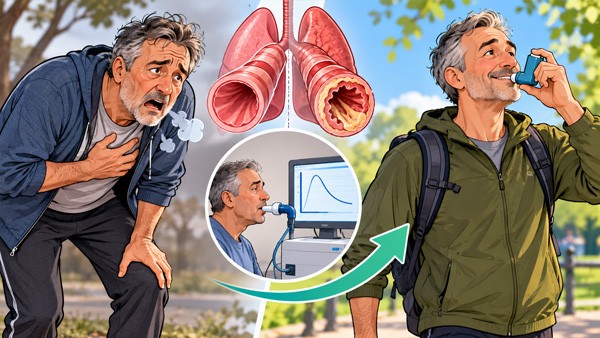

Healthy lungs empty themselves passively. The chest recoils, the small airways stay open, and the air leaves without effort. In chronic obstructive pulmonary disease that recoil weakens and the small airways collapse early during exhalation, so air that should have left stays behind. The next breath then has to start from a lung that is already partly full.
That single mechanism, air trapping, explains most of what people with COPD experience. It is why breathing out is harder than breathing in, why the chest feels tight after climbing stairs, and why slowing the exhale helps more than trying to inhale harder.
COPD is usually a mixture of two processes. Chronic bronchitis means inflamed airways producing daily mucus. Emphysema means destroyed alveolar walls and lost elastic recoil. Most people have some of both, in a ratio that shapes how their disease behaves.
🌬️ Why hyperinflation makes breathing feel like work
When trapped air accumulates, the lungs sit at a higher resting volume. The diaphragm, which normally domes upward, is pushed flat. A flat diaphragm pulls sideways instead of downward and loses most of its mechanical advantage, so the neck and shoulder muscles are recruited to help. That is the visible effort seen in advanced disease.
💨 Why pursed-lip breathing works. Exhaling slowly through narrowly pursed lips holds a small back-pressure inside the airways, which keeps the floppy small airways open long enough to empty. It is not a relaxation trick. It mechanically reduces trapped air, and most people feel the difference within a few breaths.
🔍 Symptoms, and the ones that mean go now
COPD arrives slowly enough that people adapt without noticing. They take the lift, walk a little slower, stop carrying shopping in one trip. Shrinking activity is itself a symptom and often the earliest one.
| Usual symptoms | Warning signs that need same-day assessment |
|---|---|
| Breathlessness on exertion, worsening over years | Breathlessness at rest that does not settle |
| Cough with mucus, worst in the morning | Coughing blood |
| Wheeze and chest tightness | Blue lips or fingertips |
| Frequent chest infections | New confusion or drowsiness |
| Fatigue and unintended weight loss | Swollen ankles with worsening breathlessness |
| Poor sleep, morning headache | Chest pain, or a fever that does not respond |
Morning headache with daytime sleepiness deserves attention, because it can mean carbon dioxide is being retained overnight.
🧩 What causes it, including in people who never smoked
- Tobacco smoke
- The dominant cause in most countries. Smoke drives chronic airway inflammation, increases mucus and destroys alveolar walls. Risk rises with pack-years, and susceptibility varies widely between individuals.
- Biomass smoke
- Cooking and heating with wood, coal or dung indoors. Worldwide this is responsible for a large share of COPD, particularly in women who have never smoked a cigarette.
- Occupational exposure
- Dust, grain, silica, welding fumes, cadmium. Years of exposure produce the same airway changes.
- Alpha-1 antitrypsin deficiency
- An inherited lack of the protein that protects lung tissue from its own enzymes. Suspected when emphysema appears before 45, when the lower lobes are affected first, or when there is a family history. It is worth testing for, because it changes management.
- Early-life lung damage
- Severe childhood respiratory infections, prematurity and heavy passive smoke exposure reduce the peak lung function ever reached, leaving less reserve to lose later.
🧪 Spirometry: the number that defines the diagnosis
COPD cannot be diagnosed from symptoms alone. Spirometry is required, and one measurement decides it.
📏 The diagnostic threshold. After inhaling a bronchodilator, the ratio of FEV1 to FVC below 0.70 confirms persistent airflow limitation. FEV1 is the volume blown out in the first second; FVC is the total volume blown out. The bronchodilator matters: measuring before it can mislabel reversible asthma as COPD.
Once the diagnosis is set, FEV1 as a percentage of predicted grades how severe the obstruction is:
| Grade | FEV1 percent predicted | Typical picture |
|---|---|---|
| GOLD 1, mild | 80 and above | Often unnoticed or blamed on age |
| GOLD 2, moderate | 50 to 79 | Breathless on hills and stairs; most diagnoses happen here |
| GOLD 3, severe | 30 to 49 | Breathless on flat ground, exacerbations common |
| GOLD 4, very severe | Under 30 | Breathless with minimal activity |
Treatment, however, is not chosen from that number. It is chosen from how breathless the person is and how often they flare. Two questionnaires do that work: mMRC, a five-point scale of breathlessness during daily activity, and CAT, an eight-question score of symptom burden. Combining symptoms with exacerbation history produces the GOLD A, B and E groups, where group E means a history of frequent or hospitalised flare-ups and gets the most intensive treatment regardless of how the person feels on a good day.
🚬 Stopping smoking: the only step that changes the slope
Every other treatment for COPD improves symptoms. Stopping smoking is the only intervention shown to slow the rate at which lung function is lost. It also cuts exacerbations, improves how well inhalers work, and reduces cardiovascular risk in parallel.
The lung function already lost does not come back. What changes is the angle of the line from that day forward, and within a year the decline settles towards the rate seen in people who never smoked.
- 💊 Chantix (Varenicline) — a partial nicotinic receptor agonist, started one week before the quit date and continued for twelve weeks. The most effective single medicine available for quitting
- 💊 Zyban (Bupropion) — an alternative that also reduces the weight gain that often follows quitting, avoided in people with seizure risk
- 🤝 Medication plus behavioural support roughly doubles success compared with either alone
💨 The inhaler classes and what each one does
| Class | Mechanism | Role in COPD |
|---|---|---|
|
LAMA tiotropium |
Blocks muscarinic receptors, keeping airways relaxed for 24 hours | Maintenance foundation; the strongest single class for preventing exacerbations |
|
LABA salmeterol, formoterol |
Stimulates beta-2 receptors for 12 to 24 hours | Maintenance, usually combined with a LAMA |
|
SABA albuterol, also called salbutamol |
Rapid beta-2 stimulation lasting 4 to 6 hours | Rescue only, for sudden breathlessness |
|
SAMA ipratropium |
Short-acting muscarinic block | Rescue, alone or with a SABA |
|
ICS fluticasone, budesonide |
Reduces airway inflammation | Added for frequent exacerbations or high blood eosinophils, never used alone in COPD |
|
Methylxanthine theophylline |
Weak bronchodilation with some anti-inflammatory effect | Add-on when inhaled therapy is not enough or is unavailable |
⚠️ Inhaled steroids are not automatic in COPD. Unlike asthma, where an inhaled steroid is the base of treatment, in COPD it is reserved for specific situations, because it raises the risk of pneumonia. The decision usually turns on exacerbation history and blood eosinophil count.
Our respiratory category carries the maintenance inhalers, and the asthma category carries the rescue and steroid inhalers that COPD also uses.
🌀 Tiotropium in practice
Spiriva (Tiotropium Bromide) is the original long-acting muscarinic antagonist and remains the reference treatment for maintenance in COPD. Its generic equivalent, Tiova (Tiotropium Bromide), delivers the same 18 mcg dose through a Rotahaler device.
- 🕒 One dose per day, at the same time each day. Tiotropium binds its receptor slowly and releases it slowly, which is what gives 24-hour cover
- 🚫 It is not a rescue inhaler. It does nothing useful for sudden breathlessness. Taking an extra dose during a flare-up adds side effects and no relief
- 💧 Dry mouth is the usual side effect, from the anticholinergic action. Sipping water and good dental care handle it
- 👁️ Caution with narrow-angle glaucoma, and with prostate enlargement or bladder outflow obstruction, where it can cause urinary retention. Powder blown accidentally into the eye can trigger eye pain and blurred vision
- 💨 Technique decides the benefit. The capsule is placed in the device, pierced, and inhaled with a steady deep breath, then held for ten seconds. Many people inhale too weakly to empty the capsule, and a second inhalation from the same capsule is part of the correct method
For rapid relief, Ventolin (Albuterol) and Proventil (Albuterol) act within minutes, while Atrovent (Ipratropium) is the short-acting anticholinergic alternative. Where an inhaled steroid is indicated, Flovent (Fluticasone) is the common choice, always alongside a long-acting bronchodilator rather than on its own.
📌 Theophylline and the detail people miss
Theo-24 (Theophylline extended release 400 mg) is an oral bronchodilator from an older class, used as an add-on when inhaled therapy is not enough, when inhaler technique cannot be mastered, or where inhalers are hard to obtain. The extended-release form is designed to hold a level through the night, which suits people whose worst breathlessness is at dawn.
What makes it demanding is a narrow therapeutic range. Levels slightly above target cause nausea, tremor, palpitations and insomnia; further above, seizures and dangerous rhythms. Blood level monitoring is standard practice when the dose changes or symptoms shift.
🚬 The interaction almost nobody is warned about. Cigarette smoke speeds up the liver enzyme that clears theophylline, so smokers need higher doses. When a smoker quits, that enzyme slows down within days and theophylline levels climb, sometimes into the toxic range on an unchanged dose. Anyone taking theophylline who stops smoking needs the dose reviewed. The same applies in reverse to starting ciprofloxacin, erythromycin, fluvoxamine or allopurinol, and during a feverish illness or heart failure, all of which raise levels.
🚨 Exacerbations change the trajectory
An exacerbation is a sustained worsening beyond normal day-to-day variation: more breathlessness, more cough, mucus turning thicker or changing colour. They matter more than any single spirometry reading, because each one accelerates the loss of lung function, strains the heart, and raises the chance of another within weeks.
Triggers are mostly viral infections, then bacterial infections and air pollution. Roughly a third have no identifiable cause.
| Severity | Usual handling |
|---|---|
| Mild | Increase the rescue inhaler; observe closely |
| Moderate | Rescue inhaler plus a short course of oral steroids, with antibiotics when sputum becomes purulent |
| Severe | Hospital assessment; controlled oxygen, nebulised bronchodilators, sometimes non-invasive ventilation |
A written action plan, agreed in advance with the doctor and kept where it can be found, shortens the time between the first warning sign and treatment. That delay is usually what decides whether a flare-up is handled at home or in hospital. For the productive cough that accompanies many flare-ups, Mucolite (Ambroxol) thins mucus and makes it easier to clear.
🏃 The non-drug treatments that match medicines for effect
- Pulmonary rehabilitation
- A supervised programme of exercise, breathing training and education, usually six to eight weeks. It improves walking distance and quality of life more than any inhaler does, and reduces readmission after an exacerbation. It is the most underused treatment in COPD.
- Vaccination
- Influenza every year, pneumococcal, COVID-19 boosters, and shingles and pertussis where recommended. Each prevented infection is a prevented exacerbation.
- Long-term oxygen therapy
- Used when resting oxygen is persistently low, for at least 15 hours a day. At that threshold it extends survival; below it, it does not, which is why it is prescribed on blood measurements rather than on how breathless someone feels.
- Nutrition
- Breathing burns calories in advanced disease, and low body weight predicts worse outcomes. Adequate protein supports the respiratory muscles; smaller frequent meals avoid the fullness that presses on a flattened diaphragm.
- Breathing technique and pacing
- Pursed-lip breathing, forward-leaning posture with arms supported, and planning tasks around rest points reduce the panic loop that makes breathlessness worse than the airflow alone would explain.
❤️ What COPD does outside the lungs
- 💓 Cardiovascular disease shares the same main risk factor and is a leading cause of death in COPD; inflammation and low oxygen add further strain
- 🫀 Pulmonary hypertension and right heart failure, showing as swollen ankles and a distended neck vein, follow chronic low oxygen
- 🦴 Osteoporosis, from inactivity, low weight, smoking and steroid courses
- 🧠 Anxiety and depression, roughly twice as common as in the general population, and both worsen the perception of breathlessness
- 😴 Sleep disturbance, including overlap with obstructive sleep apnoea, which sharply increases risk
- 💪 Muscle wasting, which reduces exercise capacity independently of lung function and responds to rehabilitation
❓ Frequently asked questions
What is the difference between COPD, chronic bronchitis and emphysema?
COPD is the umbrella diagnosis for persistent airflow limitation. Chronic bronchitis describes inflamed airways with daily mucus production, and emphysema describes destroyed alveolar walls with lost elastic recoil. Most people with COPD have a mixture of both.
How is COPD diagnosed?
With spirometry. A ratio of FEV1 to FVC below 0.70 measured after a bronchodilator confirms persistent airflow limitation. FEV1 as a percentage of predicted then grades the severity from GOLD 1 to GOLD 4.
Can COPD be reversed?
Lung damage already present does not reverse. Stopping smoking slows further decline, and treatment reduces symptoms and flare-ups, so people often function considerably better even though the airflow measurement stays the same.
How does tiotropium work?
It blocks muscarinic receptors in the airway muscle, keeping the airways relaxed for a full 24 hours. That reduces air trapping, improves exercise tolerance and lowers the exacerbation rate. It is taken once daily as maintenance, not for sudden breathlessness.
What are the side effects of Spiriva?
Dry mouth is the most common. Care is needed with narrow-angle glaucoma, prostate enlargement and bladder outflow problems, and the powder should be kept away from the eyes.
Which inhaler do I use when I suddenly cannot breathe?
A short-acting reliever such as albuterol or ipratropium, which works within minutes. Long-acting maintenance inhalers do not help in that moment, and taking extra doses of them adds side effects without relief.
Do I need a steroid inhaler for COPD?
Not routinely. Unlike asthma, inhaled steroids in COPD are added only for frequent exacerbations or a high blood eosinophil count, because they raise the risk of pneumonia, and they are never used without a long-acting bronchodilator.
Why does quitting smoking change my theophylline dose?
Cigarette smoke speeds up the liver enzyme that clears theophylline. After quitting, that enzyme slows within days and blood levels rise on an unchanged dose, which can reach the toxic range. The dose needs reviewing whenever smoking status changes.
Is exercise safe with COPD?
Yes, and it is one of the most effective treatments. Pulmonary rehabilitation improves walking distance and quality of life more than any inhaler, and reduces readmission after a flare-up.
When should I go to hospital with a COPD flare-up?
Breathlessness at rest that does not ease with the reliever, blue lips, confusion or drowsiness, chest pain, coughing blood, or worsening ankle swelling. Those signs need emergency assessment rather than a wait-and-see approach.
📑 Sources and editorial
- GOLD strategy reports on the diagnosis, management and prevention of chronic obstructive pulmonary disease
- Prescribing information for tiotropium, ipratropium, albuterol, fluticasone and extended-release theophylline
- Trials of long-acting bronchodilators on exacerbation rate and lung function decline
- Evidence on smoking cessation and the rate of FEV1 decline, and on varenicline effectiveness
- Reviews of pulmonary rehabilitation outcomes and long-term oxygen therapy criteria
- Related products: Spiriva (Tiotropium Bromide), Tiova (Tiotropium Bromide), Atrovent (Ipratropium), Theo-24 (Theophylline), Chantix (Varenicline)
- Categories: respiratory, asthma, stop smoking
- RXshop Editorial Team — reviewed by Daniel Kim, MD, Endocrinology
Medical Disclaimer: The information in this article is for educational and informational purposes only and is not a substitute for professional medical advice, diagnosis, or treatment. Always seek guidance from a qualified healthcare provider with any questions you may have regarding a medical condition, and before starting, stopping or changing any medication.