Acne Vulgaris Treatment: How Retinoids and Isotretinoin Clear the Skin

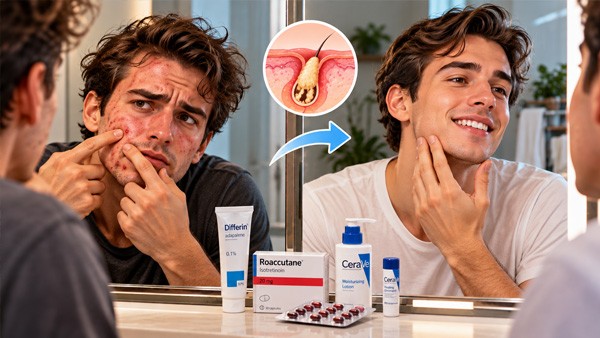

Almost every effective acne treatment is a retinoid or works alongside one. That is not marketing; it follows from how acne starts. Before there is anything to see, cells lining the follicle stick together and plug the opening. The plug is called a microcomedone, and retinoids are the only class that reliably prevents it from forming.
Everything else in acne treatment targets what happens after the plug. Antibiotics reduce the bacteria that inflame it. Benzoyl peroxide kills them and mildly unplugs. Hormonal treatment turns down the oil supply. But if the plugs keep forming, the breakouts keep coming, which is why retinoid therapy is the part people are told to continue even after the skin looks clear.
This guide is about how that treatment actually runs: what dose, how long, what gets worse before it gets better, and what needs checking along the way.
🔬 The four steps behind a spot
- Excess sebum. Androgens enlarge the sebaceous gland and increase oil output. This is why acne starts at puberty and why it flares with hormonal shifts
- Follicular plugging. Skin cells lining the follicle fail to shed normally and form the microcomedone
- Bacterial overgrowth. Cutibacterium acnes, harmless on normal skin, multiplies in the oxygen-poor plug and releases inflammatory signals
- Inflammation. The immune response produces the redness, swelling and pus, and when it reaches deep enough it destroys collagen and leaves a scar
💡 Why treatment has to be applied to the whole area. Microcomedones are invisible and spread across the affected zone, not just where spots are visible today. Treating individual spots leaves the next generation forming underneath. Retinoids are applied to the whole face, which is the single most common instruction people get wrong.
📊 Matching treatment to severity
| Severity | What is seen | Usual treatment |
|---|---|---|
| Mild comedonal | Blackheads and whiteheads, little redness | Topical retinoid, with or without benzoyl peroxide |
| Mild to moderate inflammatory | Papules and pustules | Topical retinoid plus benzoyl peroxide, often with a topical antibiotic |
| Moderate to severe | Widespread papules, pustules, early nodules | Oral tetracycline antibiotic plus topical retinoid and benzoyl peroxide |
| Severe nodulocystic | Deep nodules, cysts, scarring | Oral isotretinoin |
| Adult female, jawline pattern | Deeper spots along jaw and chin, premenstrual flare | Hormonal treatment, often with a topical retinoid |
Two situations jump the queue regardless of how the lesions look: scarring and significant psychological effect. Both justify moving to stronger treatment early rather than working patiently up the ladder, because scars do not respond to acne treatment once formed.
🧴 Topical retinoids and the retinization phase
Tretinoin, the original topical retinoid, normalises how follicular cells shed. It is the active ingredient in Retin-A (Tretinoin) and Tretiheal (Tretinoin), available in strengths from 0.025 to 0.1 percent.
The first four to six weeks are the hard part, and knowing that in advance is most of the battle:
- 📉 Skin often looks worse before better. Existing microcomedones are pushed to the surface, so weeks two to four can bring a wave of spots. This is the treatment working, not failing
- 🏜️ Dryness, flaking and stinging are expected during retinization and settle as the skin adapts
- 📅 Real improvement takes 8 to 12 weeks, and full benefit around six months
| Practical rule | Why |
|---|---|
| A pea-sized amount for the whole face | More does not work faster; it only irritates |
| Apply at night, on dry skin | Tretinoin is degraded by light, and damp skin increases penetration and irritation |
| Start every third night, build up | Gradual exposure prevents the irritation that makes people quit |
| Moisturiser before or after is fine | Buffering reduces stinging without reducing effect |
| Daily sunscreen | Retinoids thin the outer layer and increase sun sensitivity |
| Keep benzoyl peroxide to the morning | Benzoyl peroxide oxidises tretinoin if applied at the same time |
🚫 Retinoids and pregnancy. Topical retinoids are avoided during pregnancy and while trying to conceive. Oral isotretinoin is absolutely contraindicated, with formal pregnancy prevention requirements described below.
💊 Oral antibiotics: a tool with a time limit
For moderate inflammatory acne, a tetracycline is added for its anti-inflammatory action as much as its antibacterial one. Vibramycin (Doxycycline) is typically used at 50 to 100 mg daily, and Minomycin (Minocycline) at 50 to 100 mg daily.
Three rules govern their use:
- ⏳ Three to four months, not indefinitely. Longer courses drive antibiotic resistance without adding benefit
- 🤝 Never alone. A topical retinoid runs alongside and continues after the antibiotic stops, which is what prevents relapse
- ☀️ Doxycycline causes sun sensitivity and can irritate the oesophagus, so it is taken with a full glass of water while sitting or standing upright, not at bedtime
Minocycline carries rarer but more distinctive risks with long use, including blue-grey skin pigmentation and drug-induced lupus, which is one reason doxycycline is usually tried first.
⭐ Isotretinoin: how a course actually runs
Accutane (Isotretinoin 5, 10, 20 and 40 mg) is the only acne treatment that acts on all four steps at once. It shrinks the sebaceous gland, normalises follicular shedding, removes the environment the bacteria need and reduces inflammation. It is also the only one that produces lasting remission in a majority of people after a finite course.
📏 Dose and the cumulative target
Isotretinoin is dosed by body weight and judged by a total, not a daily figure.
- 🔹 Typically started at 0.5 mg per kg per day, often lower for the first weeks to limit the initial flare
- 🔹 Increased towards 1 mg per kg per day as tolerated
- 🔹 The course continues to a cumulative dose of roughly 120 to 150 mg per kg, which usually means four to seven months
- 🔹 Absorption doubles when taken with a fatty meal, so it is taken with food. Taking it on an empty stomach effectively halves the dose
Reaching the cumulative target matters more than the daily number. Courses stopped early because the skin cleared are the main reason acne comes back, and relapse after a full course runs at roughly 20 to 30 percent.
📆 What the months feel like
- Weeks 1 to 4
- Lips dry out first, almost universally. Many people get an initial flare of acne that can be worse than the starting point.
- Weeks 4 to 12
- Dryness extends to skin, eyes and nose, with nosebleeds common. Oil production visibly drops. Clearing begins.
- Months 3 to 6
- Most of the improvement happens here. Muscle and joint aches appear in some, particularly with exercise.
- After the course
- Skin continues improving for months. Dryness resolves within weeks of the last capsule.
⚠️ Side effects and monitoring
| Effect | Frequency | Handling |
|---|---|---|
| Dry, cracked lips | Almost everyone | Heavy ointment applied many times a day, started from day one |
| Dry skin, dry eyes, nosebleeds | Very common | Emollients, eye drops, saline nasal gel; contact lenses often become uncomfortable |
| Initial acne flare | Common | Starting at a lower dose reduces it; it settles |
| Muscle and joint aches | Common | Reduce heavy exercise during the course |
| Raised triglycerides and cholesterol | Common, usually mild | Blood tests before and during the course; alcohol makes it worse |
| Raised liver enzymes | Uncommon | Monitored with the same blood tests |
| Mood change | Uncommon but important | Any change in mood is reported promptly rather than waited out |
| Headache with visual change | Rare | Needs urgent assessment; risk rises sharply if combined with a tetracycline |
🚫 Never combine isotretinoin with doxycycline or minocycline. Together they raise the risk of benign intracranial hypertension, which can threaten vision. Any oral tetracycline is stopped before isotretinoin starts.
🤰 Pregnancy prevention is not negotiable. Isotretinoin causes severe birth defects and pregnancy loss, and a single exposure during pregnancy can be enough. For anyone who could become pregnant this means: a negative pregnancy test before starting, two reliable forms of contraception beginning one month before the first capsule, monthly pregnancy tests during the course, and continued contraception for one month after the last capsule. The drug clears the body quickly, so the required period afterwards is one month, not years.
Two further rules apply during the course and for a month afterwards: no blood donation, because the blood could reach a pregnant recipient, and no waxing, dermabrasion or laser resurfacing, because the skin tears and scars more easily. Vitamin A supplements are stopped, since they add to the same toxicity.
🌀 Hormonal acne in adult women
Acne appearing or persisting after the mid-twenties, concentrated along the jaw, chin and neck, flaring before periods and often deep and tender, responds better to hormonal treatment than to antibiotics.
- 💊 Combined oral contraceptives lower free androgen levels and reduce sebum output. Effect builds over three to six months
- 💊 Spironolactone blocks androgen receptors in the skin and is widely used off-label for adult female acne, typically 50 to 100 mg daily, with potassium monitored. It is not used in pregnancy
- 🔍 Look for a cause when acne comes with irregular periods, excess hair growth or hair thinning, since polycystic ovary syndrome is common in this group
🧴 Skincare that helps, and what to stop doing
| Do | Avoid |
|---|---|
| Gentle cleanser twice daily | Scrubs, brushes, astringent toners |
| Non-comedogenic moisturiser | Heavy oils and thick foundations on active acne |
| Daily sunscreen, gel or fluid texture | Skipping sunscreen on retinoid treatment |
| Give a routine 12 weeks | Changing products every two weeks |
| Leave lesions alone | Squeezing, which converts a spot into a scar |
On diet, the evidence is narrower than the internet suggests. High-glycaemic diets and, in some studies, large amounts of skimmed milk are associated with more acne. Chocolate and greasy food as causes have not held up. Diet changes help some people modestly; none of them substitute for treatment.
📌 Scars: treat the acne first
Acne scars come in types that need different approaches. Ice-pick and boxcar scars are atrophic and respond partially to microneedling, fractional laser or subcision. Raised keloid scars need different handling entirely. Dark marks left after a spot heals are not scars at all: they are post-inflammatory hyperpigmentation, they fade over months, and sunscreen plus a topical retinoid speeds that up.
The sequence matters. Scar treatment is done once acne is controlled, because working on skin that is still breaking out produces new scars alongside the treated ones.
❓ Frequently asked questions
Why does my skin get worse when I start a retinoid?
Because existing invisible plugs in the follicles are pushed to the surface. This purge typically peaks at weeks two to four and settles. Stopping at that point restarts the process from the beginning.
How long before tretinoin works?
Noticeable improvement takes 8 to 12 weeks, and the full effect around six months. The first four to six weeks are the retinization phase, when dryness and flaking are expected.
How much tretinoin should I apply?
A pea-sized amount for the entire face, at night, on dry skin, spread over the whole affected area rather than onto individual spots. More product irritates without working faster.
What is the cumulative dose of isotretinoin?
Most courses aim for a total of roughly 120 to 150 mg per kilogram of body weight, usually reached in four to seven months. Reaching that total matters more than the daily dose, because stopping early is the main cause of relapse.
Should isotretinoin be taken with food?
Yes, with a meal containing fat. Absorption roughly doubles compared with an empty stomach, so taking it without food effectively reduces the dose.
What are the main side effects of isotretinoin?
Dry cracked lips affect almost everyone, along with dry skin, dry eyes and nosebleeds. Muscle aches, raised triglycerides and raised liver enzymes are common enough to require blood tests. Mood changes and severe headache with visual symptoms are reported immediately.
How long must I avoid pregnancy after isotretinoin?
One month after the last capsule. The drug clears the body quickly. During the course, two reliable forms of contraception and monthly pregnancy tests are required, starting one month before the first dose.
Can I take doxycycline and isotretinoin together?
No. The combination raises the risk of benign intracranial hypertension, which can threaten vision. Oral tetracyclines are stopped before isotretinoin starts.
How long should I take antibiotics for acne?
Three to four months. Longer courses drive resistance without adding benefit. A topical retinoid runs alongside and continues afterwards, which is what prevents relapse.
Do the dark marks left after spots count as scars?
No. Those are post-inflammatory hyperpigmentation and fade over months. Daily sunscreen and a topical retinoid speed it up. True scars are changes in skin texture and need procedural treatment once the acne is controlled.
📑 Sources and editorial
- Dermatology guidelines on the management of acne vulgaris, including severity-based treatment ladders
- Prescribing information for isotretinoin, covering cumulative dosing, food effect, monitoring and pregnancy prevention requirements
- Prescribing information for tretinoin, doxycycline and minocycline
- Studies on relapse rates after isotretinoin courses and the effect of cumulative dose
- Research on antibiotic stewardship in acne and on hormonal treatment in adult female acne
- Related reading: acne vulgaris causes and severity, nodular and conglobate acne
- Related products: Accutane (Isotretinoin), Retin-A (Tretinoin), Vibramycin (Doxycycline), Minomycin (Minocycline), skin care category
- RXshop Editorial Team — reviewed by Daniel Kim, MD, Endocrinology
Medical Disclaimer: The information in this article is for educational and informational purposes only and is not a substitute for professional medical advice, diagnosis, or treatment. Always seek guidance from a qualified healthcare provider with any questions you may have regarding a medical condition, and before starting, stopping or changing any medication.