Menopause and Perimenopause: What Is Happening, Which Treatments Work and the One Rule About Estrogen

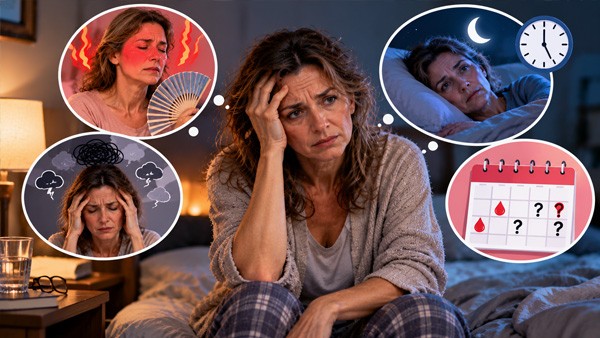

Most women expect this to start when their periods stop. It usually starts years earlier, while periods are still arriving on time, and that mismatch is why so many spend two or three years being investigated for something else.
The symptoms that bring people in are rarely hot flushes first. They are poor sleep, anxiety that has no cause, joint aches, a shoulder that will not move properly, heart palpitations, and a kind of mental fog that feels like early decline. Each one gets looked at separately. The hormonal change underneath them does not get mentioned.
⚠️ The one rule that matters most, stated before anything else on this page.
If you still have a uterus, estrogen must never be taken on its own. It has to be combined with a progestogen.
Estrogen alone thickens the lining of the womb, and over time that causes abnormal overgrowth and substantially raises the risk of cancer of the womb lining. A progestogen prevents it entirely. Estrogen-only treatment is for women who have had a hysterectomy, and for nobody else.
This is not a nuance. It is the central safety rule of menopause treatment, and any source promoting an estrogen product without saying it should not be relied on.
📅 The three stages, and what each one is called
The vocabulary is used loosely everywhere, including by clinicians, and getting it straight explains a great deal.
| Stage | What it is | When |
|---|---|---|
| Perimenopause | The transition. Hormones fluctuate rather than simply falling — often with higher peaks than before, which is why symptoms can be erratic. Periods may still be regular | Typically 4 to 8 years, sometimes longer. Commonly begins in the mid-forties |
| Menopause | A single point in time, diagnosed looking backwards: 12 consecutive months with no period | Average age around 51, normal range roughly 45 to 55 |
| Postmenopause | Everything after. Symptoms gradually settle; some, such as vaginal and urinary changes, continue and progress | The rest of life |
Two cases need naming separately because they change the treatment entirely. Periods stopping before 40 is premature ovarian insufficiency; between 40 and 45 is early menopause. In both, hormone treatment is normally recommended until at least the average age of menopause — not for symptom relief but to protect bone and cardiovascular health during years the body expected to have estrogen. The risk-benefit calculation for a 38-year-old is not the one discussed in the news.
And the duration figure that surprises people most: hot flushes and night sweats last an average of seven to ten years, longer in women whose symptoms begin early in perimenopause. The expectation of a difficult twelve months is the main reason women put off treatment.
🌡️ The symptoms, including the ones nobody connects
Around three in four women get vasomotor symptoms. The rest of the list is longer than most people realise, and the unexpected entries are where years get lost to the wrong investigations.
| Area | What it looks like |
|---|---|
| Vasomotor | Hot flushes, drenching night sweats, sudden flushing of face and chest, chills afterwards |
| Sleep | Waking at 3 or 4 am, unable to return to sleep — often without a sweat, which is why it gets diagnosed as insomnia |
| Mood | Anxiety with no trigger, irritability, tearfulness, loss of confidence, low mood. Often the first symptom and usually treated as depression alone |
| Cognition | Word-finding difficulty, losing the thread, forgetting names. Frightening, real, and usually transient |
| Genital and urinary | Dryness, pain with sex, urinary urgency, recurrent urinary infections. Unlike flushes these progress rather than settle |
| Musculoskeletal | Joint aches and stiffness, and frozen shoulder, which is markedly more common in this age band and almost never linked to it |
| Other | Palpitations, dry eyes, dry mouth, itchy or crawling skin sensations, thinning hair, migraines changing pattern, periods becoming heavy or erratic |
| Body composition | Weight redistributing to the abdomen, sometimes without weight gain |
Two overlaps worth knowing. The anxiety and low drive here can look exactly like a depressive episode — see our guides to the worry loop and apathy and low drive. And the cognitive fog is a common point at which lifelong, compensated inattentive ADHD finally becomes unmanageable, because falling estrogen removes the compensation that had held for decades.
🩸 You probably do not need a blood test
This section corrects something widely repeated, and it saves money.
If you are over 45 with typical symptoms, menopause is a clinical diagnosis. No hormone test is required, and guidelines say so explicitly. The reason is that in perimenopause FSH fluctuates wildly from week to week, so a single normal result does not rule anything out and an abnormal one adds nothing you did not already know from the symptoms.
Blood tests do have a place, and it is narrower than the internet suggests:
- 📌 Under 45, and especially under 40 — here FSH does matter, usually measured twice, because premature ovarian insufficiency needs identifying and treating
- 📌 After hysterectomy, where there are no periods to go by
- 📌 Where the picture is ambiguous, or to exclude look-alikes
The genuinely useful tests are the ones that rule out conditions producing the same symptoms. Thyroid function above all — an overactive or underactive thyroid reproduces this almost exactly. Then full blood count and ferritin, since heavy perimenopausal periods cause iron deficiency that is itself exhausting, and vitamin D. Where there is fatigue and low drive rather than flushing, the wider list in our guide to low drive applies.
One result that always needs investigating rather than attributing to menopause: bleeding after periods have stopped for a year, or bleeding between periods, or bleeding after sex. That is not a menopausal symptom and it needs assessing.
💊 What hormone treatment actually is
Not one product. Two decisions: which estrogen and how it is delivered, and which progestogen alongside it.
The estrogen replaces what the ovaries no longer make, and it is what treats the symptoms. Estradiol is the form identical to the body own, available as tablets, patches, gels and sprays. Conjugated estrogens, such as Premarin, are the older preparation.
The route changes the risk profile, and this is the most practically useful thing to know when discussing options:
| Tablets | Patch, gel or spray | |
|---|---|---|
| How it is absorbed | Through the gut and the liver first | Through the skin, bypassing the liver |
| Clot risk | Raised, from a low starting point | Not meaningfully raised |
| Usually preferred when | Simple, no clot risk factors | Any clot history or family history, migraine, higher body weight, liver conditions, gallstones, or taking several other medicines |
The progestogen protects the womb lining, as set out at the top. Options include micronised progesterone, which has the most favourable profile for breast and metabolic effects, dydrogesterone, medroxyprogesterone, and norethisterone — available here as Aygestin (Norethindrone Acetate), which is also used in its own right to control the heavy, unpredictable bleeding that perimenopause often brings. A hormone-releasing coil is another way to deliver it, and it handles contraception at the same time.
Regimens come in two shapes: sequential, with progestogen for part of each month and a monthly bleed, used while periods are still happening; and continuous combined, with both hormones daily and no bleed, used once periods have stopped for a year.
⏰ The thing that changed the whole conversation
If you grew up hearing that hormone treatment causes breast cancer and heart attacks, the explanation for that belief is specific, and it matters.
💡 The timing of starting changes the balance of risk and benefit substantially. Beginning hormone treatment within about ten years of menopause, or before the age of 60, carries a favourable profile for most women with troublesome symptoms. Beginning it much later, well past that window, loses the benefits and adds risk.
The large trial that produced the frightening headlines in 2002 was conducted largely in women with an average age of 63, more than a decade past menopause, many with existing cardiovascular risk. Its findings were then applied to 51-year-olds with hot flushes, for whom they were never relevant. That misapplication deterred a generation of women from effective treatment.
Which does not mean there are no risks. It means the honest numbers belong in the open:
- 🎈 Breast cancer. Combined estrogen and progestogen adds a small absolute risk, in the region of one extra case per thousand women per year of use, rising with duration. Estrogen alone, after hysterectomy, shows little or no increase. For scale, regular alcohol intake and significant excess weight carry risks of comparable or greater size
- 🩸 Clots. Oral treatment roughly doubles a low baseline risk. Patches and gels do not raise it meaningfully, which is why the route matters
- 🧠 Stroke. A small increase with oral treatment, mainly relevant over 60
- 🦴 Bone. A clear benefit — it prevents fractures, which is why early menopause is treated regardless of symptoms
- ❤️ Heart. Hormone treatment is not prescribed to prevent heart disease, whatever else you may read. Blood pressure and cholesterol are managed on their own terms — see our guides to blood pressure and cholesterol
Who should not take systemic hormone treatment: anyone with current or past breast cancer, estrogen-dependent cancer, a history of clot in a leg or lung without a clear provoked cause, previous stroke or heart attack, active liver disease, undiagnosed vaginal bleeding, or who might be pregnant. Those are conversations with a clinician, not judgements to make from a page.
🌸 The treatment that almost nobody is offered
Of everything on this page, this is the most under-used, and the group it helps is large.
Vaginal dryness, burning, pain with sex, urinary urgency and recurrent urinary tract infections are caused by thinning of the genital and urinary tissue as estrogen falls. Unlike hot flushes, this does not settle on its own — it progresses, often for decades, and it goes unreported more than any other symptom here.
Low-dose vaginal estrogen treats it directly: a small tablet, cream, gel or ring used locally, typically every night for two weeks and then twice weekly indefinitely.
What makes it different from systemic treatment, and the reason it deserves its own section:
- 📉 Systemic absorption is minimal, so blood estrogen levels stay in the postmenopausal range
- 🛡️ A progestogen is not required alongside it, because the womb lining is not stimulated
- ♾️ It can be used long term, and needs to be, since symptoms return when it stops
- 🏥 Many women who cannot take systemic hormones can use it, including a large proportion of breast cancer survivors with their oncologist agreement
- 💊 It measurably reduces recurrent urinary infections, which for some women is the main reason to use it
- 💧 It can be combined with non-hormonal moisturisers and lubricants, which work on comfort but do not restore the tissue
The related effect on desire and arousal is covered in our guide to reduced libido.
💊 What works when hormones are not an option
Whether because of a contraindication, a personal decision, or availability, non-hormonal treatment for hot flushes is genuinely effective and recommended in guidelines. It is less effective than estrogen and it is far from nothing.
Medical Disclaimer: The information in this article is for educational and informational purposes only and is not a substitute for professional medical advice, diagnosis, or treatment. Always seek guidance from a qualified healthcare provider with any questions you may have regarding a medical condition, and before starting, stopping or changing any medication.