How Sunlight Ages Skin: UVA Versus UVB, Sunscreen Used Properly and What Tretinoin Can Actually Reverse

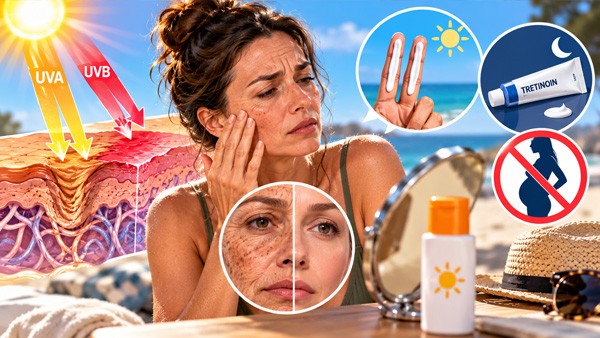

There is a well-known medical photograph of a lorry driver of 69. One side of his face looks his age. The other looks twenty years older — deeply lined, coarse, sagging, mottled. Same man, same genetics, same diet, same number of birthdays.
The difference is that for 28 years the left side sat next to a window.
☀️ Around 80 to 90 percent of visible facial ageing is caused by ultraviolet light, not by time. Studies of identical twins with different sun histories show the same thing from the other direction: the one who spent more time outdoors or smoked looks substantially older than a person with the same DNA.
Which is unexpectedly good news. Most of what people treat as inevitable is accumulated injury — and injury can be stopped, and to a useful degree repaired.
☀️ Two kinds of ultraviolet, two different jobs
The distinction matters because the one that ages you is not the one that burns you, and most people only guard against the second.
| UVA | UVB | |
|---|---|---|
| Reaches | Deep into the dermis, where collagen and elastin live | The upper layers, the epidermis |
| What it does | Ageing. Breaks down collagen, disorganises elastin, drives pigment patches | Burning and direct DNA damage |
| Through window glass | Yes — ordinary glass does not stop it | Largely blocked |
| Through cloud | Mostly yes | Partly |
| Daily and seasonal pattern | Fairly constant all day, all year | Peaks at midday and in summer |
| You can feel it | No. No warning sensation at all | Yes — you go red |
So the radiation responsible for lines, laxity and brown patches is the one that produces no sensation, passes through glass and cloud, and is present on a grey February morning. That is the whole explanation for the lorry driver.
The practical consequences are the ones nobody applies:
- 🪟 Driving and sitting by a window are real exposure. Car side windows block much less UVA than the windscreen, which is why left-sided damage shows in countries that drive on the right, and right-sided in those that drive on the left
- 🌧️ Overcast does not mean protected
- 🏔️ Snow and water reflect it, and altitude increases it
- 💡 Visible light matters too, particularly for pigmentation in darker skin and in melasma, which is why mineral tints are often recommended for those. Screens, though, emit far too little to be a meaningful factor — that particular worry is marketing
🔬 What is physically happening
Worth understanding because it explains why the two treatments on this page are the two that work.
Ultraviolet light generates reactive oxygen species in the skin, and those switch on enzymes called matrix metalloproteinases whose job is to break down collagen. In sun-exposed skin these run persistently, so collagen is degraded faster than it is replaced. At the same time the cells that build collagen become less productive, and what they do build is laid down in disorganised fragments rather than orderly bundles.
Elastin, which gives skin its snap-back, becomes clumped and non-functional. The result is thinner dermis with poor scaffolding, which reads on the surface as fine lines, crepey texture, loss of firmness, enlarged pores, broken capillaries and uneven brown pigment.
Two levers follow directly. Stop the enzyme activation — that is sun protection. Restart organised collagen production —> that is a retinoid. Everything else on the market is working at the margins of those two.
🧴 Sunscreen, used the way it was tested
This is where almost all the available benefit is lost, and it is not about which product.
A randomised trial following adults for four and a half years found that those applying broad-spectrum sunscreen daily showed no detectable increase in skin ageing over the period, while the comparison group did. Daily sunscreen is not a cosmetic preference; it is the single most effective anti-ageing intervention that exists.
📏 The amount is the problem. SPF is measured in the laboratory at 2 mg per square centimetre. Most people apply a quarter to a half of that, and protection falls disproportionately — applying half the amount does not give you half the SPF, it gives considerably less.
The two-finger rule: squeeze a line of sunscreen along the full length of your index and middle fingers. That is one application for the face and neck. It is roughly a quarter of a teaspoon and it is far more than people expect.
The rest of the specifics:
- 🔢 SPF 30 blocks about 97 percent of UVB; SPF 50 about 98 percent. The step from nothing to 30 is enormous; from 30 to 50 is small. Applying SPF 30 properly beats applying SPF 50 thinly
- 🌟 SPF only measures UVB. For the ageing part you need UVA protection stated separately — look for broad spectrum, a PA+++ or PA++++ marking, or the circled UVA symbol. A high SPF with poor UVA cover protects you from burning while you age
- ⏲️ Reapply every two hours in real sun exposure, and after swimming, heavy sweating or towelling. No product is genuinely all-day
- 👂 The missed areas are consistent: ears, eyelids, the strip in front of the ears, the sides and back of the neck, the chest, the backs of the hands, and the scalp parting
- 🔅 Indoors near a window counts, and so does the daily commute
- 🎩 Shade, a wide brim and UV-blocking sunglasses do more than any product during peak hours, and sunglasses also protect the thin eyelid skin where you cannot apply much
One caveat to keep in proportion: diligent sun avoidance lowers vitamin D, so if you cover up thoroughly, have the level checked rather than guessing.
🚨 Before anything else about treatment
⚠️ Tretinoin must not be used in pregnancy, or while trying to conceive.
Tretinoin is a retinoid, and retinoids as a class can cause birth defects. Although absorption through the skin is low, the guidance for topical tretinoin is to avoid it in pregnancy, and to stop it before trying to conceive rather than on discovering a pregnancy. Discuss breastfeeding with a clinician, and keep it off any area a baby may contact.
What is considered appropriate instead during pregnancy: sunscreen, azelaic acid, niacinamide, vitamin C and plain moisturiser. Those are a genuinely useful routine, not a consolation.
Separately and far more seriously: oral isotretinoin, the capsule taken for severe acne, is absolutely contraindicated in pregnancy and requires reliable contraception and medical supervision throughout. It is a different drug from the cream discussed here, despite the similar name.
💊 What tretinoin actually does
Retin-A (Tretinoin) is the most studied topical treatment for sun-damaged skin, and the only widely available one with consistent long-term evidence for changing the structure of the dermis rather than the look of the surface.
It binds receptors inside skin cells and changes what they do: normalises how the surface layer matures, thickens the living epidermis, stimulates new collagen, and suppresses the enzymes that break collagen down. It also disperses pigment clumps, which is why uneven tone improves, and it is a first-line acne treatment through the same normalising effect on pores.
Strengths and where to begin:
- 🔹 0.025% — the sensible starting strength for photoageing, and enough for many people permanently
- 🔹 0.05% — the usual step up once tolerated
- 🔹 0.1% — strongest, and markedly more irritating. Not a starting point
- 💧 Cream is more moisturising, gel is drier and better suited to oily skin
Higher is not better here. Trials show the difference in outcome between strengths is modest, while the difference in irritation is large — and irritation is what makes people stop, which is the only thing that guarantees no result. A tolerated 0.025% used for two years beats 0.1% abandoned in week three.
For context on the weaker cosmetic versions: retinol has to be converted by the skin into retinoic acid, which makes it roughly ten to twenty times less potent. It is gentler and genuinely does something; it is not equivalent.
🥪 How to start without peeling your face off
The first month decides whether this works, and almost all failures are technique.
- 🌡️ Apply at night, to clean dry skin. Wash, then wait 20 to 30 minutes until the skin is genuinely dry — damp skin absorbs more and irritates more
- 🫘 A pea-sized amount for the entire face. That is the correct quantity and it feels like too little. Dot it on five points and spread thinly
- 📅 Start two or three nights a week, not nightly. Build up over six to eight weeks as the skin adapts
- 🥪 The sandwich method — moisturiser, then tretinoin, then moisturiser again. It substantially reduces irritation with little loss of effect, and it is the single most useful trick for sensitive skin
- 🚿 Short-contact for very reactive skin — apply, leave 30 to 60 minutes, wash off. Build the contact time up gradually
- 🚫 Avoid the corners of the nose and mouth, and the eyelid skin, which irritate first. Keep a thin margin
- 🧴 Sunscreen every morning is not optional with this. Tretinoin makes skin more sun-sensitive, and the new collagen is undone by the exposure you are failing to block
Do not use on the same night as: benzoyl peroxide, which chemically degrades it; AHA or BHA acids; scrubs or cleansing brushes; anything fragranced or astringent. One active at a time, and separate nights if you want both. And stop it five to seven days before waxing, threading, peels or laser, because the skin lifts.
⏱️ The real timeline
Expectations cause more abandonment than side effects do.
| When | What happens |
|---|---|
| Weeks 1 to 6 | The adaptation phase. Dryness, flaking, tightness, mild redness, stinging on application. Skin may look temporarily worse. This is expected and it passes |
| Weeks 6 to 12 | Irritation settles. Texture smooths — usually the first genuine improvement, and often noticed as makeup sitting better |
| Months 3 to 6 | Fine lines soften, pigment evens out, pores look smaller |
| Months 6 to 12 and beyond | Continued improvement. The gains keep accruing with use and reverse if it stops |
Two things to be clear about. Tretinoin works on fine lines, texture and pigment. It does not lift sagging, remove deep folds or change bone structure — those need different interventions. And a flare of spots in the first weeks, if you are acne-prone, is the drug clearing pores rather than a reaction to stop for.
Stop and seek advice for swelling, cracking or weeping skin, significant pain, or a spreading rash. Mild adaptation is normal; injury is not something to push through, and it risks lasting pigment change.
🌸 What else has real evidence
Short list, because most of the category does not.
- 🧪 Azelaic acid — good for pigment and redness, well tolerated, and considered acceptable in pregnancy
- 🍊 Vitamin C — an antioxidant that reduces some UV-driven damage and helps pigment modestly. Useful in the morning under sunscreen
- 💧 Niacinamide — supports the barrier, reduces redness and pigment a little, and is one of the few things that reliably pairs with tretinoin without trouble
- 🛡️ A plain moisturiser — not anti-ageing in itself, and it makes tretinoin tolerable, which makes it the reason tretinoin works
- 🏥 In-clinic options — peels, lasers, microneedling and injectables do things topicals cannot. They also require UV control to hold, and all of them build on the same base
🚭 The accelerators that are not sunlight
UV is the dominant factor. These are the next ones, and the first is not far behind.
- 🚬 Smoking. An independent and additive effect, well enough documented to have its own name in dermatology. It degrades collagen, narrows the small vessels that feed the skin, and produces the characteristic deep lines around the mouth and eyes. Stopping it is covered in our guide to smoking cessation
- 🛏️ Sleeping face-down or on one side produces asymmetric creases over years, and a silk pillowcase does not prevent it — the pressure does the work, not the friction
- 🍷 Alcohol dehydrates and dilates small vessels, worsening redness
- 🍬 Very high sugar intake contributes to collagen stiffening, though the effect is modest compared with UV
- 🌊 Pollution adds oxidative load, which is one argument for an antioxidant in the morning routine
❌ What does not work
- 🥤 Collagen drinks and powders. Evidence is weak and largely industry-funded. Eaten collagen is digested into amino acids like any other protein
- 🧴 Most firming, lifting and plumping creams. They hydrate, which temporarily reduces the look of fine lines. No structural change
- 🌞 Base tans as protection. A tan is damage, and it provides the equivalent of roughly SPF 3
- 🛏️ Sunbeds. Concentrated UVA — the ageing wavelength — plus a clear cancer risk
- 💅 Facial exercises and rollers. Mixed to absent evidence, and repeated pulling is not obviously helpful
🔎 The part of sun damage that is not cosmetic
A page about accumulated ultraviolet injury has to say this, because the same exposure that causes the lines causes the other thing.
Have any of the following looked at promptly:
- 🔵 A new mole after about 30, or an existing one that is changing
- 🔵 Asymmetry, an irregular or blurred border, more than one colour, diameter over about 6 mm, or any change in size, shape, colour, itch or bleeding
- 🔵 A mole that looks different from all your others — often the most useful single sign
- 🔵 A sore, scab or ulcer that has not healed in a month, especially on the face, ears, scalp or backs of the hands
- 🔵 A rough scaly patch that keeps coming back, or a pearly raised lump with fine vessels on it
- 🔵 A new dark streak under a nail with no injury to explain it
Risk is higher with fair skin that burns easily, many moles, previous severe sunburn, sunbed use, a family history of melanoma, or a suppressed immune system. None of this is a reason for alarm about ordinary spots, and all of it is a reason to have a changing one checked rather than watched.
📞 When to seek help
Promptly:
- Any of the skin lesion changes above
- Swelling, cracking, weeping or significant pain from a topical treatment — stop and get advice
- Pregnancy, or planning one, while using tretinoin — stop and speak to a clinician
- Taking or considering oral isotretinoin — this requires medical supervision and reliable contraception, without exception
Worth an appointment:
- Persistent irritation after eight weeks of correct technique at the lowest strength
- Rosacea or eczema alongside photoageing, where the order of treatment matters and the barrier comes first
- Melasma or stubborn pigment patches, which need a specific approach and strict UV control
- Darker skin tones with pigment concerns — irritation here can leave lasting marks, so slower titration is important
- No change after six months of consistent use with daily sunscreen
- Thinking about peels, laser or injectables, and worth asking what a topical base should look like first
❓ Frequently asked questions
What is the difference between UVA and UVB?
UVB burns the surface and peaks at midday. UVA reaches deep into the dermis, breaks down collagen, passes through window glass and cloud, is fairly constant all year, and produces no sensation. UVA does the ageing.
How much sunscreen should I put on my face?
A line along the full length of your index and middle fingers covers the face and neck — roughly a quarter of a teaspoon. Most people apply a quarter to a half of the amount SPF is tested at, which cuts protection sharply.
Is SPF 50 much better than SPF 30?
Not much. SPF 30 blocks about 97 percent of UVB and SPF 50 about 98 percent. Applying SPF 30 properly beats applying SPF 50 thinly. Check for broad spectrum or a PA rating, since SPF measures only UVB.
Is tretinoin safe in pregnancy?
No. Tretinoin is a retinoid and should be avoided in pregnancy and when trying to conceive. Sunscreen, azelaic acid, niacinamide and vitamin C are considered appropriate instead. Oral isotretinoin is absolutely contraindicated.
How long does tretinoin take to work?
Adaptation with dryness and flaking takes one to six weeks, texture improves by weeks six to twelve, and fine lines soften between months three and six, with gains continuing past a year of use.
How do I use tretinoin without irritation?
Pea-sized amount for the whole face, on dry skin 20 to 30 minutes after washing, two or three nights weekly at first. The sandwich method — moisturiser, tretinoin, moisturiser — cuts irritation with little loss of effect.
Which tretinoin strength should I start with?
0.025%. The difference in results between strengths is modest while the difference in irritation is large, and irritation is what makes people stop. A tolerated low strength used for years beats a strong one abandoned in week three.
What should I not use with tretinoin?
Not on the same night as benzoyl peroxide, which degrades it, nor with AHA or BHA acids, scrubs or fragranced products. Stop it five to seven days before waxing, peels or laser, and use sunscreen every morning.
Do I need sunscreen indoors or on cloudy days?
Near a window, yes, because UVA passes through ordinary glass, and it also largely passes through cloud. Driving is real exposure, which is why one-sided facial ageing is documented in long-distance drivers.
Do collagen supplements help skin ageing?
Evidence is weak and largely industry-funded, and eaten collagen is digested into amino acids like any other protein. Daily broad-spectrum sunscreen and a topical retinoid are the two measures with real evidence.
📑 Sources and editorial
- Clinical and histological studies of photoaging, including documented unilateral facial photoaging from chronic occupational window exposure
- Twin studies and epidemiological analyses attributing the majority of visible facial ageing to ultraviolet exposure rather than chronological age
- Research on ultraviolet-induced matrix metalloproteinase activation, collagen fragmentation, elastin disorganisation and reduced fibroblast function in photoaged skin
- Comparative data on UVA and UVB wavelength penetration, transmission through window glass and cloud, and diurnal and seasonal variation
- Evidence on visible light contribution to pigmentation, particularly in darker skin phototypes and melasma
- Randomised controlled trial of daily broad-spectrum sunscreen over four and a half years and its effect on measured skin ageing
- Sun protection factor testing methodology, including the 2 mg per square centimetre application standard, the relationship between applied quantity and achieved protection, and UVA rating systems
- Randomised trials of topical tretinoin for photodamage, including comparative efficacy and tolerability across 0.025, 0.05 and 0.1 percent concentrations
- Mechanistic studies of retinoic acid receptor activation, epidermal normalisation, procollagen induction and metalloproteinase inhibition
- Prescribing information for topical tretinoin, including application technique, photosensitivity, avoidance in pregnancy, and interaction with benzoyl peroxide
- Guidance on retinoid teratogenicity, and pregnancy prevention requirements for oral isotretinoin
- Evidence on retinol conversion to retinoic acid and relative potency compared with tretinoin
- Reviews of azelaic acid, topical vitamin C and niacinamide in photoaging and pigmentation, including agents considered appropriate in pregnancy
- Studies of smoking as an independent contributor to facial ageing, and of sleep position, alcohol, glycation and pollution
- Guidance on recognition of melanoma and keratinocyte carcinomas, including the asymmetry, border, colour, diameter and evolution criteria and the ugly duckling sign
- Reviews of oral collagen supplementation and of topical firming preparations
- Related reading: smoking cessation aids, androgenetic alopecia
- Related products: Retin-A (Tretinoin), Tretiheal (Tretinoin), skin care category
- RXshop Editorial Team — reviewed by Sarah Mitchell, PharmD — Clinical Pharmacist & Chief Editorial
Medical Disclaimer: The information in this article is for educational and informational purposes only and is not a substitute for professional medical advice, diagnosis, or treatment. Always seek guidance from a qualified healthcare provider with any questions you may have regarding a medical condition, and before starting, stopping or changing any medication.