What Herpes Is and How Every Form of It Is Treated

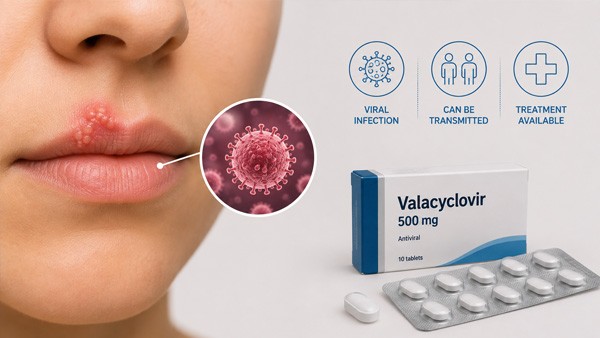

Herpes is the most common viral infection almost nobody discusses. Roughly two thirds of the world population under fifty carries herpes simplex type 1, and around half a billion adults carry type 2. Most have no idea, because the great majority of infections produce either nothing at all or symptoms mild enough to be blamed on something else.
It is also more varied than the two conditions people associate with the name. The same virus family causes cold sores, genital lesions, a painful finger infection, one of the leading infectious causes of corneal blindness, a rare but devastating brain infection, and a serious illness in newborns. This guide covers all of them — what the virus is, why it never leaves, the forms it takes, how each is treated, and which presentations are genuine emergencies.
🧬 An important distinction before anything else: herpes simplex virus and the virus causing chickenpox and shingles are relatives, not the same organism. Cold sores and genital herpes come from herpes simplex; shingles comes from varicella zoster reactivating decades after chickenpox. They behave differently, are treated at different doses, and only one of them has a vaccine.
🦠 Two types, and what actually separates them
Herpes simplex comes in two types. HSV-1 is traditionally associated with oral infection and is usually acquired in childhood through ordinary family contact. HSV-2 is traditionally genital and is acquired sexually. That neat division no longer holds.
HSV-1 now causes a large and growing share of first-episode genital infections, particularly in younger adults in higher-income countries — a consequence of fewer children acquiring oral HSV-1 early, leaving more adolescents without antibodies when they become sexually active. The practical implication is that genital herpes can be caused by either type, and knowing which matters for prognosis.
| Feature | HSV-1 | HSV-2 |
|---|---|---|
| Global prevalence | Around 3.8 billion people under 50 | Around 520 million adults aged 15 to 49 |
| Usual site | Oral, but increasingly genital in first episodes | Genital |
| Where it hides | Trigeminal ganglion, near the base of the skull | Sacral ganglia, at the base of the spine |
| Recurrence rate when genital | Low — roughly one episode a year or fewer | Higher — several episodes a year initially |
| Asymptomatic shedding | Less frequent at genital sites | More frequent, which drives transmission |
That recurrence difference is the main reason type-specific testing is worth doing when genital herpes is diagnosed. A person with genital HSV-1 can reasonably expect infrequent episodes that decline further over time; a person with HSV-2 faces a different pattern, and the decision about suppressive therapy differs accordingly.
🔐 Why the virus never leaves
After the first infection, herpes simplex travels along sensory nerves to the ganglion serving that area and enters a dormant state called latency. In that state it produces almost no viral proteins, which makes it invisible both to the immune system and to antiviral drugs — every available medicine acts only on virus that is actively replicating.
Reactivation sends the virus back down the same nerve to the skin or mucous membrane, producing either a visible lesion or, more often, asymptomatic shedding: infectious virus present at the surface with nothing to see. That silent shedding is how most transmission occurs and why avoiding contact during visible outbreaks, while sensible, is insufficient on its own.
📋 The forms it takes
The virus produces different illnesses depending on where it enters and who the host is. Several of these are unfamiliar even to people who have lived with herpes for years.
| Presentation | What it looks like | Notes |
|---|---|---|
| Herpes labialis — cold sores | Tingling, then blisters at the lip border, crusting over 7–10 days | The commonest recognised form; usually HSV-1 |
| Primary gingivostomatitis | Extensive painful mouth ulcers with fever, in young children | First infection; dehydration is the main risk |
| Genital herpes | Painful grouped blisters and ulcers, sometimes with dysuria and swollen nodes | First episode is far more severe than recurrences |
| Herpetic whitlow | Painful swollen finger with deep-seated blisters | Seen in healthcare workers and thumb-sucking children; do not incise it |
| Herpes gladiatorum | Clusters of lesions on face, neck or arms in contact-sport athletes | Spreads through skin-to-skin contact on the mat |
| Ocular herpes | Painful red eye, blurred vision, light sensitivity, watering | A leading infectious cause of corneal blindness — see below |
| Eczema herpeticum | Rapidly spreading punched-out erosions over eczematous skin, with fever | Occurs in atopic dermatitis; a medical emergency |
| HSV encephalitis | Fever, confusion, personality change, seizures | Rare and devastating; treatment cannot wait for confirmation |
| Neonatal herpes | Skin lesions, poor feeding, lethargy, seizures in a newborn | Highest risk when the mother acquires infection late in pregnancy |
🚨 The forms that are emergencies
Most herpes is a nuisance. Four presentations are not, and recognising them is the most clinically important part of this article.
Ocular herpes
HSV infection of the cornea causes a dendritic ulcer that, treated promptly, usually heals without lasting damage — and, treated wrongly, can scar the cornea permanently. Any painful red eye with blurred vision or light sensitivity in someone with a history of herpes needs same-day ophthalmology assessment.
🔴 Never use a steroid eye drop on an undiagnosed red eye. Topical steroids suppress inflammation while allowing the virus to replicate freely, and in herpetic keratitis they can turn a treatable ulcer into corneal perforation. Steroids have a role in some stages of ocular herpes, but only under an ophthalmologist who has examined the eye.
Eczema herpeticum
In people with atopic dermatitis, herpes can spread rapidly across damaged skin, producing widespread uniform erosions with fever and malaise. It can progress to systemic infection and requires urgent antiviral treatment, frequently intravenously. Any child or adult with eczema whose skin deteriorates suddenly with painful clustered lesions needs assessment the same day rather than a stronger steroid cream.
Herpes encephalitis
The most serious form. HSV is among the commonest causes of sporadic viral encephalitis, and untreated it kills the majority of those affected while leaving most survivors with significant deficits. Presentation is fever with confusion, personality or behavioural change, speech difficulty and seizures, developing over days. Treatment with intravenous aciclovir is started immediately on suspicion, before confirmatory testing returns, because delay directly worsens outcome.
Neonatal herpes
Rare but severe. Risk is highest when a mother acquires a first genital infection late in pregnancy, since she has not yet developed antibodies to pass to the baby. Recurrent maternal herpes carries far lower risk. Management includes suppressive therapy in the final weeks of pregnancy and caesarean delivery where active lesions are present at labour. In a newborn, poor feeding, lethargy, fever, seizures or any vesicular rash requires immediate assessment.
🔬 How herpes is diagnosed properly
Diagnosis by appearance alone is unreliable, and getting it right matters because the diagnosis carries social weight that a wrong answer should not impose.
- PCR from a fresh lesion is the gold standard. It identifies the virus and the type, and it is most sensitive when the blister is new rather than crusted — swabbing early matters.
- Type-specific IgG serology detects antibodies and distinguishes HSV-1 from HSV-2. Useful for establishing whether a partner is already infected, or in a person with suggestive symptoms but no lesion available to swab. It cannot say when infection was acquired.
- IgM testing is not recommended. It performs poorly, can be positive during reactivation as well as new infection, and produces false results that lead to unnecessary distress and wrong conclusions about who infected whom.
- Viral culture and Tzanck smear are largely historical, with lower sensitivity than PCR.
⚠️ Why the type matters practically: a genital HSV-1 diagnosis carries a considerably better prognosis for recurrence than HSV-2, and that information changes both expectations and the decision about daily suppressive therapy. Being told simply that you have genital herpes, without the type, withholds the single most useful piece of information available.
💊 Treatment by situation
All treatment uses the same three antiviral drugs, at doses that vary substantially by condition. The principle throughout is that starting early — at the prodrome, before lesions form — determines how much benefit is obtained.
| Situation | Typical approach |
|---|---|
| Cold sore | Single-day high-dose regimen at the first tingle; topical agents add little |
| First genital episode | 7 to 10 days of oral antiviral; the most severe episode, worth treating fully |
| Recurrent genital episode | Short 3 to 5 day course, started at the prodrome |
| Frequent recurrences | Daily suppressive therapy, which also reduces transmission risk |
| Ocular herpes | Ophthalmologist-directed; topical or oral antivirals, steroids only under supervision |
| Eczema herpeticum | Urgent systemic antiviral, often intravenous, plus dermatology input |
| Encephalitis | Immediate intravenous aciclovir, before confirmation |
| Neonatal infection | High-dose intravenous antiviral under specialist care |
The oral agents available here are Valtrex (valacyclovir), Zovirax (aciclovir) and Famvir (famciclovir). They are comparably effective; valacyclovir and famciclovir require fewer daily doses than aciclovir, which matters when adherence over a short window determines the outcome. Detailed dosing sits in our valacyclovir guide.
🤝 Transmission and how to reduce it
Transmission requires direct skin or mucous membrane contact with infectious virus. It happens during visible outbreaks, during the prodrome, and during asymptomatic shedding — and the last of those accounts for most cases.
✅ Measures that work
Daily suppressive antiviral therapy roughly halves transmission to an uninfected partner in trial data. Consistent condom use reduces it further. Avoiding contact from the first tingle until lesions have fully healed removes the highest-risk periods.
💬 The conversation
Disclosure before intimacy is both ethical and practical. Type-specific blood testing can establish whether a partner already carries the same virus — frequently they do, which changes the discussion entirely.
Two specific precautions are worth naming. A person with an active cold sore should avoid kissing infants, because neonatal and infant HSV infection is serious — and should avoid oral sex, since HSV-1 transmits readily to the genital area. And anyone with active lesions should avoid contact sports, where herpes gladiatorum spreads efficiently through skin contact.
📊 A public health point worth knowing: HSV-2 infection is associated with a substantially increased risk of acquiring HIV, because the breaks in mucosal surfaces and the immune cells recruited to them provide an entry route. That association is one of the reasons genital herpes receives more attention in sexual health services than its own symptom burden might suggest.
🧠 Triggers and everyday management
Reactivation is not random. Most people identify a personal pattern after tracking a few episodes, and knowing it allows pre-emptive treatment.
- Ultraviolet light is the classic trigger for cold sores — a beach holiday or a skiing trip reliably produces one in susceptible people. Lip balm with sun protection genuinely helps.
- Physical or emotional stress, including illness and fever — hence the old name fever blisters.
- Menstruation in many women, following a predictable monthly pattern.
- Local trauma, including dental work, facial procedures and friction.
- Immunosuppression from illness or medication, which produces more frequent and more severe episodes.
Recurrence frequency also declines naturally over the years in most people, which is worth telling anyone recently diagnosed and facing the prospect of a lifetime of monthly outbreaks. The first year is usually the worst.
💙 The part that hurts more than the lesions
For genital herpes in particular, the psychological impact routinely exceeds the physical. People report shame, fear of rejection, and a belief that the diagnosis ends their romantic prospects — none of which matches the epidemiology, given how many people carry the same virus without knowing.
Three facts are worth holding onto. The condition is extremely common. Transmission risk with suppressive therapy, condoms and avoidance during symptoms is modest. And most partners, told directly and calmly with accurate information, respond far better than the person disclosing expects. Counselling at the point of diagnosis measurably improves psychological outcomes, and it is the part of care most often skipped.
There is currently no vaccine against herpes simplex, though candidates remain in development. Prevention rests on the measures above rather than on immunisation — unlike shingles, where an effective vaccine exists and is recommended for older adults.
❓ Frequently asked questions
Can herpes be cured?
No. After the first infection the virus persists permanently in sensory nerve ganglia in a dormant state where antivirals cannot reach it, because it is not replicating. Treatment shortens outbreaks, prevents most recurrences during suppressive therapy and reduces transmission, but it does not eliminate the virus. No vaccine currently exists either, though candidates are in development.
What is the difference between HSV-1 and HSV-2?
HSV-1 is traditionally oral and HSV-2 genital, but HSV-1 now causes a large share of first-episode genital infections. The practical difference is recurrence: genital HSV-1 typically recurs about once a year or less and declines further, while HSV-2 recurs more often and sheds asymptomatically more frequently. That is why type-specific testing is worth requesting.
How is herpes diagnosed accurately?
PCR taken from a fresh lesion is the gold standard, identifying both the virus and its type; swabbing early, before crusting, gives the best result. Type-specific IgG serology is useful when no lesion is available or to test a partner. IgM testing is not recommended, because it performs poorly and produces misleading results about timing and source of infection.
Is a red painful eye with herpes an emergency?
Yes. Herpetic keratitis is a leading infectious cause of corneal blindness and needs same-day ophthalmology assessment. Critically, steroid eye drops must never be used on an undiagnosed red eye: they suppress inflammation while the virus replicates freely and can turn a treatable ulcer into corneal perforation. Steroids have a role only under an ophthalmologist who has examined the eye.
What is eczema herpeticum?
Herpes spreading rapidly across skin damaged by atopic dermatitis, producing widespread uniform punched-out erosions with fever. It can progress to systemic infection and requires urgent antiviral treatment, often intravenous. Any sudden painful deterioration of eczema with clustered lesions needs same-day medical assessment rather than a stronger steroid cream, which would make it worse.
Can herpes affect the brain?
Rarely, but HSV encephalitis is among the commonest causes of sporadic viral encephalitis and is devastating untreated. Presentation is fever with confusion, personality change, difficulty speaking and seizures developing over days. Intravenous aciclovir is started immediately on suspicion, before confirmatory tests return, because every hour of delay worsens the outcome.
How much does suppressive therapy reduce transmission?
Daily antiviral therapy roughly halved transmission to uninfected partners in randomised trial data. Combined with consistent condom use and avoiding contact from the first tingle until healing is complete, the annual risk becomes modest. No combination eliminates it entirely, because asymptomatic shedding can occur with nothing visible.
Can I give my partner genital herpes from a cold sore?
Yes. HSV-1 transmits readily from the mouth to the genital area through oral sex, and this now accounts for a substantial share of new genital herpes diagnoses. Avoiding oral sex from the first tingle until the cold sore has fully healed is the practical precaution. The same reasoning applies to avoiding kissing infants during an active cold sore.
What triggers outbreaks?
Ultraviolet light is the classic trigger for cold sores, along with physical or emotional stress, illness and fever, menstruation, local trauma including dental work, and anything that suppresses immunity. Most people identify a personal pattern after tracking several episodes, which allows treatment to be started pre-emptively. Sun protection on the lips genuinely reduces UV-triggered recurrences.
Will outbreaks continue at the same rate forever?
No, and this is worth knowing at diagnosis. Recurrence frequency typically declines over the years in most people, and the first year after a first genital episode is usually the worst. Genital HSV-1 recurs considerably less often than HSV-2 from the outset. Suppressive therapy is frequently reviewed after a year precisely because the natural pattern changes.
Is pregnancy affected?
Recurrent herpes in a woman who was already infected before pregnancy carries low risk, because antibodies cross the placenta. The higher risk situation is a first infection acquired late in pregnancy. Management includes suppressive therapy in the final weeks and caesarean delivery if active lesions are present at labour. This belongs entirely with the team managing the pregnancy.
Is herpes the same as shingles?
No. Shingles is reactivation of varicella zoster, the chickenpox virus, which is a relative of herpes simplex but a different organism. It produces a painful rash in a band on one side of the body, is treated at higher antiviral doses within 72 hours of the rash appearing, and unlike herpes simplex it has an effective vaccine recommended for older adults.
📑 Sources and editorial
- World Health Organization — global prevalence estimates for herpes simplex virus types 1 and 2
- CDC sexually transmitted infections treatment guidelines — diagnosis, episodic and suppressive regimens, and testing recommendations
- Corey L et al., New England Journal of Medicine — once-daily valacyclovir and transmission of genital herpes
- Published guidance on herpes simplex keratitis, eczema herpeticum, HSV encephalitis and neonatal herpes management
- Related reading on RXshop: Valacyclovir and herpes, Shingles, Cold sores
- RXshop Editorial Team — reviewed by Emily Chen, MD, MPH, Internal Medicine
Medical Disclaimer: The information in this article is for educational and informational purposes only and is not a substitute for professional medical advice, diagnosis, or treatment. Always seek guidance from a qualified healthcare provider with any questions you may have regarding a medical condition, and before starting, stopping or changing any medication.