After Childbirth: Blues, Depression or Emergency

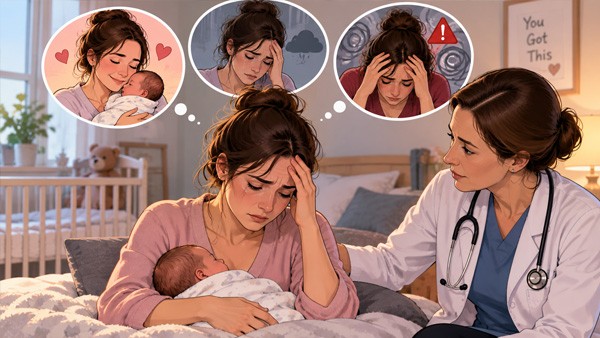

Low mood after childbirth covers three quite different conditions. One is normal and needs nothing. One is an illness needing treatment. One is a medical emergency that can develop within days of the birth.
They are routinely discussed as a single spectrum of feeling sad, and that framing costs lives — because the most dangerous of the three is also the one that looks least like sadness.
🔴 The one that cannot wait. Postpartum psychosis usually begins within the first two weeks and sometimes within hours. It does not look like depression. It looks like confusion, agitation, not making sense, being unable to sleep while not feeling tired, rapidly shifting mood, and holding beliefs that are not true — frequently about the baby. It affects roughly one or two women in every thousand who give birth, it is a psychiatric emergency requiring assessment the same day, and it is highly treatable. If a new mother seems confused, is behaving out of character or is saying things that do not make sense, that is an emergency now, not something to watch overnight.
📊 The three, side by side
| Baby blues | Postnatal depression | Postpartum psychosis | |
|---|---|---|---|
| How common | Most women | Roughly one in eight | One or two per thousand |
| When it starts | Days three to five | Any time in the first year | Usually the first two weeks |
| How long | Resolves within two weeks | Months if untreated | Escalates over hours to days |
| What it looks like | Tearful, irritable, up and down, anxious | Persistent low mood, no enjoyment, guilt, exhaustion | Confusion, agitation, delusions, no need for sleep |
| Function | Still coping | Struggling but recognisable | Not oriented to reality |
| Needs | Rest, support, reassurance | Treatment | Emergency assessment |
🌥️ The blues, which are not an illness

Most women experience a period of tearfulness in the first week, typically peaking around the third to fifth day, and it is a normal physiological event rather than a disorder.
The pattern is distinctive. Crying without being able to say why. Feeling overwhelmed one hour and fine the next. Irritability with people who are trying to help. Anxiety about doing it wrong. Difficulty sleeping even when the baby sleeps.
The cause is largely hormonal. Delivering the placenta removes the source of the hormones that had risen enormously through pregnancy, and levels fall within days more steeply than at any other point in adult life. Add profound sleep disruption, physical recovery from birth, and the sudden weight of complete responsibility for another person.
It resolves on its own within about two weeks and needs no treatment. What it needs is sleep where possible, practical help, food, and someone saying that this is expected.
The single thing to watch is the timeline. Beyond two weeks, or worsening rather than easing, it is no longer the blues.
😔 Postnatal depression
Around one woman in eight develops depression in the year after birth, and it is missed more often than almost any other common illness.
Several reasons combine. The symptoms — exhaustion, disturbed sleep, appetite change, poor concentration — are indistinguishable from what every new parent experiences. Everyone expects a new mother to be tired. And the woman herself frequently does not report it, because saying she is not happy feels like an admission that she is failing at something she is supposed to want.
What distinguishes it from ordinary exhaustion:
- Low mood present most of the day, most days, for more than two weeks
- Nothing is enjoyable — including things unrelated to the baby
- Not feeling connected to the baby, or feeling nothing at all, which produces enormous guilt
- Guilt out of proportion, and a conviction of being a bad mother
- Unable to sleep even when given the opportunity — distinct from being woken
- Anxiety that will not switch off, often about the baby’s health
- Withdrawing from people who want to help
- Thoughts that the family would be better off without her
That last item needs stating plainly. Suicide is among the leading causes of death in women in the year following childbirth in developed countries. This is not a mild condition that resolves with time, and any thought of not wanting to go on requires help immediately rather than at the next appointment.
Risk is higher with previous depression, previous postnatal depression, bipolar disorder, a difficult or traumatic birth, a baby with health problems, lack of support, and relationship difficulty or abuse.
🚨 The emergency, in detail
Postpartum psychosis is uncommon and it is the reason this article leads with a warning, because recognising it early changes the outcome completely.
It does not resemble depression. What families describe is a woman who is not herself in a way that is difficult to put into words — confused, unusually talkative or unusually silent, saying things that do not follow, elated one hour and terrified the next, and awake for long periods without appearing tired.
Beliefs that are not true frequently feature, and they often concern the baby — that something is wrong with the baby that nobody else can see, that the baby is not hers, that she is being watched, or that she has a special mission. She may hear or see things that are not there.
Onset is usually within the first two weeks and can be within the first days. It escalates over hours rather than weeks.
It is treatable and recovery is usually complete. What it requires is same-day psychiatric assessment and, almost always, admission — ideally to a unit where mother and baby stay together. Waiting to see how she is tomorrow is the mistake that turns a treatable illness into a tragedy.
⚠️ One group carries a substantially higher risk and can plan for it in advance. Childbirth is the strongest known trigger for a first episode of bipolar illness, and women who already have bipolar disorder face a risk of postpartum psychosis in the region of one in four or five. Anyone with a previous episode of postpartum psychosis has around a one in two chance of recurrence after another birth.
These are not reasons to avoid having children. They are reasons to plan before conception or early in pregnancy — a named specialist, a written plan, decisions about medication during and after pregnancy, and arrangements for the first two weeks. Where this planning happens, outcomes are far better. Where a woman with bipolar disorder reaches delivery with nobody having discussed it, the first two weeks are unnecessarily dangerous.
😰 The thoughts nobody admits to
This section may be the most useful in the article, because the fear it addresses keeps women silent.
The great majority of new parents experience sudden, unbidden, horrifying thoughts of harm coming to the baby — dropping the baby down the stairs, the baby stopping breathing, images of something terrible. They arrive unwanted, they are deeply distressing, and they are extremely common.
These are intrusive thoughts, and they are not a sign of danger. The defining feature is that the person finds them abhorrent. They are the opposite of a wish. A mother experiencing them is typically hypervigilant about her baby’s safety rather than a threat to it, and the distress they cause is itself the evidence.
The critical distinction is between a thought that horrifies and a belief that feels true. Intrusive thoughts are experienced as intrusions — unwanted, alien, resisted. Psychotic beliefs are experienced as reality, are not distressing in the same way, and can direct behaviour. The first needs reassurance and sometimes treatment for anxiety. The second is the emergency described above.
Enormous numbers of women never mention intrusive thoughts because they fear that saying them aloud will result in their baby being taken away. That silence is the actual danger, because it prevents help for the anxiety or depression underneath. Clinicians who work in this field expect these thoughts and are not alarmed by them — saying them out loud is safe and is usually met with relief and an explanation.
🔬 What else should be checked
Several physical conditions produce exactly these symptoms after birth and are simple to exclude.
Thyroid disturbance affects a meaningful proportion of women after delivery, and it characteristically runs in two phases: an overactive period in the first few months producing anxiety, palpitations, irritability and weight loss, followed by an underactive period producing exhaustion, low mood, cold intolerance and slowness. Both phases are readily mistaken for postnatal mental illness, both are found by one blood test, and it is routinely not done.
Anaemia, particularly after significant blood loss at delivery, produces profound fatigue, breathlessness and low mood. Iron stores are depleted long before the blood count falls, so ferritin needs requesting specifically.
Vitamin D deficiency, common and easily corrected.
Sleep deprivation, which is not a diagnosis to dismiss. Chronic fragmented sleep independently causes low mood, poor concentration and emotional volatility. Protecting one uninterrupted stretch — someone else covering a single feed — produces a measurable difference and is one of the most effective practical interventions available.
💊 Treatment, and breastfeeding
The fear of harming the baby through medication keeps many women untreated for months, and the balance is not the one they assume.
Psychological therapy is first-line for mild to moderate depression and works well, with the practical obstacle being availability and childcare rather than effectiveness.
Medication is appropriate for moderate to severe illness, and several antidepressants are well studied in breastfeeding. Sertraline has among the lowest transfer into breast milk and the largest body of evidence behind it, which is why it is the usual first choice where a woman is breastfeeding and wishes to continue.
The point that gets lost: untreated depression is not the safe option. It affects the mother’s health, her ability to care for and interact with her baby, the relationship between them, and there is evidence of effects on the child’s development. Weighing a small and well-characterised medication exposure against months of untreated illness is a different calculation from the one most women perform alone at three in the morning.
Nobody should stop breastfeeding in order to take an antidepressant, and nobody should refuse treatment in order to breastfeed. In the great majority of cases both are possible.
👨 Partners
Around one father in ten develops depression in the year after a birth, most commonly between three and six months, and almost nobody asks.
It presents differently — more often as irritability, withdrawal, working longer hours, increased drinking, and anger rather than sadness. It is strongly associated with depression in the mother, so where one partner is struggling the other should be asked about directly.
The same applies to adoptive parents and to non-birthing partners, whose difficulties are frequently assumed not to count.
🏠 What genuinely helps
Protected sleep. One uninterrupted stretch, with somebody else covering a feed. The single highest-value practical measure.
Specific help rather than offers. Bringing food, doing a load of washing, taking the baby for an hour so she can shower or sleep. Asking what she needs places the work of deciding on the person with least capacity for it.
Eating. New mothers frequently eat badly, and low blood sugar makes everything worse.
Getting outside. Daylight and movement, briefly and daily.
Contact with other new parents, which normalises what is happening more effectively than reassurance from anyone else.
Saying it out loud to one person. The isolation is a substantial part of the illness.
Lowering the standard. The house does not need to be tidy and nobody needs a photograph of it.
🩺 When to seek help
- Confusion, agitation, or saying things that do not make sense in a new mother — emergency, today
- Beliefs that are not true, particularly about the baby
- Not sleeping while not feeling tired, in the first two weeks
- Any thought of not wanting to go on, or of harming herself — immediately
- Low mood persisting beyond two weeks, or worsening rather than easing
- Unable to enjoy anything, or feeling nothing toward the baby
- Anxiety preventing sleep even when the opportunity exists
- Intrusive frightening thoughts — safe to say aloud, and worth saying
- Known bipolar disorder or previous postpartum psychosis — before delivery, ideally before conception
- A partner who has become irritable, withdrawn or is drinking more
Where medication is appropriate, treatment is stocked in the antidepressant category — including Sertafine (sertraline), which has among the lowest transfer into breast milk and the most evidence behind it in this situation. Any medicine taken during breastfeeding should be prescribed for that situation specifically rather than continued from before or borrowed, and the article on types of depression and the guide to bipolar disorder cover the wider picture.
❓ Frequently asked questions
How do I know if it is more than baby blues?
By the timeline and the direction. The blues affect most women, peak around the third to fifth day and resolve within about two weeks, easing as they go. Beyond two weeks, or worsening rather than settling, it is no longer the blues. The other distinguishing features are being unable to enjoy anything at all and being unable to sleep even when given the opportunity.
What does postpartum psychosis actually look like?
Not like depression. Families describe someone who is not herself in a way that is hard to put into words — confused, saying things that do not follow, elated one hour and terrified the next, awake for long periods without appearing tired, and holding beliefs that are not true, frequently about the baby. It usually starts within the first two weeks and escalates over hours. It is an emergency and it is treatable.
I have horrifying thoughts about my baby being harmed. Am I dangerous?
Almost certainly not. Most new parents experience sudden unwanted images of harm coming to the baby, and the defining feature is that you find them abhorrent — they are the opposite of a wish. Mothers experiencing them are typically hypervigilant about safety rather than a threat to it. The distinction that matters is between a thought that horrifies and a belief that feels true; the second is the emergency, the first is not.
Will my baby be taken away if I say it?
That fear keeps enormous numbers of women silent, and the silence is the actual danger, because it prevents help for what is underneath. Clinicians who work in this field expect intrusive thoughts, are not alarmed by them, and hearing them usually produces relief and an explanation rather than alarm. Saying it aloud to one person is safe and it is the step that changes things.
Can I take an antidepressant while breastfeeding?
In most cases yes. Several are well studied in breastfeeding, and sertraline has among the lowest transfer into milk and the largest body of evidence, which is why it is the usual first choice. Nobody should stop breastfeeding in order to take treatment, and nobody should refuse treatment in order to breastfeed — in the great majority of cases both are possible.
Is it safer to go without medication?
Not necessarily, and the calculation is not the one most women perform alone at three in the morning. Untreated depression affects the mother's health, her capacity to care for and interact with her baby, the relationship between them, and there is evidence of effects on the child's development. A small, well-characterised medication exposure weighed against months of untreated illness is a genuinely different comparison.
Should anything be tested?
Yes, and it frequently is not. Thyroid disturbance affects a meaningful proportion of women after delivery and runs in two phases — an overactive one causing anxiety and palpitations, then an underactive one causing exhaustion and low mood — both easily mistaken for postnatal mental illness and both found by one blood test. Also ferritin after blood loss, and vitamin D.
I have bipolar disorder and want a baby. What should I do?
Plan before conception if possible. Childbirth is the strongest known trigger for a first bipolar episode, and women who already have the diagnosis face a risk of postpartum psychosis around one in four or five. That is a reason to plan rather than a reason not to have children: a named specialist, a written plan, decisions about medication through pregnancy and after, and arrangements covering the first two weeks.
Can fathers and partners get this?
Around one in ten, most commonly between three and six months, and almost nobody asks. It presents differently — more often as irritability, withdrawal, working longer hours, drinking more and anger rather than sadness. It is strongly associated with depression in the mother, so where one partner is struggling the other should be asked directly rather than assumed to be fine.
What is the single most useful practical thing?
One protected stretch of uninterrupted sleep, with somebody else covering a feed. Chronic fragmented sleep independently causes low mood, poor concentration and emotional volatility, and restoring a single unbroken block produces a measurable difference. After that, specific practical help rather than offers — bringing food, doing washing, taking the baby for an hour — since deciding what to ask for is itself work.
📑 Sources and editorial
- NICE guideline on antenatal and postnatal mental health
- Royal College of Psychiatrists guidance on postpartum psychosis and perinatal services
- Confidential enquiries into maternal deaths, including suicide in the postnatal year
- Studies of postpartum psychosis risk in bipolar disorder and recurrence after a previous episode
- Literature on intrusive thoughts in new parents and their distinction from psychotic phenomena
- Evidence on antidepressant transfer into breast milk, including comparative data on sertraline
- Research on outcomes of untreated maternal depression for mother and infant
- Guidance on postpartum thyroiditis and its two-phase course
- Studies of paternal perinatal depression prevalence and presentation
- Related reading: bipolar disorder, types of depressive state, weakness and fatigue
- Related products: antidepressant category
- RXshop Editorial Team — reviewed by Thomas Walsh, MD, Psychiatrist and Mental Health Specialist
Medical Disclaimer: The information in this article is for educational and informational purposes only and is not a substitute for professional medical advice, diagnosis, or treatment. Always seek guidance from a qualified healthcare provider with any questions you may have regarding a medical condition, and before starting, stopping or changing any medication.