Chronic Pain and Depression: How They Interact

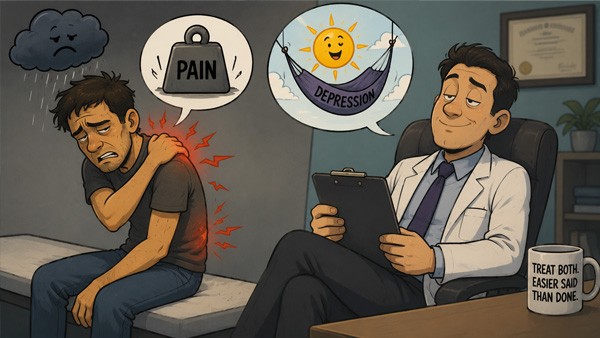
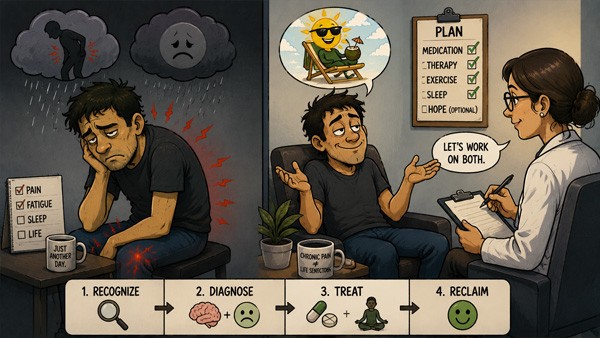
Pain and depression share more machinery than either condition shares with anything else. The same neurotransmitter systems, the same brain regions, the same descending pathways from brain to spinal cord. That overlap explains why each makes the other worse, and why one class of drug treats both — though not for the reason most people assume when they are offered it.
It also creates a specific and avoidable problem. Being offered an antidepressant for pain is regularly heard as being told the pain is imaginary, and a great many people decline treatment that would have helped because of that misunderstanding.
🧠 The fact that resolves the misunderstanding: antidepressants relieve pain at doses far below those used to treat depression, they work in people who are not depressed at all, and they act through a different mechanism — strengthening the descending pathways that dampen pain signals in the spinal cord. Amitriptyline for nerve pain is typically given at a fraction of an antidepressant dose. It is not being prescribed because anyone thinks the pain is in your head.
🔗 How they feed each other
The relationship runs in both directions, which is why it becomes self-sustaining.
Pain leads to depression through loss — of sleep, work, income, activity, independence, social contact, and the sense of a future that resembles the past. Persistent pain is exhausting in a way that is difficult to convey to anyone who has not experienced it, and the losses accumulate quietly.
Depression worsens pain measurably. It lowers pain thresholds, increases the attention paid to bodily sensation, reduces activity which leads to deconditioning and more pain, disrupts sleep which amplifies pain further, and removes the motivation required for rehabilitation.
The biology overlaps. Serotonin and noradrenaline are central to mood regulation and are also the transmitters of the descending inhibitory pathways — the system by which the brain turns pain signals down before they reach consciousness. When that system is weakened, more signal gets through. This is why drugs acting on both transmitters relieve pain, and why drugs acting on serotonin alone do so considerably less well.
⚠️ One correction worth making explicitly: it is not true that everyone with chronic pain is depressed. Depression is far commoner in this group than in the general population — estimates commonly fall somewhere between a third and half depending on setting and severity — but a majority of people living with persistent pain are not depressed. Assuming otherwise is both inaccurate and insulting, and it leads to mood being treated while the pain is not.
🔬 Three kinds of pain
Modern pain medicine distinguishes three mechanisms, and treatment differs substantially between them. Getting this wrong is a common reason for treatment failure.
| Type | Mechanism | Examples |
|---|---|---|
| Nociceptive | Actual tissue damage or inflammation detected by normal pain receptors | Osteoarthritis, injury, inflammatory arthritis |
| Neuropathic | Damage to or disease of the nerves themselves | Diabetic neuropathy, shingles pain, sciatica, nerve injury |
| Nociplastic | Altered pain processing without identifiable tissue or nerve damage | Fibromyalgia, irritable bowel syndrome, chronic widespread pain, some persistent back pain |
That third category is the one that causes the most distress, because investigations come back normal and people are told nothing is wrong. What is actually happening is central sensitisation — the nervous system itself has become amplified. Pain signals are turned up, non-painful sensations register as painful, and the pain spreads beyond any original site.
This is a measurable neurophysiological state, not a figure of speech. It is real pain produced by a real mechanism, and the fact that a scan looks normal is a statement about the scan rather than about the person. Understanding this changes the treatment approach entirely, since anti-inflammatories and opioids work poorly here while drugs acting on central pain processing work considerably better.
🩺 Recognising depression alongside pain
Diagnosis is complicated by overlap: fatigue, disturbed sleep, poor concentration and reduced appetite belong to both conditions, so counting symptoms overstates depression in someone with pain.
The features that discriminate better are the ones pain does not usually produce:
- Loss of pleasure in things that were still enjoyable despite the pain
- Feelings of worthlessness or excessive guilt
- Hopelessness about the future, beyond realistic concern about the pain
- Persistent low mood present most of the day, most days, rather than fluctuating with pain levels
- Thoughts of death or self-harm
A questionnaire such as the PHQ-9 is often used and is useful for tracking change, though it too counts symptoms that pain produces independently.
🔴 Suicide risk is meaningfully raised in chronic pain, independently of depression, and it is under-recognised because both patients and clinicians treat hopelessness as an understandable response to circumstances rather than as a warning sign. Persistent hopelessness, feeling like a burden, statements about not being able to continue like this, or any thoughts of ending life need to be raised directly and acted on. Asking about it does not plant the idea — that concern is not supported by evidence.
💊 Medication that treats both
Certain antidepressants relieve pain directly, and the choice depends on which pain mechanism is present.
| Drug | Pain evidence | Notes |
|---|---|---|
| Duloxetine | Diabetic neuropathy, fibromyalgia, chronic musculoskeletal pain, osteoarthritis | Licensed for both pain and depression; the most directly relevant drug where both are present |
| Amitriptyline | Neuropathic pain, fibromyalgia, chronic headache, some abdominal pain | Long-established for pain at low doses; sedating, which helps sleep; anticholinergic effects limit the dose |
| Nortriptyline | Similar to amitriptyline | Better tolerated, less sedating and fewer anticholinergic effects; often preferred in older people |
| Venlafaxine | Some evidence in neuropathic pain at higher doses | Acts on both transmitters only once the dose is raised |
| SSRIs such as sertraline or escitalopram | Little direct effect on pain | Appropriate where depression is the main problem; do not expect analgesia |
The pattern is consistent: drugs acting on both serotonin and noradrenaline relieve pain, and drugs acting on serotonin alone largely do not. This reflects the biology of the descending inhibitory pathway and is worth knowing, because someone prescribed an SSRI who expected pain relief will be disappointed for a reason that has nothing to do with the drug being wrong for depression.
📏 Doses for pain are different
This point is worth its own section because it changes how the treatment is understood and how side effects are experienced.
Amitriptyline for pain typically starts at a very low dose taken at night and is increased slowly to a level well below what would be used for depression. Many people get pain benefit at doses a fraction of the antidepressant range.
Duloxetine is used within a similar range for both, which is part of why it suits people who have both conditions.
Two consequences follow. Side effects at pain doses are generally milder than the prescribing information suggests, since that information describes higher doses. And someone told the tablet is an antidepressant, who then reads about it, may be alarmed by a description that does not apply to what they have been given.
Timing also matters: sedating agents are taken a couple of hours before bed rather than at bedtime, since morning grogginess is the commonest reason people abandon them and shifting the timing usually resolves it.
🧪 Other medication for pain
Gabapentin and pregabalin have good evidence in neuropathic pain and considerably weaker evidence in non-neuropathic pain, where they are nonetheless widely prescribed. They cause drowsiness, dizziness and weight gain, have recognised misuse potential and a withdrawal syndrome, and are increasingly controlled. Where they help they are valuable; where they are being taken for pain that is not neuropathic, a review is worthwhile.
Anti-inflammatories work well for inflammatory and nociceptive pain and poorly for neuropathic and nociplastic pain. Long-term use carries stomach, kidney and cardiovascular risks.
Paracetamol is safe and its effect in chronic conditions is modest.
Opioids require an honest account. They work well for acute pain and cancer pain. For chronic non-cancer pain, long-term trial evidence is poor: benefit is small on average and diminishes with time, while harms accumulate — tolerance, dependence, constipation, hormonal suppression, increased falls, and a phenomenon called opioid-induced hyperalgesia in which the drug itself increases pain sensitivity. They also worsen depression over time and interact dangerously with alcohol and sedatives.
This does not mean nobody should take them. It means the expectation of long-term benefit should be modest, doses should be kept low, and a plan to review is part of starting rather than an afterthought.
Topical treatments — capsaicin, lidocaine patches, topical anti-inflammatories — deliver useful relief for localised pain with far less systemic exposure and are under-used.
🧠 The psychological treatments that work
These are frequently offered in a way that implies the pain is not physical, which guarantees rejection. Presented accurately, they are among the better-evidenced interventions available.
Cognitive behavioural therapy for pain does not aim to convince anyone the pain is imaginary. It works on the relationship between pain, thought, mood and behaviour — reducing avoidance, restoring activity, breaking the cycle in which fear of pain produces inactivity which produces more pain.
Pain catastrophising is the strongest psychological predictor of outcome in chronic pain, and it is modifiable. It describes a pattern of magnifying the threat, ruminating on the sensation and feeling helpless about it — and it measurably increases experienced pain intensity through effects on the nervous system, not through imagination. Addressing it directly reduces pain.
Acceptance and commitment therapy takes a different route, working on living according to what matters while the pain is present rather than waiting for it to resolve first. It has good evidence in conditions where complete relief is not achievable.
Pain management programmes combine education, graded activity, psychological work and medication review, usually in groups. Group format is not a cost compromise: much of the benefit comes from being among people who do not need the pain explained to them.
🏃 Activity and pacing
Exercise improves pain, function and mood across most chronic pain conditions, and the type matters less than consistency. The obstacle is that increased activity often increases pain temporarily, which is read as damage.
Pacing addresses this. The common pattern is the boom-and-bust cycle: on a good day the person does everything that has accumulated, pays for it over the following days, rests, and repeats. Over time the good days shrink.
Pacing means working to a level that can be sustained daily, including on good days when it feels unnecessary, and increasing gradually and deliberately rather than opportunistically. It is genuinely difficult to accept, because it involves doing less than you could on the days you feel able.
Graded activity builds from that baseline in small planned increments over weeks, based on the schedule rather than on how the pain feels on any given day.
😴 Sleep, the third element
Pain, depression and insomnia form a triangle in which each worsens the other two, and sleep is frequently the most tractable of the three.
The relationship with pain is bidirectional and the direction that surprises people is that poor sleep increases pain more reliably than pain disturbs sleep. Experimental sleep restriction lowers pain thresholds in healthy volunteers within days.
The most effective treatment is cognitive behavioural therapy for insomnia, which outperforms sleeping tablets and works in people with chronic pain specifically. Sedating antidepressants used for pain deliver a useful double effect here, which is one reason amitriptyline at night suits people whose pain and sleep are both problems.
Sleeping tablets are a poor long-term solution: tolerance, dependence, next-day impairment and increased falls, with no effect on pain.
🗣️ Being taken seriously
Something worth saying directly, because it affects whether people accept treatment at all.
People with chronic pain, particularly the nociplastic kind where investigations are normal, frequently report being disbelieved. Conditions such as fibromyalgia have a long history of being dismissed. Women report this more often than men, and studies of pain assessment have documented systematic differences in how pain reports are treated.
The consequences are practical: people stop reporting symptoms, avoid appointments, and refuse psychological or antidepressant treatment because accepting it feels like conceding that the pain was never real.
The accurate position is that pain is always real. Its mechanism may be tissue damage, nerve damage or altered central processing, and all three produce genuine pain. Treatment aimed at the nervous system is treatment of the mechanism, not a verdict on the patient.
📋 A practical approach
Establish the pain mechanism, since it determines which treatments have a chance of working. Nociceptive, neuropathic and nociplastic pain respond to quite different things.
Screen for depression properly, using the features that distinguish it from pain rather than the overlapping ones, and treat it where present because untreated depression makes pain worse and rehabilitation impossible.
Choose medication that addresses both where both are present — duloxetine most directly, or a tricyclic at low dose where sleep is also disrupted.
Set realistic goals. A thirty per cent reduction in pain is considered a meaningful clinical response, and complete relief is usually not achievable in long-standing pain. Aiming for function rather than for a pain score of zero produces better outcomes and less disappointment.
Treat sleep directly rather than assuming it will improve when the pain does.
Keep moving, with pacing, and expect a temporary increase in symptoms that does not indicate damage.
Ask about a pain management programme, which combines the elements above and is under-referred.
Review medication periodically, particularly opioids and gabapentinoids, since drugs started for a good reason accumulate and continue long after they stopped helping.
✅ The most encouraging finding in this field: treating the depression improves the pain, and treating the pain improves the depression, so progress in either direction helps both. This is unusual — most conditions require separate treatment for separate problems. Here the two are connected closely enough that a single well-chosen medication, better sleep, or restored activity moves both at once.
Medication addressing both pain and mood is stocked in the antidepressants category, including Cymbalta (duloxetine), which is licensed for depression and for several chronic pain conditions, and Elavil (amitriptyline), long used at low doses for nerve pain. Both require assessment and gradual dose adjustment.
❓ Frequently asked questions
Why have I been given an antidepressant for pain?
Because certain antidepressants relieve pain directly, at doses well below those used for depression, and they work in people who are not depressed at all. They strengthen the descending pathways by which the brain dampens pain signals in the spinal cord, and serotonin and noradrenaline are the transmitters of that system. It is treatment of a pain mechanism, not a statement that the pain is imagined.
Does everyone with chronic pain get depressed?
No. Depression is considerably commoner in chronic pain than in the general population, with estimates commonly between a third and a half depending on setting and severity, but the majority of people living with persistent pain are not depressed. Assuming otherwise is inaccurate and leads to mood being treated while the pain itself is not.
My scans are normal. Does that mean nothing is wrong?
No — it is a statement about the scan rather than about you. Nociplastic pain arises from altered processing in the nervous system itself, a measurable state called central sensitisation in which pain signals are amplified and non-painful sensations register as painful. It produces real pain by a real mechanism, and it responds better to drugs acting on central pain processing than to anti-inflammatories.
Which antidepressant works best for pain?
Duloxetine is licensed for both depression and several chronic pain conditions, which makes it the most directly relevant where both are present. Amitriptyline and nortriptyline are long established for neuropathic pain at low doses, with nortriptyline generally better tolerated. SSRIs such as sertraline and escitalopram have little direct effect on pain, because drugs acting on serotonin alone do not strengthen the descending pathway effectively.
The dose seems very low. Will it do anything?
Yes — pain relief occurs at doses well below the antidepressant range for tricyclics, and many people benefit at a fraction of what would be used for depression. This also means side effects are generally milder than the prescribing information describes, since that document covers higher doses. If a sedating agent causes morning grogginess, taking it a couple of hours before bed rather than at bedtime usually resolves it.
Are opioids a reasonable long-term option?
For chronic non-cancer pain the evidence is poor. Average benefit is small and diminishes over time, while harms accumulate: tolerance, dependence, constipation, hormonal suppression, increased falls, and a phenomenon where the drug itself increases pain sensitivity. They also worsen depression over time. This does not mean nobody should take them, but expectations should be modest, doses low, and review built in from the start.
What is pain catastrophising and is it saying I exaggerate?
No. It describes a pattern of magnifying threat, ruminating on sensation and feeling helpless, and it is the strongest psychological predictor of outcome in chronic pain. Crucially it increases experienced pain intensity through measurable effects on the nervous system rather than through imagination — the pain genuinely becomes worse. It is also modifiable, and addressing it directly reduces pain rather than merely coping with it.
What is pacing and why does it feel counterproductive?
Working to a level sustainable every day, including on good days when it feels unnecessary, and increasing gradually by plan rather than opportunistically. It feels wrong because it means doing less than you could on days you feel able. The alternative is the boom-and-bust cycle — doing everything on a good day, paying for it over the following days, resting, repeating — in which the good days progressively shrink.
Should I treat the sleep problem or wait for the pain to improve?
Treat it directly. The relationship runs both ways, and the direction that surprises people is that poor sleep increases pain more reliably than pain disturbs sleep — experimental sleep restriction lowers pain thresholds in healthy volunteers within days. Cognitive behavioural therapy for insomnia outperforms sleeping tablets and works in people with chronic pain specifically. Sleeping tablets bring tolerance, dependence and falls without touching the pain.
How much improvement should I expect?
A thirty per cent reduction in pain is regarded as a meaningful clinical response, and complete relief is usually not achievable in long-standing pain. Aiming for function — what you can do, how you sleep, whether you can work or see people — rather than for a pain score of zero produces better outcomes and considerably less disappointment. Progress in either pain or mood tends to move the other as well.
Are gabapentin and pregabalin useful?
In neuropathic pain, yes, with good evidence. In non-neuropathic pain the evidence is considerably weaker, and they are nonetheless widely prescribed for it. They cause drowsiness, dizziness and weight gain, have recognised misuse potential and a withdrawal syndrome, and are increasingly controlled. If one is being taken for pain that is not neuropathic, that is worth reviewing rather than continuing by default.
I feel hopeless about this. Is that just realistic?
It is worth raising rather than accepting. Suicide risk is meaningfully raised in chronic pain, independently of depression, and it is under-recognised precisely because hopelessness gets treated as an understandable response to circumstances. Persistent hopelessness, feeling like a burden, or thoughts of not being able to continue need to be said out loud to someone who can help. Asking about it does not plant the idea.
📑 Sources and editorial
- IASP definitions of nociceptive, neuropathic and nociplastic pain
- NICE guidance on chronic pain in over 16s and on neuropathic pain in adults
- Cochrane reviews of duloxetine, amitriptyline and other antidepressants for neuropathic pain and fibromyalgia
- Evidence reviews on long-term opioid therapy for chronic non-cancer pain
- Sullivan MJL and colleagues — pain catastrophising and its relationship to pain outcomes
- Research on experimental sleep restriction and pain threshold
- Studies of suicide risk in chronic pain populations
- FDA prescribing information for duloxetine, amitriptyline and nortriptyline
- Related reading: generalised anxiety disorder
- Related products: antidepressants category, pain medication category
- RXshop Editorial Team — reviewed by Thomas Walsh, MD, Psychiatry
Medical Disclaimer: The information in this article is for educational and informational purposes only and is not a substitute for professional medical advice, diagnosis, or treatment. Always seek guidance from a qualified healthcare provider with any questions you may have regarding a medical condition, and before starting, stopping or changing any medication.