Generic or Brand: What Is Actually Different

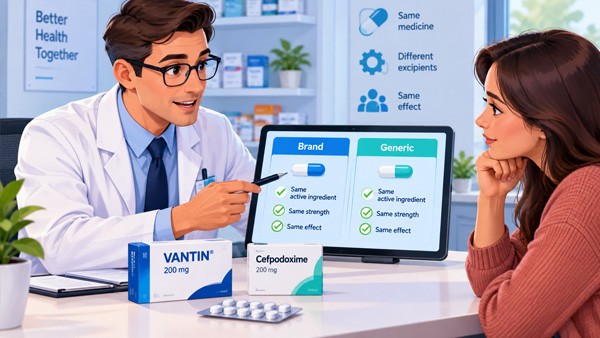

Many people feel uneasy when a pharmacy offers a generic instead of the brand they know. The tablet looks different, the name is unfamiliar, and it costs a fraction of the price — which naturally raises the question of whether something has been left out.
The short answer is that a generic medicine must contain the same active ingredient, in the same amount, and deliver it into the body in essentially the same way. The longer answer explains what is allowed to differ, why that almost never matters, and the small number of situations where switching deserves extra care. Cefpodoxime, sold as the brand Vantin, is used here as a worked example.
🧪 What must be the same. A generic must match the brand in its active ingredient, strength, dosage form (tablet, capsule, liquid) and route (by mouth, injection, cream). It must also prove that it is absorbed into the bloodstream at essentially the same rate and to the same extent. That proof is called bioequivalence.
📊 Bioequivalence, and the 20 per cent myth
To be approved, a generic is tested against the brand in volunteers, measuring how much of the drug reaches the blood and how quickly. Statistical limits require the results to fall within a tight range of the brand.
Those limits are often misquoted as meaning a generic can contain up to 20 per cent less medicine. That is not what they mean. The limits apply to the statistical confidence range around the comparison, and for a product to pass, its average must sit very close to the brand. In practice, reviews of approved generics have found that the average difference in absorption is only a few per cent — similar to the natural variation between different batches of the brand itself.
🎨 What is allowed to differ
| What differs | Why | Does it matter? |
|---|---|---|
| Colour, shape, size, markings | Trademark law prevents copying the brand appearance | No effect on how it works, though it can be confusing — check the name on the pack |
| Inactive ingredients | Fillers, binders, colourings and coatings can vary | Rarely. Relevant for genuine allergies or intolerances, such as to certain dyes or lactose |
| Packaging | Different manufacturer | No |
| Price | No original research or marketing costs, and competition between makers | No — lower price reflects cost, not quality |
| Name | Generics are sold under the active ingredient or a different brand name | No, but always check the active ingredient to avoid doubling up |
A useful habit: read the active ingredient, not just the name. Taking a brand and a generic of the same medicine together, believing them to be different drugs, is a real and avoidable source of overdose.
⚠️ When switching needs extra care
For the vast majority of medicines, switching between brand and generic, or between generics, makes no clinical difference. A small group is the exception: medicines where the gap between an effective dose and a harmful one is narrow, so that even small changes in blood levels can matter.
📏 Narrow therapeutic index medicines include:
- Warfarin — blood clotting tests should be checked after any switch
- Levothyroxine — thyroid levels are usually rechecked after changing product
- Lithium — blood levels need checking after a change, as discussed in the article on lithium and ECT
- Some epilepsy medicines, such as phenytoin and carbamazepine — many specialists advise staying on the same manufacturer
- Digoxin and ciclosporin
For these, the practical advice is simple: stay on the same product where possible, and if a switch happens, tell the prescriber so levels can be checked.
Modified-release tablets, designed to release medicine slowly over the day, are another area where formulation matters more. Their release mechanism can differ between manufacturers, and there has been at least one case where a regulator withdrew a generic extended-release product after it was found not to perform like the brand. If a slow-release medicine seems to work differently after a switch, report it rather than assuming it is imagined.
🧠 Why generics can feel different
Some people genuinely feel worse after switching to a generic, even when the medicine is equivalent. Part of this is the nocebo effect: expecting a cheaper or unfamiliar tablet to work less well can itself increase side effects and reduce perceived benefit. Studies have shown this effect is real and measurable.
That does not mean every reported difference is psychological. Inactive ingredient intolerance and narrow therapeutic index medicines are real exceptions. The sensible response is to report any change, rather than either dismissing it or stopping the medicine.
💊 The worked example: cefpodoxime and Vantin
Cefpodoxime is a cephalosporin antibiotic, first sold under the brand name Vantin. Generic cefpodoxime contains the same active ingredient at the same strength and is expected to work the same way.
| Point | Details |
|---|---|
| Used for | Certain respiratory infections, urinary infections and skin infections, when the bacteria are susceptible |
| Take with food | Tablets are absorbed better with food |
| Antacids and acid reducers | Antacids, H2 blockers and stomach acid medicines can reduce absorption. Space them apart or discuss alternatives |
| Penicillin allergy | Cross-reaction with cephalosporins is uncommon, but anyone with a severe reaction to penicillin, such as anaphylaxis, should not take it without medical advice |
| Complete the course | Stopping early when symptoms improve risks the infection returning |
| Side effects | Diarrhoea, nausea, and occasionally thrush. Severe or bloody diarrhoea needs urgent assessment |
Antibiotics also commonly trigger vaginal thrush by disturbing normal bacteria, as described in the article on thrush.
🔎 Buying medicines safely
The equivalence of generics applies to properly manufactured, genuine products. Counterfeit medicines — which may contain the wrong dose, the wrong ingredient or none at all — are a separate problem and have nothing to do with legitimate generics. Some practical checks:
- Know the active ingredient and strength of what you are taking
- Check the manufacturer is named on the pack
- Be wary of unusually high doses or combinations that do not exist in normal practice
- Report tablets that look damaged, smell odd or behave differently from previous supplies
- Keep the same product for narrow therapeutic index medicines
More about how this pharmacy operates is available on the information page about RXshop.
🩺 When to seek help
- A medicine seems to work differently after switching, especially a slow-release product
- Changing product for warfarin, levothyroxine, lithium, epilepsy medicines or digoxin
- A new rash, swelling or breathing difficulty after starting a new product — emergency if severe
- Severe or bloody diarrhoea on an antibiotic
- Unsure whether two medicines contain the same ingredient — ask a pharmacist
Cefpodoxime is stocked as Vantin (cefpodoxime) in the antibiotics category, alongside other cephalosporins such as Keflex (cephalexin) and Ceftin (cefuroxime). Antibiotics should be used only for bacterial infections, at the dose and duration prescribed.
❓ Frequently asked questions
Are generic drugs as good as brand drugs?
For almost all medicines, yes. A generic must contain the same active ingredient in the same strength and form, and must prove it is absorbed into the blood at essentially the same rate and extent as the brand. Reviews of approved generics find average absorption differences of only a few per cent, similar to variation between batches of the brand.
Can a generic contain 20 per cent less medicine?
No. That is a common misreading of the statistical limits used in bioequivalence testing. The limits apply to the confidence range of the comparison, and to pass, the generic average must be very close to the brand. In practice the difference is typically only a few per cent.
Why are generics so much cheaper?
Generic manufacturers do not repeat the original research and development or large marketing campaigns, and several companies usually compete to make the same medicine. The lower price reflects lower costs, not lower quality.
Why does my generic tablet look different?
Trademark rules prevent generics from copying the brand appearance, so colour, shape and markings differ. This does not affect how the medicine works. Always check the active ingredient on the pack to confirm what you are taking.
Which medicines should I not switch casually?
Medicines with a narrow gap between effective and harmful doses, such as warfarin, levothyroxine, lithium, digoxin, ciclosporin and some epilepsy medicines like phenytoin and carbamazepine. Staying on the same product is sensible, and if a switch happens, levels or tests should be checked.
Can inactive ingredients cause problems?
Rarely. Fillers, colourings and coatings can differ between products, which matters mainly for people with a genuine allergy or intolerance, for example to certain dyes or lactose. If you have such an allergy, check the ingredient list or ask a pharmacist.
Why do I feel worse on the generic?
Sometimes it is the nocebo effect, where expecting a cheaper tablet to work less well genuinely increases side effects. But real differences can occur with narrow therapeutic index medicines, slow-release formulations or ingredient intolerances. Report the change rather than dismissing it or stopping the medicine.
Is generic cefpodoxime the same as Vantin?
Yes. Generic cefpodoxime contains the same active ingredient at the same strength as Vantin and is expected to work the same way. The same advice applies to both: take tablets with food, avoid taking them at the same time as antacids or acid reducers, and complete the prescribed course.
Can I take cefpodoxime if I am allergic to penicillin?
Cross-reactions between penicillins and cephalosporins are uncommon, and many people with a mild penicillin allergy can take cephalosporins. Anyone who has had a severe reaction to penicillin, such as anaphylaxis, should not take it without medical advice.
Are counterfeit medicines the same as generics?
No. Generics are legitimate, tested products. Counterfeits are fake medicines that may contain the wrong dose, the wrong ingredient or none at all. Check the active ingredient, strength and manufacturer, and report anything that looks or behaves differently from previous supplies.
📑 Sources and editorial
- Regulatory requirements for generic drug approval and bioequivalence testing
- Analyses of absorption differences between approved generics and reference products
- Guidance on narrow therapeutic index medicines and product switching
- Regulatory review of a withdrawn extended-release generic that failed to match the reference product
- Studies on nocebo effects associated with generic medicines
- Prescribing information for cefpodoxime, including food effects and interactions with acid-reducing agents
- Evidence on penicillin and cephalosporin cross-reactivity
- Related reading: antibiotic interactions, lithium monitoring, thrush after antibiotics
- Related products: antibiotics category
- RXshop Editorial Team — reviewed by Sarah Mitchell, PharmD, Clinical Pharmacist and Chief Editorial
Medical Disclaimer: The information in this article is for educational and informational purposes only and is not a substitute for professional medical advice, diagnosis, or treatment. Always seek guidance from a qualified healthcare provider with any questions you may have regarding a medical condition, and before starting, stopping or changing any medication.