Products to replace salt


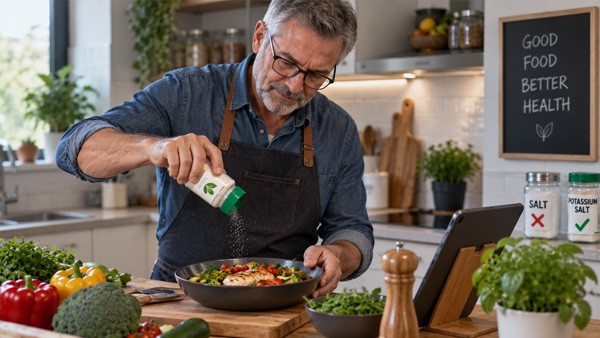
Someone is told to cut down on salt, so they take the shaker off the table. It is the obvious move, it requires real discipline to maintain, and it changes their intake by very little — because the shaker was never where most of their salt was coming from.
This article is about where it actually comes from, what genuinely replaces it, and one substitute that works well enough to have reduced strokes in a major trial while being outright dangerous for a large group of the people most likely to buy it.
📊 The number that reorganises the whole problem. In a typical modern diet, roughly three quarters of all salt is already in the food before it reaches the kitchen — in bread, processed meat, cheese, sauces, ready meals, soups and restaurant food. Around a tenth occurs naturally in ingredients. Only about a tenth to a sixth is added during cooking or at the table.
So the person who stops using the shaker has addressed a small fraction of their intake while accepting a daily loss of enjoyment. Meanwhile the sandwich they had at lunch quietly contributed more than a week of shaker use. Salt reduction that ignores packaged food is mostly symbolic.
🍞 Where it is actually hiding
The surprise for most people is that the biggest contributors are rarely the foods that taste salty.
| Source | Why it matters |
|---|---|
| Bread and rolls | Frequently the single largest contributor in a whole diet. Not because any slice is high, but because of how much is eaten and how rarely it is suspected |
| Processed and cured meat | Ham, bacon, sausage, salami. Salt is part of the preservation, so quantities are substantial |
| Cheese | Varies enormously between types, and the harder and more mature, the more it usually contains |
| Sauces, stock cubes and condiments | Soy sauce, stock, ketchup, mustard, pickles, and the seasoning mixes sold as spice blends, which are often mostly salt |
| Ready meals and takeaway | A single portion can approach or exceed a whole day of recommended intake |
| Breakfast cereals | Contains more than expected, in a food nobody thinks of as savoury |
| Tinned soups and vegetables | Rinsing tinned beans and vegetables removes a meaningful proportion |
| Some effervescent tablets | Soluble painkillers and supplements can carry a surprising sodium load if taken daily |
The last row catches people out completely. Someone taking a soluble painkiller several times a day for a long-standing problem can be adding a significant amount of sodium without any food being involved — worth checking on the packet where daily use is happening.
📖 Reading the label without being misled
Two things make food labels harder to use than they should be.
Sodium and salt are different numbers. Some labels give sodium, some give salt, and salt is roughly two and a half times the sodium figure. So a label showing one gram of sodium means about two and a half grams of salt — which is a substantial part of a sensible daily total, not a small one. Multiply by two and a half whenever you see sodium.
Per hundred grams is not per portion. A figure that looks modest per hundred grams becomes a different figure when the packet contains four hundred. The portion column is the one that matters, and the portion size printed on the pack is frequently smaller than what anyone actually eats.
A rough working rule for scanning quickly: on a per hundred gram basis, anything above about one and a half grams of salt is high, and anything below about a third of a gram is low. That single comparison, applied in the supermarket, does more than any amount of cooking discipline afterwards.
🧂 The substitutes that genuinely work
Products sold as low-sodium or reduced-sodium salt usually work by replacing part of the sodium chloride with potassium chloride. They taste close enough to salt that most people accept them, sometimes with a slightly metallic or bitter note that cooking largely conceals.
These are not a marketing gimmick. A large trial in people at high cardiovascular risk found that using a potassium-enriched substitute in place of ordinary salt reduced strokes, major cardiovascular events and deaths over several years. The effect works from both directions: less sodium, and more potassium, which independently helps lower blood pressure.
That is a genuinely strong result for a change as simple as swapping what is in the salt pot. And it comes with a serious condition attached.
🔴 Potassium-based salt substitutes are dangerous for a large group of people, and that group overlaps almost exactly with the people advised to reduce salt.
Potassium is normally cleared by the kidneys. Several extremely common medications reduce that clearance deliberately, and when potassium intake rises on top of them, blood levels can climb to the point of dangerous heart rhythm disturbance and cardiac arrest.
Do not use potassium-based salt substitutes if you take:
- An ACE inhibitor — drug names ending in pril, such as lisinopril, ramipril, enalapril, perindopril, captopril, quinapril or benazepril
- An angiotensin receptor blocker — names ending in sartan, such as losartan, valsartan, candesartan, irbesartan, olmesartan or telmisartan
- A potassium-sparing diuretic — spironolactone, amiloride or eplerenone, including in combination tablets
- A potassium supplement of any kind
Also avoid them if you have kidney disease of any degree, diabetes affecting the kidneys, heart failure, or Addison disease.
Two further contributors are easy to miss. Regular use of anti-inflammatory painkillers raises potassium and reduces kidney clearance. And the antibiotic combination containing trimethoprim raises potassium in its own right — a short course taken by someone already on a sartan and using a potassium salt is a genuine and documented route to trouble.
High potassium is often silent until it is severe. When symptoms do appear they are muscle weakness, tingling, palpitations, an irregular pulse or unusual fatigue — and any of those in someone in the categories above needs a blood test rather than reassurance.
The practical position is simple. If you take none of those medicines and your kidneys are healthy, a potassium-based substitute is one of the more effective single changes available. If you take any of them, use ordinary salt sparingly instead, and get the flavour from the section below. This is a case where the safe option and the effective option are genuinely different for different people, which is why the packet warning deserves reading rather than skipping.
| If you take | Potassium salt substitute |
|---|---|
| Nothing, healthy kidneys | Suitable, and worth considering |
| A calcium channel blocker, beta blocker, thiazide or alpha blocker alone | Generally suitable, though worth confirming with a pharmacist |
| Anything ending in pril or sartan | Avoid |
| Spironolactone, amiloride or eplerenone | Avoid |
| Any combination tablet containing the above | Avoid |
| Kidney disease, heart failure or diabetic kidney damage | Avoid |
👄 The palate resets, and faster than expected
The most reassuring fact in this subject is that the preference for salt is learned rather than fixed, and it can be unlearned.
Reduce intake gradually and taste receptors adjust over roughly two to four weeks. Food that seemed bland at the start becomes normal, and — the part people always report — food that was previously enjoyed begins to taste unpleasantly salty. That reaction is the signal that the adaptation has happened, and it makes the change self-sustaining rather than a permanent act of willpower.
Two practical points. Reduce gradually rather than all at once, because an abrupt drop produces a strong sense of deprivation that most people abandon within days. And be patient through the first fortnight, which is the only genuinely difficult part.
🌿 What actually replaces the sensation

Acid, aromatics and toasted spice do the jobs salt was doing — each one replaces a different part of the sensation.
Herbs alone are a weak substitute, which is why advice consisting only of a list of herbs tends to fail. Salt does several different jobs in food, and each needs replacing with something that does the same job.
| What salt was doing | What replaces it |
|---|---|
| Brightening and lifting flavour | Acid — lemon or lime juice, vinegar, a splash of wine. The single most effective substitution, and the least used |
| Adding savoury depth | Umami — mushrooms, tomato paste, roasted garlic, nutritional yeast, a small amount of parmesan, seaweed. This is what people actually miss |
| Providing an immediate hit | Heat and pungency — chilli, black pepper, mustard, ginger, horseradish. Occupies the same attention on the palate |
| Creating aroma | Toasted whole spices, freshly ground. Toasting before grinding transforms them, and pre-ground spice loses most of its aroma within weeks |
| Adding complexity | Browning — roasting, searing, caramelising onions. Cooking method contributes more flavour than seasoning does |
| Freshness and finish | Herbs added at the end rather than during cooking, where much of their aroma is lost |
One technique is worth more than the rest combined. If a dish tastes flat, add acid before reaching for salt. The sensation of something missing is very often a lack of brightness rather than a lack of salt, and a squeeze of lemon fixes it in a way that a pinch of salt only masks.
A second technique: salt added at the end, on the surface, registers far more strongly than the same amount stirred in during cooking, because it meets the tongue directly. A small quantity used as a finish delivers more perceived saltiness than several times as much added early.
🚫 Other things raising the same number
Since the goal is blood pressure rather than salt as such, several other contributors are worth knowing, and they are routinely missed.
Anti-inflammatory painkillers raise blood pressure and cause sodium retention, and they blunt the effect of most blood pressure medications. Someone taking them regularly for a joint or a headache may be undoing much of what their treatment is doing, and the connection is rarely made. The article on headache covers why regular painkiller use causes its own problems.
Liquorice, in confectionery or herbal tea, raises blood pressure and lowers potassium. It behaves in the body somewhat like a hormone, and regular consumption produces measurable effects.
Decongestants in cold remedies raise blood pressure, which matters for anyone already treating it.
Alcohol raises blood pressure in a straightforwardly dose-dependent way, and cutting back produces one of the more reliable reductions available.
Poor or short sleep, and untreated sleep apnoea in particular, which is a common and treatable cause of blood pressure that resists medication.
🧪 Who benefits most
Not everyone responds to salt reduction equally, and being honest about that makes the advice more credible rather than less.
Blood pressure responds most strongly to salt reduction in older people, in those who already have high blood pressure, in people with kidney disease or diabetes, and in some ethnic groups where salt sensitivity is more prevalent. A young person with normal blood pressure and healthy kidneys will see less change.
That said, the other reasons hold regardless. High salt intake increases calcium loss in the urine and is associated with reduced bone density. It is also associated with a higher rate of stomach cancer. And reducing intake at a population level lowers cardiovascular events even where individual responses vary, which is why the recommendation is general rather than targeted.
🩺 When to seek help
- Muscle weakness, tingling, palpitations or an irregular pulse while using a potassium salt substitute — stop it and get a blood test urgently
- Before using any potassium-based substitute if you take a blood pressure medication of any kind — a pharmacist can check the name in a moment
- Blood pressure staying high despite treatment — ask about painkillers, alcohol, liquorice, decongestants and sleep apnoea before the dose is increased again
- Swelling of the ankles, or a sudden change in urine output — needs assessment
- Any kidney disease — potassium and salt advice both need individual guidance rather than general rules
- Regular use of anti-inflammatory painkillers alongside blood pressure treatment — worth reviewing
- Taking a soluble or effervescent medication daily — check its sodium content
Blood pressure treatment is stocked in the blood pressure category, including Cozaar (losartan), Zestril (lisinopril) and Aldactone (spironolactone). Anyone taking one of these, or any other medicine whose name ends in pril or sartan, should use ordinary salt sparingly rather than a potassium-based substitute. The same caution applies alongside the antibiotic combination containing trimethoprim, stocked as Bactrim.
❓ Frequently asked questions
Does taking the salt shaker off the table help?
Much less than people assume. Roughly three quarters of the salt in a typical modern diet is already in food before it reaches the kitchen — bread, processed meat, cheese, sauces, ready meals and restaurant food. Only about a tenth to a sixth is added while cooking or at the table. Salt reduction that ignores packaged food is mostly symbolic, however disciplined it feels.
What food contributes the most salt?
Often bread, which surprises almost everyone. Not because any single slice is high, but because of how much is eaten and how rarely it is suspected. After that come processed and cured meats, cheese, sauces and stock, ready meals and takeaway food, and breakfast cereals. The foods that taste obviously salty are usually not the main contributors.
How do I convert sodium to salt on a label?
Multiply the sodium figure by about two and a half. So one gram of sodium is roughly two and a half grams of salt, which is a substantial share of a sensible daily total rather than a small amount. Also check whether the figure is per hundred grams or per portion, since the two differ considerably and the printed portion is often smaller than what is actually eaten.
Do low-sodium salt substitutes actually work?
Yes. They replace part of the sodium chloride with potassium chloride, and a large trial in people at high cardiovascular risk found that using one instead of ordinary salt reduced strokes, major cardiovascular events and deaths over several years. The benefit works from both directions — less sodium, and more potassium, which independently helps lower blood pressure. But they are not safe for everyone.
Who must not use potassium salt substitutes?
Anyone taking a medicine whose name ends in pril or sartan, anyone on spironolactone, amiloride or eplerenone including in combination tablets, anyone taking potassium supplements, and anyone with kidney disease, heart failure or diabetic kidney damage. In those situations the kidneys clear potassium less effectively, and added potassium can raise blood levels to the point of dangerous heart rhythm disturbance.
What does high potassium feel like?
Often nothing at all until it is severe, which is what makes it dangerous. When symptoms do appear they are muscle weakness, tingling, palpitations, an irregular pulse or unusual fatigue. Any of those in someone using a potassium substitute alongside blood pressure medication needs a blood test rather than reassurance. Regular anti-inflammatory painkillers and the antibiotic combination containing trimethoprim both push potassium up as well.
Will food ever taste normal again?
Yes, and sooner than expected. The preference for salt is learned rather than fixed, and taste receptors adjust over roughly two to four weeks. Food that seemed bland becomes normal, and food previously enjoyed starts to taste unpleasantly salty — which is the signal that the change has taken hold. Reduce gradually rather than abruptly, and be patient through the first fortnight, which is the only hard part.
Herbs are not enough. What actually works?
Acid, first and foremost — lemon, lime, vinegar or a splash of wine. If a dish tastes flat, add acid before reaching for salt, because the missing element is very often brightness rather than saltiness. Then savoury depth from mushrooms, tomato paste, roasted garlic or a little parmesan, which is what people actually miss. Also heat, toasted whole spices ground fresh, and proper browning during cooking.
Why is my blood pressure still high despite treatment?
Several contributors get missed before the dose gets increased. Regular anti-inflammatory painkillers raise blood pressure, cause sodium retention and blunt most blood pressure medicines. Liquorice raises pressure and lowers potassium. Decongestants in cold remedies raise it. So does alcohol, dose for dose. And untreated sleep apnoea is a common cause of pressure that resists medication. All are worth reviewing first.
Does everyone need to cut salt?
Responses vary. Blood pressure falls most with salt reduction in older people, in those who already have high blood pressure, and in people with kidney disease or diabetes, while a young person with normal pressure and healthy kidneys sees less change. The other reasons hold regardless: high salt intake increases calcium loss in the urine and is linked to lower bone density, and it is associated with a higher rate of stomach cancer.
📑 Sources and editorial
- Dietary intake studies on the proportion of sodium derived from processed and restaurant food versus discretionary use
- National food composition data on leading dietary sodium contributors
- Trial evidence on potassium-enriched salt substitution and cardiovascular outcomes in high-risk populations
- Guidance on hyperkalaemia risk with renin-angiotensin system inhibitors, potassium-sparing diuretics and potassium supplementation
- Pharmacological literature on trimethoprim-associated and NSAID-associated potassium retention
- Evidence on taste receptor adaptation following gradual sodium reduction
- Literature on salt sensitivity of blood pressure by age, ethnicity and comorbidity
- Evidence on sodium intake, urinary calcium excretion and bone density
- Epidemiological association between high salt intake and gastric cancer
- Literature on glycyrrhizin, blood pressure and potassium depletion
- Related reading: food and blood pressure, exercise and cardiometabolic health, reading food labels
- Related products: blood pressure category
- RXshop Editorial Team — reviewed by Emily Chen, MD, Internal Medicine
Medical Disclaimer: The information in this article is for educational and informational purposes only and is not a substitute for professional medical advice, diagnosis, or treatment. Always seek guidance from a qualified healthcare provider with any questions you may have regarding a medical condition, and before starting, stopping or changing any medication.