Vasoconstriction: When Narrowing Vessels Helps and Harms

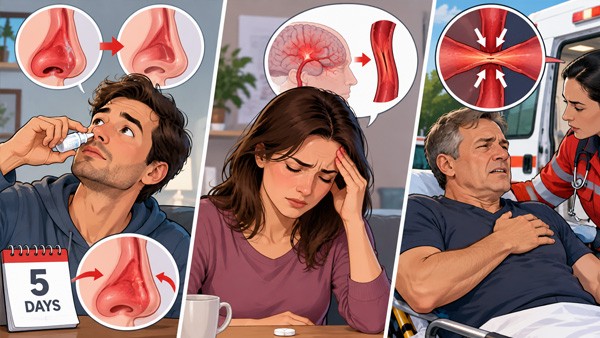

Vasoconstriction is the narrowing of blood vessels, and it is not a malfunction. It is one of the body’s most constantly used controls — running every second, adjusting where blood goes, keeping you upright, keeping you warm, and stopping you bleeding to death from a small cut.
It is also what several widely used medicines do on purpose, including one that saves lives and one that causes a problem most people who have it do not recognise.
💡 The same fourth-power rule that governs widening governs narrowing, and it cuts both ways. Flow through a vessel changes with the fourth power of its radius, so narrowing a vessel by around a fifth roughly halves the blood passing through it. That is why constriction is such an efficient control — and why drugs that cause it produce effects out of proportion to the small anatomical change involved. A decongestant does not shrink your nose. It narrows the vessels in the lining by a fraction of a millimetre, and the lining deflates.
🧬 What tightens a vessel

The muscle in an artery wall sits in permanent partial contraction, and the sympathetic nervous system sets the tension. Nerve endings release noradrenaline, which binds receptors on the muscle, calcium floods into the cell, and the muscle shortens.
Several other signals do the same thing by different routes — hormones released when blood pressure falls, substances released from injured tissue, and cold acting directly on the vessels of the skin.
Anything that stimulates the sympathetic system therefore constricts: stress, fear, pain, cold, nicotine, and any drug mimicking noradrenaline.
✅ What it does for you every day
It stops bleeding. A cut vessel constricts within seconds, reducing flow before clotting has even begun. This is the first stage of haemostasis and it happens before anything else.
It keeps you warm. In cold, the vessels of the skin clamp down, diverting blood inward and reducing heat loss. That is why hands and feet go cold and pale first — they are being sacrificed to protect the core.
It keeps you upright. Standing up sends around half a litre of blood into the legs. The body detects the fall in pressure within a second and constricts vessels throughout the lower body to compensate. When that response fails or is blunted by medication, the result is the light-headedness on standing that causes falls.
It redirects blood where it is needed. During exercise, vessels to the gut constrict while those to muscle open, which is why exercising immediately after a large meal is uncomfortable.
🤧 The everyday use
Nasal congestion is not mucus filling the nose. It is the lining swelling, because the blood vessels within it have dilated. The nose is unusually rich in vessels, and when they open the lining expands and the airway closes.
Decongestants constrict those vessels, the lining deflates, and the nose opens within minutes. They come in two forms and the difference matters more than most people realise.
Sprays and drops act locally and work impressively well — and carry the problem described below.
Tablets reach the whole circulation, so they constrict vessels everywhere rather than only in the nose. That is where their side effects come from and why the cautions below apply mainly to them.
One point worth knowing about the tablets: the two main ingredients are not equivalent. One is genuinely effective by mouth. The other is very poorly absorbed when swallowed, and a substantial review of the evidence concluded it does not work at the doses sold, despite being the most widely available decongestant on many shelves. Checking the ingredient is worth doing before buying.
🔴 Decongestant sprays must not be used beyond about three to five consecutive days, and the reason is a trap that catches thousands of people. With repeated use the vessels become less responsive and rebound harder each time the drug wears off — so the nose blocks more severely than it did originally. The obvious response is another spray, which works briefly, and the cycle tightens.
The condition has a name, rhinitis medicamentosa, and people remain in it for months or years, spraying several times daily for a blockage the spray itself is producing. They frequently believe they have severe allergies or a structural problem.
Breaking it requires stopping the decongestant, starting an intranasal steroid, and enduring an uncomfortable one to two weeks while the lining recovers. Some people find stopping one nostril at a time more tolerable. It does resolve.
⚠️ Who should avoid the tablets
Because oral decongestants constrict everywhere, several groups should not take them — and they are sold without prescription to exactly those people.
| Situation | Why |
|---|---|
| An enlarged prostate | Constricting the bladder neck can produce complete inability to pass urine. A common route into an emergency department, and the cold remedy is rarely suspected |
| High blood pressure | Raises it further, and blunts the effect of blood pressure medication |
| Coronary disease or a rhythm disorder | Increases cardiac work and can provoke palpitations or chest pain |
| Closed-angle glaucoma | Pupil dilation can precipitate an acute attack — a sight-threatening emergency |
| An overactive thyroid | Adds to an already overstimulated state |
| Taking a monoamine oxidase inhibitor antidepressant | Can cause a dangerous surge in blood pressure. An absolute prohibition |
| Taking a beta blocker | With the calming effect blocked, the constricting effect acts unopposed and blood pressure can rise sharply |
For most of these groups a saline rinse, an intranasal steroid or simply time is the sensible route instead.
🤕 Migraine
Triptans are the standard specific treatment for a migraine attack, and vasoconstriction is part of how they work.
They act on serotonin receptors in two places. On blood vessels around the brain, where they reverse the dilation that accompanies an attack. And on the nerve endings of the trigeminal system, where they block the release of the signalling molecules driving the pain. Both contribute, and the second is probably the larger effect — but the vascular action is what determines who can safely take them.
⚠️ Because they constrict arteries generally rather than only in the head, triptans are not for everyone. They should not be taken by anyone with coronary artery disease, a previous heart attack, a previous stroke or mini-stroke, uncontrolled high blood pressure, or poor circulation in the legs. Nor with ergotamine within twenty-four hours in either direction, since the vasoconstriction adds. Certain unusual forms of migraine, including those with weakness on one side, are also excluded. Someone who develops chest tightness, jaw or arm discomfort after taking one should stop and be assessed rather than taking another next time.
Two things determine whether they work.
Timing. Effectiveness falls sharply once an attack is established, so a triptan should be taken at the earliest warning, within the first half hour to an hour. Waiting to see whether it becomes a bad one is the commonest reason people report that triptans do not help them. The clue that the window has closed is when the scalp becomes tender to touch.
Frequency. Taken on ten or more days a month, triptans cause a headache of their own — medication overuse headache, which is indistinguishable from worsening migraine and drives further use. Anyone needing them that often needs preventive treatment instead, not more of them.
💉 The one time you want maximum constriction
In anaphylaxis, vessels throughout the body dilate at once and become leaky. Blood pressure collapses, fluid floods into the tissues, the airway swells, and the situation becomes life-threatening within minutes.
Adrenaline reverses precisely that. It constricts the dilated vessels, restoring blood pressure and reducing the leak, while simultaneously opening the airways and supporting the heart. Nothing else does all three.
Four points decide whether it works.
It goes into the outer thigh muscle, not the arm and not under the skin. Absorption from that site is faster and more reliable, and it can be given through clothing.
There is no reason to wait. In anaphylaxis there is no absolute contraindication to adrenaline — not heart disease, not age, not pregnancy. Delay is the commonest factor in deaths. The mistake is almost never giving it unnecessarily; it is giving it too late.
A second dose after five minutes if there is no improvement.
An ambulance regardless of response. Symptoms can return hours after apparently resolving, so anyone who has needed adrenaline needs observation even if they feel entirely well afterwards.
The same principle appears in a far more ordinary setting: dental and minor surgical local anaesthetics contain a small amount of adrenaline, which constricts local vessels so the anaesthetic stays put and works longer, and the field bleeds less. The brief racing heart some people notice afterwards is that dose reaching the circulation.
🥶 When constriction is the disease
In Raynaud phenomenon, the small arteries of the fingers and toes constrict far beyond what is useful, triggered by cold or stress.
The sequence is characteristic and worth recognising: the digits turn white as flow stops, then blue as the remaining blood loses its oxygen, then red and often painful as flow returns. Not everyone shows all three colours.
The common form is harmless, usually begins in young women, affects both hands symmetrically, and needs nothing beyond keeping warm, avoiding sudden cold and stopping smoking, since nicotine constricts vessels directly.
A less common form accompanies an underlying condition, and the features that distinguish it matter: starting after about thirty, affecting one hand more than the other, ulcers or sores on the fingertips, or accompanying joint pains, rashes or difficulty swallowing. That combination warrants investigation rather than a pair of gloves.
Where treatment is needed, the drugs used are the ones that relax vascular muscle — the same calcium channel blockers used for blood pressure.
🚬 The constrictors nobody counts
Nicotine constricts vessels within seconds of the first draw, in every form including vapes and patches. It is why smoking worsens Raynaud phenomenon, delays wound healing and impairs circulation in the legs.
Cold, which is the intended physiological response and becomes a problem where the response is excessive.
Stress, through the same sympathetic pathway. Blood pressure measured during an anxious clinic visit is genuinely higher than the same person’s pressure at home, which is why home readings are increasingly preferred.
Caffeine, mildly and briefly.
Beta blockers, which produce cold hands and feet in a substantial minority. With the relaxing signal blocked, the constricting one is left unopposed. It is the commonest reason people dislike them, and switching within the class often resolves it.
Ergot-derived migraine drugs, which produce prolonged and powerful constriction and are little used now precisely because of it.
Cocaine and amphetamines constrict intensely, which is why heart attacks occur in young people with entirely normal arteries after using them.
📋 What to take from this
A blocked nose is swollen lining, not mucus, which is why a decongestant opens it and blowing does not.
Three to five days is the limit for a decongestant spray. Beyond that it becomes the cause rather than the treatment.
Oral decongestants reach everywhere, so a man with prostate symptoms, someone with raised blood pressure and anyone on a beta blocker should choose something else.
Triptans work early or not at all, and they are not for anyone with vascular disease.
In anaphylaxis, adrenaline early into the thigh, and never a reason to hesitate.
Fingers going white in the cold is usually harmless, and worth checking if it started after thirty, affects one hand more, or breaks the skin.
Migraine treatment is stocked in the migraine category — Imitrex (sumatriptan) and Maxalt (rizatriptan) for attacks, and Sibelium (flunarizine) for prevention where attacks are frequent. Nasal treatment that does not cause rebound is in the allergy category, and the companion article on vasodilation covers the drugs that do the opposite.
❓ Frequently asked questions
Why does my nasal spray stop working?
Because beyond three to five days the vessels become less responsive and rebound harder each time it wears off, so the nose blocks more severely than it did originally. The obvious response is another spray, and the cycle tightens. The condition is called rhinitis medicamentosa, people stay in it for months or years, and many believe they have severe allergies or a structural problem.
How do I get out of the spray cycle?
Stop the decongestant, start an intranasal steroid, and endure an uncomfortable one to two weeks while the lining recovers. Some people find it more tolerable to stop one nostril at a time, keeping the spray for the other while the first settles. It does resolve, and there is no way through it that avoids a difficult fortnight.
Why is a blocked nose not about mucus?
Because the blockage is the lining swelling rather than something filling the passage. The nose is unusually rich in blood vessels, and when they dilate the lining expands and closes the airway. That is why a decongestant, which narrows those vessels, opens it within minutes, while blowing achieves very little.
Who should not take decongestant tablets?
Anyone with an enlarged prostate, since constricting the bladder neck can cause complete inability to pass urine. Also raised blood pressure, coronary disease or a rhythm disorder, closed-angle glaucoma, an overactive thyroid, anyone on a monoamine oxidase inhibitor, and anyone on a beta blocker, where the constricting effect acts unopposed and pressure can rise sharply.
Are all decongestant tablets the same?
No. The two main ingredients differ substantially: one is genuinely effective by mouth, while the other is poorly absorbed when swallowed, and a substantial review concluded it does not work at the doses sold — despite being the most widely available option on many shelves. Checking which ingredient is in the box is worth doing before buying.
Why did my triptan not work?
Most often timing. Effectiveness falls sharply once an attack is established, so it should be taken at the earliest warning, within the first half hour to an hour. Waiting to see whether it becomes a bad one is the commonest reason people conclude triptans do not help them. The signal that the window has closed is the scalp becoming tender to touch.
Who cannot take triptans?
Because they constrict arteries generally rather than only in the head, they are excluded in coronary artery disease, previous heart attack, previous stroke or mini-stroke, uncontrolled high blood pressure and poor circulation in the legs, along with certain unusual forms of migraine. Not with ergotamine within twenty-four hours either way. Chest or jaw discomfort after taking one means stopping and being assessed.
Can migraine tablets cause headaches?
Yes, and it is common. Taken on ten or more days a month, triptans produce a headache of their own that is indistinguishable from worsening migraine and drives further use. Simple painkillers do the same at fifteen or more days. Anyone needing acute treatment that often needs preventive treatment instead, not a larger supply of the acute one.
Why is adrenaline given into the thigh?
Absorption from the outer thigh muscle is faster and more reliable than from the arm or from under the skin, and it can be given through clothing. In anaphylaxis there is no absolute contraindication — not heart disease, not age, not pregnancy — and delay is the commonest factor in deaths. A second dose follows after five minutes if there is no improvement, and an ambulance regardless of response.
My fingers go white in the cold. Is that serious?
Usually not. The common form starts in young women, affects both hands symmetrically and needs nothing beyond warmth, avoiding sudden cold and stopping smoking, since nicotine constricts directly. What warrants investigation is onset after about thirty, one hand affected more than the other, ulcers or sores on the fingertips, or accompanying joint pains, rashes or difficulty swallowing.
📑 Sources and editorial
- Cardiovascular physiology references on vascular smooth muscle tone and sympathetic control
- Literature on rhinitis medicamentosa, its mechanism and management
- Regulatory review of oral phenylephrine efficacy at recommended doses
- Guidance on oral decongestant cautions in hypertension, prostatic enlargement and glaucoma
- Prescribing information for sumatriptan and rizatriptan, including cardiovascular contraindications
- Evidence on early triptan administration, cutaneous allodynia and treatment response
- International Headache Society criteria for medication overuse headache
- Resuscitation council guidance on intramuscular adrenaline in anaphylaxis
- Literature on primary versus secondary Raynaud phenomenon and features prompting investigation
- Related reading: vasodilation, allergic rhinitis, enlarged prostate
- Related products: migraine category
- RXshop Editorial Team — reviewed by Robert Hayes, MD, Cardiologist
Medical Disclaimer: The information in this article is for educational and informational purposes only and is not a substitute for professional medical advice, diagnosis, or treatment. Always seek guidance from a qualified healthcare provider with any questions you may have regarding a medical condition, and before starting, stopping or changing any medication.