Enlarged Prostate: What Works and How Fast

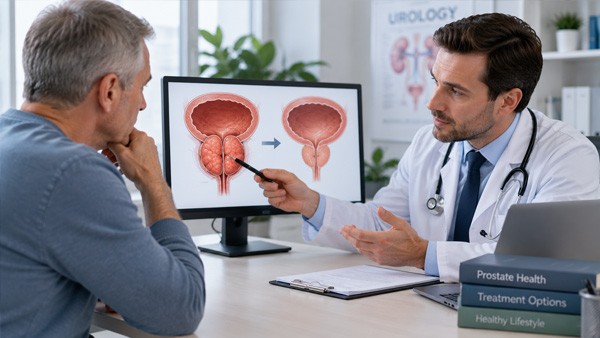

Two beliefs cause most of the trouble with an enlarged prostate. The first is that the symptoms are simply part of getting older and nothing can be done. The second is that the size of the prostate determines how bad things are.
Neither holds up. Treatment is effective and several options exist, and the relationship between gland size and symptoms is weak enough that a man with a very large prostate can have almost no trouble while another with a modestly enlarged one cannot get through a night.
💡 The idea that makes the treatments make sense. Obstruction from an enlarged prostate has two separate components. The static component is the bulk of the tissue itself, physically narrowing the channel. The dynamic component is the tone of smooth muscle within the prostate and bladder neck, which is under nervous system control and can account for a substantial share of the obstruction on its own. The two main drug classes each address one of them — which is why one works within days and the other takes six months, and why combining them outperforms either alone in the right men.
🔬 What is actually happening
The prostate sits beneath the bladder and surrounds the urethra, so anything that increases its bulk narrows the tube urine has to pass through.
From roughly the age of forty, the innermost part of the gland — the transition zone, the part immediately surrounding the urethra — begins to grow. The growth is driven by dihydrotestosterone, a more potent form of testosterone produced within prostate tissue itself by an enzyme called 5-alpha reductase. It is entirely benign, and it is close to universal: most men in their eighties have it to some degree, whether or not it causes symptoms.
Alongside that physical bulk, the smooth muscle of the prostate and bladder neck maintains a resting tone controlled by a specific type of adrenergic receptor. That tone is not fixed. It rises with stress, with cold, and with anything that stimulates the sympathetic nervous system — which is why symptoms fluctuate and why certain everyday medications can tip a man into complete retention overnight.
Over time a third element appears. A bladder working against sustained resistance thickens, becomes irritable, and starts contracting at lower volumes. That is why the symptoms of an enlarged prostate include urgency and frequency, which have nothing obvious to do with obstruction, and why some men still have symptoms after the obstruction has been relieved.
📋 Two kinds of symptom
Separating them matters, because they respond to different things.
| Voiding symptoms — getting urine out | Storage symptoms — holding it |
|---|---|
| Hesitancy before flow starts | Frequency during the day |
| Weak or slow stream | Urgency, with little warning |
| Stream stopping and starting | Waking at night to pass urine |
| Straining to pass urine | Occasional urge incontinence |
| Dribbling at the end | |
| Feeling the bladder is not empty |
Most men have a mixture. Which group predominates guides treatment, and men frequently underreport the storage symptoms because they find them more embarrassing, even though those are usually the ones interfering most with daily life.
Waking at night deserves separate mention, because it is the symptom that most often prompts a man to seek help and it is frequently not caused by the prostate at all. Heart failure, untreated sleep apnoea, diabetes, ankle swelling that redistributes when lying flat, and evening fluid or alcohol all produce it. Treating the prostate in a man whose nocturia comes from one of those achieves nothing.
⚖️ Why size predicts so little
The correlation between prostate volume and symptom severity is genuinely weak, and understanding why is useful.
Growth outward, away from the urethra, can produce a large gland that obstructs very little. Growth inward, into the channel, can produce marked obstruction from a modest gland. On top of that sits the dynamic component — muscle tone rather than bulk — and the state of the bladder muscle, which varies independently of both.
The practical consequences are worth stating. A man told his prostate is enlarged has not been told how much trouble he will have. A man with severe symptoms and a moderately sized gland is not exaggerating. And size does matter for one specific decision: the drugs that shrink the prostate only work when there is enough tissue to shrink.
🩺 Working out what is going on
Assessment is straightforward and largely non-invasive.
A symptom score. A standard questionnaire converts the symptoms into a number, which classifies severity as mild, moderate or severe and, more usefully, gives a baseline against which to judge whether treatment is working. A man who feels no better after three months can compare scores rather than rely on recollection.
A bladder diary kept for three days, recording times, volumes and fluid intake. It regularly reveals things the history does not — two litres of tea, most of it after six in the evening, or a man producing more urine at night than during the day, which points away from the prostate entirely.
Examination of the prostate gives an approximate size and, more importantly, its texture. A smooth, rubbery, symmetrically enlarged gland is typical of benign growth. A hard, irregular or asymmetric one requires further assessment.
Urine testing to exclude infection, blood and glucose.
A PSA blood test, discussed beforehand, since it rises with benign enlargement as well as with cancer and an isolated raised value causes considerable anxiety without being decisive.
Flow measurement and a scan of what remains after passing urine, which together separate genuine obstruction from an overactive bladder.
Blood tests of kidney function where obstruction has been longstanding or severe.
🔴 Seek urgent care for complete inability to pass urine with a painful, distended lower abdomen. Acute urinary retention needs a catheter, not an appointment next week. Also seek prompt assessment for visible blood in the urine, fever with urinary symptoms, symptoms that worsen rapidly over days, or persistent bone pain with weight loss. Chronic retention can be painless — a bladder that never empties, leaking overflow at night, and quietly damaging the kidneys — which is why a man who has stopped noticing symptoms because he has adapted to them is not necessarily doing well.
💊 The treatments and what each does
| Class | Acts on | Time to effect | Shrinks the gland |
|---|---|---|---|
|
Alpha blockers tamsulosin and others |
The dynamic component — smooth muscle tone | Days to two weeks | No |
|
5-alpha reductase inhibitors finasteride, dutasteride |
The static component — the tissue itself | Three to six months | Yes, by roughly a fifth to a quarter |
| Daily tadalafil | Smooth muscle relaxation by a different route | Two to four weeks | No |
| Bladder-directed drugs | Storage symptoms — urgency and frequency | Two to four weeks | No |
| Combination | Both components together | Both timescales | Yes |
Alpha blockers
These relax the smooth muscle in the prostate and bladder neck, widening the channel without changing the gland. They are the usual starting point because they work quickly — often noticeably within a few days — and because they help regardless of prostate size.
Tamsulosin is selective for the receptor subtype concentrated in the prostate, which means less effect on blood pressure than the older, non-selective drugs in this class. It improves symptom scores substantially in most men who respond.
What it does not do is alter the disease. It relieves symptoms while it is being taken and the prostate continues to grow underneath.
5-alpha reductase inhibitors
These block the enzyme converting testosterone to dihydrotestosterone within prostate tissue, so the hormonal drive to growth falls and the gland shrinks by roughly twenty to twenty-five percent over six months.
Two things distinguish them. They are the only drugs that change the course of the condition, reducing the risk of eventually going into retention and of needing surgery. And they only work where there is enough tissue to shrink — in a man with a small prostate they do very little, which is why gland size matters for this decision specifically.
⚠️ These drugs take months, and that is the commonest reason they get abandoned. A man who starts a 5-alpha reductase inhibitor and feels no different after six weeks concludes it does not work and stops. Meaningful benefit typically appears somewhere between three and six months. Anyone starting one should be told the timescale at the outset and given something faster-acting alongside if symptoms are troublesome now — which is one of the reasons combination treatment is common.
Daily tadalafil
Taken as a low daily dose rather than as needed, tadalafil improves urinary symptoms through a different smooth muscle pathway. Its distinguishing advantage is that it treats erectile dysfunction at the same time, and the two conditions occur together often enough that this matters to a lot of men.
It improves symptom scores well while doing relatively little to measured flow rate, and it does not shrink the gland. It is not combined with alpha blockers without care, since both lower blood pressure, and it is absolutely incompatible with nitrates.
Combination treatment
An alpha blocker with a 5-alpha reductase inhibitor outperforms either alone in men with larger prostates, giving fast relief from the first and long-term modification from the second. The trade-off is two drugs and the side effects of both.
🚩 Side effects that are worth knowing in advance
Several of these are unremarkable medically and matter a great deal to the man taking the drug, and being told beforehand changes how they land.
Retrograde ejaculation with alpha blockers — semen passing backward into the bladder rather than outward, so orgasm occurs with little or no ejaculate. It is harmless, it reverses on stopping, and discovering it without warning is alarming. It affects a minority of men on tamsulosin and more on some related drugs.
Dizziness on standing, more with the older non-selective alpha blockers than with tamsulosin. First doses are taken at night for this reason.
Sexual side effects of 5-alpha reductase inhibitors — reduced libido, erectile difficulty and reduced ejaculate volume in a minority, along with occasional breast tenderness or enlargement. Most resolve on stopping.
🔴 Two things that must be said to other doctors.
Before any eye surgery, tell the ophthalmologist you take an alpha blocker — including if you stopped it recently, and including if you only took it briefly. These drugs cause a condition in which the iris behaves unpredictably during cataract surgery, which the surgeon can manage completely if warned and which causes real difficulty if discovered mid-operation. Stopping the drug shortly beforehand does not reliably prevent it, so disclosure rather than discontinuation is the answer.
A 5-alpha reductase inhibitor roughly halves the PSA reading after about six months. Anyone interpreting the result must double it to compare with previous values. A man on one of these drugs whose PSA has been quietly halved can appear reassuringly normal while a genuine rise is under way, and cancers have been missed this way. Make sure it is on the request form and in the notes.
💊 Medicines that make it worse
This list accounts for a substantial share of sudden deteriorations, and most of the entries are things men buy without advice.
| Medicine | Effect |
|---|---|
| Decongestants — pseudoephedrine, phenylephrine, in cold and flu remedies | Increase smooth muscle tone at the bladder neck. A genuine and common cause of acute retention in a man with an enlarged prostate |
| Older antihistamines | Anticholinergic effects that weaken bladder contraction |
| Tricyclic antidepressants | Same anticholinergic effect |
| Bladder antispasmodics | Useful for storage symptoms and can tip a man with significant obstruction into retention |
| Opioid painkillers | Reduce bladder contraction and awareness of fullness |
| Diuretics | Do not obstruct but increase volume and urgency. Timing them earlier in the day helps night-time symptoms considerably |
The first row is worth emphasising because it is so ordinary. A man with an enlarged prostate who takes an over-the-counter cold remedy containing a decongestant can find himself in an emergency department the same evening, unable to pass urine at all.
🚶 What actually helps without a prescription
These measures produce real improvement in mild and moderate symptoms, and they are consistently underused because they sound too simple.
Move the fluid earlier. Not less fluid overall, which risks dehydration and concentrated urine that irritates the bladder, but the same amount shifted into the earlier part of the day, with little in the three hours before bed.
Reduce caffeine and alcohol. Both increase urine production and irritate the bladder. Alcohol in the evening is a particularly reliable cause of a bad night.
Double voiding. After passing urine, wait about thirty seconds and try again. A bladder that empties incompletely frequently gives up a useful additional amount on the second attempt, and this alone can reduce night-time waking.
Take time and sit down. Rushing worsens an already slow stream, and sitting relaxes the pelvic floor. Many men find sitting produces noticeably better emptying, particularly at night.
Treat constipation. A loaded rectum presses directly on the bladder and the prostate, and relieving it improves urinary symptoms more than most men expect.
Elevate the legs in the evening where there is ankle swelling. Fluid that has pooled in the legs during the day returns to the circulation on lying down and is excreted overnight. Two hours with the legs up before bed shifts that excretion into the evening instead.
Exercise. Physical activity is consistently associated with fewer urinary symptoms, and the metabolic factors linked to prostate growth — obesity, diabetes, raised blood pressure — are the same ones exercise improves.
Keep warm. Cold raises sympathetic tone and worsens the dynamic component measurably. Symptoms genuinely are worse in winter.
🌿 Saw palmetto and the supplement question
Saw palmetto is the most widely sold supplement for this condition and the evidence deserves stating plainly.
Early small studies were encouraging. Subsequent large, well-conducted randomised trials, including one testing doses up to three times the usual, found no benefit over placebo on symptom scores or flow rates.
It is safe and it is not doing much. The more consequential problem is the delay: a man managing troublesome symptoms with a supplement for two years is a man not being assessed, and not receiving a treatment that would have worked.
Other preparations — beta-sitosterol, pygeum, rye pollen extract — have thinner evidence bases with similar limitations.
✂️ When drugs are not enough
Surgery is considered where symptoms remain troublesome despite medication, where the man prefers not to take tablets indefinitely, or where complications have developed — recurrent retention, recurrent infection, bladder stones, persistent bleeding from the prostate, or kidney impairment from obstruction.
The long-established operation removes obstructing tissue from within the urethra and produces the largest and most reliable improvement in flow. Its main long-term consequence is retrograde ejaculation, which occurs in the majority of men afterwards.
Newer approaches aim to relieve obstruction with less disruption — implants that hold the tissue aside, steam or laser treatments, and blocking the blood supply to the gland through a catheter. Several of these preserve normal ejaculation in most men, which is the reason many choose them, and they generally deliver a somewhat smaller improvement in flow.
The trade-off worth discussing before any of it: how much does normal ejaculation matter to you, weighed against how much flow improvement you want. Men are frequently not asked this and frequently mind the answer.
🎯 A word about cancer
Benign enlargement is not cancer, does not become cancer, and does not increase the risk of cancer. The two arise in different parts of the gland — benign growth in the inner transition zone, cancer usually in the outer peripheral zone — which is also why early prostate cancer typically causes no urinary symptoms at all while benign enlargement causes many.
They do occur together, simply because both are common with age. So symptoms are assessed on their own terms, and the possibility of cancer is considered separately rather than being ruled in or out by how bad the urinary stream is. The article on hormonal therapy for prostate cancer covers that condition separately.
📋 A sensible sequence
Score the symptoms and keep a three-day diary. It establishes a baseline and often identifies something correctable straight away.
Review every medication, including anything bought over the counter, against the list above.
Apply the behavioural measures for a month. In mild symptoms this is frequently sufficient.
Start an alpha blocker if symptoms remain troublesome. Expect an answer within two weeks.
Add or substitute a 5-alpha reductase inhibitor if the prostate is genuinely enlarged, understanding that it takes months and that it reduces the risk of retention and surgery later.
Consider daily tadalafil where erectile dysfunction is also present, since one drug then addresses both.
Address storage symptoms separately if urgency persists once the obstruction is treated.
Rescore at three months. Comparing numbers is far more reliable than comparing impressions.
Discuss surgery if symptoms remain troublesome on treatment, or at any point if complications appear.
Treatment is stocked in the mens health category, including Flomax (tamsulosin 0.4 mg) as the usual first-line alpha blocker, Proscar (finasteride) and Avosteride (dutasteride) as 5-alpha reductase inhibitors, and Cialis (tadalafil) where erectile dysfunction is also present.
❓ Frequently asked questions
Does a bigger prostate mean worse symptoms?
Only loosely. Growth outward can produce a large gland that obstructs very little, while growth inward can obstruct badly from a modest one. Muscle tone within the prostate and the state of the bladder muscle both vary independently of size. Size matters for one decision specifically: the drugs that shrink the gland only work when there is enough tissue to shrink.
How quickly should treatment work?
It depends entirely on which drug. Alpha blockers relax muscle tone and often work within days, certainly within two weeks. 5-alpha reductase inhibitors shrink the gland and take three to six months, which is the commonest reason men abandon them — feeling no different at six weeks and concluding they do nothing. Anyone starting one should be told the timescale at the outset.
Why do I have almost no ejaculate now?
Probably retrograde ejaculation, a known effect of alpha blockers, where semen passes backward into the bladder rather than outward. It is harmless and it reverses on stopping the drug. It is alarming to discover without warning, which is why it is worth knowing before starting rather than after. It affects a minority of men on tamsulosin and more on some related drugs.
I am having cataract surgery. Does my prostate drug matter?
Yes, and you must tell the ophthalmologist — including if you stopped it recently or took it only briefly. Alpha blockers cause a condition in which the iris behaves unpredictably during cataract surgery. A surgeon who knows in advance manages it completely; one who discovers it mid-operation faces real difficulty. Stopping the drug beforehand does not reliably prevent it, so telling them is the answer rather than stopping.
Does finasteride affect my PSA test?
Substantially. 5-alpha reductase inhibitors roughly halve the PSA reading after about six months, so anyone interpreting the result has to double it to compare with previous values. A man whose PSA has been quietly halved can look reassuringly normal while a genuine rise is under way, and cancers have been missed this way. Make sure it is recorded on the request form and in your notes.
Can a cold remedy make this worse?
Considerably, and this is one of the commonest causes of a sudden deterioration. Decongestants containing pseudoephedrine or phenylephrine increase smooth muscle tone at the bladder neck, and a man with an enlarged prostate who takes one can be unable to pass urine at all the same evening. Older antihistamines, tricyclic antidepressants and opioid painkillers all cause problems through a different route.
Is my night-time waking definitely the prostate?
Often not, which is why a bladder diary is worth keeping. Heart failure, untreated sleep apnoea, diabetes and evening fluid or alcohol all cause it. So does ankle swelling — fluid pooled in the legs during the day returns to the circulation on lying down and is excreted overnight, which two hours with the legs up before bed shifts into the evening instead.
Does saw palmetto work?
Early small studies were encouraging, and subsequent large randomised trials, including one testing up to three times the usual dose, found no benefit over placebo on symptom scores or flow rates. It is safe and it is not doing much. The bigger problem is delay — two years spent managing troublesome symptoms with a supplement is two years not assessed and not receiving something that would have worked.
Does an enlarged prostate turn into cancer?
No. Benign enlargement is not cancer, does not become cancer, and does not raise the risk of it. The two arise in different parts of the gland — benign growth in the inner zone around the urethra, cancer usually in the outer zone — which is also why early prostate cancer typically causes no urinary symptoms while benign enlargement causes many. They coexist simply because both are common with age.
What can I do without medication?
More than most men expect. Shift fluid into the earlier part of the day rather than drinking less overall, cut evening caffeine and alcohol, and try double voiding — waiting thirty seconds after passing urine and going again, which often yields a useful extra amount. Sit rather than stand, take your time, treat constipation, and keep warm, since cold genuinely worsens the muscle-tone component.
Will surgery affect my sex life?
The long-established operation gives the largest improvement in flow and leaves most men with retrograde ejaculation afterwards. Several newer approaches — implants holding the tissue aside, steam or laser treatments, blocking the gland blood supply — preserve normal ejaculation in most men while generally delivering somewhat less flow improvement. It is worth deciding in advance how much that trade-off matters to you, since men are often not asked.
I have stopped noticing symptoms. Is that good?
Not necessarily. Chronic retention can be painless — a bladder that never empties, sometimes leaking overflow at night, quietly raising pressure and damaging the kidneys, in a man who has adapted so gradually he no longer registers it. Adaptation is not improvement. A scan of what remains after passing urine settles the question in a few minutes and is worth asking for.
📑 Sources and editorial
- American Urological Association guideline on the management of benign prostatic hyperplasia and lower urinary tract symptoms
- European Association of Urology guidance on non-neurogenic male lower urinary tract symptoms
- MTOPS and CombAT trials of combination alpha blocker and 5-alpha reductase inhibitor therapy
- Randomised trials of saw palmetto for lower urinary tract symptoms, including high-dose comparisons
- Literature on intraoperative floppy iris syndrome associated with alpha-1 antagonists
- Studies of PSA suppression by 5-alpha reductase inhibitors and adjustment of interpretation
- Trials of daily tadalafil for lower urinary tract symptoms associated with prostatic enlargement
- Comparative data on transurethral resection and minimally invasive alternatives, including ejaculatory outcomes
- FDA prescribing information for tamsulosin, finasteride, dutasteride and tadalafil
- Related reading: hormonal therapy for prostate cancer, urinary tract infections
- Related products: mens health category
- RXshop Editorial Team — reviewed by Michael Reeves, MD, FACS, Urologist and Mens Health Specialist
Medical Disclaimer: The information in this article is for educational and informational purposes only and is not a substitute for professional medical advice, diagnosis, or treatment. Always seek guidance from a qualified healthcare provider with any questions you may have regarding a medical condition, and before starting, stopping or changing any medication.