Living With COPD: Breathlessness and Flare-Ups

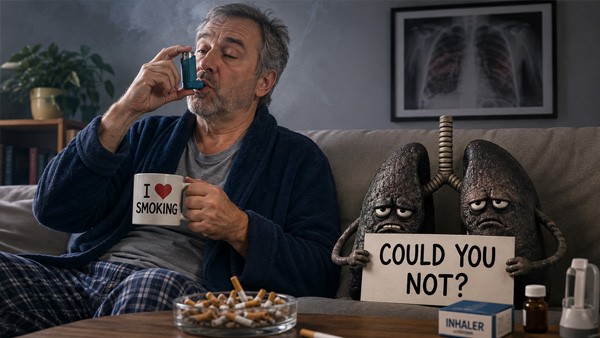

Chronic obstructive pulmonary disease is defined by airflow that does not fully reverse, and it is lived through two things: breathlessness that shapes every decision about what to do, and flare-ups that periodically undo months of stability.
Most written material covers the diagnosis and the inhalers. This guide covers the parts that determine how well someone actually lives with it — managing the sensation of breathlessness, recognising and responding to flare-ups, understanding what oxygen does and does not do, and planning for the later stages while there is time to do it properly.
🧠 A measure that costs almost nothing and is rarely mentioned: a small handheld fan directed at the face reduces the sensation of breathlessness. Cool air on the area supplied by the trigeminal nerve alters how the brain interprets the signal, and trials in people with chronic breathlessness show a real effect. It does nothing for oxygen levels — it changes the experience, which is what is actually distressing. Anyone with COPD should have one and should know to use it during an episode.
🫁 The two faces of the same disease
COPD covers a spectrum, and where someone sits on it shapes their symptoms.
| Chronic bronchitis picture | Emphysema picture | |
|---|---|---|
| Dominant symptom | Cough with sputum most days | Breathlessness on exertion |
| What is damaged | Airway lining, with excess mucus and impaired clearance | Alveolar walls destroyed, reducing surface area for gas exchange |
| Build | Frequently heavier | Frequently thin, with muscle loss |
| Infections | Frequent chest infections | Less prominent |
| Breathing pattern | Less obviously laboured at rest | Pursed lips, using accessory muscles, leaning forward |
Most people have elements of both. The cough-and-sputum side is covered in detail in the guide to chronic bronchitis, including diagnosis by spirometry and why it is so often delayed. This article takes the breathlessness side.
One point about emphysema explains a great deal of what follows. The destroyed alveolar walls also provide the elastic recoil that empties the lungs, so air becomes trapped and the chest stays inflated. That hyperinflation is why breathing feels effortful even at rest, why breathing out takes longer than breathing in, and why the techniques below work — they all help empty the lungs more completely.
😮💨 Managing breathlessness
Breathlessness is a sensation generated by the brain, not a direct readout of oxygen levels. People can be profoundly breathless with normal oxygen saturation and comfortable with low saturation. That is why the measures below work despite changing nothing measurable in the blood.
Pursed-lip breathing is the most useful and the least taught. Breathe in through the nose for a count of two, then out gently through pursed lips as though blowing out a candle, for a count of four or more. The back-pressure keeps the small airways open longer during exhalation, so more air leaves and less is trapped. It works immediately, it can be used during any episode, and it is worth practising when not breathless so that it is automatic when needed.
Positioning. Leaning forward with the forearms resting on the thighs, on a table, or on a windowsill allows the accessory muscles to work more efficiently. Standing leaning forward against a wall serves the same purpose. These are not signs of distress to be corrected; they are effective mechanics.
The handheld fan, as above.
Pacing. Breaking activity into segments with pauses built in, rather than pushing until forced to stop, allows considerably more to be achieved across a day. Breathing out during the effortful part of a movement — standing up, lifting, reaching — rather than holding the breath, makes each action less costly.
Managing the anxiety loop. Breathlessness causes fear, fear causes faster shallower breathing, faster breathing worsens air trapping, and that worsens breathlessness. Recognising the loop is what allows it to be interrupted, and the techniques above are what interrupt it.
⚠️ Avoiding activity because it causes breathlessness is the single most damaging pattern in COPD. Less activity produces weaker muscles, weaker muscles demand more oxygen for the same task, and the same task then causes more breathlessness. The spiral is gradual and people rarely notice they are inside it until their world has contracted to a few rooms. Becoming breathless during exercise is not damaging the lungs, and this is the entire rationale for pulmonary rehabilitation.
🏋️ Pulmonary rehabilitation
This deserves its own section because it is the most effective non-drug treatment available and reaches a small fraction of the people who would benefit.
It is a structured programme, usually six to twelve weeks, combining supervised exercise with education, breathing technique, nutrition and psychological support. Trials consistently show it improves breathlessness, exercise capacity and quality of life more than any inhaler does, and it reduces hospital admissions when delivered after an exacerbation.
Two things stop people accessing it. It is under-provided almost everywhere. And it is declined by many who are offered it, because exercising while breathless seems both dangerous and pointless. It is neither, and explaining the spiral above is usually what changes the answer.
💨 Inhaled treatment
Inhalers relieve symptoms and reduce flare-ups. They do not reverse the underlying damage, and setting that expectation prevents disappointment.
| Type | Role |
|---|---|
| Short-acting reliever (albuterol) | As needed for immediate relief. Rising use is a signal that control is deteriorating |
| Long-acting beta agonist (salmeterol) | Twice daily maintenance, taken whether or not symptoms are present. Reduces breathlessness and flare-ups |
| Long-acting antimuscarinic | The other maintenance class; frequently combined with a beta agonist |
| Inhaled corticosteroid combinations (fluticasone with salmeterol) | Added where flare-ups continue despite bronchodilators, or where blood eosinophils are raised. Carries a pneumonia risk in this population |
The key difference from asthma is worth restating: in COPD, long-acting bronchodilators are the foundation and inhaled steroids are added selectively. In asthma it is the reverse. Steroids used indiscriminately in COPD add pneumonia risk without benefit.
🔴 Inhaler technique is not a detail and should be checked at every review. Studies repeatedly find that a large proportion of patients use their device incorrectly, meaning much of the drug never reaches the airways. The common errors are not breathing out fully first, inhaling too slowly from a dry powder device or too fast from a pressurised one, not holding the breath afterwards, and not rinsing the mouth after a steroid inhaler. A spacer improves delivery considerably with pressurised inhalers. A person whose treatment appears to have stopped working should have their technique watched before anything is escalated.
📉 Flare-ups
An exacerbation is a sustained worsening beyond normal day-to-day variation, and it matters more than it appears at the time.
Each one accelerates the decline in lung function. Recovery to baseline takes weeks and is frequently incomplete. And a hospital admission for an exacerbation carries a mortality over the following year that most people, and many clinicians, substantially underestimate. Preventing flare-ups is therefore not about comfort — it is the main way of altering the trajectory.
Recognising one: increased breathlessness, increased sputum volume, a change in sputum colour, more coughing and wheeze, and sometimes fever, ankle swelling or confusion.
What to do depends on which features are present:
| Feature | Response |
|---|---|
| Increased breathlessness | Increase reliever use as agreed in the plan |
| Significantly increased breathlessness | A short course of oral corticosteroid speeds recovery |
| Sputum has become purulent | Antibiotics are indicated here, not simply because a flare has occurred |
| Not improving after starting treatment | Contact the clinical team rather than waiting |
A meaningful proportion of exacerbations are viral or triggered by air pollution rather than bacterial, which is why antibiotics are tied to purulent sputum rather than given automatically.
Rescue packs — a supply of steroid tablets and antibiotics kept at home — work well when accompanied by a written plan specifying which symptoms trigger which medicine and when to seek help. Handed over without that plan they get used unnecessarily, or not at all.
Go to hospital for: severe breathlessness at rest, inability to speak in full sentences, blue lips or fingers, confusion or drowsiness, chest pain, or new ankle swelling with worsening breathlessness.
🪶 Oxygen, and what it is for
This is widely misunderstood, and the misunderstanding causes both false hope and unnecessary requests.
Long-term oxygen therapy improves survival in people whose blood oxygen is persistently low, measured formally and on more than one occasion in a stable period. In that group, used for at least fifteen hours daily including overnight, it is genuinely life-prolonging.
It does not relieve breathlessness in people whose oxygen levels are normal. Breathlessness and low oxygen are different things, and someone who is very breathless with normal saturation will not feel better with oxygen. That is precisely where the handheld fan, breathing techniques and pacing belong.
Two safety points. Oxygen supports combustion, so smoking near it causes serious burns and house fires — and this is not theoretical, it happens regularly. And in some people with COPD, high-flow oxygen given during an exacerbation reduces the drive to breathe and causes carbon dioxide to accumulate dangerously, which is why ambulance and hospital teams aim for a target saturation range rather than the highest achievable number. Someone whose saturation is deliberately kept below normal during an admission is being managed correctly rather than under-treated.
🫀 The conditions that come with it
COPD is not confined to the lungs, and several accompanying problems affect outcome as much as the lung disease does.
| Condition | Note |
|---|---|
| Cardiovascular disease | The commonest cause of death in mild to moderate COPD. Shared risk factors and shared inflammation. Blood pressure, lipids and glucose need managing actively |
| Muscle wasting and weight loss | Predicts worse outcome independently of lung function. Protein intake and resistance training matter |
| Osteoporosis | From inactivity, low body weight, smoking and steroid courses. Bone density assessment is worth requesting |
| Depression and anxiety | Very common, substantially under-treated, and they worsen breathlessness through the anxiety loop |
| Lung cancer | Risk is raised beyond that of smoking alone; new or changed cough, blood, weight loss need investigating rather than attributing to COPD |
| Sleep apnoea | Where it coexists, the combination is considerably worse than either alone |
| Gastro-oesophageal reflux | Associated with more frequent exacerbations |
The cardiovascular point deserves emphasis. People with mild to moderate COPD are more likely to die of heart disease than of their lungs, and the lung diagnosis frequently absorbs all the clinical attention.
🚬 The things that change the trajectory
Stopping smoking is the only intervention proven to slow the decline in lung function. Nothing else does. The rate of loss falls back toward that of the general population, at any stage and any age. Combining medication — nicotine replacement, varenicline or bupropion — with behavioural support roughly doubles success compared with willpower alone, and repeated attempts are the normal path rather than evidence of failure.
Vaccination against influenza annually, pneumococcus, COVID-19 and RSV where available reduces exacerbations and admissions.
Pulmonary rehabilitation, as above.
Correct inhaler use, which is a bigger determinant of outcome than which inhaler was chosen.
Nutrition. Both underweight and overweight cause problems — muscle loss worsens outcome, and excess weight increases the work of breathing. Small frequent meals suit people who become breathless while eating, and adequate protein supports the muscle that rehabilitation is building.
Treating the accompanying conditions rather than treating only the lungs.
🗓️ Planning ahead
This is the part most often left too late, and having the conversation early makes it a planning exercise rather than a crisis.
COPD is progressive, and although its course is less predictable than that of many conditions — people can deteriorate sharply with an exacerbation and then partially recover — the overall direction is known from the outset. That unpredictability is precisely why planning belongs earlier rather than at a point of deterioration when the person may be too unwell to participate.
What is worth discussing while well:
- What matters most — being at home, avoiding hospital, comfort, staying alert, particular events to reach
- Ventilation — whether non-invasive breathing support would be wanted, and whether a breathing tube and intensive care would be
- Preferred place of care during a severe deterioration
- Who should decide if the person cannot
- Documentation, so the plan is available to whoever is on duty at three in the morning
Two things are worth saying plainly. Palliative care is not the same as end-of-life care — it is symptom-focused support that runs alongside active treatment and improves quality of life, and involving it early is associated with better outcomes rather than with giving up. And low-dose opioids reduce the sensation of breathlessness in advanced disease, are supported by evidence, and do not hasten death when used appropriately, contrary to a fear that prevents a great many people from being offered them.
✅ The seven questions worth asking at a review: has spirometry been done and what did it show; is my inhaler technique correct; am I on the right combination for how often I get flare-ups; have I been referred for pulmonary rehabilitation; are my vaccinations up to date; do I have a written action plan and a rescue pack; and has anyone assessed my mood, my weight and my heart risk. Those cover most of what determines outcome, and several are routinely missed.
🚨 When to seek help
- Severe breathlessness at rest, or inability to speak in full sentences
- Blue lips or fingertips
- Confusion or increasing drowsiness
- Chest pain
- A flare-up not improving after starting the agreed treatment
- New ankle swelling with worsening breathlessness
- Coughing blood, unexplained weight loss, or a cough that has changed in character — these need investigating rather than attributing to COPD
- Rapidly increasing reliever use
Maintenance and reliever inhalers are stocked in the respiratory category, including Serevent (salmeterol) as twice-daily maintenance and albuterol for relief. Which combination is appropriate depends on spirometry and how often flare-ups occur, so treatment should follow assessment rather than precede it.
❓ Frequently asked questions
What helps immediately when I cannot breathe?
Pursed-lip breathing — in through the nose for a count of two, out gently through pursed lips for four or more, as though blowing out a candle. It keeps small airways open longer so more air leaves. Lean forward with forearms resting on your thighs or a table. And use a small handheld fan directed at your face, which reduces the sensation of breathlessness through cool air on the face, with real supporting evidence.
Why does a fan help if my oxygen is fine?
Because breathlessness is a sensation generated by the brain rather than a direct readout of oxygen levels — people can be profoundly breathless with normal saturation. Cool air on the face stimulates a nerve supplying that area and alters how the brain interprets the breathing signal. It changes the experience rather than the numbers, and the experience is what is distressing.
Should I avoid activity that makes me breathless?
No, and doing so is the most damaging pattern in COPD. Less activity produces weaker muscles, weaker muscles demand more oxygen for the same task, and the task then causes more breathlessness. The spiral is gradual and people rarely notice until their world has contracted. Becoming breathless during exercise is not damaging your lungs, and that is the entire rationale for pulmonary rehabilitation.
Is pulmonary rehabilitation worth doing?
It is the most effective non-drug treatment available and reaches a small fraction of those who would benefit. Trials consistently show it improves breathlessness, exercise capacity and quality of life more than any inhaler does, and it reduces hospital admissions when delivered after a flare-up. Many people decline it because exercising while breathless seems dangerous and pointless, and it is neither.
Why do flare-ups matter so much?
Because each one accelerates the decline in lung function, recovery to baseline takes weeks and is frequently incomplete, and a hospital admission for one carries a mortality over the following year that most people substantially underestimate. Preventing them is therefore not about comfort — it is the main way of altering the trajectory, through vaccination, correct inhaler use, rehabilitation and prompt treatment.
Do I need antibiotics every flare-up?
No. Antibiotics are indicated where sputum has become purulent, not simply because a flare has occurred, since a meaningful proportion are viral or triggered by air pollution. Increased reliever use is the first step, and a short course of oral corticosteroid speeds recovery where breathlessness has increased significantly. A written plan specifying which symptoms trigger which medicine is what makes a rescue pack work.
Would oxygen help my breathlessness?
Only if your blood oxygen is genuinely low, measured formally on more than one occasion in a stable period. In that group it prolongs life when used at least fifteen hours daily. It does not relieve breathlessness in people whose oxygen is normal, because breathlessness and low oxygen are different things. For that, breathing techniques, positioning, a handheld fan and pacing are what work.
Why did the hospital keep my oxygen low?
Because in some people with COPD, high-flow oxygen reduces the drive to breathe and allows carbon dioxide to accumulate dangerously. Ambulance and hospital teams therefore aim for a target saturation range rather than the highest achievable number. Saturation deliberately kept below the usual normal during an admission means you are being managed correctly, not under-treated.
Why are inhaled steroids used differently here than in asthma?
In asthma they are the foundation of treatment. In COPD long-acting bronchodilators are the foundation and steroids are added selectively — to people who keep having flare-ups despite bronchodilators, or who have raised blood eosinophils predicting a response — because they carry a measurable increase in pneumonia risk in this population. Used indiscriminately they add risk without benefit.
What else should be monitored besides my lungs?
Cardiovascular risk above all — people with mild to moderate COPD are more likely to die of heart disease than of their lungs, and the lung diagnosis frequently absorbs all the attention. Also weight and muscle mass, since wasting predicts worse outcome independently of lung function; bone density; mood, since depression and anxiety are common and under-treated; and any new or changed cough, since lung cancer risk is raised.
Does stopping smoking still help at this stage?
Yes, and it remains the only intervention proven to slow the decline in lung function. After stopping, the rate of loss falls back toward that of the general population, at any stage and any age, and the cough frequently improves within months. Combining nicotine replacement, varenicline or bupropion with behavioural support roughly doubles success compared with willpower alone.
When should I think about planning ahead?
Earlier than most people do. COPD deteriorates unpredictably — someone can drop sharply with a flare-up and then partially recover — which is exactly why planning belongs while well rather than at a point where the person may be too unwell to take part. Worth covering: what matters most, whether ventilation would be wanted, preferred place of care, who decides if you cannot, and documentation available at three in the morning.
📑 Sources and editorial
- Global Initiative for Chronic Obstructive Lung Disease (GOLD) strategy report
- NICE guideline on chronic obstructive pulmonary disease in over 16s
- Cochrane reviews of pulmonary rehabilitation and of handheld fan therapy for breathlessness
- Trial evidence on long-term oxygen therapy and survival in chronic hypoxaemia
- Evidence on mortality following hospitalisation for COPD exacerbation
- Guidance on target oxygen saturation ranges and hypercapnic respiratory failure risk
- Evidence reviews on low-dose opioids for refractory breathlessness in advanced disease
- FDA prescribing information for salmeterol, fluticasone with salmeterol and albuterol
- Related reading: chronic bronchitis
- Related products: respiratory category
- RXshop Editorial Team — reviewed by Emily Chen, MD, MPH, Internal Medicine
Medical Disclaimer: The information in this article is for educational and informational purposes only and is not a substitute for professional medical advice, diagnosis, or treatment. Always seek guidance from a qualified healthcare provider with any questions you may have regarding a medical condition, and before starting, stopping or changing any medication.